
ETHNIC GROUPS IN NUSA TENGARRA
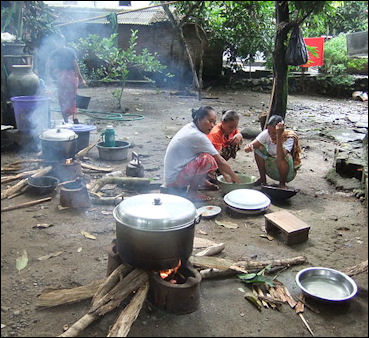
cooking in Lombok, Indonesia The Ndaonese live on the islands of Ndao and Nuse off the west coast or Roti. Little grows on their islands. They men have traditionally been silversmiths and goldsmiths and traded their jewelry with other peoples, particularly the Timorese. [Source: “Encyclopedia of World Cultures, East and Southeast Asia” edited by Paul Hockings (G.K. Hall & Company, 1993) ~]
The Tetum live in south central Timor. Also known as the Belu. Teto and Tetun, they speak the Tetum language but other very diverse and fall into a number of different groups. They are primarily slash and burn agriculturalist with those in the highlands growing rice and breeding buffalo and those in the coastal plains growing corn and breeding pigs. They supplement their diet with some hunting and fishing and also make mats, iron tools, textiles and containers. Surplus food and goods are sold in markets. ~
Traditionally there have been four classes: royalty, aristocrats, commoners and slaves. Political organization was formed around princedoms and kingdoms. Most are Catholics although traditional religions remain, Marriage customs include a bride price, bride-service, marriage to form alliances and concubinage. Clans are dispersed among different villages. There are an estimated 300,000 Tetum speakers. ~
RELATED ARTICLES:
NUSA TENGGARA factsanddetails.com
Sasak
The Sasak are the dominant group living on Lombok. They were Hindus before they converted to Islam beginning in the 16th century. Feuding between Sasak princedoms allowed the Balinese to dominate the island and reduce the Sasak to vassals and servants until the Dutch drove the Balinese out in 1894 and the Balinese ruling family committed ritual suicide. The Sasak language is similar to Balinese and Javanese. [Source: “Encyclopedia of World Cultures, East and Southeast Asia” edited by Paul Hockings (G.K. Hall & Company, 1993) ~]
The Sasak are divided into two groups: 1) the Wetu Telu, the more traditionalist Sasak, and the 2) Waktu Lima, the more conservatively Islamic and market-oriented Sasak. There has traditionally been some friction between the two groups over their beliefs and power. The Waktu Lima held higher positions under the Dutch and some have accused the Wetu Tela of being infidels. ~
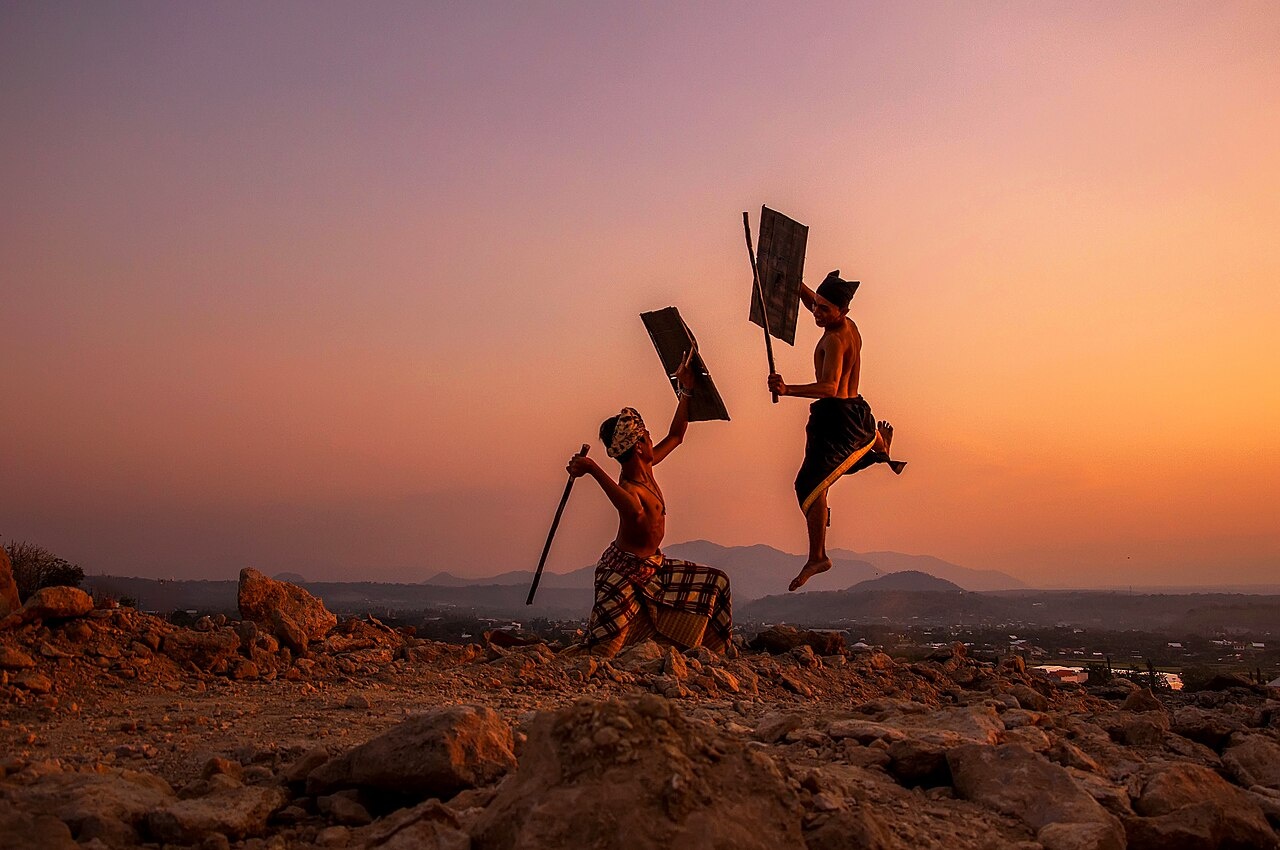
The Wetu Tela regard themselves as Muslims but have many radical beliefs. They do not build mosques, pray five times, go on pilgrimages to Mecca and have no objection to eating pork. In the Sasak language Wetu means “result” and telu means “three.” The number “three” looms large in their belief system. They fast for only three days during Ramadan and recognize the trilogy of the sun, moon and stars and the head, body and limbs The Wetu Tela have been declining in numbers and now mostly persist in remote areas. Their number are believed to be less than 30,000. ~
Traditional Sasak beliefs embrace ancestor cults, life-crisis ceremonies, beliefs in local spirits and local holy places. Some traditional animist and Hindu beliefs have been incorporated into their version of Islam even though they regard themselves as devoutly Islamic. Some Balinese-Hindu concepts of caste also remain in the existence of two classes of nobles and one of commoners. Nobles and commoners often live in separate neighborhoods and high rank men are allowed to marry lower rank women but high rank women are allowed to marry lower rank men. ~
See Separate Articles: SASAK OF LOMBOK: HISTORY, CULTURE, LIFE, RELIGION factsanddetails.com ;
LOMBOK: HISTORY, PEOPLE, TOURISM, GETTING AROUND factsanddetails.com
Sumbanese
The Sumbanese are an Austronesian ethnic group that live on the island of Sumba in eastern Indonesia. Also known as Sumba or Sumbans, they are mostly a Malay people with some Melanesian blood and speak a language similar to that of the people on Flores. Although most are Christian traditional beliefs remain. The Sumbanese have unusual funeral customs and believe the first people of the world descended from heaven on a ladder and settled on the northern part of the island. [Source: “Encyclopedia of World Cultures, East and Southeast Asia” edited by Paul Hockings (G.K. Hall & Company, 1993) ~]
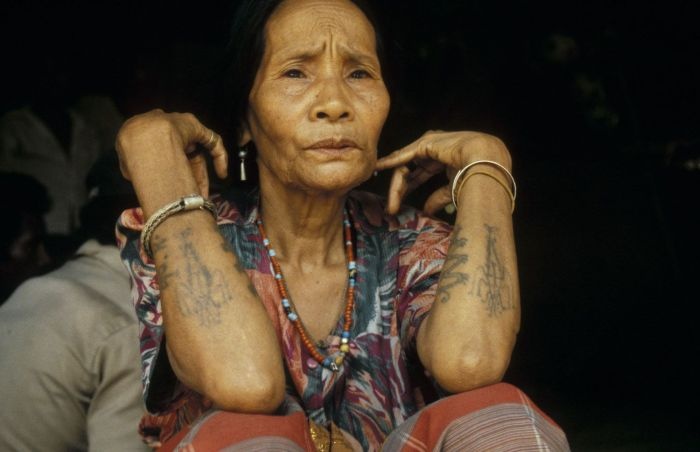
Administratively, Sumba island is divided into four regencies: Southwest Sumba, West Sumba, Central Sumba, and East Sumba. The Sumbanese refer to themselves as Tau Humba. Despite long-standing external influences that have reached the Lesser Sunda Islands, the Sumbanese have retained much of their traditional culture. Eastern Sumbanese have a distinctive culture shaped by the dry-season savanna and hilltop villages, as well as their long history of limited agricultural seasons. [Source: Joshua Project, Wikipedia]
Sumbanese are very diverse. Native Sumba languages include Kambera, Momboru, Anakalang, Wanukaka, Wejewa, Lamboya and Kodi. Bahasa Indonesian — the national language of Indonesia — is also spoken. The population of Sumba was estimated to be 853,428 in mid 2024, with 291,000 of these being Kambera-speaking East Sumbanese. The total population of Sumbanese was approximately 656,000 in 2008.
RELATED ARTICLES:
SUMBANESE: LIFE, RELIGION, TRADITIONAL HOUSES factsanddetails.com
SUMBA CULTURE: IKAT, CEREMONIAL CLOTHES, PASOLA HORSE FIGHTS factsanddetails.com
SUMBA: SIGHTS, TOURISM, VILLAGES factsanddetails.com
Ethnic Groups on Flores
Flores is home to a number of distinct ethno-linguistic groups. Many of their names—such as Manggarai, Ngada, Ende, and Sikka—are today also correspond to modern Indonesian administrative units (regencies). These labels, however, appear to have gained wide currency only in the twentieth century, particularly under colonial and postcolonial administration, rather than reflecting long-standing, island-wide ethnic self-designations. [Source: Gregory Forth, e Human Relations Area Files (eHRAF) World Cultures, Yale University; Google AI]
The principal ethnic groups on Flores include the Manggarai of western Flores around Ruteng; the Ngada of the central highlands centered on Bajawa; the Ende and Lio peoples of the central region around Ende; the Sikkanese of eastern Flores around Maumere; and the Lamaholot peoples of the far eastern part of Flores and the surrounding islands, including Larantuka. Closely related populations inhabit neighboring islands, notably Lembata, where communities are well known for traditional whale hunting carried out by hand-thrown harpoons from small boats.
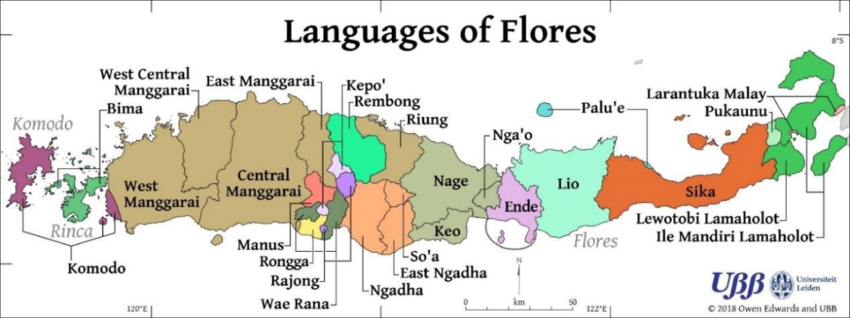
Although these groups share a common Austronesian heritage, each has developed distinctive languages, social institutions, and cultural traditions. Manggarai society is characterized by clan-based organization and strong ancestral and environmental orientations. The Ngada are noted for their prominent ancestor shrines (ngadhu and bhaga) and for ritual practices, such as buffalo sacrifice, that coexist with a deeply rooted Catholic faith. The Ende and Lio peoples are renowned for their ikat textiles and for ritual and cosmological associations with landscape features such as Mount Kelimutu. In eastern Flores, Sikkanese culture reflects a long history of Catholic influence combined with local ritual traditions, while Lamaholot communities in the far east are known for elaborate ancestral ceremonies, warrior traditions, and distinctive dances such as hedung.
RELATED ARTICLES:
FLORES: VOLCANOS, SIGHTS, LABUAN BAJO factsanddetails.com
PEOPLE OF FLORES factsanddetails.com
ETHNIC GROUPS ON FLORES factsanddetails.com
WESTERN FLORES: ISLANDS, TRADITIONAL VILLAGES AND HOMO FLORESIERNSIS (HOBBITS) factsanddetails.com
SIKKA PEOPLE OF FLORES: RELIGION, CULTURE, LIFE, SOCIETY factsanddetails.com
MANGGARAI PEOPLE OF FLORES: HISTORY, RELIGION, SOCIETY, LIFE factsanddetails.com
CENTRAL-EASTERN FLORES; ENDE, KELIMUTU. MAUMERE factsanddetails.com
ENDE PEOPLE: HISTORY, RELIGION, SOCIETY, LIFE factsanddetails.com
LARANTUKA AND LAMALERA IN EAST FLORES: UNUSUAL FESTIVALS, WHALE AND MANTA RAY HUNTS
LAMAHOLOT PEOPLE OF FLORES: HISTORY, RELIGION, SOCIETY, LIFE factsanddetails.com
ALORESE: HISTORY, RELIGION, SOCIETY, LIFE factsanddetails.com
ALOR ISLAND factsanddetails.com
Alorese
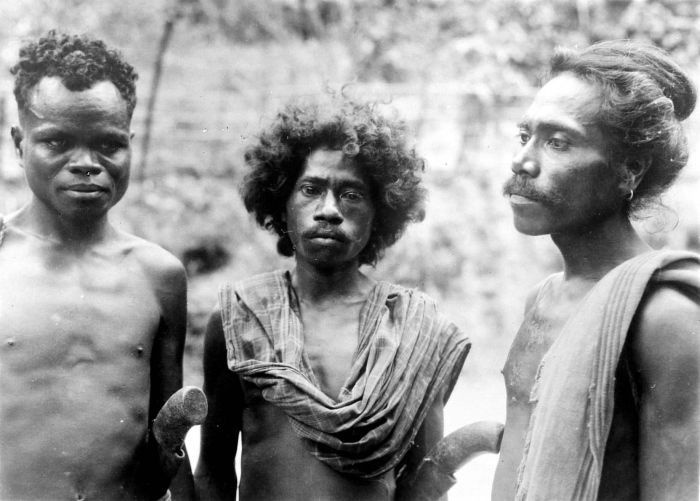
The Alorese live on the island of Alor, which lies in East Nusa Tengarra, north of Timor and east of Bali and Flores. Also known as the Aloreezen, they embrace a wide range of groups that speak different languages—a number of them mutually unintelligible—and have different defining characteristics that at least are partly attributable to Alor’s rugged mountainous terrain. Most Alorese are Christians. Many of the those that live the mountains are Papuan. Most of the Muslims live on the coast and many of these are immigrants from elsewhere in Indonesia. [Source: “Encyclopedia of World Cultures, East and Southeast Asia” edited by Paul Hockings (G.K. Hall & Company, 1993) ~]
Alor (east of Flores, 30 kilometers north of Timor) is an island that lies east of Bali and Flores in East Nusa Tengarra. Home to the Alorse, it is 2,884.5 square miles in area and is very mountainous, with limited coastal lowlands. It was a Portuguese holding until 1854 when it was handed over to the Dutch. Alor is one of the world’s most ethnically diverse places. On the island there are 140,000 people divided among 50 tribes, each of which speaks a distinct languages or dialects that fall into seven distinct language groups. Some groups practiced head headhunting up until the 1950s. They used arrows tipped with chicken bones that splintered inside the body, producing a very nasty wound. Occasionally, it tribal warfare still breaks out between different groups.
The mountain Alorese have traditionally lived in mutually hostile highland villages that remained largely untouched by the outside world until Indonesia became independent in 1949. The coastal Alorese have had more contact with the outside world. The Alorese languages resemble those spoken elsewhere in Indonesia, particularly on Timor, although some have a strong Papuan influence. Traditionally there has been little organization beyond the village level. ~
See Separate Article: ALORESE: HISTORY, RELIGION, SOCIETY, LIFE factsanddetails.com
Atoni
The Atoni live in the central mountainous part of western Timor and East Timorese (former Portuguese) enclave of Oe-cussi, . Also known as the Atoin Pah Meto, Atoin Meto, Timorese, Orange Timor Asli (in Indonesian), they are largest ethic group in western Timor, with around 750,000 members. Atoni means “man person’ and is short for “Atoin Pah Meto. Europeans called them Timorese. They number around 840,000, with 761,000 in West Timor and 80,000 in East Timor. [Source: Encyclopedia of World Cultures, East and Southeast Asia edited by Paul Hockings (G.K. Hall & Company, 1993) ~, Wikipedia]

Their language is Uab Meto is an Austronesian language. It had no written form until a Dutch linguist romanticized the script before World War II. Christianity is predominant religion. Some are Muslims. Folk beliefs are still alive. Traditional Atoni religion revolved around beliefs in ancestral rewards and punishments. Deities and spirits included Lords of the Sky and Warth, ghosts and spirits of places and things. The Atoni belief in the power of spirits and ancestors and their ability to meet out justice remains. Traditional life-cycle rituals have been incorporated into Christian rituals. Traditional healers are called upon to deal with sorcery, curses and illness and to communicate with spirits and the Lords of the Sky and Earth. ~
The Atoni are also primarily slash and burn agriculturalist who grow maize rice, raise chickens, pigs and cattle and collect forest products such as palm sugar and honey. The nuclear family is the primary farming unit, working its own plot with some help from other relatives. The rights to Atoni slash-and burn agricultural land has traditionally been controlled by clans and territorial groups. Orchards are held by families. As a rule land has traditionally not been treated as commodity.
See Separate Article: ATONI PEOPLE: HISTORY, RELIGION, SOCIETY, LIFE factsanddetails.com
Kedang
The Kedang live on the island of Lembata, which is east of Flores and north of Timor. Also known as the Edang, they are primarily slash and burn farmers who do a small amount of coastal fishing and raise a few animals. Most are Roman Catholics. Some are Muslims. A few retain their traditional beliefs. They are culturally similar to the Lamaholot who live to the west. [Source: R. H. Barnes, “Encyclopedia of World Cultures Volume 5: East/Southeast Asia:” edited by Paul Hockings, 1993 ~]
The Kedang have traditionally lived in bamboo houses with grass and palm leaf roofs oriented according to traditional religious beliefs. Maize and dry rice are the primary staple crops. Copra, tamarind and candlenuts are raised as cash crops. Many men leave their home island in search of work. Marriages involve an elaborate series of exchanges set by social class seen as alliance builders. In the old days there was no marriage ceremony. Those today are in line with the customs of the Catholic or Islamic faiths. Gifts traditionally included elephant tusks, gongs and fine ikat cloth. Divorce is common among non-Catholics. In the old days children had their teeth blackened and filed as part of coming of age rituals. ~
The incorporation of traditional religion into Catholicism and Islam is reflected in the names for God: Moon-Sun, Great Sun, White Sun, Morning Star-Sun and Great Morning Star. Traditionally, the sun has been viewed as male and the Pleiades and the morning star is associated with divinity. In their belief system there are also guardian spirits, free spirits and witches. In addition to Catholic and Muslim rituals, the Kedang also conduct special village purifying and agricultural ceremonies. Feasts are held at funerals and marriage presentations. On occasion rain-making ceremonies are held. After death, the Kedang believe, people go through a process of death and rebirth through levels of the universe and are briefly a fish before ascending to their place with God.
See Separate Article: KÉDANG PEOPLE OF EASTERN INDONESIA: HISTORY, RELIGION, SOCIETY, LIFE factsanddetails.com
Rotinese
The Rotenese mainly live on Rote, off southwestern Timor, the southernmost Indonesian island, and in western Timor. Also known as the Atahori Rote and Hataholi Lote and sometimes spelled Rotinese, they tend to be short and light in build, with features typical of Malay populations, are and known for their characteristic sombrero-like hats and have a long traditional of education and working as civil servants. [Source: James J. Fox, “Encyclopedia of World Cultures Volume 5: East/Southeast Asia:” edited by Paul Hockings, 1993 ~]
The Rotenese derive their name from variants of their island’s name combined with a local word meaning “person” or “man,” such as Atahori Rote or Hataholi Lote. In ritual language, Rote is known as Lote do Kale, while “man” is expressed as Hataholi do Dae Hena. The Rotenese maintain that the name “Rote” is a Portuguese imposition. A seventeenth-century Dutch map, for example, labels the island Nusa Da Hena, meaning “Island of Man.”
According to the Christian group Joshua Project the Tii-speaking Rotenese population was 27,000 in the early 2020s. Census figures from 1980 record a population of just over 83,000 on Rote island. There were probably another 50,000 Rotenese on Timor and Semau at that time. Large numbers of Rotenese have migrated to the northeastern plains of Timor, as well as to Kupang and the island of Semau. In these areas, they have worked as rice cultivators, lontar palm tappers, traders, and, in Kupang, as civil servants. In addition to inhabiting Rote Island and western Timor, the Rotenese have also settled on surrounding islands, including Ndao (together with the Dhao), Nuse, Pamana, Doo, Heliana, Landu, Manuk, and several smaller islands. Rotenese communities are also found on Sumba and Flores. Owing to a long-standing emphasis on education, many educated Rotenese have settled in major cities throughout Indonesia.
See Separate Article: ROTENESE: HISTORY, RELIGION, SOCIETY, LIFE factsanddetails.com
Image Sources: Wikimedia Commons
Text Sources: “Encyclopedia of World Cultures Volume 5: East / Southeast Asia:” edited by Paul Hockings, 1993; National Geographic; New York Times, Washington Post, Los Angeles Times, Lonely Planet Guides, Library of Congress, Smithsonian magazine, The New Yorker, Time, Reuters, AP, AFP, Wikipedia, BBC, CNN, and various books and other publications.
Last Updated January 2026