
ENDE
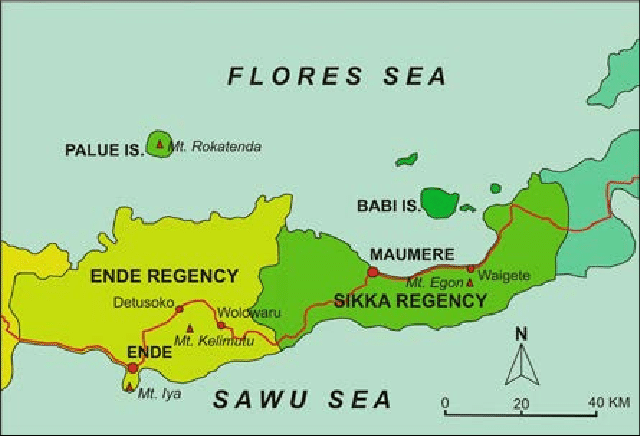
Ende (five hours from Bajawa) is a port and one of the larger cities on Flores with several active volcanos nearby. Gunung Meja rises from near the airport. Gunung Iya lies on a promontory south of the city. The December 1992 earthquake caused extensive damage here. Sights include a waterfront, ikat markets. the house that Sukarno lived in when he was exiled here. Hiking up Kelimuti, the volcano with three lakes that change color, is the one of main reasons people stop in Ende.
During the struggle for Indonesian independence, the first Indonesian President,Sukarno, was exiled by the Dutch colonial government to Ende from 1934 to 1938. Upon his arrival here, Sukarno did not have any place to stay. After staying in a house near Port Ende, he then looked for a rented house facing east. Sukarno then found a Dutch house occupied by Haji Abdulah Ambuwaru. In this house, Sukarno lived for four years. During his exile here, Sukarno painted and wrote several plays such as Dokter Setan (Satanic Doctor). In 1954, when Sukarno became the Indonesian President, he officially inaugurated this house as a museum. This house is now called Rumah Sukarno.
Sukarno’s house has two bedrooms, a living room and an office. In the back of the house is a room previously used by Sukarno for meditation and several rooms for maids. In the back yard is a well, which is still working today. You can see the interior of Sukarno’s house including its rooms, well, items previously used by Sukarno (plates, bed, and kerosene lamp), and Sukarno’s painting made in 1935 called Pura Bali (Balinese Temple). When you arrive at Sukarno’s house in the late afternoon, on Sunday, or on a public holiday, you can ask help from the owner of a house across the street to call the security guard to fetch you by motorbike for Rp10,000 (about 1 USD).
RELATED ARTICLES:
ENDE PEOPLE: HISTORY, RELIGION, SOCIETY, LIFE factsanddetails.com
FLORES: VOLCANOS, SIGHTS, LABUAN BAJO factsanddetails.com
PEOPLE OF FLORES factsanddetails.com
ETHNIC GROUPS ON FLORES factsanddetails.com
WESTERN FLORES: ISLANDS, TRADITIONAL VILLAGES AND HOMO FLORESIERNSIS (HOBBITS) factsanddetails.com
SIKKA PEOPLE OF FLORES: RELIGION, CULTURE, LIFE, SOCIETY factsanddetails.com
MANGGARAI PEOPLE OF FLORES: HISTORY, RELIGION, SOCIETY, LIFE factsanddetails.com
LARANTUKA AND LAMALERA IN EAST FLORES: UNUSUAL FESTIVALS, WHALE AND MANTA RAY HUNTS factsanddetails.com
LAMAHOLOT PEOPLE OF FLORES: HISTORY, RELIGION, SOCIETY, LIFE factsanddetails.com
ALORESE: HISTORY, RELIGION, SOCIETY, LIFE factsanddetails.com
ALOR ISLAND factsanddetails.com
NUSA TENGGARA factsanddetails.com
PEOPLE OF NUSA TENGARRA (ISLANDS EAST OF BALI) factsanddetails.com
Accommodation, Restaurants and Getting to Ende
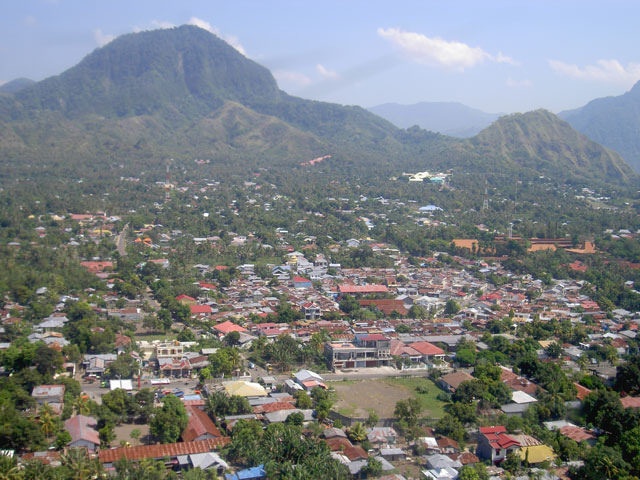
Ende has many hotels and inns. Hotel Iklas (0381-21695) is usually for backpackers while Hotel Mentari (0381-21997) is for tourists. In addition, Hotel Dwi Putri, Safari, and Flores are also available. Istana Bambu Restaurant on Pasar Street or on Kemakmuran Street offers various types of Chinese, Western and Indonesian foods. The Hotels Iklas and Mentari also have their own restaurants selling various types of food. If you like to eat Padang food, there are many Padang restaurants in this city.
Getting Around: The airport and seaport in Ende are located near the city center. From these two places, you can take a bemo (city transportation). In addition, you can also take a rented car easily found in front of the hotel Flores Sare, the seaport and airport when ships or airplanes arrive.
Getting There: Flight schedules and routes to Ende are not always fixed. As of the mid 2010s, Transnusa had a flight scheduled everyday from Kupang to Ende (Transnusa Ende: 0381-24222). In addition, Merpati has four flights a week (Merpati Ende: 0381-21355). Flights in and out Lubuan Bajo, which is a 13 hour bus ride away, is more reliable. Ende is the busiest port in the southern part of Flores island. Motorboats to many cities such as Kupang also have an unreliable schedules. It is therefore best for you to ask information from ASDP (0381-22007). The Pelni ship from Bali and Lombok also makes a stop over in Ende every two weeks. Land transportation to western and eastern cities in Flores is more reliable, Ende has two inter-city bus stations, namely Wolowona for buses to eastern cities such as Moni, Maumere and Larantuka; and Ndao for buses to western cities such as Bajawa, Ruteng and Labuan Bajo.
Kelimutu
Kelimutu (66 kilometers from Ende and 83 kilometers from Maumere) is one of the an awesome places in Indonesia. It is a 1600-meter-high volcano with three lakes inside the crater. Each lake is a different color and the colors are changing all the time. When Dutch geologists discovered the craters in 1914, the colors were red, blue and white, In the 1960s one lake was blue, one was reddish brown and the other was like milk coffee. In the late 1990s the colors were maroon, black and blue. Currently they are green, blue and black. The colors are related to the mineral content of the lakes and the springs that feed.
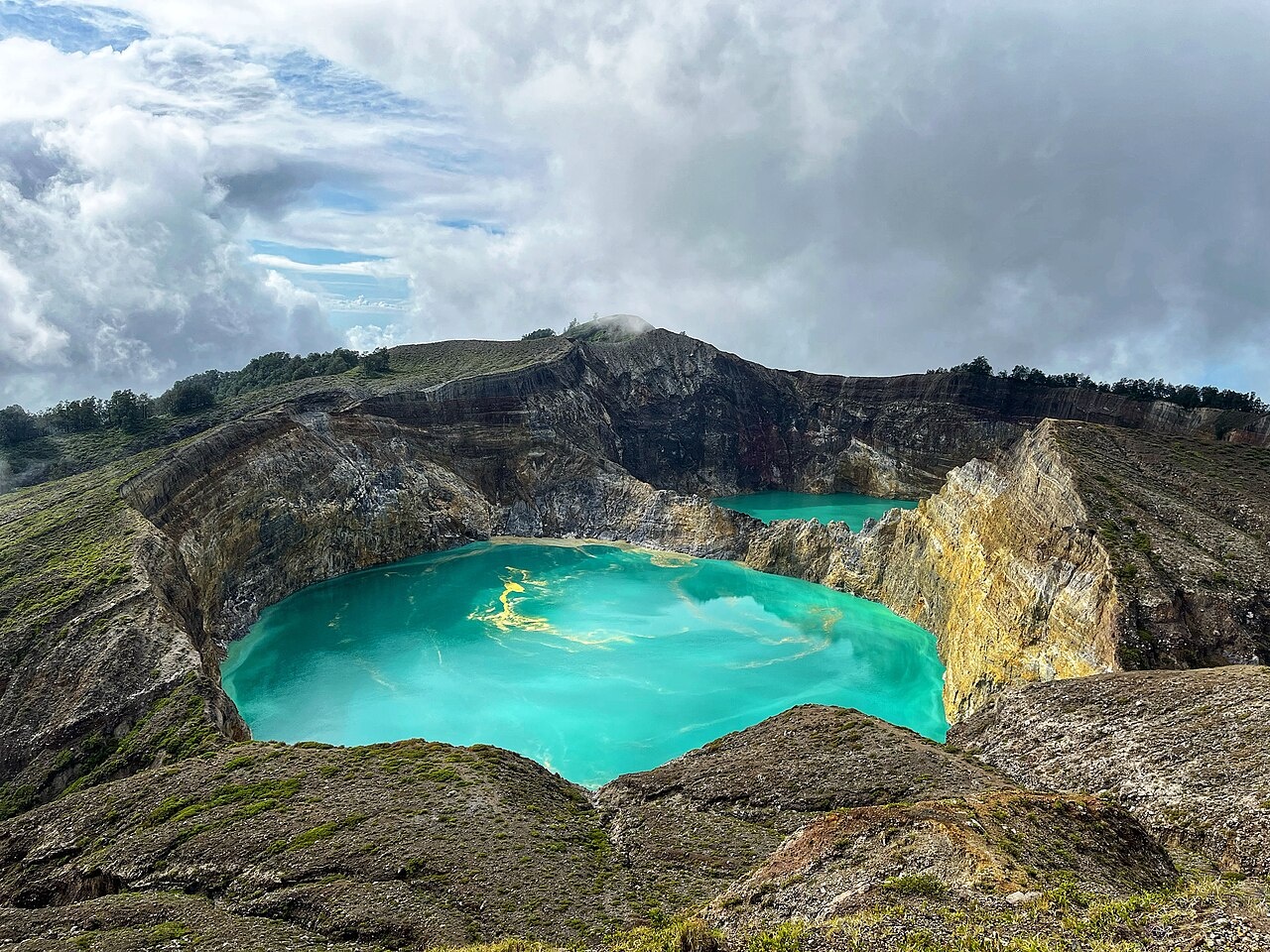
When I was at Kelimutu in the late the 1980s one lake was dark blue, one was chocolate colored and one was an opaque turquoise with a layer of yellow sulphur outlining its perimeter. Little bits of sulphur floated around in the middle as well. Most people stay below the volcano and visit the lakes as part of a day trip, taking a minibus most of the way on mountain’s windy, dirt road. But walked up and back and camped overnight on top of a platform that overlooked all three lakes. It was wonderful having a place like this all to ourselves, watching the sunset and sunrise from there. In the middle day the place can get swarmed with school groups and the like. A barren moonscape surrounds the lakes.
Kelimutu is the centerpiece of Mt. Kelimutu National Park, the smallest of the six national parks in Bali and the Nusa Tenggara islands. Kelimutu, meaning ‘the boiling lake’. Local believe the three lakes are resting place of departed souls. The first European to lay eyes on the lakes was a Dutchman named Van Such Telen, who say them in 1915. Kelimutu gained global fame after Y. Bouman wrote about the bizarre color-changing lakes in 1929..
Unlike the Blue Lake in Mt. Gambier, South Australia, that changes color from blue to cold steel grey within a predictable period, or Lake Yudamari in Mt. Nakadake, in Japan, that changes from blue-green to green, the Kelimutu lakes are unpredictable as to when and what color they will change into. Sometimes, the colors are blue, green, and black, and some other times they turn to white, red, and blue. The last time a traveler saw them, one was dark brown, just like a pond of chocolate. Previously, the east lake was red and the middle lake was blue.
The lakes change colors due to presence of subaqueous fumaroles. Scientists believe that these are the result of minor phreatic eruptions in ancient times. Phreatic, or steam-blast, eruptions occurs when magma heats ground or surface water. The extreme temperature of the magma causes near-instantaneous evaporation to steam, resulting in an explosion of steam, water, ash, rock, and volcanic bombs The Kelimute lakes are of particular interest to geologists since the three lakes are of different colors but at the same place. At local ranger in the national park said that the different colors is due to chemical reactions of materials contained in the lake, triggered by volcanic gaseous activities. Locals believe that when the lakes change color it is because someone died or did something evil.
Kelimutu National Park’s highest point is Mt. Kelibara at 1,731 meters (5,679 feet) high. Mt. Kelimutu is the second highest at 1,690 meters (5,544 feet) high. The national park protects 19 endemic and endangered animals, among which are the Floresian punai (Treron floris), Wallacea owl (Otus silvicola), Floresian kancilan (Pachycephala nudigula), Floresian eagle (Spizeatus floris), and Timorese tesia (Tesia everetti). There are also endemic mice, deer, porcupines and the legendary luwak or civet (Pharadoxurus hermaphroditus) that gained its fame for the expensive coffee it produces.
Hiking at Kelimutu
A hike or day trip to the lakes Kelimutu is one reason many people come to Flores in the first place. The Kelimutu area is surrounded by forests and bush. Beside pine trees, there are also ferns, casuarinas, red wood and edelweiss. Pine forests grow well on this height of the Mt. Kelimutu. The other part of the mountain is dry with highly unstable sand and soil. The locals believe that Mt. Kelimutu is sacred and a source of fertility to the lands nearby. Several parts of the national park are restricted due to geothermal instability. Trekking is best around the safe areas between Moni and Mt. Kelimutu. The track, which can be driven in a study vehicle, is a challenging 12-kilometer rocky dirt and graven road path that begin on the maid road in a place called Moni.
Most visitors come up the road in a minibus or hired car. From the parking lot one has to walk 1.5 kilometers. then climb 127 steps to the edge of the crater, from where one has a panoramic view of the three lakes. Climbing to the viewpoint from the parking takes about 30 minutes on foot. It is also possible to hike up the road from Moni. That takes about four hours one way. There are precipitous trails around one of the crates that drop into he lakes. Hotels in Mono organize vehicle that reach the summit for sunrise. . The lakes are most stunning in bright sunlight.
Moni is a small rural town and base for backpackers visiting Kelimutu. The ascent up is easy road walking if you take the road with nice views of the Flores countryside. From Moni to Kelimutu there is also a path which is shorter than the car access route. The westernmost lake is named Tiwu Ata Mbupu, meaning ‘the lake of old people’. The middle one is called Tiwu Nuwa Muri Koo Fai, or ‘the lake for young men and maiden’. The easternmost is called Tiwu Ata Polo, or ‘the lake for evils spirits’. Visitors can only walk around Lake Kelimutu but not all areas can be explored because some are dangerous and therefore restricted.
If you hiking from Moni bring enough and make sure you have plenty of drinking water as water is water is in short supply on the ascent to the lakes. If you are going in a vehicle then food is not so necessary as the hiking is only an hour or so. Ginger tea sellers are available at the top of the mountain where people flock there to watch the sunrise Kelimutu is usually blanketed by thick fog. Travelers, however, go very early in the morning to catch the sunrise before the clouds roll in. Trekkers begin their walk up as early as 3.30 am. The best time to visit Kelimutu is in July and August. Book your hotels early as possible if you are coming then, as people tend to reserve a room one or two months in advance.
Accommodation and Restaurants at Kelimuti
Moni, the base for trips to Kelimutu, is home to a number of cheap backpacker hotels, bungalows and losmen. If you want something nice you will have to stay in Maumere, three hours away, or Ende, two hours away with its Grand Wista Hotel. There are a few restaurants in Moni. Simple warungs for locals are also available in Moni’s local market, but very limited to local needs.. Arwanti Restaurant and Bintang Restaurant have been recommended. The following are some of the accommodation found in the Kelimutu area.
Kelimutu Crater Lakes Ecolodge is built in 2010 and is only a 20 minutes drive to Kelimutu National Park. Hot shower is available as well as western toilet. It is an environmentally conscious hotel. Book it via several hotel directory websites. So far, this is the best resort and accommodation in the village. Honeymooners and backpackers share a universal idea about the place. Desa Koanara, Kelimutu, Ende, Tel. +62 361 7474 205 / 7474 204, Mobile: +62 813 39776 232, E mail: reservation@ecolodgesindonesia.com; Website: ecolodgesindonesia.com
Watugana bungalow is a decent guesthouse suitable for backpackers or budget travelers. Its 5 rooms are located on the first floor at the sublevel of the building, and 2 others (the newly built ones) on the upper level. There is very simple shower in each room, together with mosquito-net bed. The price ranges from IDR 150,000 to IDR 250,000. To book the rooms, you must be sure that John, the local keeper of the bungalow, has confirmed the availability. Sometimes, in Moni, the faster person will get the room although you booked one an hour or a day before, Tel. +62 813 3916 7408 (John).
Bintang Lodge has only one room at the moment, but the interior is fresh and new. The room is air-conditioned and the shower is cold and hot. It is part of the café named Bintang Café. The room is tagged for IDR 250,000 per night.
Hotel Arwanti is at the middle of the accommodation area in Moni. The not-so-impressive shower is a cold one with 2 rooms in a spacious wooden bungalow. The bungalows are part of the Arwanti Café and Restaurant run by a local man named Andre.
Hotel Flores Sare is physically the tallest as it is often a place for meetings and workshops on the top floor. The unattended lobby is strangely impressive with lots of Jesus statues. The rooms, however, are not that impressive and you must ask the staff to clean the rooms before you check in. Flores Sare is close to Kelimutu Crater Lake Ecolodge an can be reached at +62 381 21075
Sao Ria Wisata (Local Government-run bungalows): The setting is excellent, overlooking the lush garden and vegetable plantation. Ask the staff to clean the facilities prior to checking in.
Getting There: Koanara village, in the Wolowaru sub-district is closest to Mt. Kelimutu, and is about 66 kilometers from the town of Ende, or 83 kilometers from Maumere. Moni is the closest small town, lying at the foot of Mount Kelimutu. It is the gate to Lake Kelimutu. The distance between Moni and Kelimutu is 15 kilometers.
Buses and bemos between Ende and Maumere pass Moni. They call it BIS KAYU or oto kol, the wooden pick-up truck. From there, you must walk 30 minutes along the mountain side. You can take an ojek, a motorbike taxi, car or public transportation to take you to a parking lot before Kelimutu’s peak.
Maumere
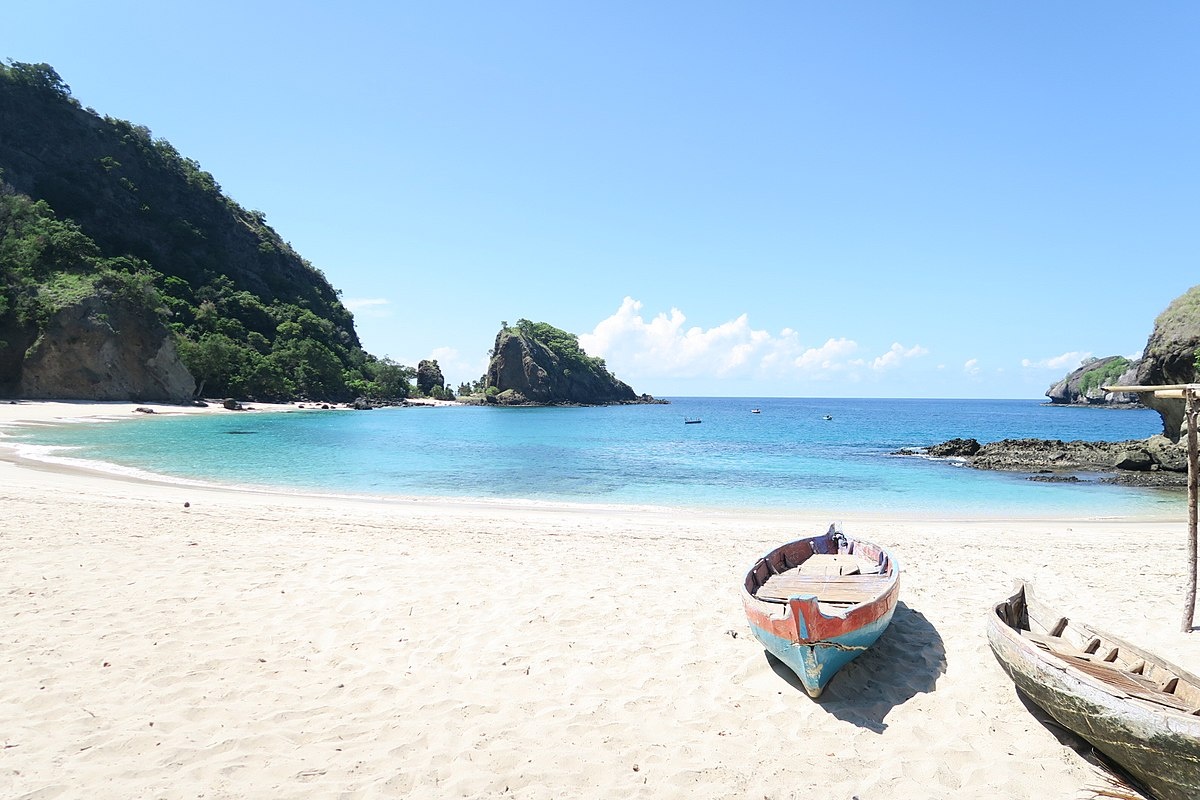
Maumere (six hours by bus from Ende) is the largest city in Flores and the place where many travelers begin or end their journey in Flores. The main attraction here is the diving and snorkeling. The reefs here are famous because the coral comes in so many colors. Flores in fact got its name from 17th century Portuguese sailors who were so astounded by the colors they saw in the sea that they decided to call the island "Flores," which is Portuguese for “flower.” Maumere unfortunately was devastated by a magnitude-7.8 earthquake and tsunami in 1992. The tsunami waves did a number on the coral garden and the recovery has been steady but slow.
Capital of the district of Sikka on the eastern coast of Flores Island, Maumere is blessed with a beautiful landscape of hills and mountains complemented with clear green and blue ocean. Waiara Beach has traditionally been the main jumping off point for the snorkeling and diving. Located at the narrowest part of the island, from Maumere due south to near the town Nita at Koting village, one can see as far as the Flores Sea to the north and the Savu Sea to the Indian Ocean to its southern horizon.
Before the Dutch colonial merchants arrived, Maumere was known as Sikka Alok or Sikka Kesik. Here, traders from China, Bugis, and Makassar often came to trade with the locals. These traders often stayed for days near the seaport called Waidoko. With the arrival of the Dutch, they eventually built government offices in Sikka and gave new names to the area such as Maunori, Mautenda, Mauwaru, Maurole, Mauponggo, and obviously Maumere in Sikka.
Since the majority of its people are Catholic, the town’s existence cannot be separated from the church of Larantuka. Catholicism was first introduced in 1566 by two missionaries from Dominica named P.Joao Bautista da Fortalezza and Simao da Madre de Deos. They initially started their mission in Paga, a small town about 45 kilometers west of Maumere and were sent by P.Antonio Cruzz from the town of Larantuka. Every year congregations from Maumere head to Larantuka to join in the Semana Santa Easter Holy Week Ritual.
Deadly Flores Earthquake and Tsunami of 1992
In December 1992, a 7.8-magnitude earthquake and the waves generated by it killed at least 2,500 people and destroyed thousands of buildings on the island of Flores about 1,000 kilometers east of Bali. It was the largest and also the deadliest earthquake in 1992. [Source: Wikipedia]
The quake struck at around 5:30am local times and was followed by several serious aftershocks. Of the 2,500 people killed or missing, 1,490 were at Maumere and 700 were on Babi. More than 500 people were injured and 90,000 were left homeless. Nineteen people were killed and 130 houses were destroyed on Kalaotoa. Damage was assessed at exceeding US$100 million. Approximately 90 percent of the buildings were destroyed at Maumere, the hardest hit town, by the earthquake and ensuing tsunami while 50 to 80 percent of the structures on Flores were damaged or destroyed. Electricity in the general area and the port of Maumere was shut down. Maumere's hospital was completely destroyed, and patients were treated in tents. Damage also occurred on Sumba and Alor.
The tsunami on Flores ran inland as far as 300 meters with wave heights of 25 meters reported. The Indonesian government sent rescue and relief missions to earthquake-stricken areas and declared the earthquake a national disaster. The Indonesian air force provided assistance, mostly transporting medicine and clothing. Malaria and influenza rose significantly after the disaster. Babi Island survivors were evacuated since all the houses on the island were demolished. International relief efforts were hindered by the onset of the rainy season.
Sights in and Around Maumere
Today, Maumere is a starting point to see the Three-Coloured Lakes on Mt. Kelimutu on the way to Ende or to attend the Easter celebrations in Larantuka. It can also be used to reach Lembata, Labuan Bajo, and Komodo National Park but these places are at least 15 hours by bus or boat.. The village of Sikka, some 30 kilometers from Maumere is the center of weaving in this area. Here visitors can watch, on request, the complete intricate process of ikat-weaving, including dying the threats with natural colors. Another village known for its weaving is Watublapi, which distinguishes itself through the use of symbolic motifs such as lizards, horses, birds and geometrical patterns.
While you are in Maumere, you might want to explore the beautiful landscape of Maumere around Waiara Beach and the Kambing Island and Pangabatang Island. Waiterang Beach is definitely a must if you are in Maumere. Located only 31 kilometers from the heart of the town, the beach is renowned among divers, and also has the certified PADI diving course. Koka Beach, 45 kilometers west of Maumere has the legendary white sand which is as soft as powder. Not too far from the beach, you can find the traditional village of Mau Lo’o with all its unique traditional houses.
Do not forget to visit the unique Bikon Blewut Museum located in the campus of Sekolah Tinggi Filsafat Katholik Ledalero, a Catholic priest seminary, six kilometers. south of Maumere. Here you can find a large assortment of Flores history in artefacts collected by the priests. There are are rare ikat cloths, stone age tools, musical instruments, ceramics from China, traditional weapons, and fossil bones from the stegodon, an extinct elephant-like animals a mammoth which inhabited from between 400,000 — 10,000 BC. The Museum opens Mondays to Saturdays in the mornings from 07.00 to 13.00 hrs.
Maumere used to be a favorite snorkeling and diving area, made famous by the Sao Wisata Resort built by Flores’ own hero, Frans Seda. Unfortunately, the 1992 tsunami davastated parts of the sea and the city. Before that, Maumere was considered by many as the true illustration of “Flores” or Flower of the East Nusa Tenggara Archipelago. After nearly two decades, the town is now reviving, back to its former beauty with the newly renovated Frans Seda Airport (formerly called Wai Oti Airport).
Accommodation, Restaurants and Getting to Maumere
Maumere has several cozy inns and hotels. Some of these are located near the coastline of Maumere. Here are some of the hotels you can try: 1) Sylvia Hotel in Jalan Gajah Madal 2) Permah Sari Hotel in Jl. Sudirman No.1 Maumere; 3) Adi Darma Hotel in Jl. R.E. Martadhinata, Kalabahi.
With access to wide open seas, Maumere is obviously seafood haven. An abundance of fish and other sea creatures are caught and served fresh every day. For a special treat, try the kasuami, the typical coastal dish of Eastern Indonesia popular in Ambon and Maluku Islands. Here, you can also find this dish in several restaurants.
Flights to Maumere are available from Bali and Kupang. Transnusa Airlines serves flights between Bali and Maumere three times a week in planes with a seating capacity of 82. Batavia Air runs connecting flights from Surabaya-Bali-Kupang-Maumere four days a week on Tuesday, Thursday, Friday, and Sunday. Other Airlines that also serve flights to Maumere are Merpati Nusantara and Garuda Indonesia. Buses and bemos connect Maumere with places like Kelimutu (Moni), Ende and Labuan Bajo.
Image Sources: Wikimedia Commons
Text Sources: Indonesia Tourism website ( indonesia.travel ), Indonesia government websites, UNESCO, Wikipedia, Lonely Planet guides, New York Times, Washington Post, Los Angeles Times, National Geographic, The New Yorker, Bloomberg, Reuters, Associated Press, AFP, Japan News, Yomiuri Shimbun, Compton's Encyclopedia and various books and other publications.
Last Updated Janaury 2026