
LARANTUKA: HOME OF THE ‘SEMANA SANTA’ FESTIVAL
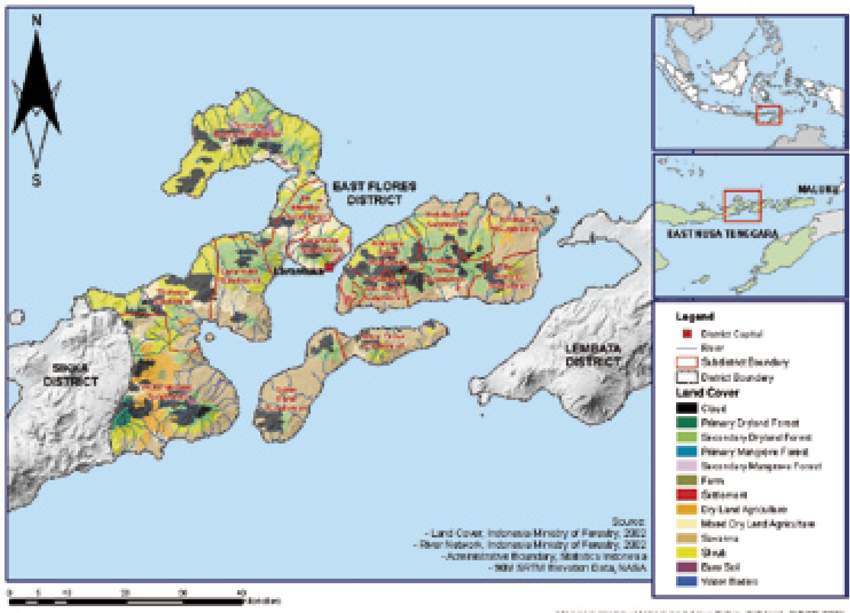
Larantuka (eastern Flores, three or four hours by bus from Maumere) is a sleepy town that comes alive once a year during Holy Week when thousands of pilgrims throng the town to follow the unique Semana Santa ceremonies and the town then literally bursts at the seams. The capital of the District of East Flores, Larantuka has a long history and once was a hive of activities when in the 16th century, Portuguese traders came here to load their vessels with precious sandalwood, which is now largely gone from Flores. In the local Lamaholot language “Larantuka” means “Meeting Point,” because it is the meeting place for people from the surrounding Adonara, Lembata and Solor islands as well as the people from Flores mainland. The town has merged Lamaholot, Portuguese and Malay traditions brought by merchants.
The first Portuguese ship is said to have arrived here in 1556 at the nearby Solor island near Larantuka. But soon the Portuguese were defeated by the Dutch, and so they retreated to Larantuka. The predominantly Catholic Portuguese intermarried with the local population, and gradually Portuguese culture, traditions and faith, were adopted by the local elite. The King of Larantuka at the time, Ola Ado Bala the 11th, changed his name to Don Fransisco Ola Ado Bala Diaz Viera Deo Godinho, or better known as Don Fransisco Ola Ado Bala DVG. And as the king changed his name, everyone followed suit. The 13 tribes living in Larantuka then also changed name, the Lamaholot people became the Fernandez tribe, the De Rosari, Da Costa, Da Santo, Gonzales, Ribeiru, Skera and the De Ornay.
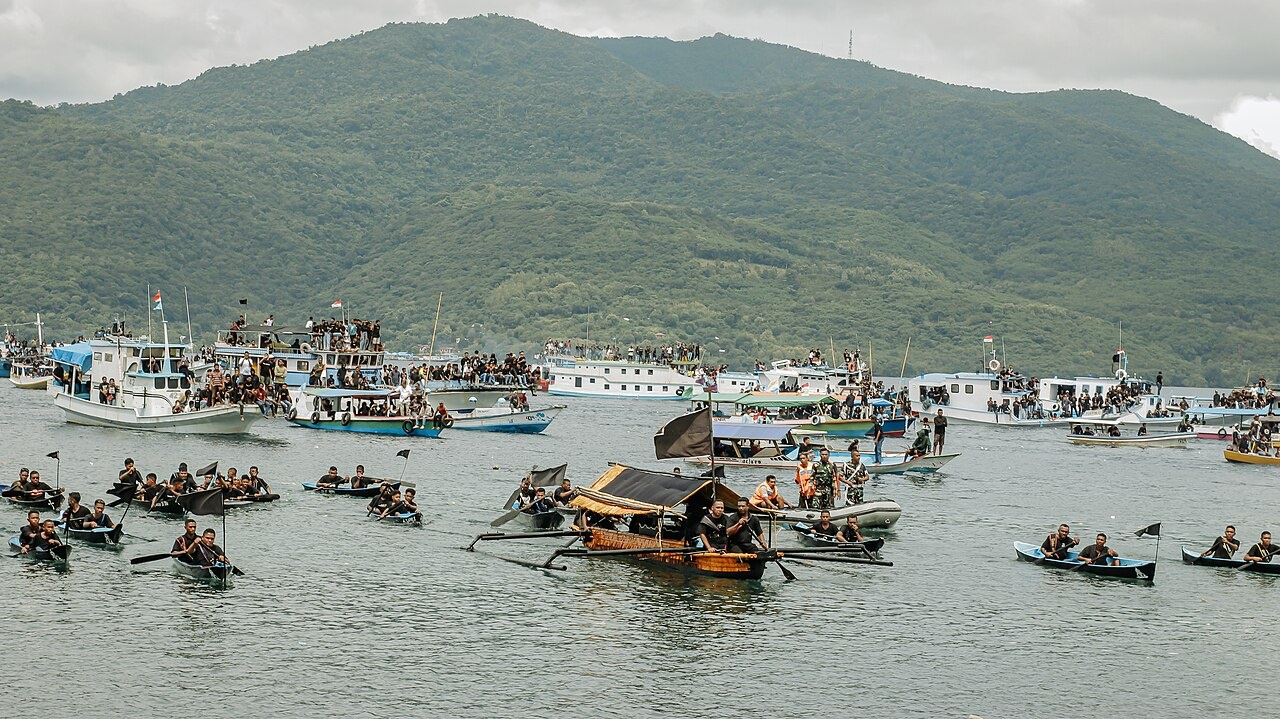
In the 19th century the Portuguese sold its ruling rights in Flores to the Dutch. Consequently, the booming sandalwood trade declined and now the local inhabitants mostly live on subsistence agriculture. Today, Larantuka’s landmark is its Cathedral called Reinha Rosari. The cathedral together with the two chapels known as Capela Tuam Ana (Chapel of Jesus Christ) and Capela Tuan Ma (Mother Mary Chapel) are the center of the yearly Easter processions, when the statues of Jesus and Mary, originally brought here by the Portuguese are carried from the chapels to the cathedral
This area is also famous for its ikat-weaving. Besides its meticulous and arduous process, the locally named kwatek kinge cloth is unique among the Flores fine ikat cloths in that it has sewn-in small seashells into the design. This cloth is produced in the remote village of Lewokluo some 26 kilometers. from Larantuka, and is chiefly used in ceremonial functions. Unfortunately there are very few women left today who still own the knowledge and the skill to manufacture these beautiful intricate materials.
RELATED ARTICLES:
LAMAHOLOT PEOPLE OF FLORES: HISTORY, RELIGION, SOCIETY, LIFE factsanddetails.com
ALORESE: HISTORY, RELIGION, SOCIETY, LIFE factsanddetails.com
ALOR ISLAND factsanddetails.com
CENTRAL-EASTERN FLORES; ENDE, KELIMUTU. MAUMERE factsanddetails.com
ENDE PEOPLE: HISTORY, RELIGION, SOCIETY, LIFE factsanddetails.com
FLORES: VOLCANOS, SIGHTS, LABUAN BAJO factsanddetails.com
PEOPLE OF FLORES factsanddetails.com
ETHNIC GROUPS ON FLORES factsanddetails.com
WESTERN FLORES: ISLANDS, TRADITIONAL VILLAGES AND HOMO FLORESIERNSIS (HOBBITS) factsanddetails.com
SIKKA PEOPLE OF FLORES: RELIGION, CULTURE, LIFE, SOCIETY factsanddetails.com
MANGGARAI PEOPLE OF FLORES: HISTORY, RELIGION, SOCIETY, LIFE factsanddetails.com
NUSA TENGGARA factsanddetails.com
PEOPLE OF NUSA TENGARRA (ISLANDS EAST OF BALI) factsanddetails.com
Accommodation and Getting to Larantuka
Larantuka has mostly modest but clean accommodations, among these are: 1) The Sunrise Hotel, Jl. Sukarno-Hatta, Weri, Larantuka, Flores; 2) Hotel Fortuna, Jl. Basuki Rachmat No. 171, Larantuka, Flores; 3) ASA Hotel larantuka, Jl. Sukarno-Hatta,Weri,Larantuka, Flores, Tel. +62383 2325018, E mail: asahotel.larantuka@gmail.com ; Website/blog: /asahotel-larantuka.blogspot.com; Further east, on the island of Alor is the Alor Divers Eco Resort. Information on this resort can be found at alor-divers.com
Larantuka does not have a commercial airport. Therefore to get there you must take a flight from Jakarta or Bali to Maumere or Kupang, and travel to Larantuka. Maumere is linked by air to Kupang and Bali with regular flights. 3 airlines fly from here, Lion air and Merpati. All flights eventually end up in Bali, either via Kupang, Sumba or Labuan Bajo, so together there is at least 1 flight every day to Bali.
According to Travelfish: Larantuka is usually reached by a three- to four-hour bus or car ride from Maumere. The comfortable Travel vans that run in other areas of Flores don't come this far, so you'll have to take the local bus. These can be an interesting cultural experience, but can also be crowded to the brim, and the drivers sometimes have interesting notions of road safety.
A bus from or to Maumere will cost about 80,000 rupiah and can be caught either at the city bus terminal or from your hotel, where you will be deposited on the side of the road with your bags. The bus terminal in Larantuka is far outside of town, and you will need a bemo to get to your hotel. Alternately, your bus may be heading for the town centre from the terminal; ask the driver.
True masochists can catch a local bus all the way to Bajawa from the Hotel Tresna. This costs about 100,000 and takes about 12 hours, give or take. It's also possible to take this bus to Ende. As with all travel in Flores, things are very fluid and you should always verify this information upon arrival. A private car and driver from Maumere will cost between 450,000 to 500,000 rupiah to make the journey. Stops at small villages along the way are possible if you go this route.
Kedang
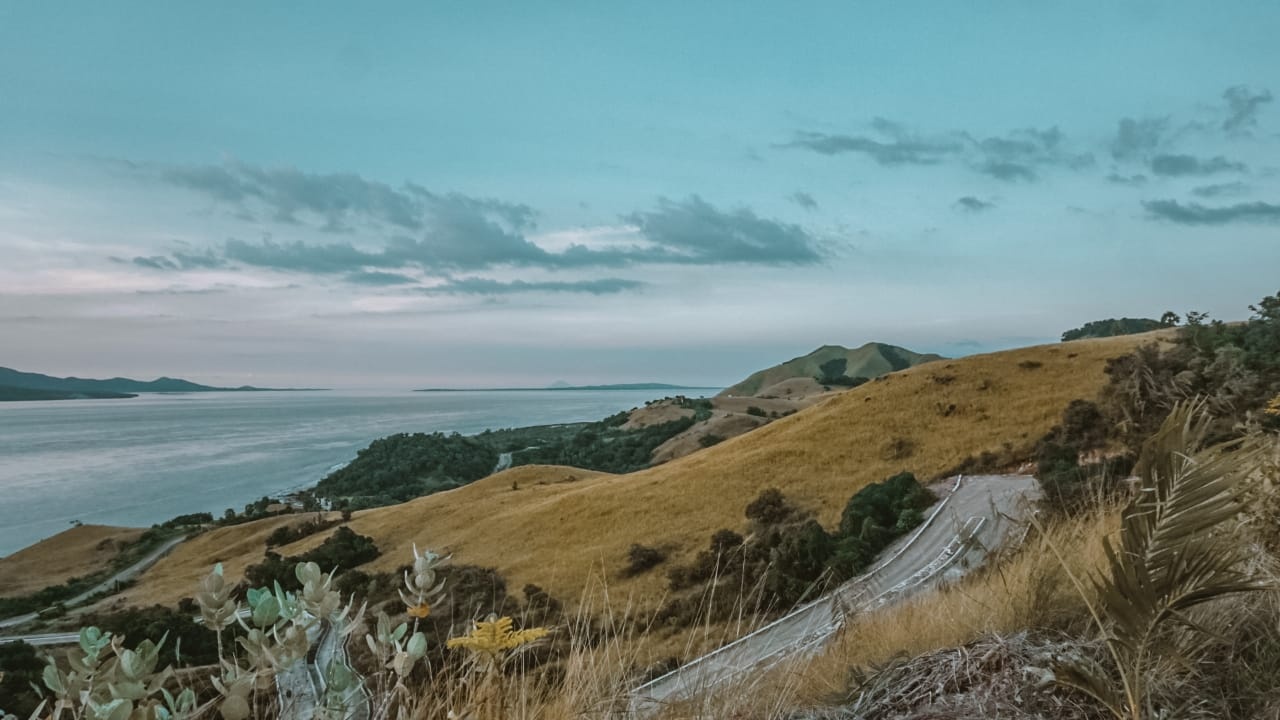
The Kedang live on the island of Lembata, which is east of Flores and north of Timor. Also known as the Edang, they are primarily slash and burn farmers who do a small amount of coastal fishing and raise a few animals. Most are Roman Catholics. Some are Muslims. A few retain their traditional beliefs. They are culturally similar to the Lamaholot who live to the west. [Source: R. H. Barnes, “Encyclopedia of World Cultures Volume 5: East/Southeast Asia:” edited by Paul Hockings, 1993 ~]
The Kedang have traditionally lived in bamboo houses with grass and palm leaf roofs oriented according to traditional religious beliefs. Maize and dry rice are the primary staple crops. Copra, tamarind and candlenuts are raised as cash crops. Many men leave their home island in search of work. Marriages involve an elaborate series of exchanges set by social class seen as alliance builders. In the old days there was no marriage ceremony. Those today are in line with the customs of the Catholic or Islamic faiths. Gifts traditionally included elephant tusks, gongs and fine ikat cloth. Divorce is common among non-Catholics. In the old days children had their teeth blackened and filed as part of coming of age rituals. ~
The incorporation of traditional religion into Catholicism and Islam is reflected in the names for God: Moon-Sun, Great Sun, White Sun, Morning Star-Sun and Great Morning Star. Traditionally, the sun has been viewed as male and the Pleiades and the morning star is associated with divinity. In their belief system there are also guardian spirits, free spirits and witches. In addition to Catholic and Muslim rituals, the Kedang also conduct special village purifying and agricultural ceremonies. Feasts are held at funerals and marriage presentations. On occasion rain-making ceremonies are held. After death, the Kedang believe, people go through a process of death and rebirth through levels of the universe and are briefly a fish before ascending to their place with God.
See Separate Article: KÉDANG PEOPLE OF EASTERN INDONESIA: HISTORY, RELIGION, SOCIETY, LIFE factsanddetails.com
Lamalera on Lembata Island: Where People Still Hunt Whales with Hand Harpoons
Lembata (difficult to reach via bus and ferry from Maumere) is a harsh volcanic island to the east of Flores in the Solor archipelago which contains the whaling village of Lamalera. During the whaling season from May to September the people from this town hunt whales using relatively small sail-paddle boats and hand thrown harpoons. Lamalera has only about 2,000 people. As of 1999, it still had no cars, roads, phones, electricity or television.
It is possible to go on a whale hunt if you pay enough, find the right guide or become friendly with the local people. If you are not into gory scenes, though, this hunt can be very disturbing. You may want to stay ashore. When you decide to go along in a boat led by a lamafa, you should be ready to endure all the risks. It is highly recommended, therefore, that you go along on a different boat, as the raging whale can be very deadly. Beware of the frenzy as you may lose your equipment, especially your cameras.
Hotel Puri in Lewoleba, the largest city and the capital of Lembata Island, is available for those who wish to visit Lamalera. The hotel is simple but decent enough as a getaway. Lewoleba jetty is nearby and you can take an Ojek for less than IDR 10,000 to the hotel. When you mention ‘bis’, literally means bus, the people will refer the term to wooden boat as a public transport. At restaurants and warung in town try to sample jagung titi, locally made corn chips. It is very special in Lembata, and made in Weienga Village. Observe how it is made and you will find traditional tools from ancient times. Corn is cropped from the local corn fields. Jagung titi is best served when hot with fish sauce made locally, called lawar. Get three cups of jagung titi for only IDR 10,000 and you already taste the ancient Lembata.
Getting There: Lembata Island is 190 kilometers north of Kupang, the capital city of East Nusa Tenggara. Loweleba is the largest city in Lembata Island, and perched at the southern coast of the island. To get to Lowelaba, fly or get to Maumere some how. From Maumere, go to Larantuka by bus. From Larantuka, the only way to go to Lamalera is by ferry crossing to Lewoleba which ply each day, or straight to Lamalera from Larantuka with a once-a-week ferry.
Whale Hunters of Lamalera and Their Boats
Whaling is still done in Lamalera using traditional method that have been employed for more than 500 years. The island is one of the few places left on earth where whaling is still allowed by international conservation groups because the local people rely on whale meat as a food source. [Source: Jeffrey Gettleman, Los Angeles Times, September 3, 1999, Fred Bruemmer. Natural History. October 2001]
About 150 or so hunters and 2,000 people live in Lamalera. The residents of the village believe they originated from an island to the north that was destroyed by a tsunami. Whaling and culture on Lamalera are intertwined. For centuries whale blubber was used as currency and oil taken from the blubber was used as cooking oil and as a light source. Even today it used to trade for basic provisions like salt and bananas.
The people of Lamalera are mostly Catholics who retain animist beliefs about the spirituality of the animals they hunt. They grow some manioc and corn but rely almost exclusively on their ocean hunts for food and sometimes to trade. They are thought to have originated on Lapan Bata, an island destroyed by a volcanic eruption.
About 15 boats are used for hunting. In the eyes of the Lamalera islander, their boats are sacred and immortal. The prow is painted with a snake that symbolizes the tsunami that destroyed their village and is outfit with a false keel keel that can easily be replaced as it is often damaged in rough landings. When boat is wrecked by a whale or through old age it is mourned like a human for two months, about the length of time it takes to build a new one.
The heavy, sturdy boats are about 10 meters long and two meters wide at the beam. A typical boat is made from eighteen palm trees with their root sections in the stern so that the life force of the boat flows towards the bows. Planks are shaped with adzes not bent to their proper curve and calked with palm fiber oakum and fastened with wooden pegs — not nails or screws — driven in with stone hammers. Carved crosspieces are fastened with rattan.
The huge rectangular sail of a boat is woven from leaves of the gebang plant and suspended from a 20-foot-high bamboo mast. Two large outriggers provide stability. Jutting out from the bow is a narrow, one-and-half-meter-long, bamboo -and-plank platform on which the harpooner stands. Some boats are particularly treasured. Some are said to be boats used to come from their original homeland that have been continuously repaired for hundreds of years.
Lamalera Whale Hunt
The whaling season takes place when whales gather to feed on abundant supplies of squid. Each boat carries a team of around a dozen men. The men use the sails to move around at sea, but when a whale is spotted the sails are lowered and the crew paddles like crazy to reach the whale
The whale hunters hunt all day, going out in the morning and returning in the evening. They go out everyday except Sunday (for religious reasons) and often return home empty handed. One of the greatest challenges they face is getting the boat out past the breakers and they often chant when they paddle. The search for whales begins when the mast is raised with a prayer. The crew scans the sea for blow holes of whales and the curved tips of manta ray wings.
The whalers kill the whales by jumping on the back of the whales and thrusting the harpoon deep into the whale. It is very dangerous but easier to get in a good shot using this technique. The harpooner usually rides the animal for short distance and then leaps onto an outrigger before making his way back to the boat,
Some whalers have drowned or lost arms or legs that got caught in the coils of the rope. In 1994, a wounded whale dragged two boats 300 kilometers to East Timor. The boats sank and their crew was rescued by a third boat which drifted for days before it was rescued by a passing ship.
The whalers use paddles chopped from trunks of palm trees. The harpoons are hammered from crude metal, usually rusted iron. There primary targets are sperm whales, which can reach a length of 20 meters and weigh 60 tons and can feed all 2,000 people on the island. Generally they avoid adult sperm whales and go after juvenile males, which are eight to 13 meters long. Pilot whales are sometimes caught. Baleen whales are regarded as taboo.
When a whale is caught, the whalers chant. “We do not hunt for fun. We desperately need your meat to live, to feed our hungry children.” The hunters took a peak of 57 whales in 1960. After that their catch dropped to about 10 whales a year the islanders believe because they sold one of their sacred whale skulls to some tourists. Catches began to pick up after 1990. These days between 15 and 25 whales are caught each year. The meat is divided in accordance with a customary law that dates back to the 15th century. The blubber s melted for use on oil.
Lamalera Manta Ray Hunt
Whalers from the village of Lamalera on Lembata also hunt manta rays by jumping on their backs. Describing this Jeffrey Gettleman wrote in Los Angeles Times, "The fishermen stroked across the water, scanning for signs of life. After hours of searching, one sinewy fisherman, Francise Bole Beding, saw a black fin pop through the surface...Paddlers yanked in their oars. Mr. Beding, a harpooner, scampered to the bow, a crude spear in his hands. He coiled himself, preparing to leap down onto the prey and drive harpoon deep into its flesh."
"The sight of a fin cutting through the water focused all minds on what swam below. Mr. Beding saw it was a manta ray, not a whale, and because the giant rays are swift swimmers, he had to attack quickly... Mr. Beding leaped. The rope tied to the end of his harpoon spooled out furiously. The boat careened to the side as the three-meter-wide manta tried to bolt, a harpoon driven deep into its back. Mr. Beding fought the fish in a cloud of red water until two men plunged overboard with heavy iron hooks to finish it off...The paddlers dragged the limp, 136-kilogram fish up on the deck. Mr Beding and the other men wriggled back into the boat."
See Separate Article MANTA RAYS factsanddetails.com
Image Sources: Wikimedia Commons
Text Sources: Indonesia Tourism website ( indonesia.travel ), Indonesia government websites, UNESCO, Wikipedia, Lonely Planet guides, New York Times, Washington Post, Los Angeles Times, National Geographic, The New Yorker, Bloomberg, Reuters, Associated Press, AFP, Japan News, Yomiuri Shimbun, Compton's Encyclopedia and various books and other publications.
Last Updated Janaury 2026