
RICH IN THE PHILIPPINES
The Philippine economy has traditionally been controlled small group of rich families. The ruling oligarchy of the era of President Ferdinand E. Marcos in the 1970s and 80s remains very much alive although some new families and individuals have appeared Most of the wealth in the Philippines is controlled by old Spanish families, ethnic Chinese and the rich mestizo elite. The rich are sometimes called the “dominant classes. The elite have names like Buenaventura, Roxas, Ayala, Zobel, Lopez, Pangilinan. Many live in the Manila area. Some have Ivy League educations.
There has been a significant shift in the composition of the elite as a result of political and economic policies following the end of the Marcos regime in 1986. Some of the elite families displaced by the Marcos regime regained wealth and influence, and many of the families enjoying power, privilege, and prestige in the early l990s were not the same as those enjoying similar status a decade earlier. In 1995, the Philippines had nine billionaires.In That year the Filipino real estate mogul Tan Yu was ranked the 10th richest man in the world with $7 billion. [Source: Library of Congress]
During the Marcos era, a whole coterie of Marcos cronies made millions even billions. Many had most of their property seized by the government after Marcos’s fall. Most settled with the government to get some of their holdings back. Antonio “the Banana King” Floirendo, for instance, settled out of court for $12.5 million in real estate and cash. The abolition of monopolistic marketing boards, along with some progress in privatization, has eliminated the economic base of some of Marcos's powerful associates.
RELATED ARTICLES:
FILIPINO SOCIETY factsanddetails.com
POVERTY IN THE PHILIPPINES: POOR, HUNGRY, INEQUALITY, CAUSES factsanddetails.com
TONDO — MANILA LARGEST SLUM AND HOME TO SMOKY MOUNTAIN factsanddetails.com
FILIPINO CHARACTER AND PERSONALITY: VALUES, EMOTIONS, FRIENDLINESS factsanddetails.com
FILIPINO HIYA (SHAME), AMOR PROPIO (SELF-ESTEEM) AND GO BETWEENS factsanddetails.com
CATHOLIC, ASIAN, SPANISH AND AMERICAN INFLUENCES ON FILIPINO IDENTITY AND CULTURE factsanddetails.com
SOCIAL RELATIONS IN THE PHILIPPINES: UTANG NA LOOB, BAYANIHAN AND PAKIKISAMA factsanddetails.com
ETIQUETTE AND MANNERS IN THE PHILIPPINES: CUSTOMS, PUBLIC ACTIONS, RESPECT factsanddetails.com
FILIPINO COMMUNICATION STYLES: GESTURES, BODY LANGUAGE, EYEBROWS, SPACE factsanddetails.com
PEOPLE OF THE PHILIPPINES: FILIPINOS, IDENTITY, CHARACTERISTICS factsanddetails.com
AUSTRONESIAN PEOPLE OF THE PACIFIC, INDONESIA, MALAYSIA, TAIWAN AND THE PHILIPPINES: ORIGIN, HISTORY, EXPANSION factsanddetails.com
MALAYS AND MALAY-RELATED PEOPLE: HISTORY, DEFINITIONS, ORIGINS, LIFE, CULTURE factsanddetails.com
ETHNIC GROUPS AND MINORITIES IN THE PHILIPPINES factsanddetails.com
MAIN ETHNIC GROUPS OF LUZON: TAGALOGS, ILOCANO AND BICOL factsanddetails.com
ETHNIC GROUPS OF THE CENTRAL PHILIPPINES ISLANDS: VISAYANS, CEBUANO, WARAY factsanddetails.com
MOROS: MUSLIMS IN MINDANAO AND THE SOUTHERN PHILIPPINES factsanddetails.com
LANGUAGES IN THE PHILIPPINES factsanddetails.com
RELIGION IN THE PHILIPPINES factsanddetails.com
Richest People and Families in the Philippines
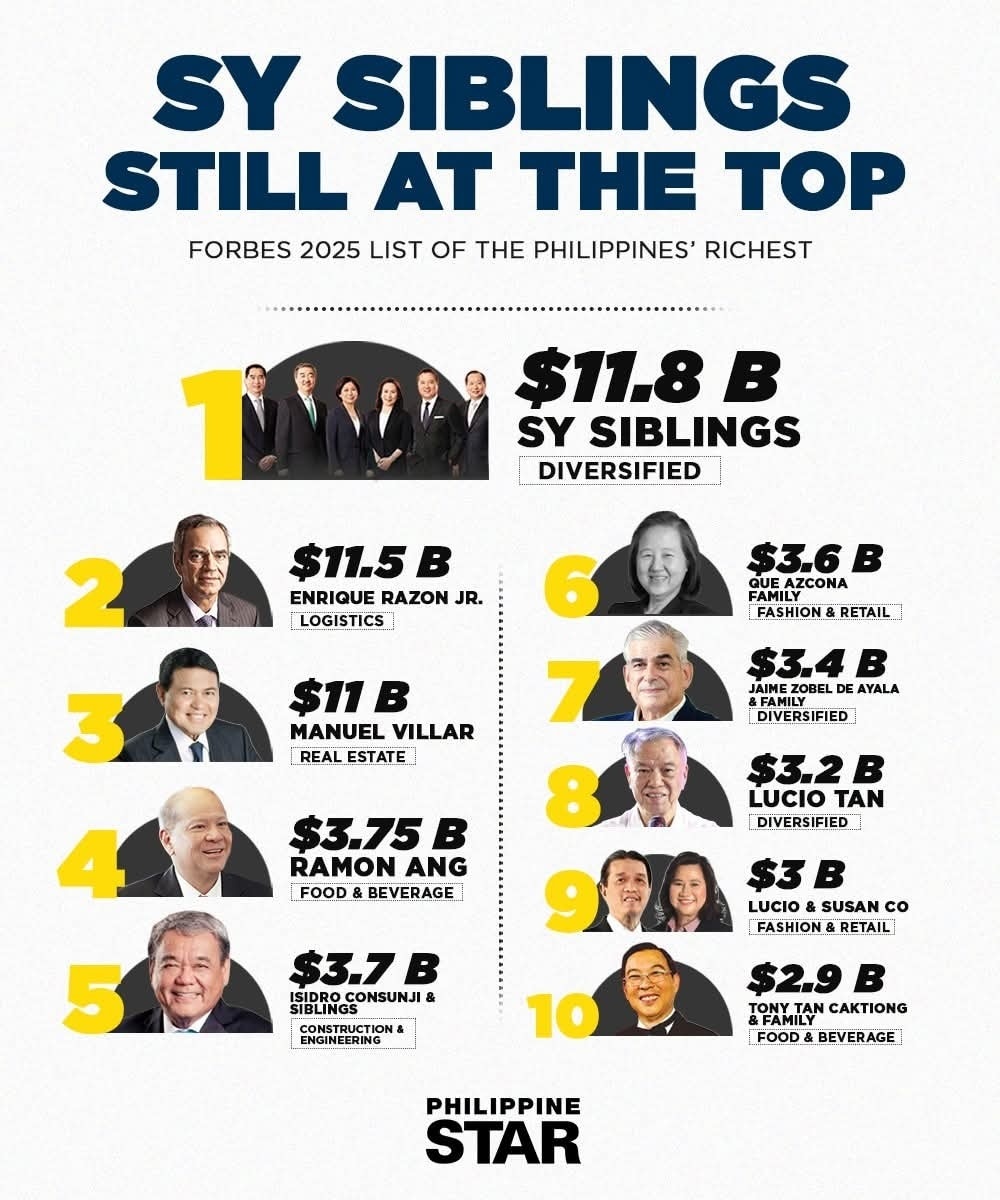
As of August 2025, the Sy siblings topped the list of the Philippines' richest, with a combined net worth of US$11.8 billion, followed closely by ports tycoon Enrique Razon Jr. at US$11.5 billion and property developer Manuel Villar at US$11 billion. The top 10 also includes Ramon Ang, the Consunji family, and the Que Azcona family. [Source: Forbes]
Top 10 Richest People in the Philippines (2025)
Sy Siblings (SM Group): US$11.8 billion
Enrique Razon Jr. (ICTSI/Ports): US$11.5 billion
Manuel "Manny" Villar (Vista Land/Real Estate): US$11 billion
Ramon Ang (San Miguel Corp): US$3.75 billion
Isidro Consunji & Siblings (DMCI Holdings): US$3.7 billion
Que Azcona Family (Mercury Drug): US$3.6 billion
Jaime Zobel de Ayala & Family (Ayala Corp): US$3.4 billion
Lucio Tan (LT Group/PAL): US$3.2 billion
Lucio & Susan Co (Puregold): US$3 billion
Tony Tan Caktiong & Family (Jollibee): US$2.9 billion
The top 50 richest Filipinos saw their collective wealth rise by over 6 percent drom 2024 to 2025 to $86 billion. The richest individuals primarily hold wealth in real estate, banking, retail, and infrastructure/ports.
The richest families and individuals in 2013 were: 1) Henry Sy & family, $12 billion; 2) Lucio Tan & family, $7.5 billion; 3) Andrew Tan, $4.6 billion; 4) Enrique Razon, Jr., $4.5 billion; 5) John Gokongwei, Jr., $3.4 billion; 6) Jaime Zobel de Ayala & family, $3.1 billion; 7) Family Aboitiz, $3 billion; 8) David Consunji, $2.7 billion; 9) George Ty & family. $2.6 billion; 10) Lucio and Susan Co, $1.9 billion. [Source: Forbes]
Rich Families of the Philippines
Lopezes: Few families have experienced the dramatic rises and falls of fortune that marked the history of the Lopezes of Iloilo. Don Eugenio Lopez (1901–1975) guided the family through its most difficult period, rebuilding its wealth—largely based on sugar—after World War II, only to see much of it lost during the years of martial law. Although he did not live to see the family’s major companies—Meralco, ABS-CBN, and the Manila Chronicle—returned to them, his sons Geny (“El Capitan”), Oscar, and Manolo helped usher in a new era of prosperity after the 1986 EDSA Revolution. The next generation of leadership includes Piki Lopez of First Philippine Holdings and Gaby Lopez of ABS-CBN. [Source: Town & Country Philippines, November 8, 2016]
Gotianuns: Andrew Gotianun stepped away from business in the 1980s, hoping to enjoy a quiet retirement with his wife, Mercedes. Not long afterward, however, he returned to lead Filinvest Development Corporation, the company he founded in 1955, bringing with him new ideas for expansion. His renewed leadership helped propel the family onto Forbes magazine’s list of the richest Filipinos, reaching 18th place in 2015. Gotianun passed away in March 2016, leaving the company in the hands of his children—Josephine (president and CEO), Jonathan (chairman), Andrew Jr. (director), and Michael (vice president). His wife Mercedes serves as chairman emeritus.
Consunjis: David Consunji, founder of DMCI, remained known for his simple lifestyle despite being one of the richest Filipinos. According to Forbes, he ranked among the country’s wealthiest individuals, yet he was known for modest habits and values such as honesty and frugality. While the architects of famous buildings often receive the recognition, it was Consunji’s construction company that built many landmark projects, including the Cultural Center of the Philippines, the Philippine International Convention Center, the Westin Philippine Plaza, and developments around the Ayala Triangle. Today, the construction firm is managed by his eldest son, Sid, with siblings Jing, Victor, Jorge, Lucy, Cristina, and Dinky also involved in the family business.
Gokongweis: The story of this family’s patriarch, John Gokongwei, is often described not as a typical rags-to-riches tale but rather as riches to rags and back to riches again. Born into a prosperous Chinese family in Cebu, he saw the family fortune disappear after his father’s sudden death. As he later explained in a speech at the 20th Ad Congress: “So, what could I do? I worked.” Over time he rebuilt the family’s wealth and created a major business empire. In later years he gradually handed responsibilities to his children. His only son, Lance, took on major roles in Cebu Pacific and JG Summit, while his eldest daughter, Robina, became president of Robinsons Retail Holdings, which includes Robinsons Department Store, Robinsons Supermarket, Handyman, and Toys “R” Us.
Tony Tan Caktiong and his family built a global fast-food empire through their company Jollibee. The chain has continued to expand internationally, with new branches opening across the world. According to Forbes, Jollibee has become one of the fastest-growing Asian restaurant chains. Over the years the company also acquired other restaurant brands, including Chowking, Greenwich Pizza, and Red Ribbon, helping increase both the company’s share value and Tan’s personal fortune. Tan’s wife Grace leads the Jollibee Foundation, while their eldest child and only son, Carl Brian, serves as the company’s business development director. Their two daughters live in California.
See Separate Article: JOLLIBEE factsanddetails.com
Powerful Family Politics in the Philippines
Elections in the Philippines are typically battles between powerful political families and Philippine politics have long been dominated by politicians belonging to the same bloodlines. At least 250 political families have dominated power nationwide, despite a prohibition against dynasties in the 1987 Constitution. Congress—long controlled by members of influential clans covered by the ban—has never passed the enabling law required to define and enforce the provision. [Source: Hrvoje Hranjski, Associated Press, May 13, 2013]
The same old faces, the same old families and the same old interests continue to dominate political life in the Philippines. “Wherever you go, you still see the same names we’ve known since childhood,” businessman Martin Tunac told Associated Press, after casting his vote in Manila. “One of the problems with political dynasties is that they control everything, including business.” School counselor Evelyn Dioquino described the spread of dynasties as a cultural issue, noting that candidates outside established clans face steep odds. Political families, she said, “have money, so they are the only ones who can afford to run. Of course, if you don’t have the logistics, you can’t seek office.”
Among the most prominent political families in the Philippines are the Marcos family of Ilocos Norte, led by President Bongbong Marcos; the Duterte family of Davao, headed by Vice President Sara Duterte and former president Rodrigo Duterte; and the Villar family of Las Piñas, led by business magnate and former Senate President Manuel Villar. The Romualdez clan of Leyte, closely allied with the Marcos family and represented nationally by House Speaker Martin Romualdez, also wields significant power. The Estrada/Ejercito family, founded by former president Joseph Estrada, remains influential in San Juan and Laguna.
See Separate Article: POLITICS IN THE PHILIPPINES:POWERFUL FAMILIES, RICH BACKERS, PATRONAGE, CELEBRITY factsanddetails.com
Land Ownership in the Philippines
An important legacy of the Spanish colonial period was the high concentration of land ownership, and the consequent widespread poverty and agrarian unrest. United States administrators and several Philippine presidential administrations launched land reform programs to maintain social stability in the countryside. Lack of sustained political will, however, as well as landlord resistance, severely limited the impact of the various initiatives. [Source: Library of Congress *]
A lot of the old money families in the Philippines are large ;and owners/ Large amounts of arable land remain in the hands of absentee landowners who were granted land during the Spanish colonial period. Although land reform legislation has been passed, loopholes in the legislation allow owners to retain possession of the land. Those responsible for enacting and enforcing the legislation often come from the same families that own the land. Source: “Encyclopedia of World Cultures Volume 5: East / Southeast Asia:” edited by Paul Hockings, 1993 |~|]
Farm size is a significant indicator of concentration of ownership. Although nationwide approximately 50 percent of farms in 1980 were less than two hectares, these small farms made up only 16 percent of total farm area. On the other hand, only about 3 percent of farms were over ten hectares, yet they covered approximately 25 percent of farm area. Farms also varied in size based on crops cultivated. Rice farms tended to be smaller; only 9 percent of rice land was on farms as large as ten hectares.
Coconut farms tended to be somewhat larger; approximately 28 percent of the land planted in coconuts was on farms larger than ten hectares. Sugarcane, however, generally was planted on large farms. Nearly 80 percent of land planted in sugarcane was on farms larger than ten hectares. Pineapple plantations were a special case. Because the two largest producers were subsidiaries of transnational firms — Del Monte and Castle and Cooke — they were not permitted to directly own land. The transnationals circumvented this restriction, however, by leasing land. In 1987 subsidiaries of these two companies leased 21,400 hectares, 40 percent of the total hectarage devoted to pineapple production. *
Land reform has been a concern since independence. Spanish and American rule left arable land concentrated in the hands of 2 percent of the population and those owners will not give up their land without compensation. Attempts made to provide land, such as the resettlement of Christian farmers in Mindanao in the 1950s, have not provided enough land to resolve the problem. Until land reform takes place, poverty will be the nation's primary social problem.
See Land Reform Efforts Under Corazon Aquino Under CORAZON AQUINO AS PRESIDENT factsanddetails.com
Sy Siblings
The Sy siblings—Teresita Sy-Coson, Elizabeth Sy, Henry Sy Jr., Hans Sy, Herbert Sy, and Harley Sy— are the children of Henry Sy Sr. and heirs to the Philippines’ largest conglomerate, the SM Investments Corporation. The family built their wealth through major businesses in retail, banking, and real estate. As of August 2025, the siblings have a combined fortune of about $11.8 billion and have consistently ranked among the richest individuals in the Philippines for several years. They continue the business legacy started by their father, who founded the company in 1958 with a small shoe store that later grew into a vast commercial empire.
Today, the siblings serve as executives and board members across the group’s major companies, including SM Prime Holdings and BDO Unibank. They reportedly hold regular family meetings to coordinate major business decisions, with Teresita Sy-Coson often regarded as one of the group’s key advisers and leaders.
Each sibling manages specific parts of the business: Teresita Sy-Coson is vice-chairperson of SM Investments and chairperson of BDO Unibank; Elizabeth Sy leads the company’s hotels and conventions businesses; Henry Sy Jr. serves as vice-chairperson of SM Investments and chairperson of SM Prime; Hans Sy chairs China Banking Corporation and advises SM Prime; Herbert Sy oversees supermarket-related operations and advises SM Prime; and Harley Sy serves as executive director of SM Investments. Together, they maintain and expand the conglomerate founded by their father.
Henry Sy was 89 and living in Manila in 2013. At that time he and his family’s wealth as around $12 Billion. Henry earned a Bachelors degree from Far Eastern University and had six children. He merged his vast property assets under mall operator SM Prime Holdings. In November 2012 his property unit SM Land snatched a $1.2 billion contract to reclaim land in Manila, next to his Mall of Asia complex. Despite big moves, Sy's fortune dropped by $1.8 billion in 2012 mainly because shares of his holding firm SM Investments tumbled 30 percent in the past year. They took a hit when the company sold some shares to institutional investors at a discount to market price. In 2013, Son Henry Sy Jr chaired SM Prime, while son Hans was group president.;
Enrique K. Razon Jr
Enrique K. Razon Jr. (born March 3, 1960) is a Spanish-Filipino billionaire businessman and the chairman and chief executive officer of International Container Terminal Services, Inc. (ICTSI), a Manila-listed company that manages port terminals in the Philippines and in several countries across Eastern Europe, Africa, and the Americas. He is also the chairman of Bloomberry Resorts Corporation, the developer of Solaire Resort & Casino, one of the major integrated resort complexes in Metro Manila’s Entertainment City. In addition, he chairs Manila Water Company, which serves more than seven million residents in the eastern zone of Metro Manila and parts of Rizal Province. Companies associated with Razon, including ICTSI, Bloomberry Resorts, Manila Water, and Apex Mining Co., Inc., are listed on the Philippine Stock Exchange. He also owns MORE Electric and Power Corporation, the sole electricity distributor in Iloilo City since 2020. In 2025, Forbes ranked him the second-richest Filipino and the 227th richest person in the world, with an estimated net worth of $10.9 billion.
Razon comes from a third-generation Spanish-Filipino family involved in the marine cargo-handling industry. His grandfather established a port business in Manila in 1916, and his father rebuilt and expanded the company after World War II. Razon studied at De La Salle University before entering the family business. He later transformed the company into a global port-management enterprise, operating dozens of terminals around the world. Alongside his port operations, he expanded into hospitality and gaming through Bloomberry Resorts, whose flagship development is the Solaire Resort & Casino.
He is married to Felicia “Lizzy” Santos, a trustee of Child Protection Network, which supports abused and vulnerable children. She studied at Saint Louis University Madrid Campus and the University of the Philippines. The couple has two children: Enzo Razon, an artist and co-founder of Tarzeer Pictures, and Katrina Razon, a disc jockey, composer, and entrepreneur who owns KSR Ventures. Outside business, Razon is known for supporting sports such as kiteboarding and golf.
Manny Villar
Manuel B. Villar Jr. (born December 13, 1949), commonly known as Manny Villar, is a Filipino businessman and former politician. He served as a senator in the Senate of the Philippines from 2001 to 2013 and was the 25th president of the Senate from 2006 to 2008. Before becoming a senator, he represented the Las Piñas–Muntinlupa district in the House of Representatives of the Philippines from 1992 to 1998 and later represented the at-large district of Las Piñas from 1998 to 2001. During this period, he also served as Speaker of the House from 1998 to 2000 and presided over the impeachment proceedings of President Joseph Estrada.
Villar was born into a poor family in Tondo, a densely populated district of Manila. After graduating from the University of the Philippines, he began his career as an accountant and financial analyst before entering the real estate business. His property companies later built more than 200,000 homes, helping establish him as one of the most successful real estate developers in the country.
In 2010, Villar ran for president under the Nacionalista Party but lost to Benigno Aquino III. Despite leaving electoral politics, his business ventures continued to grow. In 2025, Forbes ranked him as the richest person in the Philippines with an estimated net worth of $17.2 billion, a significant increase from $11 billion in 2023. Earlier, in 2022, he was listed by Forbes as the country’s biggest wealth gainer, with his fortune rising to $7.8 billion—more than $1 billion higher than the previous year.
While attending the University of the Philippines Diliman as a junior, Villar befriended Cynthia Aguilar, a classmate in the College of Business Administration. They married at 25 and have three children: Manuel Paolo, Mark, and Camille. The Villar and Aguilar families have a long-standing friendship with the family of Romeo Jalosjos Sr., a fellow politician and the chairman of Television and Production Exponents (TAPE) Inc., the former producer of the longest-running noontime variety show, Eat Bulaga!, and its successor, Tahanang Pinakamasaya.
Lucio Tan
Lucio C. Tan (born July 17, 1934) is a Filipino-Chinese businessman and philanthropist who founded and leads LT Group, Inc., a diversified conglomerate with interests in banking, airlines, beverages, tobacco, liquor, real estate, and education. A former janitor, Tan is one of the richest men in the Philippines. He was the second richect man in the Philippines in 2013 with $7.5 billion but ranked 8th in 2025 with $3.2 billion. Tan was one of the Philippines worst tax dodgers. In 1996, the Supreme Court dismissed a $1 billion tax evasion case against Tan on a technicality. He was regarded as a Estrada crony and little was done to collect taxes he oweed.
Tan was born in Amoy (now Xiamen) and moved with his family to the Philippines as a child, growing up in Cebu City. Coming from modest beginnings, he reportedly attended school barefoot and worked various jobs to support his education. He later earned a degree in chemical engineering from Far Eastern University, where he also worked as a janitor in a tobacco factory to pay for his studies.
Tan began building his business empire in 1966 when he co-founded Fortune Tobacco Corporation. He expanded rapidly into other industries, acquiring a struggling bank in 1977 and transforming it into Allied Banking Corporation. In 1982 he founded Asia Brewery, Inc., which produced popular brands such as Beer na Beer. He later acquired the well-known liquor producer Tanduay Distillers in 1988 and gained control of Philippine Airlines in the early 1990s, eventually becoming its chairman.
In 2012 Tan consolidated many of his holdings—including interests in tobacco, banking, real estate, liquor, and aviation—into a single listed conglomerate, LT Group, Inc., creating a business group with billions of dollars in assets. His companies also include property developer Eton Properties Philippines and aviation services firm MacroAsia Corporation. Tan is known for building his fortune from humble beginnings and for maintaining influence across several key industries in the Philippine economy.
Eduardo Cojuangco
Eduardo Cojuangco Jr. (1935-2020) was the richest man in the Philippines at one time. Known in the Philippines by his nickname Dandling, he headed the San Miguel Corp., the Philippines largest company at one time and was perhaps the greatest comeback figure in the history of Philippine business. [Source: Robert Frank, Wall Street Journal, August 31, 1999; Jim Gomez, Associated Press, June 17, 2020]
Cojuangco (pronounced co-HONKO-o) was something of a maverick. He dressed in jeans and cowboy boots and flew around in a Learjet with leather seats in the cockpit. He also maintained a 30-car garage filled with Ferraris, a Rolls-Royce, and a bomb-proof Mercedes, and he bred racehorses and fighting cocks. At the same time, he was full of contradictions. He was a staunch conservative who consulted a Marxist priest and was allergic to alcohol even though he owned a beer empire. Cojuangco was born on June 10, 1935 in Paniqui, Tarlac, the first-born child of Eduardo Chichioco Cojuangco and Josephine B. Murphy.. He attended UP Los Baños and California Polytechnic State University, San Luis Obispo. In the 1960s, Cojuangco served as governor of the northern Philippine province of Tarlac, the base of the Cojuangco clan, which has interests in sugarcane plantations.
Aside from business, Cojuangco delved into sports, and owned three teams in the Philippine Basketball Association. He had been linked to the 1983 assassination of a key anti-Marcos politician, former Sen. Benigno Aquino Jr., but the allegation has never been proven and Aquino’s family later said he was not involved. Aquino’s wife, Corazon Aquino, who was Cojuangco’s estranged cousin, was hailed as a democracy icon amid the anti-Marcos protests in 1986 and succeeded Marcos. During his years in exile, he was known to have traveled to the United States and Australia, where he bred thoroughbred racehorses.
See Separate Article: SAN MIGUEL AND EDUARDO COJUANGCO factsanddetails.com
Jaime Augusto Zobel de Ayala and the Ayala Family
Jaime Augusto Zobel de Ayala (born 1959) is a prominent Filipino business leader and has served as chairman of Ayala Corporation since 2016. He leads one of the Philippines’ oldest and largest conglomerates, with major business interests in real estate, banking, telecommunications, and sustainable energy. Zobel de Ayala is widely recognized for his leadership in corporate governance and for promoting sustainable development within the Philippine business community. He previously served as chief executive officer of Ayala Corporation from 2006 to 2021.
A member of the influential Zobel de Ayala family, he succeeded his father, Jaime Zobel de Ayala, who had served as chairman of the conglomerate from 1984 to 2006. Under their leadership, the company expanded its presence in key sectors of the Philippine economy. Zobel de Ayala studied at Harvard University, where he earned a bachelor’s degree in economics in 1981 and later completed an MBA at Harvard Business School in 1987. He has also been active in international business and policy circles, serving as chair of the Harvard Business School Asia-Pacific Advisory Board and as a member of the JPMorgan International Council.
The Ayala family, controllers of the Ayala Group, has been one of the most powerful families in the Philippines. At one time it controlled four of the country’s six largest companies in terms of market value and owns many properties in Manila’s Makati financial district. Unlike some other large companies in the Philippines, they stay fairly close to home. The Zobel de Ayala family remains among the wealthiest families in the Philippines, with an estimated net worth of about $3.4 billion as of August 2025.
The Ayala family is originally from the Basque region of Spain. Juan Valentin de Ayala arrived in the Philippines in 1795 and founded a company that began by producing gin and rum from sugar grown in the Philippines. After World War II, the family developed a marshland outside Manila known as Makati. The Ayala Group has owned the Philippines’ second-largest bank, Bank of the Philippine Islands, and the mobile phone company Globe Telecom. It provided about half of Manila’s water through Manila Water Co., and has run Integrated Microelectronics and Isuzu Philippines. The group also operates shopping malls and has invested in Manila’s second mass transit line. It is has been involved in a major development project in Fort Bonifacio in Manila.
Image Sources: Wikimedia Commons
Text Sources: “Encyclopedia of World Cultures Volume 5: East/Southeast Asia:” edited by Paul Hockings, 1993; “Culture Shock!: Philippines” by Alfredo Roces and Grace Roces, Marshall Cavendish International, 2010; National Geographic, Live Science, Philippines Department of Tourism, New York Times, Washington Post, Los Angeles Times, Smithsonian magazine, Encyclopedia.com, Library of Congress, The Conversation, The New Yorker, Time, BBC, CNN, Reuters, Associated Press, AFP, Lonely Planet Guides, Google AI, Wikipedia, The Guardian and various websites, books and other publications.
Last updated March 2026