
LANGUAGES IN THE PHILIPPINES
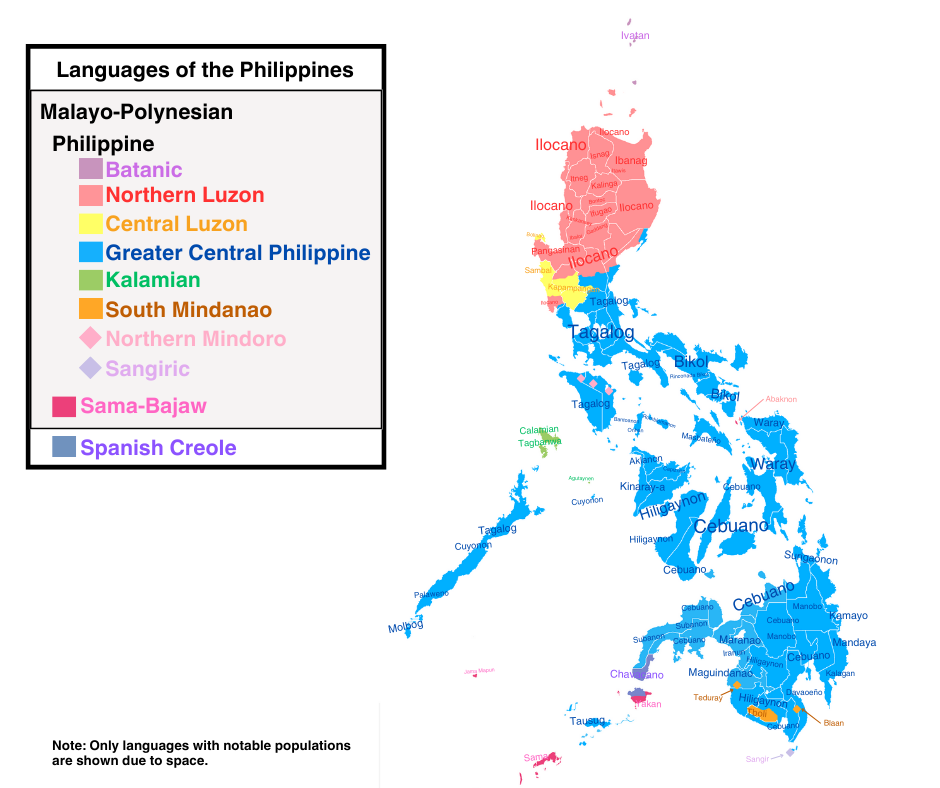
The Philippines has two official languages: Filipino (or Pilipino) and English. There are eight major dialects, in order of use: Tagalog, Cebuano, Ilocano, Hiligaynon or Ilonggo, Bicol, Waray, Pampango, and Pangasinense. Some regard these as separate languages. They are spoken by 80 to 90 percent othe population of the Philippines. Filipino is based on Tagalog. Three dialects are of national importance: Cebuano in the southern islands, Ilocano in the north, and Tagalog, the language of the Manila and National Capital Region. When Tagalog was chosen as the basis for Filipino, the national language, Cebuanos refused to use it. Apart from the previously-mentioned languages there are more than 176 local dialects. [Source: “Encyclopedia of World Cultures Volume 5: East/Southeast Asia:” edited by Paul Hockings, 1993; CIA World Factbook]
Filipino, Tagalog and most other Philippines languages are related to Malay and Indonesian and are part of the Malayo-Polynesian subgroup of the Austronesian language family. Filipino is the common language used between speakers of different native languages, which are closely related but not mutually intelligible. Tagalog is the predominant dialect from the Luzon mainland. English is used in government and as the medium of instruction in higher education.
All Philippine languages are grammatically and phonetically similar and all are classified as Austronesian or Malayo-Polynesian languages and are similar to the languages spoken in Indonesia and Malaysia. About 10 languages are spoken by 90 percent of the population of the Philippines. Pilipino, a language based in Tagalog, is technically the national language of the Philippines but in actuality it is primarily the local language of people in the Manila area and the plains of Luzon. Many people outside of Luzon and Manila understand it because newspapers, film scripts and magazines are written in Tagalog and radio and television shows are broadcasts are broadcast in the language.
Among the languages from the Taiwan-Philippines language group that were on the verge of extinction in the 2000s were: 1) Arta (with 6 speakers); Bubuza (with 5 speakers); and Pazeh (with 1 speaker). Maybe there are extinct now. On the other side of the cpin the number of people speaking Tagalong in the United States doubled between 1980 and 2010. [Source: National Geographic]
RELATED ARTICLES:
NAMES, NICKNAMES AND TITLES IN THE PHILIPPINES factsanddetails.com
ENGLISH IN THE PHILIPPINES: TAGLISH, MISUNDERSTANDINGS, FILIPINO VERSUS AMERICAN factsanddetails.com
ENGLISH EDUCATION IN THE PHILIPPINES: STUDYING THERE. FOREIGNERS, CHEAP ENGLISH SCHOOLS factsanddetails.com
For Information in the Language of Different Ethnic Group See the Ethnic Groups and Minorities listed Under the MINORITIES factsanddetails.com
ETHNIC GROUPS AND MINORITIES IN THE PHILIPPINES factsanddetails.com
MAIN ETHNIC GROUPS OF LUZON: TAGALOGS, ILOCANO AND BICOL factsanddetails.com
ETHNIC GROUPS OF THE CENTRAL PHILIPPINES ISLANDS: VISAYANS, CEBUANO, WARAY factsanddetails.com
PEOPLE OF THE PHILIPPINES: FILIPINOS, IDENTITY, CHARACTERISTICS factsanddetails.com
AUSTRONESIAN PEOPLE OF THE PACIFIC, INDONESIA, MALAYSIA, TAIWAN AND THE PHILIPPINES: ORIGIN, HISTORY, EXPANSION factsanddetails.com
MALAYS AND MALAY-RELATED PEOPLE: HISTORY, DEFINITIONS, ORIGINS, LIFE, CULTURE factsanddetails.com
Classification and Division of Languages in the Philippines
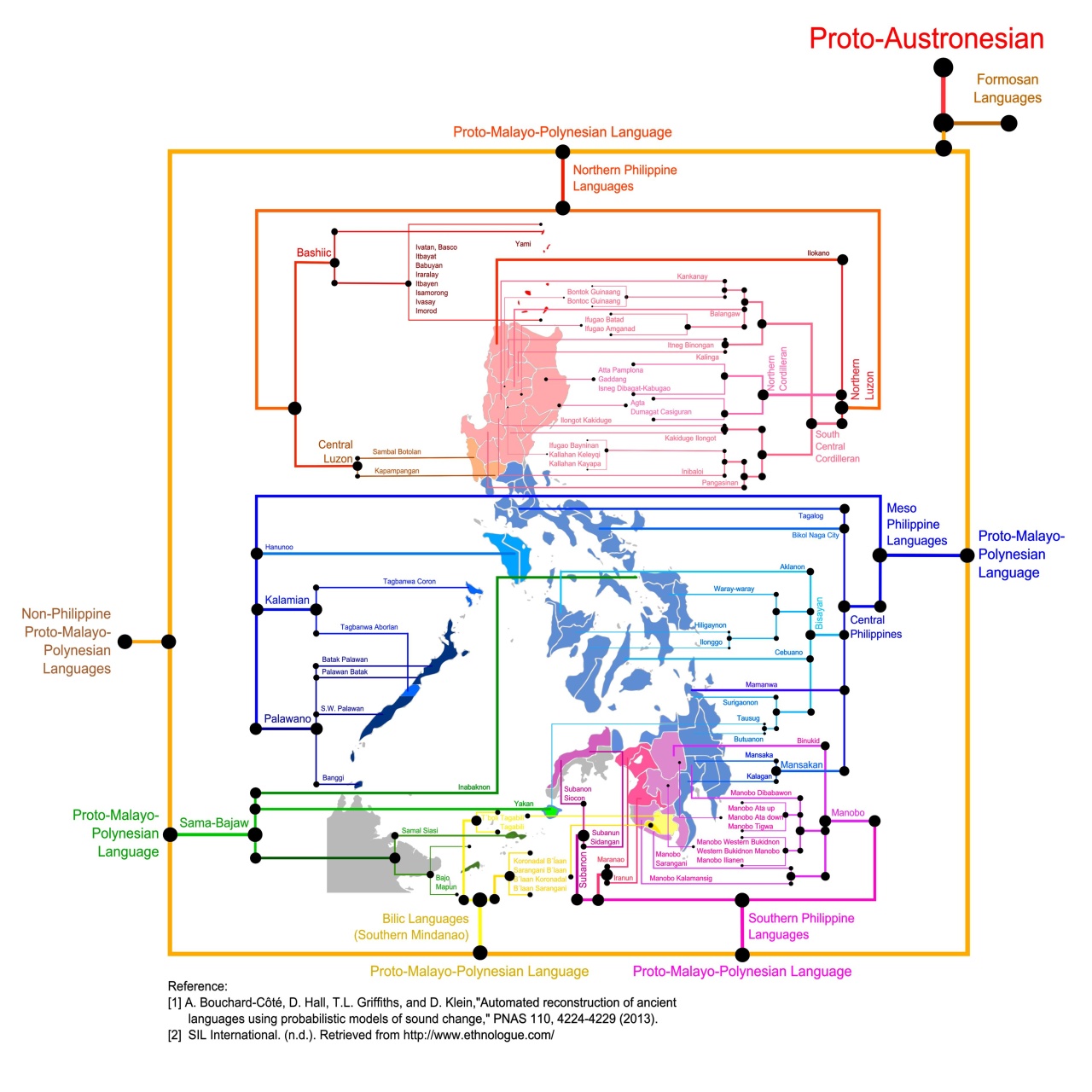
Some eleven languages and eighty-seven dialects were spoken in the Philippines in the late 1980s. Eight of these — Tagalog, Cebuano, Ilocano, Hiligaynon, Bicolano, Waray-Waray, Pampangan, and Pangasinan — were native tongues for about 90 percent of the population. All eight belong to the Malay-Polynesian language family and are related to Indonesian and Malay, but no two are mutually comprehensible. Each has a number of dialects and all have impressive literary traditions, especially Tagalog, Cebuano, and Ilocano. Some of the languages have closer affinity than others. It is easier for Ilocanos and Pangasinans to learn each other's language than to learn any of the other six. Likewise, speakers of major Visayan Island languages — Cebuano, Ilongo, and Waray-Waray — find it easier to communicate with each other than with Tagalogs, Ilocanos, or others. [Source: Library of Congress *]
Nearly all the languages spoken in he Philippines are Austronesian (formerly Malayo-Polynesian) languages. There are 1,200 Austronesia languages—about a fifth of the world's total. They are spoken on islands in the Indian and Pacific oceans from Madagascar to Hawaii. About a hundred different languages are spoken on Vanuatu alone. Malay, Formosan, and most of the languages of Indonesia, the Philippines and Polynesia are Austronesia languages. The Austronesian family of languages most likely originated in China.
Language divisions were nowhere more apparent than in the continuing public debate over national language. The government in 1974 initiated a policy of gradually phasing out English in schools, business, and government, and replacing it with Pilipino, based on the Tagalog language of central and southern Luzon. Pilipino had spread throughout the nation, the mass media, and the school system. In 1990 President Corazon Aquino ordered that all government offices use Pilipino as a medium of communication, and 200 college executives asked that Pilipino be the main medium of college instruction rather than English. Government and educational leaders hoped that Pilipino would be in general use throughout the archipelago by the end of the century. By that time, it might have enough grass-roots support in non-Tagalog-speaking regions to become a national language. In the early l990s, however, Filipinos had not accepted a national language at the expense of their regional languages. Nor was there complete agreement that regional languages should be subordinated to a national language based on Tagalog. *
Tagalog
Tagalog is the predominant dialect of the Luzon mainland. It is related to Malay and Indonesian and is part of the Malayo-Polynesian subgroup of the Austronesian language family. Tagalog is primarily the local language of people in the Manila area and the plains of Luzon. Many people outside of Luzon and Manila understand it because newspapers, film scripts and magazines are written in Tagalog and radio and television shows are broadcasts are broadcast in the language. Tagalog is the basis of Pilipino, the national language and the primary language taught in schools.

Tagalogs are the dominant ethnic group in the Philippines both politically and culturally. Also known as Pilipino, they have traditionally lived in the central Luzon Plain around Manila Bay. Tagalogs are regarded as proud, boastful and talkative. They are dominate in business, government and the media. Many of their customs involving marriage , death and life events are rooted in Catholic traditions. The word Tagalog is derived from “taga ilog”, meaning “inhabitants of the river.”
Tagalog speakers in the Philippines have many ways of greeting other people. It is common also to hear them say "Hi" or "Hello" as a form of greeting, especially among close friends. There are no Tagalog translations for these English greetings because they are basically borrowed terms. Below are a few Tagalog greetings that are important to learn if one wants to endear himself/herself to Filipinos. [Source: Philippines Department of Tourism]
Filipino Language
Filipino, the national language of the Philippines, is a standardized form of Tagalog supplemented with words from other languages, including Spanish, Sanskrit, and Malay. Section 6, Article XIV of the 1987 Constitution states: “The national language of the Philippines is Filipino. As it evolves, it shall be further developed and enriched on the basis of existing Philippine and other languages.” Government institutions, including the National Commission for Culture and the Arts, formally recognize Filipino as the country’s national language. [Source: NextShark, October 20, 2022]
The Institute of National Language—now known as the Commission on the Filipino Language—was established in 1936 and endorsed Tagalog as the foundation of a national language in 1937, citing its wide usage and strong literary tradition. Tagalog itself was explicitly named the national language only in the 1943 Constitution during the Japanese occupation. Before that, Spanish and English had served as the official languages under Spanish and American rule.
Under the current Constitution, the government promotes Filipino as a medium of official communication and instruction. Filipino and English are both taught from Grade 1, with Filipino increasingly used as a language of instruction from elementary through senior high school.
Like any living language, Filipino continues to evolve by incorporating elements and loan words from various Philippine and foreign languages, as well as from inventions among different sub-cultures (ask someone about “becky speak” or “gay lingo”).
Iloco, Visayan and Cebuano
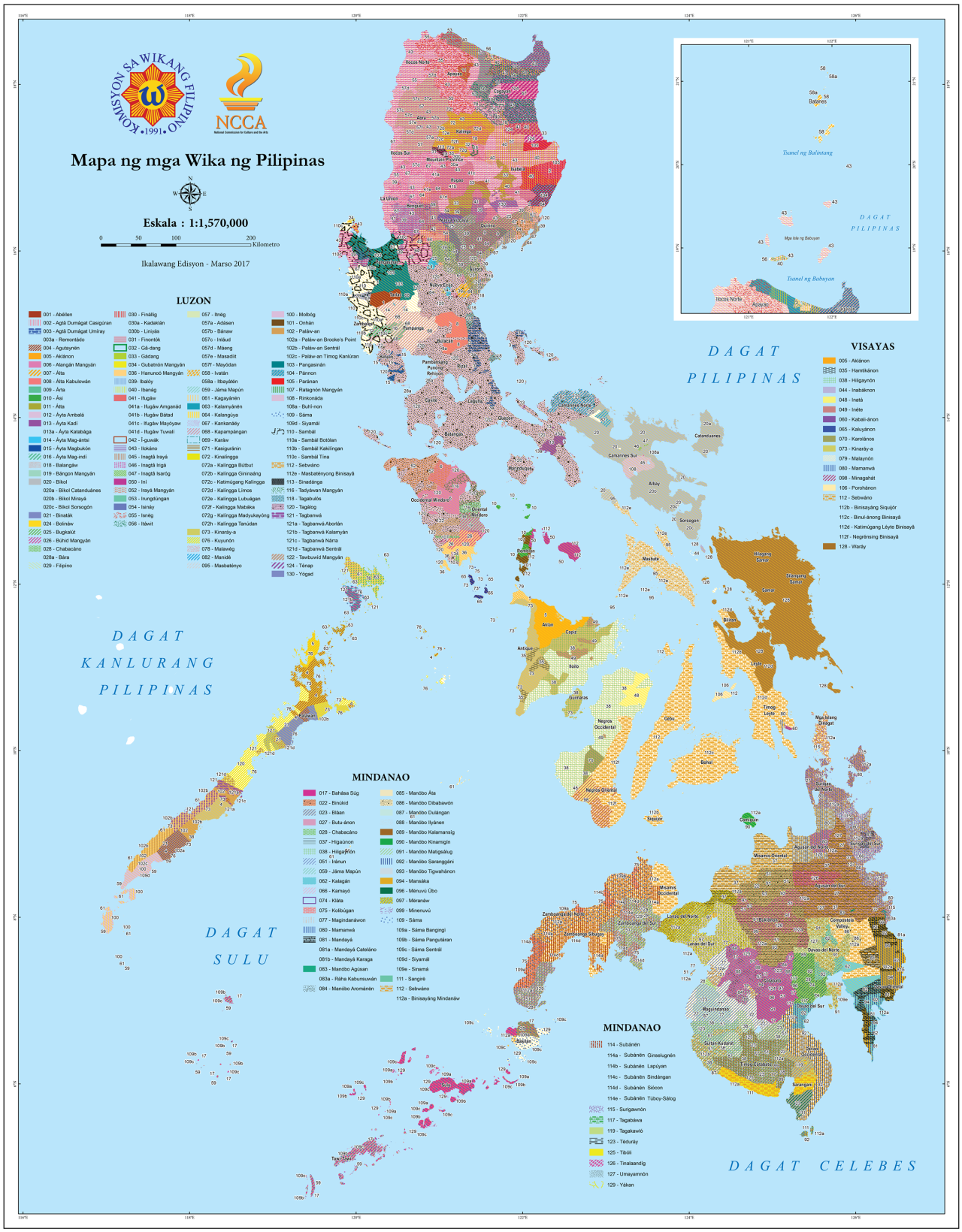
The Language of the Ilocanos in northern Luzon is called Iloco or Iloko. There are about 8.7 million native speakers and about 2 million people who speak it as their second language. Iloco is classified under its own branch within the Northern Philippine subgroup of the Austronesian language family. It is closely related to other Austronesian languages in Northern Luzon, and is slightly mutually intelligible with the Balangao language and the eastern dialects of the Bontoc language.
Most Ilocanos are trilingual. Their first language is Iloco, and they commonly speak Filipino (Tagalog) and English as second languages. Because of migration and close contact with other ethnolinguistic groups, many Ilocanos also speak additional regional languages. In the Cordillera Administrative Region, Iloco functions as a lingua franca among different Igorot groups. It is widely used as a second language there. These people make up the last majority of the two million people who speak Iloco as their second language.
Bisayan (Visayan) Languages are commonly referred to as Binisaya or Bisaya. The most widely used is Cebuano, followed by Hiligaynon (Ilonggo) and Waray-Waray. While these languages are classified as "Bisayan" by linguistic terminology, not all speakers identify as Visayan ethnically or culturally. The predominantly Muslim Tausug people, for example, prefer to identify as part of the Moro ethnic group. They use the term "Bisaya" to refer to the predominantly Christian lowland natives despite speaking the Bisayan Tausug language and being closely related to the Visayan Surigaonon and Butuanon peoples. Conversely, the natives of Capul in Northern Samar speak Abaknon, a Sama–Bajau language, yet they identify as culturally Visayan. The Ati people also distinguish themselves from other Negritos despite being native to the Visayan islands.
The Cebuano Language is the most widely spoken of the Visayan languages. Most Cebuano speakers are found in Cebu, Bohol, Siquijor, southeastern Masbate, Biliran, western and southern Leyte, and eastern Negros, as well as most of Mindanao, except the Bangsamoro Autonomous Region in Muslim Mindanao. As with other Filipino ethnic groups, Cebuanos also speak Tagalog (Filipino) and English as second languages. Despite being one of the largest ethnic groups, Cebuanos tend to fluently learn the native languages of the areas where they have settled, along with Cebuano.
Baybayin Language
Prior to the arrival of the Europeans, the inhabitants of the archipelago were literate and had their own system of writing that they used for communication. This writing system is often erroneously referred to as Alibata (the first three letters of the Maguindanao version of the Arabian alphabet: alif, ba, ta). It is more properly named Baybayin, which in Filipino means "to spell." [Source:Juanita Villena-Alvarez and Victoria Villena, World Education Encyclopedia, Gale Group Inc., 2001]
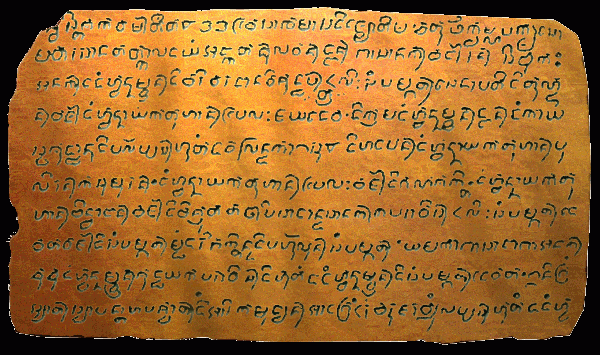
Baybayin has seventeen basic symbols, three of which are vowel sounds. This writing system was used extensively by the inhabitants of the islands, as witnessed by the Spanish upon their arrival. Father Pedro Chirino, a Jesuit chronicler and historian for Miguel de Legazpi (an explorer and the first royal governor of the islands), reports in Relaciones de las Islas Filipinas that when he arrived in the islands in 1565, all the islanders, both men and women, were reading and writing. Another witness and recorder of this fact was Antonio Morga, the Senior Judge Advocate of the High Court of Justice and Commander of the galleon warship San Diego. He noted in Sucesos de las Islas Filipinas that almost all the natives, men and women alike, wrote in the Baybayin language and that there were few who did not write it excellently or correctly.
See Separate Article: PHILIPPINES BEFORE THE ARRIVAL OF THE SPANISH factsanddetails.com
Interesting Tagalog Words and Terms
The expression "out in the boondocks" comes from the Philippines. "Bundok" is a Tagalog word meaning "mountain." People used to say the Kalingas tribes lived so deep in the North Luzon bundok the word "boondocks" has come to mean extremely remote. The word imeldific after Imelda Marcos was coined to mean excessively ostentatious or in bad taste. “Susmariosep” is Philippine expletive that is Filipino contraction for Jesus, Mary and Joseph. The Philippine phrase “magandang hinaharap” translates to “phwoar!” and is used as term to express admiration of a woman’s breasts.
“Mabuhay” is a Tagalog greeting. It means “long life” and literally is the imperative form of "live", from the root word buhay (life). Mabuhay Gardens was a San Francisco nightclub. Originally a Filipino restaurant and club owned by the late Ness Aquino, it featured many Filipino celebrities, including Amapola (aka Amapola Cabase). During the late 1970s, Bay Area punk and new wave bands performed there, and it was an important touring stop for bands from beyond the San Francisco Bay Area. Among the bands that performed there were the Dead Kennedys, Boys, Nico, Devo, and X. Comedians like Whoopi Goldberg also made early appearances at the venue. [Source: Wikipedia]
According to Time magazine: In 1996, President Clinton was in Manila for an Asia-Pacific Economic Cooperation summit, and had on his agenda a visit with a local official. He was running late, in a surly mood, and eager to get going. According to Gormley, just moments before the motorcade was about to move, agents using a special intelligence-gathering capacity—one that remains classified—picked up radio chatter mentioning the words wedding and bridge. Knowing well that wedding was often a code word for a terrorist hit, Merletti changed the route, which happened to include a bridge. Clinton was angry at the decision, which would cause further delay, but he did not override it. When agents arrived at the bridge, they indeed found explosives: had Clinton taken the prescribed route, he very likely would have been killed. [Source: “The Assassination Attempts Against George W. Bush and Bill Clinton, time.com, February 8, 2011]
Important Tagalog Phrases and Words
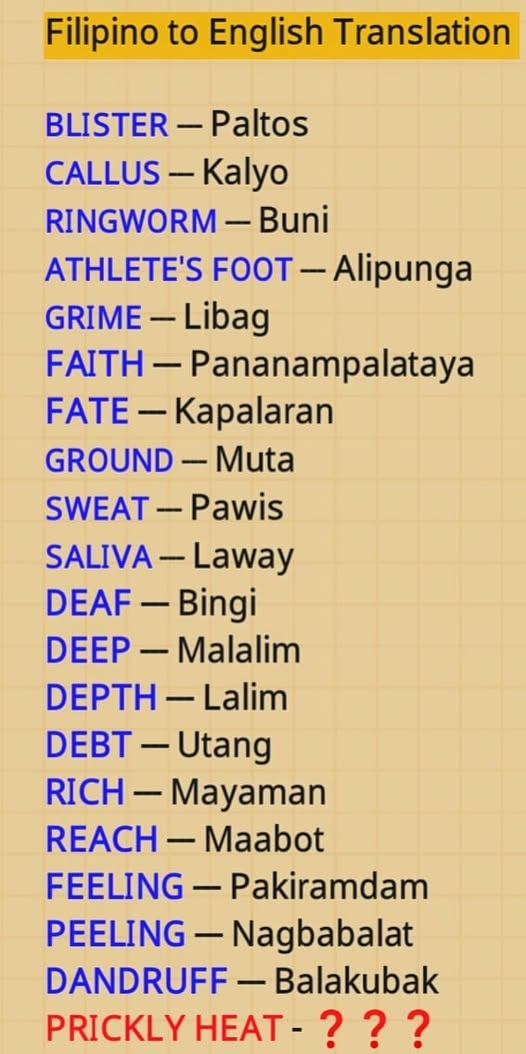
Question words; Ano? - What?; Alin? - Which?; Sino? - Who?; Saan? - Where?; Bakit? - Why?; Kailan? - When?; Paano?/Papaano? - How?; Magkano? - How much? (money); Nasaan? - Where? (to look for something/somebody);
Magandang umaga po. (formal/polite) — Good morning
Magandang umaga. (informal) — Good morning
Magandang tanghali po. (formal/polite) — Good noon
Magandang tanghali. (informal) — Good noon
Magandang hapon po. (formal/polite) — Good afternoon
Magandang hapon. (informal) — Good afternoon
Magandang gabi po. (formal/polite) — Good evening
Magandang gabi. (informal) — Good evening
Kumusta po kayo? (formal/polite) — How are you?
Kumusta ka? (informal) — How are you?
Mabuti po naman. (formal/polite) — I'm fine
Mabuti naman. (informal) — I'm fine
Tuloy po kayo. (formal/polite) — Please, come in
Tuloy. (informal) — Please, come in.
Salamat po (formal/polite) — Thank you
Salamat. (informal) — Thank you
Maraming salamat po. (formal/polite) — Thank you very much
Maraming salamat. (informal) — Thank you very much
Wala pong anuman. (formal/polite) — You are welcome
Walang anuman. (informal) — You are welcome
Opo/ oho. (formal/polite) — Yes
Oo (informal) — Yes
Hindi po/ho (formal/polite) — No
Hindi (informal) — No
Hindi ko po/ho alam. (formal/polite) — I don't know
Hindi ko alam. (informal) — I don't know.
Anong oras na po? (formal/polite). What time is it?
Anong oras na? (informal) — What time is it?
Saan po kayo papunta? (formal/polite) — Where are you going?
Saan ka papunta? (informal) — Where are you going?
Saan po kayo galing? (formal/polite) — Where did you come from?
Saan ka galing? (informal) — Where did you come from?
Ano po ang pangalan nila? (formal/polite) — What is your name?
Anong pangalan mo? (informal) — What is your name?
Ako po si ________ (formal/polite) — I am ______ (name).
Ako si _________ (informal) — I am ______ (name).
Ilang taon na po kayo? (formal/polite) — How old are you?
Ilang taon ka na? (informal) — How old are you?
Ako po ay _______ gulang na. (formal/polite) — I am _______ years old.
Ako ay _______ gulang na. (informal) — I am _______ years old.
Saan po kayo nakatira? (formal/polite) — Where do you live?
Saan ka nakatira? (informal) — Where do you live?
Taga saan po sila? (formal/polite) — Where are you from?
Taga saan ka? (informal) — Where are you from?
Kumain na po ba sila? (formal/polite) — Have you eaten yet?
Kumain ka na ba? (informal) — Have you eaten yet?
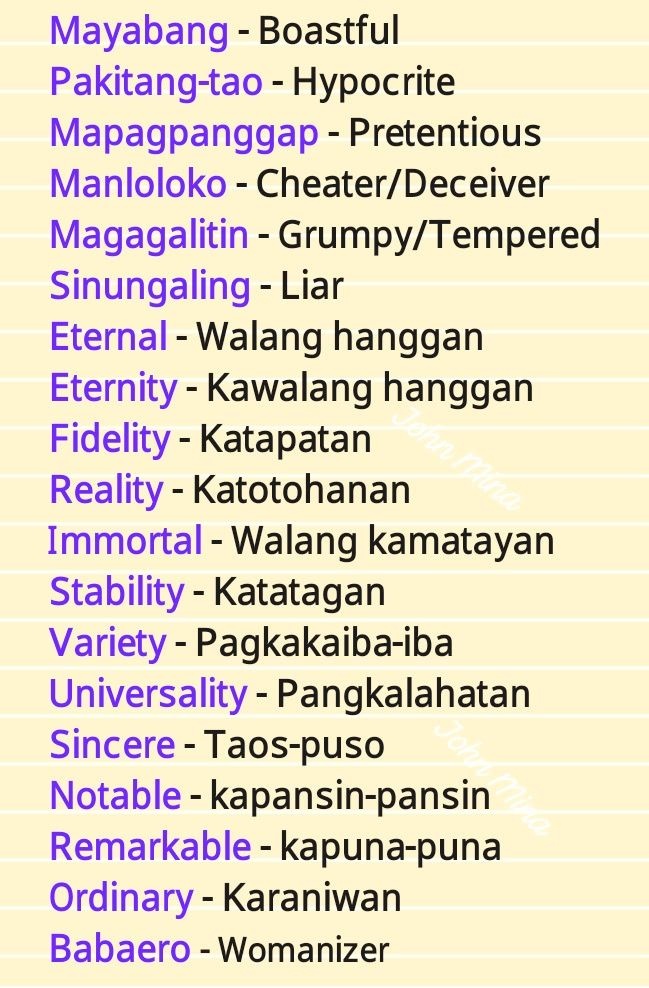
Directions words: deretso — straight ahead
(sa) kanan — on the right
(sa) kaliwa — on the left
umikot — turn around
(sa) harap — in front
(sa) likod/likuran — at the back/behind
hilaga — north
silangan — east
kanluran — west
timog — south
(sa) itaas — on top
(sa) ibaba — below/at the bottom
(sa) ilalim — at the bottom
(sa) loob — inside
(sa) labas — outside
There are a number of Tagalog words and phrases which are rather vague in terms of specific distance but signify "nearness" or "farness" of a particular object, thing, or place from the speaker. These are:
doon — yonder (over there)
diyan lang po sa tabi — there, on that side
sa banda po doon — over on that side.
Tagalog Swear Words and Expressions (with English Translations)
Tagalog (Pilipino) Swearing — English Translation; Tarantado Ka — You're stupid; Tsupain mo titi ko — Suck my dick; Sinabay mo kinantot ang nanay at tatay mo habang yung kapatid mo nanonood — You fuck your mom and your dad, while your siblings are watching!; Ang butas ng puwet mo ay malaki! — The hole in your ass is really big!; Karida puta — Stupid fucking whore; Pokpok — Whore; Puta — Bitch, whore; Kaskasin mo puke mo sa dingding — Scratch your pussy off the wall; Malaking tae sa mukha mo! — That shit on your face is big!; Ang okie mo amoy ng pussit! — Your pussy smells like squid!; Putit ang bulbul mo! — Your pubis are white!; Ang mama mo kalbo! — Your mom is bald!; Walang tungtung ng yung lolo mo! — Your grandpa has no dick!; Dinilaan mo ang pwet nang lola mo — You lick your grandmother's ass; Putang ina ang baho mo — Mother fucker, you stink; Puke mo mabaho — Your pussy stinks; Putragis na impyerno (Tagalog dialect) — Fucking hell. [Source: myinsults.com ***]
Isinusumpa kita — I curse you; Anak ka ng puta — You're a child of a whore; Puta — Whore, slut; Puta ka — You're a whore; Putang ina mo — Your mother is a whore; Bilat sini mo — You're a cunt; Kantutin mo ang nanay mo — Go fuck your mother; Buwa ka ng ina mo — You're the slime of your mother; Kiki mo — Your cunt; Titi mo — Your dick; Putanginamo — Fuck you; Maliit ang titi mo — You got a small dick; Magkantutan tayo — Let's fuck; Gusto kong kantutin tulad nito — I like to be fucked like that; Gusto kitang kantutin na parang hayop — I want to fuck you like an animal; Gusto kitang kantutin — I want to fuck you; Kantutin mo ko pag mali ako — Fuck me if I'm wrong; Naninigas ang titi ko — I got a hard on; Didilaan ko ang tinggil mo — I'll lick your clit; Sipsipin mo ang titi ko — Suck my dick; Lunukin mo ang tamod ko — Swallow my cum; Malaki ang suso mo — You got big tits; Anak ng puta mo — Son of a bitch; Puke ng ina mo — Your mom's pussy; Tukmol — Ugly; Putang Puta — Fucking whore; Ikaw, walang kang titi — You have no dick; Ikaw, wala kang puwet — You have no butt; Ang pangkit ng ina mo — Your mom is so ugly; Malaki ang tae mo — Your shit is big; Puputulin ko titi mo — I will slice your dick; Baho ng utot mo — Your fart stinks. ***
Pumunta ka sa impiyerno — Go to hell; Puro kagaguhan ka — You're full of shit; Sisipain ko puwet mo — I'll kick your ass; Laki ng tenga mo — You have big ears; Putang ina, ang pangit mo — Fucking hell! You're so ugly; Bakla — Faggot, gay; Mantsutsupa — Cocksucker; Jologs — Poor loser; Titi — Penis, dick, cock; Lola mong panot — Your grandmother is bald; Sipain ko lolo mo e — I'll kick your grandfather; Lola mong panot — Your grandmother is bald; Tatay mo kab skawt — Your dad's a little boy scout; Masyado maliit ang suso mo — Your breasts are way too small; Tae — Shit; Titi mo mabaho — Your cock is smelly; Putanginamo — Your mom is a slut; Gunggong — Moron; Tanga — Stupid; Abnoy — Abnormal, retarded; Pututuy — Tiny penis; Tababoy — Fat Pig; Tae — Shit; Ina — Mother; Taena — Shitty mother; Nak Ng Pu — Son of a whore; Unggok — Irritating bastard; Tiyo Paeng — An uncle who sexually molests relatives; Igad — Immature shit; Bernal — Shitty bulldog
Ukinnam — Your mother's cunt; Kainin mong tae mo — Go eat your shit; Mabuhok ang utong mo — You re nipples are hairy; Laplapin mo na lang lola mo — Go eat your grandma s cunt; Gusto kitang himasin — I wanna caress you; Ganito ka ba talaga kabaho? — Do you really stink this bad?; Magsubuan kayo ng tae — Go feed each other shit; Walang kuwentang kantutin ang joa mo — Your girlfriend isn't worth fucking; A ulol! — Go to hell!, Fuck you!; Magtsupaan kayo ni Hesus — Let you and Jesus blow each other; Magjakol ka na lang — Go fuck yourself; Magtikol ka na lang — Go fuck yourself; Sibakan tayo — Let s fuck; Umuwi ka na — Go home!, Go to hell!; Amoy pusod ka — You reek of belly buttons; Amoy Yuropeo ka — You smell like a European; Hanggang jakol ka lang naman e — That's all you can do; masturbate; Malibog ako — I'm horny; Malibog ako sa iyo — You make me horny; E tuyo naman yung puke mo e — At least I don t have a dry pussy; Tinitigasan ako sa iyo — You're giving me a hard on; Jakolin mo ako! — Jack my cock! ***
Masarap ka ba? — Do you taste good?; Putang inang trabaho ito — Fuck this Job; Putang inang lugar ito — Fuck this Place; Putang inang buhay ito — Fuck this life; Sino ang putang ina ito? — Who is this fucker?; Sino ang gagong ito? — Who is this idiot?; Bading — Faggot; Pokpok — Whore; Jakolero — Someone who masturbates a lot; Punitin mo ako — Tear me apart; Sibakin mo ang joga ko — Fuck my tits; Tsupaero — Cocksucker; Gabakoy ka permi? — Do you masturbate often?; Walang hiya ka/ Lang hiya ka — You're shameless; Gago — Crazy; Pusang gala — Runaway pussy; Pucha (Also Putsa) — Whore; E kung sipain kita diyan — What would you say if I kick you right now?; Manahimik ka na nga lang — Why don't you just shut up?; Hesus — Jesus; Susmariosep — Jesus Mary and Joseph!; Diyos ko po — My god!; Tanginang kano 'to — This American son of a whore; Tanginang intsik 'to — This Chinese son of a whore; Tadyakan kita diyan sa ngalangala e — Wait until I kick you in the chin; Hanggang tae ka na lang — All you'll ever be is shit; Tae ka — You're shit; Tae mo — Your shit; Tae mo amoy tae — Your shit smells like shit; Ttumae ka nga — Go shit; Matae ka sana sa pantalon mo — I hope you shit your pants; Amoy tae ka — You smell like shit; Hindi na utot yan a — That's not flatulence anymore; Saksak mo sa baga mo — Stick this in your lung; Maihi ka sana sa kama — I hope you wet your bed; May laman ba yang kokote mo — You got anything in that head of yours; Kulang sa turnilyo — Stupid, crazy (lit. lacks screws in the head); Mangulangot ka na lang kaya — Why don't you just pick your nose; Laway mo tumatalsik — Your mouth is a shower of saliva; Sumibak ka na lang ng kalabasa! — Go fuck a pumpkin!; Punyeta — Shit; Baliw — Mentally retarded; Sira ulo (or ulol) — Nuts, crazy; Bayag — Testicle; Puki (or puke) — Pussy; Dyoga (or joga) — Boobs; Tumbong — Ass; Pwet (or puwet) — Butt; Burat — Head of dick; Unggoy — Monkey; Tanga — Stupid; Bugok — Slow learner; Bobo — Slow learner; Tikol — Masturbate; Sinto sinto — Retarded; Hayop — Animal; Malintong — Slutty; Prosti — Prostitute; Hayup ka! — You animal!; Ay puta! — Oh, shit!; Pangit! Putang ina mo! — You ugly son of a bitch.; Pangit — Nasty; Halika, putang ina mo. — Come here, you son of a bitch.; Layas, putang ina ka! — Get out, you mother fucker!; Ulol — Crazy. ***
Gago — Asshole; Ebak — Shit; Takim — Shit; Tarantado ka — You Bastard; Putik ka — Slang of 'putang inamo'; Gagi — Slang of 'gago'; Ang uten mo ay kasing liit ng buteke — Your cock is little like a lizard; Mang-aagaw ng lakas — Homosexual (lit. strength drainer); Amoy tamod ang bunganga mo, bakla! — Hey fag, your mouth smells like cum; Gusto kong dilaan ang tinggil mo — I want to lick your clit; Hunsvotti — A horse's ass (lit. "dog's cunt"); Masarap ang puke mo! — Your pussy is delicious!; Tarakun — Stupid; Gusto kong dilaan ang kiki mong basa! — I want to lick your wet pussy!; Puke mo, malaki! — You have a big pussy; Broha (Slang) — Bitch; Laplapin mo pekpek ng nanay mo! — Lick your mom's pussy; Basa ang utot mo — Your fart is wet;
Umutot ka kaya sa ilong mo — Why don't you fart thru your nose; Sipsipin mo ang utot ko — Suck my fart; Tatlo ba ang betlog mo? — Do you have three balls?; Wala kang silbi sa mundo pakamatay ka na lang — You're worthless in this world, better kill yourself; Sa lagay na yan e di ka pa tinutubuan ng sungay? — You haven't grown horns after what you've done?; Bukas tatakpan ka na ng diyaryo — Tomorrow newspapers will cover your dead corpse; Mas ma sarap ang tae ng aso sa pagkain mo — This dog's shit tastes better than your food; Ang bait mo, sana kunin ka ni Diyos — You're too good, I hope the lord takes you now; Kausapin mo ang tinga ko — Talk to the pieces of food in between my teeth; Saksak ko tong bote ng grande sa wetpacks mo e — Wait until I stick this (huge) bottle of beer into your ass; Langhiya ka — Shameless (lit. no sensibilities for embarrassment) [Contraction of "walang hiya ka"]; Manahimik ka kung wala kang magawa sa buhay mo — Shut your mouth if you cant do anything with your life; Hindi maliit ang titi ko - maluwag ang puke mo! — It's not my dick that's small - it's your pussy which is loose! ***
Nagbabra ka pa e wala ka namang joga — Why wear a bra when you don't even have tits?; Masarap kaya ang kesong gawa sa gatas mo? — I wonder if cheese made from your milk will taste good; Mas gugustuhin ko pang singhutin ang utot ko kaysa mapatabi sa'yo — I'd rather sniff my fart rather than sit beside you; Makitalo ka lang sa sibakan ng lolo at lola mo — Go join your grandparents fucking; Baka gusto mong hilahin ko yung titi mo tapos isuksok ko dyan sa pwet mo? — How would you like it if I take your dick and stick it deep up your ass?; Kung ayaw mong oras mo, kauusapin mo, putang ina___________! — If you don't like your work schedule, talk to that fucking ________! (Put a name in the blank.); Masmalaki pa yata ang ugat ng titi ko kaysa sa titi mo — My dicks veins are bigger than your dick; Nag-brip ka pa, wala ka namang bayag!? — Why wear underwear when you don't have any balls!?; Ikao Tarantado A Mabaho — You're a bastard and you stink!; Malandi ka — You're a slut; Tamaan ka sana ng kidlat — May lightning strike you; Lintek ka — Asshole!; Marame bule bule sa pek pek. — Hairy cunt; Kantot sa pwet — Fuck your ass; Malibo — Horny; Pare dilaan mo puwet ko — Lick my ass, dude; Kiri ka — You're a bitch; Putang ina mo puta ka — Your mother is a whore, bitch; Dyug-dyug — Fuck; Malibog ka — Lustful; Hindot — Fuck; Salsalin mo — Masturbate it; Tamud — Semen; Puki mo — Your vagina; Titi mo — Your penis; Lunukin mo tamod ko — Eat my cum; Matamis ang tamod ko — My cum taste sweet; Pare dilaan mo bayag ko — Lick my balls, dude. ***
Bisaya and Cebuano Swear Words and Expressions
Bisaya Swearing — English Translation:Hiwi — Pervert; Baboy — Pig; Pugaw — Pimp; Istambayan — Doss house; Sekso — Sex; Kinatawo — Sex; Satanas — Satan; Anak sa gawas — Bastard (lit. "son/daughter from outside"); Bastardo — Bastard; Babayeng ulagan — Bitch; Irong baye — Bitch; Puta — Bitch; Yawa — Devil; Piste ka — Damn you; Atay — Crap!, Damn it!; Iyot — Fuck. [Source: myinsults.com]
Lôlô — Masturbate; Buli han iya iroy — You mother's vagina; Oten — Penis; De puga! — It flew!; Boysette ka — You're a damn waste!; Gago ka — You're an empty headed fool!; Yawardz — Devil (A slang form from the original "yawa"); Putang ina mo — Fuck you / son of a bitch; Bigaon — Bitch (really vulgar); Bilat — Vagina; Boang ka — You are crazy; Bilat sa imong ina — Your mom's pussy; Baho kag bilat — Your pussy stinks; Bisong — Pussy
Colorful Cebuan Swear expressions
Pahawa tambok baho bilat sa baka — Fuckoff fat stinking cow-cunt
Imong pangit nga daguay murag gitarikean nga sampot sa masakiton nga bayot — Your ugly face looks like the fucked ass of an infected faggot
Kaona akong baho nga tae nahulog sa impyerno nga pa la iyot sa mga bata — Eat my stinking shit, you fallen from hell child-fucker
Spanish Language in the Philippines
It is no surprise that over this long period of time, the Spanish language made its way into the Filipino dialects. Today it is estimated that about 20 percent of Tagalog words are Spanish. In fact, the common Tagalog greeting “Kumusta” was derived from the Spanish “Como esta” (How are you). Here are a few very common words that came from Spanish (the spellings have been Filipino-ized): Diyos (god), eskwela (school), gwapo (handsome), kalye (street), kabayo (horse), kwento (story), karne (meat), pamilya (family), sapatos (shoes), bintana (window), and many, many more. [Source: by Rebecca, Philippines Baguio Mission, 2009-2011, the missionary website, preparetoserve.com \=/]
Tagala - the Philippines first Filipino-Spanish dictionary which was printed in 1613. It is 25 years older than the first book printed in the United States. Spanish has also influenced Philippines numbers, name and money. The Spanish money system (based on pesos) was adopted into the Filipino lifestyle as well as the use of Spanish numbers in business and money transactions. Today, using Spanish numerals is the marketplace norm. It is also interesting to note that the Spanish were the ones who appointed Manila as the capital city of the Philippines. They also named the islands “Filipinas” after Prince Philip os Asturias, who later became the King of Spain. [Source: by Rebecca, Philippines Baguio Mission, 2009-2011, the missionary website, preparetoserve.com \=/]
Spanish was taught as a compulsory language until 1968 but is seldom used today. AFP reported: “What surprises Spaniards who come to the Philippines is the fact that their language has virtually disappeared. The archipelago was first colonized by the Spanish in the early 16th century shortly after Ferdinand Magellan arrived in the islands and later died here in 1521. Spanish culture permeates the country where 80 percent of the population are followers of a Spanish-styled Roman Catholicism and where 20,000 Spanish words have been absorbed into most of the local dialects. Even today, Filipinos eat paella, menudo and chorizo, have brazo de Mercedes and turrones for dessert and drink Fundador Brandy. [Source: AFP, September 12, 2007 ==]
“But when the Philippines passed from Spanish to American control after the Spanish-American war of 1898, English completely supplanted Spanish. Today, most Filipinos speak and read English. The most serious blow came in 1987 when the government removed Spanish as one of the official national languages of the country and did away with a requirement that college students take courses in Spanish. Jose Rodriguez, local director of Instituto Cervantes, the Spanish cultural center, notes that ironically, only one Philippine university now offers a doctoral course in Spanish compared to 12 universities in South Korea and 10 in Japan. ==
“Rodriguez says there is no updated figure on how many Filipinos can actually speak Spanish although Molina says a study in the 1990s found one out of eight Filipinos could understand some Spanish. Spanish radio producer Chaco Molina says the Spanish language was never as widespread in the Philippines as in Latin America. Christian missionaries who came to the Philippines found it easier to learn the local dialects to preach to the natives rather than teaching them Spanish.” ==
Radio Station Keeps Spanish Language Alive
In 2007, AFP reported: “Despite 400 years as a colony of Spain, the Philippines has retained little trace of the language but producers of the country’s only Spanish-language radio program say that’s about to change. “Filipinas Ahora Mismo” – which loosely translated means “Philippines Right Now” – features book and movie reviews, information on the Spanish influence in different parts of the country and music by modern stars such as Enrique Iglesias and Ricky Martin, all in Spanish. It is just a small step but its producers hope the show can help lead a revival in a language that has withered away in most of the Southeast Asian archipelago nation. [Source: AFP, September 12, 2007 ==]
“It is not a question of making Filipinos speak Spanish again,” says Spanish Ambassador Luis Arias Romero. “It is a question of making Filipinos aware of the importance of Spanish in culture and world affairs.” The radio show, sponsored by the Cadiz Press Association, is part of this effort although the project’s manager Chaco Molina concedes they still have a long way to go. Molina said when the Cadiz association first proposed the plan, they suggested an eight-hour radio show. “I told them that was too ambitious. This isn’t Guatemala where everyone speaks Spanish,” he said. ==
“The show, hosted by veteran Filipino broadcaster Bon Vivar, airs from 7-8 p.m. Monday to Friday on government-owned dzRM radio at 1278 kHz in Manila, and in simulcast to several major cities. “I see a renaissance of the Spanish language in the Philippines,” says Molina, adding the show is aiming at a young audience who will be more receptive to the language. ==
Image Sources: Wikimedia Commons
Text Sources: “Encyclopedia of World Cultures Volume 5: East/Southeast Asia:” edited by Paul Hockings, 1993; “Culture Shock!: Philippines” by Alfredo Roces and Grace Roces, Marshall Cavendish International, 2010; National Geographic, Live Science, Philippines Department of Tourism, New York Times, Washington Post, Los Angeles Times, Smithsonian magazine, Encyclopedia.com, Library of Congress, The Conversation, The New Yorker, Time, BBC, CNN, Reuters, Associated Press, AFP, Lonely Planet Guides, Google AI, Wikipedia, The Guardian and various websites, books and other publications.
Last updated March 2026