
POLITICS IN THE PHILIPPINES

Politics in the Philippines has traditionally been dominated by clans and political bosses and patronage and is characterized by law makers that make decisions based on fiscal incentives rather that beliefs and voters that make choices based on personality rather than reasoned policies. Politics in the Philippines is less about policy, more about personalities and compelling backstories. It's also about life imitating art, or rather, the movies.
On the Philippines politics, David Byrne, the Talking Heads frontman and composer of a disco musical about Imelda Marcos, said: “Things here are not as simple as they were in my preconceived picture.” Personalities are more important than parties in Philippine politics. Movie stars and other celebrities have enjoyed considerable success. In addition, several prominent families play a disproportionate role in politics. The support of the military and the Catholic church are key to political survival and success in the Philippines. Promises are generally not kept. Arroyo, for example, pledged to bring cheap power to the poor as a campaign pledge and then doubled power rates after she was elected. She also promised not to run for a second time but changed her mind because she said God made her decide to run.
The Philippines is known for its rough-and-tumble political scene. Politicians are rountinely killed and sometimes they even do the do the killing themselves. Every now and then it seems the entire country is on the verge of collapse because of a coup attempt, People Power protest or impeachment effort. On the day-to-day level, politicians are unable to achieve many of their goals and carry out programs they proposed due to political opposition, mainly from the ruling elite. Arroyo and her cabinet said that political fighting and sniping exhausted and frustrated them deeply.
Carlos H. Conde wrote in the New York Times, “In the Philippines, politics is a blood sport. Here, politicians often behave like gladiators: To survive they have to entertain the spectators. The turmoil from the [Arroyo] scandal has once again brought Filipinos and their unique brand of rambunctious democracy to international attention, providing a sideshow to the more pressing problems. Filipinos are no longer surprised by election fraud. Thanks to the damage Ferdinand Marcos, the dictator, did to the democratic institutions that American-style democracy helped establish after World War II, and the prevalence of an almost feudal political structure, particularly in the provinces, Filipinos have come to accept election cheating as normal. [Source: Carlos H. Conde, New York Times, July 2, 2005]
Pollster Social Weather Station and Pulse Asia.
RELATED ARTICLES:
POLITICAL PARTIES IN THE PHILIPPINES factsanddetails.com
POLITICIANS, THE CATHOLIC CHURCH AND PROTESTS IN THE PHILIPPINES factsanddetails.com
ELECTION AND POLITICAL VIOLENCE IN THE PHILIPPINES factsanddetails.com
MAGUINDANAO MASSACRE: EVENTS, KILLERS, POLITICS, TRIAL factsanddetails.com
ELECTIONS IN THE PHILIPPINES: ELECTORAL SYSTEM, IRREGULARITIES, CAMPAIGNS factsanddetails.com
2022 PHILIPPINE ELECTIONS factsanddetails.com
GOVERNMENT OF THE PHILIPPINES: HISTORY, SYMBOLS, CONSTITUTION factsanddetails.com
BRANCHES OF THE PHILIPPINES GOVERNMENT: EXECUTIVE (PRESIDENT), LEGLISLATURE, JUDICIARY factsanddetails.com
PEOPLE POWER AND THE FALL OF MARCOS factsanddetails.com
FERDINAND MARCOS: HIS LIFE, LIES, EDUCATION, WAR RECORD, POLITICAL RISE factsanddetails.com
FERDINAND MARCOS AS PRESIDENT: EARLY PROMISE, RESISTANCE, WASTE factsanddetails.com
MARTIAL LAW YEARS UNDER FERDINAND MARCOS factsanddetails.com
INDEPENDENCE FOR THE PHILIPPINES AFTER WORLD WAR II factsanddetails.com
PHILIPPINES IN THE 1950s AND 60s: HUK REBELLION, MAGSAYSAY, GARCIA AND MACAPAGAL factsanddetails.com
MARCOS’S PLUNDER AND WEALTH factsanddetails.com
Patronage, Utang Na Loob and Politics in the Philippines
Under the traditional “Utang na loob” system of patronage, or obligation earned through favors, voters expect money or jobs in return for their political support. In many cases politician’s performance was based on dole-outs not on programs or policies. Philippine concepts about debt repayment and kinship responsibilities plays a major role in how political networks are set up and run.
Obligation and responsibility in the Philippines are often viewed in terms of utang na loob (reciprocity) which consists of debts ("utang") and free will of the inner self ("na loob"). The essence of utang na loob is the obligation to repay someone who has done you a favor appropriately. The favors that evoke the Filipino sense of utang na loob are usually those whose value is impossible to quantify or involve a deeply personal internal dimension, even if there is a quantifiable value. This internal dimension, loob, differentiates utang na loob from an ordinary debt ("utang"). [Source: Wikipedia]
Alfredo Roces and Grace Roces wrote: Filipino politicians utilise political patronage in exchange for votes at election time, thus introducing the Filipino utang na loob element into a Western political system put into operation in the Philippines by the Americans. The political system, from barrio level to national machinery, functions largely on utang na loob, despite impinging contradictions from theoretical principles and tenets of the Western political model established in the Philippines. [Source: “Culture Shock!: Philippines” by Alfredo Roces and Grace Roces, Marshall Cavendish International, 2010]
See Separate Article: SOCIAL RELATIONS IN THE PHILIPPINES: UTANG NA LOOB, BAYANIHAN AND PAKIKISAMA factsanddetails.com
Development of Philippines Politics After the Marcos
In 1991 Philippine politics resembled nothing so much as the "good old days" of the pre-martial law period — wide-open, sometimes irresponsible, but undeniably free. Pre-martial law politics, however, essentially were a distraction from the nation's serious problems. The parties were completely nonideological. Therefore, politicians and office-holders switched parties whenever it seemed advantageous to do so. Almost all politicians were wealthy, and many were landlords with large holdings. They blocked moves for social reform; indeed, they seemed not to have even imagined that society required serious reform. Congress acquired a reputation for corruption that made the few honest members stand out. When Marcos closed down Congress in 1972, hardly anyone was disappointed except the members themselves. [Source: Library of Congress]
The February 1986 People's Power Revolution, also called the EDSA Revolution had restored all the prerequisites of democratic politics: freedom of speech and press, civil liberties, regularly scheduled elections for genuine legislatures, plebiscites, and ways to ensure honest ballot counting. But by 1991 the return to irrelevant politics had caused a sense of hopelessness to creep back into the nation that five years before had been riding the euphoric crest of a nonviolent democratic revolution. In 1986 it seemed that democracy would have one last chance to solve the Philippines' deep-rooted social and economic problems. Within five years, it began to seem to many observers that the net result of democracy was to put the country back where it had been before Marcos: a democratic political system disguising an oligarchic society. *
In 1986, the world watched as millions of Filipinos peacefully confronted troops and tanks to oust dictator Ferdinand Marcos in what became known as the “people power” revolution. The movement, marked by images of civilians praying in front of armored vehicles, inspired similar uprisings elsewhere. Fifteen years later, mass protests again forced a president—Joseph Estrada—from office over corruption allegations. Yet despite these dramatic displays of civic action, the country’s democracy has remained fragile. [Source: Jim Gomez and Oliver Teves Associated Press, February 25, 2006 +^+]

In the late 2000s, President Gloria Macapagal Arroyo faced impeachment complaints tied to vote-rigging and corruption accusations and declared a state of emergency to thwart an alleged coup attempt. She claimed that political opponents and extremist groups were intent on destabilizing her administration. Even Corazon Aquino, the icon of the 1986 uprising, later expressed reservations about repeated street revolts, saying she preferred constitutional solutions over extra-legal mass actions.
Despite the restoration of democratic institutions, many structural problems persisted. The Philippines continued to struggle with widespread poverty, inequality, rural underdevelopment, and long-running communist and Muslim insurgencies. Political controversies endured, and figures such as Imelda Marcos retained influence decades after the dictatorship. Historians noted that successive administrations, including those of Aquino and Arroyo, faced familiar accusations of corruption, human rights abuses, and failure to deliver meaningful land reform.
Analysts argue that the deeper issue lies in a political system dominated by entrenched families and patronage networks. According to commentators such as Manuel Quezon III, while many Filipinos agree that systemic change is necessary, there is little consensus on what should replace it. Dynastic control, weak electoral institutions, limited political awareness, and persistent corruption have created a cycle of dysfunction, undermining governance and economic development and threatening what was once seen as one of Southeast Asia’s most promising democracies.
Powerful Family Politics in the Philippines
Elections in the Philippines are typically battles between powerful political families and Philippine politics have long been dominated by politicians belonging to the same bloodlines. At least 250 political families have dominated power nationwide, despite a prohibition against dynasties in the 1987 Constitution. Congress—long controlled by members of influential clans covered by the ban—has never passed the enabling law required to define and enforce the provision. [Source: Hrvoje Hranjski, Associated Press, May 13, 2013]
The same old faces, the same old families and the same old interests continue to dominate political life in the Philippines. “Wherever you go, you still see the same names we’ve known since childhood,” businessman Martin Tunac told Associated Press, after casting his vote in Manila. “One of the problems with political dynasties is that they control everything, including business.” School counselor Evelyn Dioquino described the spread of dynasties as a cultural issue, noting that candidates outside established clans face steep odds. Political families, she said, “have money, so they are the only ones who can afford to run. Of course, if you don’t have the logistics, you can’t seek office.”
Critics warn that when one family dominates multiple levels of government, it can weaken safeguards against corruption and abuse. A stark example often cited is the 2009 massacre in Maguindanao province, where 58 people—including 32 journalists—were killed in an ambush linked to a feud between rival clans. Ana Maria Tabunda of the independent polling firm Pulse Asia said that while dynasties limit democratic competition, surveys show many Filipinos are more concerned with the benefits and patronage they may receive from candidates than with dismantling entrenched family rule. Voters, she added, often choose familiar surnames over those with stronger track records. “It’s name recall, like a brand. They go by that,” she explained.
In the 1990s book An Anarchy of Families, American anthropologist Brian Fegan observed that the Filipino family is the country’s most enduring political institution. Writing in The New York Times, he argued that, absent broader organizing principles, political life tends to revolve around family ties. For many Filipinos, political continuity simply means the transfer of authority from one relative to another, while competition is viewed as rivalry between clans. “A family that has once contested an office, particularly if it has once won it, sets its eye on that office as its permanent right,” Fegan said.
A 2012 study published in the Philippine Political Science Journal found that nearly 40 percent of Philippine lawmakers had ties to politically connected families—far higher than the roughly 6 percent in the United States and 10 percent in Argentina—highlighting the entrenched role of dynasties in the country’s legislature.[Source: Clarissa Batino,, Norman P Aquino, Bloomberg, June 15, 2016]
According to the BBC, however, political dynasties have increasingly become a liability. Critics argue that much of the Philippines’ recent economic growth has benefited oligarchs, fueling public frustration and prompting some voters to seek leaders outside the traditional elite families. [Source: Jonathan Head, BBC, May 8, 2016]
Powerful Political Families in the Philippines

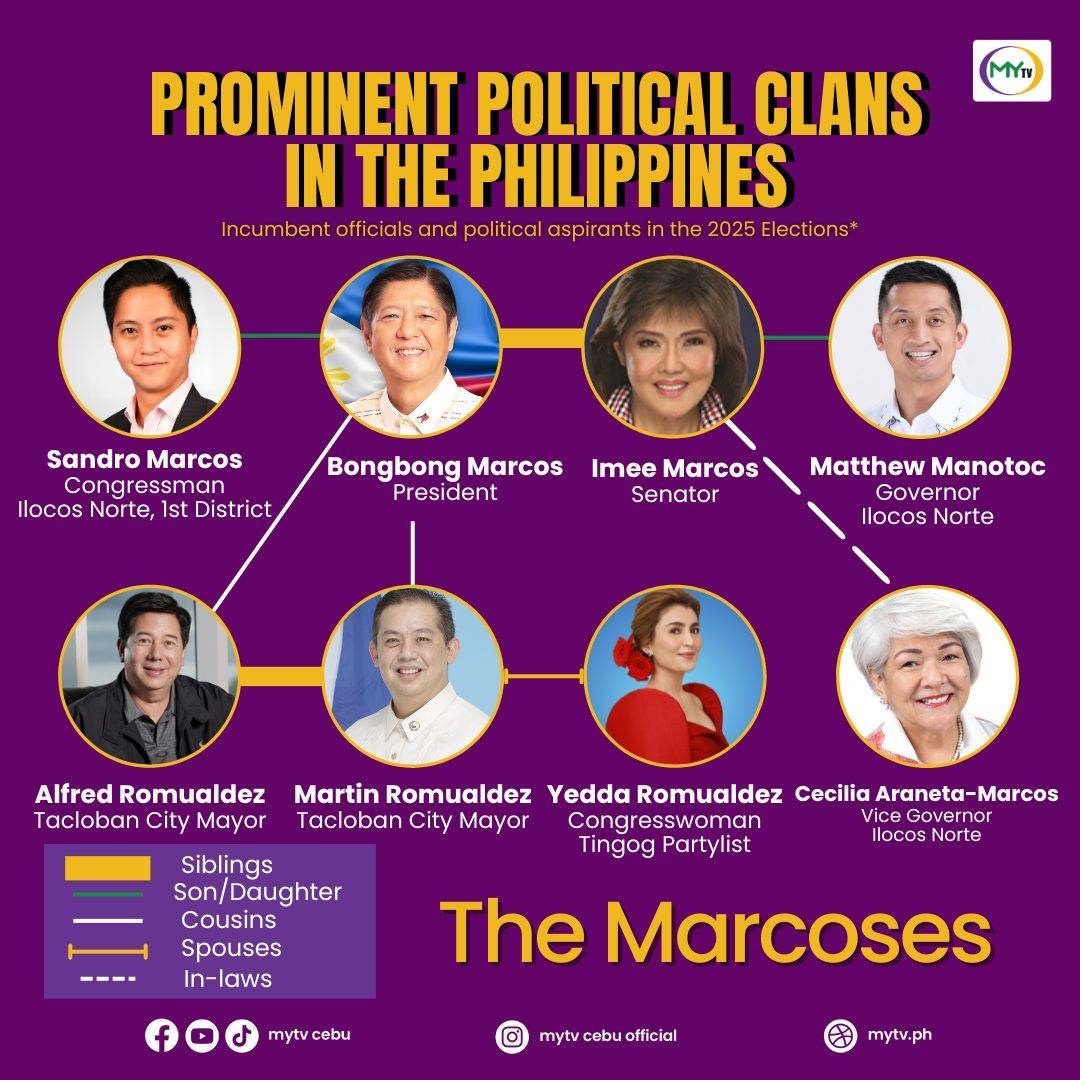
Among the most prominent political families in the Philippines are the Marcos family of Ilocos Norte, led by President Bongbong Marcos; the Duterte family of Davao, headed by Vice President Sara Duterte and former president Rodrigo Duterte; and the Villar family of Las Piñas, led by business magnate and former Senate President Manuel Villar. The Romualdez clan of Leyte, closely allied with the Marcos family and represented nationally by House Speaker Martin Romualdez, also wields significant power. The Estrada/Ejercito family, founded by former president Joseph Estrada, remains influential in San Juan and Laguna.
Other major political clans include the Binay family, long dominant in Makati; the Singsons of Ilocos Sur; the Revillas of Cavite; and the Ampatuans of Maguindanao, a province long associated with clan-based power struggles. These families have maintained their positions through successive elections, often rotating offices among relatives or simultaneously holding multiple posts.
At the regional and local levels, additional dynasties exert strong influence. The Ynares family has ruled Rizal province for decades, while the Pinedas are influential in Pampanga. The Dy clan holds sway in Isabela, the Suarez family maintains a significant presence in Quezon, and the Pacquiao family has built political strength in Sarangani and South Cotabato.
These families often consolidate authority by combining local strongholds with national positions, reinforcing their control across different layers of government. As of 2024, nearly 80 percent of Philippine lawmakers reportedly come from political dynasties, underscoring the deep entrenchment of family-based power in the country’s democratic system.
Political Family Dynasties in the Philippines
Politics in the Philippines has been dominated by powerful families for as long as anyone can remember. Aquino was the wife of a opposition leader. Arroyo was the daughter of a president. In 2004, Arroyo’s son and brother-in-law held Congressional seats and five relatives of Aquino were in Congress and one was a Senator. Even the Marcos family remains powerful and influential in Philippines politics, especially in northen Luzon. Many local positions and governments are dominated by clans and powerful and wealthy families.
One Philippine political analyst told the Washington Post, “Some dynasties have made positive contributions, but by and large the dynastic system in the Philippines has stunted the growth of real democracy. It is not representative of the broad majority in any place.” Efforts to reduce the hold on power of local families by establishing term limits has meant that families hand over power from one family member to another.
The Although the Constitution prohibits family dynasties, Congress — often controlled by members of influential political families — has not enacted a law clearly defining or enforcing the ban. Following the street protests that ousted Marcos Sr. in 1986, the Philippines introduced congressional term limits and a constitutional provision banning political dynasties from government. However, clans have become even more entrenched since then. A 2019 study found that, after the midterm elections that year, dynasties held four in five governor posts, compared with 57 percent in 2004. These families also controlled two-thirds of the congressional seats, up from just under half during the same period. Scholars blame this phenomenon for contributing to one of Asia’s highest income inequality rates. [Source: Philip Heijmans, Bloomberg, May 11, 2022]
This trend is beginning to change in some places. Grace Padaca, a former radio commentator, was elected governor of Isabela Province in 2004. She moved into the mansion of the former governor, from the powerful Dy family, thought he had built for himself. Padaca won by nonstop campaigning and dedicated grassroots volunteer movement.
Backers of Powerful Political Families in the Philippines
One element of the Philippines’s campaign finance system is that politicians often become indebted to wealthy, and sometimes undisclosed, benefactors. Under Philippine law, there are no caps on how much individuals or corporations may donate to candidates, and contributors do not have to be publicly identified until a month after election day. Longtime backers of dynastic politicians include business magnates Eduardo Cojuangco Jr. and Manuel Villar, both of whom support Rodrigo Duterte’s presidential bid. Cojuangco, chairman of San Miguel Corporation, the country’s largest corporation, ran for president in 1992 but lost to Fidel Ramos, who was supported by Corazon Aquino. A former associate of Ferdinand Marcos and the uncle of then-outgoing president Benigno Aquino III, Cojuangco founded the Nationalist People’s Coalition. [Source: Clarissa Batino,, Norman P Aquino, Bloomberg, June 15, 2016; Cecil Morella, AFP, May 8, 2016]
Villar, meanwhile, heads the Nacionalista Party, which allied with Bongbong Marcos’s political camp in 2009. Marcos endorsed Villar’s unsuccessful presidential bid in 2010 against Aquino. Beyond politics, Villar built a vast business empire as owner of Vista Land & Lifescapes. The day Villar formalized his support for Duterte, his son Mark Villar agreed to serve as secretary of the Department of Public Works and Highways in the incoming administration. Political analyst Richard Javad Heydarian, an assistant professor at De La Salle University, described Villar as an “extremely Machiavellian” choice, noting that Duterte might require strong congressional backing should he ever face impeachment. At least seven Philippine presidents, including the last three before Duterte, have confronted impeachment attempts.
Duterte said he selected Mark Villar for his managerial and organizational abilities. Villar, speaking to Bloomberg TV Philippines insisted that his family’s business interests would not benefit from his Cabinet appointment. Duterte also pledged that his administration would not be swayed by powerful corporate interests. Outgoing lawmaker Neri Colmenares said Duterte’s rise was fueled by public frustration with the previous administration and widespread hope for meaningful change. “We hope that he will be independent and work for the people,” Colmenares said. “Otherwise, we have a big problem.”
During his 2016 presidential campaign, Rodrigo Duterte cast himself as a frugal, anti-establishment figure willing to confront entrenched elites. “When I become president, by the grace of God, I serve the people, not you,” he told reporters, addressing the country’s powerful families. Yet in the final stretch of the campaign, Duterte—who as mayor of Davao was officially earning less than $2,000 a month—faced allegations that millions of dollars had flowed into previously undisclosed bank accounts. After initially denying their existence, he later acknowledged that the accounts were real and that 193.7 million pesos (about $4.2 million) had been deposited into them on his birthday two years earlier, a sum far exceeding his declared assets.
Another presidential contender, Grace Poe, who promoted herself as a reformist newcomer, was widely rumored to have received backing from business tycoons Eduardo Cojuangco Jr. and Ramon Ang, executives of San Miguel Corporation. Cojuangco had once been an ally of dictator Ferdinand Marcos, fleeing into exile after the 1986 People Power uprising before returning to rebuild his business empire and political influence. When asked about the alleged support, Poe responded generally that there was nothing improper about accepting contributions from individuals linked to the Marcos era.
Although campaign spending is formally capped at 10 pesos per voter—amounting to roughly $11 million for each presidential candidate—unlimited private donations allow wealthy benefactors to wield disproportionate influence. Ronald Mendoza, dean of the Ateneo School of Government, has warned that weak safeguards make elected officials more accountable to financiers than to voters. Historically, he said, this dynamic has fostered monopolies and slowed economic reform, as leaders prioritize the interests of campaign backers seeking returns on their investment. A study by the Philippine Center for Investigative Journalism found that just 308 Filipinos financed the 2010 presidential race, effectively acting as venture capitalists in a high-stakes political marketplace.
Celebrity and Entertainment in Philippines Politics
Chad de Guzman wrote in Time: Recent history shows a strong link between celebrity status and election victory: five sitting senators (out of 24) enjoy some sort of fame outside of politics, including world boxing champion Manny Pacquiao, who is also running for president. “The sheer number of people doing it suggests now that it must be an established career path that many are aware of once they develop their media or showbiz success,” Pertierra tells TIME. [Source: Chad de Guzman, Time, April 21, 2022]
President Joseph Estrada and popular politician and president candidate Edward Poe were popular actors. At least 36 Filipino celebrities are running for public office in 2022 the Southeast Asian nation of 110 million—from city council member to president, according to a tally by Rappler. Francisco “Isko Moreno” Domagoso, Manila’s mayor and a presidential contender, is a former TV star, who previously also appeared in steamy romance films. He is currently no. 3 in the polls behind Marcos and Robredo, with 8 percent support.
On the flip side, politicians also sell themselves as celebrities. Between the 1960s and the late 1980s, the dictatorship of Ferdinand Marcos leveraged First Lady Imelda Marcos—a pageant queen and glamorous socialite—to boost his public appeal. Mass appeal is a tried-and-tested formula in the national polls to this day. In one campaign appearance, senate candidate Salvador Panelo, a longtime political adviser who enjoys the support of outgoing President Rodrigo Duterte, serenaded his supporters with a popular Filipino ballad. Former Duterte spokesperson and top-flight lawyer Harry Roque, also campaigning for senate, did a choreographed dance routine to his own campaign jingle.
Why the search for star-like qualities in Philippine politics? Pertierra says one factor was how television culture in the Philippines took off in 1986 after the broadcast networks were freed from government control following the ouster of Marcos Sr. Action stars seem to have a particular grip on Filipinos’ political imagination: Duterte was branded “Duterte Harry”—a reference to the brutal 1970s detective played by Clint Eastwood. His former top cop became a senator after earning the nickname “Bato” (The Rock). (Three 2022 senate candidates have action star backgrounds.) Pertierra says that acting tough wins voter support, even in the absence of policy substance.
Filipino politicians often call on tropes from primetime dramas to keep people talking about them. Just as fans of a teleserye (Philippine dramas influenced by Mexican telenovelas) talk about bombshell revelations over dinner, families and neighbors often discuss televised senate hearings, including even trivial findings. Take the case of detained Duterte critic and senator Leila de Lima, whose drug trafficking hearings focused on her affair with her driver, including a reported sex tape. Pertierra says political scandals and episodic dramas both occupy a fantasy world interesting for voters: distant, but still exciting enough to follow for gossip. “They’re not people that you’re necessarily expecting to directly impact your everyday life,” Pertierra says.
Ultimately, it’s about finding some way to break through the noise of the Philippines’ many social ills, including poverty and corruption. “Many voters may not really feel like a traditional politician is going to solve the problems that they feel that they’re experiencing,” says Pertierra. However, not everyone is dazzled by political star-power. Janet Baheracion, a 53-year-old housekeeper, says she will not vote for anyone of celebrity status. “It just doesn’t seem like they’re serious,” she says.
Palakasan System
The Palakasan System is a widely criticized sociocultural practice in the Philippines in which personal connections—family ties, friendships, or political alliances—are prioritized over merit in securing jobs, promotions, or public services. Derived from the Filipino word lakas (meaning strength or power), the term refers to the use of influence to bypass formal rules and procedures. It is closely associated with patronage politics, cronyism, and the padrino (patron) system, allowing individuals with powerful “backers” to gain advantages regardless of qualifications, often at the expense of institutional integrity.
Deeply embedded in political and bureaucratic culture, the Palakasan System undermines meritocracy, weakens morale among qualified professionals, and fuels corruption. It commonly surfaces in government hiring, appointments to public office, contract approvals, and even access to public services. Rather than transparent evaluation processes, decisions are frequently shaped by loyalty and personal loyalty networks.
Commentary from Filipino bloggers and observers has highlighted how difficult it can be to secure a government position without a “backer”—a well-placed official or influential contact willing to endorse an applicant. Although civil service rules require Filipino citizenship, appropriate educational credentials, eligibility certification, and relevant experience, these qualifications may not guarantee employment. In some cases, newly elected officials reportedly replace employees hired under previous administrations, reinforcing a cycle of political favoritism. [Source: iamthur.blogspot.jp]
Critics argue that this entrenched system discourages capable and honest job-seekers while normalizing corruption within public institutions. Many Filipinos express frustration that competence and integrity are often secondary to political loyalty. Despite this, there remains hope among reform advocates that stronger governance, accountability, and a renewed commitment to fairness can gradually dismantle the Palakasan System and restore trust in public service.
Religion and Old-Style Politics in the Philippines
Philippine politics, along with other aspects of society, rely heavily on kinship and other personal relationships. To win a local election, one must assemble a coalition of families. To win a provincial election, the important families in each town must be drawn into a wider structure. To win a national election, the most prominent aristocratic clans from each region must temporarily come together. A family's power is not necessarily precisely correlated with wealth — numbers of followers matters more — but the middle class and the poor are sought mainly for the votes that they can deliver. Rarely will they be candidates themselves. [Source: Library of Congress *]
The suspension of elections during martial law seemed at first to herald a radical centralization of power in Manila, specifically in the Marcos and Romualdez clans, but traditional provincial oligarchs resurfaced when Aquino restored elections. To the dismay of her more idealistic followers, Aquino followed her brother's advice and concluded agreements with many former Marcos supporters who were probably going to win elections anyway.
About 70 percent of the candidates elected to the House of Representatives in 1987 were scions of political dynasties. They included five relatives of Aquino: a brother, an uncle, a sister-in-law, a brother-in-law, and a cousin. Another brotherin -law was elected to the Senate. The newly elected Congress passed a bill prohibiting close relatives of government officials from becoming candidates, but it did not take effect until after the 1988 local elections. Many of the same prominent families who had dominated Philippine society from the Spanish colonial period returned to power. Commonly, the same two families vie for control of provinces. The specific reason for social and political bipolarity is not known, but it nourishes feuds between rival clans that are renewed generation after generation. *
Coercion is an alternative to buying votes. Because the population of the Philippines has multiplied by a factor of nine in the twentieth century, there is not enough land to go around. As a result, tenant-landlord relationships have become more businesslike and less personal, and some old elite families now rely on force to protect their interests. Article 18 of the constitution directs the dismantling of all "private armies," but it seemed unlikely that it could be enforced. *
According to the BBC the Philippines, leaders of religious organisations and sects become politically powerful when they direct their followers to vote as a bloc, analysts say. Electoral contests can get so cutthroat that some candidates believe the endorsement of leaders like Mr Quiboloy could make or break their campaign. "Politics in the Philippines is very much a moral exercise. Therefore, voters look to their religious leaders for guidance," political scientist Cleve Arguelles told BBC News.
See Separate Article: HOMEGROWN RELIGIONS IN THE PHILIPPINES: IGLESIA NI KRISTO, AGLIPAYAN CHURCH, KINGDOM OF JESUS CHRIST factsanddetails.com
Why the Powerful Family and Patronage System Endure in the Philippines
The Philippines, once known for having one of Southeast Asia’s most sophisticated intelligentsias, continues to grapple with what one Filipino columnist described as “the most drawn-out political adolescence in modern history.” Despite its democratic institutions, political life remains dominated by a small circle of powerful families, echoing patterns once common in other former Spanish colonies, particularly in Latin America. Observers often ask why the country has not produced a transformative grassroots leader like Luiz Inácio Lula da Silva, someone capable of reshaping national politics and broadening economic opportunity. [Source: Carlos H. Conde, International Herald Tribune, July 16, 2005 \~/]
Clarita Carlos, a governance expert at the University of the Philippines, argues that Philippine politics largely enables the “circulation of elites”—individuals who have mastered how to navigate and exploit the system’s limitations for social and economic mobility. Political analyst Manuel Quezon III has similarly suggested that the country’s ruling class has become so insular that it is increasingly detached from the concerns of ordinary citizens. In a healthier political environment, he contends, entrenched oligarchs would eventually yield space to a new generation of leaders—something that has rarely occurred in the Philippines.
Steven Rood of The Asia Foundation believes the more pressing question is not why familiar faces dominate politics, but why this pattern has endured for decades. Those who benefit most from the system, he argues, have little incentive to change it. This deep continuity, rooted in both Spanish and American colonial legacies, has reinforced elite control. Meanwhile, the two-decade rule of Ferdinand Marcos sidelined a generation of emerging leaders, according to Nereus Acosta of the Ateneo School of Government. After Marcos’s fall in 1986, old political families were largely replaced by new ones aligned with the administration of Corazon Aquino, while ideological lines between former allies and adversaries gradually blurred. Party-switching and shifting alliances became routine, leaving today’s political landscape fragmented and fluid.
Given these conditions, Acosta argues, genuine idealism struggles to take root. Although many capable and principled Filipinos exist, wealth and power remain concentrated in a few hands, limiting opportunities for reform-minded newcomers. Even when promising leaders enter public office, they often find themselves constrained—or compromised—by the very system they hoped to change.
Is the U.S. to Blame for the Philippines’s Political Failures
The system of family dynasties has its roots in U.S. colonial rule when initially voting rights were only granted to Filipinos with property and education, allowing the landed aristocracy to attain a monopoly of power in the provinces. The United States also put in place a Congressional system that allowed families to establish local fiefdoms rather than fostering competition through an electoral list system.
Rood of The Asia Foundation told the International Herald Tribune that the Americans did not change the Filipino social structure. "They imposed a political system that allowed this social structure to gain political power," he said. "It's been the marriage of social position and political power ever since that produced essentially the same state that we have now." [Source: Carlos H. Conde, International Herald Tribune, July 16, 2005 \~/]
Luis Teodoro, the executive director of the Center for People Empowerment in Governance, a political research institute in Manila, told the International Herald Tribune that the Americans had a hand in this predicament. They supported regimes led by powerful political families who, in turn, furthered American interests and helped suppress the nationalist politicians who tended to undermine them. "To a great extent, the United States is responsible for keeping these political dynasties in power," Teodoro said. Without U.S. support, he said by way of example, the regime of Ferdinand Marcos would not have lasted as long as it did and Marcos would not have been able to inflict the heavy damage on political institutions here that he is generally held responsible for. \~/
Carlos H. Conde wrote in the International Herald Tribune, “Marcos persecuted the oligarchs who went against him and befriended those who were willing to cooperate with his regime. While he used these families to prop up his regime and amass the wealth for which he would later be infamous, these families went on to exploit their ties with him, widening and strengthening their political bases and enriching themselves even more. Marcos, in turn, used these power bases, particularly in the provinces, to keep himself in the presidential palace. This resulted in a kind of political interregnum. Because the dictator, his wife, Imelda, and his closest cronies were the only kingmakers, they either corrupted young and idealistic politicians or made sure that those who could challenge them did not stand a chance. \~/
Image Sources: Wikimedia Commons
Text Sources: New York Times, Washington Post, Los Angeles Times, Times of London, Lonely Planet Guides, Library of Congress, Philippines Department of Tourism, Compton’s Encyclopedia, The Guardian, National Geographic, Smithsonian magazine, The New Yorker, Time, Newsweek, Reuters, AP, AFP, Wall Street Journal, The Atlantic Monthly, The Economist, Foreign Policy, Wikipedia, BBC, CNN, and various books, websites and other publications.
Last updated March 2026