
JOLLIBEE

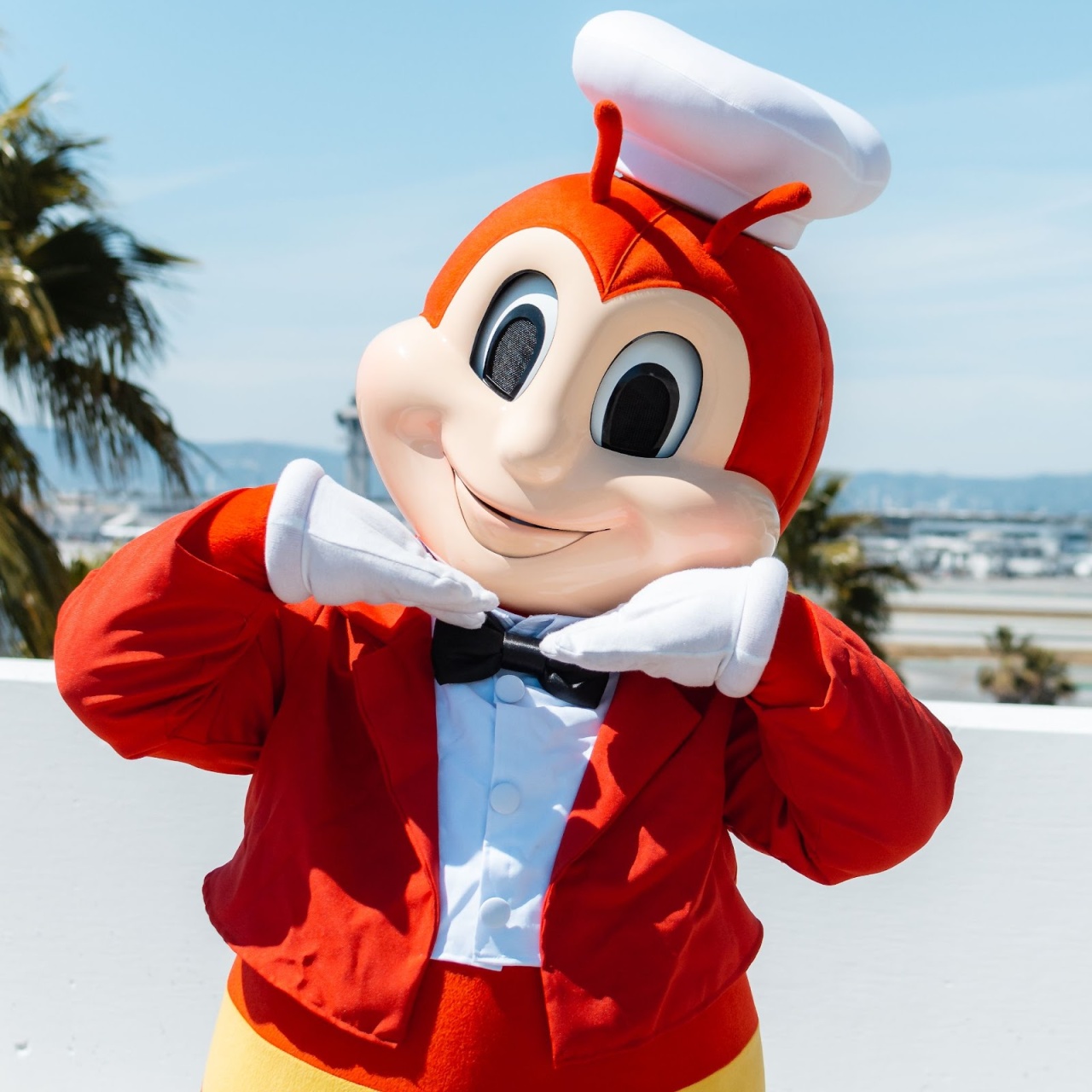
Jollibee is the Philippines main nationwide fast food chain. Launched with just two outlets in the mid 1970s, it had grown into a 365-unit chain by the mid 1990s. Widely seen as Asia's equivalent of Kentucky Fried Chicken, Jollibee is as popular on the lesser islands of the Philippines as it is in Manila, where it is estimated that the average Manileno eats at least twice a week at a Jollibees. The mascot for Jollibees is a jolly bee.
Jollibee’s outlets are especially crowded at lunch time, when every seat s taken and there are long lines in front of all six cashiers. Customers are often forced to sit on the ground or on the steps outside. In Manila you can find boarded up McDonald’s that dared to go head to head against Jollibee. Jollibee’s success lies in its ability to set up nationwide supply lines and offer things that Filipinos like at cheap prices. It offers longganisa pork sausage and fried rice for breakfast, Aloha burgers, topped with pineapple and bacon and meals with fried chicken and spaghetti for lunch and dinner along with palabok (tofu served on rice noodles with an aromatic sauce spiced with dried fish flakes and spring onions) and “chicheron” (dried, ground pork skin). In the 1990s a typical customer paid 35 pesos for breakfast, 65 pesos for lunch and 55 to 65 pesos for dinner.
Jollibee Foods Corporation (JFC), the umbrella company, is one of the biggest restaurant chains in the world. It operates over 10,000 stores globally and is recognized as one of the fastest-growing restaurant chains, aiming for a spot in the top 5 worldwide. Jollibee Foods Corporation reported higher revenues and profits in 2025 supported by strong sales across its Philippine and international operations. In a statement, the company said consolidated revenues rose 13 percent to US$5.44 billion from US$4.81 billion, while systemwide sales — which measure sales from company-owned and franchised stores — increased 16.6 percent to US$8.11 billion. [Source: Jollibee Corporation, Manila Times, March 11, 2026]]
Jollibee had more than 5,800 eateries in 33 countries at the end of 2020. However, that was 147 fewer than at the end of 2019, as the company closed nearly 500 stores during the pandemic. Jollibee posted a loss of about US$240 million that year — its first annual loss in more than three decades—as dining out was severely affected by virus lockdowns. But that did not deter the company from expanding. The restaurant chain said it was aiming to add 450 new eateries in 2021. In 2019, the company made its largest acquisition when it bought The Coffee Bean & Tea Leaf, an American chain, for US$350 million. Around 80 percent of its new stores were expected to be overseas and “equally split” among China, North America and Southeast Asia, including Vietnam, the Philippines, Singapore and Malaysia. [Source: Justin Harper, BBCm March 17, 2021]
RELATED ARTICLES:
FILIPINO RESTAURANTS AND PLACES TO EAT IN THE PHILIPPINES factsanddetails.com
FOOD AND THE PHILIPPINES: DIET, STAPLES, AND COOKING FOR U.S. PRESIDENTS factsanddetails.com
EATING AND DRINKING CUSTOMS IN THE PHILIPPINES factsanddetails.com
FILIPINO CUISINE: CHARACTERISTICS, REGIONAL VARIATIONS, FUSION, DEFENDING IT factsanddetails.com
FILIPINO DISHES: EATING, COOKING AND ENJOYING THEM factsanddetails.com
FILIPINO SNACKS AND DESSERTS: SWEETS, FRUITS, STREET FOOD factsanddetails.com
FILIPINO FOOD RECIPES factsanddetails.com
EXOTIC AND WEIRD FOODS IN THE PHILIPPINES factsanddetails.com
DRINKS IN THE PHILIPPINES: BEER, TUBA, COCKTAILS, CIVET COFFEE factsanddetails.com
DRINKING IN THE PHILIPPINES: CUSTOMS, HOBBIT BAR, WINE PARTIES, TAXES factsanddetails.com
TOBACCO AND BETEL NUT IN THE PHILIPPINES: SMOKING, HISTORY, STRICT LAWS factsanddetails.com
ILLEGAL DRUG USE IN THE PHILIPPINES: MAINLY CANNABIS AND METH factsanddetails.com
ILLEGAL DRUG TRADE IN THE PHILIPPINES factsanddetails.com
History of Jollibee

Jollibee began as a ice cream parlor founded by Chinese immigrants in Manila. It was founded in 1975 by Tony Tan Caktiong as a Magnolia ice cream parlor in Quezon City. It transitioned into a fast-food restaurant in 1978, popularizing iconic items like Chickenjoy and Yumburger. It became the largest fast-food chain in the Philippines, expanding globally and acquiring brands like Chowking, Red Ribbon, and Tim Ho Wan. By the ealy 2020s, it was multi-billion dollar empire, managing 17 food brands—including Panda Express and The Coffee Bean and Tea Leaf from the U.S., as well as Hong Kong dim sum chain Tim Ho Wan—and more than 6,300 stores across 34 territories, almost a quarter of which are Jollibees. [Source: Jollibee Corporation]
Key Events in Jollibee's History
1975: Tony Tan Caktiong and his family open a Magnolia ice cream parlor in Cubao,
Quezon City.
1978: Jollibee Foods Corporation (JFC) is incorporated, transforming the ice cream parlor into a fast-food restaurant offering hot meals.
1980s: Jollibee overcomes the entry of McDonald's into the Philippines by tailoring its menu to local tastes.
1985: First international outlet opens in Singapore; branches also open in the Middle East and Guam.
1989: Jollibee becomes the first Filipino fast-food chain to break 1 billion pesos in sales.
2000s–Present: Major international acquisitions, including Chowking, Yonghe King (China), Red Ribbon, and a controlling stake in Tim Ho Wan.
Sunshine Lichauco de Leon wrote in Forbes in 2013: “Jollibee’s red-and-white bumblebee logo is a familiar sight in the Philippines, where there are now 2,040 outlets after roughly 120 were added in past three years. It controls 18 percent of the Metro Manila market, compared with 10 percent for McDonald’s. In 2013, Jollibee to earned $102 million, or 22 percent more than in 2012, and for revenue figures reached $2 billion, double the 2009 sales. Meantime, the stock jumped 11 percent in 2012. [Source: Sunshine Lichauco de Leon, Forbes, February 11, 2013]
Marketing consultant Manuel Lumba is credited with coming up with the name. He suggested "Jollibee"—a combination of "jolly" and "bee"—symbolizing a hardworking, happy spirit.Design: The mascot was inspired by Disney characters and comic book heroes, designed to resemble a bee in a chef's hat and red blazer. [Source: Esquire Philippines]
The "Yumburger" was the original hit, followed by the highly popular "Chickenjoy" and "Jolly Spaghetti". JFC president and CEO Ernesto Tanmantiong, brother of Jollibee founder Tony Tan Caktiong, told Time magazine: The Chickenjoy came out because after the hamburger [Yumburger], we said that to be able to grow to a bigger customer base, we need more products. And fried chicken is a popular product in the Philippines. So we started with the fried chicken. But in the early years, there was still some tweaking on product development, until sometime in 1981, when we were able to almost, say, perfect the product.” The 1981 recipe remains intact today. “That’s why [we have] the joke: instead of chickening out against McDonald’s, we serve Chickenjoy.” [Source: Chad de Guzman, Time, March 1, 2023]
Tony Tan Caktiong: Jollibee’s Billionaire Owner

Tony Tan Caktiong recalls that what he remembers most about his childhood is taste. His father, a chef in a Buddhist monastery in Manila, often came home and cooked for the family, preparing flavorful meals from whatever simple ingredients were available. Tan, the third of seven children, quickly developed a reputation for being picky. “My mother would say I was the most difficult to bring up because I was the choosiest in terms of taste, whereas my brothers would just eat anything,” he says. “She would say, ‘You are the hardest to satisfy.’” [Source: Sunshine Lichauco de Leon, Forbes, February 11, 2013 ]
“I never thought I would be in the food business,” Tan says today. Yet beginning with two ice-cream parlors in Manila in 1978, he built Jollibee Foods Corporation into one of Asia’s largest home-grown restaurant groups. The company’s “flavorful environment,” as Tan calls it, and his Buddhist appreciation for simplicity are evident in its outlets around the world, from Saudi Arabia to the borough of Queens in New York City. “We keep things simple and fill a simple need: very tasty food at a reasonable price,” he explains. “To this day I repeat to my people what my father told me — you have to make sure your food tastes really good.”
The worldwide success of Jollibee has made Tan a billionaire, with an estimated net worth of about US$1.3 billion, according to Forbes Asia. His rise is particularly striking given that, according to his wife Grace Tan, he never really learned to cook himself. Tan’s calm, methodical outlook may partly reflect his Buddhist upbringing. As a child he spent afternoons around monks at the monastery where his father worked and attended Buddhist schools on scholarship. “I think our destiny is already defined, but you still have to do your best or else that might change,” he says. “We do our best and let God just handle the rest.”
Tan’s path into the food business began almost by accident while he was still studying chemical engineering at University of Santo Tomas in Manila. “I liked numbers so I thought I would be an engineer,” he recalls. But during a class visit to a Magnolia Ice Cream plant with a classmate who later became his wife, he learned about a franchise opportunity. Intrigued, he and Grace opened two ice-cream shops soon after graduating. When Tan noticed that customers were craving sandwiches and that hamburgers were becoming popular worldwide, he decided to transform the business into a hamburger chain.
Both he and Grace had entrepreneurial instincts, making the shift from engineering to running restaurants a natural step. Grace’s father was a businessman who helped them get started. Tan’s own father had also opened a small Chinese restaurant after leaving the monastery and moving the family to Davao City in the southern Philippines. As a teenager Tan worked there after school. “It was nothing special for ambiance, but it became known for the tastiness of its food,” he remembers.
Today Tan’s eldest son, Carl Brian Tan, works as the company’s business development director and focuses on the firm’s 12 Sabu venture with Wowprime in Shanghai. Tan also has two daughters who live in California. “I’d like them all to work for the company,” he says, “but we don’t force them. If they are interested we will ask them to try. If they like it, the better. If not, it’s okay.”
Tony Tan Caktiong as Jollibee's Manager
Tony Tan Caktiong takes a hands-on approach to developing new menu items at Jollibee Foods Corporation. “If I taste a new product and like it, I will say, ‘Wow, this is good, we can do this,’” he says. “But the marketing department will want a product survey, which takes time. A lot of times I give in to them, but I try to balance the organization. Everyone can do market research. We also need gut-feel.” [Source: Sunshine Lichauco de Leon, Forbes, February 11, 2013 ]
At work, Tan prefers persuasion to issuing orders and places strong emphasis on reaching consensus. He motivates employees by delegating responsibility and maintaining a strong rewards system. “I learned to be kind to people, so I seldom scold a person in the organization, even in private,” he says. “I try to put myself in his shoes — try to imagine how he feels and respond from that point of view. I try to see if he did something wrong, is it intentional? Usually it’s not. You try to understand why so you can teach him.”
Gerry A. Refugio Jr., a store manager at a Jollibee outlet in Hong Kong, says the company’s culture has kept him there for more than 20 years. Speaking of Tan, he says, “He has that charisma to move his people, and the strategic capacity.”
To keep the company growing, Tan constantly scans the world for new trends, innovations and technologies in the restaurant industry. He studies the design and product mix of fast-food chains such as Wendy's but also looks beyond the sector. “We also look at airlines to see what they are doing on the service side, as we are also in the service industry,” he says. “And Disneyland — we learn how they keep their look. It’s more than 50 years old but if you go there it looks like it opened yesterday. And people are always courteous.”
Keys to Jollibee’s Success
Sunshine Lichauco de Leon wrote in Forbes: “A big part of Jollibee Foods’ success has been the development of market-leading brands across several categories. Jollibee outlets accounted for 49 percent of the company’s sales, as of September, and that share is slipping as the rest of its brand portfolio–both in the Philippines and abroad–grows faster. In the Philippines the company boasts Chinese fast-food chain Chow King, Red Ribbon bakeries, Mang Inasal grilled chicken outlets, Greenwich pizza parlors and its U.S. chain Burger King franchises. Lovell Sarreal, senior assistant vice president of research at Maybank ATR Kim Eng Securities in Manila, says, “Most competitors have single brands. Having multi-food concepts enables Jollibee to capture a bigger chunk of the dining-out market. For example, a typical customer can eat at Jollibee on Monday, Chow King on Tuesday, etc.” [Source: Sunshine Lichauco de Leon, Forbes, February 11, 2013 ]
“Tan says the company is ready to expand because it’s developed a management corps with the right experience in catering to local customs and preferences, but he’s aware of the challenges, such as maintaining consistency. “Food development is key, in terms of making sure that the hamburger here and there tastes the same regardless of whether ingredients might be different quality; beef might vary in taste or tomatoes in sweetness,” he says. “And as it’s a location-based business we need to know the community very well in order to understand traffic flow, where people stay.” Understanding that local consumers might have different tastes — Jollibee’s products are often saltier or sweeter –the company is open to adjusting recipes if needed. “Core products like chicken don’t need to be adjusted because, all over, they love chicken the same, but our spaghetti might be adjusted, as it’s supersweet,” he says. “For the Filipino market, we just have to do our job very well and it’s there. For the others you have to go beyond that. You have to build a brand because they don’t know anything about it.”
“Investors such as Lindsay Cooper, founding director of Arisaig Partners, a shareholder for ten years who now owns 3.5 percent of the company, cites Jollibee’s strengths. He sees a scalable, long-term growth story based on the rising consumption of fast food, strong brands that cater to local tastes, a dominant market position at home, strong cash flow and strong management. “Jollibee is clearly a thinking organization and continually evaluating the competitive landscape,” he says.
Jollibee Versus McDonald’s
Sunshine Lichauco de Leon wrote in Forbes: “In 1981, just three years after starting Jollibee, Tan heard some terrible news: McDonald’s was about to enter the Philippine market. Tiny Jollibee would soon be in battle with a global giant, both selling hamburgers and soft drinks. “We had a meeting to strategize how we could compete,” says Tan. After a long trip to the U.S. to study how McDonald’s operated, top managers brainstormed over every attribute that helps decide where customers go to eat and measured how Jollibee compared on each one. “We found that they excelled over us in all aspects–except product taste,” he says. “It suited Americans but not really Filipinos. Our [food] tends to be sweeter, more spices, more salty. We were lucky as it was not easy for them to change their product because of their global image.” [Source: Sunshine Lichauco de Leon, Forbes, February 11, 2013 ]
“But even “with better-tasting food, could we really compete?” wondered Tan. “If we want to compete we have to make sure we at least equal them in all the other attributes. It was a challenge because in advertising, promotion, store look, size, playgrounds, service speed, we ranked lower. We focused on the other attributes one by one.” Sometime later “we did a customer survey, and we were surprised we ranked higher than McDonald’s on a lot of attributes,” continues Tan. “We were surprised customers ranked us higher in courtesy and service style. Maybe they felt we were warmer? And then they liked our marketing, promotion and advertising better. And then customers kept just coming back.”“ Eventually McDonald’s — which added nearly 50 outlets in 2012 in the Philippines to reach 375 — introduced new products geared to Filipinos. “They have a Burger McDo, where they tried to Filipinize the burger, and McSpaghetti, because Filipinos really love spaghetti,” says Tan.”
When asked why Jollibee decided to go up against McDonald’s,Tanmantiong told Time magazine: When friends were advising us to go into other businesses, we started trying to look back and do some strategic planning. And then we tried to do some competitive gap analysis. So we try to write down what are the advantages of McDonald’s versus us. And what’s the advantage of Jollibee against them? When we look at the advantages of McDonald’s, it’s a long list—more than one page. And when we look at Jollibee, what’s the advantage of Jollibee over McDonald’s: only one item. That is the product’s taste, because American products usually are bland. And then we said, “Okay. These are the advantages of McDonald’s. Can we overcome those advantages and make it even at least parity?” And we said yes, because actually, the most difficult part is the product. The others are easy to do: service, cleanliness—these are easy to do and to learn. Over time, we closed the gap of those advantages of McDonald’s. And fortunately, they were not able to close the gap on taste.[Source: Chad de Guzman, Time, March 1, 2023]
Jollibee Goes Global
In the early 2010s, Tony Tan Caktiong pushed an ambitious international expansion for Jollibee Foods Corporation. His vision was clear: he wanted the company to become a global player, with a 50–50 split between domestic and international sales by 2020. After a few early missteps, the company’s 541 overseas outlets—up from 326 at the end of 2009—were contributing about 20 percent of revenue. “It’s a challenge to reach 50 percent because the Philippines is growing fast so the outside has to grow much faster,” he said in an interview in his office in Manila. [Source: Sunshine Lichauco de Leon, Forbes, February 11, 2013 ]
Tan, who turned 60 in January 2013, was not only opening new outlets in the United States and other places where large Filipino communities had settled. He was also acquiring local restaurant chains in large markets such as China and Vietnam, where relatively few Filipinos lived. Around that time, Jollibee ranked as the world’s fifth-fastest-growing restaurant company outside the United States in terms of sales, according to Euromonitor International. The rapid expansion boosted revenues while profit margins remained steady.
Jollibee’s first moves abroad had been made with confidence in the brand loyalty of the roughly 10 million Filipinos working overseas. The company opened Jollibee, Chowking and Red Ribbon Bakeshop stores in the United States in the 1980s, and by 2008 it had franchises in Saudi Arabia, Qatar and the United Arab Emirates. A new Jollibee branch in Jersey City, New Jersey, drew lines around the block for days after it opened in June of that period. In the following months the company planned to open its first restaurant in Singapore, with more to follow. Opening Jollibee restaurants in places with large Filipino communities remained a key strategy, Tan said: “We don’t have to advertise when we open in these places. The longing for home is there. It’s just packed. They come here because it’s the taste of comfort food. When we opened a store in the Middle East, a customer asked me, ‘Sir, can you play your old jingle? I want my daughter to hear it.’”
Lyn Mina, a domestic helper in Hong Kong who visited the Jollibee branch in Central, Hong Kong on her days off, explained the brand’s appeal: “All Filipinos love Jollibee because we feel like we are at home.” Seeing the company’s bumblebee logo outside the Philippines filled her with pride. “Jollibee can do what other food chains can do, franchise to other countries. It means that Filipinos can make their name [around the world].”
At that time, Jollibee had not expanded into Europe, where many Filipinos also worked, but Tan said he remained open to the idea. “Filipinos are asking for it,” he said. “And interested parties are asking for a joint venture or franchise. So it’s a matter of internal capability and whether we have the people and support team. Right now we have not focused there yet.”
Jollibee was also entering Taiwan through an agreement with a subsidiary of the country’s largest restaurant-chain group, Wowprime. The partners planned to operate the hot-pot dining chain 12 Sabu, which had 18 restaurants in Taiwan and expansion plans in China, Hong Kong and Macau; Jollibee invested about US$8 million in the venture. The company also expanded in Vietnam, spending US$25 million in January of the previous year to acquire half of the SuperFoods Group, which operated Highlands Coffee cafés, Pho24 noodle houses and Hard Rock Cafe outlets. The deal also broadened Jollibee’s presence in Indonesia, where it had already operated two Chowking restaurants and gained an additional 13 Pho24 outlets through the acquisition.
Jollibee in the U.S.
Chad de Guzman wrote in Time: On the night of January 17, 2023 a line of people began to form on Colonial Drive in Orlando, Fla. They weren’t waiting to enter a nightclub or a concert, but to be the first customers of a branch of Philippine fried chicken chain Jollibee opening the next day. It was a similar scene to when Jollibee’s flagship U.S. store opened in August 2022 at Times Square in Manhattan.[Source: Chad de Guzman, Time, March 1, 2023]
To some, the fanfare may be mind-boggling. But the company, with its iconic fried chicken product called the “Chickenjoy,” is the Philippines’ answer to the fast food giants of the U.S. The average American already eats an estimated 100.6 lbs of chicken annually, and deep frying it is a backbone of American Southern cuisine. Even in the face of competition from Chick-Fil-A, KFC, and McDonald’s, Jollibee has managed to carve out its own niche in the fried chicken market and winning over the U.S. palate, thanks in part to the more than 4 million Filipino-Americans who crave the taste of home that might include a chicken dish with a side of spaghetti.
The Orlando branch may be one of 66 Jollibee stores in the U.S. since first opening a shop in Daly City, Cal. in 1998, but even in a post-pandemic world and in the face of an anticipated recession, the company still wants to aggressively grow its food service footprint. It plans to open 500 stores in North America in the next five to seven years, and even expand into China, an economy that is only just emerging from swingeing COVID-19 restrictions.
Jollibee in China
For Jollibee, the path to becoming an international force had to pass through countries without a large Filipino presence. In China the company opened a Jollibee outlet in Xiamen in 1998 but closed it three years later. Rather than building its own brand there, the company decided to acquire already-popular local brands and strengthen them in the marketplace. Tony Tan Caktiong explained the reasoning: “We decided the harder thing to do was marketing the brand, so we buy brands with a following and just have to improve the back end of the operation.” [Source: Sunshine Lichauco de Leon, Forbes, February 11, 2013]
Jollibee expanded its presence in China by opening more than 100 outlets of the fast-food chain Yonghe King over the previous two years, bringing its total there to 288 locations. The company had purchased the noodles, rice and dim sum chain in 2004. With its 52-outlet Hong Zhuang Yuan congee chain, which it acquired in 2008, Jollibee improved the taste of the food, redesigned the restaurants and introduced new products. In March of that period it also paid about US$6 million for a 55 percent stake in Chinese beef noodle chain San Pin Wang, which had 39 stores. Overall sales for Jollibee’s China operations rose 20 percent the previous year. “We don’t even have to launch a Jollibee store in China — these branches in themselves can be a major business,” Tan said.
With revenue of about US$192 million the previous year, China had become Jollibee’s largest overseas market, though it was not yet profitable. According to Sarreal of Maybank Kim Eng, “Overall, if you include the head-office expense, they are still not making money in China. It’s a tough market, and they are putting in a lot of resources. They are facing competition from brands like KFC and McDonald's, which are bigger in China. Although they are different in food concept because Jollibee’s concept is Chinese, they are still fast food. The challenge is to turn around the China operations. The Philippine business is doing very well, but because of the drag in China, if you look at the consolidated financial statements, it’s not very evident.”
Jollibee did not disclose the size of its losses in China but said it expected to break even within two years. The company noted that its three Chinese chains generated strong cash flow but required heavy investment to support long-term growth. In 2011 it opened a food processing plant in Anhui Province and built a research and development center as well as corporate offices in Shanghai. Tan explained the strategy: “It is a matter of getting to a certain number of stores and continuously growing our same-store sales to achieve absolute profitability in China. We now have nearly 400 stores. We estimate we need 500 to get to breakeven. We think we can get to that in 2014.”
Tanmantiong told Time magazine: We attempted to enter China actually, twice with the Jollibee brand. I think one was in the mid-1990s. The first was in Xiamen, then the second attempt was in Shenzhen. I think at that time we entered too early. And we didn’t do our homework well. And that’s why after those two failed attempts, we decided maybe the Jollibee brand is not yet ready. Instead of bringing Jollibee to China, let’s instead acquire local chains. And that’s why today we have Hong Zhuang Yuan, a Beijing congee chain. And then we have Yonghe King. And then recently, we brought in Tim Ho Wan. But it doesn’t mean that the Jollibee brand will never enter China. Recently we [have been] quite successful in Hong Kong. [Source: Chad de Guzman, Time, March 1, 2023]
Image Sources: Wikimedia Commons
Text Sources: “Encyclopedia of World Cultures Volume 5: East/Southeast Asia:” edited by Paul Hockings, 1993; “Culture Shock!: Philippines” by Alfredo Roces and Grace Roces, Marshall Cavendish International, 2010; Metropolitan Museum of Art; National Geographic, Live Science, Philippines Department of Tourism, New York Times, Washington Post, Los Angeles Times, Smithsonian magazine, Encyclopedia.com, Library of Congress, The Conversation, The New Yorker, Time, BBC, CNN, Reuters, Associated Press, AFP, Lonely Planet Guides, Google AI, Wikipedia, The Guardian and various websites, books and other publications.
Last updated March 2026