
CORAZON AQUINO AS PRESIDENT
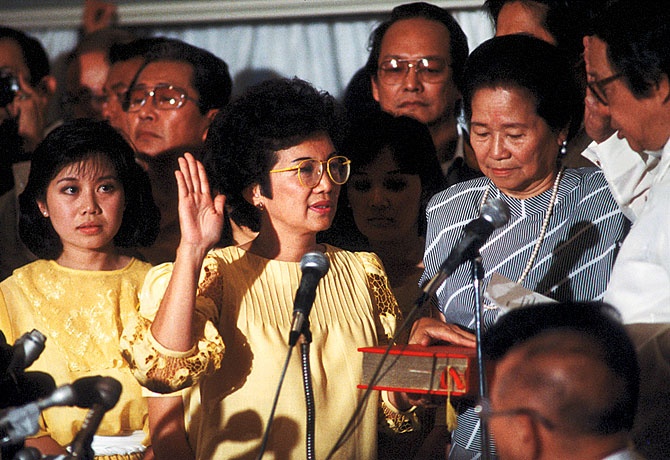
Corazon Aquino assumed the presidency on 25 February 1986, the same day Ferdinand Marcos fled the country. Aquino was elected in a general election after the "People Power" revolution of 1986. Her vice president was Salvador H. Laurel. Aquino’s government restored civil liberties, released political prisoners, and offered the NPA a six-month ceasefire in exchange for renouncing violence and negotiating grievances. However, because Aquino came to power through the forced departure of an officially proclaimed president, the legality of her regime was suspect. Consequently, she operated under a transitional "freedom constitution" until February 11, 1987, when the electorate ratified a new constitution. The first free elections in nearly two decades were held on May 11, 1987, under the new constitution. More than 83 percent of eligible voters cast their ballots. Eighty-four candidates ran for the 24 Senate seats and 1,899 candidates ran for the 200 House seats. There were 63 election-related killings. Old-line political families still controlled the system: 169 out of the 200 House members either belonged to or were related to these families. [Source: Worldmark Encyclopedia of Nations, Thomson Gale, 2007]
Aquino was largely regarded an ineffectual and indecisive ruler who devoted her efforts to wiping out vestiges of the Marcos regime but accomplished little else. The economy faltered during her term and there was a great deal of discontent. Under Aquino a new “dictator-proof” constitution was ratified in February 1987; political prisoners were released; the American military bases were closed down; and peace talks were launched with Muslim insurgents. She pledged agrarian reform and land redistribution, but her background as a member of the landed classes made this a difficult promise to keep.
Aquino did not seek to create a political party to perpetuate her rule, preferring instead to rely on her personal popularity, which initially was strong but diminished throughout her term. A devout Catholic, Aquino often dealt with crises by praying. She followed the church by discouraging birth control and dismantling her country's family planning program. After taking office Aquino ordered an exorcism of the Marcoses palace by a Roman Catholic priest, and turned into a tourist attraction to bring attention to the excesses of the Marcos regime. president Ferdinand Marcos had appealed to Aquino to allow him to attend the funeral of his mother, as he had appealed several times to visit his mother while she was ill; Aquino denied each request.
Aquino's government faced mounting problems, including coup attempts, significant economic difficulties, and pressure to remove the U.S. military from the Philippines (the last U.S. bases were evacuated in 1992). President Aquino's early years in office were punctuated by a series of coup attempts. Her greatest frustration, and a most serious impediment to economic development, was a fractious, politicized army. Some officers wanted to regain the privileges they enjoyed under Marcos; others dreamed of saving the nation. Although all coup attempts failed, they frightened away foreign investors, forced Aquino to fire cabinet members of whom the army did not approve, pushed her policies rightward, and lent an air of impermanence to her achievements. In 1990, in response to the Moros' demands, a partially autonomous Muslim region was established in the southern part of the country. Aquino declined to run for reelection in 1992 and was succeeded by her former army chief of staff, Fidel Ramos. [Source: Library of Congress; Columbia Encyclopedia, 6th ed., Columbia University Press]
RELATED ARTICLES:
CORAZON (CORY) AQUINO: HER LIFE, CHARACTER, FAMILY, NINOY AND MARCOS factsanddetails.com
PEOPLE POWER AND THE FALL OF MARCOS factsanddetails.com
NINOY AQUINO: HIS LIFE, POLITICAL CAREER, EXILE AND THE ANTI- MARCOS OPPOSITION factsanddetails.com
ASSASSINATION OF NINOY AQUINO factsanddetails.com
BENIGNO AQUINO III — PHILIPPINES PRESIDENT 2010-201 — HIS LIFE, CAREER, ANTI-CORRUPTION FIGHT factsanddetails.com
FIDEL RAMOS — PHILIPPINES PRESIDENT (1992-1998) — HIS LIFE, CAREER AND GENERALLY POSITIVE IMPACT factsanddetails.com
FERDINAND MARCOS: HIS LIFE, LIES, EDUCATION, WAR RECORD, POLITICAL RISE factsanddetails.com
FERDINAND MARCOS AS PRESIDENT: EARLY PROMISE, RESISTANCE, WASTE factsanddetails.com
MARTIAL LAW YEARS UNDER FERDINAND MARCOS factsanddetails.com
MARCOS’S PLUNDER AND WEALTH factsanddetails.com
MARCOS AFTER HIS DEATH: HIS EMBALMED BODY AND EFFORT TO GIVE HIM A HERO’S BURIAL factsanddetails.com
Corazon Aquino After Marcos's Ouster
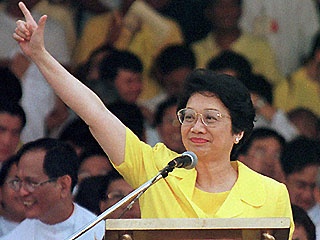
Corazon Aquino was swept into the presidency by the February 1986 "People's Power" uprising amid high expectations that she would be able to right all of the wrongs in the Philippine body politic. It soon became evident, however, that her goals were essentially limited to restoring democratic institutions. She renounced the dictatorial powers that she had inherited from President Ferdinand E. Marcos and returned the Philippines to the rule of law, replacing the Marcos constitution with a democratic, progressive document that won overwhelming popular approval in a nationwide plebiscite, and scheduling national legislative and local elections. [Source: Library of Congress *]
The new constitution, ratified in 1987, gives the Philippines a presidential system of government similar to that of the United States. The constitution provides the checks and balances of a three-branch government. It provider for the presidency; a two-house Congress, the Senate and the House of Representatives; and an independent judiciary capped by the Supreme Court. The constitution also provides for regular elections and contains a bill of rights guaranteeing the same political freedoms found in the United States Constitution. Fueled by a constitutionally guaranteed free and open press, the freewheeling political life that had existed before the martial law period (1972-81) soon resumed. But most of the political problems, including widespread corruption, human rights abuses, and inequitable distribution of wealth and power, remained. *
Corazon Aquino had wide popular support but no political organization. Her vice president, Salvador H. “Doy” Laurel, had an organization but little popular support. Enrile and Ramos also had large stakes in what they saw as a coalition government. The coalition unraveled quickly, and there were several attempts, including unsuccessful military coups, to oust Aquino. She survived her fractious term, however, and was succeeded in the 1992 election by Ramos, who had served loyally as chief of staff of the armed forces and secretary of national defense under Aquino. *
According to Lonely Planet: “If people thought that ousting the Marcoses would lead to period of political stability, they were wrong. Cory Aquino had helped shepherd through a new constitution that greatly limited presidential power to do undemocratic things like declare martial law or appoint oneself president for life. The first real presidential elections were held in 1992 and showed how messy democracy could be. Aquino's endorsed successor, Defense Secretary Fidel Ramos, won with barely 24 percent of the vote. This lack of a resounding mandate left people restless.” [Source: Lonely Planet]
Cory Aquino's Leadership Style
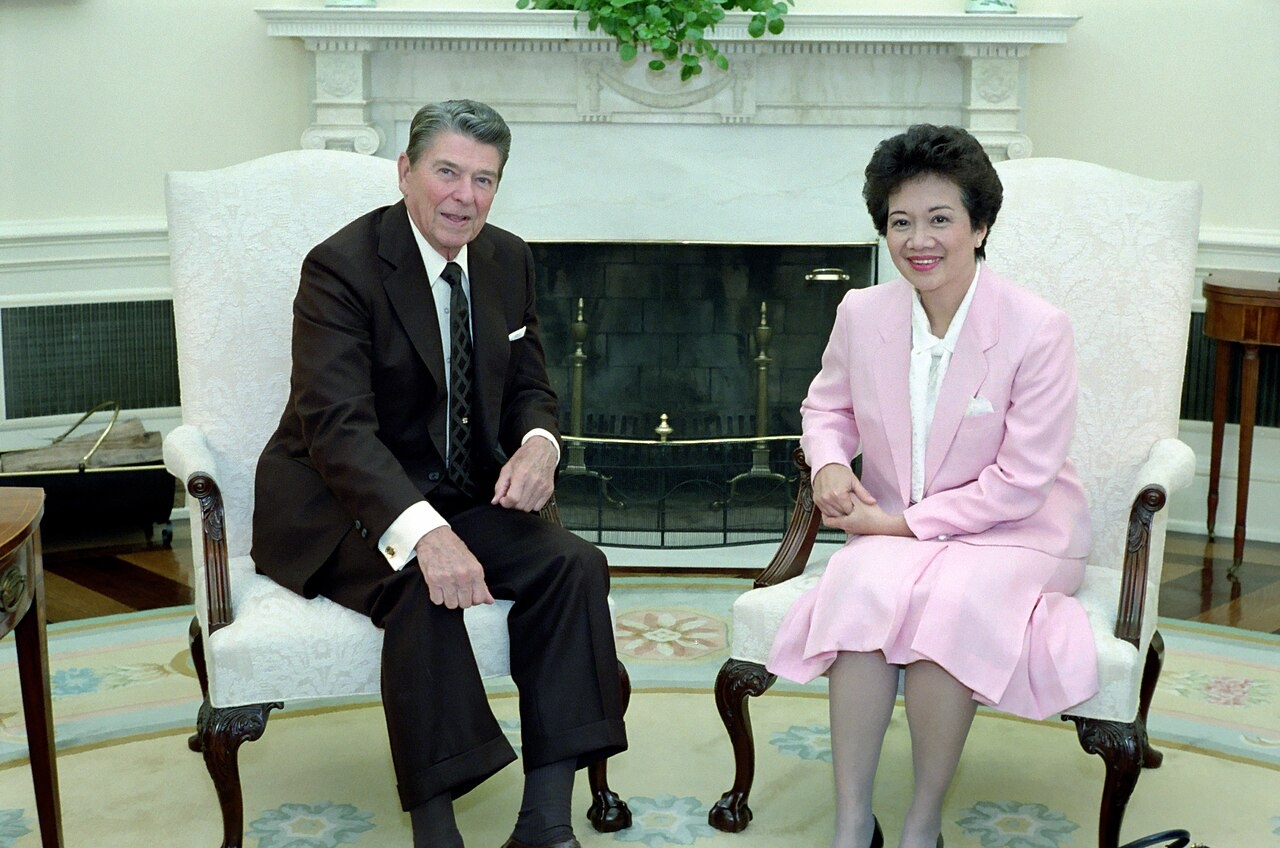
As president, Aquino was determined to “lead by example.” To indicate she was serious about making a break from the past, Aquino insisted that her driver stop at red lights to let civilians pass as she was being driven to her inauguration. During her six years in power she made every effort possible to expunge the imperial trappings of the Marcos years. In 1992, when she drove to the inauguration of her successor, she arrived not in Mercedes as other VIPs did but in a humble Toyota Crown.
Although many saw her weakness and delay, Aquino did not waiver from her decision that the most important legacy of her presidency would be her presidential leadership style, as she was always more concerned with process over policy. In March 1986, she proclaimed a provisional Constitution and soon after appointed a commission to write a new Constitution. This document was ratified by a landslide popular vote in February 1987. She served for one term that lasted six years as defined by the new Constitution, as she decided not to seek re-election. [Source: people.brandeis.edu]
There was however no change in the social and economic circumstances under Aquino's government. It is important to realize that her government was pressured by huge popular expectations, as the people prior to her had been living under martial law for 14 years. She saw herself as a transition president, from going to dictatorship to democracy, as she believed the Philippines would take at least 10 years to recover after Marcos Regime. It is also important to understand, that what could have impacted her ability to create change was the fact that she had to survive 6 coups and no one was loyal to her.
As President Corazon C. Aquino entered the final year of her six-year term in 1991, she presided over a demoralized nation reeling from the effects of natural calamities and economic malaise. The country had slid into dictatorship and gross economic mismanagement during Ferdinand E. Marcos's twenty-year presidency. When Aquino was elevated to the presidency in an inspiring People's Power Revolution in 1986, Filipinos' hopes rose. Inevitably, the stark realities of the nation's economic and political predicaments tarnished Aquino's image. [Source: Library of Congress *]
Aquino's achievements, however, were significant. She helped topple a dictator who had unlimited reserves of wealth, force, and cunning. She replaced a disjointed constitution that was little more than a fig leaf for Marcos's personalistic rule with a democratic, progressive document that won overwhelming popular approval in a nationwide plebiscite. She renounced the dictatorial powers she inherited from Marcos and returned the Philippines to the rule of law; she lived with the checks on her own power inherent in three-branch government; and she scheduled national elections to create a two-chamber legislature and local elections to complete the country's redemocratization. *
Land Reform Efforts Under Corazon Aquino

The Corazon Aquino government introduced laws in the 1980s and 90s to break up big landholdings and limit individual property ownership to roughly 12 acres. Under the law, landowners could either sell their land to the government at prices set by the government or sell it voluntarily, preferably to peasants, and receive a cash bonus. According to the plan peasants would receive loans and financial assistance from the government and pay back loans at a discounted rate over 20 years. The Department of Agrian Resources was set up to hand over the transfer of land. As of 2002, it had managed to give out about 80 percent of the 10.6 million acres targeted by the plan to 1.8 million peasants.
Getting the last 30 percent was difficult. In many cases it was the best land and it was owned by the richest and most powerful landlords, who had thwarted government effort to claim the land using lawyers, armed militias and political influence. In many cases the landowners create conditions, namely high montage rates, that made peasants feel they have no choice but to lease back land to the landowners under terms that made them worse off than they were before.
Land reform was a central promise of Corazon Aquino during her 1986 presidential campaign, as she vowed to make “land-to-the-tiller” a reality—even for her own family’s vast Hacienda Luisita estate. However, meaningful action was delayed until January 1987, when government troops fired on peasants marching to Malacañang to demand reform, killing 18 and injuring more than 100. The tragedy forced the administration to act. Aquino created a land reform commission and, in July 1987, issued a decree establishing the Comprehensive Agrarian Reform Program (CARP). The plan aimed to cover over 80 percent of cultivated land and nearly two-thirds of agricultural households, but key provisions—such as implementation details and retention limits—were left to the new Congress, many of whose members were themselves linked to large landholdings. [Source: Library of Congress]
The program drew criticism from both landowners and peasant groups. Landowners argued that it went too far, while reform advocates contended that it did not go far enough and was weakened by allowing a landlord-dominated Congress to shape the final rules. A World Bank mission also criticized early drafts, recommending faster implementation, objective land valuation formulas, and stricter safeguards against evasion. It warned in particular against provisions allowing corporations to distribute stock to tenants instead of transferring land outright, arguing that such measures could undermine genuine reform. Most of these recommendations were not incorporated into the final version.
In June 1988, Congress passed the Comprehensive Agrarian Reform Law. It permitted landowners to retain up to five hectares, plus additional allotments for heirs, and allowed phased implementation. A highly controversial clause enabled corporate landowners to transfer shares of stock equivalent to the value of the land instead of subdividing it. In 1989, tenants of Hacienda Luisita accepted a 33 percent share in corporate stock rather than direct land ownership, leaving effective control in the hands of the Aquino family. Critics saw this as a major loophole that other large landowners would likely exploit, raising doubts about Aquino’s commitment to sweeping reform.
Financing and implementation posed serious challenges. Cost estimates ranged from ₱170 billion to over ₱300 billion, far beyond the government’s fiscal capacity without major tax increases or spending cuts. The administration planned to rely heavily on foreign aid, but progress was limited. Official claims of early success were questioned, as much of the land distributed between 1987 and 1990 came from earlier Marcos-era programs, while redistribution of privately owned land remained minimal. Budget underutilization and Supreme Court rulings further slowed progress, forcing reductions in land acquisition targets and casting uncertainty over the program’s long-term effectiveness.
Privatization in the Philippines Under Cory Aquino in the 1980s
When Aquino assumed the presidency in 1986, P31 billion, slightly more than 25 percent of the government's budget, was allocated to public sector enterprises — government-owned or government-controlled corporations — in the form of equity infusions, subsidies, and loans. Aquino also found it necessary to write off P130 billion in bad loans granted by the government's two major financial institutions, the Philippine National Bank and the Development Bank of the Philippines, "to those who held positions of power and conflicting interest under Marcos." The proliferation of inefficient and unprofitable public sector enterprises and bad loans held by the Philippine National Bank, the Development Bank of the Philippines, and other government entities, was a heavy legacy of the Marcos years. [Source: Library of Congress, 1991 *]
Burdened with 296 public sector enterprises, plus 399 other nonperforming assets transferred to the government by the Philippine National Bank and the Development Bank of the Philippines, the Aquino administration established the Asset Privatization Trust in 1986 to dispose of government-owned and government-controlled properties. By early 1991, the Asset Privatization Trust had sold 230 assets with net proceeds of P14.3 billion. Another seventy-four public sector enterprises that were created with direct government investment were put up for sale; fifty-seven enterprises were sold wholly or in part for a total of about P6 billion. The government designated that about 30 percent of the original public sector enterprises be retained and expected to abolish another 20 percent. There was widespread controversy over the fairness of the divestment procedure and its potential to contribute to an even greater concentration of economic power in the hands of a few wealthy families. *
Elections and Politics Under Cory Aquino
The first free congressional elections in nearly two decades were held on May 11, 1987. The pre-martial law Philippine Congress, famous for logrolling and satisfying individual demands, was shut down by Marcos in 1972. The 1973 constitution created a rubber-stamp parliament, or National Assembly, which only began functioning in 1978 and which was timid in confronting Marcos until some opposition members were elected in May 1984.In the 1987 elections, more than 26 million Filipinos, or 83 percent of eligible voters, cast their ballots at 104,000 polling stations. [Source: Library of Congress *]
In the 1987 legislative elections, Corazon Aquino achieved an overwhelming victory, with 23 of her 24 endorsed Senate candidates winning seats. The sole opposition senator was Juan Ponce Enrile, who secured the final seat after a Supreme Court ruling halted a recount. Although roughly three-quarters of the newly elected House members were also Aquino-backed, her influence was less decisive than it appeared. She had not formed her own political party, instead endorsing candidates from established political clans. Of the 200 House members elected, 169 belonged to or were related to traditional political families, underscoring the continued dominance of elite networks in Philippine politics.
Despite her electoral support, Congress did not shy away from challenging Aquino’s authority. Within months of convening in July 1987, legislators summoned her executive secretary for questioning and later rejected her proposed administrative code, which would have expanded executive powers. Criticism of Aquino came from across the political spectrum. Communist groups refused to cooperate with what they viewed as an oligarchic government, while the democratic left faulted her for favoring business interests and maintaining close ties with the United States. Her own vice president, Salvador H. Laurel, openly criticized her leadership, and conservative factions—including former Marcos allies—dismissed her as inexperienced. Amid this pressure, Aquino appeared to accept that her primary achievement would be restoring democratic institutions rather than solving deep-rooted structural inequalities.
The Roman Catholic Church remained a powerful political force, though less visibly activist than during the final years of the Marcos regime. Church leaders often condemned military human rights abuses while supporting constitutional government. Cardinal Jaime Sin, instrumental in Aquino’s rise, praised her integrity but criticized corruption within her administration. Meanwhile, the communist insurgency led by the New People's Army persisted, though at reduced strength, and Muslim separatist conflict in Mindanao also continued. Though diminished, both movements reflected enduring social and economic grievances.
Aquino’s policy of reconciliation toward figures associated with the Marcos regime drew significant criticism. She appointed key former Marcos allies to influential posts, including General Fidel Ramos as armed forces chief—he later succeeded her as president in 1992. Other controversial appointments included Anniano Desierto as national ombudsman, while Enrile remained a political presence. Critics argued that her reliance on the pro-Marcos military limited accountability for martial law abuses and allowed violence against activists to continue in some regions. Aquino also failed to secure the extradition of Ferdinand Marcos and Imelda Marcos from exile in Hawaii or to recover much of the wealth allegedly taken during their rule. Nonetheless, Aquino left office having reestablished constitutional democracy and laid the groundwork for a peaceful transfer of power. [Source: Vincent McKee and Claire Wallerstein, The Guardian, August 1, 2009]
Aquino’s Shaky Coalition
Marcos maintained power for years by skillfully dividing his opponents—intimidating some, forcing others into exile, and manipulating rivalries among elite provincial families. The fragmented opposition only united before the 1986 snap election through the mediation of Jaime Sin. Corazon Aquino, buoyed by public sympathy but lacking a political machine, joined forces with seasoned politician Salvador Laurel, who agreed to run as her vice-presidential candidate. Although Aquino was declared the winner of the February 7, 1986 election, the result was marred by widespread fraud, intimidation, and vote manipulation, leaving the true margin of victory uncertain. [Source: Library of Congress *]
Aquino’s success depended heavily on the dramatic defection of Defense Minister Juan Ponce Enrile and Armed Forces Vice Chief Fidel Ramos, both longtime Marcos loyalists who broke ranks after being sidelined by General Fabian Ver. Their support was decisive during the People Power uprising, and they envisioned the new administration as a coalition government in which they would wield significant influence. Laurel shared similar expectations, seeing the post-Marcos order as a shared political enterprise rather than a purely Aquino-led presidency.
Initially, Aquino’s government drew backing from across the political spectrum. The middle class rallied strongly behind her as a democratic alternative to dictatorship. Many on the left regarded her as potentially reformist, even if not radically transformative, while most conservatives outside the Marcos camp also supported the transition. This broad but fragile coalition reflected widespread hope for political renewal after years of authoritarian rule.
The alliance, however, quickly began to fracture. Enrile advocated declaring the new government “revolutionary,” which would have nullified the 1986 election results and triggered fresh presidential polls. Aquino rejected this idea and made clear her intention to serve a full six-year term. Enrile and Laurel subsequently moved to weaken her position, while Ramos adopted a cautious but ultimately loyal stance that proved crucial in helping Aquino survive multiple coup attempts. Without Ramos’s support, her presidency might not have endured.
Political tensions intensified throughout 1986 and 1987. A brief attempt by Arturo Tolentino, Marcos’s former running mate, to proclaim himself acting president quickly failed. Enrile was dismissed after being linked to a coup plot, and Aquino reorganized her cabinet, removing left-leaning members to placate military conservatives and replacing Enrile with Rafael Ileto as defense minister. Although Laurel remained vice president, he continued publicly criticizing Aquino and even suggested he would lead the country if she were ousted. Despite persistent internal dissent and coup threats, Aquino managed to hold her government together, though her early period of unity and goodwill had clearly ended.
Aquino’s Popularity Takes a Dive as She Struggles with Military
The disintegration of the original Aquino-Laurel-Enrile coalition was only part of a bigger problem: The entire cabinet, government, and, some would say, even the entire nation, were permeated with factionalism. Aquino also had difficulty dealing with the military. The first serious dispute between Aquino and the military concerned the wisdom of a cease-fire with the New People's Army. Aquino held high hopes that the communists could be coaxed down from the hills and reconciled to democratic participation if their legitimate grievances were addressed. She believed that Marcos had driven many people to support the New People's Army. [Source: Library of Congress *]
The Philippine military, which had been fighting the guerrillas for seventeen years, was hostile to her policy initiative. When talks began in September 1986, military plotters began work on the "God Save the Queen" uprising that was aborted two months later. Aquino tried reconciliation with the Moro National Liberation Front and sent her brother-in-law to Saudi Arabia, where he signed the Jiddah Accord with the Moro National Liberation Front on January 4, 1987. A coup attempt followed three weeks later. In the wake of these coup attempts, Aquino reformed her cabinet but she also submitted to military demands that she oust Executive Secretary Joker Arroyo, a political activist and her longtime confidant. Her legal counsel, Teodoro Locsin, whom the military considered a leftist, and her finance secretary, Jaime Ongpin, also had to go. (Ongpin was later found dead; the coroner's verdict was suicide, although he was lefthanded and the gun was in his right hand.) *
Aquino had been swept into office on a wave of high expectations that she would be able to right all of the wrongs done to the Philippines under Marcos. When she could not do this and when the same problems recurred, Filipinos grew disillusioned. Many of Aquino's idealistic followers were dismayed at the "Mendiola Massacre" in 1987 in which troops fired into a crowd of protesting farmers right outside Malacañang. The military was simply beyond her control. The entire staff of the Commission on Human Rights resigned in protest even though Aquino herself joined the protestors the next day. Those people who hoped that Aquino would liberally use emergency power to implement needed social changes were further dismayed by the fate of her promised land reform program. Instead of taking immediate action, she waited until the new Congress was seated, and turned the matter over to them. That Congress, like all previous Philippine legislatures, was dominated by landowners, and there was very little likelihood that these people would dispossess themselves. *
Aquino's declining political fortunes were revealed in public opinion polls in early 1991 that showed her popularity at an alltime low, as protesters marched on Malacañang, accusing her of betraying her promises to ease poverty, stamp out corruption, and widen democracy. Nevertheless, Aquino's greatest achievement in the first five years of her term was to begin the healing process.
Coup Attempts Against Aquino
Between the time Aquino took office and the end of 1987, there were five coup attempts. This ongoing series of coup plots culminated in a large-scale, bloody, well-financed attempt in December 1989. Led by Colonel Gregorio Honasan, who had participated in the 1987 coup attempt and was a close associate of Senator Juan Ponce Enrile, the attempt involved more than 3,000 troops and targeted several bases. US air support helped quell this attempt. The Senate granted Aquino emergency powers for six months. However, President Aquino's administration lost international credibility by appealing to the US for military support to quell the coup attempt. Authorities made arrests, but the Supreme Court ruled that Senator Juan Ponce Enrile could not be charged with murder, thus nullifying the criminal case against him. He was charged with rebellion in a lower court. In September 1990, sixteen military members were convicted of assassinating Senator Benigno Aquino in 1983 and sentenced to life in prison. [Source: Worldmark Encyclopedia of Nations, Thomson Gale, 2007]
The coup attempts against Aquino were mainly led by dissident officers. One was lead by Enrile because Aquino was going to negotiate with Muslim rebels. She barely survived a bloody coup attempt in December 1989. The coups were largely dismal failures in achieving their goals and made the military very unpopular.
The Aquino government had been in office only five months when it was challenged by the first of six coup attempts led by dissatisfied armed forces factions. The first attempt, a relatively minor affair, was quickly put down, but later attempts in August 1987 and December 1989, led by the same reformist officers that had helped bring Aquino to power, came very close to toppling her government. [Source: Library of Congress *]
In the 1989 attempt, elite rebel units seized a major air base in Cebu, held parts of army and air force headquarters and the international airport, and were preparing to move on armed forces headquarters in Camp Aguinaldo when they were turned back. The threat of another coup attempt hung over the capital in 1990, but as Aquino's term drew to a close in 1991 and 1992, the threat had considerably diminished. Most disaffected military officers seemed content to seek change through the political process, and many officers involved in earlier coup attempts had been persuaded to give themselves up, confident of lenient treatment. *
Bloody December 1989 Coup Attempt Against Aquino
The large, bloody, and well-financed coup attempt in December 1989 was led by renegade Colonel Gregorio Honasan, and involved upwards of 3,000 troops, including elite Scout Rangers and marines, in a coordinated series of attacks on Camp Crame and Camp Aquinaldo, Fort Bonifacio, Cavite Naval Base, Villamor Air Base, and on Malacañang itself, which was dive-bombed by vintage T-28 aircraft. Although Aquino was not hurt in this raid, the situation appeared desperate, for not only were military commanders around the country waiting to see which side would triumph in Manila, but the people of Manila, who had poured into the streets to protect Aquino in February 1986, stayed home this time. Furthermore, Aquino found it necessary to request United States air support to put down this uprising. [Source: Library of Congress *]
Politically this coup was a disaster for Aquino. Her vice president openly allied himself with the coup plotters and called for her to resign. Even Aquino's staunchest supporters saw her need for United States air support as a devastating sign of weakness. Most damaging of all, when the last rebels finally surrendered, they did so in triumph and with a promise from the government that they would be treated "humanely, justly, and fairly."
A fact-finding commission was appointed to draw lessons from this coup attempt. The commission bluntly advised Aquino to exercise firmer leadership, replace inefficient officials, and retire military officers of dubious loyalty. On December 14, 1989, the Senate granted Aquino emergency powers for six months. One of the devastating results of this insurrection was that just when the economy had finally seemed to turn around, investors were frightened off, especially since much of the combat took place in the business haven of Makati. Tourism, a major foreign-exchange earner, came to a halt. Business leaders estimated that the mutiny cost the economy US$1.5 billion. *
Closing of U.S. Bases in the Philippines
Communist rebels applied pressure to remove the US military bases from the Philippines. They took responsibility for the murder of three U.S. servicemen outside Clark Air Force Base, A Communist guerrilla who admitted participating in the April 1989 assassination of US Army Colonel James Row was arrested. In September 1989 two American civilians working on the bases were killed. Anti-American demonstrations at Clark Air Base and in Manila led to clashes with the police and to injuries. The Communists continued their threats and two more US servicemen were killed near the Clark Air Base. In June of 1990 the Peace Corps removed 261 volunteers from the Philippines after Communist threats against them. In September 1990 Aquino said it was time to consider an "orderly withdrawal" of US forces from the Philippines. [Source: Worldmark Encyclopedia of Nations, Thomson Gale, 2007]
Philippine foreign relations in the late 1980s and early 1990s were colored by the contradiction between subjective nationalism and objective dependency. After nearly fifty years of independence, Filipinos still viewed their national identity as undefined and saw international respect as elusive. They chafed at perceived constraints on their sovereign prerogatives and resented the power of foreign business owners and military advisers. Yet, as a poor nation deeply in debt to private banks, multilateral lending institutions, and foreign governments, the Philippines had to meet conditions imposed by its creditors. This situation was galling to nationalists, especially because the previous regime had squandered its borrowed money. Filipinos also sought to achieve a more balanced foreign policy to replace the uncomfortably close economic, cultural, military, and personal ties that bound them to the United States, but this was unlikely to happen soon. [Source: Library of Congress *]
These problems has been compounded by a series of natural disasters: in the wake of a massive earthquake in northern Luzon in July 1990 and a devastating typhoon in the central Visyas in November 1990, the Mount Pinatubo volcano in Central Luzon erupted for the first time in 600 years in early June 1991. The eruption covered the surrounding countryside with molten ash and caused serious damage to the infrastructure of the region, including United States military facilities at Clark Air Base and Subic Bay Naval Base.
Despite Filipinos' serious concern for maintaining national identity and avoiding any appearance of foreign subjugation, in 1992 congruent interests and a long history of friendly relations made it seem likely that the United States would remain the Philippines' closest ally — even after the long, difficult, and ultimately unsuccessful negotiations to extend the Military Bases Agreement. The original Military Bases Agreement of 1947, amended in 1959 and again in 1979, was scheduled to expire in 1991 unless an extension was negotiated. Negotiations for continued United States use of the two major bases in the Philippines — Clark Air Base in Pampanga Province and Subic Bay Naval Base in Zambales Province — had begun in 1990.
The tenor of the negotiations changed significantly, however, in 1991, when the end of the Cold War made the bases less important and the eruption of the Mount Pinatubo volcano rendered Clark Air Base unusable. By the end of August 1991, United States and Philippine negotiators had agreed to extend the United States lease of Subic Bay Naval Base for another ten years in return for US$360 million in direct compensation for the first year and US$203 million for the remaining nine years of the lease. But in September 1991, the Philippine Senate rejected the agreement. As a result, the United States was expected to vacate Subic Bay Naval Base, its only remaining base in the Philippines, by the end of 1992. *
The conversion to civilian use of the military bases vacated by the United States poses another major economic challenge. The United States forces departed from the huge Subic Bay Naval Base on September 30, 1992, and the United States was expected to leave Cubi Point Naval Air Station, its last base in the Philippines, in November 1992. The Philippine Congress ratified a base conversion bill in February 1992 that created five special economic zones at the vacated United States bases under the Base Conversion Development Authority. The authority, which will exist for five years, will sell the land connected with the bases within six months and use half the proceeds to convert the bases to civilian use. One plan envisions converting the former Subic Bay Naval Base into a tourist center, industrial zone, container port, and commercial shipyard. But this plan will be hampered by the United States removal of major equipment, including three dry docks, from the base. *
Cory Aquino’s Achievements as President
Howard Chua-Eoan wrote in Time, “To govern the Philippines, she would need all the good will she could muster. The country was one breath away from the economic morgue, while Manila’s brand of democracy was built on reeds. Aquino survived eight coup attempts by plotters who hoped to head off her liberal constitution and the return of a bicameral Congress. She took pride in her fortitude. “I have to project my confidence even more than some men do,” she said early in her presidency. “No one can say that Cory did not give it her all.”
Seth Mydans wrote in the New York Times, “Although often criticized as an indecisive and ineffectual leader, Mrs. Aquino combined passivity and stubbornness and an unexpected shrewdness to hold firm against powerful opponents from both the right and the left. Her survival in office was one of her chief accomplishments. She was succeeded by Fidel V. Ramos, whose challenge to Mr. Marcos was a catalyst for the uprising in 1986 and whose support as Mrs. Aquino’s military chief was crucial to her in quelling coup attempts. [Source: Seth Mydans, New York Times, July 31, 2009]
In the months after she took office, while ambitious people who had wilted under Mr. Marcos’s dominance jockeyed for power, Mrs. Aquino succeeded in restoring a freely elected Parliament and an independent judiciary. One year later, in February 1987, an 80 percent popular vote for a new Constitution was seen as a vote of confidence in her presidency, and coming after her nonelectoral ascent to power, it confirmed her legitimacy and helped keep her challengers at bay. But these challenges, including the attempted coups and continuing agitation from pressure groups, limited her options. Lacking political experience, she held back from making the most of her overwhelming mandate.
As far as her impact on the lives of women both generally speaking and politically in the Philippines, Aquino accomplished a lot for women in terms of being the first woman president of the Philippines, but she did not deal specifically with women's issues. Many of her proclaimed policy priorities, addressing poverty, would have had a positive impact on women, as the majority of those impoverished are women. Also, two women ran after her for president. Although these women did not win, the fact that they even ran, illustrates that in some regards Corazon Aquino is partially responsible for "breaking the glass ceiling" in the Philippines. But as a devout Catholic, Aquino followed the church by discouraging birth control and dismantling her country's family planning program. [Source: people.brandeis.edu]
Cory Aquino’s Failures as President
Blaine Harden wrote in Washington Post: “Although Cory Aquino's honesty was never doubted, her leadership was often feckless, bouncing from crisis to crisis and remembered by many for chronic electricity blackouts. Her signature issue was land reform, but her family resisted — and some of them continue to resist — state efforts to distribute the family estate to 10,000 farmers. [Source: Blaine Harden, Washington Post, May 7, 2010]
Vincent McKee and Claire Wallerstein wrote in The Guardian, “As president Aquino can best be remembered for her noble fight to restore democracy and the systematic dismantling of the worst abuses of dictatorship. Yet her vision of a functional Christian democracy never materialised. The euphoria of February 1986 was quickly replaced by disappointment. Her 1987 constitution, with its ban on abortion and divorce, also restored traditional dynastic government and the presidential system, a feature that benefited powerful families like her own. She was inexperienced and surrounded by squabbling advisers, and her presidency was plagued by massive debts and unremitting intrigues by her enemies. The most serious coup attempt against her, in December 1989, was quashed only when a flyover by US jets deterred mutinous soldiers. Her retirement in June 1992 came as a relief to herself and her hard-pressed allies. [Source: Vincent McKee and Claire Wallerstein, The Guardian, August 1, 2009]
Seth Mydans wrote in the New York Times, “Although often criticized as an indecisive and ineffectual leader, Mrs. Aquino combined passivity and stubbornness and an unexpected shrewdness to hold firm against powerful opponents from both the right and the left. Her survival in office was one of her chief accomplishments. She was succeeded by Fidel V. Ramos, whose challenge to Mr. Marcos was a catalyst for the uprising in 1986 and whose support as Mrs. Aquino’s military chief was crucial to her in quelling coup attempts. [Source: Seth Mydans, New York Times, July 31, 2009]
“Aquino did not lead the social revolution that some had hoped for. She failed to institute effective land reform or to address the country’s fundamental structural ailment, the oligarchic control of power and politics. Under pressure from her restive military, she was forced to abandon one of the most strongly held ideas she brought to her presidency, an amnesty and reconciliation with a Communist insurgency. In one of the most striking retreats of her presidency, addressing the graduating class at the Philippine Military Academy a year after taking power, she said, “The answer to the terrorism of the left and the right is not social and economic reform, but police and military action.” She turned her military loose, and the war against the Communist New People’s Army resumed. The four-decade conflict continues today, along with widespread extrajudicial killings by the military that are reminiscent of Mr. Marcos’s time. Although the economy revived under her leadership, it remains weak, sustained by the remittances of millions of overseas workers. Economic growth is also hampered by an exploding population in a largely Roman Catholic nation in which artificial birth control is rejected by the church.
In 1992, Amnesty International released a report criticizing the administration of Corazon Aquino for failing to prevent human rights abuses committed by elements of the military. The organization alleged that approximately 550 extrajudicial killings occurred between 1988 and 1991. Military officials rejected the findings, arguing that their actions were part of legitimate counterinsurgency operations against rebel groups. [Source: Worldmark Encyclopedia of Nations, Thomson Gale, 2007]
Last Years of Aquino’s Term as President
Within a year, the Philippines was struck by three major natural disasters. In July 1990, a 7.7-magnitude earthquake struck. The epicenter was located 55 miles north of Manila, and the disaster killed more than 1,600 people. In November 1990, a supertyphoon devastated the central islands. On June 12, 1991, an even more destructive natural disaster occurred when Mount Pinatubo, a volcano dormant for more than five hundred years, violently erupted. [Source: Junior Worldmark Encyclopedia of the Nations, Thomson Gale, 2007]
In early spring 1992, as Aquino approached the end of her term, there was no doubt that her administration had restored a functioning democratic system to the Philippines. Aquino herself had decided not to seek another term, however, there was no dearth of aspirants for the position. Eight candidates, including former First Lady Imelda Marcos, who had returned to the Philippines in the fall of 1991 to face embezzlement charges, were considered serious contenders. [Source: Library of Congress *]
In 1992, although its citizens had many reasons to hope for a brighter future, the Philippines was a nation beset with numerous economic and political problems. The economy, which had slowed to a 3-percent gross national product (GNP) growth in 1990, fell by 0.6 percent in the first six months of 1991 and by slightly more than that in the third quarter. Inflation peaked at 19.3 percent in August 1991, declined to 15.8 percent by November, but remained far above the 9.5-percent International Monetary Fund (IMF) target for the year. Investment, up 19.7 percent from January to September 1991, was nearly offset by the inflation rate, resulting in only a marginal increase. Unemployment was 10.3 percent in July 1991, nearly two percentage points higher than the previous year, and most economists estimated underemployment to be at least twice that rate. *
In the early 1990s, the Philippines was rather densely populated (220 persons per square kilometer), and the annual population growth rate was 2.5 percent. Approximately 57 percent of the population was under twenty years of age. Education was very highly regarded, as it had been throughout most of the twentieth century. The literacy rate of the total population approached 90 percent, and compulsory, free education reached nearly all elementary school-age children, even in the remotest areas. Health care was adequate in urban areas, less so in the countryside. *
In 1992 the threat from domestic insurgents was somewhat reduced. Although the MNLF and other Moro insurgent groups were a major threat in the southern Philippines in the early 1970s, since that time, internal divisions, reduced external support, pressure by the armed forces, and government accommodations — including the creation of an Autonomous Region in Muslim Mindanao in 1990 — had greatly reduced that threat. The communist NPA peaked in 1987, when there were 26,000 guerrillas active in the field. In 1992, with approximately 20,000 full-time guerrilla troops, the NPA remained a formidable threat to the government. Arrest of a number of top insurgent cadres and major internal purges, however, had greatly reduced its power. *
Image Sources: Wikimedia Commons
Text Sources: “Encyclopedia of World Cultures Volume 5: East/Southeast Asia:” edited by Paul Hockings, 1993; National Geographic, Live Science, Philippines Department of Tourism, Metropolitan Museum of Art, Natural History magazine, New York Times, Washington Post, Los Angeles Times, Smithsonian magazine, Encyclopedia.com, Times of London, Library of Congress, The Conversation, The New Yorker, Time, BBC, CNN, Reuters, Associated Press, AFP, Lonely Planet Guides, Google AI, Wikipedia, The Guardian and various websites, books and other publications.
Last updated February 2026