
MARCOS AS PRESIDENT
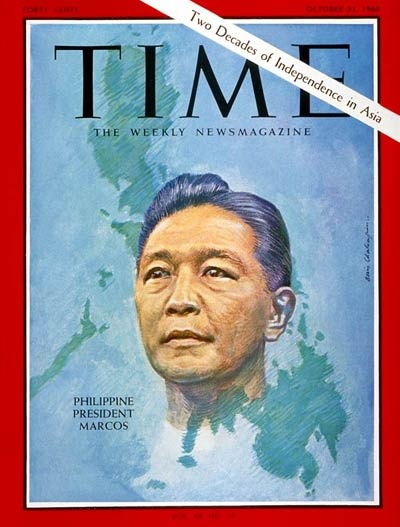
Marcos became President after the 1965 elections. He was reelected in 1969 with a record majority. During his first term, Ferdinand Marcos launched major public works projects that improved infrastructure and quality of life while rewarding political allies. His promised land reform was not seriously pursued to avoid angering powerful landowners. He sought strong economic and military support from the United States and kept Philippine involvement in the Second Indochina War limited. In 1967, the Philippines became a founding member of ASEAN. After his reelection in 1969, Marcos soon faced economic decline, rising crime, and growing unrest. A renewed communist insurgency led by the Communist Party of the Philippines and its armed wing, the New People’s Army, emerged, while the Moro National Liberation Front began fighting in Muslim regions. Political violence increased, prompting Marcos to suspend habeas corpus and eventually declare martial law in 1972.
Martial law lasted until 1981. Although Marcos promoted the idea of a “New Society,” his regime became associated with widespread corruption involving his cronies and his wife, Imelda Marcos. Despite lifting martial law and proclaiming a “New Republic” in 1981, little changed politically, and Marcos easily secured reelection with continued U.S. support.
After taking office in 1965, he improved his country's infrastructure but failed to lift the economy. As the years wore he became increasingly dictatorial. Marcos labeled his government as "authoritarian" not "a dictatorship. He ruled the Philippines like a party boss, dispensing favors to loyal followers and handing over big contracts and concessions to his wealthy friends.
Eric Pace wrote in the New York Times, “While he was President, Mr. Marcos was not apologetic about departing from the norms of Western democracy. ''What we ask of the developed countries,'' he wrote in 1982, ''is to let the third world find a third way. We must now create a political and economic system responsive to our unique character and our special realities.'' Defending his right to rule by decree, if he chose, he asserted that otherwise ''you will have Communists going back and forth, causing the dastardly ruin of our country, the killing of people and the rape of women.'' [Source: Eric Pace, New York Times, September 29, 1989 ]
RELATED ARTICLES:
FERDINAND MARCOS: HIS LIFE, LIES, EDUCATION, WAR RECORD, POLITICAL RISE factsanddetails.com
INDEPENDENCE FOR THE PHILIPPINES AFTER WORLD WAR II factsanddetails.com
PHILIPPINES IN THE 1950s AND 60s: HUK REBELLION, MAGSAYSAY, GARCIA AND MACAPAGAL factsanddetails.com
IMELDA MARCOS: HER LIFE, LIFESTYLE, ASSASSINATION ATTEMPT factsanddetails.com
MARTIAL LAW YEARS UNDER FERDINAND MARCOS factsanddetails.com
MARCOS’S PLUNDER AND WEALTH factsanddetails.com
NINOY AQUINO: HIS LIFE, POLITICAL CAREER, EXILE AND THE ANTI- MARCOS OPPOSITION factsanddetails.com
ASSASSINATION OF NINOY AQUINO factsanddetails.com
PEOPLE POWER AND THE FALL OF MARCOS factsanddetails.com
MARCOS AFTER HIS DEATH: HIS EMBALMED BODY AND EFFORT TO GIVE HIM A HERO’S BURIAL factsanddetails.com
IMELDA MARCOS AFTER FERDINAND'S DEATH: FASHION, POLITICS, PAINTINGS, LAWSUITS factsanddetails.com
POLITICAL COMEBACK OF THE MARCOSES factsanddetails.com
FERDINAND “BONGBONG” MARCOS factsanddetails.com
Marcos Elected with High Hopes in 1965
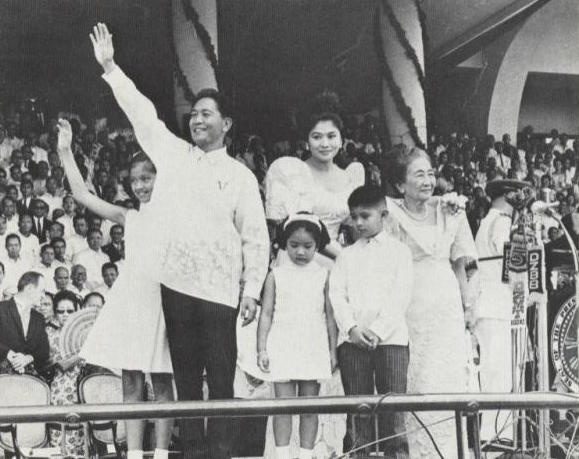
Marcos became president when he defeated Macapagal in the 1965 elections. He used the slogan “This nation can be great again” and became the first Philippine president to win two terms in office. According to Lonely Planet: “At first it indeed was a new era, and Marcos and his even more charismatic wife Imelda went about trying to bring back some of Manila's pre-war energy. Imelda drove projects like the Cultural Center for the Philippines, which got lots of international attention.” [Source: Lonely Planet]
Marcos’s government was initially considered a showcase for democracy. During his first term as president, Marcos initiated ambitious public works projects — roads, bridges, schools, health centers, irrigation facilities, and urban beautification projects — that improved the quality of life and also provided generous pork barrel benefits for his friends. Massive spending on public works was, politically, a cost-free policy not only because the pork barrel won him loyal allies but also because both local elites and ordinary people viewed a new civic center or bridge as a benefit. By contrast, a land reform program — part of Marcos's platform as it had been that of Macapagal and his predecessors — would alienate the politically all-powerful landowner elite and thus was never forcefully implemented. [Source: Library of Congress *]
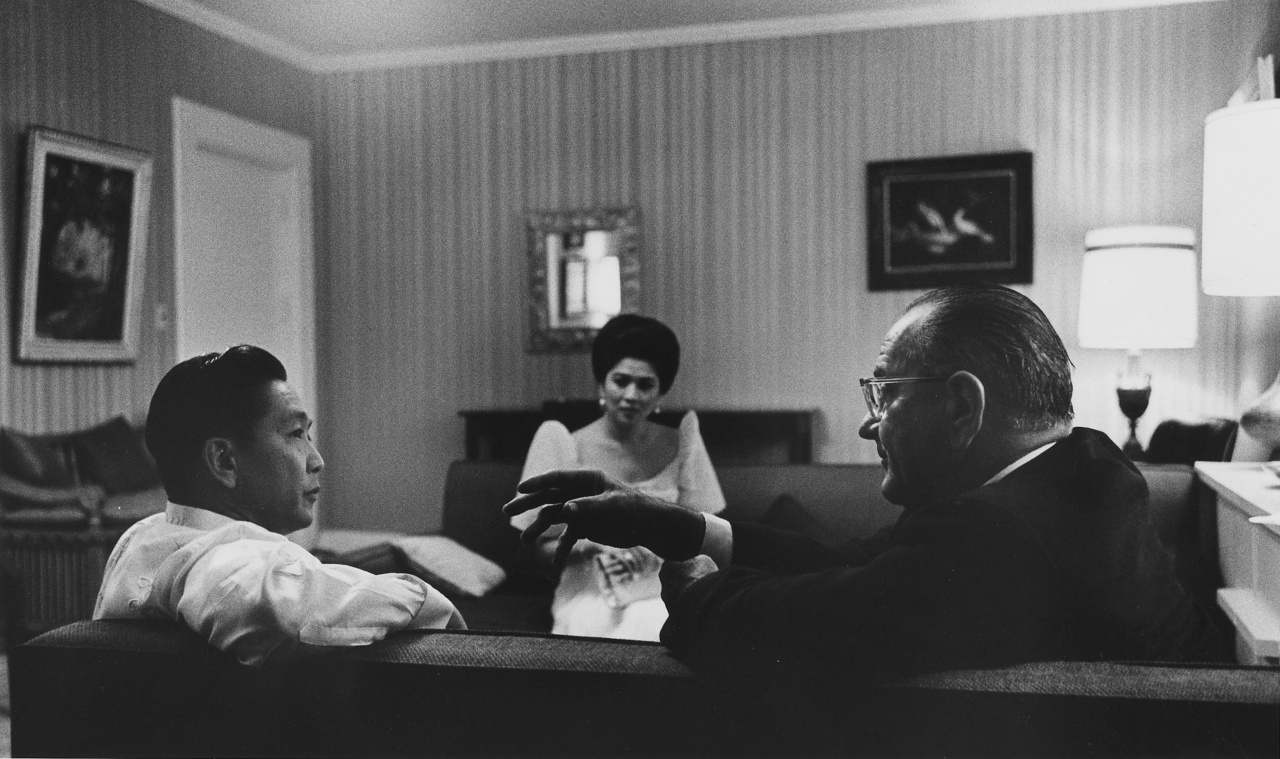
Marcos lobbied rigorously for economic and military aid from the United States but resisted pressure from President Lyndon Johnson to become significantly involved in the Second Indochina War. Marcos's contribution to the war was limited to a 2,000- member Philippine Civic Action Group sent to the Republic of Vietnam (South Vietnam) between 1966 and 1969. The Philippines became one of the founding members of the Association of Southeast Asian Nations (ASEAN), established in 1967. *
The Philippines Under Marcos
Marcos presided over an economy that grew at the beginning of his 20-year rule, but it ended with the loss of livelihoods and extreme poverty for nearly half of the Philippine population, combined with a debt crisis. He pursued infrastructure development funded by foreign debt, which made him popular during his first term. However, the aid triggered an inflation crisis that led to social unrest during his second term. The Philippines experienced strong economic growth throughout much of the 1970s, but its fortunes dropped sharply in the early 1980s due to soaring debt and global interest rates, according to economists. According to World Bank data, the economy contracted by nearly 15 percent during the last two years of the Marcos administration. [Source: Karen Lema and Tom Allard, Reuters,May 10, 2022; Wikipedia]
In the 1950s, Filipinos was probably the best fed country in Asia. During the Marcos period, people in India, Indonesia and perhaps Bangladesh ate better than Filipino. A staggering 40 percent of all the nation’s death were caused by malnutrition. Under the Marcos government 80 percent of the Philippines’ people live below poverty line and 75 percent of the land was owned by 2 percent of the people. More than a half a million women prostituted themselves. [Source: people.brandeis.edu]
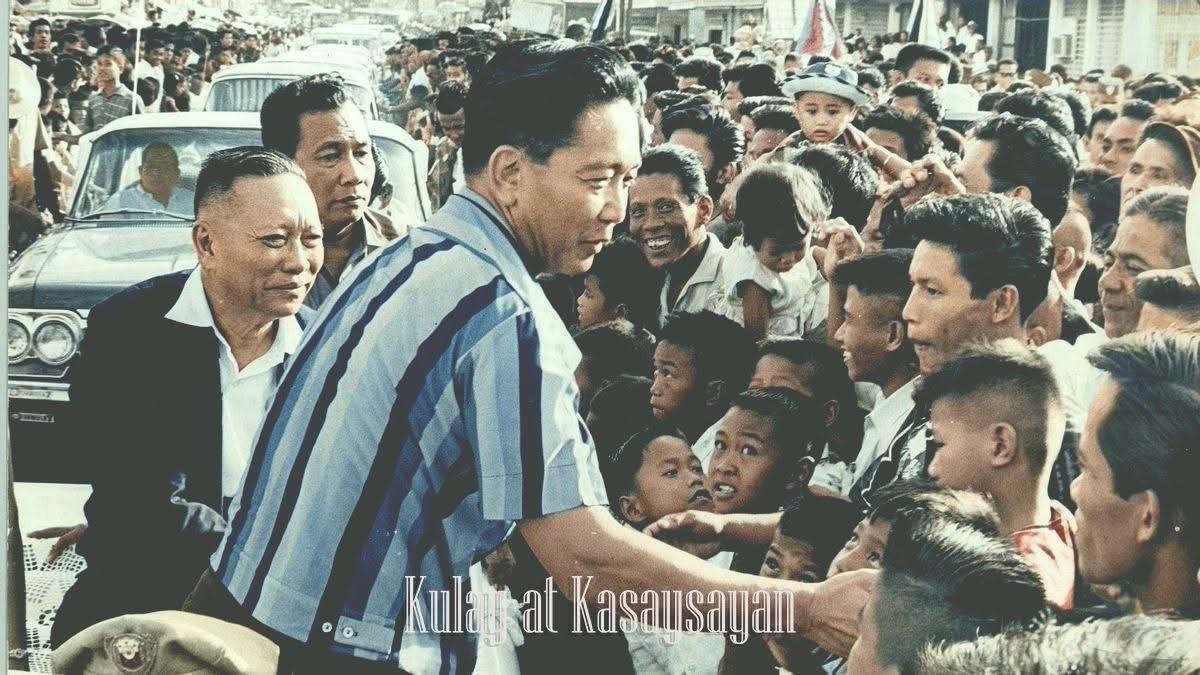
Amnesty International estimates 34,000 people were tortured and 3,240 killed under Marcos. Lonely Planet reported: “By 1970, widespread poverty, rising inflation, pitiful public funding and blatant corruption triggered a wave of protests in Manila. When several demonstrators were killed by police outside the presidential Malacañang Palace, Marcos' image as a political saviour died with them. However he still had a hugely powerful backer in the form of the US military, whose Clark and Subic Bay bases were vital to the Vietnam War.
Marcos' leadership was also marked by political turmoil that was partly the result of widespread unemployment and the gap between the lower class poor and the upper class elite. Under Marcos, the poor were encouraged to improve their lives by eating earthworms and snails for protein. Television shows were often interrupted for Marcos speeches. His solution to the Philippines’s deforestation problem was to decree that every Filipino over the age of 10 had to plant and maintain one tree for five years to offset the logging done by his cronies.
King Ferdinand and Queen Imelda
Ferdinand and Imelda lived like a king and queen in their riverside palace. With her husband’s support, Imelda Marcos built her own power base. She became governor of Metropolitan Manila and minister of human settlements.
When Pope John Paul II visited the Philippines in 1981, Mr. Marcos had bronze medals struck depicting himself and the Pope. The Cultural Center that Marcos built hosted the Bolshoi Ballet, Frank Sinatra and Placido Domingo. AFP reported: “In the glory days of the 1970s, the world's best ballerina, Margot Fonteyn, brought great pleasure to those in the 1,893-seat main theatre. That halcyon era also saw tenor Placido Domingo sing for the opera "Tosca", while the Bolshoi Ballet performed "Swan Lake" and Frank Sinatra cast his famous blue eyes across an enraptured audience.” [Source: Agence France-Presse, September 24, 2009]
The previously nonpolitical armed forces became highly politicized, with high-ranking positions being given to Marcos loyalists.
“Over the years, Mr. Marcos's hand was strengthened by the support of the armed forces, whose size he tripled, to 200,000 troops, after declaring martial law in 1972. The forces included some first-rate units as well as thousands of unruly and ill-equipped personnel of the civilian home defense forces and other paramilitary organizations. In the martial-law years, he also consolidated his parliamentary power and curbed civil liberties, harassing or exiling political opponents.
Philippine’s Claim to Sabah
Marcos inherited the territorial dispute over Sabah. In 1968, he approved a congressional bill annexing Sabah to the Philippines. Malaysia, whose federation had included Sabah since 1963, suspended diplomatic relations, and the matter was referred to the United Nations. [Source: Columbia Encyclopedia, 6th ed., Columbia University Press]
In the 1960s there were disputes between the Philippines and Malaysia over Sabah in northeast Borneo, The Philippines objected to the formation of the Malaysian federation, which including Sarawak and Sabah in northern Borneo, claiming North Borneo was part of Sulu, and thus the Philippines. It was discovered, after an army mutiny and murder of Muslim troops in 1968 (the "Corregidor Incident") that the Philippine army was training a special unit to infiltrate Sabah.
Philippine Muslims regard themselves as descendants of the Royal Sultanate of Sulu. The Royal Sultanate of Sulu was an Islamic kingdom that ruled the islands and seas in the southern Philippines and northern Borneo long before the arrival of the Spanish in the 15th century.
In 1966 the new president, Ferdinand Marcos, dropped the claim, although it has since been revived and is still a point of contention marring Philippine-Malaysian relations. The Philippines’ differences with Malaysia did not involve organized violence but were longer lasting. A legally complex territorial dispute over Sabah led to the occasional suspension of diplomatic relations between 1963 and 1968, although relations were restored in December 1969. Relations were later strained as Sabah’s chief minister allowed Muslim insurgents from the Philippines to use Sabah as a haven until he lost an election in April 1976. [Source: Wikipedia]
Marcos and Resistance Movements in the Philippines
The Marcos government brutally suppressed the ongoing and renewed Hukbalahap (Huk) insurgency, which was sparked in Central Luzon by the need for land reform , and was accompanied by a surge in assassinations and acts of terror. In 1969, Marcos initiated a significant military campaign to suppress the uprising. The Maoist-oriented New People's Army (NPA), linked with the Huks, gathered force in the early 1970s. [Source: Worldmark Encyclopedia of Nations, Thomson Gale, 2007]
Communist insurgency, particularly the activity of the Huks — had degenerated into gangsterism during the late 1950s, but the Communist Party of the Philippines-Marxist Leninist, usually referred to as the CPP, was "reestablished" in 1968 along Maoist lines in Tarlac Province north of Manila, leaving only a small remnant of the orgiinal PKP. The CPP's military arm, the New People's Army (NPA), soon spread from Tarlac to other parts of the archipelago. [Source: Library of Congress *]
President Marcos declared martial law in September 1972 in part on the claim that a Communist rebellion threatened the entire country. Marcos's government did swell the ranks of Communist guerrilla groups, which continued to grow into the mid-1980s and continued on a smaller scale into the 21st century. [Source: Columbia Encyclopedia, 6th ed., Columbia University Press]
In the south , armed opposition by Muslim groups was organized around the Moro National Liberation Front (MNLF), which was was organized in Malaysia in 1969. On Mindanao and in the Sulu Archipelago, violence between Muslims and Christians, the latter often recent government-sponsored immigrants from the north, was on the rise. The MNLF conducted an insurrection supported by Malaysia and certain Islamic states in the Middle East, including Libya. In the early 1970s, the fighting on Mindanao had spread to the Sulu Archipelago. By 1973 some 3,000 people had been killed and hundreds of villages burned. [Source: Columbia Encyclopedia, 6th ed., Columbia University Press]
Marcos and the United States
Marcos was propped up by the U.S. government which provided economic aid to the Philippines and trained the Philippine military and police in return for permission to keep American soldiers in American military bases on the Philippines and be a bulwark against Communism in Asia. During the Vietnam War era, when the Philippines was a key American ally, the United States had a major naval base at Subic Bay and a major air force base at Clark Air Force base, with 16,000 U.S. military personnel.
The Vietnam War and the continued U.S. military presence in the Philippines sparked anti-American protests and riots in the late 1960s and early 1970s. These tensions helped strengthen the authoritarian rule of Ferdinand Marcos, who declared martial law in 1972 and established a dictatorship. Although American economic interests in the Philippines had declined compared to Japanese and Taiwanese investments, the strategic importance of U.S. military bases led the Richard Nixon and Gerald Ford administrations to remain largely silent about the collapse of democracy. [Source: Dictionary of American History, Gale Group Inc., 2003]
In the mid-1970s, increasing domestic criticism of Marcos resulted in harsher repression, including killings and mass imprisonments. The United States, prioritizing military base agreements, continued to overlook human rights abuses. Under Jimmy Carter, a new agreement on U.S. bases was reached in 1979, and American economic aid persisted despite the regime’s record.
By the 1980s, rising unrest posed challenges for the Ronald Reagan administration. Although Reagan personally supported Marcos for Cold War reasons, the 1983 assassination of opposition leader Benigno Aquino Jr. intensified instability and threatened U.S. interests. With major bases such as Clark Air Field and Subic Bay Naval Station at stake, Washington pressured Marcos to reform, but continued repression fueled protests, a revived communist insurgency by the New People’s Army, and renewed Muslim guerrilla attacks.
U.S. President Ronald Reagan supported Marcos during most his time in office. After one clearly rigged election, Reagan stood up for Marcos, saying, “There was cheating on both sides.” On a visit t the Philippines, Reagan’s vice president, George Bush, proclaimed “love” for Marcos and his “devotion to the democratic process.” To gather information about Marcos' health the CIA reportedly tried to retrieve the contents of his visits to the toilet while in Washington.
Eric Pace wrote in the New York Times, “His ties with Washington were of long standing. Early in his presidency, Mr. Marcos was a strong defender of American involvement in Vietnam, and he maintained close relations with Washington in the years that followed. Those relations soured somewhat under the Carter Administration, which included the Philippines among the targets of its human-rights campaign. But Vice President George Bush appeared to signal a different tack in 1981 when he visited Manila and told Mr. Marcos: ''We love your adherence to democratic principles and to democratic processes. We will not leave you in isolation.'' Mr. Bush said the next day that he had been speaking generally of American allies in Southeast Asia, but his remarks were associated in the public mind with the Philippines and came to be quoted with ironic intent.” [Source: Eric Pace, New York Times, September 29, 1989]
Marcos’s Second Term
In November 1969, Marcos won an unprecedented reelection, easily defeating Sergio Osmeña, Jr. However, the election was accompanied by violence and fraud allegations, and Marcos's second term began amid growing civil unrest. Although Marcos was decisively reelected with 62 percent of the vote and was was the first president of the independent Philippines to gain a second term the atmosphere of optimism that characterized his first years in power was largely dissipated. Economic growth slowed. Ordinary Filipinos, especially in urban areas, noted a deteriorating quality of life reflected in spiraling crime rates and random violence.
The carefully crafted "Camelot" atmosphere of Marcos's first inauguration, in which he cast himself in the role of John F. Kennedy with Imelda as his Jackie, gave way in 1970 to general dissatisfaction with what had been one of the most dishonest elections in Philippine history and fears that Marcos might engineer change in the 1935 constitution to maintain himself in power. On January 30, 1970, the "Battle of Mendiola," named after a street in front of the Malacañang Palace, the presidential mansion, pitted student demonstrators, who tried to storm the palace, against riot police and resulted in many injuries. *
Random bombings, officially attributed to communists but probably set by government agents provocateurs, occurred in Manila and other large cities. Most of these only destroyed property, but grenade explosions in the Plaza Miranda in Manila during an opposition Liberal Party rally on August 21, 1971, killed 9 people and wounded 100 (8 of the wounded were Liberal Party candidates for the Senate). Although it has never been conclusively shown who was responsible for the bombing, Marcos blamed leftists and suspended habeas corpus — a prelude to martial law. But evidence subsequently pointed, again, to government involvement. *
Government and opposition political leaders agreed that the country's constitution, American-authored during the colonial period, should be replaced by a new document to serve as the basis for thorough-going reform of the political system. In 1967 a bill was passed providing for a constitutional convention, and three years later, delegates to the convention were elected. It first met in June 1971. *
The 1935 constitution limited the president to two terms. Opposition delegates, fearing that a proposed parliamentary system would allow Marcos to maintain himself in power indefinitely, prevailed on the convention to adopt a provision in September 1971 banning Marcos and members of his family from holding the position of head of state or government under whatever arrangement was finally established. But Marcos succeeded, through the use of bribes and intimidation, in having the ban nullified the following summer. Even if Marcos had been able to contest a third presidential term in 1973, however, both the 1971 mid-term elections and subsequent public opinion polls indicated that he or a designated successor — Minister of National Defense Juan Ponce Enrile or the increasingly ambitious Imelda Marcos — would likely be defeated by his arch-rival, Senator Benigno "Ninoy" Aquino. *
Image Sources: Wikimedia Commons
Text Sources: Library of Congress, Philippines Department of Tourism, Philippines government websites, Encyclopedia.com, New York Times, Washington Post, Los Angeles Times, Wikipedia, “Encyclopedia of World Cultures Volume 5: East/Southeast Asia:” edited by Paul Hockings, 1993, UNESCO, National Commission for Culture and the Arts (NCCA) the official government agency for culture in the Philippines), Lonely Planet Guides, The Guardian, National Geographic, Smithsonian magazine, The New Yorker, Time, The Conversation, BBC, CNN, Reuters, Associated Press, AFP, Google AI, and various websites, books and other publications.
Last updated February 2026