
FERDINAND “BONGBONG” MARCOS
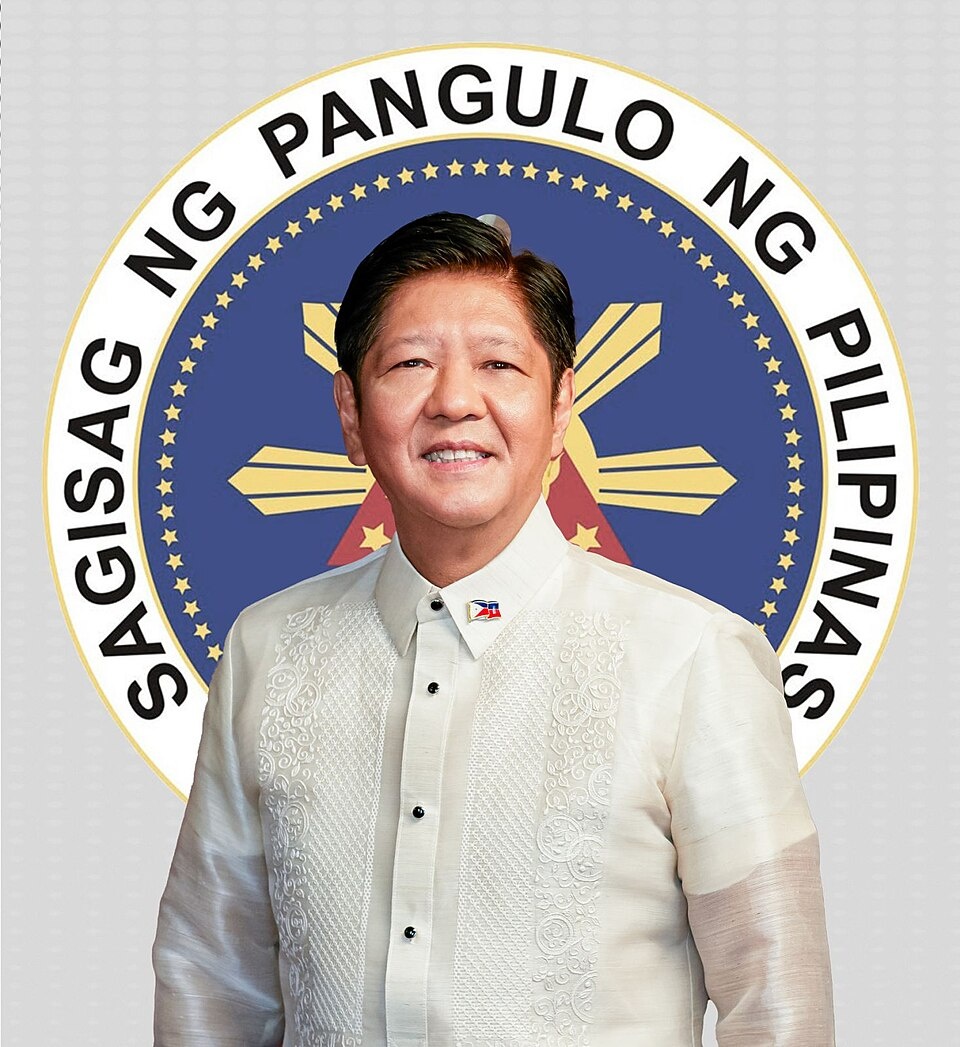
Ferdinand “Bongbong” Romualdez Marcos Jr. (born 1957) is widely known as BBM or PBBM. Elected the 17th president of the Philippines in 2022, he is the second child and only son of former president Ferdinand Marcos and former first lady Imelda Marcos. Aside from his nickname “Bongbong,” he is also known among peers as “Bonggets.” He is a fan of rock and roll, rhythm and blues, and jazz. He once kept a record collection at Malacañang Palace that he described as “the best record collection in the Philippines,” but he left it behind when his family went into exile in 1986. He was a fan of The Beatles and cited their album Sgt. Pepper's Lonely Hearts Club Band as his favorite. He also collected Beatles memorabilia and played the saxophone. [Source: Wikipedia]
Bongbong Marcos is married to lawyer Louise “Liza” Cacho Araneta, a member of the prominent Araneta family. They were wed in Fiesole, Italy, on April 17, 1993. The couple have three sons: Ferdinand Alexander III “Sandro” (born 1994), Joseph Simon (born 1995), and William Vincent “Vinny” (born 1997). Marcos exercises regularly and said he abstains from sweets and soft drinks. He enjoys cooking, reading, watching films, and firearms, and he sponsored a shooting competition bearing his name. He follows Formula One racing as a supporter of Scuderia Ferrari and, during his presidency, attended the 2022 and 2023 Singapore Grand Prix with Prime Minister Lee Hsien Loong and other foreign dignitaries.
Bongbong was 28 at the time of the 1986 EDSA uprising — the People Power Revolution led by Cory Aquino which ousted his father. Bongbong, Ferdinand S., Imelda and the rest of the family went into exile in Hawaii.. The Marcoses were whisked from the Philippines' presidential palace by helicopter, flown out of the Philippines aboard a U.S. Air Force aircraft and initially stayed at Hickam Air Force Base before eventually settling more permanently in the state. Soon after arriving in Hawaii, Bongbong tried to withdraw $200 million from a secret family account with Credit Suisse in Switzerland. The move led to the freezing of the account, drawing further scrutiny to the family’s alleged overseas assets.
During his time in exile, Marcos Jr. publicly maintained a defiant stance regarding the events that forced his family from power. In a 1989 interview, he said he did not regard the EDSA uprising as a true revolution and suggested that it did not reflect the will of the majority of Filipinos. Despite the political upheaval and legal challenges surrounding the family, Marcos Jr. later acknowledged that members of the Filipino community in Hawaii offered assistance and support to them during their years in exile.
RELATED ARTICLES:
POLITICAL COMEBACK OF THE MARCOSES factsanddetails.com
2022 PHILIPPINE ELECTIONS factsanddetails.com
IMELDA MARCOS AFTER FERDINAND'S DEATH: FASHION, POLITICS, PAINTINGS, LAWSUITS factsanddetails.com
IMELDA MARCOS: HER LIFE, LIFESTYLE, ASSASSINATION ATTEMPT factsanddetails.com
RODRIGO DUTERTE: HIS LIFE, FAMILY, PERSONALITY AND OUTRAGEOUS STATMENTS factsanddetails.com
RODRIGO DUTERTE AS PRESIDENT factsanddetails.com
DUTERTE’S WAR ON DRUGS: DEATHS, TACTICS, RHETORIC, FAILURES factsanddetails.com
FERDINAND MARCOS: HIS LIFE, LIES, EDUCATION, WAR RECORD, POLITICAL RISE factsanddetails.com
FERDINAND MARCOS AS PRESIDENT: EARLY PROMISE, RESISTANCE, WASTE factsanddetails.com
MARTIAL LAW YEARS UNDER FERDINAND MARCOS factsanddetails.com
MARCOS’S PLUNDER AND WEALTH factsanddetails.com
MARCOS AFTER HIS DEATH: HIS EMBALMED BODY AND EFFORT TO GIVE HIM A HERO’S BURIAL factsanddetails.com
Bongbong’s Early Life
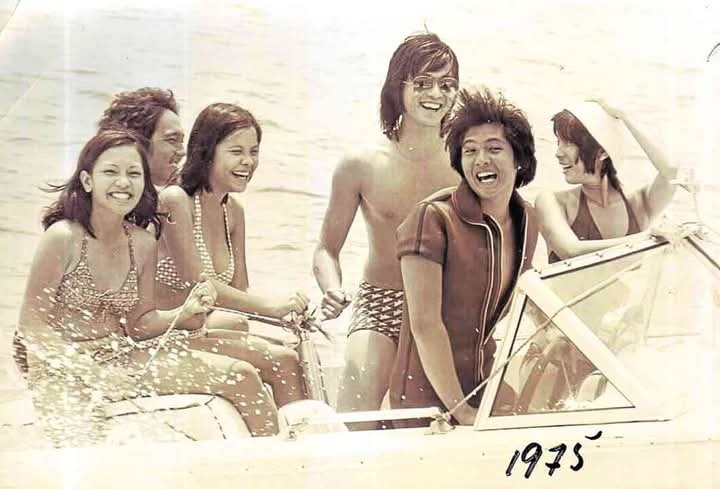
Bongbong Marcos was born as Ferdinand Romualdez Marcos Jr. on September 13, 1957, to Ferdinand Marcos and Imelda Marcos at a hospital in Santa Mesa, Manila, Philippines, which was later named Our Lady of Lourdes Hospital.h. At the time, his father was serving as representative for the second district of Ilocos Norte and became a senator two years later. Although he is Ilocano by ancestry, he was raised in a Manileño household and did not speak the Ilocano language. The Marcos family maintained a residence in Forbes Park, Makati. Bongbong's godfathers included prominent figures and future Marcos associates such as Eduardo "Danding" Cojuangco Jr. and pharmaceutical magnate Jose Yao Campos. [Source: Wikipedia]
Bongbong’s father, Ferdinand E. Marcos, was the 10th president of the Republic. Bongbong described his early life as a blend of “normal” childhood experiences within an extraordinary and high-pressure environment shaped by his father’s presidency and what he portrayed as a destined path toward public service. Bongbong spent much of his childhood in Malacañang Palace, where he was exposed at an early age to the workings of national leadership. He later characterized this period as both formative and demanding, saying he grew up observing governance firsthand.
Marcos moved into Malacañang at age seven. He recalled initially finding the Palace “dark and old” and even fearing it might be haunted. Despite the formal setting and the security surrounding the presidential residence, he maintained that his upbringing was “as much as it was possible to have a normal childhood.” His father nicknamed him “Bongbong,” derived from bumbong, a bamboo water container, because as a child he would cling playfully to his father’s back.
Marcos has portrayed his upbringing as a “master class” in governance, saying that watching his father lead prepared him for public office. At the same time, historical records, including his father’s 1972 diary entries, suggest that questions about his diligence and seriousness emerged early on. From a young age, he was thrust into public view. At age eight, he appeared as himself in the 1965 biographical film Iginuhit ng Tadhana, which depicted his father’s rise to power and foreshadowed his own political future. He also recalled witnessing the so-called “Manila incident” involving The Beatles during their 1966 visit to the Philippines, an episode that drew international attention.
In an interview with Reuters, Marcos acknowledged his privileged upbringing but said his parents had reminded him and his siblings that “everything we have, all the advantages that we have gained, any successes that we have achieved, and any comfort or privilege that we enjoy comes from the people. And that is why you have to serve.”
Bongbong’s Education
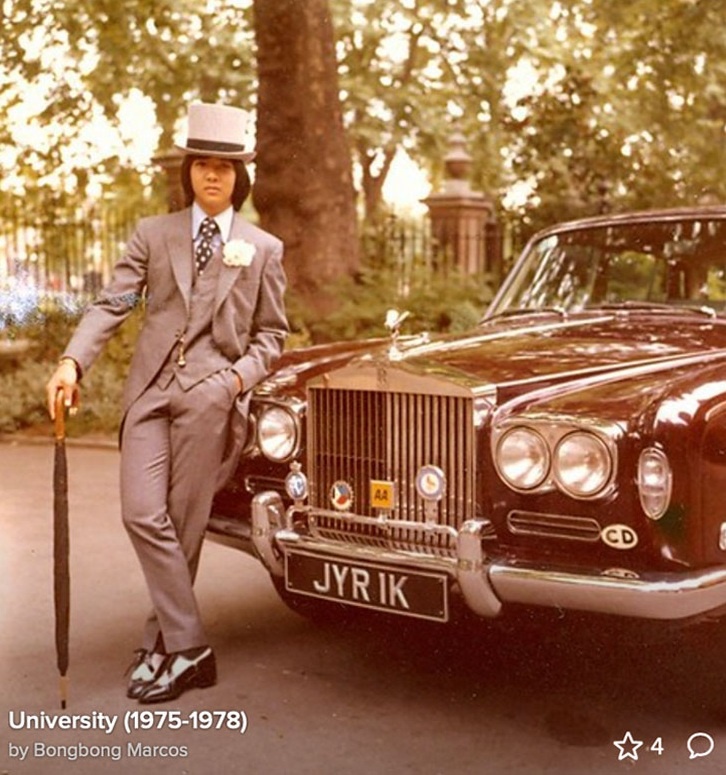
Marcos first studied at Institución Teresiana in Quezon City and later attended La Salle Green Hills in Mandaluyong, where he completed his kindergarten and elementary education, respectively. [Source: Wikipedia]
In 1970, he was sent to England, where he lived and studied at Worth School, an all-boys Benedictine institution in West Sussex. He was studying there when his father declared martial law throughout the Philippines in 1972. Archival accounts from that year, including his father’s diary, reportedly described him as “too carefree and lazy,” reflecting concerns about his discipline and work ethic.
Marcos later attended the Center for Research and Communication, where he took a special diploma course in economics but did not complete it. He then enrolled at St Edmund Hall, a college of the University of Oxford, to study philosophy, politics, and economics (PPE). Although he claimed that he graduated with a bachelor of arts degree in PPE, he did not obtain such a degree. He passed philosophy but failed economics and failed politics twice, making him ineligible for graduation. Instead, he received a special diploma in social studies, which was primarily awarded to non-graduates and is no longer offered by the university. Despite this, Marcos continued to claim that he earned a degree from Oxford, although the university confirmed in 2015 that he did not complete the program.
He later enrolled in the master of business administration program at the Wharton School of the University of Pennsylvania in Philadelphia, United States, but he did not complete the program. Marcos stated that he withdrew after being elected vice governor of Ilocos Norte in 1980. The Presidential Commission on Good Government later reported that his tuition, his monthly allowance of US$10,000 (equivalent to 492,500 in 2025), and the estate where he lived while studying at Wharton were funded using money traced partly to the intelligence funds of the Office of the
Bongbong’s Alleged Drug Use
On November 18, 2021, President Rodrigo Duterte claimed in a televised speech that a candidate in the 2022 presidential election was using cocaine, without naming the individual but using male pronouns and describing the candidate as a “weak leader” who was “capitalizing on his father’s accomplishments.” Duterte had previously criticized Marcos as a “weak leader” and a “spoiled child.” [Source: Wikipedia]
Days after the allegation, Marcos took a cocaine drug test at St. Luke's Medical Center – Global City and submitted a negative result to authorities, with the hospital issuing a memo confirming the legitimacy of the test. He said he did not believe he was the person Duterte had referred to. In an April 2022 interview with CNN Philippines, Marcos described Duterte’s remarks as political maneuvering.
In May 2022, former senator Nikki Coseteng alleged in an interview that Marcos had used illegal substances during his youth. Marcos neither confirmed nor denied her claims. In January 2024, Duterte again raised allegations of Marcos’s supposed cocaine use during a prayer rally in Davao City, claiming that Marcos had once appeared on a watchlist of the Philippine Drug Enforcement Agency (PDEA), an assertion the agency denied. Duterte also alleged that Marcos had used cocaine at a plantation in Davao del Norte. Marcos rejected the accusations and said he had never used illegal narcotics. He also criticized Duterte’s admitted use of fentanyl, which Duterte said had been prescribed by a doctor at St. Luke's Medical Center – Quezon City for pain from past injuries.
In April 2024, documents purportedly from the PDEA circulated online linking Marcos and actress Maricel Soriano to illegal drugs. The Senate Committee on Public Order and Dangerous Drugs, chaired by Senator Ronald dela Rosa, held hearings on the matter. Former PDEA agent Jonathan Morales said the documents were authentic, while PDEA Director General Moro Virgilio Lazo said they were fake.
On May 20, 2024, the Senate panel cited Morales in contempt for what it described as false statements and ordered his detention upon the motion of Senator Jinggoy Estrada, seconded by dela Rosa. A former National Police Commission officer, Eric “Pikoy” Santiago, was also cited in contempt. Both men were released on May 23, 2024. In August 2024, a municipal trial court in San Fernando, Pampanga convicted Morales of perjury, sentencing him to four months’ imprisonment and a fine.
In November 2025, Marcos’s sister Imee Marcos publicly alleged during a rally in Manila that their family had long been aware of his supposed drug problem, citing statements from their father regarding his behavior.
President and partly to several bank accounts the Marcos family had secretly opened in the United States under assumed names.
Bongbong’s Political Career and Vice President Run
In 1980, he was elected vice governor of Ilocos Norte, running unopposed under his father’s Kilusang Bagong Lipunan party during the period of martial law. He became governor in 1983 and held the post until the 1986 People Power Revolution ousted the Marcos family, forcing them into exile in Hawaii. After his father’s death in 1989, President Corazon Aquino permitted the family to return to the Philippines to face legal cases, and in 1991 he became the first Marcos to return. Marcos and his mother have faced U.S. court orders to pay $353 million in restitution to victims of human rights abuses during the dictatorship; however, as a sitting president he is able to travel to the United States under diplomatic immunity. [Source: Wikipedia]
Marcos was elected representative of Ilocos Norte’s second district from 1992 to 1995 and returned as governor in 1998. After nine years, he again served as representative from 2007 to 2010 before winning a Senate seat under the Nacionalista Party, serving from 2010 to 2016. In the 2016 elections, Leni Robredo was the winner of the vice presidential race. And proclaimed Vice President on May 30, 2016 in the House of Representatives. Robredo narrowly defeated Bongbong Marcos. Bongbong Marcos filed an electoral protest through the Presidential Electoral Tribunal, but that was unanimously dismissed in 2021 after a recount widened Robredo’s margin. [Source: Wikipedia +]
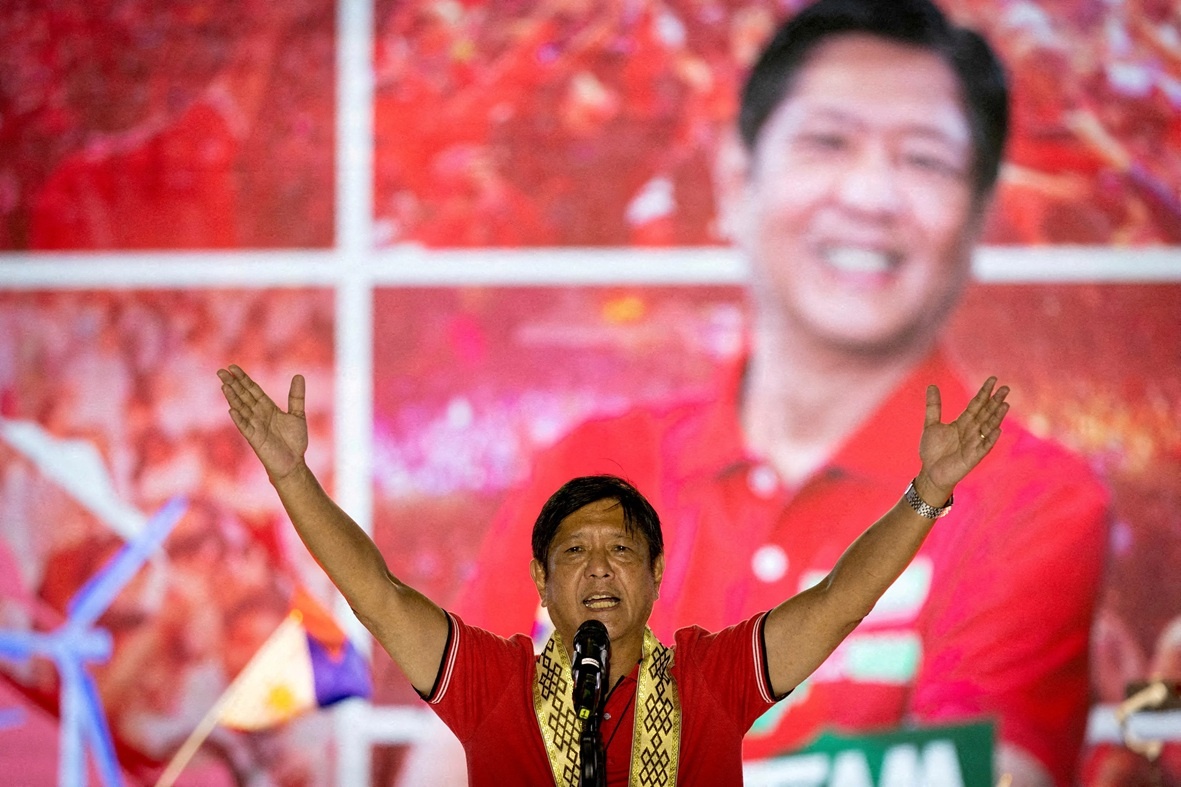
1996 Philippines Vice Presidential Election Results
Candidate — Party — Votes — Percent
Leni Robredo — Liberal Party — 14,418,817 — 35.11
Bongbong Marcos — Independent — 14,155,344 — 34.47
Alan Peter Cayetano — Independent — 5,903,379 — 14.38
Francis Escudero — Independent — 4,931,962 — 12.01
Antonio Trillanes — Independent — 868,501 — 2.11
Gregorio Honasan — United Nationalist Alliance — 788,881 — 1.92
After the election, Bongbong’s team issued a statement raising concerns about “contradictions” and possible “irregularities” in the results. According to them he was ahead in all exit polls and appeared to be winning in the “quick count” of preliminary results until around 9 p.m. on election night when his substantial lead began to erode. Shortly afterward, Robredo’s vote count began to rise, and Marcos linked this pattern to the allegation that a piece of computer code was entered into the election body’s server around that time. Bongbong supporters took to social media and the streets, alleging that the candidate was the victim of election fraud. For his part, Bongbong called for "calm and sobriety." [Source: Simon Lewis, Time, May 12, 2016]
Bongbong Marcos on the Legacy of His Family
In an interview with AFP in 2016, Bongbong said that rather than being apologetic about his family he was pround and that his name was a political asset rather than hinderance, repeating the no-apology stance that has underpinned his family’s political resurgence, arguing that he is benefiting from what he described as the accomplishments of his father’s administration. “I think one of the things that is happening now is I am a beneficiary of the good work that was done in my father’s time,” Marcos said at his campaign headquarters in Manila. “There were so many different things that were initiated at that time that to this day are of benefit to the people.” [Source: Karl Malakunas, Cecil Morella, AFP, April 18, 2016 ^]
During the 2022 Presidential election campaign Bongbong heaped praise on his father, the late dictator Ferdinand Marcos, calling him a as a “political genius” and describing his mother, Imelda Marcos, as the Marcos dynasty’s “supreme politician.” Bongbong described his father, as his “idol”: “My father is the statesman, he is the political genius, he is all that,” Marcos said. [Source: Reuters, April 26, 2022]
Marcos Jr., who rarely grants interviews, dismissed claims of massive corruption by his parents, suggesting that many of the allegations were exaggerated and saying he had not been involved in their decisions. When asked whether his family stole billions, he said he believed much of the information had not been properly verified and questioned the origins of the figures frequently cited. He did, however, concede that abuses occurred under his father’s regime, while arguing that such violations are not unique to that period. “I acknowledge that there were,” he said when asked about human rights abuses. “But there are widespread human rights abuses in any administration, and that is a problem that we as a country have to face.” ^
2022 Philippine Presidential Election
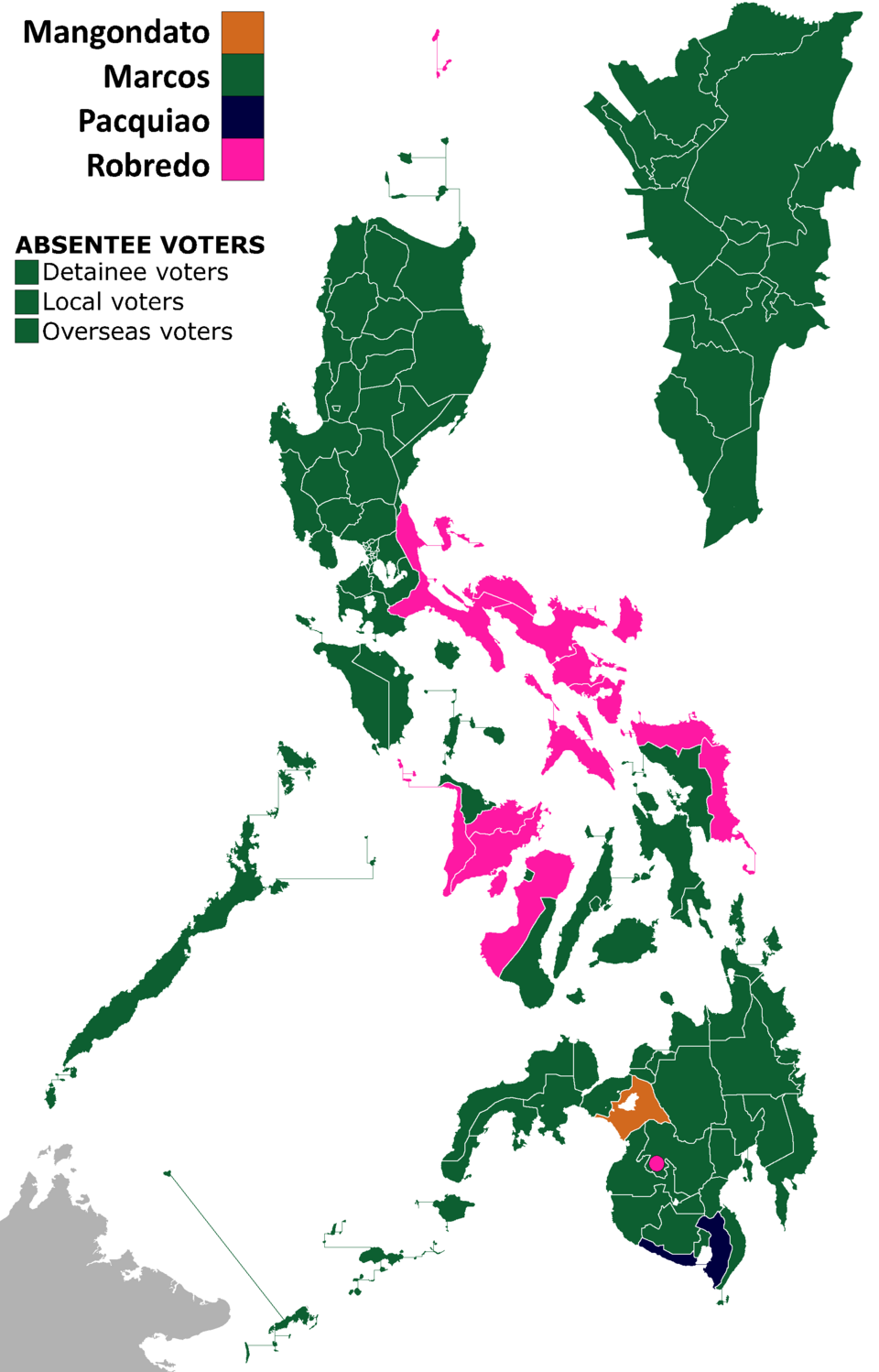
The 2022 Philippine presidential election was held on May 9 as part of the 2022 general elections. It was the country’s 17th direct presidential vote since 1935.The election took place during the COVID-19 pandemic, with major campaign issues including economic recovery from recession, the continuation of Duterte’s policies, foreign relations and territorial tensions with China, rising debt and inflation, and climate change. [Source: Wikipedia]
Ferdinand (Bongbong) Marcos Jr. Became President after he won by a landslide over former Vice President Leni Robredo and Senator Francis Pangilinan. Davao City Mayor Sara Duterte (Sara Duterte-Carpio), former President Rodrigo Duterte’s daughter, won by a landslide for vice president, Sara Duterte helped Marcos get elected by agreeing to be his vice presidential running mate, allowing Marcos to tap into Rodrigo Duterte’s father's huge support base and secure a comeback for the disgraced Marcos dynasty. The Dutertes' strong backing in the southern Philippines, traditionally a weak base for the Marcos family, was seen as a major advantage.. Although there has been no formal quid pro quo, political experts said Marcos would likely do what he could to impede the International Criminal Court (ICC) investigation of Duterte for the alleged extrajudicial killings in his war on drugs.
Marcos became the second president from Ilocos Norte after his father, Ferdinand Marcos, signaling the Marcos family’s return to national power decades after the 1986 People Power Revolution. Sara Duterte became the first vice president from Davao City and the youngest ever elected to the post. She was inaugurated on June 19, 2022, and Marcos took office on June 30, 2022. Incumbent President Rodrigo Duterte was barred from seeking reelection under the 1987 Constitution’s single-term Robredo chose to run for president instead of seeking another term as vice president. The two offices were elected separately, allowing winners from different parties.
See Separate Article: 2022 PHILIPPINE ELECTIONS factsanddetails.com
Bongbong as President
As president, Marcos initially also served as agriculture secretary for 16 months. He expanded on Duterte’s “Build! Build! Build!” infrastructure drive with his own “Build Better More” program. In foreign policy, he pivoted toward closer ties with the United States, reversing the more China-focused stance of the previous administration. Amid escalating tensions with China in the West Philippine Sea, he repeatedly affirmed Philippine sovereignty, declaring in 2023 that the country “will not lose an inch of its territory.”
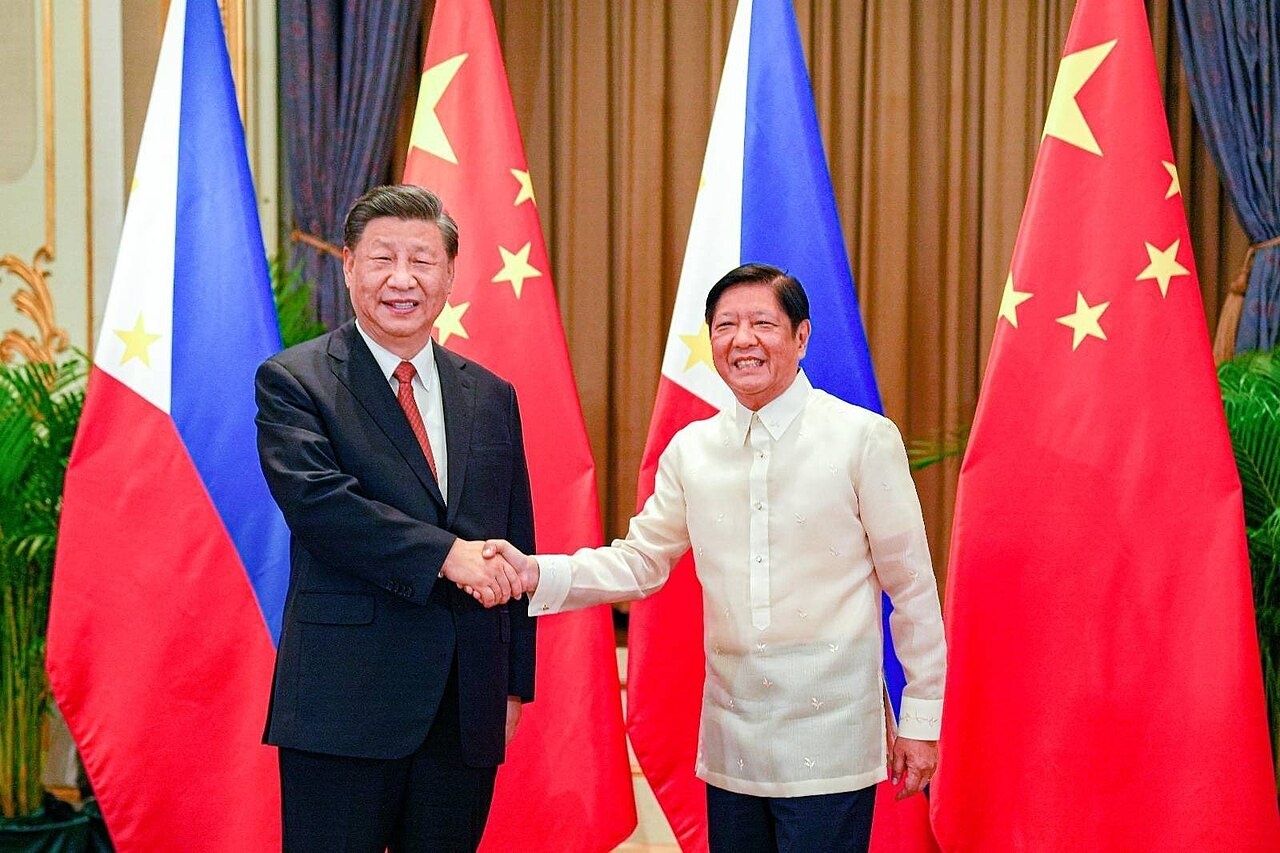
Bongbong took office with a large legislative majority. His sister, Imee, is a senator; his son, Ferdinand, is a congressman; and his cousin, Martin Romualdez, is the House Majority Leader. In 2025, younger Ferdinand was named Speaker of the House. This demonstrates the extent of the power the family will wield. He has said that he will focus on energy prices, jobs, infrastructure, and education.[Source: Neil Jerome Morales, Reuters, May 25, 2022]
In 2024, Marcos banned Philippine offshore gaming operators that had grown under Duterte, while Vice President Sara Duterte resigned from his cabinet amid deepening political tensions between their families. In 2025, his administration faced controversies including disputes over the national budget, the impeachment of Vice President Duterte, the arrest of former president Rodrigo Duterte, and a major infrastructure corruption scandal that he had initially exposed and condemned.
Sara Duterte — President Duterte's Daughter and Bongbong’s Vice President
Sara Duterte served as Vice President of the Philippines beginning in 2022 while Bongbong Marcos served as President. Before she became vice president, Sara Duterte served as mayor in Davao, where her father former president Rodrigo Duterte, also served as mayor. She served as mayor of Davao City from 2010 to 2013 and again from 2016 to 2022, and as vice mayor from 2007 to 2010.
Popularly known as “Inday Sara” and the mother of three, Sara Duterte (Sara Zimmerman Duterte-Carpio) was born on May 31, 1978. She is a lawyer and politician is the third woman to be vice president after Gloria Macapagal Arroyo and Leni Robredo, the third vice president from Mindanao, and the youngest person ever elected to the position.
Duterte graduated from San Pedro College, initially intending to pursue a career in medicine. She later studied law at San Beda College before completing her law degree at San Sebastian College–Recoletos. In 2007, she was elected vice mayor of Davao City. In 2010, she succeeded her father as mayor, becoming both the youngest and the first female mayor of the city. After serving one term, she stepped away from politics briefly, then returned in 2016 to reclaim the mayoralty and was reelected in 2019. During her second tenure, she launched initiatives such as Byaheng DO30 and Peace 911 and oversaw the city’s response to the COVID-19 pandemic. She also played a visible role in national politics during her father’s presidency, forging alliances with political parties and contributing to the 2018 removal of Pantaleon Alvarez as Speaker of the House.
In 2022, Duterte ran for vice president under Lakas–CMD and became the running mate of Bongbong Marcos of Partido Federal ng Pilipinas under the UniTeam alliance. Their ticket won by a landslide, marking the first time since 2004 that a presidential and vice-presidential tandem won together, and the first majority victory for both positions since the establishment of the Fifth Republic in 1986.
During her campaign Sara called for national unity, devotion to God and patriotism inspired by national hero Jose Rizal. She highlighted social challenges facing Filipino children, including poverty, broken families, illegal drugs, bullying and online misinformation, and urged parents to instill values such as integrity, discipline, respect and compassion. She drew national attention in 2011 after being filmed punching a court sheriff during a demolition dispute. Despite occasional public disagreements with her father, she publicly supported his 2016 presidential bid, even shaving her head in solidarity before he went on to win a single six-year term on promises to eradicate drugs and corruption. [Source: Jim Gomez, Associated Press June 19, 2022]
Sara Duterte was 44, when she became Vice President. She had declined appeals from supporters, including her father, to run for president but did not rule out a future bid. She had topped early presidential preference surveys and ultimately won the vice presidency by a wide margin, similar to Marcos Jr.’s victory.In addition to serving as vice president, she agreed to head the Department of Education, despite earlier reports that she preferred to lead the Department of National Defense, traditionally viewed as a stepping stone to the presidency. The education post provided her with a national platform, especially as the country sought to resume in-person classes after prolonged coronavirus lockdowns.
Marcos Beefs Up U.S. Military Presence in the Philippines
President Ferdinand Marcos Jr. expanded the United States’ military presence in the Philippines, calling it essential for safeguarding the country’s territory despite strong objections from China, which warned the move would “drag the Philippines into the abyss of geopolitical strife.” [Source: Jim Gomez, March 22, 2023]
In early February 2023, the Marcos administration announced it would permit rotating groups of American troops to stay indefinitely at four additional Philippine military camps, on top of the five bases previously designated under the 2014 Enhanced Defense Cooperation Agreement (EDCA) between the longtime treaty allies.
Marcos said the locations of the four new sites — including areas in northern Philippines — would be revealed soon. The prospect of expanded U.S. access in the north has angered Chinese officials, who view it as positioning American forces closer to southern China and Taiwan.
Marcos added that, under EDCA, U.S. forces would also be allowed access to sites in western Palawan province, which faces the contested South China Sea. He stressed that the expanded cooperation is intended to enhance coastal defense. Addressing concerns from some local officials, he said resistance had largely been resolved.“We explained to them why it was important that we have that and why it will actually be good for their province,” Marcos said, noting that many initial critics had ultimately come “to support the idea of an EDCA site in their province.”
Philippines In the South China Sea Under Marcos Jr.
Under President Ferdinand Marcos Jr., the Philippines has taken a firmer, more transparent, and more assertive position toward China’s activities in the South China Sea, signaling a shift from the approach of the previous administration. His government has emphasized defending national sovereignty, reinforcing its alliance with the United States, and openly publicizing maritime confrontations with Chinese forces.
A central element of Marcos Jr.’s policy has been assertive diplomacy grounded in the 2016 arbitral ruling that invalidated China’s sweeping historical claims in the South China Sea. He has repeatedly pledged not to give up any Philippine territory. Through what officials describe as a “transparency initiative,” the administration has released details and footage of incidents at sea, including water-cannon attacks, dangerous maneuvers, and the obstruction of Philippine vessels by Chinese ships.
Security cooperation with the United States has also deepened. Manila expanded the Enhanced Defense Cooperation Agreement (EDCA) to allow U.S. access to additional Philippine military bases and increased joint patrols and military exercises. These moves are aimed at strengthening deterrence and enhancing the country’s ability to defend its maritime interests.
Tensions in disputed waters have intensified, with frequent confrontations between Philippine vessels and the Chinese coast guard and maritime militia. Flashpoints have included areas around Scarborough Shoal and Second Thomas Shoal, where both sides have accused each other of provocative actions.
At the same time, the Philippines has pursued energy exploration projects in contested areas, particularly near Palawan, as part of efforts to secure domestic energy supplies. These initiatives have drawn objections from Beijing but remain a priority for Manila.
Despite the tougher stance on territorial issues, Marcos Jr. has articulated a “friend to all” foreign policy. While standing firm on sovereignty and strengthening defense ties with Western partners, his administration has also expressed a desire to maintain economic cooperation and stable diplomatic relations with China.
Rifts Between Marcos and the Dutertes
Tensions between Ferdinand Marcos Jr. and the Duterte family arose over a range of political and policy differences. One major source of friction has been Marcos Jr.’s tone regarding the deadly anti-drug campaign launched by former president Rodrigo Duterte. Duterte’s war on drugs left thousands dead and drew widespread international condemnation. While did not directly repudiate the campaign, some of his remarks have been viewed as critical of its excesses. [Source: Joel Guinto, BBC, May 8, 2024]
Foreign policy has created an even sharper divide. Marcos Jr. has strengthened ties with the United States, effectively reversing his predecessor’s pivot toward Beijing. He has expanded American access to Philippine military bases, increased the scale of joint military exercises, and leveraged the country’s strategic location in the Pacific to bolster partnerships not only with Washington but also with Japan. His administration has also maintained a firm stance in maritime confrontations with China in disputed waters of the South China Sea.
By contrast, Duterte avoided invoking the Philippines’ 2016 arbitral victory against Beijing’s sweeping claims in the South China Sea during his presidency. Instead, he pursued warmer relations with China, in part as a response to Western criticism of his drug war.
There have also been personal and political disagreements. Sara Duterte was appointed education secretary in the Marcos administration, despite having publicly expressed interest in leading the defense department. She later said she accepted the post to prevent speculation about a rift. However, she faced intense congressional scrutiny over her request for millions of pesos in confidential funds — discretionary allocations available to certain government agencies. Subsequently, lawmakers aligned with Marcos reduced her discretionary budget, a move widely seen as both politically embarrassing and a sign of worsening tensions between the two camps.
”Assassination” Threats by Sara Duterte and Maracos Jr.
Marcos Jr. and Duterte ran together in the 2022 national elections under the “UniTeam” alliance and won by a landslide, uniting two of the most powerful political families in the Philippines. However, strains reportedly emerged after they assumed office. Differences over foreign policy — particularly Marcos Jr.’s stronger alignment with the United States and firmer stance against China — contrasted with the Duterte camp’s approach, which had favored closer ties with Beijing during the presidency of Rodrigo Duterte.
The situation escalated when Vice President Duterte made public remarks in November 2024 that were widely interpreted as threatening. In a strongly worded statement, she suggested that if harm were to come to her, she had made arrangements for retaliation against the president and other top officials. The comment sparked public concern, drew criticism from political leaders, and prompted calls for investigation.
AFP reported: The Philippines justice department labelled Vice President Sara Duterte the "mastermind" of a plot to assassinate Marcos. In a weekend press conference Sara Duterte she said she had instructed that President Marcos be killed should an alleged plot to kill her succeed. "The government is taking action to protect our duly elected president," Justice Undersecretary Jesse Andres said. "The premeditated plot to assassinate the president as declared by the self-confessed mastermind will now face legal consequences." [Source AFP, November 25, 2024]
“In the expletive-laced press conference, Duterte also singled out first lady Liza Araneta-Marcos and presidential cousin Martin Romualdez as potential targets. "I said, if I die, don't stop until you have killed them," she claimed to have told a security team member in regard to the trio. Hours later, the presidential palace said it was treating the comments as an "active threat". "That sort of criminal attempt must not go unchallenged," Marcos said Monday. "As a democratic country, we need to uphold the law." "The vice president is not immune from suit. She can be the subject of any criminal or administrative case," Andres told reporters, adding the subpoena was in the process of being served. He added that a manhunt was underway for the "assassin" allegedly engaged by Duterte.
Duterte later said her remarks were hypothetical and related to her security concerns.Despite the uproar, no verified assassination plot was uncovered. The controversy appeared to reflect deepening political rivalry rather than an actual violent conspiracy. Analysts viewed the episode as part of a broader power struggle between the Marcos and Duterte factions, especially as political maneuvering for the 2028 presidential race begins to take shape.
After the spat Marcos Jr.’s trust rating tumbled, with a notable decline in the southern Mindanao island, a stronghold for the Duterte clan.[Source: Andreo Calonzo, Bloomberg, April 3, 2024]
Image Sources: Wikimedia Commons
Text Sources: Library of Congress, Philippines Department of Tourism, Philippines government websites, Encyclopedia.com, New York Times, Washington Post, Los Angeles Times, Wikipedia, “Encyclopedia of World Cultures Volume 5: East/Southeast Asia:” edited by Paul Hockings, 1993, UNESCO, National Commission for Culture and the Arts (NCCA) the official government agency for culture in the Philippines), Lonely Planet Guides, The Guardian, National Geographic, Smithsonian magazine, The New Yorker, Time, The Conversation, BBC, CNN, Reuters, Associated Press, AFP, Google AI, and various websites, books and other publications.
Last updated February 2026