
DUTERTE’S WAR ON DRUGS

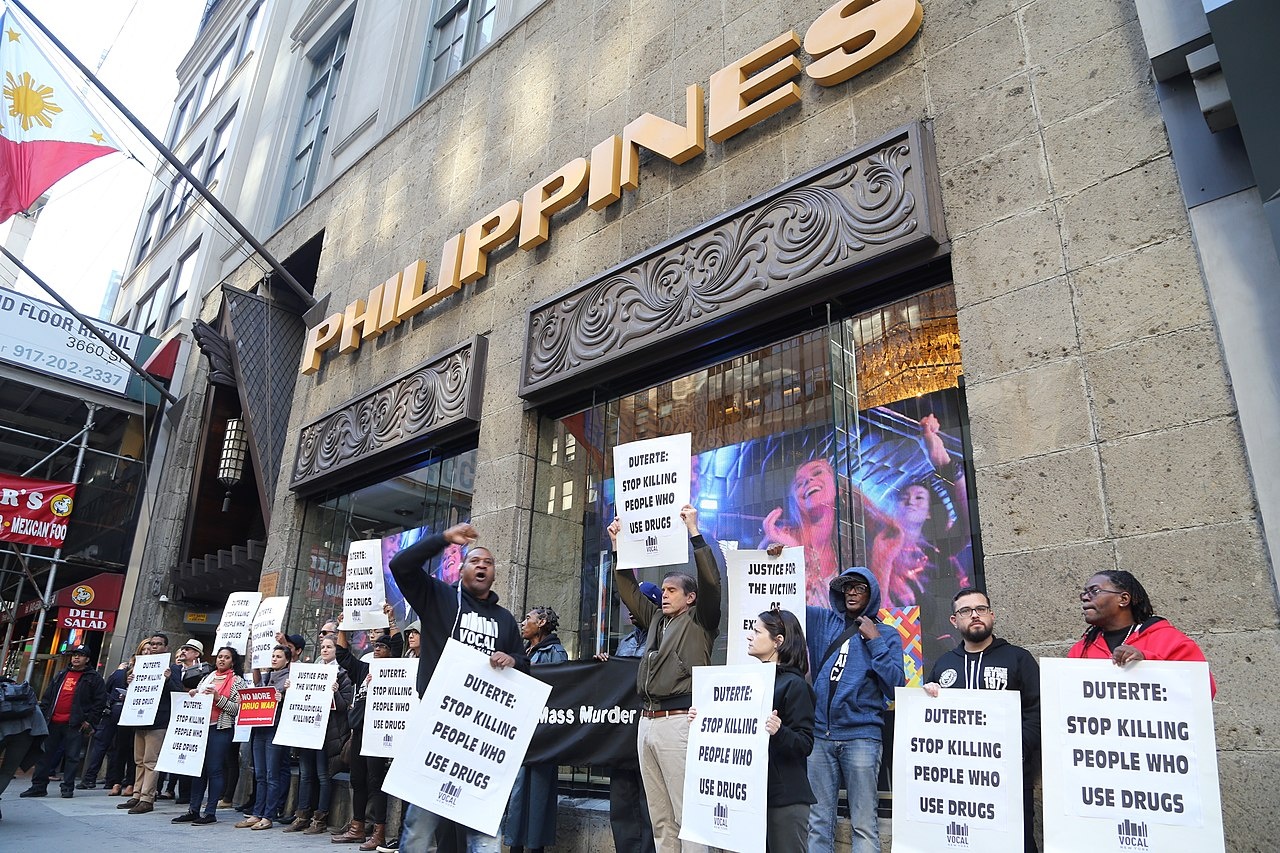
After taking office on June 30, 2016, Philippine President Rodrigo Duterte has launched a “war on drugs” that led to the deaths of over 12,000 Filipinos, mostly urban poor. According to Human Rights Watch” At least 2,555 of the killings have been attributed to the Philippine National Police. Duterte and other senior officials have instigated and incited the killings in a campaign that could amount to crimes against humanity. Human Rights Watch research has found that police are falsifying evidence to justify the unlawful killings. [Source: Human Rights Watch]
Dubbed “Duterte Harry,” a reference to Dirty Harry, the film featuring the vigilante detective played by Clint Eastwood, Duterte openly encouraged citizens and police officers to shoot and kill suspected drug dealers and users. Citing an estimated three million addicts in the Philippines, he said he would be “happy to slaughter them.” Extra-judicial killings of suspected drug dealers was a hallmark of Duterte's presidency, and it was his track record in Davao that won him nationwide support when he ran for president. He knew it, too: "If I make it to the presidential palace, I will do just what I did as mayor. You drug pushers, hold-up men, and good-for-nothings better get out of town. Because I'll kill you," he said at his final campaign rally. In a televised debate, he said that he would kill his own children if they took drugs. When his son and son-in-law were accused of drug smuggling, he promised to resign if they were guilty. [Source: BBC, May 10, 2022]
Adrian Chen wrote in The New Yorker: Duterte speaks of drug use as an existential threat, a “contamination” that will destroy the country unless radical action is taken. “They are the living walking dead,” he said of shabu users. “They are of no use to society anymore.” Duterte sees drug use as a symptom of a government’s ineffectiveness, but his animus suggests a personal vendetta. Duterte, who has four children by two women, was asked at a Presidential debate what he would do if he caught his children using drugs. “None of my children are into illegal drugs,” he responded. “But my order is, even if it is a member of my family, kill him.” The WikiLeaks cable reported that the regional director of the Philippine Commission on Human Rights had claimed that one of Duterte’s sons had a history of drug abuse. “The Mayor channeled his anger over his son’s drug use not just against drug pushers, but also drug users, eventually leading him to embrace vigilante killings as a means to reduce crime,” the report read. After one of Duterte’s political opponents raised the allegation of drug abuse, Duterte’s eldest son, Paolo, took a drug test and publicized his clean result. [Source: Adrian Chen, The New Yorker, November 21, 2016]
RELATED ARTICLES:
VICTIMS AND KILLERS IN DUTERTE’S WAR ON DRUGS: factsanddetails.com
ILLEGAL DRUG USE IN THE PHILIPPINES: MAINLY CANNABIS AND METH factsanddetails.com
ILLEGAL DRUG TRADE IN THE PHILIPPINES factsanddetails.com
RODRIGO DUTERTE: HIS LIFE, FAMILY, PERSONALITY AND OUTRAGEOUS STATEMENTS factsanddetails.com
DUTERTE, MAYOR OF DAVAO: THE FRIENDLY LAW-AND-ORDER CITY WITH DEATH SQUADS factsanddetails.com
RODRIGO DUTERTE AS PRESIDENT factsanddetails.com
POLITICAL COMEBACK OF THE MARCOSES factsanddetails.com
FERDINAND “BONGBONG” MARCOS factsanddetails.com
2022 PHILIPPINE ELECTIONS factsanddetails.com
MAGUINDANAO MASSACRE: EVENTS, KILLERS, POLITICS, TRIAL factsanddetails.com
BENIGNO AQUINO III — PHILIPPINES PRESIDENT 2010-201 — HIS LIFE, CAREER, ANTI-CORRUPTION FIGHT factsanddetails.com
Early Months of Duterte’s Drug War
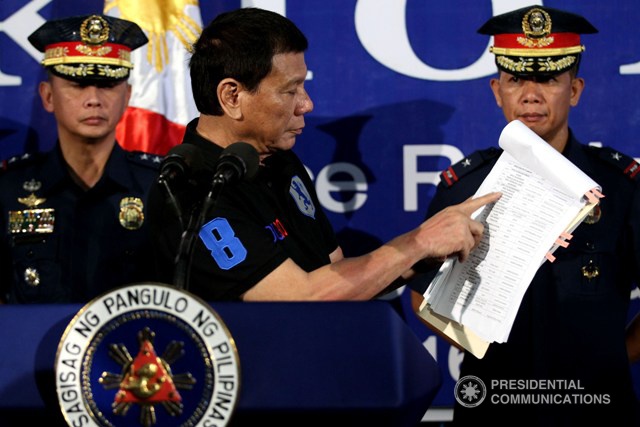
Adrian Chen wrote in The New Yorker:During Duterte’s first hundred days in office, the drug war was carried out with a distinctly Filipino mixture of high drama, mass spectacle, and enigmatic violence. In early August, in a speech at a naval base, Duterte read out a list of more than a hundred and fifty politicians and police officers who he alleged were involved in the illegal drug trade, the first of a number of “narcolists” that he released in the following months. It was a tactic from his days as mayor, when he went on his weekly television show, “Gikan Sa Masa, Para Sa Masa,” and read lists of names of alleged criminals and drug dealers, many of whom ended up as victims of the D.D.S (Davao Death Squad( [Source: Adrian Chen, The New Yorker, November 21, 2016].
In Duterte’s first three months as President, the Philippine Daily Inquirer, which has been monitoring the killings, listed more than fourteen hundred drug users killed by police and vigilantes. Front pages were filled with photos of the bloodstained victims, bound and gagged with duct tape, who had been shot in the head or garrotted; cardboard signs around their necks served as a warning to others. In the slums of the big cities, police carried out Operation Tokhang, or “knock and plead,” visiting the homes of people who were suspected of involvement with drugs and urging them to turn themselves in. Government reports boasted that seven hundred thousand “drug personalities” surrendered in the first two months in mass ceremonies in malls, city plazas, and auditoriums. An administration official told me that the “Guinness Book of World Records” expressed interest in certifying it as the biggest mass surrender of criminals in history.
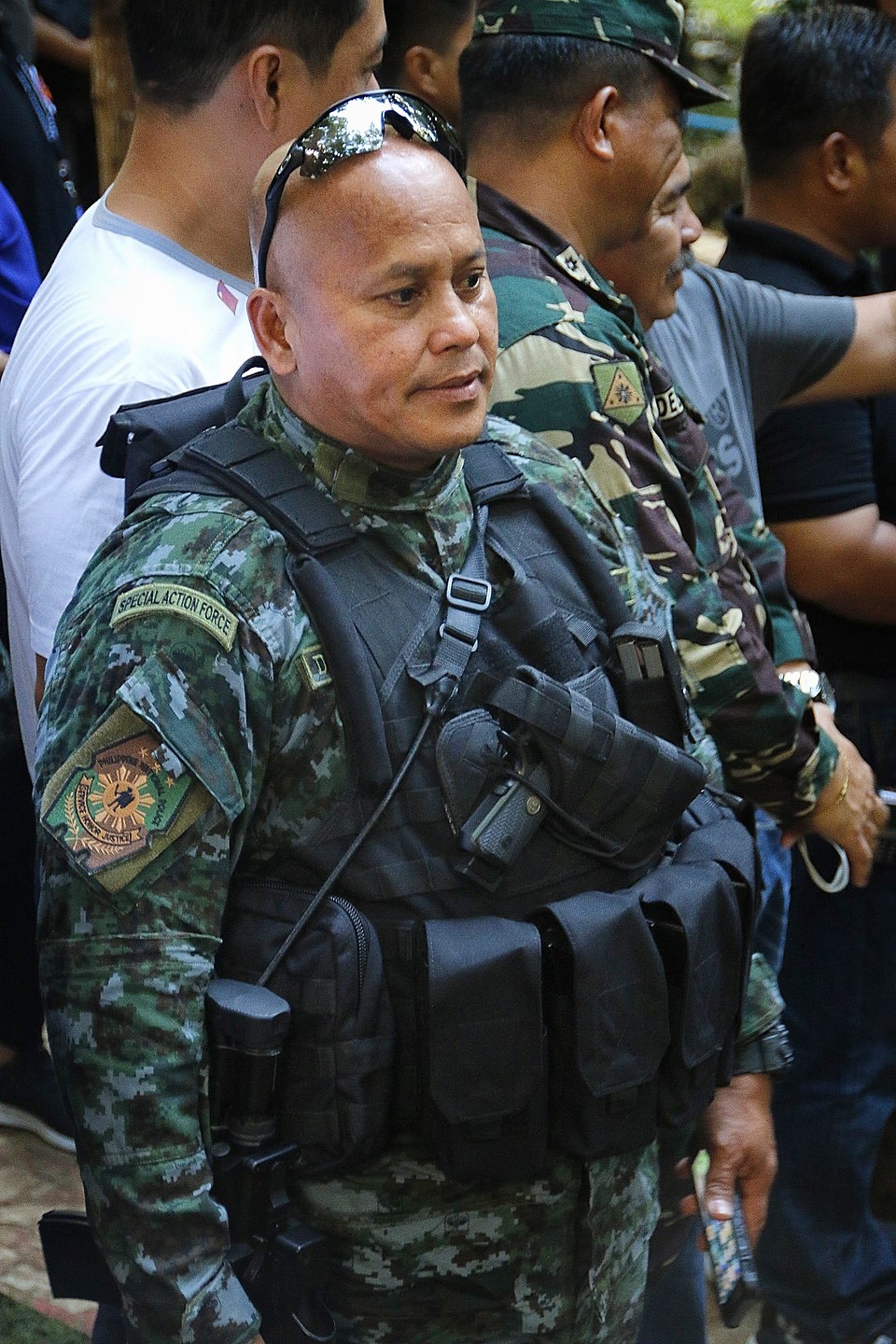
From Davao, Duterte brought with him Ronald (the Rock) dela Rosa, who had served as the city’s police chief, and made him head of the Philippine National Police. The federal police are notorious for corruption, and Duterte has promised to clean up the force, calling out “ninja” cops who resell drugs confiscated in busts. But he dismissed those killed by police as “drug-crazed” maniacs who had resisted arrest, and claimed that murders attributed to the vigilantes were the result of gang wars. In August, Dela Rosa announced that the campaign had already cut the crime rate in half. The killings have done little to diminish Duterte’s popularity. “It’s part of this narrative that killing has been normalized,” Curato, the sociologist, told me. “Before, it’s the state that turns a blind eye on it, and now a broader society is also willing to just turn a blind eye on the culture of violence.” Extrajudicial killing is common enough that there’s a slang term for it: “salvaging,” which, according to the writer Jose F. Lacuna, derives from the Tagalog salbahe, meaning “wild” or “savage.”
Statements and Policies During Duterte’s Drug War
During his anti-drug campaign, encouraged the public to kill suspected drug offenders. Bounties were reportedly placed on the heads of alleged drug dealers. He promised that any officer who killed a drug lord would receive $28,500—and he followed through by paying police who carried out such killings. Determined to demonstrate results, he even set up a public “scoreboard” so citizens could track how many people had been killed in the campaign. [Source: Mark Oliver, Listverse, October 9, 2016]
His rhetoric was equally stark. “If you know of any addicts, go ahead and kill them yourself,” Duterte told the public. “Getting their parents to do it would be too painful.” Individuals whose names appeared on drug watch lists reported receiving anonymous threats. One person showed a reporter a message from an unknown number that read simply: “Bro, just wait. You’ll be next.”
When a reporter once asked Duterte what he would do if he caught one of his own children using drugs, he responded without hesitation: “I will kill him.” Although he never acted on such a statement toward his own family, children of suspected drug offenders were among those caught in the violence. Four-year-old Althea Barbon was fatally shot during a police operation targeting her father, who was on a suspect list. She had been riding on the back of his motorcycle, hugging him as he drove her to buy popcorn, when police opened fire. Shortly afterward, a five-year-old child was killed by vigilantes reportedly targeting her grandfather.
Duterte’s so-called “shoot-to-kill” policy meant that police did not necessarily have to issue warnings or attempt arrests before using deadly force. As criticism mounted at home and abroad, Duterte acknowledged that he might face legal trouble after leaving office—but insisted he was prepared. He reminded the public that the Philippine president has the power to grant pardons and promised to “issue 1,000 pardons a day” to police officers charged with brutality or human rights abuses.
He also publicly referenced his own violent past. Duterte once boasted that he shot a college classmate for hitting him in the nose, an incident that led to his expulsion but not imprisonment. Speaking before a crowd, he joked about the possibility of pardoning himself: “Pardon given to Rodrigo Duterte for the crime of multiple murder,” he said. “Signed, Rodrigo Duterte.”
Bounties and Dead “Drug-Linked” Politicians
In May 2016, as Duterte drag war was beginning, Cebu City Mayor Tomas Osmeña announced that he would reward police officers with about $1,000 for every criminal killed in the line of duty and $100 for each suspect wounded. He said the payments would come with “no questions asked,” emphasizing that his goal was to instill fear among criminals and support law enforcement rather than prosecute officers. A member of a prominent Cebu political family, Osmeña also said he would not suppress vigilante groups, stating that his priority was protecting victims of crime. He declined to reveal the source of the bounty funds but had already given 20,000 pesos to a police officer who wounded two robbery suspects in a gunfight. [Source: Mynardo Macaraig, AFP, May 21, 2016]
Around the same time Duterte urged Filipinos to take up arms and encouraged citizens to shoot and kill drug dealers who fight arrest. "Please feel free to call us, the police, or do it yourself if you have the gun, you have my support," he said in a speech in Davao, which was broadcast nationally. He added that a citizen "can kill drug dealers" if they resist arrest or threaten people with a gun or knife. "Shoot him and I'll give you a medal," Duterte said.
On July 30, 2017 police raided the mansion of Mayor Reynaldo Parojinog. in Ozamiz City, of Mindanao, targeting, who was on President Rodrigo Duterte’s list of officials allegedly linked to illegal drugs. Authorities said officers serving search warrants for firearms and narcotics were met with gunfire from armed men at the mayor’s residence, prompting a shootout that left Parojinog, his wife, two siblings, and 11 others dead. No police officers were killed. The mayor’s daughter, the city’s vice-mayor, and one of his sons were arrested, and police reported seizing weapons and drugs. [Source: The Economist, August 5, 2017
Parojinog denied involvement in the drug trade, though his family had a long and controversial history. His father had led the Kuratong Baleleng gang, originally armed in the 1980s to fight communist insurgents before evolving into a criminal syndicate involved in robbery, kidnapping, and drug trafficking. After violent deaths within the family, Parojinog entered politics, building influence in Ozamiz amid allegations that wealth and patronage shielded the clan from prosecution.
The police account of the raid drew skepticism. Human Rights Watch questioned why security cameras at the mayor’s home were disabled and cited claims by the vice-mayor that officers planted evidence. Duterte, however, dismissed human rights criticisms, arguing that drug dealers themselves disregarded human life. Despite controversy over the anti-drug campaign, opinion polls at the time showed strong public approval for Duterte’s presidency, reflecting broad support for his hardline approach.
War on Drugs Put On Pause
In October 2016, Philippine National Police chief Ronald dela Rosa suspended the national police force’s participation in anti-drug operations and disbanded all anti-narcotics units after rogue officers exploited Duterte’s crackdown to kidnap and murder a South Korean businessman for ransom. Dela Rosa announced a purge of officers involved in criminal activities. Although operations were temporarily halted, Rodrigo Duterte declared that his anti-drug campaign would continue until the end of his six-year term. Phelim Kine of Human Rights Watch dismissed the suspension as “nothing less than an empty public relations gesture” unless it led to genuine accountability for the thousands killed. [Source: Jonathan Kaiman, Los Angeles Times, October 10, 2016]
Critics described the campaign as a “war on the poor,” noting that most victims came from impoverished communities where drug use was widespread. Many lived in overcrowded slums and struggled on only a few dollars a day, sometimes turning to drugs as a temporary escape. Victims were frequently found dead in alleyways, hands bound and faces taped, beside signs labeling them “pusher.” Analysts observed that while more Filipinos began questioning Duterte’s focus on the drug war over issues like poverty, unemployment, and urban traffic, many voters were still willing to give him six months to a year before judging his leadership more harshly.
The October crisis centered on the abduction and killing of 53-year-old South Korean businessman Jee Ick-joo, who was seized by police using a fabricated drug charge warrant. He was murdered inside the main police headquarters in metropolitan Manila, and officers allegedly collected ransom money from his wife without revealing his death. Duterte angrily stated that the victim had been cremated and his ashes flushed down a toilet. Two suspects were members of a key anti-drug unit. Dela Rosa resigned amid the scandal but remained in office at Duterte’s request. Human rights groups long suspected that some extrajudicial killings were carried out by police or with their backing. Addressing drug lords after the scandal, Dela Rosa warned, “this is a momentary victory on your part. Go ahead and enjoy, but there is always a time for reckoning.”
In January 2017, Duterte ordered the Philippine National Police to suspend its anti-drug efforts and instead to "cleanse" itself from corruption over the killing of the South Korean businessman. "Cleanse your ranks. Review their cases. Give me a list of who the scalawags are," Duterte said referring to the police. Dela Rosa said he dissolved all anti-drug units to shift efforts to fighting corruption. "We will cleanse our ranks ... then maybe after that, we can resume our war on drugs," Dela Rosa said at a press conference. "Rogue cops, beware! We no longer have a war on drugs; we now have a war on scalawags." [Source: Andrew V. Pestano, UPI, January 30, 2017]
Duterte Enlists the Army and Tries to Brings Back the Death Penalty in the War on Drugs
In early February 2016, Rodrigo Duterte said he would issue an executive order seeking military support for his campaign against illegal drugs, which he described as a national security threat. He declared that he would “kill more” people if necessary but ruled out imposing martial law, saying he did not need extraordinary powers. Instead, he signaled his intention to involve the Armed Forces of the Philippines (AFP) in the anti-drug campaign, citing declining trust in law enforcement agencies. [Source: Karen Lema and Martin Petty, Reuters, February Feb 2, 19 2017]
Amid concerns about deep-rooted corruption within the police, all police-led drug operations were temporarily suspended. Duterte placed the Philippine Drug Enforcement Agency (PDEA) in charge of the crackdown and emphasized that the military would play a supporting role. Speaking in Davao, he said he was considering issuing either a proclamation or executive order to formally designate illegal drugs as a national security threat, allowing him to call on the armed forces for assistance. “I have limited warm bodies but so many wars to fight,” he remarked.
By mid-February, the Philippine Army announced the creation of a battalion-sized task force to assist PDEA in pursuing high-level drug targets. Duterte had ordered the military to take part in the crackdown and indicated he wanted troops to have the authority to arrest “scalawag” police officers implicated in wrongdoing. AFP chief General Eduardo Ano said the military was “ready to operate” alongside PDEA. He explained that the proposed task force would be roughly battalion-sized, potentially mobilizing between 500 and 5,000 soldiers depending on the level of threat. However, he stressed that the AFP would not conduct street-level anti-drug raids or target small-time dealers, distancing the military from the more controversial operations previously carried out by the national police.
In March 2017, the Philippine House of Representatives approved a bill seeking to restore the death penalty for drug-related offenses, despite strong opposition from the influential Roman Catholic Church and human rights groups. Lawmakers voted 216 in favor, 54 against, with one abstention, moving closer to fulfilling President Rodrigo Duterte’s campaign promise to reinstate capital punishment for serious crimes, particularly drug trafficking. Earlier versions of the measure proposed applying the death penalty to a broader range of crimes, including large-scale corruption and economic plunder. However, legislators later limited the scope to drug offenses such as production and trafficking. For the bill to become law, the House version would need to be reconciled with a counterpart measure under consideration in the Senate and then signed by Duterte. At the time, both chambers of Congress were largely controlled by the president’s allies.
Although the House of Representatives approved a bill aimed at reinstating capital punishment for drug-related crimes, it never became law. The proposed measure did not pass the Senate, and because the restoration of the death penalty would require a full law, it did not take effect. The legal framework still reflects the abolition of capital punishment in 2006; proposals to bring it back — including for drug trafficking — have repeatedly stalled and been withdrawn or amended before final passage.
Duterte Targets Children As He Expands the Drug War
In 2019, the Philippines' House of Representatives committee initially approved a bill to lower the minimum age of criminal responsibility from 15 to 9 years old to target syndicates using children for crime. However, following intense backlash from UNICEF, Amnesty International, and human rights groups, the House approved a compromise version at 12 years old, with the Senate stalling further movement.
In June 2016, as President Rodrigo Duterte took his oath of office, his allies introduced a bill in the Philippine Congress that would allow children as young as nine to be held criminally liable as part of his sweeping anti-drug campaign. The proposed measure sought to lower the minimum age of criminal responsibility as nine because, its supporters said, existing laws “pampered” young offenders who committed crimes believing they could not be punished. [Source: Clare Baldwin and Andrew R.C. Marshall, February 14, 2017]
Targeting younger children underscored Duterte’s resolve to escalate his drug war, despite international condemnation and rising concern at home. His congressional allies said they were confident the House of Representatives would pass the bill by June. In a December 2016 speech in Manila, Duterte said the country was “producing a generation of criminals.” He claimed that children were increasingly being used as drug couriers, thieves, and even rapists, and insisted they had to be “taught to understand responsibility.”
Supporters such as Representative Fredenil Castro defended the proposal, saying many children were “in cahoots” with drug users and traffickers. Castro said his views were shaped by what he observed daily — children begging and pickpocketing in the streets and outside churches. “For me, there wasn’t any evidence more convincing than what I saw in every day of my life,” he said.
Advocates of lowering the age of criminal responsibility argued that prosecuting children would deter drug syndicates from exploiting them. Critics, including opposition lawmakers and human rights organizations, countered that the bill would endanger children without proof it would reduce crime.
Some police officers working in Manila’s poorest neighborhoods said children were already being drawn into the drug trade at a young age. Cecilio Tomas, an anti-narcotics officer, said children as young as six acted as lookouts, shouting warnings when police approached. By their early teens, some reportedly moved into delivering drugs and eventually became dealers or users themselves.
Salvador Panelo, Duterte’s chief legal adviser, said the legislation would ultimately shield children by removing incentives for criminals to recruit them. “They would not become targets simply because they would no longer be involved,” he said.
Child-rights advocates warned the law could instead place minors directly in harm’s way. They cited the example of Davao City, where Duterte had previously served as mayor and implemented his tough anti-crime policies. The Coalition Against Summary Execution documented 1,424 vigilante-style killings in the city between 1998 and 2015, including 132 victims aged 17 or younger. Duterte denied any role in those killings.
Official police data appeared to challenge claims that large numbers of young children were deeply embedded in the drug trade. Of the roughly 800,000 drug users and dealers who had registered with authorities by November 30, about 24,000 were minors. Fewer than 2 percent of those minors — roughly 400 children — were involved in delivering or selling drugs, and only 12 percent were 15 or younger. Most were listed as drug users. “The number of minors involved in the drug trade was just a small portion,” said Noel Sandoval, deputy head of the Women and Children’s Protection Center, the police unit that compiled the statistics.
Duterte’s War on Drugs Casualties, Numbers, Jails
The Philippine government estimates that more than 6,252 people were killed by police and “unknown assailants” in Duterte “war on drugs” from 2016 to 2020. Human rights groups argue that the true toll may reach into the tens of thousands. [he Commission on Human Rights said in 2018 that the toll could have reached as high as 27,000. The International Criminal Court (ICC) has estimated that the number of people killed between July 2016 and March 2019 may range from 12,000 to 30,000. [Source: Karen Lema, Reuters, March 11, 2025; Linda Pressly, BBC, January 4, 2024; BBC, May 10, 2022]
Most of intense action in Duterte’s war on drugs took place in the early months of Duterte's term as President, which began in late June 2016. Duterte claimed there were 3 million drug dealers in the country of 102.7 million at the time, though the Dangerous Drugs Board, a government agency, estimated there were only 1.24 million. Of the estimated 7,000 drug-related killings, more than 2,500 involved suspects who allegedly fought back and were killed in clashes with police, according to the national police. They added that 35 police officers and three soldiers had been killed. [Source: Jonathan Kaiman, Los Angeles Times, October 10, 2016]
The number of reported killings fell in later years. But as of early December 2016, five months into the drug war, the Philippine National Police have counted more than 3,500 unsolved homicides beyond those killed in official drug operations. Some bodies were found on the streets with their heads wrapped in packing tape. Others were left with crude cardboard signs labeling victims as dealers or addicts. More than 35,600 people were arrested in antidrug operations the government called Project Tokhang. The name is derived from a phrase meaning “knock and plead” in Cebuano, Mr. Duterte’s first language. Government forces went door to door to more than 3.57 million residences, according to the police. More than 727,600 drug users and 56,500 pushers surrendered, the police said, overcrowding prisons. At the Quezon City Jail, inmates had to take turns sleeping in any available space, including a basketball court. [Source: Daniel Berehulak, New York Times, December 7, 2016]
Duterte’s war on drugs also filled Philippine’s decaying jails — and treatment centers — to a breaking point. At Quezon City Jail, built to hold 800 inmates but housing about 3,800, detainees competed for space, sleeping in shifts on cement floors, staircases and an open-air basketball court. One toilet was shared by around 130 inmates, and government spending amounted to just 50 pesos (about $1.10) per day for food and five pesos for medicine per prisoner. [Source: Ayee Macaraig, AFP, July 31, 2016]
Duterte Drug War Tactics Didn’t Work, Top Policeman Says
In February 2020, Colonel Romeo Caramat, who oversaw the deadliest single day of the Philippines’ drug war—when 32 people were killed in 24 hours in Bulacan province in 2017—later said the ultra-violent approach had been ineffective. As head of drug enforcement for the Philippine National Police, he told Reuters that “shock and awe definitely did not work” and acknowledged that illegal drugs remained widely available. While he said overall crime had decreased, he admitted that users could still buy drugs “any time, anywhere.”[Source: Tom Allard and Karen Lema, Reuters February 7, 2020]
Caramat said he favored a shift in strategy. Instead of immediately arresting or killing low-level pushers and couriers, he proposed placing them under surveillance to trace larger syndicates and “big drug bosses.” His remarks marked a notable departure from the aggressive tactics that defined the early years of President Rodrigo Duterte’s anti-drug campaign, which began in 2016 with a call to kill traffickers and addicts.
Duterte at one point praised the Bulacan killings, reportedly saying, “Let’s kill another 32 every day.” Despite official claims that the campaign reduced crime, critics argued it largely targeted low-level offenders while failing to dismantle major trafficking networks or significantly curb supply.
Evidence suggested that methamphetamine, locally known as shabu, continued to flood the country. Large seizures increased, yet retail prices dropped—an indication, according to the United Nations Office on Drugs and Crime, that supply remained strong. Vice President Leni Robredo, who briefly served as anti-drug coordinator, described the failure to restrict supply as a “massive failure,” though government spokesman Salvador Panelo insisted that drug lords had been “neutralised” and that public satisfaction with the campaign remained high.
Efforts to reduce drug demand through rehabilitation also struggled. A major treatment center built to house 10,000 patients treated only a fraction of that number, and nationwide in-patient admissions declined. Limited funding and weak organization left many of the country’s estimated 1.3 million drug users without meaningful access to treatment, with community programs often reduced to brief lectures or videos.
Investigating Duterte Drug War Deaths in the Philippines
At the forefront of efforts to document the victims of Duterte’s drug are Father Flavie Villanueva and forensic pathologist Raquel Fortun. The two have joined forces to collect and preserve evidence that could one day be used in a formal judicial inquiry into the thousands of killings linked to the campaign. [Source: Linda Pressly - BBC News, Manila, January 4, 2024]
Dr. Fortun has conducted autopsies on the remains of more than 90 victims as of early 2024 and has uncovered numerous inconsistencies. Among them are gunshot victims whose death certificates listed “natural causes” as the cause of death, as well as reports that appeared to be “copy-pasted” and bore little relation to the actual injuries sustained. Police have maintained that those killed were drug lords or pushers who died in shootouts, often claiming self-defense. However, many families insist their loved ones—sons, brothers, and husbands—were innocent and simply in the wrong place at the wrong time.
At cemeteries where exhumations take place under Father Flavie’s watchful eye, grief is ever-present. As two more bodies—both men shot dead in 2019—are unearthed, a family member collapses in anguish. “It’s very traumatic,” Father Flavie says quietly. “This isn’t a normal kind of death.” Dr. Fortun became involved when she learned of plans to exhume victims of the drug war. “I heard about the plan that they would exhume. I stepped in—show me the body. So, he started bringing the bodies over,” she recalls. Her primary focus is gathering forensic evidence. “My primary concern would be: are there bullets? The bullets are evidence that can link a victim to a gun, and the shooter.”
Examining one of the newly exhumed remains, she notes visible trauma. “I’m already seeing fractures in the head,” she says, brushing aside long black hair. “This one looks like a bullet hole—on the right side of this young man’s head.” From a body bag, she carefully removes disintegrating clothing—a white shirt and black trousers—preserving them as evidence.
She also reflects on the victims’ social circumstances. “You see, the teeth are very badly maintained. That means they killed the poorest of the poor. You don’t forget these were people, and they were loved.” Whenever possible, Dr. Fortun returns personal effects to grieving families. Some discoveries are strikingly ironic. “Irony of ironies, I’ve had two cases where there were remnants of a plastic band [bracelet] from the Duterte campaign,” she says. In one case, a widow explained that her husband believed wearing the bracelet would protect him because he supported Duterte.
Dr. Fortun’s work is painstaking and time-consuming. In addition to her forensic investigations, she serves as a professor in the College of Medicine and chair of the Department of Pathology at the University of the Philippines. It will take weeks before she completes detailed reports on the three newly exhumed victims—among them a man named Felizardo—continuing her effort to document evidence that might one day bring accountability.
Duterte Arrested by the ICC over 'Drugs War' Killings
In March 2025, just shy of his 80th birthday, was arrested at the request of the International Criminal Court (ICC) at Manila's main airport on his arrival from Hong Kong. The ICC has said it would pursue an investigation into suspected crimes against humanity linked to the bloody “war on drugs” overseen by former President Rodrigo Duterte during his 2016–2022 term. The anti-drug campaign left thousands of Filipinos dead. Earlier this week, speaking at a rally in Hong Kong, Duterte declared he was prepared to face arrest. Reflecting on his presidency, he asked: “What is my sin? I did everything in my time for peace and a peaceful life for the Filipino people.” [Source: Karen Lema, Reuters, March 11, 2025]
Philippine authorities have consistently denied carrying out extrajudicial killings, maintaining that many of those who died were killed in legitimate police shootouts. However, human rights groups and other critics argue that police officers and vigilantes acting with official encouragement systematically targeted and killed unarmed drug suspects on a large scale during Duterte’s time in office.
In September 2021, the ICC authorized a formal investigation into possible crimes against humanity allegedly committed under Duterte’s leadership. The probe was suspended in November 2021 after the Philippine government requested deferral, saying it was conducting its own investigations. But in January 2023, the court said it was “not satisfied that the Philippines is undertaking relevant investigations,” and prosecutors resumed their inquiry. The ICC later rejected the Philippine government’s appeal against that decision.
Duterte withdrew the Philippines from the ICC’s founding treaty in 2019, shortly after the court began examining allegations of systematic extrajudicial killings. Despite the withdrawal, the ICC maintains that it retains jurisdiction over alleged crimes committed while the Philippines was still a member. Duterte has remained openly defiant about the accusations. “I have nothing to hide. What I did, I did it for my country and for the young people. No excuses. No apologies. If I go to hell, so be it,” he told a congressional hearing on the drug war in 2024.
For years, Duterte rebuked and taunted the ICC following the country’s withdrawal from the court. The Philippines initially refused to cooperate with the investigation. However, under Philippines President Ferdinand Marcos Jr., elected president of 2022, the government shifted its stance in November, signaling that it would comply if an arrest warrant were issued. That development came only hours after Duterte, speaking at a legislative inquiry, urged the ICC to accelerate its work. “Hurry up,” he said. “I am already old, I might die soon. You might miss the pleasure of seeing me standing before the court hearing the judgement whatever it is.” He added that he assumed full responsibility for what had happened during his presidency.
After his arrest Duterte's was transfer to The Hague on March 11, 2025, making him the first Philippine president to face an international tribunal and the first Asian leader to face a trial before the ICC. Despite this, he was re-elected as the mayor of Davao City in 2025; as he remains in The Hague, his son Baste is serving in his place as the acting mayor. As he failed to take his oath within the prescribed six-month period, he was disqualified from assuming office under the provisions of the Local Government Code. [Source: Wikipedia]
Image Sources: Wikimedia Commons
Text Sources: Wikipedia, New York Times, Washington Post, Los Angeles Times, Smithsonian magazine, Encyclopedia.com, Times of London, Library of Congress, The Conversation, The New Yorker, Time, BBC, CNN, Reuters, Associated Press, AFP, Lonely Planet Guides, Google AI, The Guardian and various websites, books and other publications.
Last updated February 2026