
ILLEGAL DRUG SMUGGLING AND PRODUCTION IN THE PHILIPPINES
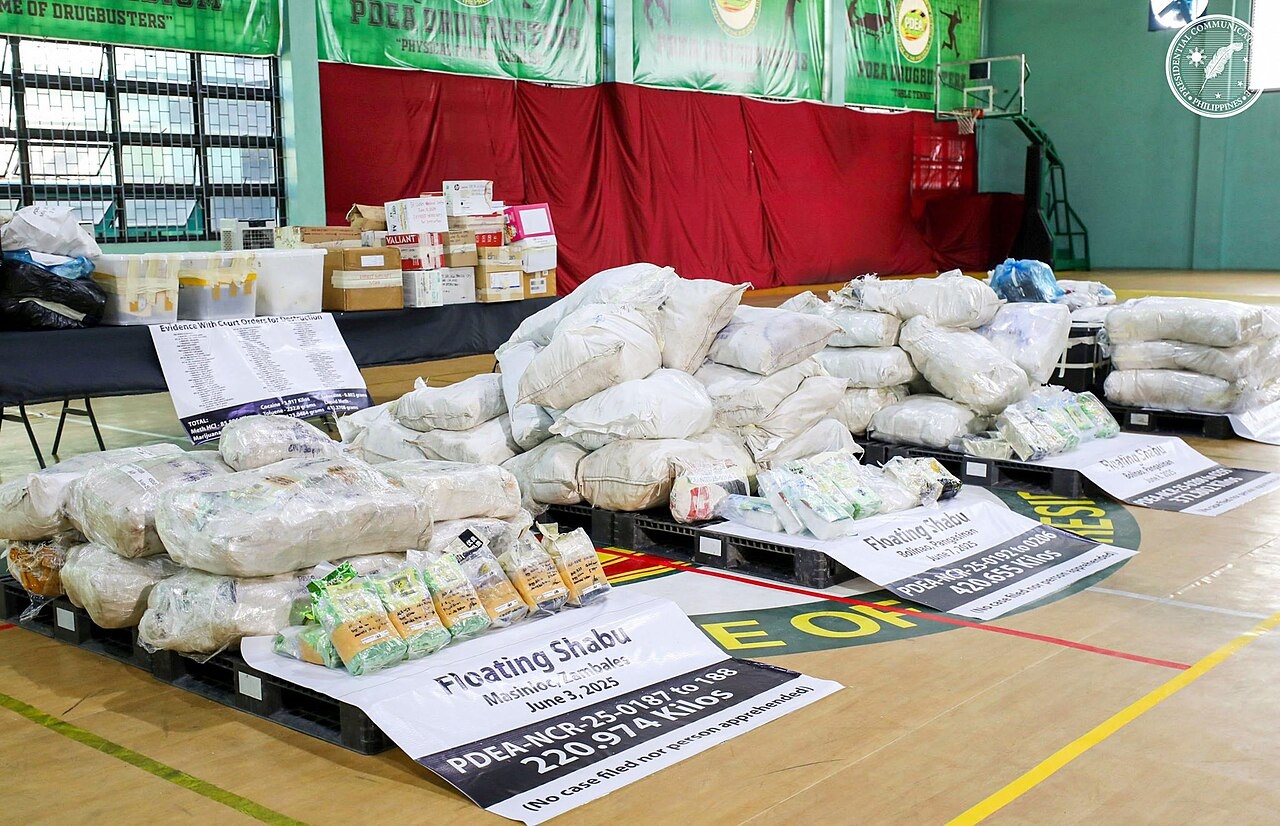
The Philippines’ porous borders, weak rule of law and the many hidden inlets and channels created by its geography has made made it easy for traffickers and smugglers to operate in the country. It is relatively easy to smuggle drugs in and out of the Philippines because of it almost endless unmonitored coastline and the large number of boats going in and out. According to authorities, the Philippines functioned both as a drug-consuming nation and as a transshipment hub for methamphetamines, locally known as shabu. The chemicals used to produce the drug were mostly imported from China and Taiwan, though Mexican drug cartels and West African syndicates had also been involved in smuggling and distribution. [Source: Joseph Hincks, Al Jazeera, September 8, 2016]
According to the United Nations Office on Drugs and Crime (UNODC) 2025 drug report methamphetamine ("shabu") as the primary drug of abuse, comprising over 92 percent of drug-related admissions. The 2023 National Survey on Drug Abuse showed a decrease in drug users, from approximately 1.67 million in 2019 to 1.47 million in 2023. [Source: UNODC]
There is a fair amount of drug production in the Philippines, some of it involving insurgencies such as the New People’s Army. Large meth labs in Malaysia, Indonesia and the Philippines were closed in 2006. Police discovered a huge methamphetamine factory in Antipolo city, east of Manila. Capable of producing 500 kilograms of drugs, it contained 30 drums of chemicals, including acetone and tetradrofuran, used to make amphetamines, and two garbage-truck-size freezers. In another laboratory in Valenzula in metropolitan Manila about $50 million worth of amphetamines was seized.
The Philippines’ geographic location in Southeast Asia has also made it an important transit point for international drug trafficking networks, contributing to the availability and relatively low cost of methamphetamine in the country. According to the United Nations’s top drug group in 2021: There are indications of a possible decline in the availability of methamphetamine in the Philippines. The retail purity of methamphetamine hydrochloride in that country was reported to have fallen, from 74 percent in 2014 to 68 percent in 2019, while methamphetamine prices increased from an already high level in comparison with other Asian countries, from about $140 per gram in 2014 (range: $56–$223) to about $177 per gram in 2019 (range: $25–$329), and the quantity of methamphetamine seized fell from a peak of 2.2 tons in 2016 to 0.8 tons in 2018, before increasing again in 2019 (2.1 tons). The authorities reported that this reflected an actual increase in methamphetamine trafficking activities compared with the previous year. [Source: United Nations Office on Drugs and Crime (UNODC), World Drug Report 2021]
RELATED ARTICLES:
ILLEGAL DRUG USE IN THE PHILIPPINES: MAINLY CANNABIS AND METH factsanddetails.com
METHAMPHETAMINES (METH): USE, EFFECTS AND DANGERS factsanddetails.com ;
HISTORY OF AMPHETAMINES AND METHAMPHETAMINES factsanddetails.com ;
METHAMPHETAMINE PRODUCTION AND TRAFFICKING factsanddetails.com
METHAMPHETAMINES, MYANMAR AND SOUTHEAST ASIA factsanddetails.com
DRINKS IN THE PHILIPPINES: BEER, TUBA, COCKTAILS, CIVET COFFEE factsanddetails.com
DRINKING IN THE PHILIPPINES: CUSTOMS, HOBBIT BAR, WINE PARTIES, TAXES factsanddetails.com
TOBACCO AND BETEL NUT IN THE PHILIPPINES: SMOKING, HISTORY, STRICT LAWS factsanddetails.com
FOOD AND THE PHILIPPINES: DIET, STAPLES, AND COOKING FOR U.S. PRESIDENTS factsanddetails.com
EATING AND DRINKING CUSTOMS IN THE PHILIPPINES factsanddetails.com
EXOTIC AND WEIRD FOODS IN THE PHILIPPINES factsanddetails.com
Major Drug Traffickers in the Philippines
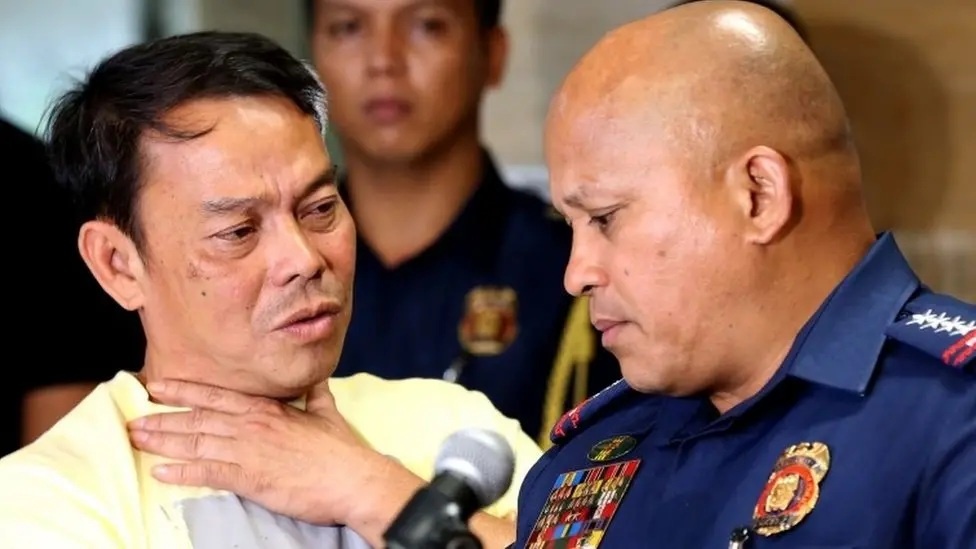
Chinese, Philippine-Chinese drug syndicates and African (mostly Nigerian) drug trafficking groups are believed to be involved in the large-scale drug trade in the Philippines. Among the individuals frequently mentioned is Michael Yang, a Chinese businessman who served as an economic adviser to former president Rodrigo Duterte. Whistleblowers, including former police officer Arturo Lascañas, accused him of operating a network of methamphetamine laboratories and acting as a major drug lord in the country. Lin Weixiong, described as an associate of Yang, has also been accused of involvement in narcotics trafficking and businesses connected to drug shipments. [Source: Wikipedia]
Other figures identified in investigations include Peter Lim, whom the Duterte administration listed as a “Level 5” drug lord and an alleged member of a Chinese triad network. Herbert Colangco, also known as Ampang, and Wu Tuan, also called Peter Co, were high-profile inmates at New Bilibid Prison who were accused of continuing to run drug operations from inside the prison, reportedly with links to the Kuratong Baleleng syndicate. Lawmakers have also cited Allan Lim in connection with a company linked to a large methamphetamine, or shabu, seizure in Pampanga, while businessman Sammy Uy has been named by whistleblowers as a financial backer for alleged drug activities.
Congressional quad-committee hearings in 2024 and 2025 further examined claims that individuals such as Michael Yang, Charlie Tan and Sammy Uy were connected to drug smuggling operations, including activities centered in Davao City. Investigators also discussed allegations involving a so-called “Davao Group,” which whistleblowers claimed included politically connected figures who facilitated smuggling through the Port of Davao. Separately, authorities have exposed corruption within law enforcement itself through cases involving so-called “ninja cops,” officers accused of recycling confiscated drugs and reselling them, including the 2022 arrest of Police Master Sergeant Rodolfo Mayo Jr. with a large quantity of methamphetamine.
Large Drug Busts in the Philippines
In March 2022 authorities seized an estimated $200 million worth of methamphetamine (shabu) in Infanta, Quezon in what police described as the "biggest drug haul in Philippine history",The operation, conducted by the National Bureau of Investigation (NBI), Philippine National Police (PNP), and Philippine Drug Enforcement Agency (PDEA), led to the arrest of ten individuals. About 1,585.25 kilograms (over 1.5 tons) of methamphetamine hydrochloride was found concealed in 1,589 tea bags packed into 80 sacks. The operation occurred on March 15, 2022, around 4:00 a.m. in Barangay Comon, Infanta, Quezon province, at a police checkpoint where three vans transporting the illicit cargo were intercepted. [Source: Wikipedia]
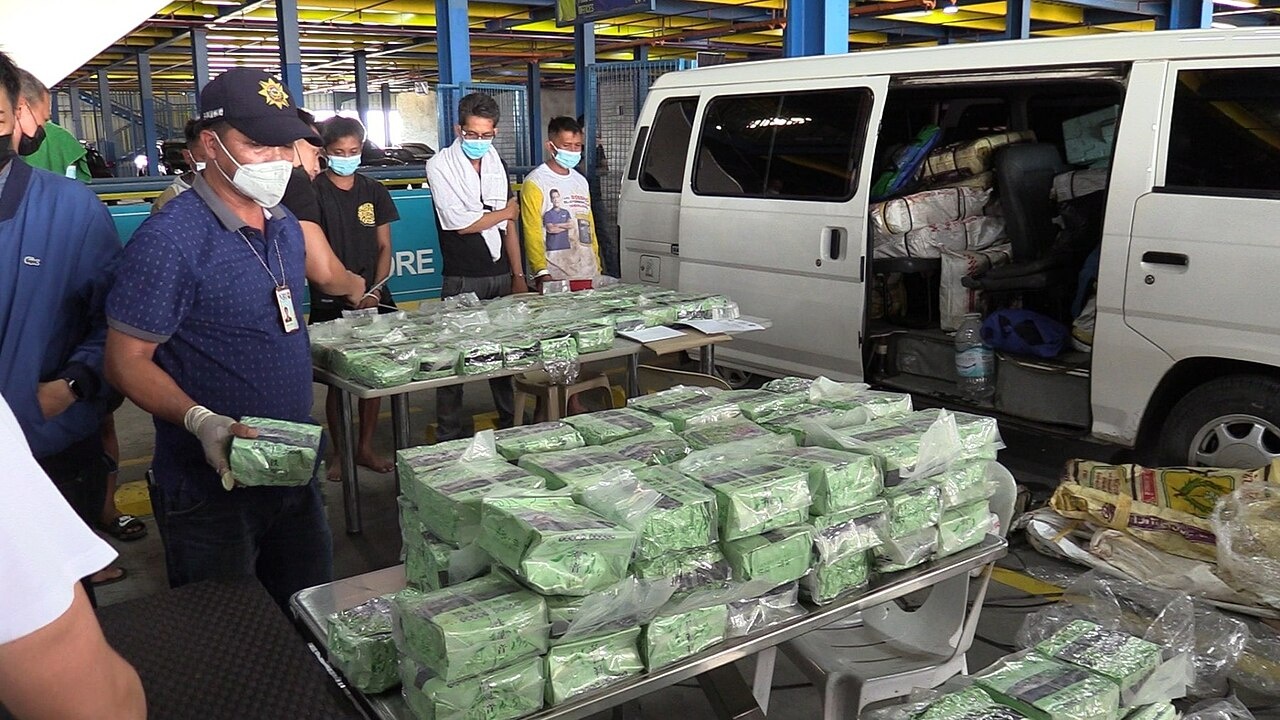
Also in March 2022, Philippine authorities seized a methamphetamine stash worth more than $19.6 million at a home in the Manila region and arrested a Chinese suspect. Wilkins Villanueva, chief of the Philippine Drug Enforcement Agency, said that about 160 kilograms (352 pounds) of the suspected stimulant shabu was discovered in a house in Valenzuela City, a metropolitan Manila suburb, after law enforcers posing as drug buyers arrested the Chinese suspect and his Filipina companion. Some of the meth was packed in tea bags. The raid was part of a series of anti-drug operations across the country that had led to the arrest of 11 suspects and the confiscation of large amounts of methamphetamine. About a week earlier, police and anti-drug agents seized 60 kilograms (132 pounds) of methamphetamine, estimated to be worth more than $7.8 million) in a raid in Marilao town, Bulacan province, near Valenzuela City. [Source: Associated Press, March 9, 2022]
In June 2020, Philippine President Rodrigo Duterte threatened to kill drug dealers after police seized 756 kilograms (1,667 pounds) of methamphetamines, a haul he said proved the Southeast Asian country had become a transhipment point for narcotics. The crystal meth, with a Philippine market value that police put at $102.22 million, was one of the biggest seizures since Duterte unleashed his bloody war on drugs, which has defined his presidency, in 2016."If you destroy my country distributing 5.1 billion pesos worth of shabu ... I will kill you," Duterte said in recorded address, referring to the drugs. He did not say where the drugs were believed to have come from but said the Philippines was a transhipment centre for Mexican drugs gangsters. Duterte also hurled insults at human rights groups for criticising his anti-narcotics campaign. [Source: Reuters, June 5, 2020]
In early July 2016, at the height of the Duterte drug war, a government team seized a cache of 180 kilograms of shabu with an estimated market value of $19 million in an operation in Cagayan in ther northern Philippines.. From July 1 to July 31, 2016, the Philippines Drug Enforcement Agency participated in 123 anti-drug operations and confiscated more than $53.7 million worth of illegal drugs — almost as much as the $61 million seized during the entire year of 2015. The agency had also made several high-profile arrests and seizures: four Chinese nationals were detained after a sea vessel being used as a floating shabu factory ran aground on July 11; Meco Tan, described as a “big time drug lord,” was killed on July 22; and a former mayor and her Army major husband were arrested on July 23.
Santol — Rehabilitation of ‘Marijuana Town’
Santol, a small fourth-class municipality in the Ilocos Region, was once widely known for its marijuana plantations. Located near the tri-boundaries of Ilocos Sur, La Union, and Benguet, the town sat within what authorities called the “Golden Green Triangle,” an area where cannabis cultivation was common. Before 2007, marijuana farming was deeply embedded in the local economy, and drug seizures elsewhere in the Philippines were often assumed to have originated from Santol. [Source: Manila Bulletin, January 12, 2013]
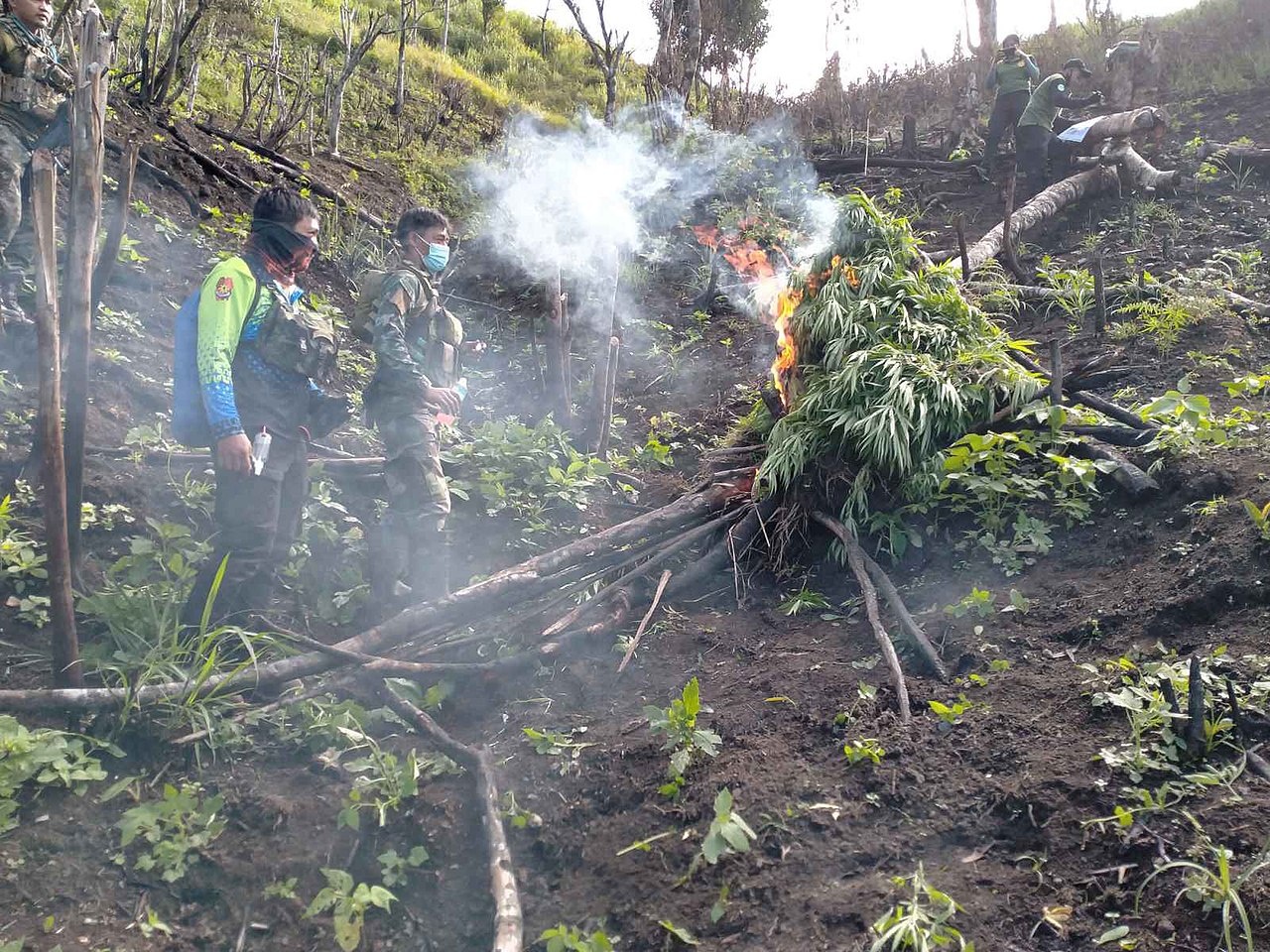
When Daisy Sayangda Olivar became mayor in 2007, she made eliminating the marijuana trade a priority while promoting a new vision of transforming Santol into an ecotourism destination. She worked with the Municipal Anti-Drug Abuse Council, local peace and order councils, and the Philippine Drug Enforcement Agency to organize a coordinated campaign against cannabis cultivation. This effort culminated in “Oplan Farmville,” a multi-agency operation conducted in January 2010 that targeted marijuana plantations across the mountainous region.
During the operation, authorities and community leaders encouraged farmers to voluntarily uproot and destroy their marijuana crops, which were estimated to be worth about P1 billion. Many growers had relied on marijuana as their primary livelihood and initially resisted the campaign, asking for compensation. Instead, the local government introduced alternative livelihood programs and infrastructure support, including farm-to-market roads and agricultural assistance.
Through the Santol Development Center cooperative and the town’s “Siapay” livelihood program, former marijuana farmers received loans and support to switch to legal agriculture such as vegetables, fruit crops, and livestock. The program began with 120 farmers and later expanded to around 800 participants. Over time, Santol shifted away from its reputation as a cannabis-growing area and began promoting agriculture and ecotourism, aiming to replace the illegal marijuana economy with more sustainable sources of income.
School-Based Illegal Drug Trade In the Philippines
The Los Angeles Times reported: Christian Nilo grew up surrounded by poverty and corruption, often with barely enough food to eat and teachers who demanded bribes in exchange for passing grades. In 2015, when he was 20, an acquaintance offered him $2 to deliver a package. Only later did he learn that it contained shabu, the powerful methamphetamine widely used in the Philippines. More work was available if he wanted it. Nilo resisted the temptation to enter the drug trade, but several of his classmates did not. “There are a lot of them,” Nilo said. “They have more money than regular students.” [Source: Jonathan Kaiman, Los Angeles Times, February 28, 2017]
Experts say that to truly tackle the drug problem in the Philippines a serious effort has to be made to address the widespread poverty and corruption that has fueled the drug trade. “There wasn’t enough employment, or social resources, so everyone needed a second job,” said Clarke Jones, a professor at Australian National University who has studied drug dealing in the Philippines. “Duterte might be trying to eliminate the drug market — which will never happen, by the way — but he’s failed to realize, what’s going to replace those funds?” “This society is built on corruption,” he added. “It’s learned at a very, very early age.”
At Batasan Hills National High School, which Nilo attended, teachers and students described conditions that help explain the attraction of the drug trade. Tess Busadre, head of the social studies department, said most of the school’s budget went toward electricity, water and other basic needs. With salaries of about $4,500 a year — barely enough to cover living costs — teachers often sold school materials to students “to make ends meet,” she said.
“One of the reasons why we have dropouts, or problematic students, is that they can’t finance the projects that they have to submit,” Busadre said. Jenelyn Escovanez, a 10th-grade student, said a math teacher once told his class to order T-shirts from him instead of completing a project. She paid the teacher and passed the class, she said, but later discovered “there was no T-shirt.”
The teacher had a drug problem and remained at the school, Busadre said. Nilo said he had often been forced to pay teachers for supplies, photocopies and the privilege of completing class projects. In one class the previous year, students were assigned to make a toolbox. Nilo did not have the $1.50 needed to buy the materials from his teacher. “I was made to choose between buying medicine for my father, and passing my class,” he said. “I chose to buy medicine for my father.” As a result, he failed the class.
The school, located in Quezon City — one of Manila’s poorer areas — allowed older students like Nilo to attend classes only once a week so they could work full time. Most days he operated a pedicab from dawn until dusk, ferrying commuters in a low-slung yellow carriage attached to his rusty bicycle. He usually earned less than $5 a day, which he spent on medicine for his father, who had heart problems, and on food for his two younger siblings.
Some classmates facing similar hardships had turned to drugs or prostitution. “They hide [drugs] in socks, they hide it in their shirts,” Nilo said. “Some of my girl classmates, they allow themselves to be touched, caressed, and they get paid for it.” Joel M. Durban, dean of the College of Education, Arts and Sciences at National University in Manila, said the conditions described at the school were typical. “It’s poor by Manila standards, but if you’re going to look at the whole country, it’s basically the same,” he said.
Corrupt Drug-Selling Police in the Philippines
There has been reports that Philippines police are involved in protecting drug dealers into return for bribes and an some cases are directly involved in the trade. The Narcotics Command of the Philippine National Police was so corrupt it was dismantled.
A source in intelligence told Al Jazeera that the practice of "recycling," whereby corrupt law enforcement officials resell confiscated drugs or turn small-time dealers into personal "assets," has been going on since the 1990s. The source suggested that recycling is widespread and that police might kill their assets to prevent exposure. [Source: Joseph Hincks, Al Jazeera, September 8, 2016]
At the Senate hearing, Philippine National Police (PNP) Chief Ronald dela Rosa confirmed that, during a internal purge in 2016, 130 police officers tested positive for drug use. Twenty were arrested, six were administratively charged, and seven faced criminal charges. Dela Rosa said that a total of 284 PNP personnel believed to be involved in illegal drugs had been transferred to new assignments.
Duterte’s War on Drugs
Drug enforcement intensified dramatically after July 2016, when the government launched a nationwide “war on drugs.” The campaign led to widespread police operations targeting drug dealers and users and resulted in large numbers of arrests and controversial fatalities linked to anti-drug operations.
After taking office on June 30, 2016, Philippine President Rodrigo Duterte has launched a “war on drugs” that led to the deaths of over 12,000 Filipinos, mostly urban poor. According to Human Rights Watch” At least 2,555 of the killings have been attributed to the Philippine National Police. Duterte and other senior officials have instigated and incited the killings in a campaign that could amount to crimes against humanity. Human Rights Watch research has found that police are falsifying evidence to justify the unlawful killings. [Source: Human Rights Watch]
Dubbed “Duterte Harry,” a reference to Dirty Harry, the film featuring the vigilante detective played by Clint Eastwood, Duterte openly encouraged citizens and police officers to shoot and kill suspected drug dealers and users. Citing an estimated three million addicts in the Philippines, he said he would be “happy to slaughter them.” Extra-judicial killings of suspected drug dealers was a hallmark of Duterte's presidency, and it was his track record in Davao that won him nationwide support when he ran for president. He knew it, too: "If I make it to the presidential palace, I will do just what I did as mayor. You drug pushers, hold-up men, and good-for-nothings better get out of town. Because I'll kill you," he said at his final campaign rally. In a televised debate, he said that he would kill his own children if they took drugs. When his son and son-in-law were accused of drug smuggling, he promised to resign if they were guilty. [Source: BBC, May 10, 2022]
See Separate Articles:
DUTERTE’S WAR ON DRUGS: DEATHS, TACTICS, RHETORIC, FAILURES factsanddetails.com
VICTIMS AND KILLERS IN DUTERTE’S WAR ON DRUGS: factsanddetails.com
Drug Violence in the Philippines
In August 2009, a Canadian was killed in an alleged shootout with anti-narcotics agents before dawn in Ugong, Quezon City, police reported. The Philippine Daily Inquirer reported: Police identified the slain man as Antonio L. Kcompt through documents found in his BMW car. The encounter between the foreigner and members of the Philippine Drug Enforcement Agency (PDEA) happened at around 3:15 a.m. along Giraffe Street near Green Meadows subdivision. Officer on case, Police Officer 3 Gregorio Maramag, said among the items found on Kcompt’s car were a National Bureau of Investigation identification card bearing the latter’s name as consultant, a permit to carry firearms, several pieces of capsules suspected to be ecstasy, a cal. 9 mm gun, and an undetermined amount of money. [Source: Nancy C. Carvajal,Philippine Daily Inquirer, August 22, 2009]
Maramag said that Kcompt was reportedly selling ecstasy and cocaine and had been the subject of PDEA surveillance for the past months. Police investigation showed PDEA operatives on board two unmarked vehicles spotted the foreigner driving a BMW car without plates along Giraffe Street and blocked the vehicle and signaled him to stop. Instead of stopping, the foreigner drove on and fired at the agents, police said. PDEA operatives retaliated and hit the driver, causing the car to skid before stopping in a grassy vacant lot, police said. Kcompt was brought to Medical City by PDEA agents where he succumbed to multiple gunshot wounds at about 4 a.m.
In April 2009, three government anti-drug agents were killed, according to the military and police, and three Philippine Drug Enforcement Agency agents were wounded in the ambush in Sultan Kudarat town, Maguindanao province, . in the southern Philippines about 930 kilometers south of Manila. According to Colonel Jonathan Ponce, a local army spokesman, the agents were on a mission to raid a suspected safe house of a notorious drug dealer in the town when they were attacked. “The agents had just gotten off their vehicles when they were fired upon by unidentified gunmen,” Ponce said. Superintendent Danilo Bacas, a regional police spokesman, said that government forces have launched pursuit operations to track down the assailants. Bacas said investigators suspect members of the Moro Islamic Liberation Front (MILF), a separatist group, might have been involved in the attack, which occurred near their main headquarters. The MILF is the largest Muslim rebel group fighting for a separate Islamic state in the southern Philippines. [Source: DPA, April 13, 2009]
In June 2014 in Cebu City, a suspected “big-time” drug lord, Lloyd Cabahug, was killed during a buy-bust operation. Police said Cabahug opened fire after realizing he was dealing with an undercover officer, leading to a shootout in which he was fatally wounded. Authorities seized packs of shabu, a firearm, and drug paraphernalia. A civilian was injured by a stray bullet but survived. [Source: Manila Bulletin, June 22, 2014]
In May 2014 in Quezon City, two suspected drug peddlers were killed in a separate pre-dawn sting operation. According to the Philippine Star (May 28, 2014), one suspect—known only as “Mac-Mac”—opened fire on police after sensing the presence of backup officers, prompting a gun battle that left both suspects dead. Authorities said the suspects had been attempting to sell shabu during the operation. (Source: Philippine Star, May 28, 2014)
Thirteen Killed in a Gun Battle with Drug Traffickers in Bicol
In January 2013, 13 suspected members of a criminal group from the Bicol region were killed in a gun battle with police and soldiers on the Maharlika Highway in Quezon province, south of Manila. Authorities said the clash began when two sport utility vehicles carrying the suspects tried to break through a joint police–military checkpoint near the boundary of Plaridel and Atimonan towns. [Source: aseanaffairs.com, January 7, 2013]
According to military officials, the vehicles ignored orders to stop and their occupants allegedly opened fire on security forces, triggering a firefight that lasted about 18 minutes. Eleven suspects were killed at the scene and two more died while being taken to a hospital. One police officer was wounded but later reported to be out of danger. The checkpoint had been set up after police received intelligence that members of a major criminal syndicate from Bicol would pass through the area. Soldiers from the Army’s 1st Special Forces Battalion and intelligence officers from the Quezon Provincial Police Office participated in the operation. Authorities recovered several weapons from the suspects, including .45-caliber pistols and assault rifles. Police said the men were believed to be part of a large drug syndicate, though investigators were still determining whether they were connected to a previous incident in Quezon in which three motorists were killed and 10 kilograms of shabu, valued at about 90 million pesos (around $2.2 million), were seized.
In February 2014 In Davao City, seven alleged drug dealers were killed and 36 others arrested during coordinated raids on 26 suspected hideouts in the Tibungco district. According to AFP, police and drug enforcement agents came under fire during prompting a shootout. Authorities recovered firearms, bomb-making components, and quantities of shabu. The raids followed surveillance indicating widespread drug and weapons activity in the area. More broadly, officials reported record drug seizures in 2013, including over $101 million worth of methamphetamine and thousands of related arrests. [Source: AFP, February 22, 2014]
Hundreds of Filipino Drug Mules in Foreign Jails
Many Filipinos have been arrested — and some have been executing — for transported drugs outside of the Philippines. As of July 2014, at least 807 Filipinos were imprisoned in various countries for drug smuggling, according to the Philippine Drug Enforcement Agency (PDEA). The agency issued repeated warnings to overseas Filipino workers (OFWs) not to be lured into acting as drug couriers in exchange for quick money. PDEA Director General Arturo Cacdac stressed that becoming a drug mule is a dangerous gamble, risking both life and future for financial gain. Among those detained were 34 Filipinos in Malaysia on drug charges, while three in Vietnam were on death row. In one recent case, a Filipina was arrested in Kuala Lumpur for attempting to smuggle three kilograms of shabu and faced the death penalty. [Source: Aries Joseph Hegina, inquirer.net, September 4, 2014]
The Department of Foreign Affairs (DFA), under Foreign Secretary Albert del Rosario, said it was exerting its “best efforts” to secure commutations in more than 80 death penalty cases involving Filipinos abroad. These efforts included high-level appeals for clemency and the provision of legal and consular assistance to over 610 Filipinos accused of working as drug couriers for international syndicates. DFA officials emphasized that the government would extend all possible support while respecting the laws of host countries.
In the Middle East alone, at least 27 OFWs faced the death penalty, mostly for murder, while in Malaysia six Filipinos were on death row, five of them for drug-related offenses. In Indonesia, a Filipina also faced execution for alleged involvement as a drug mule. China remained a major concern, with more than 70 Filipinos on death row, including 42 for drug-related crimes, although many had received two-year reprieves that could lead to life imprisonment. Chinese law imposes the death penalty for trafficking relatively small quantities of drugs. The Philippine government continued to campaign against the recruitment of Filipinos by international drug syndicates, urging travelers not to carry packages for others and warning that “no amount of money can ever justify” the risks. Officials also pushed for stronger regional cooperation to combat drug trafficking and protect Filipinos from exploitation.
Philippine authorities warned that international drug syndicates are increasingly using social media and online platforms to recruit Filipinos as drug couriers. According to the Philippine Drug Enforcement Agency, traffickers often initiate contact through sites like Facebook, building relationships through messaging before offering opportunities to travel abroad. Officials said this method has become one of the most common recruitment tactics, with syndicates exploiting online communication to target vulnerable individuals. People from poorer backgrounds are particularly at risk, as they may be drawn by promises of quick money and a chance to improve their circumstances. [Source: Agence France-Presse, March 1, 2011]
Recruits are then coerced into acting as drug mules, transporting illegal substances by concealing them on or inside their bodies. Authorities described this as a dangerous and exploitative practice that puts individuals at severe legal and physical risk. The issue gained attention after the Philippine government sought clemency for Filipinos sentenced to death in China, arguing that many were victims of organized crime networks rather than willing participants in drug trafficking.
On Filipinos executed in China on drug charges See DRUG TRAFFICKING AND EXECUTIONS IN CHINA factsanddetails.com
Filipino Drug Mules That Escaped Being Executed
In April 2011, the Philippine government obtained a pardon from the King of Saudi Arabia, sparing the life of a Filipino man sentenced to death for drug smuggling. The man, who worked overseas in the conservative kingdom, was convicted in 2009. Saudi authorities seized a package containing methamphetamine that was mailed to him, and he was sentenced to death by beheading. The man was released and returned to Manila the next day. He has not been identified due to privacy concerns. [Source: Associated Press, April 19, 2011;
Filipina Mary Jane Veloso narrowly escaped execution in Indonesia after being granted a last-minute stay, just as she was prepared to face a firing squad alongside eight other convicted drug traffickers, including members of the “Bali Nine.” Her reprieve came minutes before her scheduled death, sparking emotional reactions from her family, who had already begun preparing for her burial. [Source: Lindsey Bever, Washington Post, April 29 2015]
The delay was granted after Maria Cristina Sergio, the woman accused of recruiting Veloso, surrendered to authorities in the Philippines. Investigators believed Veloso may have been a victim of human trafficking and wanted her to testify. Indonesian President Joko Widodo said the decision respected the legal process and new evidence.
Veloso had been arrested in 2010 after Indonesian authorities discovered 2.6 kilograms of heroin hidden in her suitcase at the airport. She maintained that she had been deceived into carrying the drugs, having been promised a job abroad. According to her account, she was recruited in Malaysia, given luggage by handlers, and unknowingly transported drugs into Indonesia.
Her case drew international attention, with appeals for clemency from Philippine officials and public figures, who argued that she was an exploited migrant worker rather than a criminal. The incident highlighted how drug syndicates prey on vulnerable individuals—especially women seeking work overseas—by tricking them into acting as couriers.
Image Sources: Wikimedia Commons
Text Sources: “Encyclopedia of World Cultures Volume 5: East/Southeast Asia:” edited by Paul Hockings, 1993; “Culture Shock!: Philippines” by Alfredo Roces and Grace Roces, Marshall Cavendish International, 2010; Metropolitan Museum of Art; National Geographic, Live Science, Philippines Department of Tourism, New York Times, Washington Post, Los Angeles Times, Smithsonian magazine, Encyclopedia.com, Library of Congress, The Conversation, The New Yorker, Time, BBC, CNN, Reuters, Associated Press, AFP, Lonely Planet Guides, Google AI, Wikipedia, The Guardian and various websites, books and other publications.
Last updated March 2026