
DRINKING CUSTOMS IN THE PHILIPPINES

The drinking age is 21. People who drink too much are regarded as greedy. Women often don't drink. What to do if you don't drink alcohol? This is usually not a problem, since not everyone does, and fruit juices and soft drinks are very popular.
According to etiquettescholar.com: “Because you must never pour your own drink (be it beer or tea), you must always be alert throughout the meal as to whether your neighbor's cup or glass needs refilling. If it is less than half full, it needs refilling; alternately, if yours is less than half full, your neighbor is obliged to refill it. If he or she does not, do not refill it yourself, for this will cause them to lose face: instead, diplomatically indicate your need by pouring a little more drink into your neighbor's glass, even if it doesn't really need it.” [Source: Mike Lininger etiquettescholar.com *]
If you are a guest at a gathering of people you may expected to make a toast, usually soon after the host does or at the end of the meal, just before everyone departs. An appropriate toast is to the health of the host and all those present, and to the prosperity of the business under discussion. *
RELATED ARTICLES:
EATING AND DRINKING CUSTOMS IN THE PHILIPPINES factsanddetails.com
DRINKS IN THE PHILIPPINES: BEER, TUBA, COCKTAILS, CIVET COFFEE factsanddetails.com
SAN MIGUEL AND EDUARDO COJUANGCO factsanddetails.com
TOBACCO AND BETEL NUT IN THE PHILIPPINES: SMOKING, HISTORY, STRICT LAWS factsanddetails.com
ILLEGAL DRUG USE IN THE PHILIPPINES: MAINLY CANNABIS AND METH factsanddetails.com
ILLEGAL DRUG TRADE IN THE PHILIPPINES factsanddetails.com
FILIPINO RESTAURANTS AND PLACES TO EAT IN THE PHILIPPINES factsanddetails.com
JOLLIBEE: HISTORY, TONY TAN CAKTIONG, SUCCESS factsanddetails.com
FOOD AND THE PHILIPPINES: DIET, STAPLES, AND COOKING FOR U.S. PRESIDENTS factsanddetails.com
FILIPINO CUISINE: CHARACTERISTICS, REGIONAL VARIATIONS, FUSION, DEFENDING IT factsanddetails.com
FILIPINO DISHES: EATING, COOKING AND ENJOYING THEM factsanddetails.com
FILIPINO SNACKS AND DESSERTS: SWEETS, FRUITS, STREET FOOD factsanddetails.com
FILIPINO FOOD RECIPES factsanddetails.com
EXOTIC AND WEIRD FOODS IN THE PHILIPPINES factsanddetails.com
Manila's Hobbit House Bar
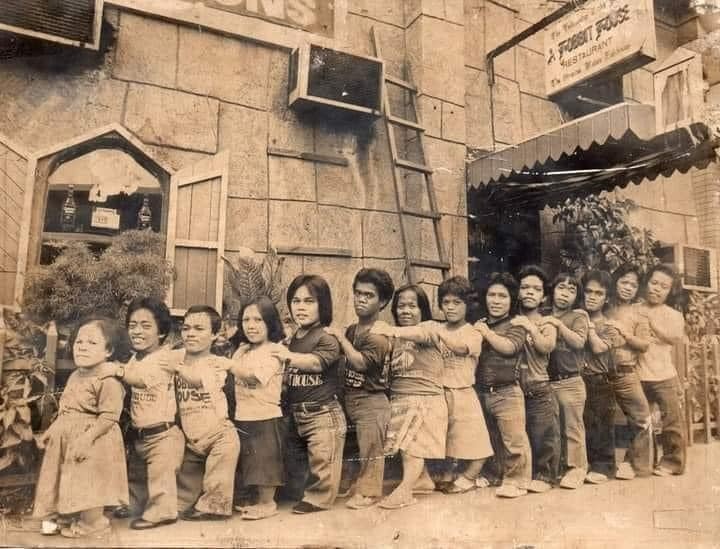
John M. Glionna wrote in the Los Angeles Times: “Every night without fail, Jim Turner is there at the far corner of the bar, chain-smoking his Marlboros and sipping ice-cold San Miguel from the bottle, watching over the Little Ones. He considers them family, but they're not his children. They're the dwarfs and other little people the 70-year-old Iowa native has rescued from the heartless streets of this capital city to offer them friendship and honest work. [Source: John M. Glionna, Los Angeles Times, August 10, 2009 ^]
“For 35 years, the former Peace Corps volunteer has operated the Hobbit House, a bar themed on J.R.R. Tolkien's fantasy novels, a realm marked by all things miniature. Under his care, hundreds of dwarfs have adopted new cultural identities. They're no longer shunned or even feared as supposed evil spirits, but have become popular characters called hobbits — merry figures who serve drinks, crack ribald jokes and even entertain onstage. ^
“At Turner's bar, on a dingy block of strip clubs and speak-easies in central Manila, the dwarfs draw a loyal crowd. They're entertainers who get the joke, always ready to use their small size for a few good-natured laughs. The Hobbit House features what may be the world's smallest Elvis impersonator. There have been hobbit jugglers, comics, dancers, flame-eaters and a singer who sounded eerily like Frank Sinatra. ^
“Many of the waiters and bartenders are the grandchildren of the dwarfs who helped Turner launch the bar. There's now even a second location, at a tourist resort in the central Philippines. Yet critics have accused Turner of exploiting his workers. Stubbing out a Marlboro, he frowns. "We took many from the worst slums in Manila, where they were mocked and ridiculed," he says. "Now they're no longer carnival freaks. They're respected entertainers and businesspeople." ^
Peace Corp Volunteer Who Founded the Hobbit House
John M. Glionna wrote in the Los Angeles Times: “Turner arrived in the Philippines in 1961, a young idealist out to change the world. Among the first group of Peace Corps volunteers in the country, he taught English for two years in a rural province, then moved back to Manila. Slowly, he became consumed by this poor, exotic and often-maddening country. He wanted to stay. After years in Manila, Iowa seemed more like the foreign country. He did odd jobs, eventually becoming a television station manager. That's when he was introduced to his first dwarfs. We ran a lot of variety shows where we cast midgets, dwarfs and transvestites," says Turner, a graying man with bushy eyebrows. "They were a staple of TV then." [Source: John M. Glionna, Los Angeles Times, August 10, 2009 ^]
“In 1972, then-President Ferdinand Marcos declared martial law and shut down the station. Turner needed work, so he and some friends came up with an idea for a theme bar. He'd read Tolkien's books as a boy in Cedar Rapids and knew that little people were easy to find in Manila. His first stop was a business called Central Casting, where he hired two dwarfs to work as doormen. Word got out and little people from all over the country began asking for work.^
“Soon Turner was overrun with little people. They worked as waiters and bartenders and he built them miniature sets of stairs that they climbed to conduct business at the towering wooden bar. But they soon wanted more: They asked to entertain. So Turner let them have the stage for vaudeville-type acts that featured little people as the big stars. His first performer was a woman named Little Lucy, who ate fire and juggled, balanced on a fulcrum. "For a while," Turner recalls, "everyone wanted to be an Elvis impersonator."^
Stories from Hobbit House
John M. Glionna wrote in the Los Angeles Times: “Often, life at the Hobbit House was surreal. In one act, a dwarf dressed as a security guard patrolled with a Great Dane three times his size. On New Year's Eve, some of the performers wear diapers and bonnets and carry rattles onstage to become tottering symbols of the infant year. For a while, after an employee's uncle closed his pet store, monkeys roamed the bar. There were parrots, turkeys, an eagle and even an alligator. Turner eventually found homes for them too. [Source: John M. Glionna, Los Angeles Times, August 10, 2009 ^]
“During martial law, the bar became the watering hole of the city's political subversives: anti-Marcos reactionaries, U.S. spies, protesters on the run from the law. In the mid-1970s, when Francis Ford Coppola filmed "Apocalypse Now" in the Philippines, the Hobbit House was a regular hangout for the director, actors and crew, Turner says, doing his impersonation of Marlon Brando shouting for another drink. ^
“Over the years, he learned that not all of the hobbits were fairy-tale characters. He had to fire some who stole from the till. But Turner quickly recognized the ones he could trust. They are people like Fetalino. He started as a cashier, but when Turner heard he'd had two years of college, he sent Fetalino for management training. He's been general manager for 15 years. "You see the hurdles they scale," Turner says, "and you realize that no matter how many problems you have, if you're average size in this world, you've got the game half-won."
Benefactor of the Hobbit House
John M. Glionna wrote in the Los Angeles Times: ““And Turner is their godfather. Workers tell of the night when two drunken Australians began playing catch with terrified little people; Turner stepped between two ruffians nearly twice his size and threw them out of the bar. He has provided many of his workers with loans and housing and has paid tuitions. Several years ago, he gave them something perhaps even more precious: the Hobbit House itself. He founded a corporation, naming seven of his employees the main stockholders. Now they make the decisions and call the shots. From his perch at the bar, Turner watches over the business as a consultant and takes only enough salary to pay his bills. The dwarfs call him tito and kuya, "uncle" and "older brother." [Source: John M. Glionna, Los Angeles Times, August 10, 2009 ^]
“Pidoy Fetalino, a 35-year veteran of the bar, likes to stroll into business meetings, raise his hand to greet average-sized clients and proudly announce that he's the establishment's general manager. Over drinks after the bar closes, he gets emotional about Turner, who has helped him put two children through college and discover self-respect. "He's our protector, a big man with a big heart," Fetalino says. "One day he said to us: 'This Hobbit House belongs to all of you. You earned it.' A lot of us cried that day." ^
“One afternoon, Turner sits on the street-side patio as colorful jeepneys race past, their horns blaring, seats filled with passengers. An elderly dwarf limps in with two small men. Naida Morehon retired from the Hobbit House two years ago when her knees gave out. Her husband died last year and she needed money. As always, Turner took care of things. "Hi, Naida," he says, lighting a cigarette. "Did you get the check?" She hurries to embrace him. Seated, Turner is face to face with Morehon, who places her small hand on his cheek. "I did, Tito," she says. "What would we do without you?" ^
“The Monday rush is here and the workers at the Hobbit House are ready for action. But sitting around a table, a few quietly voice a common concern: What would they ever do without the nurturing and guidance of Jim Turner? Although he swears he's in perfect health, they know he drinks and smokes too much. A decade ago, when he got sick, a large group of employees went to visit him in the hospital. An exhausted Turner had to tell nurses not to admit any visitor less than 4 feet tall. Many say it gives them comfort knowing he's there at his perch, with a green lamp by his side so he can see bills and paperwork in the darkened bar. But they know he's getting older and more frail. Perhaps Waiter Edward Vitto, 33, said it best: "It won't be the same place without him — just a bunch of little people with broken hearts." ^
Château Margaux Party in Manila
The Philippine Daily Inquirer reported: “The most interesting private dinner of late 2008 in Metro Manila was perhaps one people didn’t know about, for it was held in utmost secrecy. Held in the home of a business/industry titan, it gathered 30 of the country’s Who’s Who, with diverse interests and clouts but sharing a consuming passion: fine covetable wine. They sat down to a gourmet dinner to relish and discourse on glasses of Château Margaux, the French wine with a heritage derived from over 400 years. [Source: Philippine Daily Inquirer, April 15, 2009 ==]
“Château Margaux officials led by director general Paul Pontallier and business development director Aurélien Valance flew in from France, with executives of leading wine merchant Ficofi— founding chairman and CEO Philippe Capdouze, and director/head of Asia Pacific Christophe Bourrié. For the exclusive dinner, they brought from the Château Margaux estate bottles of vintage years many a wine connoisseur dream to have: 1989, 1995 and 1998 Château Margaux, 2000 Pavillon Rouge du Château Margaux, 2005 Pavillon Blanc du Château Margaux. ==
“The dinner was a privilege extended by a private host to the select gathering. It wasn’t even a selling jaunt for the wine officials. However, in an exclusive sit-down with the Philippine Daily Inquirer, the Château Margaux executives shared interesting observations about the growing wine investment— yes, investment—in the world, especially Asia. ==
“Stocks, derivatives, mutual funds, every financial mutant imaginable— these traditional investments suddenly don’t seem like safe havens today. However, even long before the world economy began to unravel, a highly select market has already been investing in wine. In the Philippines alone, claimed a regional banker, wine investment could run to an estimated tens of millions of pesos a year; that in Japan or another rich country in Asia could be triple that. Pontallier said in the past two years, the Asian wine market has been fast approaching the level of Europe and the US. His group regularly meets with Ficofi clients to be in touch with the markets of, say, Korea and Singapore. ==
“Why are investors lured to investing in wine? Passion. Obsession. There are people to whom fine wine is a passion that surpasses all else (passion for wife included?), so much so that their lifestyle revolves around it. And what fans the flames of passion in this case is the fact that mastery of wine is a lifetime work. It’s an elusive craft, where the pursuit of excellence is like running toward a finish line you never do reach. Pontallier notes a recent direction: “What has changed in 10 years is that our market isn?t limited to the traditional anymore. In more and more places, people are into fine cuisine [likewise, fine wine]—in the Philippines, Thailand, Eastern Europe.” “==
Alcohol and Cigarette Taxes in the Philippines
In January 2013. The Philippines imposed new taxes on alcohol and tobacco. Jess Diaz wrote in the Philippine Star, “The New Year ushers in higher taxes on cigarettes, beer, liquor, wine, and other tobacco and alcohol products. When he signed Republic Act No. 10351 on Dec. 20, President Aquino said, “Today, we are again making history: for the past 15 years, we have been trying to reform the tax structure of imposing excise tax on tobacco and alcohol products. After 15 long years, we have finally succeeded.” “As the people’s servant, I shall personally ensure that this government shall implement the Sin Tax Reform Act of 2012 in a transparent and accountable manner starting Jan. 1, 2013,” he said. [Source: Jess Diaz, Philippine Star, January 1, 2013 ^=^]
“Starting today, the tax on cigarettes packed by hand, which comprise the bulk of tobacco products sold in the country, is P12 per pack for those with a net retail price (excluding the excise tax and the 12-percent value added tax) of P11.50 and below. For those with a higher retail price, the tax is P25. The rates will go up to P17 and P27 in 2014, P21 and P28 in 2015, and P25 and P29 in 2016. There will be a single rate of P30 per pack starting 2017, rising by four percent every year. This means that the four categories of cigarettes based on their retail prices and tax rates under the old law have been reduced to just two, with the new law providing for a uniform tax treatment beginning in 2017. ^=^
The old levies ranged from P2 per pack for low-priced cigarettes to P28 for those classified as premium. For fermented liquor (beer), the tax is P15 per liter if the net retail price is P50.60 and below per liter, and P20 per liter for those with a higher price. The rates will rise to P17 and P21 in 2014, P19 and P22 in 2015, and P21 and P23 in 2016. A uniform tax of P23.50 will be imposed starting in 2017, which will increase by four percent every year. For distilled spirits, the tax is 15 percent of net retail price plus P20 per proof liter, rising to 20 percent plus P20 in 2015. In the case of wine, the tax is P200 per bottle of 750 ml (milliliter) if its net retail price is P500 or less, and P500 per if the wine costs more. ^=^
“According to Sen. Franklin Drilon, principal author of the Senate version of the sin tax bill, additional sin tax collections for 2013 would amount to P33.96 billion, P42.82 billion in 2014, P50.63 billion in 2015, P56.86 billion in 2016, and P64.18 billion in 2017, for a total of P248.49 billion in five years. Some 70 percent of such collections would come from tobacco products. The law allocates 15 percent of incremental revenues for programs that would benefit tobacco farmers. Of the remaining 85 percent, 80 percent “shall be allocated for universal health care under the national health insurance program, the attainment of the Millennium Development Goals (MDGs) and health awareness programs; and 20 percent shall be allocated nationwide, based on political and district subdivisions, for medical assistance and health enhancement facilities, the annual requirements of which shall be determined by the Department of Health.” The 20 percent for medical assistance and hospitals to be distributed among “political and district subdivisions” is additional pork barrel funds for members of Congress.
WTO Rules Philippines Tax on Alcohol Imports Is Illegal
In August 2011, the World Trade Organisation ruled that a tax levied in the Philippines on imports of alcohol broke global rules on free trade. The BBC reported: “It said the tax, which supports domestic producers who use local cane and palm sugar, gives them an unfair advantage. The US has previously urged the Philippines to open its market to foreign alcoholic drinks.The Filipino government argued that the tax was apt. US Trade Representative, Ron Kirk, said the decision shows "the commitment of the US to combat trade barriers". [Source: BBC, August 16, 2011]
“The ruling could lead to more sales of imported alcoholic drinks in the country. The US and the European Union argued that because the Filipino products were marketed as whiskey, gin, vodka, and tequila just like the foreign products, they should be taxed at the same rate. However, the government in Manila claimed that because the beverages are actually made from different ingredients the excise tax was correctly applied. European companies have complained that the tax meant foreign products managed to grab just 2.5 percent of the domestic market, giving control of the sector to three Filipino companies. [Ibid]
Image Sources: Wikimedia Commons
Text Sources: “Encyclopedia of World Cultures Volume 5: East/Southeast Asia:” edited by Paul Hockings, 1993; “Culture Shock!: Philippines” by Alfredo Roces and Grace Roces, Marshall Cavendish International, 2010; Metropolitan Museum of Art; National Geographic, Live Science, Philippines Department of Tourism, New York Times, Washington Post, Los Angeles Times, Smithsonian magazine, Encyclopedia.com, Library of Congress, The Conversation, The New Yorker, Time, BBC, CNN, Reuters, Associated Press, AFP, Lonely Planet Guides, Google AI, Wikipedia, The Guardian and various websites, books and other publications.
Last updated March 2026