
FOOD IN THE PHILIPPINES
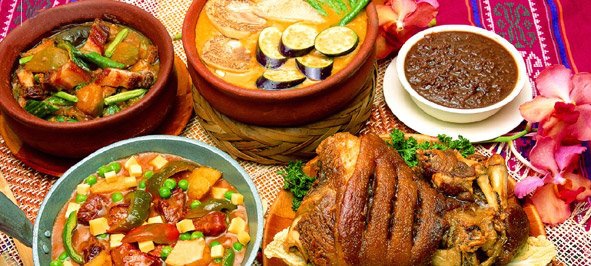
Meat—particularly fish, chicken, and pork—is commonly fried, although increasing health awareness has encouraged the use of alternative cooking methods such as grilling, stewing, or steaming. Garlic is widely used in cooking and is valued both for its flavor and for its perceived health benefits. Filipino cuisine is generally mild rather than spicy. Meals are traditionally prepared on gas burners or over wood or charcoal fires, and dishes are often allowed to cool before being eaten. [Source: Sally E. Baringer, Countries and Their Cultures, Gale Group Inc., 2001]
Vegetables are commonly incorporated into soups and stews, which accompany rice in many meals. Frequently used vegetables include green beans and potatoes. Up north in Ilocos, the vegetable dish of okra, eggplant, bitter gourd, squash, tomatoes and bagoong (shrimp or fish paste) called pinakbet is a favorite. And now, this healthy, cheap, and easy to cook dish has made its way around the archipelago. It is cooked in most households and local restaurants. [Source: Maida Pineda, Candice Lopez-Quimpo, CNN March 6, 2012 ]
The leaves of camote, or sweet potato, are used in salads and soups. Ube, a bright purple yam with a mild flavor, is widely used as a colorful ingredient in desserts such as cakes, pastries, and ice cream. One well-known dessert is halo-halo, meaning “mixture,” which typically consists of layered ingredients such as sweetened corn kernels, gelatin cubes, shaved ice, ice cream, and cereal flakes. Another staple condiment is patis, a salty fermented fish sauce that is placed on the table so diners can add it to dishes according to taste.
Favorite comfort foods include monggo, a mung-bean stew with melted pork fat, and deep-fried meatballs called bola-bola. In recent decades, fast food has become an important part of urban Filipino food culture. Both domestic and international fast-food chains operate in many towns and cities. Unlike most Western fast-food meals, Filipino fast-food menus commonly include rice as a standard accompaniment, although French fries are also available. Banana ketchup—a sweet, banana-based condiment—is often preferred locally, though international chains also serve tomato ketchup. One of the country’s most prominent fast-food companies, Jollibee, has expanded internationally and opened restaurants in areas with large Filipino immigrant populations, including in the U.S. state of California, with plans for further expansion in other cities with significant Filipino communities.
RELATED ARTICLES:
EATING AND DRINKING CUSTOMS IN THE PHILIPPINES factsanddetails.com
FILIPINO CUISINE: CHARACTERISTICS, REGIONAL VARIATIONS, FUSION, DEFENDING IT factsanddetails.com
FILIPINO DISHES: EATING, COOKING AND ENJOYING THEM factsanddetails.com
FILIPINO SNACKS AND DESSERTS: SWEETS, FRUITS, STREET FOOD factsanddetails.com
FILIPINO FOOD RECIPES factsanddetails.com
EXOTIC AND WEIRD FOODS IN THE PHILIPPINES factsanddetails.com
FILIPINO RESTAURANTS AND PLACES TO EAT IN THE PHILIPPINES factsanddetails.com
JOLLIBEE: HISTORY, TONY TAN CAKTIONG, SUCCESS factsanddetails.com
DRINKS IN THE PHILIPPINES: BEER, TUBA, COCKTAILS, CIVET COFFEE factsanddetails.com
DRINKING IN THE PHILIPPINES: CUSTOMS, HOBBIT BAR, WINE PARTIES, TAXES factsanddetails.com
TOBACCO AND BETEL NUT IN THE PHILIPPINES: SMOKING, HISTORY, STRICT LAWS factsanddetails.com
ILLEGAL DRUG USE IN THE PHILIPPINES: MAINLY CANNABIS AND METH factsanddetails.com
ILLEGAL DRUG TRADE IN THE PHILIPPINES factsanddetails.com
Importance of Food to Filipinos
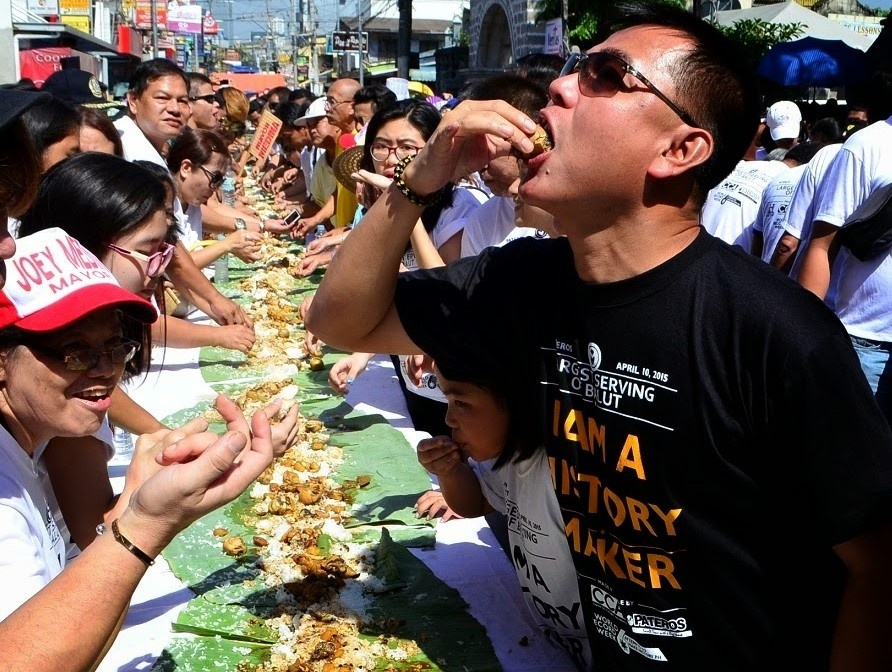
According to “Culture Shock!: Philippines”: The importance of food in the Filipino psyche cannot be underestimated. They fear running short of food, and everywhere they goes they must have, as a security blanket, abundant provisions to reassure them that they will not starve to death. A driver not given his meal on time has his driving impaired. The most constant and visible growth in Metro Manila has been in eateries. And try getting service from a clerk eating lunch at her desk, or a bureaucrat at his coffee break! [Source: “Culture Shock!: Philippines” by Alfredo Roces and Grace Roces, Marshall Cavendish International, 2010]
There is no gathering of Filipinos without food. Major social occasions—such as baptisms, weddings, funerals, and town fiestas—almost always revolve around food, and gatherings of friends or family typically center on shared meals. Filipinos love desserts. Lunch and dinner are always followed by dessert.
It is standard hospitality to offer visitors not just a drink but food, be it only biscuits or rice cakes. The usual Filipino greeting is “Kumain ka na ba?” (“Have you eaten?”). Eating in front of others and not offering to share is rude. A sojourn to the beach which consists of a safari of food bundles, will not seem sufficient unless there are stops at fruit shops for more supplies. Even a trip to see a film will require provisions.
One Filipino expression captures the pleasure of eating well: linamnam. The word has no direct English translation but refers to a feeling of delight or excitement when tasting something deeply satisfying. [Source: Karl Malakunas, AFP, April 26, 2012]
Rice in the Philippines
Rice is the central staple of the Filipino diet, and many Filipinos do not consider a meal complete without it. The average Filipino consumes well over 100 kilograms of rice per year, making it the country’s most important dietary staple. Rice is commonly eaten for breakfast as well as lunch and dinner. It is typically cooked first because it requires the longest preparation time; once ready, it is placed on the table while the remaining dishes are finished and served. Plain steamed rice forms the basis of most meals and is typically served with a variety of accompanying dishes. In many rice-producing regions, as many as three harvests are obtained annually to meet national demand, and government reserves are maintained to safeguard against shortages caused by drought or natural disasters. [Source: Mike Dilger and Rico Hizon, BBC, April 14, 2018; Sally E. Baringer, Countries and Their Cultures, Gale Group Inc., 2001]
Rice has been cultivated in the Philippines for more than 2,000 years. More than twenty varieties of rice are grown in the country and used to produce a wide range of foods, including cakes, noodles, and pancakes. Rice noodles are especially common in fast-food restaurants and street stalls, often served in large portions with various meats and vegetables. [Source: Junior Worldmark Encyclopedia of Foods and Recipes of the World, Gale Group, Inc., 2002]
Most new strains of rice have been developed at the International Rice Research Institute (IRRI) in Los Banos, the Philippines. Founded in 1967, the IRRI has produced 300 different varsities of rice. One strain, called IR36, is resistant to 15 insect, disease and environmental stresses and is currently planted on about 27 million acres worldwide.

World’s Top Producers of Rice, Paddy (2020): 1) China: 211860000 tonnes; 2) India: 178305000 tonnes; 3) Bangladesh: 54905891 tonnes; 4) Indonesia: 54649202 tonnes; 5) Vietnam: 42758897 tonnes; 6) Thailand: 30231025 tonnes; 7) Myanmar: 25100000 tonnes; 8) Philippines: 19294856 tonnes; 9) Brazil: 11091011 tonnes; 10) Cambodia: 10960000 tonnes; 11) United States: 10322990 tonnes; 12) Japan: 9706250 tonnes; [Source: FAOSTAT, Food and Agriculture Organization (U.N.), fao.org]
There are two principal kinds of domesticated rice: Oryza sativa, a species grown in Asia, and O. glaberrima, domesticated in West Africa, but the most prevalent rice varieties grown and sold in the world market come almost exclusively from Asia. By area of cultivation, rice may be classified into three subspecies: 1) The indica variety is characterized by a long, oval grain and is grown in the monsoon zones of Asia, primarily China, Vietnam, the Philippines, Thailand, Indonesia, India, and Sri Lanka; 2) The japonica variety is characterized by plump, oval grains and short stems, and it is grown in the temperate zones, such as Japan and Korea; and 3) The javanica variety is characterized by a large, plump grain, but it is planted much less than the other types because of its lower yields. It is grown in Indonesia and the Philippines.
See Separate Articles: RICE: PLANT, FOOD, CROP, HISTORY, AND AGRICULTURE factsanddetails.com ; RICE PRODUCTION: EXPORTERS, IMPORTERS, PROCESSING AND RESEARCH factsanddetails.com
Coconut Milk
Coconut milk is a common ingredient in many Filipino dishes. Homemade coconut milk tastes its best when freshly made; even if it is refrigerated, it quickly loses its flavor.
Ingredients
2 cups coconut meat, finely shredded (see instructions above; canned or frozen unsweetened, shredded coconut is available at most supermarkets.)
8-inch square of cheesecloth (can be found in most supermarkets), surgical gauze, or 8-inch square of clean nylon stocking [Source: Junior Worldmark Encyclopedia of Foods and Recipes of the World, Gale Group, Inc., 2002]
Instructions
Fill a large saucepan halfway with water and bring it to a boil. Measure out and set aside 2 cups of the boiling water.
If using a blender or food processor, combine the shredded coconut and the boiling water, then blend for about 1 minute. Allow the mixture to cool for 5 minutes.
If not using a blender or food processor, place the shredded coconut in a mixing bowl and pour the boiling water over it. Let it sit for about 30 minutes.
Strain the coconut liquid through cheesecloth, gauze, or nylon into a medium-sized bowl.
Squeeze and twist the cloth to extract as much coconut milk as possible from the coconut meat.
Repeat the process if additional coconut milk is needed.
History of Food in the Philippines
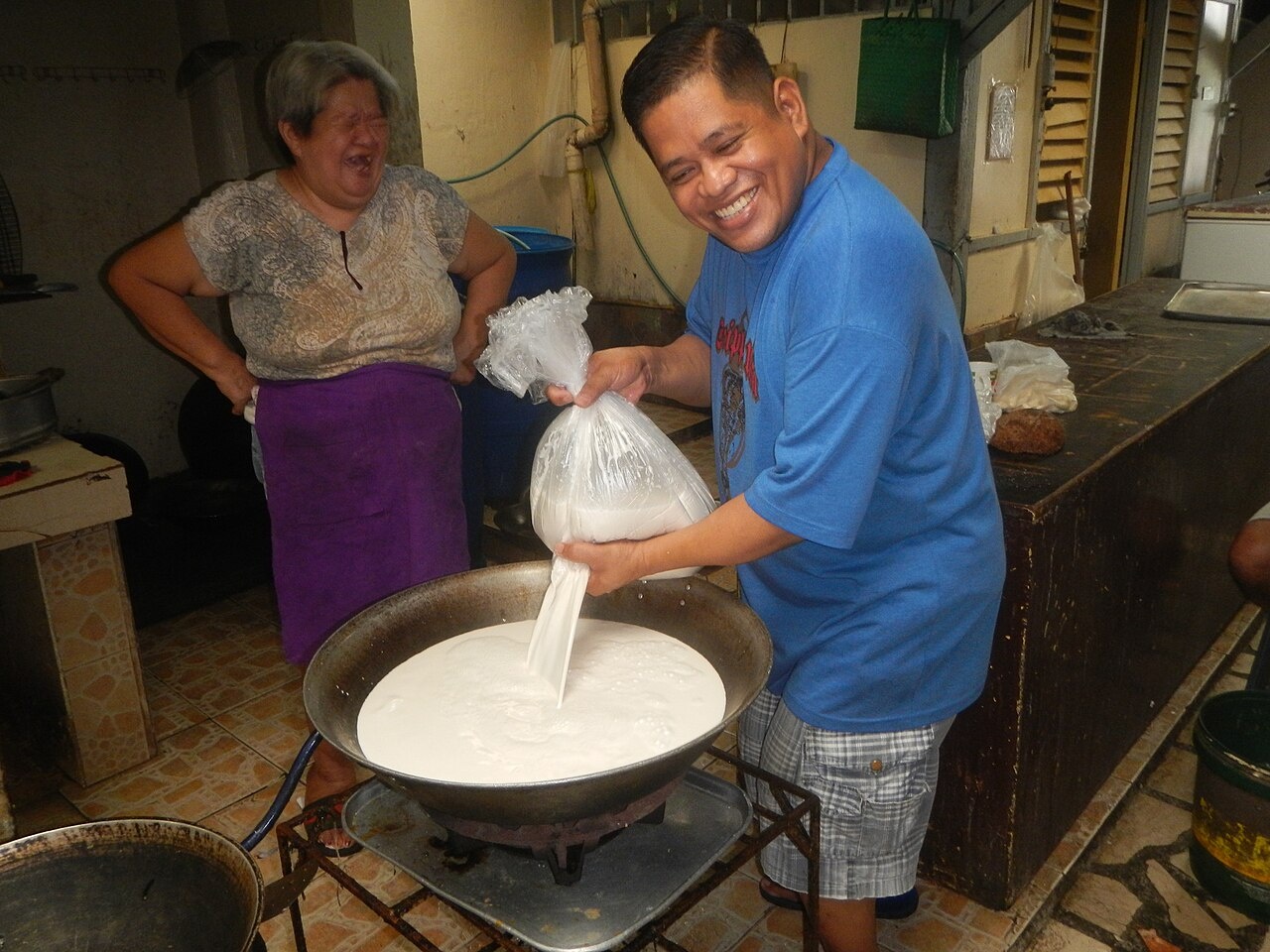
Coconut healing oil is produced in Baliuag, Bulacan by extracting cream from 27 mature coconuts (costing about $18) by grating the flesh using mechanical shredders; the coconut cream is pressed once using sacks and extractors; it is then cooked on a gas stove until the curd (latik) turns black; the oil is collected in small bottles; Rare coconuts are classified by the number of “mata” (eyes) or pores; four-eyed coconuts are extremely rare, appearing about once in 100 million; coconuts with no eyes are even rarer, occurring roughly once in a billion; two-eyed coconuts are also scarce, with only about two found in a harvest of 7,000 from a one-hectare farm and can cost around P20,000; most coconuts are the common three-eyed variety
Rice was the staple for Tagalogs, Kapampangans, Bicolanos, Ilonggos and other groups before the Spanish arrived in the Philippines. Others groups ate sweet potatoes and taro. Seafood was the main source of protein, and pigs and fowl were also present and often reserved for special occasions. The waters surrounding the Philippine archipelago contain more than 2,000 species of fish. Filipinos have also practiced aquaculture for centuries, raising fish in palaisdaan, or fishponds, a tradition that dates back more than 1,000 years. Pre-colonial Filipinos ate coconuts and bananas, drank tuba (coconut wine) and cooked in coconut oil. Sago was eaten in the form of cakes.
Three hundred years of Spanish rule had a strong influence on the food in the Philippines: The Spanish brought with them their own cuisine and many of these foods were adopted into the Filipino diet. Here’s a list of some of them: corn, flour, squash, avocado, sausage, beef, guava, sapodilla (chico fruit), papaya, cabbage, cocoa, potatoes (white), ham, coffee, beer, bread (made from wheat flour), pickles, sardines. The Spanish also introduced forks, spoons, plates, and cups to the Philippines. To this day, forks and spoons are used when eating (but not knives). However, some Filipinos still prefer to eat the truly native Filipino way, without utensils. [Source: by Rebecca, Philippines Baguio Mission, 2009-2011, the missionary website, preparetoserve.com =]
American influence followed when the United States took control of the Philippines after the Spanish–American War in 1898 and governed the islands until 1946. American soldiers and administrators introduced foods such as mayonnaise, hot dogs, hamburgers, and apple pie. They also popularized canned products, including evaporated and condensed milk, which became common ingredients in Filipino desserts such as flan. Foods like cheese and canned tomato sauce, rarely used elsewhere in Asian cuisine, became incorporated into Filipino cooking and remain popular today. [Source: Junior Worldmark Encyclopedia of Foods and Recipes of the World, Gale Group, Inc., 2002]
Filipino Diet
The typical Philippine diet revolves mainly around the local foods, especially vegetables. pork and seafood, and rice and noodles. Filipinos are also very familiar with Western foods, especially fast foods, and the diet of most today is a mixture of all these influences. Westerners familiar with Spanish-influenced cuisine will recognize the Latin-based menudo-type stews, the Cuban-style pork dishes, the tapa-like appetizers, but all with native ingredients of Asian and Polynesian origin. On top of this, add the American hamburger, and other types of fast food (which, in all fairness, are found most everywhere around the world), and you have a sense of Filipino cooking. [Source: etiquettescholar.com]
Seafood is very common everywhere. Fish and shellfish from both saltwater and freshwater sources are consumed daily, either fresh or preserved through salting. In the U.S. tilapia is popular due to its low price, easy preparation, and mild taste. It is also a traditionally popular food in the Philippines, where it is also known for its low cost and mild taste. Traditionally, the fish is either fried as an individual food or boiled as part of a dish in the country.
Preserved vegetables and rice dishes, often mixed with coconut, pork. and chicken are common. Restaurants representing various Asian cuisines abound in Manila. There are a few unique Philippine dishes that you will probably be encouraged to try: one of them is balut, which is a cooked egg with a half-developed chick or duckling inside. Winged beans, from the Philippines, can be steamed, stir fried or used in dips.
The nutritional icon for the Philippines is the six-sided diamond star which divided into six groups; 1) leafy green and yellow vegetables; 2) citrus fruits, tomatoes, cabbage and other vitamin-C-rich fruits and vegetables; 3) succulent vegetables and fruits; 4) milk, cheese, butter, and other fat-rich foods; 5) meat, poultry, fish, eggs, dried beans, mungo and other sources of protein; and 6) rice and other grains. The message conveyed by the star is that food from each group should be consumed. The Philippines guidelines also advise drinking milk everyday, getting enough protein and savoring meals.
The largest consumers of instant noodles in 1996 were: 1) Indonesia (7.97 billion packets); 2) Japan (5.3 billion packets); 3) South Korea (3.73 billion packets); 4) the United States (2.0 billion packets); 4) Thailand (1.34 billion packets); 5) the Philippines (1.04 billion packets); and 6) Taiwan (840 million packets).
Festival Foods in the Philippines
Food plays an important role during religious celebrations and ceremonial occasions in the Philippines despite the fact that the eating habits for most Filipinos, 80 percent of them Catholics, are not strictly governed by religious dietary rules. During town fiestas held in honor of patron saints or events such as house blessings, lechon—a whole suckling pig roasted slowly over coals until the skin becomes crisp and brown—is a centerpiece of the feast. The skin, especially when served with a layer of fat, is considered the most prized portion. The status of the host and the significance of the occasion are often reflected in the quantity of lechon served. The pig’s blood is commonly used to prepare dinuguan, a savory stew or porridge made with pork and blood. [Sources: Kathleen M. Nadeau, Worldmark Encyclopedia of Religious Practices, Thomson Gale, 2006; Sally E. Baringer, Countries and Their Cultures, Gale Group Inc., 2001; Junior Worldmark Encyclopedia of Foods and Recipes of the World, Gale Group, Inc., 2002]
Festive meals typically include a variety of other traditional dishes. One of the most common is pancit, a noodle dish prepared with ingredients such as small shrimp and finely chopped vegetables. Sweet dishes are also important, particularly desserts made from glutinous rice. Sticky rice cooked in coconut milk and sweetened with sugar is often wrapped in banana leaves to create traditional delicacies.
Alcoholic drinks such as tuba (a distilled liquor made from coconut juice) and beer are commonly served, particularly for male guests. These drinks may be accompanied by balut, a fertilized duck egg containing a partially developed embryo, which is widely eaten as a snack. In the past, dog meat was also considered a delicacy in some areas, although the sale of dog meat in markets is now illegal due to health concerns, including the risk of rabies.
Christian holidays are the most widely celebrated religious occasions in the Philippines, reflecting the long influence of Spanish colonial rule, which introduced Roman Catholicism to the islands. Today, the Philippines is the only predominantly Christian country in Asia, with about 90 percent of the population identifying as Roman Catholic. Filipinos are also known for having one of the longest Christmas celebrations in the world, beginning on December 16 and continuing for several weeks.
Food is central to these holiday observances. On Christmas Day, known locally as Pasko ng Bata, families may gather to share dishes such as lumpia (fried spring rolls) and warm drinks like tsokolate, a traditional chocolate beverage, and salabat, a ginger tea. Larger family feasts often take place later in the season, particularly around the Feast of the Epiphany in early January.
During these gatherings, families prepare a generous spread that often includes roasted pork lechon along with sinangag (garlic fried rice) and other rice-based dishes such as bibingka, a rice cake topped with salted eggs and coconut, and suman, glutinous rice steamed in banana leaves. These meals are accompanied by vegetable dishes and fresh fruits such as pineapples, bananas, persimmons, and papayas. Desserts, cookies, and cakes typically conclude the feast, which may last for hours and is often followed by a leisurely afternoon rest.
Complexity of Food in a Filipino Home
Angela Dimayuga, t creative director for food and culture at the Standard hotels and former Mission Chinese Food chef, wrote in the New York Times: In a Filipino house, there is always food, more food than you could ever eat, stacked in the refrigerator, edge-to-edge on the counter and simmering on the stove. My brothers and sisters and I came home from school to giant pots of sinigang, a soup that’s sour enough only if you gasp a little at the first spoonful, and arroz caldo, an earthy rice porridge brightened by a squeeze of calamansi — a native citrus that looks like a mini orange but tastes closer to a lime — plucked from the tree in our backyard. [Source: Angela Dimayuga and Ligaya Mishan, New York Times, October 7, 2019]
My mom cooked all of this at the start of each week, before she headed off to her day job at IBM. She has roots in Pampanga, which I found out later in life is rightly called the culinary capital of the Philippines; people rave about the vividness of the ingredients there, and the imagination with which they’re deployed. Food is my mom’s birthright, and I’m lucky that she passed that on to me.
Because there were so many of us — I’m the second youngest of six — when we were home, we rarely sat down at the dining table to eat. Instead, we ate where we talked, gathered around the counter or cross-legged at the coffee table, our plates anointed by the ever-ready bottle of sawsawan, a homemade tincture of spiced vinegar, with whole garlic cloves steeping. (Condiments are practically compulsory in Filipino food. You could even say that the diner plays as big a role as the chef, seasoning each dish to taste.)
My lola, a former pharmacist who tended African violets in her retirement, was the one my mom and my aunts deferred to in the kitchen. Before a party, she cooked all week. It was part of her love language. At her funeral last spring — she died at age 100 — every eulogy was an incantation of the bounty she’d fed us all our lives, from bistek, steak exalted by soy sauce and a sunny kiss of calamansi, to Christmas ensaymadas, sweet butter-soaked rolls thatched with queso de bola, a red-skinned Edam cheese.
Her most prized dish was chicken relleno, reserved for the grandest festivities. She had never revealed the recipe to anyone, which strained some friendships. The day I learned to make chicken relleno, my lola laid out two cutting boards and a set of battered but carefully sharpened knives. Wearing a shower cap over her head, she deboned the chicken with her tiny hands so fast, I had to double-check what parts were left. Her embutido — the pork and sausage stuffing to be sewn up inside the chicken — required the technical precision of a French farce (finely puréed meat). Later, at a culinary conference, I watched a demonstration by the French chef Jacques Pépin and realized that my lola was making galantine.
That was the first time I took a real look at the mechanics behind the food of my childhood. My mom emailed me her recipe archive, a 40-page document that included multiple takes on single dishes, culled from her sisters and my lola. Not all of them were complete or correct as written — certain ingredients and methods simply went unmentioned, taken for granted, part of the heritage of life in the Philippines, where those details would’ve been communal knowledge.
Yucky Food in the Philippines
Winston posted in his blog happierabroad.com: “ Food in the Philippines is considered by all foreigners unanimously to be the worst in Asia, hands down. Not only are the ingredients in the food of bad quality, but they are shabbily hacked together with no skill or class. 95 percent of restaurants owned by Filipinos serve food that is so disgusting that you wouldn't eat it if it were free, yet they charge high prices for it and get away with it! It's mind boggling. [Source: Winston, happierabroad.com, December 22, 2011 ~\~]
“The fast food franchises Chow King and Greenwich are disgusting, not even edible and shouldn't even exist, yet they are everywhere in the Philippines! It's bizarro world. To get decent food you have to be very selective, visiting only places that you know have decent food, which are usually foreign owned. Places owned by foreigners or Filipinos who were trained abroad also have a good chance of being decent. ~\~
“The poor choice of food leads to overall nutritional deficits in the Filipino population, which most are unaware of. Also keep in mind, food spoils very quickly in the Philippines, even when it's refrigerated, like it does nowhere else, probably due to the humidity that allows all kinds of molds and bacteria to grow. I've never seen food spoil as fast as it does in the Philippines. Moreover, you can't leave food on the table or anywhere in open space without ants getting to it within minutes. But it's impossible to remember every time to put food in the fridge or within locked containers, so inevitably you're going to have ants getting into some of your food. It's very annoying, and does not happen in colder or dryer climates. ~\~
Spreading the Gospel of the Joys of Filipino Cuisine
Claude Tayag describes himself as a “food missionary,” determined to introduce more people at home and abroad to the richness of Filipino cuisine. Tayag has transformed his rustic home north of Manila into an informal restaurant where guests enjoy elaborate meals showcasing dishes from across the archipelago. These gatherings typically feature multi-course menus that highlight traditional ingredients and flavors. Meals might begin with a trio of dips such as fermented rice, crab fat, and pesto made from the native pili nut, followed by dishes like grilled chicken marinated in lemongrass and calamansi, a fragrant local citrus fruit. One dessert resembles the Italian panna cotta but is made with rich milk from the water buffalo, or carabao.[Source: Karl Malakunas, AFP, April 26, 2012]
Throughout the meal, diners drink chilled tea flavored with calamansi juice, ginger, lemongrass, and honey. A highlight often occurs when Tayag prepares sisig, a sizzling pork dish made from finely chopped pig’s ears and cheeks. Popular as a late-night snack across the Philippines, sisig is typically mixed with ingredients such as chicken liver, onions, chili, and calamansi juice before being served hot from the pan.
The popularity of these gatherings suggests a growing interest in traditional Filipino cooking. Tayag believes that across the country there are chefs and food enthusiasts working to preserve slow-cooked dishes and regional specialties. In recent years, the rise of upscale Filipino restaurants, food blogs, and television travel programs has contributed to renewed attention to local cuisine.
In the later 1990s, restaurants serving refined versions of Filipino classics were uncommon even in major cities. Today, fueled partly by the growth of the middle class, more restaurants highlighting Filipino flavors are appearing in urban centers. Nevertheless, Tayag acknowledges that fast food remains the most common dining choice for many Filipinos, especially those seeking inexpensive meals.
To help raise awareness, Tayag has written several books promoting Filipino cooking and has gained international attention. His work was featured on the television program Anthony Bourdain: No Reservations hosted by Anthony Bourdain. During the program, Bourdain also visited Cebu City, where he sampled lechon, the country’s famous whole roasted pig. Praising its crisp skin and tender meat, he declared it one of the best pork dishes he had encountered anywhere in the world.
High Food Prices in the Philippines
The Philippines is highly vulnerable to rising global food prices because it relies heavily on imported food. According to Moody’s Investors Service, food makes up nearly half of the items used to measure inflation in the country, and many essential products must be purchased from abroad. As global prices increased in the early 2020s, shortages and higher costs began affecting both Filipino households and businesses. [Source: Ditas Lopez and Andreo Calonzo, BloombergSeptember 7, 2022]
These pressures were visible in several industries. Coca-Cola Beverages Philippines Inc. temporarily shut down four plants after running out of sugar, warning that the beverage industry needed about 450,000 tons of refined sugar to continue operating normally. Restaurants also struggled with supply problems. Burger King Philippines even announced that onions had become difficult to obtain, offering customers extra lettuce and tomatoes instead.
Rising prices for everyday food items have had a direct impact on ordinary Filipinos. Political scientist Jean Franco of the University of the Philippines noted that shortages involve ingredients central to Filipino cooking. Many observers say the public will judge the administration of Ferdinand Marcos Jr. largely on whether it can control food prices. Several key staples—including sugar, salt, onions, and garlic—have experienced shortages or price increases due to poor harvests, high fertilizer costs, declining local production, and suspected hoarding by traders.
The most dramatic example has been the surge in onion prices. By early January, onions in markets around Manila were selling for as much as 600 pesos (about $10.88) per kilogram. At times onions were three times more expensive than chicken and significantly more costly than pork or beef. In some cases, the price of a kilogram of onions even exceeded a worker’s daily minimum wage, illustrating how sharply food costs had risen. [Source: Chad de Guzman, Time,, January 9, 2023]
To address the crisis, the government has proposed importing about 22,000 tons of onions to increase supply and reduce prices. Officials have also investigated suspected hoarding, seized smuggled onions, and attempted to set a price ceiling. However, these measures have had limited success so far. The episode highlights how rising global food costs, domestic supply problems, and policy delays have combined to push food prices to unusually high levels in the Philippines.
Filipina White House Executive Chef
Women are cooks, but few are chefs. That’s usually a man’s territory. Yet in 2005, Filipino Cristeta Comerford was selected as the first female executive chef in the White House, responsible for whipping up official dinners, private parties and family meals for the then US President George W. Bush. Comerford born 1962) served as White House Executive Chef until her retirement in 2024. She was the first woman and the first person of Asian origin OR Filipino descent. to hold this position.
Elizabeth Williamson wrote in the Wall Street Journal, “Ms. Comerford, 47, attended the food-technology program at the University of the Philippines. She got her start in Chicago-area hotels, including the Sheraton and Hyatt Regency near O'Hare airport. In Washington, she did a stint at Le Grande Bistro in the Westin Hotel before she was recruited by former White House chef Walter Scheib III to work at the presidential residence in 1995. Laura Bush appointed her to the top job in 2005, making Ms. Comerford the first female, and the first ethnic minority, to hold the position. [Source: Elizabeth Williamson, Wall Street Journal, February 26, 2011 ||||]
“Her friendly manner carries an undercurrent of toughness. When her assistant suggested her "spring rolls" are a signature dish, she shot him a look and said, "No, that's not who I am." A Cristeta Comerford meal is known for its Asian spice, colors and "extra garlic," she said. One recent afternoon, she prepared seared lamb loin on chickpea purée for an Obama family dinner, the purée's strong garlic balanced by parsley and mint. The dish was finished with orange zest and streaks of vibrant finishing oil, made by cooking light olive oil with handfuls of parsley until the oil glows a vivid green. ||||
“Great cooking comes from "people who have an innate capacity to taste and see and smell," she said. Ms. Comerford rarely measures spices. She tastes as she goes, relying on her palate, experience and training—and sometimes, her assistants—to tell her when it's right. After she draws up a menu, she conducts multiple tastings for her staff and a full dress rehearsal. Travel, including an August trip to Beijing, exposes her to new ideas, ingredients and techniques. She belongs to the Club des Chefs des Chefs, composed of those who cook for heads of state, and sharing tricks "is what makes you a good chef," she said. Mostly, she said, the club shares secrets on the tastes and quirks of global leaders. Apparently France's President Nicolas Sarkozy loves chocolate of any kind. British monarch Queen Elizabeth II is a huge fan of fish. ||||
“White House executive chef Cristeta Comerford generally won't endorse products, but here's the equipment she used while preparing a lamb dinner for the first family last week, plus a few other of her favorite things: 1) Range: Vulcan; 2) Refrigerator: Traulsen; 3) Espresso maker: La Cimbali M32; 4) Pots/pans: Mauviel stainless. In the kitchen at Buckingham Palace, Ms. Comerford was captivated by a collection of pots dating to the 1700s, but White House vessels go back only a generation or so; 5) Knife: Misono 440; 6) Cutting board: The White House kitchen staff uses boards made of a fiber composite that doesn't shred (like plastic) or hold bacteria (like wood); 6) Thick, white, cotton terry hand towels: Ms. Comerford calls these "the best thing here." She uses them instead of paper towels for most jobs, from drying meat before searing to drying hands; 7) The Hobart 300 gravity-feed food slicer: Ms. Comerford's latest, favorite toy. It's "like driving a sports car," she said, allowing her to shave just about anything lace-thin; and 8) Birkenstocks: When it's just the chef and her assistants, you'll find her in a worn pair. But for company, she breaks out a pair of black patent-leather Dansko Professional clogs.” ||||
Killers and Thieves Compete to Be Best Chef
In 2012, Michaela Cabrera of Reuters reported that inmates at New Bilibid Prison took part in an unusual competition that replaced violence with cooking. The event, called “Iron Bar Chef,” was inspired by the television program Iron Chef and brought together convicted prisoners in a culinary contest using knives, aprons, pots, and pans instead of weapons. Prison officials introduced the cook-off as part of a broader rehabilitation program aimed at easing tensions and improving morale among inmates. .[Source: Michaela Cabrera, Reuters, January 10, 2012 ]
In the competition, six teams of three inmates were challenged to prepare an appetizer, a main course, and a dessert within 60 minutes. Each team received a box of ingredients containing items such as meat, fish, vegetables, and fruit. Once the timer began, the contestants quickly set to work chopping, frying, and steaming their dishes. Many of the participants already had culinary experience from jobs they held before entering prison, including work in restaurants and catering businesses.
Prison officials said the program was designed to help inmates develop skills that could be useful after their release. The cooking contest also encouraged cooperation among prisoners and helped build camaraderie among rival groups within the prison. Other inmates gathered to watch the contest and were later invited to taste the finished dishes.
After judging, two teams tied for first place, impressing the panel with dishes such as roast beef in marinara sauce, squash nuggets with fresh fruit, and Chinese-style steamed tilapia. One of the judges, executive chef Mark Crisologo from All Seasons Resort, said he was surprised by the quality of the meals produced in a short time and with limited resources.
The winning team received a prize of 15,000 pesos (about $340), while the runners-up were awarded 5,000 pesos. For many participants, however, the experience itself was the most meaningful reward. Organizers and inmates alike said the event provided encouragement and a sense of purpose, demonstrating that even behind prison walls people could continue to develop skills and pursue their interests.
Food Poisoning Kills at Least 27 Children in the Philipines
In March 2005, more than two dozen children died and 100 were hospitalized after eating snacks made from cassava. Some think cyanide in the cassava was not properly removed. Associated Press reported: “At least 27 elementary school children died and another 100 were hospitalized after eating a snack of cassava during morning recess in the southern Philippines, officials said. Francisca Doliente, said her 9-year-old niece Arve Tamor was given some of the deep-fried caramelized cassava by a classmate who bought it from a regular vendor outside the San Jose school. “Her friend is gone. She died,” Doliente told The Associated Press, adding that her niece was undergoing treatment. [Source: Associated Press, March 9, 2005; Paul Alexander, Seattle Times, March 10, 2005]
The roots of the cassava plant, an important crop in Southeast Asia and many other parts of the world, are rich in protein as well as minerals and vitamins A, B, and C. However, cassava can be poisonous if it is not properly prepared. When eaten raw, the human digestive system can convert part of the plant into cyanide, and even two cassava roots may contain a fatal dose. “Some said they took only two bites because it tasted bitter and the effects were felt five to 10 minutes later,” said Dr. Harold Garcia of Garcia Memorial Provincial Hospital in the nearby town of Talibon, where 47 patients were taken.
The victims experienced severe stomach pain followed by vomiting and diarrhea. Because the nearest hospital was about 20 miles from San Jose school, some victims died while being transported in a variety of vehicles, including three-wheel motorcycle taxis. Family members described the tragedy as it unfolded. Grace Vallente, 26, said her 7-year-old nephew Noel died on the way to the hospital, while her 9-year-old niece Roselle was still undergoing treatment. Doctors in nearby hospitals struggled to treat the large number of patients arriving with symptoms of poisoning.
At L.G. Cotamura Community Hospital in Bohol’s Ubay town, Dr. Leta Cutamora confirmed that 14 people had died and 35 others had been admitted for treatment. “There are many parents here,” she said. “The kids who died are lined up on beds. Everybody’s grief-stricken.” Meanwhile, Dr. Nenita Po of the government-run Gov. Celestino Gallares Memorial Hospital reported that several patients were brought there, including the 68-year-old woman who helped prepare the cassava snack.
Some victims were still vomiting nearly 12 hours after eating the food, Dr. Po said. However, those who reached the hospital alive had a good chance of surviving, and some worried parents brought their children in for examination even if they had no symptoms. Officials collected samples of the cassava and sent them to the local Crime Laboratory Group for inspection as part of the investigation into the poisoning.
Image Sources: Wikimedia Commons
Text Sources: “Encyclopedia of World Cultures Volume 5: East/Southeast Asia:” edited by Paul Hockings, 1993; “Culture Shock!: Philippines” by Alfredo Roces and Grace Roces, Marshall Cavendish International, 2010; Metropolitan Museum of Art; National Geographic, Live Science, Philippines Department of Tourism, New York Times, Washington Post, Los Angeles Times, Smithsonian magazine, Encyclopedia.com, Library of Congress, The Conversation, The New Yorker, Time, BBC, CNN, Reuters, Associated Press, AFP, Lonely Planet Guides, Google AI, Wikipedia, The Guardian and various websites, books and other publications.
Last updated March 2026