
SAN MIGUEL CORPORATION
The San Miguel Corporation, abbreviated as SMC, is a Philippine multinational conglomerate with headquarters in Mandaluyong, Metro Manila. The company is one of the largest and most diversified conglomerates in the Philippines. Originally founded in 1890 as a brewery, San Miguel has expanded well beyond its core business, and now has interests in a variety of sectors in food and drink, finance, infrastructure, oil and energy, transportation, and real estate. San Miguel’s flagship product, San Miguel Beer, is one of the best selling beers in the world. San Miguel's manufacturing operations are present in Hong Kong, China, Indonesia, Vietnam, Thailand, Malaysia, and Australia. In total, its products are exported to 60 markets around the world. [Source: Wikipedia]
San Miguel Corporation brands include Ginebra San Miguel, Magnolia, Monterey, Petron, Purefoods, Red Horse Beer, and San Miguel Pale Pilsen. In 2022 the company reported revenue of about $27.3 billion and net income of approximately $785 million. The conglomerate employed around 45,500 people that year. The company’s parent firm is Top Frontier Investment Holdings, which controls about 62.36 percent of San Miguel Corporation and is associated with the prominent Jaime Zóbel de Ayala and Ramon S. Ang families.
San Miguel’s operations are organized through several divisions and subsidiaries. Its corporate social responsibility arm is San Miguel Foundation Inc.. Major subsidiaries include Petron Corporation; San Miguel Food and Beverage, Inc.; San Miguel Equity Investments, Inc.; San Miguel Global Power Holdings Corporation; San Miguel Holdings Corporation; San Miguel Properties, Inc.; San Miguel Yamamura Packaging Corporation, a joint venture with Nihon Yamamura Glass Company, Ltd.; and Bank of Commerce.
San Miguel Holdings
The San Miguel Corporation is a food and beverage giant. It was the largest company in the Philippines in the early 2000s and was the countries largest private employer with 30,000 employees at that time when it had four breweries in the Philippines and was constructing a fifth. as a small brewery. In 2012 San Miguel generatesd four percent of the Philippines’s gross national product and seven percent of the government's tax revenues. At that time San Miguel controled 85 percent of the Philippine beverage markets, 75 percent of the soft drink market and 65 percent of its ice creams—all important products in a tropical country. San Miguel's La Tondeña's gin and rum accounted for more than half of the local liquor market. [Source: Hoover's Company Profiles]
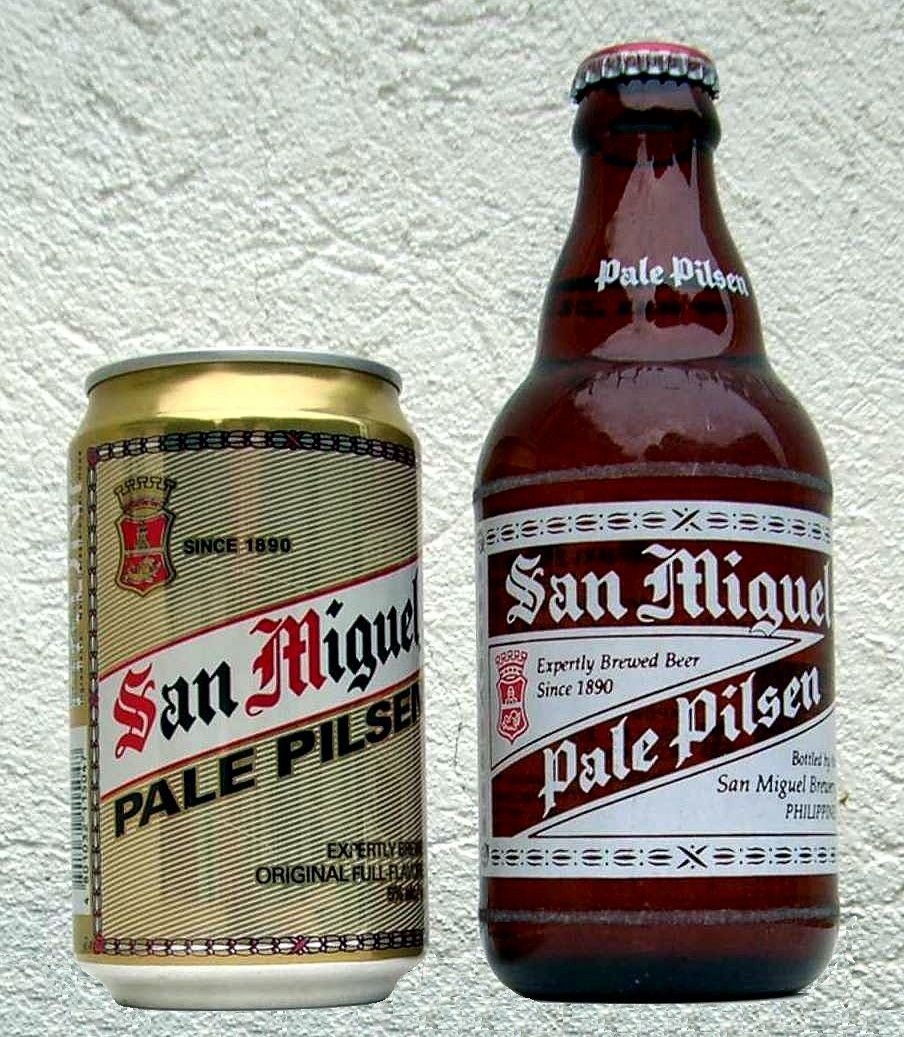
San Miguel operated more than 100 facilities across Southeast Asia and China in the early 2010s. Its Pure Foods unit manufactured a wide range of staples, including meat products, dairy goods and coffee, while San Miguel also maintained significant packaging operations. The conglomerate held a major stake in the country’s largest oil refiner, Petron, a 33 percent interest in Manila Electric, and a joint venture with Qatar Telecom that operated mobile and broadband businesses in the Philippines. In addition, San Miguel maintained investments in energy, telecommunications, mining, construction and banking. For the fiscal year ending in December 2012, the company reported sales of about $16.99 billion, a 39.3 percent increase from the previous year, and net income of about $670.4 million, representing income growth of 68.2 percent.
A 1988 brief in The Economist noted that Filipinos often ordered simply “beer” in bars and restaurants, knowing they would be served a San Miguel. But the company did not become a regional powerhouse on beer alone. It also produced agricultural feeds, processed and fresh meats, dairy products, coconut products, hard liquor, nonalcoholic beverages and a wide range of packaging materials, including glass containers, corrugated cartons, aluminum cans and metal crowns and caps.
Through wholly or majority-owned subsidiaries, San Miguel controlled dominant shares of several food and beverage markets in the Philippines: about 90 percent of carbonated beverages, 58 percent of powdered juice, 56 percent of hard liquor and more than 80 percent of margarine and butter. By the early 2000s, beer and other alcoholic drinks accounted for only about one-third of the company’s annual turnover. By 2001, after more than 110 years in business, the conglomerate generated about 3.6 percent of the Philippines’ gross domestic product and 4.5 percent of the government’s tax revenue.
Early San Miguel History
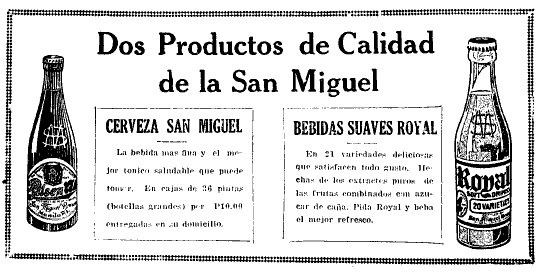
Don Enrique María Barretto de Ycaza founded Southeast Asia’s first brewery in 1890, naming it La Fábrica de Cerveza de San Miguel after the Manila district where he lived and worked. He was soon joined by Don Pedro Pablo Roxas, who brought in a German brewmaster to help produce the beer. San Miguel quickly gained recognition, winning its first major award at the 1895 Philippine Regional Exposition. By the turn of the 20th century, its brew was outselling imported competitors by a five-to-one margin. After the death of Don Pedro Roxas, the company was formally incorporated in 1913.
By then San Miguel was already exporting its beer to Hong Kong, Shanghai and Guam. Andrés Soriano y Roxas joined the company in 1918, beginning a multigenerational—though sometimes interrupted—role for the Soriano family in its leadership. A 1990 issue of San Miguel’s Beer Bulletin later observed that “Beer was the heart of San Miguel’s business, and the soul from which emanated all its other businesses.” Soriano led the company’s early diversification, much of which developed naturally through vertical integration. Experience cultivating barley, for example, helped lead the company into other agricultural ventures. San Miguel expanded rapidly during the 1920s. In 1922 it entered the nonalcoholic beverage market with the Royal Soft Drinks Plant, and in 1925 it moved into frozen foods by establishing the Magnolia Ice Cream Plant. By the early 1990s Magnolia controlled about four-fifths of the frozen dessert market. Soriano also secured the first Coca-Cola bottling and distribution franchise granted to a non-U.S. national company in 1927. San Miguel held 70 percent of the joint venture, which eventually became Coca-Cola’s sixth-largest operation worldwide. By the early 1990s the company controlled more than two-thirds of the Philippine soft drink market.
Over the decades San Miguel developed a reputation as a fierce competitor. The company used a wide range of strategies to protect its dominant position. When it could not defeat rivals through conventional competition, it often bought them out or pressured new entrants into submission. Government protection also played a role; for many years high tariffs shielded the company from foreign competitors. San Miguel’s dominance in the beer market was first seriously challenged in the late 1970s when Asia Brewery entered the industry. The rivalry intensified in 1988 when Asia Brewery cleverly introduced a low-priced product simply called “Beer.” The drink looked and tasted similar to San Miguel’s brew and capitalized on the fact that in the Philippines the word “beer” was practically synonymous with the San Miguel brand. The move countered San Miguel’s famously aggressive competitive tactics, which reportedly included attempts to disrupt Asia Brewery’s distribution network and destroy its empty bottles. Asia Brewery, whose owner was believed to have connections with allies of President Ferdinand Marcos, even managed to hire away San Miguel’s brewmaster.
Despite its near-monopoly in several markets, San Miguel was not immune to the political upheavals of the Philippines. During the 1980s the dictatorship of Ferdinand Marcos brought politics directly into the company’s affairs when a family proxy battle turned into a national political struggle. The conflict began in 1983 when Enrique Zobel, a wealthy cousin of the Soriano family and a leader of the Ayala banking and real estate group, sided with the Marcos government. Unable to gain control of San Miguel on his own, Zobel sold his 19.5 percent stake to Eduardo Cojuangco Jr., often called the “coconut king.” Although Cojuangco was related to Marcos rival Corazon Aquino, he supported the Marcos regime. Through the Coconut Industry Investment Fund—linked to the United Coconut Planters Bank—Cojuangco accumulated another 31 percent of San Miguel’s shares, giving him effective control of the conglomerate and reducing the Soriano family’s holdings to just 3 percent. Cojuangco became chairman in 1984 after Andrés Soriano Jr. died of cancer. His leadership lasted only two years. When Marcos lost the 1986 election to Aquino amid the “people power” revolution, Cojuangco fled the country along with many other Marcos allies. Marcos and Cojuangco reportedly left the Philippines in the same helicopter.
San Miguel History Timeline
1890: Don Enrique Ma Barretto de Ycaza established a brewery in Manila called La Fabrica de Cerveza de San Miguel.
1913: The brewery was incorporated.
1918: Andrés Soriano y Roxas joined San Miguel, beginning the long-term, multigenerational involvement of the Soriano family in the company.
1922: The company expanded into nonalcoholic beverages with the opening of the Royal Soft Drinks Plant.
1925: Production of ice cream began at the Magnolia Ice Cream Plant.
1927: San Miguel became the first non-U.S. national bottler and distributor of Coca-Cola. [Source: Hoover's Company Profiles]
1963: The company shortened its name to San Miguel Corporation.
1983: A Soriano family proxy fight led to the purchase of a 19.5 percent stake in San Miguel by Eduardo Cojuangco Jr., a close associate of Philippine dictator Ferdinand Marcos.
1984: Cojuangco assumed the chairmanship of San Miguel.
1986: The “people power” revolution forced Marcos to flee the country. Cojuangco joined him in exile, and the new Philippine government sequestered 51.4 percent of the company’s shares. Andrés Soriano III resumed the company chairmanship.
1987: San Miguel purchased majority control of La Tondeña Distillers, Inc., the leading producer of hard liquor in the Philippines.
1997: San Miguel exchanged its 70 percent stake in Coca-Cola Bottlers Philippines, Inc. for a 25 percent interest in the Australian firm Coca-Cola Amatil Limited (CCA).
1998: Eduardo Cojuangco Jr. returned to the chairmanship following the election of Joseph Estrada as Philippine president.
2001: Pure Foods Corporation, a producer of processed meats and flour, was acquired. San Miguel also partnered with the Coca-Cola Company to reacquire Coca-Cola Bottlers Philippines, relinquishing its stake in CCA as part of the deal.
2002: The company acquired Cosmos Bottling Corporation, and Kirin Brewery Company Limited purchased a 15 percent stake in San Miguel.
2003: Litigation continued over the 47 percent of the company’s shares still sequestered by the government.
Eduardo Cojuangco
Eduardo Cojuangco Jr. (1935-2020) was the richest man in the Philippines at one time. Known in the Philippines by his nickname Dandling, he headed the San Miguel Corp., the Philippines largest company at one time and was perhaps the greatest comeback figure in the history of Philippine business. [Source: Robert Frank, Wall Street Journal, August 31, 1999; Jim Gomez, Associated Press, June 17, 2020]
Cojuangco (pronounced co-HONKO-o) was something of a maverick. He dressed in jeans and cowboy boots and flew around in a Learjet with leather seats in the cockpit. He also maintained a 30-car garage filled with Ferraris, a Rolls-Royce, and a bomb-proof Mercedes, and he bred racehorses and fighting cocks. At the same time, he was full of contradictions. He was a staunch conservative who consulted a Marxist priest and was allergic to alcohol even though he owned a beer empire.
Cojuangco was born on June 10, 1935 in Paniqui, Tarlac, the first-born child of Eduardo Chichioco Cojuangco and Josephine B. Murphy.. He attended UP Los Baños and California Polytechnic State University, San Luis Obispo. In the 1960s, Cojuangco served as governor of the northern Philippine province of Tarlac, the base of the Cojuangco clan, which has interests in sugarcane plantations.
Aside from business, Cojuangco delved into sports, and owned three teams in the Philippine Basketball Association. He had been linked to the 1983 assassination of a key anti-Marcos politician, former Sen. Benigno Aquino Jr., but the allegation has never been proven and Aquino’s family later said he was not involved. Aquino’s wife, Corazon Aquino, who was Cojuangco’s estranged cousin, was hailed as a democracy icon amid the anti-Marcos protests in 1986 and succeeded Marcos. During his years in exile, he was known to have traveled to the United States and Australia, where he bred thoroughbred racehorses.
Cojuangco and Marcos
Cojuangco was a leading crony of Marcos and the godfather of his son Bongbong. The two men traveled together, golfed together, and visited the Reagan White House together. He was reportedly so close to Marcos that it was said Imelda was jealous. During the Marcos era, he controlled a telecommunications monopoly, thousands of hectares of plantations, a coconut-cattle empire, and a private army of 1,000 Israeli-trained commandos.
Cojuangco made his first millions in coconuts. With some help from—or more accurately, a lack of interference from—the Marcos government, he gained control of the industry at a time when coconuts were the Philippines’ largest export sector. He came to dominate a coconut cartel that controlled more than 80 percent of the world’s coconut products. With his profits he branched out into pearls, cement, shipping, and farmland development, in part with land grants from the Marcos government.
Cojuangco took control of hundreds of millions of dollars when Marcos created a coconut tax whose revenues were directed into a bank account controlled by him. With money from that account, and additional funds borrowed from the bank, Cojuangco purchased San Miguel in 1983 and joined the wealthy elite. He fled the country with Marcos on the same military transport in 1986 after the People Power Revolution.
When his cousin Corazon Aquino came to power, Cojuangco lost much of his fortune and spent most of the 1980s and 1990s either in exile in California or secluded on his mango farm, living off money from selling prize racehorses and loans from friends. While other Marcos cronies settled with the government by handing over property, Cojuangco maintained that he had done nothing wrong and that everything he obtained had been acquired legitimately. In 1989, Cojuangco returned to the Philippines without a passport and was welcomed back with a birthday bash attended by 65,000 people. He ran for president in 1990 and lost but formed a lasting friendship with the future president Joseph Estrada. After a 13-year legal battle, and with some help from political allies such as Estrada, Cojuangco regained much of his property. He retook control of San Miguel only days after Estrada was inaugurated. He later became a close associate of Estrada and a leader within his political party.
San Miguel After Marcos
After the fall of Ferdinand Marcos in 1986, Andrés Soriano III returned as chairman of San Miguel and sought to reclaim his family’s control of the company. However, the Philippine government’s Presidential Commission on Good Government (PCGG) took control—though not legal ownership—of a 51.4 percent stake in the conglomerate, claiming the shares had been illegally acquired by former chairman Eduardo Cojuangco Jr. The government argued that funds from a coconut production tax had been diverted through the United Coconut Planters Bank and used by Cojuangco to buy San Miguel shares. Although the PCGG held the stake and its nine board seats, it allowed Soriano III to run the company through a management contract with A. Soriano Corp. [Source: Hoover's Company Profiles]
Soriano III, an introverted leader educated at the Wharton School of the University of Pennsylvania, attempted several legal and financial strategies to regain full control from the government but failed. At the same time, he continued expanding San Miguel’s businesses. In 1987 the company acquired majority control of La Tondeña Distillers, the Philippines’ leading liquor producer, and in 1988 it expanded its food operations to include beef and pork production. During San Miguel’s centennial celebration in 1990, President Corazon Aquino praised the company as a model Filipino enterprise, although critics argued it also reflected some of the structural problems of Philippine business.
Soriano III then pushed San Miguel toward international expansion. Facing slow growth in its mature domestic markets, the company sought to compete with global brewing giants such as Anheuser-Busch, Miller, Kirin, and BSN. San Miguel committed about $1 billion to a five-year internationalization strategy that modernized plants, introduced computerization and quality management programs, and reorganized the company into a holding structure with separate subsidiaries. These reforms increased efficiency and reduced the workforce from more than 39,000 employees in 1989 to about 32,800 by 1993, boosting profit per employee.
With its domestic operations strengthened, San Miguel intensified its global beer strategy. Exports grew by 150 percent between 1985 and 1989, and the company began selling its beer in 24 countries, including markets across Asia, the United States, Australia and the Middle East. As sales expanded, San Miguel established brewing facilities abroad, either independently or through joint ventures. By 1995 it had production plants in Hong Kong, China, Indonesia, Vietnam, Taiwan and Guam. Despite ongoing ownership disputes, the company’s sales rose from about $227 million ( 12.23 billion) in 1986 to roughly $1.27 billion ( 68.43 billion) in 1994, while net income increased from about $21 million ( 1.11 billion) to $220 million ( 11.86 billion).
In the mid-1990s San Miguel continued restructuring and expanding internationally. In 1996 it gained full control of San Miguel Brewery Hong Kong, and in 1997 it merged Coca-Cola Bottlers Philippines into Australia-based Coca-Cola Amatil, exchanging its 70 percent stake in the Philippine unit for a 25 percent share in the multinational bottler. However, declining profits in domestic businesses and the Asian financial crisis of 1997 forced the company to restructure again, selling some food operations and cutting unprofitable ventures. During this turbulent period, Hong Kong conglomerate First Pacific attempted to acquire a large stake in San Miguel in a deal worth up to $1.3 billion, but the bid collapsed in 1998 amid political uncertainty and unresolved disputes over the government-sequestered shares.
San Miguel After Cojuangco Retook Control in 1998
In April 1998 a Philippine anti-graft court ruled that Eduardo Cojuangco Jr. could vote 20 percent of the disputed San Miguel shares, although he was not granted ownership of them. This decision allowed him to appoint three new directors to the company’s board. A month later, Joseph Estrada won the Philippine presidential election. Cojuangco had been Estrada’s main financial supporter and soon became chairman of Estrada’s political party. By July 1998, Andrés Soriano III had resigned as chairman of San Miguel, and the board—whose majority of seats were controlled by the government and therefore aligned with Estrada—voted to reinstall Cojuangco as chairman. His return marked a dramatic political comeback and raised concerns about a revival of the crony capitalism associated with the Marcos era. [Source: Hoover's Company Profiles]
After Eduardo Cojuangco retook control of San Miguel in 1998, he doubled profits in less than a year. Known as a tough cost-cutter, he overhauled marketing operations, dismissed overpaid executives and sold off noncore assets. He raised about $2 billion in cash by selling the company’s local Nestlé and Coca-Cola businesses. In the late 1990s and early 2000s, San Miguel went on a buying spree using that $2 billion in cash. Cojuangco became known as “Pac-Man” for his appetite for acquiring other companies. He bought Coca-Cola Bottlers Philippines, Cosmos Bottling Corp., and Pure Foods—acquisitions that gave the company control of about 70 percent of the hot dog market and 86 percent of the soft drink market in the Philippines. Cojuangco’s aim was to reduce San Miguel’s dependence on beer sales in the Philippines while expanding into beer markets in other countries. His goal was to turn San Miguel into a global food and beverage powerhouse and increase annual sales from about $2.5 billion to between $10 billion and $15 billion in less than five years.
San Miguel became the largest-selling foreign beer brand in China. By 2003 the company had four breweries in China, including facilities in Hong Kong and Guangzhou. It also negotiated with the Malaysian conglomerate Lion to buy all or part of its 11 Chinese breweries. The company also formed joint ventures in breweries in Vietnam and Indonesia. San Miguel worked to enter beer markets in Malaysia, Thailand and Cambodia, attempted to acquire a brewery in Taiwan, and expanded its operations in China, Australia and Vietnam. San Miguel also purchased a 21.5 percent stake in Coca-Cola Amatil of Australia, the largest soft drink bottler in that country, and made bids for Australian breweries.
See Separate Article: BEER IN CHINA factsanddetails.com
Cojuangco himself owned an estimated 200,000 acres of land throughout the Philippines, including 8,000 hectares of plantations on Negros that produced everything from palm oil to mangoes. He also owned pearl farms, cement plants, coconut mills, factories, and jewelry stores. In 1998, Eduardo Cojuangco sold his shares in the Philippine Long Distance Telephone Company to a Hong Kong corporation for $781 million. Imelda Marcos claimed that those shares had belonged to her husband. Cojuangco also launched a plan to offer 1,800 peasants “shares” in 10,000 acres of land they worked. Five years later they had not received their shares or dividends; all they reportedly received was a small payment widely regarded as a payoff. The scheme was widely viewed as an effort to prevent the peasants from asserting their claims to the land. At the time he died in 2020, Cojuangco had a net worth of $1.1 billion, according to Forbes, with interests in cement-manufacturing, orchards, a stud farm and Australian wineries, aside from San Miguel. San Miguel, one of Southeast Asia’s largest conglomerates, with a workforce of more than 28,000 people, has ventured into fuel and oil, power and infrastructure.
Ramon Ang — CEO of San Miguel
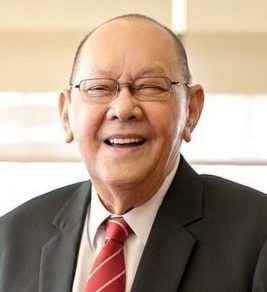
Ramon S. Ang (born January 14, 1954), often known by his initials RSA, is a Filipino business executive. He serves as president and chief executive officer of Top Frontier Investment Holdings, Inc., the largest shareholder of San Miguel Corporation (SMC). He is also chairman and CEO of San Miguel Corporation, chairman of Cyber Bay Corporation and Eagle Cement Corporation, and a member of the board of directors of Metro Pacific Investments Corporation. In 2025, he was listed as the fourth richest man in the Philippines with a net worth of $3.75 billion.
Ang’s relationship with San Miguel began through his association with Eduardo 'Danding' Cojuangco Jr.. The two reportedly met at a car repair shop, where Cojuangco—an avid car collector—had brought a high-end sports car that mechanics were unable to fix. Ang approached Cojuangco and correctly diagnosed the problem, impressing him enough that Cojuangco hired him on the spot as his personal mechanic. When Cojuangco went into exile with former president Ferdinand Marcos after the 1986 People Power Revolution, Ang managed Cojuangco’s cars, house, and business interests. When Cojuangco later returned to the Philippines, Ang reportedly handed back everything that had been entrusted to him.
Ang rose through the ranks of San Miguel Corporation over the following years. He was elected vice-chairman in January 1999 and later became president and chief operating officer in March 2002. In June 2012, he effectively gained control of the company after acquiring shares previously held by Cojuangco.
Following Cojuangco’s death in 2020, San Miguel Corporation amended its by-laws in April 2021 to consolidate the roles and responsibilities of the president and chief executive officer. On June 10, 2024, Ang became chairman and CEO of the conglomerate, while his eldest son, John Paul L. Ang, assumed the positions of vice-chairman, president, and chief operating officer. The company also planned further amendments to its by-laws to clarify the roles and responsibilities of its top executives, subject to approval by shareholders and regulators.
Image Sources: Wikimedia Commons
Text Sources: “Encyclopedia of World Cultures Volume 5: East/Southeast Asia:” edited by Paul Hockings, 1993; “Culture Shock!: Philippines” by Alfredo Roces and Grace Roces, Marshall Cavendish International, 2010; National Geographic, Live Science, Philippines Department of Tourism, New York Times, Washington Post, Los Angeles Times, Smithsonian magazine, Encyclopedia.com, Library of Congress, The Conversation, The New Yorker, Time, BBC, CNN, Reuters, Associated Press, AFP, Lonely Planet Guides, Google AI, Wikipedia, The Guardian and various websites, books and other publications.
Last updated March 2026