
BRUTALITY AND ANONYMITY OF DUTERTE’S WAR ON DRUGS
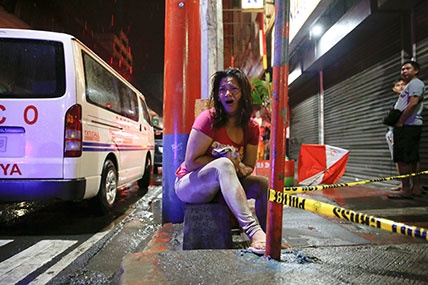
After taking office on June 30, 2016, Philippine President Rodrigo Duterte has launched a “war on drugs” that led to the deaths of over 12,000 Filipinos, mostly urban poor. According to Human Rights Watch” At least 2,555 of the killings have been attributed to the Philippine National Police. Duterte and other senior officials have instigated and incited the killings in a campaign that could amount to crimes against humanity. Human Rights Watch research has found that police are falsifying evidence to justify the unlawful killings. [Source: Human Rights Watch]
The killings, which often involved suspects being gunned down in streets or alleys by unidentified assailants, sparked outrage and international condemnation. However, they also drew support from many Filipinos who praised Duterte’s “tough” stance on crime. On one particularly violent night, police reported killing 32 people during drug raids in Bulacan province. [Source: BBC, May 10, 2022]
Police maintained that the deaths occurred in self-defense during anti-drug operations, but families and human rights advocates argued the incidents amounted to extrajudicial executions. Among the victims were teenagers, as well as a mayor and his wife. As the campaign intensified, bodies accumulated in the streets—many killed not only by police but also by unidentified vigilantes. Corpses were often discovered with their faces wrapped in duct tape. Cardboard signs were sometimes placed on their chests bearing warnings such as, “I’m a drug pusher. Don’t be like me.”
In Quezon City, a handwritten police report said officers responding to a tip about a “pot session” were met with gunfire from four men who were then killed. Senior Superintendent Guillermo Eleazar told local reporters that the suspects, allegedly “high on drugs” and emboldened by “bravado,” shot at officers who had only been “about to introduce themselves.” [Source: Emily Rauhala, Washington Post, October 4, 2016]
In 2017, the entire 1,200-member police force in a Manila district was relieved of duty after three boys—aged 19, 17, and 14—died following encounters with officers. The following year, three policemen were convicted of murdering 17-year-old Kian Delos Santos, whom authorities had accused of being a drug courier, a claim his family denied. Despite the criticism, Duterte defended his campaign, declaring in a national address in January 2022, “I will never, never apologise for the deaths.”
RELATED ARTICLES:
DUTERTE’S WAR ON DRUGS: DEATHS, TACTICS, RHETORIC, FAILURES factsanddetails.com
ILLEGAL DRUG USE IN THE PHILIPPINES: MAINLY CANNABIS AND METH factsanddetails.com
ILLEGAL DRUG TRADE IN THE PHILIPPINES factsanddetails.com
RODRIGO DUTERTE: HIS LIFE, FAMILY, PERSONALITY AND OUTRAGEOUS STATEMENTS factsanddetails.com
DUTERTE, MAYOR OF DAVAO: THE FRIENDLY LAW-AND-ORDER CITY WITH DEATH SQUADS factsanddetails.com
RODRIGO DUTERTE AS PRESIDENT factsanddetails.com
POLITICAL COMEBACK OF THE MARCOSES factsanddetails.com
FERDINAND “BONGBONG” MARCOS factsanddetails.com
2022 PHILIPPINE ELECTIONS factsanddetails.com
MAGUINDANAO MASSACRE: EVENTS, KILLERS, POLITICS, TRIAL factsanddetails.com
BENIGNO AQUINO III — PHILIPPINES PRESIDENT 2010-201 — HIS LIFE, CAREER, ANTI-CORRUPTION FIGHT factsanddetails.com
Victims of Duterte’s War on Drugs

Felizardo Virgo was 27 years old when he was shot dead on the evening of August 18. 2019. According to a BBC reported: He had left home to run an errand when gunfire rang out. His mother, Erlinda, rushed outside and found her son lying on the ground, bleeding. A witness later told her that the gunman looked familiar—he appeared to be a policeman. “I asked that witness—are you willing to testify? But, of course, the witness said no,” Erlinda recalled. “If people see something wrong, they want to turn a blind eye, and stay away from potential trouble.” [Source: Linda Pressly - BBC, January 4, 2024]
Felizardo lived in Parola, Tondo, an area often described as one of Manila’s poorest communities. Situated near the port, it is a dense maze of narrow concrete alleys and makeshift homes. He had struggled with drug use in the past, but according to his mother, he had begun to change. He recently secured a job with a trucking company and was trying to rebuild his life. “He’d turned his life around,” Erlinda said through tears. “This was Felizardo’s time to prove himself to those who didn’t believe in him.” Overwhelmed by grief and anger, she directed her blame at former President Rodrigo Duterte, saying he “has no right to live.”
Adrian Chen wrote in The New Yorker: An overwhelming number of those killed in Duterte’s drug war have been poor. When asked recently about criticism from anti-poverty groups, Duterte explained that poor people are easier targets. Rich people do drugs on private jets, and “I cannot afford the fighter planes,” he said. Jose Manuel Diokno, a human-rights lawyer, told me, “Those who have a name or have some influence or hold some position who are implicated in the drug trade are given an investigation, they’re given due process. But poorer people whose names appear on the list are just simply killed.” [Source: Adrian Chen, The New Yorker, November 21, 2016]
In August 2015, the Senate launched a probe into the killings. The first witness was a woman named Harra Kazuo, the wife of a man who was arrested for shabu possession and killed while detained at a police station. She appeared before the Senate with her face hidden behind large sunglasses, her hair wrapped in a colorful scarf. Police claimed that her husband attempted to grab an officer’s gun, but investigators found that he had been beaten so badly by police that he could not have posed a threat. Kazuo alleged that police officers had previously extorted money from her husband. One investigator for the Commission on Human Rights told me that he believed most of the police killings in the days after Duterte’s election were done to conceal crimes committed by the cops themselves. “It will cover up their bad purpose, and they might get promoted,” he said.
Photographing Victims of Duterte’s Drug War
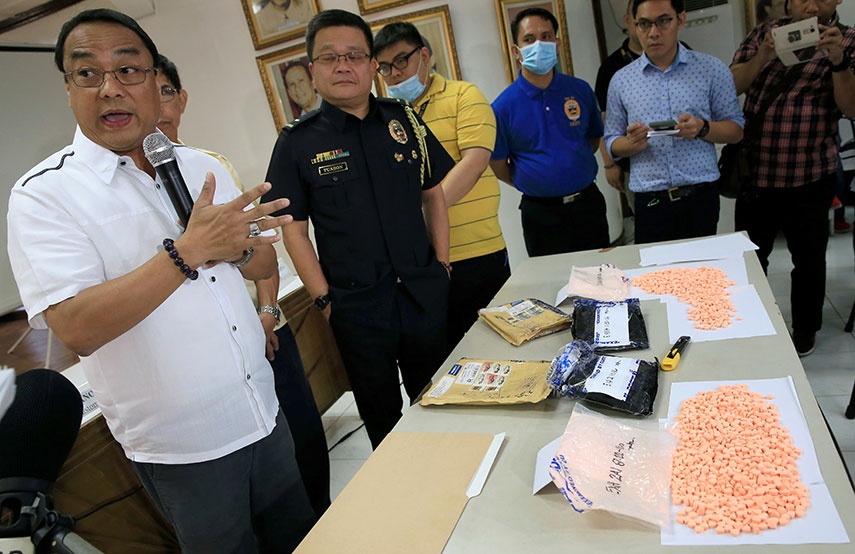
Daniel Berehulak wrote in New York Times: You hear a murder scene before you see it: The desperate cries of a new widow. The piercing sirens of approaching police cars. The thud, thud, thud of the rain drumming on the pavement of a Manila alleyway — and on the back of Romeo Torres Fontanilla. Tigas, as Mr. Fontanilla was known, was lying facedown in the street when I pulled up after 1 a.m. He was 37. Gunned down, witnesses said, by two unknown men on a motorbike. The downpour had washed his blood into the gutter. The rain-soaked alley in the Pasay district of Manila was my 17th crime scene, on my 11th day in the Philippines capital. I had come to document the bloody and chaotic campaign against drugs that President Rodrigo Duterte began when he took office on June 30: since then, about 2,000 people had been slain at the hands of the police alone.[Source: Daniel Berehulak, New York Times, December 7, 2016]
Over my 35 days in the country, I photographed 57 murder victims at 41 sites...Neighbors said Michael Araja, 29, was killed by two men riding by on a motorbike, like so many of the other victims. Frederick Mafe, 48, and Arjay Lumbago, 23, were riding together on a motorbike when they, too, were killed by a pair on another motorbike. Erika Angel Fernandez, 17, was one of three women among the 57 victims I photographed. She was killed alongside her boyfriend, Jericho Camitan, 23. Benjamin Visda, 43, had left a family birthday celebration to get something from a convenience store when he was snatched off the street and killed, according to relatives. Maria Mesa Deparine lost two sons in a single week in September. Both had turned themselves in to the police. Both were found dead under bridges. The police report said Ronald Kalau drew a .38-caliber handgun when officers tried to arrest him as he bought methamphetamine. Neighbors said the police gunned him down in a house that was being used as a drug den.
I have worked in 60 countries, covered wars in Iraq and Afghanistan, and spent much of 2014 living inside West Africa’s Ebola zone, a place gripped by fear and death. What I experienced in the Philippines felt like a new level of ruthlessness: police officers’ summarily shooting anyone suspected of dealing or even using drugs, vigilantes’ taking seriously Mr. Duterte’s call to “slaughter them all.” Earlier Duterte said that, in a telephone call with then President-elect Donald J. Trump, who had endorsed the brutal antidrug campaign and invited him to visit New York and Washington. “He said that, well, we are doing it as a sovereign nation, the right way,” Mr. Duterte said in a summary of the call released by his office.
Where the Drug War Killings in Manila Took Place
Daniel Berehulak wrote in New York Times: My nights in Manila would begin at 9 p.m. at the police district press office, where I joined a group of local reporters waiting for word of the latest killings. We would set off in convoys, like a train on rails, hazard lights flashing as we sped through red traffic lights...We joined the police on numerous stings. We also went on our own to the places where people were killed or bodies were found. The relatives and neighbors we met in those places often told a very different story from what was recorded in official police accounts. [Source:Daniel Berehulak, New York Times, December 7, 2016]
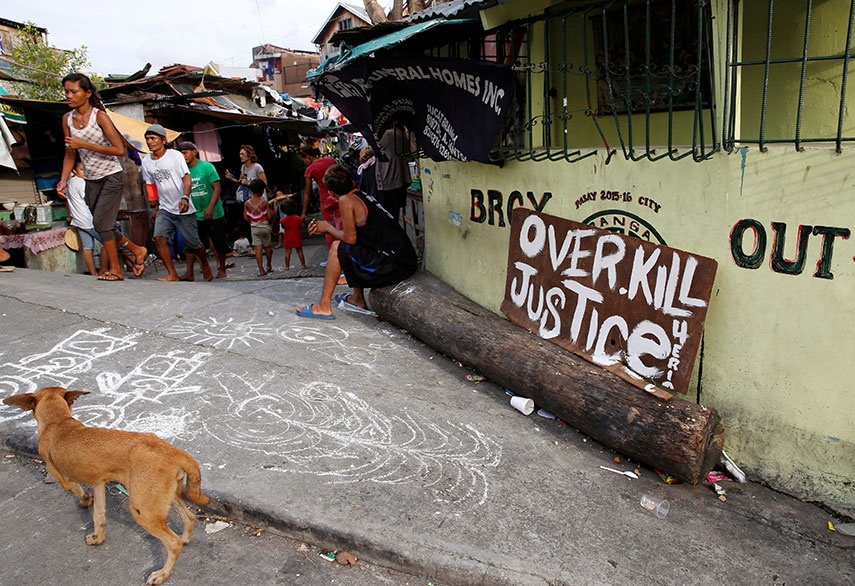
I witnessed bloody scenes just about everywhere imaginable — on the sidewalk, on train tracks, in front of a girls’ school, outside 7-Eleven stores and a McDonald’s restaurant, across bedroom mattresses and living-room sofas. I watched as a woman in red peeked at one of those grisly sites through fingers held over her eyes, at once trying to protect herself and permit herself one last glance at a man killed in the middle of a busy road.
Not far from where Tigas was killed, I found Michael Araja, dead in front of a “sari sari,” what locals call the kiosks that sell basics in the slums. Neighbors told me that Mr. Araja, 29, had gone out to buy cigarettes and a drink for his wife, only to be shot dead by two men on a motorcycle, a tactic common enough to have earned its own nickname: riding in tandem. In another neighborhood, Riverside, a bloodied Barbie doll lay next to the body of a 17-year-old girl who had been killed alongside her 21-year-old boyfriend. “They are slaughtering us like animals,” said a bystander who was afraid to give his name.
In affluent neighborhoods of gated communities and estates, there is, indeed, sometimes a polite knock on the door, an officer handing a pamphlet detailing the repercussions of drug use to the housekeeper who answers. In poorer districts, the police grab teenage boys and men off the street, run background checks, make arrests and sometimes shoot to kill.
Nanlaban and Drug Pushers
Daniel Berehulak, New York Times,“Nanlaban” is what the police call a case when a suspect resists arrest and ends up dead. It means “he fought it out.” That is what they said about Florjohn Cruz, 34, whose body was being carted away by a funeral home when I arrived at his home in the poor Caloocan neighborhood just before 11 p.m. one night. The blood of Cruz stained the floor in his family’s living room, next to an altar displaying images and statues of the Virgin Mary, among other items. His niece said they found a cardboard sign saying “Pusher at Adik Wag Tularan” — “Don’t be a pusher and an addict like him” — as they were cleaning Mr. Cruz’s blood from the floor near the family’s altar. [Source: Daniel Berehulak, New York Times, December 7, 2016]
The police report said, “Suspect Cruz ran inside the house then pulled a firearm and successively shot the lawmen, prompting the same to return fire in order to prevent and repel Cruz’s unlawful aggression.” His wife, Rita, told me, between pained cries, that Mr. Cruz had been fixing a transistor radio for his 71-year-old mother in the living room when armed men barged in and shot him dead. The family said Mr. Cruz was not a drug dealer, only a user of shabu, as Filipinos call methamphetamine. He had surrendered months earlier, responding to Mr. Duterte’s call, for what was supposed to be a drug-treatment program. The police came for him anyway.

Mirren Gidda wrote in Newsweek: It was a warm summer evening on July 18 when Ezra Acayan, a freelance photographer, saw his first shooting victim. The dead body was lying in a fetal position alongside railway tracks in the Philippine capital of Manila. The police officers responsible for it were standing nearby, behind yellow tape. Farther back, a crowd of residents had gathered, many on their way home from work. [Source: Mirren Gidda, Newsweek August 19, 2016]
Acayan couldn’t see the corpse very well, so he asked the police to shine their flashlights on it as he snapped away. They told him that the man—Acayan never learned his name—was a suspected drug pusher. An undercover cop had bought drugs from him earlier that evening, paying in marked bank notes, they said. When police arrived to make the arrest, the suspect had fought back—so they shot him. In the man's hand was a gun, and next to him were packets of shabu, Filipino slang for methamphetamine. Acayan does not know if the police planted the drugs and the gun, but in the following weeks, he saw the same scene over and over again.
“I feel afraid because anyone can just kill anyone and say they were a drug pusher,” Acayan says. (Rights groups say vigilantes have been responsible for several more of the killings.) “I could have an enemy who wants to have me killed, and he could.” The photographer says the streets are quieter as a result of the deaths—young men in particular don’t want to walk around at night, lest they be mistaken for drug dealers. But people’s fear is not a sign of disapproval. Duterte commands a 91 percent trust rating among Filipinos, many of whom want an end to the country’s drug problem, no matter the cost.
Children Killed in Duterte's Drugs War
In June 2020, two non-governmental organisations (NGOs) reported that att least 122 children were killed during the Philippines’ war on drugs—many of them allegedly deliberately. The NGOs urged the United Nations to take action and said the actual number could be far higher. The report, titled “How Could They Do This To My Child?”, was jointly published by the World Organisation Against Torture (OMCT) and the Children's Legal Rights and Development Center (CLRDC). It documented 122 child deaths between July 2016 and December 2019, involving victims aged from one to 17 years old across the Philippines. Gerald Staberock, OMCT’s secretary-general, described the figure as only a fraction of the true toll. “The 122 is only the tip of the iceberg; there may be many more in the country,” he said during a virtual briefing. “Imagine if you would have seen these 122 cases on camera. Imagine the outcry.” [Source: AFP, June 29, 2020]
The NGOs’ report identified four recurring circumstances in which minors were killed: 1) as direct targets, sometimes after witnessing other killings; 2) as proxies when intended targets could not be found; 3) due to mistaken identity; or 4) as victims of stray bullets during police operations. Among the cases highlighted was that of a seven-year-old boy reportedly killed after witnessing a murder by local authorities. The youngest victim documented was just 20 months old, and seven children were reportedly killed in the first three months of that year alone. Beyond killings, the report also noted a sharp rise in the arrest and detention of minors during the anti-drug campaign.
Four-year-old Althea Barbon was fatally wounded in August 2016 when police in an anti-narcotics operation shot at her father, Manila-based advocacy groups said. Unidentified gunmen shot dead Ericka Fernandez, 17, in a Manila alley on October 26, police said. Her bloody Barbie doll was collected as evidence. In December 28, three boys, aged 15 or 16, were killed in Manila by what police said were motorbike-riding gunmen. [Source: Clare Baldwin and Andrew R.C. Marshall, February 14, 2017]
In December 2016, six-year-old Francis Navarro was shot dead in his sleep during a drug-related killing in the Pasay City slum of Manila. “There was a knock on the door,” recalled Elizabeth Navarro, 29, who is pregnant and already has five children. “My husband asked who it was. Then I heard two gunshots.” Before Navarro could react, her husband, Domingo Mañosca, and Francis, were dead. The attackers had disappeared. “They’re killing people left and right,” one woman in the neighborhood where they killing took place said. “Sometimes 10 or 20 in a day. I’m afraid. You don’t know anymore who your enemy is.” [Source: Will Ripley and Jay Croft, CNN, December 16, 2016]
On the street where the coffins of Francis and Domingo were laid out, friends gathered to play cards and collect donations for the funeral. They hoped to raise about $900 — three times what Domingo earned in a year as a bicycle taxi driver.Two live chicks were placed atop the boy’s coffin, a symbol of the family’s plea for justice. Francis’ mother described him as a cheerful child who was set to start school the following year. In their Pasay City slum, children often beg for spare change, but Francis was known for smiling and dancing in exchange for a single peso. Domingo’s mother, Maria Musabia, said her son began using shabu, or methamphetamine, at 29. The drug is widely used among the poor for its ability to boost energy and dull hunger.Six months earlier, when President Rodrigo Duterte launched his war on drugs, Domingo surrendered to authorities and gave a statement before being released. His family insists he stopped using afterward, even as Duterte has vowed to press on with the crackdown. “My family needs help,” Musabia said.
In October 2016, at the height of the drug war, Duterte said that innocent people and children killed in the war could be described as "collateral damage" because the police use automatic weapons when confronting criminals. In an interview with Al Jazeera, Duterte said police could kill hundreds of civilians without facing criminal charges. He gave the example of an officer using an M16 rifle to deal with a "gangster" with a pistol. "When they meet, they exchange fire. With the policeman and the M16, it’s one burst, brrr, and he hits 1,000 people, and they die.” “It could not be negligence because you have to save your life. It could not be recklessness because you have to defend yourself," he said. Duterte then compared the killing of innocents in the Philippines to U.S. attacks in Vietnam and Afghanistan, where civilians are killed during airstrikes on militants. "When you bomb a village, you intend to kill militants, but you also kill children. Why is it collateral damage to the West but murder to us?” [Source: Oliver Holmes, The Guardian, October 17, 2016]
Killers in the Philippines War on Drugs
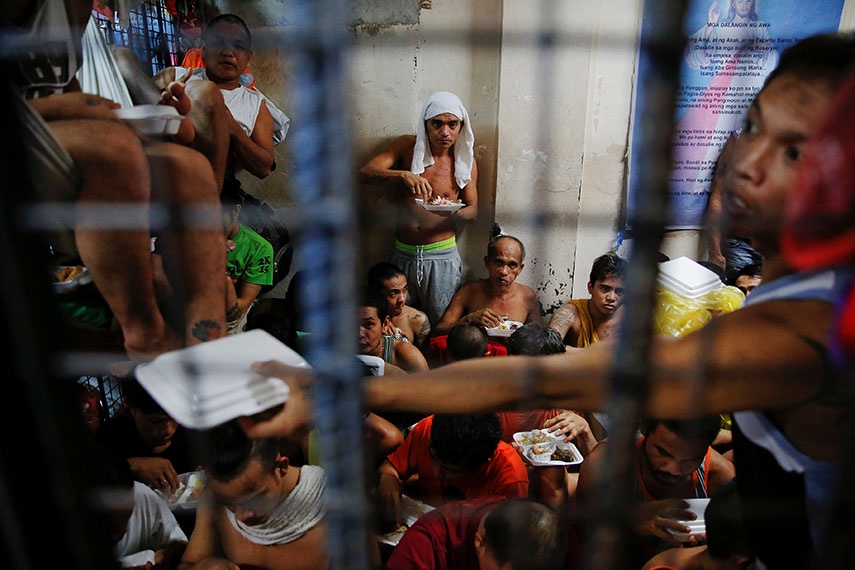
There have been cases when police officers have killed suspected drug dealers in handcuffs, in police custody or inside prison cells, civil rights lawyers have said. Only a small number of cases have resulted in police officers being arrested in connection with drug war killings. In one notable incident, six officers were taken into custody and charged with murder over the death of Jerhode “Jemboy” Baltazar, a 17-year-old fisherman shot in broad daylight in Navotas, Metro Manila, in August 2023. after Duterte's presidency was over. [Source: Linda Pressly - BBC, January 4, 2024]
Police had been pursuing a murder suspect and mistakenly identified Jemboy as their target. At the time, he was cleaning his fishing boat. Officers opened fire, striking him and causing him to fall into the water. According to reports, police made no effort to pull him out. Hours later, it was Jemboy’s uncle who recovered his body. Forensic pathologist Raquel Fortun determined that the gunshot wound to Jemboy’s head had not immediately caused his death. In her assessment, had officers pulled him from the water promptly, “potentially he could have survived.” Instead, she concluded that he drowned after being shot. “So, he drowned because he fell in the water, because he was shot in the head. We classify this as homicide,” she said. Human rights lawyer Jose Manuel Diokno Clavano argued that such cases reflect a deeper systemic issue. “The police were left alone in the field—that’s how all these abuses have happened,” Mr. Clavano said.
In February 2021, Philippines Justice Secretary Menardo Guevarra's Guevarra said police had in many cases failed to examine weapons and crime scenes after officers had shot dead suspected drug dealers. Guevarra said the Justic ministry had reviewed many incident reports where police said suspects were killed in shootouts. “Yet, no full examination of the weapon recovered was conducted. No verification of its ownership was undertaken. No request for ballistic examination or paraffin test was pursued," he said. “In more than half of the records reviewed, the law enforcement agents involved failed to follow standard protocols." [Source: Reuters, February 25, 2021]
Joseph Hincks of Al Jazeera wrote: Targets for police operations are often selected from locally compiled drugs watch lists, which are in turn derived from information provided by local government officials or submitted by community members using confidential forms. Those on a drugs watch list that want to avoid being targeted by police — or by vigilantes — can "voluntarily surrender" themselves to local authorities through a programme called Tokhang. So far the PNP has registered almost 700,000 such "surrenderers". [Source: Joseph Hincks, Al Jazeera, September 8, 2016]
Brazeness of the Duterte Drug War Killings
Daniel Berehulak, New York Times, As my time in the philippines wore on, the killings seemed to become more brazen. Police officers appeared to do little to hide their involvement in what were essentially extrajudicial executions. Nanlaban had become a dark joke. “There is a new way of dying in the Philippines,” said Redentor C. Ulsano, the police superintendent in the Tondo district. He smiled and held his wrists together in front of him, pretending to be handcuffed. [Source: Daniel Berehulak, New York Times, December 7, 2016]
Mr. Cruz’s 16-year-old nephew, Eliam, and 18-year-old niece, Princess, said they had watched from a second-story porch as the plainclothes officers who had killed their uncle emerged from the house. Eliam and Princess said they heard the beep of a text message and watched as one of the men read it from his phone. “Ginebra’s won,” he announced to the others, referring to Barangay Ginebra San Miguel, the nation’s most popular basketball team, which had been battling for the championship across town. The teenagers said the men celebrated the team’s victory as their uncle was carried out in a body bag.
Roel Scott, 13, is the nephew of Joselito Jumaquio, was slain by a mob of masked men. Roel said he was playing video games with Mr. Jumaquio, a pedicab driver who had also surrendered himself to the authorities, when 15 of the masked men descended quickly and silently over the shantytown called Pandacan. Witnesses told us the men dragged Mr. Jumaquio down an alley and shouted at gathering neighbors to go back into their homes and turn the lights off. They heard a woman shout, “Nanlaban!” Two shots rang out. Then four more. When it was quiet, the neighbors found the pedicab driver’s bloodied body — a gun and a plastic bag of shabu next to his handcuffed hands. The police report called it a “buy-bust operation.”
The killing disrupts every aspect of life. Family members told me that Benjamin Visda, had stepped out of a family birthday party to grab something at a sari sari and was eating cake when eight men grabbed him. Within 20 minutes, his body had been dumped outside a police station. The police called this, too, a buy-bust operation, and said that Mr. Visda, while handcuffed, tried to grab an officer’s gun — Nanlaban — so they shot him. A video taken from a security camera, shows him being loaded alive onto a motorcycle, sandwiched between two masked men. The same night Florjohn Cruz was killed, we found ourselves a few streets away an hour and a half later, at another home where a man had been murdered. It was raining that night, too.
Police “Self-Defense” Killing in the Duterte Drug War
Manila police reported that 22-year-old Eric Sison was killed in a gunfight in August 2016 following a high-speed chase. “He chose to fight it out,” the police report said. But cellphone video recorded by a neighbor appeared to show Sison wounded, cornered inside a room, and attempting to surrender when he was shot more than a dozen times. The report stated that the officer fired because he felt threatened. Yet in the footage, as he aimed at the unseen suspect, he did not appear to seek cover, recoil or flinch. [Source: Emily Rauhala, Washington Post, October 4, 2016]
Joseph Hincks of Al Jazeera wrote: Sison was still alive after he fell three storeys from the roof opposite Maria's* house, snagged his shorts on her neighbours' awning, and, in his underwear, crawled underneath her bed. When the police drew back the yellow curtain that partitions her shanty home from Pasay City's F Munoz street, Maria faced their gun barrels. "I shouted, 'Have mercy on us, don't fire, we don't know who this guy is,'" she told Al Jazeera through an interpreter.[Source: Joseph Hincks, Al Jazeera, September 8, 2016, * not a real name]
The police told Maria and her family to leave their house. She heard Sison plead for his life. And then she heard the gunshots. While the police report states that Sison shot at officers and was killed when they returned fire, video recorded on a neighbour's mobile phone showed him attempting to surrender while still on the roof. "The police insist that he has a gun and he uses drugs but my husband is not like that," Rachelle Bermoy, Sison's live-in partner, said through an interpreter. "He fell from the roof and his clothes got tangled on something, so he was already half-naked. If he had a gun it would have fallen.The police brought the gun," she said.
Later, At Pasay Municipal Cemetery, pall bearers wearing T-shirts that said "Overkill" and "Kill drugs, not people" hefted Eric Sison's coffin over a concrete wall to a spot hemmed by other graves beneath a palm tree. Twenty-five-year-old Joker stood among the gathered mourners. He had been friends with Sison for five years. "I only have one daughter, no boys. That's why I want to adopt Eric's son. Everyone here wants to guide his son because he was really a kind person," he told Al Jazeera. "Eric earned 200 pesos ($4.3) a day as a pedicab driver. Imagine, they say he fought back with a .38 Gloc."
That morning, Joker had received news that another friend, Lloyd Rodrigo, had been killed. Rodrigo had been at Sison's wake and left at around 4:30am — nobody had seen him since. There had been rumours of another killing and eventually news came that the victim was Rodrigo. "Our neighbourhood is kind of hot now — it's a hot spot," he said. "We're not really afraid of the police. If they do their job well then its OK with us, but if they do something wrong, that's when it gets scary."
As Joker spoke, friends and relatives placed Sison's favourite possessions inside his coffin: a music player with headphones and a pair of Nike flip-flops, along with the live chick for justice. Family and friends passed Sison's one-year-old son back and forth over the ground where his father lay. A corrugated-iron roof section was set over Sison's coffin and then dark grey cement was poured on top.
Buy-Bust Killings in Duterte’s Drug War
Joseph Hincks of Al Jazeera wrote: Aie Balagtas See, a crime reporter for the Inquirer, has been tracking stings since the war on drugs began. In early August, See got hold of 27 Manila Police Department (MPD) reports from the previous month: 17 pertained to suspects killed during "buy-bust" operations in Manila's poorest neighbourhoods. The other 10 concerned routine "anti-criminality operations", where the suspects ended up dead just the same. [Source: Joseph Hincks, Al Jazeera, September 8, 2016]
The reported sequence of events in the buy-bust cases See examined was startlingly similar, with particular phrases recurring each time: the suspect always "sensed" that they were dealing with undercover cops and thus made that instinctive self-preserving decision to draw their guns. These tense moments always followed a "consummated" drug transaction and the cops, in turn, always "sensed imminent danger to their lives". "This line alone cropped up 20 times in the 27 MPD reports," See wrote in an August 7 article about the case.
In each case the suspects had drawn on police first but no officers died in the ensuing gunfights - although one had been wounded on the arm and another saved by his bulletproof vest. Since the war on drugs began, 12 police officers have been killed during operations, according to PNP statistics.
See visited the scene of one of the alleged "shootouts" between police and suspected drug dealer Eric Caliclic. In the shanty where the police report said the gunfight had taken place, the wall behind where Caliclic had been standing was poked with bullet holes. The opposite wall, where the police stood, was unmarked. Neighbours of Caliclic told her that he had no job and struggled to pay his 800 Philippine pesos rent ($17). "How could he be firing a gun when he didn't even have a knife? Where would he get the money to buy a gun in the first place? His house didn't even have power supply," one said.
Harra Kazuo, 26, told the senate that her partner, Jaypee Bertes, and his father, Renato Bertes, were both killed in police custody after officers raided their shanty home on July 7. Both men used shabu, she admitted, and Jaypee sold it in small amounts - in 2015 local police took a 10,000 Philippine pesos ($214) bribe to turn a blind eye. Pasay police claimed that the father and son were killed because they tried to grab a cop's gun, but forensic examinations revealed that both men had been incapacitated by beatings before they were shot: Jaypee had a broken arm.
Life in Duterte’s Drug Warzone
Daniel Berehulak, New York Times, I also photographed wakes and funerals, a growing part of daily life under mr. Duterte. Relatives and priests rarely mentioned the brutal causes of death. Bodies were stacked up at a funeral parlor as the families of victims like Danilo Deparine, whose body lay on a metal stretcher on the floor, struggle to pay for burial. Ms. Deparine said it took her three weeks to collect loans and donations totaling 50,000 pesos, about $1,030, to pay for the burial of her baby, Aljon, who was 23. We went with her to the funeral home where she pleaded with the owners to reduce the fees for his brother, Danilo, 36. [Source: Daniel Berehulak, New York Times, December 7, 2016]
Danilo’s body had already spent two weeks in the morgue, where the dead are stacked like firewood, with nothing separating them. The funeral directors agreed to a cut rate of 12,000 pesos, about $240, for a one-day wake instead of the usual week. Ms. Deparine left, unsure whether she could come up with the sum, or whether Danilo would end up in a mass grave with other victims of the president’s drug war.
In another case, we heard the wrenching screams of Nellie Diaz, the new widow, before we saw her crumpled over the body of her husband, Crisostomo, 51, a drug user who had surrendered but still ended up dead. Mr. Diaz grew up in the neighborhood, and worked intermittently, doing odd jobs. His wife said he was a user, not a dealer, and had turned himself in soon after Mr. Duterte’s election. She still thought it unsafe for him to sleep at home, and told him to stay with relatives. But he missed his nine children, and had returned days before.
Mr. Diaz’s eldest son, J.R., 19, said a man in a motorcycle helmet kicked in the front door, followed by two others. The man in the helmet pointed a gun at Mr. Diaz, J.R. said; the second man pointed a gun at his 15-year-old brother, Jhon Rex. The third man held a piece of paper. J.R. said the man in the helmet said, “Goodbye, my friend,” before shooting his father in the chest. His body sank, but the man shot him twice more, in the head and cheeks. The children said the three men were laughing as they left.
How One Man Survived a Duterte-Drug-War Death Squad Attack
Francisco Santiago is something rare — a survivor a Duterte Drug War attack. According to the Washington Post before dawn on Sept. 13, on a dimly lit street in the city center, Santiago was shot in the chest and arms. Police described the incident as a botched anti-drug operation. Santiago said it was an execution attempt staged to look legitimate. When the gunfire erupted, he collapsed and pretended to be dead, remaining motionless until television lights and cameras arrived. With reporters filming, he slowly lifted his blood-covered arms in surrender — alive, at least for the moment. [Source: Emily Rauhala, Washington Post, October 4, 2016]
Speaking later from his hospital bed, where officers stood guard, Santiago said he chose to tell his story publicly because he feared he would otherwise be “eliminated.” In his view, publicity offered protection. “The police will just cover up,” his mother, Ligaya Santiago, said. “We can only rely on the media to expose this.”
The official report recounted a now-familiar version of events: a “buy-bust” operation that spiraled into violence. According to police, Santiago sold a packet of shabu to an undercover officer. He and another suspect, George Huggins y Javellana — described as a member of the “dreaded Sputnik gang” — grew suspicious and opened fire. Officers returned fire, killing Javellana and wounding Santiago. Police said they recovered .38- and .22-caliber firearms and three packets of shabu at the scene. Santiago was then taken to the hospital.
Santiago told a starkly different story. Around noon the previous day, he said, a plainclothes officer posing as a buyer lured him to the second floor of a local precinct, where he was pressured into confessing to drug offenses. That night, in sweltering heat, officers ordered him to put on a black jacket. After midnight, he said, he and Javellana were driven to a dark street and shot. As he lay still, officers placed a gun beside him but never checked whether he was alive. Security footage reviewed by The Washington Post showed Santiago walking toward a police station shortly after noon, wearing a white tank top. Photographs taken after the shooting showed him dressed in a black jacket, despite the 86-degree weather.
Manila Police District Chief Joel Coronel told the Philippine Daily Inquirer that Santiago had been a primary target on a drug watch list — a detail not mentioned in the official report. Celia Nepomuceno, an official responsible for identifying suspects in Santiago’s neighborhood, said his name had never appeared on such a list. Despite those inconsistencies, Santiago said he was transferred from the hospital into the custody of the same police force whose officer had shot him. Carolyn Mercado, a senior legal adviser at the The Asia Foundation in Manila, said cases like Santiago’s were unlikely to be thoroughly reviewed. Referring to President Rodrigo Duterte, she said: “Duterte says to police, ‘If you kill, I’m going to protect you.’”
Family Trauma Casued by Duterte’s Drug War
A woman interviewed by the Los Angeles Times was among several relatives of victims of extrajudicial killings who described their experiences during Duterte’s anti-drug campaign.Like many others, she spoke anonymously because she feared retaliation from the police. Her father, 53, and her brother, 27, had sold shabu, a cheap form of methamphetamine. Both men were killed during the drug war—the father in a police raid and the brother by unidentified gunmen. [Source: David Pierson, Los Angeles Times, March 3, 2021]
Authorities claimed that the woman’s father had resisted arrest, which they said justified the shooting. She insisted, however, that he had been asleep when officers entered their home and executed him. According to her account, weapons were planted at the scene to make it appear that he had fought back. Her 12-year-old sister reportedly witnessed the killing. The deaths plunged the family into crisis, and their mother eventually left, forcing the woman to support not only her own three children but also several younger siblings and her brother’s children.
To pay for funeral expenses and burial niches, she sold the family house and their motorcycle. Once involved in the drug trade herself, she later survived on church donations and small earnings from selling tea. Work was scarce in Manila, especially during restrictions brought about by the COVID-19 pandemic, which worsened economic hardship. She still lacked the money required to secure permanent burial places for her father and brother. “I have to keep trying because I’m not sure if we can ever attain justice,” she said. “But knowing they have a decent resting place in the cemetery gives me peace of mind somehow.”
Advocates said many families faced similar struggles. Rubilyn Litao of the organization Rise Up criticized the burden placed on relatives of the victims. “It’s enraging that families of drug war victims have to endure this in the middle of a pandemic,” she said. “They cannot even put food on the table.... Their loved ones should not have been killed in the first place.” Another widow, Rodalyn Adan, had seven children and no stable income, making it difficult to pay the fees required to move her husband’s remains to a permanent crypt. Her husband, Crisanto Abliter, disappeared after being taken by police in 2016. “Our [youngest] child was still a baby when my husband was killed,” Adan said. “Our baby is 6 years old now and he’s always asking why his father refuses to get out of the niche.”
Human rights advocates warned that the policy of removing remains from overcrowded public cemeteries after five years could complicate investigations into possible extrajudicial killings. The Commission on Human Rights urged authorities to reconsider or delay the process. Spokeswoman Jacqueline De Guia noted that “mandatory disinterment of remains from public cemeteries after five years could potentially hinder current and prospective investigations into extrajudicial killings by complicating access to remains whose deaths are in question.”
Other families also struggled to prevent the loss of their loved ones’ graves. Marissa Lazaro’s 20-year-old son Christopher was killed by police in 2017 in Bulacan after he was mistaken for a criminal. Determined to secure a permanent burial site for him, she traveled abroad to work as a domestic helper in Dubai, but returned home in debt after leaving an abusive employer. The effort was deeply personal: when she was a child, her father’s remains had been exhumed without permission and lost. Now she needed thousands of dollars to move her son’s remains. “My other children tell me: ‘Ma, stop prioritizing the dead.’ But I cannot allow my son to suffer the same fate as my father,” she said. “People killed by the police already died a gruesome death. Can’t they not have a decent repose?”
Image Sources: Wikimedia Commons
Text Sources: Wikipedia, New York Times, Washington Post, Los Angeles Times, Smithsonian magazine, Encyclopedia.com, Times of London, Library of Congress, The Conversation, The New Yorker, Time, BBC, CNN, Reuters, Associated Press, AFP, Lonely Planet Guides, Google AI, The Guardian and various websites, books and other publications.
Last updated February 2026