
RODRIGO DUTERTE AS PRESIDENT

Rodrigo Duterte (born March 28, 1945) is a Filipino lawyer and politician who served as the 16th president of the Philippines from 2016 to 2022. Duterte centered his domestic agenda on combating illegal drugs, launching a controversial nationwide anti-drug campaign that drew both strong support and widespread criticism. His administration also prioritized anti-corruption efforts, counterterrorism, and suppressing communist insurgency. He advanced a large-scale infrastructure program, pursued economic reforms, streamlined bureaucratic processes, and proposed—but failed to secure—a shift to a federal system. Major events during his term included the burial of Ferdinand Marcos at the Libingan ng mga Bayani, the 2017 Marawi siege, and the government’s response to the COVID-19 pandemic. [Source: Wikipedia]
Duterte began his term with exceptionally high public approval, earning trust ratings near 90 percent in 2016 and finishing the following year with a 75 percent net trust rating, according to the Manila-based polling group Social Weather Stations. “People like the man,” Ricardo Abad, head of sociology and anthropology at Ateneo University in Manila, told AFP. People may disagree with his policies, or are maybe ambivalent towards them, but because they like him, people will tend to give him the benefit of the doubt.” However, his ratings gradually declined to 65 percent in early 2018 and 57 percent by midyear. The drop was attributed to mounting concerns over his deadly anti-drug campaign, questions about his administration’s ties with China, and rising inflation. In 2018, inflation hit 6.4 percent — a nine-year high and the highest in Southeast Asia at the time — driven by new excise taxes, a weaker peso and higher fuel prices. Tax increases designed to fund Duterte’s ambitious $169 billion infrastructure program contributed to rising consumer prices, affecting everyday goods and beverages. [Source: Ralph Jennings, Los Angeles Times, September 24, 2018; May 14, 2019; AFP, June 30, 2017]
Despite these economic pressures, Duterte’s political position strengthened in 2019. Pro-administration candidates won nine of 12 contested Senate seats in the midterm elections, giving his coalition control of 18 of 24 seats, while allies also maintained overwhelming dominance in the House of Representatives. In late 2019 he got banged up and suffering from "unbearable pain" in his spine after falling off a motorcycle and announced he had a neuromuscular disease. The Pulse Asia survey, conducted in September 2020 during Covid-19 pandemic, 91 percent of respondents approved of both his performance and his personality, up from 87 percent and 83 percent respectively in December. Though he initially announced retirement from politics in 2021 after signaling a vice-presidential bid for 2022, he briefly filed for a Senate candidacy before withdrawing.
Duterte’s leadership style has been described as populist and nationalist, and his presidency was marked by controversy over human rights, particularly allegations of extrajudicial killings linked to his anti-drug campaign and earlier tenure in Davao. In 2018, the International Criminal Court opened a preliminary examination into the drug war, prompting the Philippines’ withdrawal from the court. In March 2025, Duterte was arrested and transferred to The Hague to face ICC proceedings, becoming the first Philippine president to appear before an international tribunal. Despite this, he won reelection as Davao City mayor in 2025 but was later disqualified for failing to take his oath within the period required under Philippine law.
RELATED ARTICLES:
RODRIGO DUTERTE: HIS LIFE, FAMILY, PERSONALITY AND OUTRAGEOUS STATEMENTS factsanddetails.com
DUTERTE, MAYOR OF DAVAO: THE FRIENDLY LAW-AND-ORDER CITY WITH DEATH SQUADS factsanddetails.com
DUTERTE’S WAR ON DRUGS: DEATHS, TACTICS, RHETORIC, FAILURES factsanddetails.com
VICTIMS AND KILLERS IN DUTERTE’S WAR ON DRUGS: factsanddetails.com
ILLEGAL DRUG USE IN THE PHILIPPINES: MAINLY CANNABIS AND METH factsanddetails.com
ILLEGAL DRUG TRADE IN THE PHILIPPINES factsanddetails.com
POLITICAL COMEBACK OF THE MARCOSES factsanddetails.com
FERDINAND “BONGBONG” MARCOS factsanddetails.com
2022 PHILIPPINE ELECTIONS factsanddetails.com
GLORIA MACAPAGAL-ARROYO — PHILIPPINES PRESIDENT 2001-2010 — HER LIFE, CAREER AND PROBLEMS factsanddetails.com
MAGUINDANAO MASSACRE: EVENTS, KILLERS, POLITICS, TRIAL factsanddetails.com
BENIGNO AQUINO III — PHILIPPINES PRESIDENT 2010-201 — HIS LIFE, CAREER, ANTI-CORRUPTION FIGHT factsanddetails.com
2016 Philippines Elections
Presidential and general elections were held in the Philippines on May 9, 2016. Rodrigo Duterte was elected President of the Philippines with 38.5 percent of the vote. Leni Robredo was the winner of the vice presidential race. Duterte was proclaimed President and Robredoe was proclaimed Vice President on May 30, 2016 in the House of Representatives. Robredo narrowly won the vice presidential election over Bongbong Marcos, son of former president Ferdinand Marcos. Bongbong Marcos filed an electoral protest through the Presidential Electoral Tribunal, but was later dismissed in 2021. [Source: Wikipedia +]
Elections in the Philippines are never boring. The one in 2016 was no exception with a presidential candidate who made a joke about rape and bragged about killing people, another being the adopted child of film stars and a boxing legend running for senator. More than 54 million people out of a population of 96.5 million were registered to vote across the archipelago of 7,000 islands. Nearly 45,000 candidates vied for 18,000 national and local posts, including five running for president. Six candidates ran for vice president, a position which is separately voted for. Fifty aspirants ran for 12 of 24 Senate seats while more than 600 are eyed 235 seats in the House of Representatives. Other openings range from provincial governors to town councilors. [Source: Associated Press, May 8 2016; Jonathan Head, BBC, May 8, 2016 ^^]
Money and who received it were at the top of the list of election issues in the 2016 election. The economy, crime, corruption, poverty, and territorial disputes with China in the South China Sea were all major concerns. Although the economy had performed well, poverty remained stubbornly difficult to eliminate in rural areas. Population growth in cities often outstripped gains in infrastructure spending. Corruption remained a serious problem, worsening the perception that economic benefits were going disproportionately to the powerful. ^^
Gay rights were also a prominent talking point. Senatorial candidate and boxing champion Manny Pacquiao caused controversy by saying that homosexuals were “worse than animals.” He later apologized, but his remarks drew anger from gay Filipino celebrities and rights groups. Tensions with China over disputed islands and reefs in the South China Sea were another major issue. All the candidates supported the Philippines’ territorial claims in the contested waters, but they were divided in their approach toward Beijing. There were also disagreements over how to end the long-running conflict in Mindanao, where some rebels had pledged allegiance to the group known as Islamic State. Some candidates opposed proposals to expand the autonomous region, while others argued that even greater concessions should be made.
2016 Philippines Vice Presidential Election Results
Candidate — Party — Votes — Percent
Leni Robredo — Liberal Party — 14,418,817 — 35.11
Bongbong Marcos — Independent[b] — 14,155,344 — 34.47
Alan Peter Cayetano — Independent — 5,903,379 — 14.38
Francis Escudero — Independent — 4,931,962 — 12.01
Antonio Trillanes — Independent[b] — 868,501 — 2.11
Gregorio Honasan — United Nationalist Alliance — 788,881 — 1.92
Total — 41,066,884 — 100.00
Valid votes — 41,066,884 — 91.30
Invalid/blank votes — 3,912,267 — 8.70 +
2016 Philippines Presidential Elections Candidates and Results
Rodrigo “Digong” Duterte is the longtime mayor of Davao City. He led pre-election polls and was nicknamed “The Punisher” for his hardline anti-crime campaign, which he credited with making the city safer during his 22 years in office. He promised to eliminate crime and corruption nationwide within months, a pledge critics, including police officials, called unrealistic. Known for inflammatory remarks—including obscene comments about rape and insults directed at Pope Francis—he later apologized for some statements. Duterte said he was open to talks with China over the South China Sea dispute, described himself as a socialist skeptical of the U.S.-Philippine security alliance, and suggested communist rebels could have a role in his government. [Source: Jonathan Head, BBC, May 8, 2016; Associated Press, May 8, 2016]
Manuel “Mar” Roxas III is the grandson of former president Manuel Roxas. A graduate of the Wharton School of the University of Pennsylvania, he worked as an investment banker for Allen & Company in New York before returning to the Philippines in 1993, where he served as trade secretary, senator and congressman. Roxas is one of the wealthiest presidential contenders. He built a reputation for supporting small businesses as trade and industry secretary and campaigned on a clean image in a country marked by corruption scandals that had unseated past leaders. Endorsed by then-president Benigno Aquino III, Roxas vowed to continue Aquino’s “straight path” reforms, supported expanded U.S. military access to Philippine bases amid tensions with China, but opposed joining the U.S.-led Trans-Pacific Partnership, arguing it could harm local agriculture.
Ramon C. Casiple, executive director of the Institute for Political and Electoral Reform, based in Manila, told the New York Times: “People know him as a very rich person related to a very rich family, part of the political elite,” Mr. Casiple said. “The poor cannot identify with him. When he tries to do things in a symbolic way to relate to the poor, like carrying a sack of rice, people make fun of him.” [Source: Floyd Whaley, New York Times, July 31, 2015]
Grace Poe was a political newcomer. She built her candidacy around the celebrity legacy of her adoptive parents, including film star Fernando Poe Jr.. Found abandoned as a newborn and later naturalized as a U.S. citizen after living in America, she faced legal challenges to her candidacy over her citizenship and status as a foundling, which the Supreme Court ultimately rejected. Although her perceived closeness to political and economic elites hurt her appeal, she backed the Aquino administration’s arbitration case against China while advocating constructive engagement with Beijing, and she pledged to pursue peace talks with communist rebels if elected.
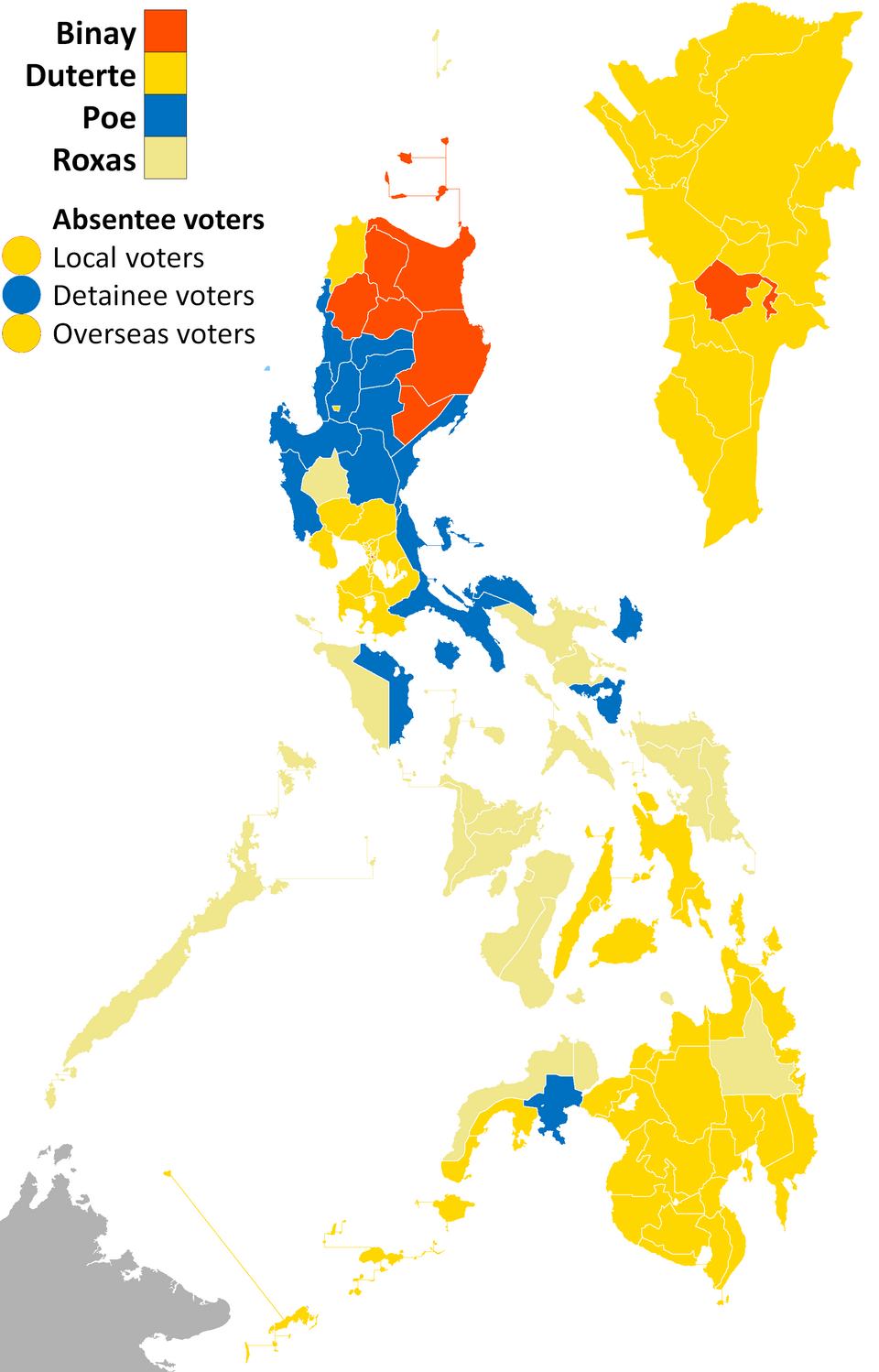
2016 Philippines Presidential Election Results
Candidate — Party — Votes — Percent
Rodrigo Duterte — PDP–Laban — 16,601,997 — 39.02
Mar Roxas — Liberal Party — 9,978,175 — 23.45
Grace Poe — Independent — 9,100,991 — 21.39
Jejomar Binay — United Nationalist Alliance — 5,416,140 — 12.73
Miriam Defensor Santiago — People's Reform Party — 1,455,532 — 3.42
Total — 42,552,835 — 100.00
Valid votes — 42,552,835 — 94.61
Invalid/blank votes — 2,426,316 — 5.39
Total votes — 44,979,151 — 100.00
Registered voters/turnout — 55,739,911 — 80.69 [Source: Wikipedia]
Jejomar Binay was orphaned at nine and became a human rights lawyer who was imprisoned for defending political prisoners during the rule of Ferdinand Marcos. He later served for years as mayor of Makati, Manila’s financial district, before being elected vice president in 2010. Once seen as a strong presidential contender, his image was damaged by corruption allegations, which he denied and described as politically motivated, and he faced the possibility of charges after his term. Binay supported talks with China over territorial disputes, favored a stronger U.S. military presence, and promoted peace negotiations to end long-running Muslim and communist insurgencies.
Miriam Defensor-Santiago is a former trial court judge, immigration commissioner, and senator. He is known for her tough rhetoric but faced persistent concerns about her health after being diagnosed with stage-4 lung cancer in 2014. Though elected to serve as a judge at the International Criminal Court, she declined the post due to illness, later insisting she had recovered sufficiently to run for president, despite being unable to campaign fully. Her decision to choose Bongbong Marcos, son of former president Ferdinand Marcos, as her running mate stirred controversy. Santiago argued that the Philippines should reduce military dependence on the United States and instead strengthen its own armed forces amid maritime tensions with Beijing.
Outgoing President Benigno Aquino III regarded the elections as a referendum on his "straight path" style of governance characterized by efforts to fight corruption and poverty. Mar Roxas was backed by Aquino, who campaigned against Rodrigo Duterte, who he regards as a threat to democracy because of remarks that he may close down Congress and form a revolutionary government if lawmakers stall his program. [Source: Associated Press, May 8 2016]
Duterte on the Campaign Trail in 2016
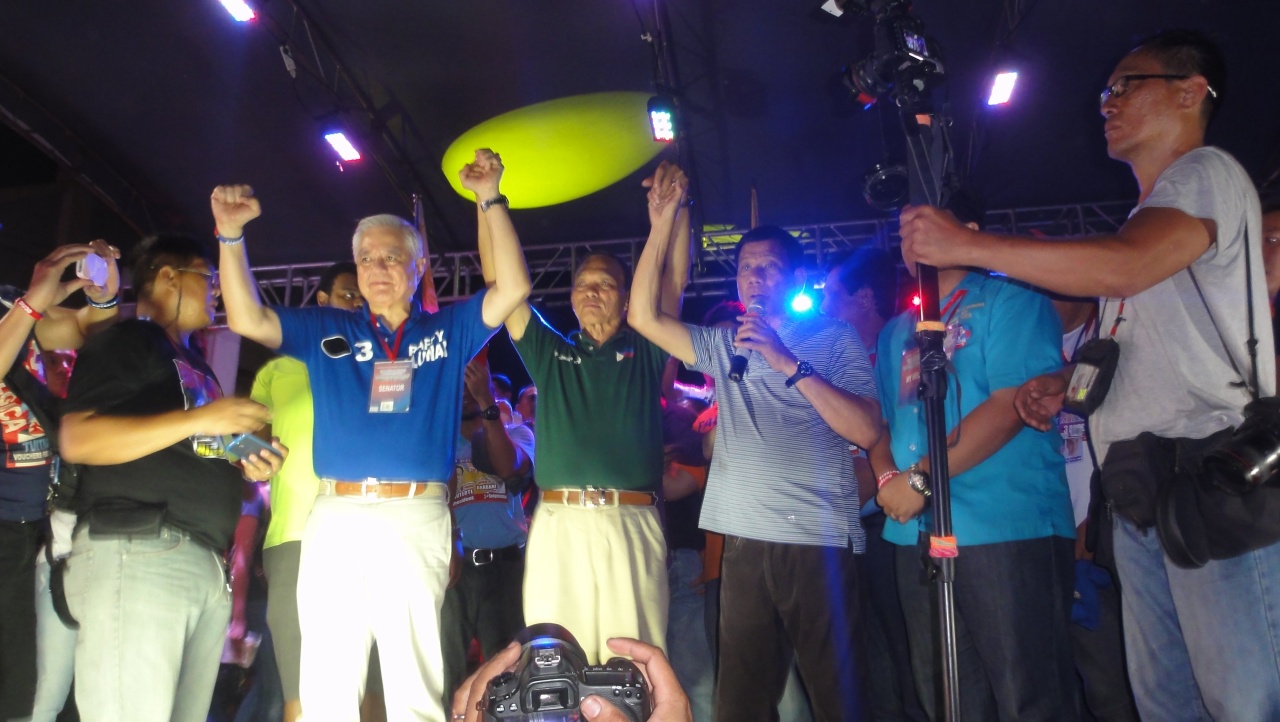
On the eve of the 2016 election Associated Press reported: After months of campaigning across the archipelago, the five presidential candidates converged on Manila for final rallies before election day, with Rodrigo Duterte drawing the largest crowd. Police estimated that about 300,000 supporters attended his rally at a historic grandstand along Manila Bay, a traditional site of presidential inaugurations, while rival gatherings were significantly smaller. [Source: Teresa Cerojano and Jim Gomez, Associated Press, May 7 2016]
In his characteristically coarse style, Duterte told the crowd, “All of you who are into drugs, you sons of bitches, I will really kill you,” vowing to risk his life to end crime and corruption within months if elected. “I have no patience, I have no middle ground, either you kill me or I will kill you idiots,” he added, later softening his tone by promising, “I'll be decent.” On another occasion, Duterte said the Philippines should build funeral parlours, not prisons, to cope with drug dealers.
In the meantime, President Benigno Aquino III urged Duterte’s rivals to unite behind a single candidate to block his rise, warning that the lead could still be overturned. However, Poe rejected Roxas’s call for talks, Vice President Jejomar Binay refused to step aside, and Miriam Defensor-Santiago said she would never withdraw. Duterte’s camp dismissed the proposed alliance as the “stench of defeat,” with campaign manager Leoncio Evasco Jr. calling it an admission that Duterte’s victory was “virtually… inevitable.” Under the Philippine system, the candidate with the most votes wins, even without a majority.
A longtime mayor of Davao City, Duterte energized supporters with promises to eradicate crime in three to six months, though critics — including Aquino — questioned the feasibility of that pledge, noting crime statistics in Davao and comparing him sarcastically to “Batman and Superman combined.” Duterte also sparked outrage after joking about the rape and murder of an Australian missionary in a 1989 jail riot, later telling Australian and U.S. diplomats to stay out of Philippine affairs and raising the possibility of cutting ties with Western allies. He further threatened to close Congress if impeached and said Marxist guerrillas could join his government. Meanwhile, Antonio Trillanes IV filed a corruption complaint accusing Duterte of undeclared bank accounts and ghost employees, and warned he would seek impeachment should Duterte win.
Adrian Chen wrote in The New Yorker: Nicole Curato, a sociologist at the University of Canberra, was doing field work in the slums of Tacloban, a provincial capital in the central Philippines, and saw the excitement inspired by Duterte’s candidacy. “It was a very do-it-yourself campaign,” she said. To attract crowds to rallies, politicians typically rely on a strategy known as hakot, in which poor Filipinos are given a free meal, a couple of hundred pesos, and a campaign shirt, and are bused from the slums to the city plaza, where they cheer for the chosen candidate. But Curato said that Duterte’s supporters borrowed money to get to the plaza themselves. Duterte is perpetually late, which meant that supporters might be kept waiting in the sweltering heat for as long as seven hours. Yet it seemed not to bother them. “People were really crazy about him,” Ranada told me. “It’s the only word for it.” [Source: Adrian Chen, The New Yorker, November 21, 2016]
Duterte relied on an army of volunteers to publicize his campaign on social media. The Philippines has among the highest rates of social-media use in the world, in large part because millions of Filipinos employed abroad use it to keep in touch with their families. Overseas workers were a crucial segment of Duterte’s supporters. Since they were spread out all over the world, they could post pro-Duterte messages on Facebook at all hours. One of Duterte’s most rabid supporters was a pop star and sex blogger named Mocha Uson, the leader of a girl group called the Mocha Girls. When Duterte was accused of sexism, she posted on Facebook an account of how, when the Mocha Girls came to Davao, he was always a gentleman, unlike most mayors, who tried to arrange liaisons with them.
How Duterte Got Elected President
According to AFP, there were five main reasons why Duterte won: 1) His strongman image:. Many Filipinos were eager for a decisive leader who could address the country’s deeply rooted problems. With profanity-laced promises to kill criminals and challenge the entrenched economic elite, Duterte positioned himself as a tough, uncompromising figure ready to impose order and deliver change. 2) His populist appeal. Presenting himself as a man of the people, Duterte tapped into widespread frustration over inequality and injustice. His coarse language, open boasts about womanizing, and disregard for political correctness angered critics but strengthened his anti-establishment credentials. A skilled and charismatic speaker, he connected with audiences through vivid storytelling about everyday struggles, often mixing humor with blunt rhetoric. [Source: AFP, May 10, 2016]
3) Law and order was a centerpiece of his campaign. Accurately gauging public concern over crime and corruption, Duterte pledged to restore safety within the first six months of his presidency. His dramatic vows to eliminate tens of thousands of criminals resonated with voters who believed that extreme measures were necessary to curb rampant criminality. 4) Duterte also benefited from being seen as the “anti-Aquino.” Although outgoing President Benigno Aquino III had presided over six years of strong economic growth, many Filipinos felt excluded from its benefits.
Critics described Aquino’s leadership style as cautious and bureaucratic, and Duterte promised to be the decisive opposite. 5) Finally, divided rivals worked to Duterte’s advantage. In the Philippines, the presidency is won by whoever receives the highest number of votes, without a runoff. Duterte captured roughly 39 percent of the vote, while his main opponents—administration candidate Mar Roxas and independent candidate Grace Poe—split a larger combined share. Aquino had reportedly encouraged Roxas and Poe to unite as a presidential and vice-presidential tandem, but Poe declined. Had the opposition vote not been divided, the outcome might have been different.
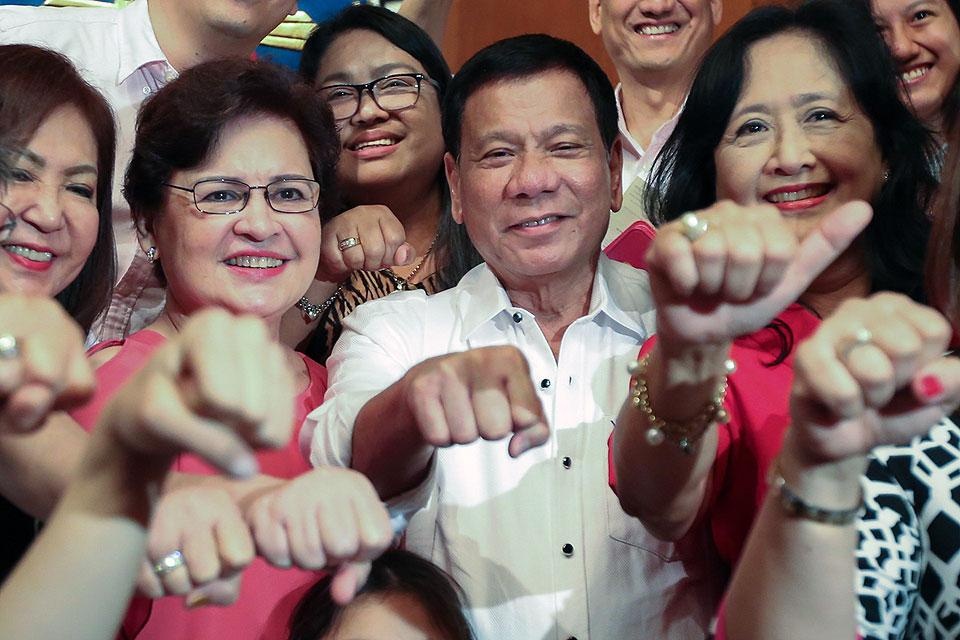
Duterte promised to remake the Philippines in the image of Davao. He pledged to rid the country of illegal drugs within six months without regard for human rights or due process. In the spring, he threatened to throw drug dealers’ bodies into Manila Bay "to fatten the fish." His campaign posters displayed a clenched fist. Voters believed him. Although the Philippines had enjoyed years of sustained economic growth under the previous president, Benigno Aquino III, many Filipinos felt left out of the boom. They were concerned about rising crime, entrenched corruption, crumbling infrastructure, and a broken justice system, not to mention rampant drug abuse. They felt that electing a radically different leader was the only way to enact real change. The Philippines’ previous two presidents were the children of former presidents, but Duterte was an outsider. He hailed from Mindanao, far from the halls of power. He eschewed the staid, diplomatic lexicon of legacy politicians. His crass outbursts were a boon; he spoke like a man of the people. [Source: Jonathan Kaiman, Los Angeles Times, October 10, 2016]
Adrian Chen wrote in The New Yorker: Duterte took from the Marcos years an ability to play both sides of a messy conflict. Marcos, who died in 1989, in Honolulu, is still surprisingly popular in the Philippines; most of his loyalists never lost faith, and many younger Filipinos look back at the charismatic leader with a kind of secondhand nostalgia. During the campaign, Duterte courted Marcos loyalists assiduously, making it a priority to rebury Marcos in the national Heroes Cemetery. He reportedly considered Marcos’s son, a fifty-nine-year-old senator named Ferdinand (Bongbong) Marcos, Jr., as a running mate, and he praised the elder Marcos, saying that he would have been the Philippines’ best President, “if he did not become a dictator.” [Source: Adrian Chen, The New Yorker, November 21, 2016]
Duterte During his Six Years as President
At the end of his year term in 2022 Duterte was still both hugely popular and controversial. Since the country's constitution only allows a single six-year term for presidents, he had earlier said he would run for vice-president. But instead, in October 2021, he told Filipinos that he was retiring from politics. According to the BBC: His legacy is a contentious one. He was a hugely popular leader who was also fiercely opposed and criticized for his sexist comments, allegations of sexual abuse and human rights violations, and a violent crackdown on drugs that left tens of thousands of Filipinos dead. [Source: BBC, May 10, 2022]
The BBC's Howard Johnson wrote that his 2016 campaign was "littered with obscenities and populist promises but light on details." Styling himself as both a socialist and a reformist, he promised sweeping political changes and greater federalism. However, critics warned that, without reforms at the local level, this would only hand unchecked power to regional clans. The arduous process of making the Philippines more federal was abandoned. He was also accused of targeting dissenters. Two of his fiercest critics, Senators Antonio Trillanes and Leila de Lima, have been jailed. Maria Ressa, a Nobel Prize–winning journalist whose news website, Rappler, reported on the controversial war on drugs, faced several court cases, ranging from tax evasion to foreign ownership violations.
Covid proved to be Duterte's biggest challenge, tanking the strong economy he had inherited as remittances from overseas and domestic consumption took a hit. Despite implementing one of the world's strictest lockdowns, the country struggled to cope with rising cases of the virus, hindered by inequality and a fragmented healthcare system. The Philippines was one of the worst-affected countries in Asia, with more than 3.6 million cases and 60,000 deaths. Yet Duterte remained hugely popular. His approval ratings, which mostly stayed above 50 percent, only declined in 2021, at the height of the pandemic.
To some degree a free press, a politically engaged citizenry, strong political ecosystem, public opinion and the Congress and Senate kept him in check. When he chose to step away from politics, he said it was because "the overwhelming sentiment is that I am not qualified," possibly referring to repeated opinion polls that showed his daughter was more popular than he was. In yet another surprising turn, however, he did not endorse his daughter, Sara, or her presidential running mate, Ferdinand "Bongbong" Marcos Jr.
Duterte’s Style as President of the Philippines
Duterte made global headlines for his shockingly blunt and offensive statements and his unpredictable policy shifts. These earned him the moniker "the Donald Trump of the East." Jonathan Kaiman wrote in the Los Angeles Times: To outsiders, Duterte is a puzzle — ideologically liberal, but disdainful of human rights; politically gifted, but often seemingly unhinged. In late September 2016, he said he wants to slaughter drug dealers like Hitler slaughtered Jews. The following week, he visited a synagogue to apologize for causing offense. In October, he said Obama — a persistent critic of his drug war — could “go to hell,” and vowed to deepen ties with China and Russia. In October 2016 20, he announced that he was “separating” from the United States and embracing China as the new best friend of the Philippines. [Source: Jonathan Kaiman, Los Angeles Times, October 10, 2016]
“Ideologically eclectic and politically savvy, Duterte combined [former Venezuelan President] Hugo Chavez-style populism with Singapore-style disciplined governance to build himself as the penultimate strongman in the city,” Richard Javad Heydarian, an assistant professor in political science at De La Salle University in Manila, told the Los Angeles Times. “He progressively cultivated a macho, no-nonsense image, backed by shock and awe approach to criminality and drugs.”
In May 2016, just after Duterte was elected, Adrian Chen wrote in The New Yorker, Duterte promised to rid the country of crime and drugs by killing thousands of criminals and vowed to stop swearing. Earlier he told reporters, “Don’t fuck with me.” He called political figures “gay.” When a reporter asked about his health, he replied, “How is your wife’s vagina? Is it smelly? Or not smelly? Give me a report.” In an overwhelmingly Catholic country, he swore at the Pope. At first, he defended his language as a gesture of radical populism. “I am testing the élite in this country,” he said. “Because we are fundamentally a feudal country.” But, the day after the election, he appeared with a popular televangelist and said, “I need to control my mouth.” He compared his forthcoming transformation to that of a caterpillar changing into a butterfly. “If you are the President of the country, you need to be prim and proper,” he said. His inaugural speech, in June, was obscenity-free. [Source: Adrian Chen, The New Yorker, November 21, 2016]
The resolution didn’t last. Duterte’s war on drugs has resulted in the deaths of more than three thousand people, In early September, before the summit of the Association of Southeast Asian Nations, in Laos, a journalist asked Duterte what he would say if President Barack Obama raised the issue of human rights. “You know, the Philippines is not a vassal state,” he replied. “We have long ceased to be a colony of the United States.” Alternating between English and Tagalog, and pounding on the lectern, Duterte, it was widely reported, said of Obama, “Son of a whore, I’ll curse you at that forum.”
Duterte does not, as he has put it, “give a shit” about human rights, which he sees as a Western obsession that keeps the Philippines from taking the action necessary to clean up the country. But the day after insulting Obama, Duterte released a statement expressing regret that his comment “came across as a personal attack on the U.S. President.” In his outburst, Duterte had used the Tagalog phrase putang ina, which means, literally, “your mother is a whore.” But it is also used to communicate frustration, as in “son of a bitch.” “It’s just an expression,” Salvador Panelo, Duterte’s chief legal counsel, explained to the press. “I don’t think it was directed to President Obama.” A columnist for the Philippine Daily Inquirer provided foreign journalists with a satirical guide to “Dutertespeak”: “Putang ina really means ‘I firmly believe you are mistaken.’ ”
Duterte: the Blunt, Offensive, Stage-Kissing Strongman
Duterte threatened to leave the U.N., called the E.U. "hypocritical," and compared his war on drugs to the Holocaust. He called former U.S. President Barack Obama the "son of a whore," but his spokesman said he regretted it when Obama canceled a meeting. He also swore at the Pope for causing traffic jams during his visits and said that God was "stupid" in a country where most people are Catholic. When he kissed a female worker onstage, rights group Gabriela described it as the "disgusting theatrics of a misogynist president." Even worse, he admitted to sexually assaulting a maid when he was a teenager.[Source: BBC, May 10, 2022]
In June 2016, Duterte said journalists were "not exempted from assassination" and many journalists killed in the Philippines had deserved to die. Citing Jun Pala, a journalist, politician and critic of Duterte who was murdered in 2003, he said: "I do not want to diminish his memory but he was a rotten son of a bitch. He deserved it. That can't be just freedom of speech. The constitution can no longer help you if you disrespect a person." [Source: BBC, June 1 2016, Reuters, June 8, 2016]
When the European Parliament issued a statement condemning the Philippines human rights, Duterte said, “F--- you” — and gave them the He criticized the U.N., which has also issued a human rights state, saying “You do not just go out and give a sh—tting statement against a country.” He went on to say the U.N. expert who wanted to investigate him was “a very stupid expert” and gave them his list of 10 bad things he can say about the group. “F—k you UN, you can’t even solve the Middle East carnage,” Duterte said. “Shut up all of you....Maybe we’ll just have to decide to separate from the United Nations,” suggesting starting his own union and inviting China to join. [Source: Mark Oliver, Listverse, October 9, 2016]
Whatever his motives were his methods were effective. According to Reuters: “Duterte's ruthless, decisive approach garnered consistently high public approval ratings and a cult-like following, which helped win control of the legislature and bureaucracy and tame independent bodies, making opponents think twice about taking him on. [Source: Martin Petty, Reuters May 10, 2022]
Duterte Bullying, Slandering, Intimidating and Arresting His Critics
According to the Washington Post: When a longtime Duterte critic, Sen. Leila de Lima, opened a Senate investigation on extrajudicial killing, he publicly urged her to hang herself. When she presented a witness who claimed that he killed for Duterte in Davao, once feeding a man to a crocodile, she was ousted from her role as chair of the Senate Committee on Justice and Human Rights. The senator has since been publicly accused of taking bribes from drug dealers and sleeping with her driver. Her personal number and address were broadcast on national television, leading to threats. “She was not only screwing her driver, she was screwing the nation,” the president joked. She’s not laughing. “The truth is, I’m not safe,” she said. [Source: Emily Rauhala, Washington Post, September 28, 2016]
In February 2017, de Lima was arrested on drug trafficking charges after a court in Muntinlupa issued a warrant accusing her of accepting bribes from jailed drug lords. She denied the allegations, calling them politically motivated and part of President Rodrigo Duterte’s effort to silence critics of his anti-drug campaign. De Lima vowed to continue fighting, saying she would not be intimidated and that it was her “honour to be jailed” for defending human rights and exposing alleged abuses. Shortly after her arrest at the Senate, more than 1,000 protesters marched in Manila to denounce Duterte’s drug war and her detention. [Source: Associated Press, February 24, 2017; AFP, February 25, 2017]
In November 2019, President Rodrigo Duterte appointed his chief political rival, Vice President Leni Robredo, to oversee his controversial war on drugs, shortly after she publicly criticized the campaign’s high death toll and called for reforms. Despite skepticism from allies who warned the role was a trap, Robredo accepted, saying she wanted to stop abuses and save lives. [Source: AFP, November 24, 2019; Petty, Reuters, November 5, 2019]
Her tenure lasted less than three weeks. Duterte and his allies accused her of embarrassing the country and seeking international attention, particularly after she met with U.S. and U.N. officials. Duterte publicly said he did not trust her, and she was abruptly removed from the post without formal notice. Human rights group Amnesty International said her reform proposals were never given a real chance. The episode highlighted deep political tensions between the separately elected president and vice president, who had long clashed over the drug war, human rights, and other policies.
Conversely, Duterte had been an outspoken ally of the Marcos family. He said the family had indicated a willingness to return some of the disputed wealth without admitting wrongdoing. Duterte fulfilled a campaign promise to allow Ferdinand Marcos’s burial at the national heroes’ cemetery, a move that sparked protests. [Source: Jason Gutierrez, New York Times, July 3, 2019]
Philippines Economy Under Duterte
In the early months of his presidency in 2016, President Rodrigo Duterte received strong support from the Philippine business community, which saw potential for sustained economic growth despite global headlines focused on his violent anti-drug campaign. Economic momentum built under his predecessor, Benigno Aquino III, had already pushed growth above 6 percent, and second-quarter growth in 2016 reached 7 percent, making the Philippines one of Asia’s fastest-growing economies at the time. [Source: Karen Lema, Reuters, August 23, 2016]
Business leaders welcomed Duterte’s emphasis on accelerating infrastructure spending, cutting red tape, reforming taxes, investing in education, and tackling corruption. His administration pledged to continue Aquino’s macroeconomic policies while expanding infrastructure investment to about 5 percent of GDP and reviewing foreign ownership limits to attract more investors. Major firms in banking, retail, and food expanded domestic operations, citing optimism about economic prospects. Duterte also promoted spreading development beyond congested Manila by creating economic zones in other regions, aiming to reduce inequality and generate jobs nationwide. Supporters argued that his tough stance on crime could improve peace and order and strengthen investor confidence, pointing to economic growth in Davao City during his time as mayor. [Source: Ian C Sayson, Bloomberg, May 12, 2016; AFP, May 27, 2016]
The Philippines’ economy under President Rodrigo Duterte (2016–2022) experienced strong growth in its early years, followed by a historic downturn during the COVID-19 pandemic. In 2017 and 2018, the economy expanded by an average of 6.6 percent, driven largely by domestic demand, increased government spending, and an ambitious infrastructure push. However, in 2020 the economy contracted by 9.5 percent as strict lockdowns halted business activity, reversing gains in poverty reduction and raising public debt. [Source: Google AI; Philippines Department of Budget and Management (DBM); Forbes]
A central pillar of Duterte’s economic strategy was the “Build, Build, Build” program, which sharply increased infrastructure spending to 6.3 percent of GDP in 2017 and 6.2 percent in 2018 — significantly higher than in previous administrations. The goal was to ease chronic bottlenecks in transport, connectivity and logistics, and stimulate long-term growth. The administration also pursued major fiscal reforms. The first package of the Comprehensive Tax Reform Program, known as the TRAIN Law, reduced personal income taxes while increasing excise taxes on fuel, sugary drinks and other goods. Officials said the changes strengthened revenue collection to fund infrastructure and social services.
Before the pandemic, the government reported progress in reducing poverty rates ahead of schedule. The country also secured its first-ever A-level credit rating from the Japan Credit Rating Agency in 2020, signaling improved investor confidence despite concerns about governance and corruption rankings. The pandemic, however, posed severe challenges. Economic activity stalled, unemployment rose, and national debt increased as the government rolled out emergency spending. While long-term infrastructure projects continued, the administration faced difficulties in fully realizing investment targets and contended with rising inflation toward the end of Duterte’s term.
Duterte and the U.S.
In 2020, Duterte moved to terminate the Visiting Forces Agreement (VFA), a long-standing pact allowing U.S. troops to operate in the Philippines. Although the withdrawal process was extended, he later stated that the United States would have to “pay” to maintain the agreement. His successor, Ferdinand Marcos Jr., subsequently restored and strengthened military ties with the United States. [Source: Karen Lema, Reuters, March 11, 2025]
Adrian Chen wrote in The New Yorker: Duterte is the first President to come from the island of Mindanao, which has a particularly fraught history with the U.S. military... When the U.S. instituted a civilian colonial authority over the Philippines, Mindanao was put under military rule and subjected to a campaign of pacification which resulted in many thousands of deaths. [Source: Adrian Chen, The New Yorker, November 21, 2016]
For twenty-one years, Duterte was the mayor of Davao, a city of two million in Mindanao, and he often brings up abuses from the colonial era in his anti-American rants. But he has said that a more recent incident was responsible for what he calls his “hatred” of America. In 2002, not long after U.S. special forces launched an operation against Abu Sayyaf in Mindanao, Michael Meiring, an American treasure hunter, was staying in a hotel in Davao when a cache of dynamite stored in his room exploded. There were rumors in Davao that Meiring was a C.I.A. agent. In Duterte’s telling, two F.B.I. agents took Meiring from his hospital room and repatriated him before he could be questioned by local authorities. Duterte was furious at what he saw as an infringement of his authority as mayor. He said he demanded that the U.S. Ambassador at the time, Francis Ricciardone, conduct an investigation, and he has fumed about the lack of answers ever since. (In an e-mail, Ricciardone told me that he did not recall discussing the case with Duterte, but he called the allegations “preposterous.”)
Since then, Duterte has repeatedly expressed his displeasure with the U.S. military presence in Mindanao. In 2007, he refused to let the U.S. and the Philippines hold joint military exercises in Davao, saying that such drills would be a magnet for terrorists. “Because of their arrogance and pretended superiority, the Americans invaded Iraq to kill Saddam Hussein but ended up destroying the country,” he said. “We don’t want that to happen to us.” In 2013, he denied requests to launch American drone flights from Davao. “I do not want it,” he said. “I do not want trouble and killings.”
Duterte, China and Russia
Duterte was not always consistent and had a tendency to be vague when it came to foreign policy and flip-flop. During the campaign he hinted at taking a stronger stance against China over maritime disputes in the South China Sea. He famously said he would ride a jet ski to a disputed island claimed by both countries and plant a flag on it. However, as president, he moved closer to China and Russia and away from the US — a former colonial ruler turned military and economic partner.
In foreign policy, Duterte promoted what he called an “independent” approach, strengthening ties with China and Russia while recalibrating relations with traditional allies. Duterte had shifted the Philippines’ closer toward China. During a visit to Beijing in November 2016, he chose not to raise the ongoing dispute over Beijing’s expansive claims in the South China Sea, even after an international tribunal ruled in favor of the Philippines’ position against China’s claims. He maintained a deferential stance toward Chinese activities around contested shoals and reefs, despite significant domestic criticism. Duterte pursued closer economic ties with China, negotiating pledges of billions of dollars in aid, loans, and infrastructure investments. However, much of the promised funding did not fully materialize. [Source: Karen Lema, Reuters, March 11, 2025]
Duterte met with Putin a couple of times. In January 2017, he visited a Russian warship docked at Manila and told the head of the Russian Pacific fleet: “We welcome our Russian friends. Anytime you want to dock here for anything, for play, for replenish supplies or maybe our ally to protect us.” [Source: Editorial, Washington Post, January 21, 2017]
Duterte pro-China, pro-Russia and anti-U.S. positions were largely reversed when he was replaced in 2022 by Ferdinand Marcos Jr. as President.
Duterte’s Criticism of the Catholic Church
In January 2017, then Philippines President Rodrigo Duterte sharply criticized the Catholic Church after priests and bishops spoke out against alleged extrajudicial killings linked to his anti-drug campaign. Despite receiving a blessing from Pope Francis through an adviser who visited the Vatican, Duterte publicly rebuked church leaders, accusing them of hypocrisy and misconduct. [Source: Neil Jerome Morales, Reuters, January 20, 2017]
During a speech to police officers, Duterte expressed anger that members of the clergy were condemning his drug war instead of helping persuade people to stop using illegal drugs. He accused priests and bishops of corruption, sexual abuse, and violating church teachings, and challenged them to a public “showdown,” threatening to reveal alleged wrongdoing within the Church.
The criticism came as the Catholic Church emerged as one of the few major institutions openly questioning the government’s anti-drug campaign, which had resulted in thousands of deaths according to police figures. Duterte argued that church leaders lacked moral authority to criticize the government because of scandals involving clergy.
After winning the 2016 Philippine presidential election, Duterte called the Catholic Church “the most hypocritical institution.” In a late-night press conference in Davao City, he accused several bishops of corruption and of asking politicians for favors such as vehicles and property assistance. Duterte questioned the influence of church leaders after they urged voters not to support him during the election campaign. Despite these warnings, he won by a large margin, which he described as proof that the bishops had failed to sway the public. The outspoken mayor argued that some church officials violated their vows of celibacy and misused public donations. [Source: Jim Gomez, Associated Press, May 22, 2016]
The confrontation reflected broader disagreements between Duterte and Catholic leaders. Church officials had previously criticized his harsh rhetoric, his promise to kill criminals as part of his anti-crime policies, and his controversial public statements, including an earlier insult directed at Pope Francis during the pope’s 2015 visit to the Philippines.
Church figures such as Socrates Villegas, then head of the Catholic Bishops' Conference of the Philippines, condemned Duterte’s remarks and behavior, criticizing his vulgar language, comments about violence, and support for contraception policies opposed by the Church. The dispute highlighted the continuing tensions between political leadership and religious authority in the Philippines.
In 2015, Duterte cursed Pope Francis, who had caused a huge traffic jam during a visit to Manila that trapped the mayor for hours. When stunned bishops reacted, Duterte apologized but then condemned the church, criticizing claims that priests can give absolution for sin. He promised to limit families to three children to go against Catholic doctrines, and declared, “The most hypocritical institution is the Catholic Church.” Despite his profanity, repeated calls to violence and the Philippines being 80 percent Catholic, Duterte was one the Philippines’s most popular leaders ever. [Source: Listverse, Jonathan Kaiman, Los Angeles Times, October 10, 2016]
Rodrigo Duterte has stated that he was sexually abused by a priest when he was 14. He told the press, “It was a case of fondling—you know what—he did during confession.” After being urged by the Catholic Bishops' Conference of the Philippines (CBCP) and officials of Ateneo de Davao University to identify the priest and pursue legal action, Duterte named him as Mark Falvey, who died in 1975.
Image Sources: Wikimedia Commons
Text Sources: Wikipedia, New York Times, Washington Post, Los Angeles Times, Smithsonian magazine, Encyclopedia.com, Times of London, Library of Congress, The Conversation, The New Yorker, Time, BBC, CNN, Reuters, Associated Press, AFP, Lonely Planet Guides, Google AI, The Guardian and various websites, books and other publications.
Last updated February 2026