
GLORIA MACAPAGAL-ARROYO
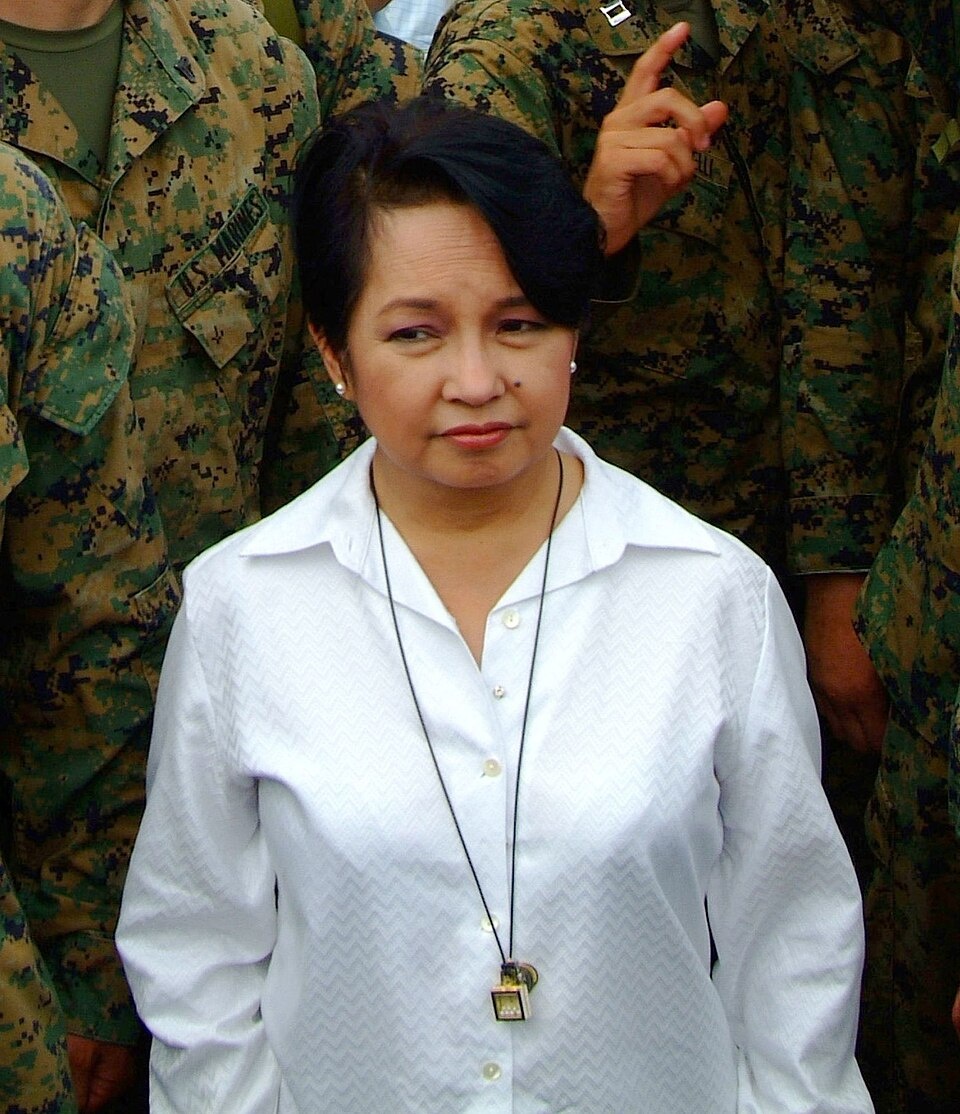
Gloria Macapagal-Arroyo succeeded Estrada as president. The daughter of Diosdado Macapagal, the president of the Philippines in the early 1960s, she was Estrada’s vice president and became president after he was ousted in 2001. Altogether she served nine years a president, three years of Estrada’s term (from 2001 to 2004) and six years after she was elected in 2004 (2004 to 2010).
Arroyo is very small and well-dressed and has a prominent mole on the left side of her nose. She was often dwarfed by the foreign leaders. When she became president she was coached to smile more, use simple sound bites and encouraged to liven up her professorial monotone. She was sometimes called the “Queen” and despite here best attempts to be otherwise she was never truly embraced by the Philippines’s poor. She was supported more by business leaders and the political elite.
Arroyo characterized herself as a troubleshooter who went about her job like a doctor cleaning an infection rather than a hero who overpowered problems with a slash from a sword. Her years in power were characterized by political divisions, severe poverty, a sluggish economy, military unrest, problems with terrorists and insurgents, corruption and efforts to impeach her.
Arroyo dominated Philippine politics during the first decade of the 21st century. Arroyo first assumed the presidency in January 2001 after “people power” protests forced Joseph Estrada from office. She later secured a full six-year term in May 2004, becoming the country’s longest-serving president since Ferdinand Marcos. However, the 2004 election was marred by controversy, particularly after an audio recording surfaced that allegedly captured Arroyo speaking with election commissioner Virgilio Garcillano about padding her vote margin. Following the scandal, her approval ratings fell to unprecedented lows and remained weak for years. [Source: Steven Rood, Asia Foundation, April 7, 2010]
Widely known by her initials “GMA,” Arroyo moved quickly to consolidate power. She permitted the return of U.S. military forces to the Philippines as part of the global war on terror. In the 2004 election, she faced several challengers, including actor Fernando Poe Jr., and won by about 1.1 million votes. Yet doubts over the legitimacy of her victory persisted after the leaked recording fueled accusations of election fraud. Her opponents attempted to mobilize public outrage, but many Filipinos, perhaps weary from previous uprisings, largely avoided mass protests. By late 2005, Arroyo had weathered the political storm despite repeated impeachment efforts and ongoing criticism. Nevertheless, her administration continued to grapple with longstanding national problems, including high unemployment and persistent poverty.
RELATED ARTICLES:
MAGUINDANAO MASSACRE: EVENTS, KILLERS, POLITICS, TRIAL factsanddetails.com
JOSEPH ESTRADA: HIS LIFE, MOVIES, POLITICAL COMEBACK factsanddetails.com
JOSEPH ESTRADA AS PRESIDENT OF THE PHILIPPINES (1998-2001) factsanddetails.com
BENIGNO AQUINO III — PHILIPPINES PRESIDENT 2010-201 — HIS LIFE, CAREER, ANTI-CORRUPTION FIGHT factsanddetails.com
FIDEL RAMOS — PHILIPPINES PRESIDENT (1992-1998) — HIS LIFE, CAREER AND GENERALLY POSITIVE IMPACT factsanddetails.com
PEOPLE POWER AND THE FALL OF MARCOS factsanddetails.com
FERDINAND MARCOS: HIS LIFE, LIES, EDUCATION, WAR RECORD, POLITICAL RISE factsanddetails.com
FERDINAND MARCOS AS PRESIDENT: EARLY PROMISE, RESISTANCE, WASTE factsanddetails.com
MARTIAL LAW YEARS UNDER FERDINAND MARCOS factsanddetails.com
CORAZON (CORY) AQUINO: HER LIFE, CHARACTER, FAMILY, NINOY AND MARCOS factsanddetails.com
CORAZON AQUINO AS PRESIDENT factsanddetails.com
Arroyo’s Early Life and Career
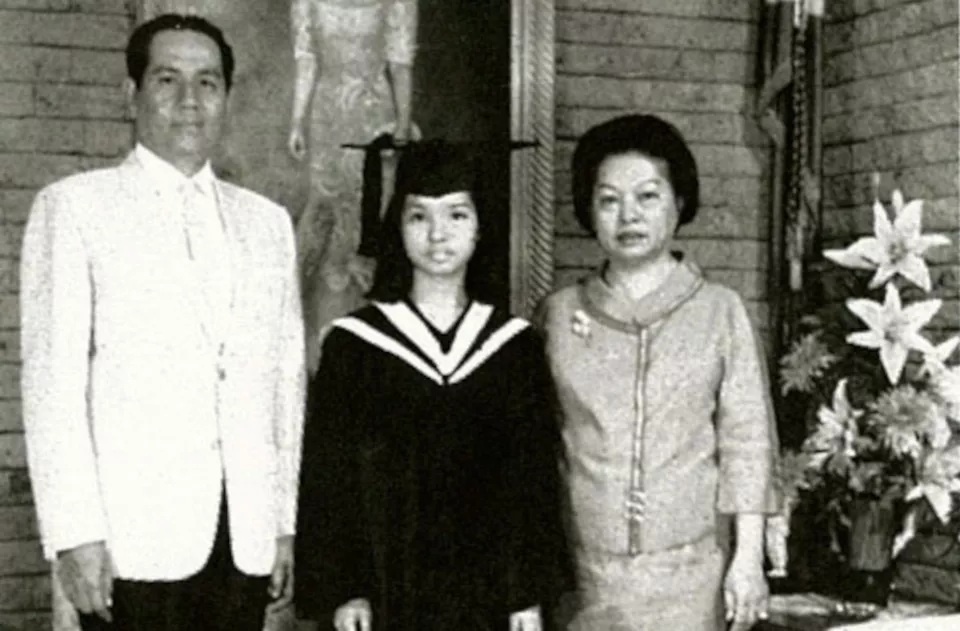
Arroyo is the daughter of Diosdado Macapagal, the president of the Philippines in the early 1960s. She was born in San Juan, Philippines on April 4, 1947 and grew up in Lubao, Pampanga, with her two older siblings from her father's first marriage, and Iligan City, with her maternal grandmother, and split her time between Mindanao and Manila until the age of 11. She is fluent in English, Tagalog, Spanish and several other Philippine languages, most importantly, Kapampangan, Ilokano, and Cebuano. Gloria’s father was elected president when she was 14. After that she lived in Malacanang Palace and had a municipality named in her honor, Gloria, Oriental Mindoro.
Gloria was always attracted to power and was a high achiever. Arroyo graduated at the top of her class from Lubai Central Elementary School and was valedictorian at Assumption Convent high school in 1964. When she was teenager she attracted a following by writing a column on local newspapers. Arroyo attended Georgetown University for two years and was a classmate of U.S. President Bill Clinton and made the dean’s list. She then earned her Bachelor of Arts degree in Economics from Assumption College, graduating magna cum laude in 1968. She eventually earned a Ph.D. in macroeconomics. She then became an economics professor.
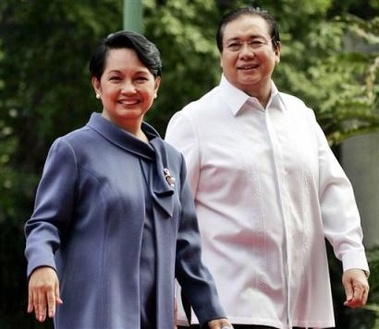
Arroyo is a devout Roman Catholic, who was often has a Bible in her hand. She sought the advice of her father after he was dead by regularly consulting his memoirs “Stone for the Edifice”. Arroyo is married to Jose Miguel Arroyo, lawyer and businessman from Binalbagan, Negros Occidental, whom she had met while still a teenager. He is member of one of the Philippines’s richest families. She has three children: 1) Juan Miguel ("Mikey") Arroyo, a former congressman and politician; 2) Evangelina Lourdes ("Luli") Arroyo-Bernas, worked in the diplomatic service and married to J. Aloysius "Luigi" Bernas; and Diosdado ("Dato") Arroyo, a Former congressman. Arroyo was a good friend of Corazon Aquino.
In 1987, Arroyo was invited by President Corazon Aquino to join the government as Assistant Secretary of the Department of Trade and Industry. She was promoted to Undersecretary two years later. In her concurrent position as Executive Director of the Garments and Textile Export Board, Arroyo oversaw the rapid growth of the garment industry in the late 1980s.
Arroyo was the biggest vote getter in the 1995 election for Senator (Several Philippine Senators are elected at one time by being the top vote getters in a group of candidates). She won with the highest number of votes in election history. While serving as a senator from 1992 to 1998, Arroyo authored 55 bills, including legislation that promoted privatization and trade. Arroyo was also the top vote getter when she ran as vice president. She changed parties three times, based more on her desire to further her political career than on ideology. People who worked with her described her disciplined, deliberate, a perfectionist, never impulsive.
Arroyo was an opposition vice president when she took that office in 1998. In the Philippines the president and vice president are voted on and elected separately and president Joseph Estrada was from a different party. Estrada put her in charge of the Department of Social Welfare and Development. In that position she showed her concern for the needy by traveling to every province, delivery food and relief supplies to the poor.
Arroyo Becomes President and the Ouster of Estrada
Arroyo kept mostly quiet on Estrada’s trouble until the very end. In October 2000 as Estrada’s situation was becoming more and more tenuous, Arroyo quit her cabinet post, most believe out of ambition rather than ethics. Her timing was perfect. She was quickly embraced by the opposition as a replacement for Estrada and became the leader of the opposition. At that time she began assembling a transition team so “she could hit the ground running” in the event she became president.
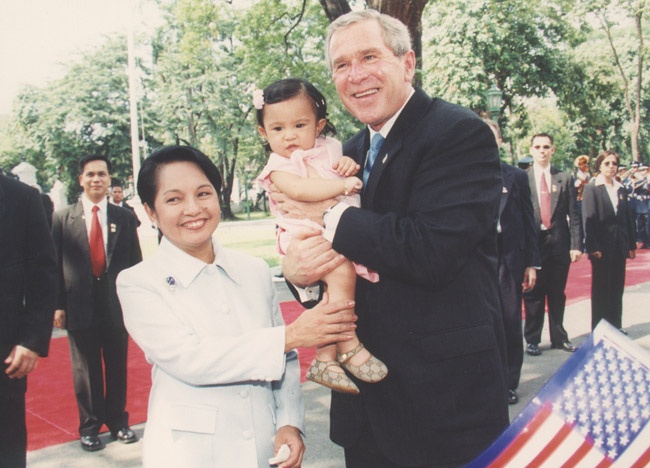
Arroyo was sworn as president on January 21, 2001, hours after Estrada was ousted and the same day that U.S. President George Bush was sworn into office. After Estrada supporters marched to Malacañang Palace,, Arroyo branded the violence as an attempt to grab power and declared a “state of rebellion” and ordered the arrest of 11 prominent military officers and opposition leaders.
In March 2001, the Supreme Court confirmed the legitimacy of Arroyo’s presidency in a vote of 13-0. In a 68-page ruling the court said that Estrada effectively quit when the left the presidential palace grounds and cited a statement by Estrada that read, “I leave the palace of our people with gratitude for the opportunities given to me for service of our people.”
Arroyo’s accession to power was further legitimated by the mid-term congressional and local elections, when her coalition later won an overwhelming victory, but the elections were fraught with allegations of coercion, fraud, and vote buying. In the May 2001 senatorial election, her allies won by a thin margin. The election was viewed as a de fact referendum on Arroyo’s rule. But at least 78 people were killed in campaign-related violence, including one Congressman and 17 candidates. In one town mortar shells exploded outside the town hall while voters were voting, sending them into a panic. In another town a boy heaved a grenade into a voting station. In another, a policemen was killed as gunmen made off with ballot boxes. One congressman and his bodyguard were killed by six gunmen as he stepped out of his car to attend a campaign rally.
Arroyo’s Early Years as President
Arroyo pledged to eliminate poverty and corruption and refused to grant amnesty to former president Joseph Estrada for his alleged crimes. She was initially supported by the military, the business elite and the Catholic church. In her early years she generally had high approval ratings. Support for Estrada remained strong in some communities in the early years of her rule. Many viewed her an usurper who took power from an elected official—Estrada. When she visited poor neighborhoods, where Estrada was popular, she was greeted with chants of “Erap pa rin” (“We are still for Erap”). Arroyo was regarded as a hard worker and a professional. She reportedly showed up for work at 6:00am and worked 16 hours a day, six days a week. Initially she was a welcome change from Estrada’s gambling, womanizing and drinking binges. Arroyo promised to lift 40 percent of Filipinos out poverty, cut the unemployment rate from 10 percent to 6 percent and eradicate corruption.
But it seemed that many Filipinos were more concerned about her appearance than her policies. In one press conference shortly after becoming president she said she had no plans to remove her beauty mark and did not consider herself particularly pretty. She described her husband as a “dreamboat” and said she would have to wear skirt to meetings to be respected. Newspapers criticized her grey suits and suggested that she wear more colorful and more feminine clothes. Many papers ran sketches of how she would look in different cloths, hairstyles and make up.
Arroyo’s initial term in office was marked by fractious coalition politics as well as a military mutiny in Manila in July 2003 that led her to declare a month-long nationwide state of rebellion, as a result of which charges were filed against more than 1,000 individuals. To strengthen her power base, Arroyo embarked on a program aimed at improving the life of the poor. Arroyo initially made a sincere effort to tackle corruption. One of her first moves as preside was to order the sale of all luxury cars that Estrada gave senior bureaucrats. She told her staff to live simply and said no one, not even members of her family, were above the law.
As time went on there were increasing accusations that Arroyo’s administration was corrupt and ineffectual. Her own husband was accused of taking a $2.5 million bribe in an effort to get him to influence his wife on a major telecom deal. Arroyo herself was accused of making too many television appearances, lacking substance and lacking the toughness to bring about real change. Arroyo was unable to achieve many of her goals and carry out programs she proposed due to political opposition, mainly from the ruling elite. Arroyo and her cabinet said that the political fighting and sniping exhausted and frustrated them deeply.
Arroyo's administration struggled to solidify its political legitimacy, revive the economy, and address long-running insurgencies in Mindanao. Among the armed groups was Abu Sayyaf, one of several Muslim separatist organizations that had fought for independence in the southern Philippines for decades and had been accused of links to Al-Qaeda. As of 2002, Philippine forces were still battling these militants with support from the United States. The separatist conflict in Mindanao had claimed more than 140,000 lives over three decades by 2005. In March 2001, the Moro Islamic Liberation Front declared a ceasefire and expressed willingness to negotiate. However, fighting resumed in February 2003 when government troops moved against an MILF base near Pikit in an operation targeting the so-called “Pentagon gang,” a kidnapping group designated by the United States as a terrorist organization. The clashes left more than a hundred MILF fighters dead. In January 2002, nearly 700 U.S. troops, including Special Forces personnel, were deployed to Mindanao to assess conditions, provide military advice, and train Philippine forces pursuing Abu Sayyaf guerrillas in Basilan and Jolo. Although the Philippine Constitution barred foreign troops from engaging directly in combat on its soil, U.S. forces played a significant advisory and support role in the counterinsurgency campaign. [Source: Dictionary of American History, Gale Group Inc., 2003]
Economy Under Arroyo
Initial optimism faded quickly after Arroyo assumed the presidency in 2001. When Arroyo took office, the Philippines was still recovering from the 1997–98 Asian financial crisis and faced a sluggish economy. She pursued privatization and deregulation policies, particularly in agriculture and the power sector. She was welcomed enthusiastically, with the stock market surging 30 percent on the day she was sworn in and business leaders praising her free-market and anti-corruption agenda. However, global economic slowdowns and security concerns soon dampened investor confidence. Foreign direct investment fell sharply, dropping to $319 million in 2001 compared with $1.8 billion in 1992. [Source: The Economist, August 16, 2007 -]
Economic growth during her early years was modest, reaching 3.4 percent in 2001, 4.3 percent in 2002, and 4.5 percent in 2003 and 6 percent in 2004 before being hurt by high oil prices in that year. Despite these gains, her administration faced significant criticism, as widespread poverty remained a persistent and deeply rooted problem in the Philippines. While inflation remained below 6 percent, government deficits widened as spending increased and tax revenues declined. By 2003, the deficit had reached $3.6 billion, total debt exceeded $100 billion, and the debt-to-GDP ratio peaked at 74 percent in 2004. Raising revenue became one of her administration’s most pressing challenges.
Beginning her second term in 2004, Arroyo promised austerity, anti-corruption reforms, energy independence, and job creation. She pledged to generate 10 million jobs, expand access to electricity and clean water, and build thousands of schools, while also doubling power rates to avert an energy crisis. Yet her reform agenda stalled amid political opposition, especially efforts to privatize state firms such as the National Power Corporation. Much of her time became consumed by allegations that she had rigged the 2004 election and by corruption accusations involving her husband.
Despite political turmoil, the economy performed better in the mid-2000s. Growth reached around 5 percent in 2003 and 2004 and 4.7 percent in 2005, fueled largely by strong demand for electronic exports. Exports accounted for about 40 percent of GDP, and remittances from overseas Filipino workers—totaling $12.8 billion in 2006—provided a major boost. Rising trade with China and the expansion of electronics manufacturing helped sustain momentum.
By 2007, observers such as The Economist noted significant improvements: growth exceeded 6 percent in early 2007, inflation had fallen to 2.6 percent, tax reforms had strengthened revenues, and the budget deficit had narrowed. Foreign investment began to recover, with companies such as Texas Instruments and Hanjin Heavy Industries committing major projects. The Philippines also emerged as a major center for business-process outsourcing, becoming a leading rival to India in call centers and related services, creating new employment opportunities despite lingering structural problems.
Arroyo Elected President in 2004 Amidst Allegations of Election Fixing
Macapagal-Arroyo declared in December 2002 that she would not contest the May 2004 presidential election, but she reversed herself in October 2003 and decided to run. She was reelected and sworn in for her own six-year term as president on June 30, 2004. With this new mandate, she was able to move with greater assurance on the political and economic reform agenda that had stalled during her first term in office, but ultimately she got bogged down by corruption charges and her second term is remembered most for the numerous attempts to impeach her.
Arroyo was elected as president in a June 2004. This was the first time that she was elected to the office. She initially became president in 2001 after Estrada was ousted not through an election. Arroyo said changed her mind to run for president because the lack of decent candidates made it her duty to run. Insiders said she initially decided not to run because of incessant sniping and attacks by her critics but changed her mind, after much prayer and a meeting with the pope, because she figured the attacks would continue even if she wasn’t president so she might as well run.
Arroyo's main challenger was actor Fernando Poe Jr., a close friend of Estrada who was immensely popular among poorer voters. Known as “Da King,” Poe was a celebrated action-film star but had little political experience. He led early opinion polls and drew huge rally crowds, yet doubts emerged about his qualifications, as he avoided debates and interviews and had no background in public service. The elections were extremely close. Arroyo ultimately won 39.5 percent of the vote (12.9 million votes), while Poe received 36.5 percent (11.8 million). Her running mate, broadcaster Noli de Castro, also added strength to her ticket.
The results were not officially proclaimed until six weeks after the election. Initial vote counting took weeks, and Poe’s camp alleged widespread fraud and threatened mass protests reminiscent of earlier “people power” uprisings. Both candidates claimed victory as tensions rose, and security forces were deployed around Congress and other sensitive locations. Poe refused to concede and brought his challenge to the Supreme Court. The post-election period saw scattered violence, including attacks on town halls, bombings at ballot-counting centers, and politically motivated shootings. By some estimates, at least 115 people—including dozens of candidates—were killed in election-related violence between late 2003 and mid-2004, significantly higher than in previous election cycles.
The “Hello Garci” scandal triggered months of political crisis following the 2004 presidential election of Arroyo. Audio recordings surfaced in June 2005 that allegedly captured Arroyo speaking with election commissioner Virgilio Garcillano about influencing the vote count. The tapes led to cabinet resignations, impeachment attempts, and street protests demanding her resignation. Arroyo publicly apologized for speaking with an election official but denied any wrongdoing and did not confirm Garcillano’s identity. Investigations failed to clearly establish the source or authenticity of the recordings, and Garcillano later left the country, fueling further speculation. At the same time, government-released recordings allegedly showed Joseph Estrada conspiring to assassinate Arroyo, though critics dismissed these tapes as fabricated. A congressional inquiry concluded that the administration had provided little cooperation in clarifying the truth behind the recordings. Despite the uproar, public anger did not reach the levels seen in the uprisings that removed Ferdinand Marcos in 1986 or Estrada in 2001, and the crisis gradually subsided. [Source: John O’Callaghan, Reuters, November 16, 2005; Carlos H. Conde, New York Times, August 2, 2005]
Further controversy arose in August 2005 when a former political aide alleged that he had witnessed cash payments to election officials at a meeting in Arroyo’s home before the 2004 vote. Meanwhile, Arroyo’s approval ratings plunged deeply into negative territory. Although her administration declared the issue closed and shifted focus to economic reforms, including tax measures to reduce budget deficits, critics insisted that the scandal would remain unresolved until Garcillano publicly testified.
Scandals and Corruption Charges Start of Arroyo’s Dismal Second Term
Arroyo began her second term with a hostage crisis in Iraq, promises of “austerity and simplicity” and the announcement of a reform package to fight corruption, attract foreign investment, improve education and make the Philippines less dependent on foreign energy. But not much of any good happened. A succession of four powerful storms in November and December 2004 devastated northern and eastern areas of the Philippines, especially Luzon, leaving up to 1,000 people dead. In early 2005, intense clashes erupted in Mindanao between government troops and a breakaway faction of the Moro Islamic Liberation Front, while separate fighting also broke out in Jolo involving a splinter group of the Moro National Liberation Front. By mid 2005, weeks of political turmoil, combined with a Supreme Court freeze on one of Arroyo's key economic reforms, put a cloud over Philippine financial markets while the central bank vigorously defended the peso. [Source: Columbia Encyclopedia, 6th ed., Columbia University Press]
Analysts believed that Arroyo had squandered the opportunity created by People Power II to move the country forward, instead focusing on repaying political debts. According to political analyst Benito Lim, the nation appeared to be in decline: the economy was struggling, Islamic and Communist insurgencies were expanding, terrorism remained unresolved, and the quality of life was worsening. Government debt and budget deficits continued to grow, and corruption persisted, reportedly deteriorating further according to Transparency International. Many Filipinos sought dangerous or overseas work, including illegal entry into Iraq, reflecting widespread pessimism. [Source: Carlos H. Conde, New York Times, January 20, 2005]
Business leaders, including the American Chamber of Commerce of the Philippines, identified weak leadership as a central problem. Public discussions in media and online forums described a growing “sense of drift” after the optimism of People Power II faded. Surveys by Social Weather Stations showed declining public optimism, with fewer Filipinos feeling hopeful about their future and many expressing pessimism about their quality of life, particularly among the poor.
In June 2005, Arroyo was confronted with allegations related to the "Hello Garci" vote-rigging scandal after the recorded phone conversation between her and the election official became public. She denied manipulating the election results but admitted speaking with the official and apologized for what she described as a lapse in judgment. The scandal, compounded by accusations that her husband and other relatives had engaged in influence-peddling and accepted bribes, triggered a nationwide political crisis. Pledging reform, Arroyo asked her Cabinet to resign in July 2005, prompting several members to step down and some to publicly call for her resignation. Former president Corazon Aquino also urged her to leave office. Meanwhile, the Supreme Court temporarily halted newly enacted sales tax increases that were part of a broader fiscal reform program aimed at reducing the national debt.
In July 2005, Jose Miguel “Mike” Arroyo, husband of Gloria Macapagal Arroyo, left for the United States in what was described as self-imposed exile amid corruption allegations, including influence-peddling and receiving kickbacks from illegal gambling. His departure was seen as an effort to shield the embattled president from mounting political scandals, while his lawyer insisted he left voluntarily and denied wrongdoing. In October 2007, Mike Arroyo became embroiled in a kickback scandal involving the Chinese telecommunications firm ZTE and a national broadband network. The investigation extended into 2008 and sparked street protests by her critics, along with renewed demands for her resignation. [Source: Associated Press, Agencies, July 7, 2005; Andrew Higgins, Washington Post, June 24, 2012; Columbia Encyclopedia, 6th ed., Columbia University Press]
In 2012, Mike Arroyo was arrested and later indicted on charges that he accepted bribes to facilitate an overpriced $330 million government contract with ZTE. The deal, initially priced at $130 million, was approved by the president but later canceled following public backlash and a Senate investigation that found it grossly overpriced. Arroyo posted bail after his arrest. The case also implicated other officials, including Benjamin Abalos Sr., former head of the Philippine Election Commission, who was accused of receiving large kickbacks from ZTE and channeling funds into political campaigns ahead of the 2007 elections. Abalos denied the allegations, calling them hearsay, while the scandal further damaged the administration’s reputation.
Military Mutiny and Protests Aimed at Ousting Arroyo
In July 2003, about 300 junior officers and soldiers launched a brief revolt against Arroyo, seizing a hotel, apartment complex, and shopping mall in Manila’s Makati financial district and temporarily taking hundreds of hostages. Although no shots were fired, the mutineers claimed they had planted explosives and threatened to detonate them if their demands were ignored. They accused the military and government of corruption, alleged that arms were being sold to terrorists, and called for the resignation of key officials. The 19-hour standoff ended peacefully after negotiations, and the soldiers returned to their barracks to face court-martial proceedings.
The mutiny, one of several uprisings since the 1980s, was seen by some observers as too well organized to have been carried out solely by idealistic young officers, leading to suspicions of backing from senior military figures or allies of former President Joseph Estrada. Arrests followed, including junior officers and an Estrada aide, while an army intelligence chief resigned for failing to detect the plot. Later in 2003, two armed men separately seized a control tower at Manila airport to protest corruption and were shot dead by authorities.
After the crisis, Arroyo announced military reforms aimed at strengthening discipline, improving morale, and curbing corruption. Hundreds of soldiers and officers were indicted, and many were court-martialed. Over time, most enlisted personnel were freed or reinstated after plea bargains, and in 2007 Arroyo ordered the early release of 53 imprisoned officers. However, several alleged leaders of the failed mutiny continued to face charges in civilian and military courts, with most eventually accepting minor penalties and discharge from service. In November 2007, renegade soldiers—many of whom had participated in the 2003 mutiny—briefly seized a hotel in Manila before surrendering. [Source: Reuters, December 20, 2007]
In January 2007, a government commission concluded that the military was responsible for many of the more than 800 activist killings that had occurred during the presidency of Arroyo. Arroyo pledged to take action in response to the findings, but the chief of staff of the armed forces criticized the report as biased and damaging. [Source: Columbia Encyclopedia, 6th ed., Columbia University Press]
In early July 2005, thousands of protesters rallied in Manila demanding the resignation of Arroyo over allegations that she had rigged the 2004 presidential election. The demonstrations, organized by left-wing groups and supporters of former president Joseph Estrada, drew around 10,000 people—far smaller than the mass uprisings that had toppled Ferdinand Marcos in 1986 and Estrada in 2001. Protest leaders described the situation as a severe political and economic crisis and argued that “people power” was a legitimate democratic response. [Arroyo responded with public-relations efforts aimed at easing tensions. She apologized for what she called a “lapse of judgment” in phoning an election official during the vote count but denied manipulating the results and refused to resign. She also reshuffled her Cabinet, removed a minister accused of tax evasion, and allowed her husband to leave the country amid corruption allegations. Gaudencio Rosales, the influential Archbishop of Manila, weighed in by saying that apology alone was not enough and that truth and accountability were still necessary. However, he cautioned that any solution involving violence was unacceptable and insisted that investigations into the allegations should proceed within constitutional processes. [Source: Associated Press, July 2, 2005]
The May 2007 congressional elections were overshadowed by allegations of fraud and episodes of campaign-related violence. The results left the opposition in control of the Senate, while Arroyo’s allies maintained control of the House of Representatives.[Source: Columbia Encyclopedia, 6th ed., Columbia University Press]
Coup Attempts Against Arroyo in 2006 and 2007
In February 2006, a group of military officers planned to defect during rallies marking the 20th anniversary of the 1986 uprising that ousted Ferdinand Marcos and to call for the resignation of Arroyo. The plot collapsed after Armed Forces chief Generoso Senga refused to support it and arrested the alleged ringleaders. Two days later, two officers briefly barricaded themselves inside a Marine base in solidarity, but they eventually stood down, avoiding bloodshed. Citing continued coup threats, Arroyo declared a state of emergency, banned rallies, and ordered the arrest of suspected plotters. Security around the presidential palace was tightened, schools were closed, and media outlets were warned against airing rebel statements. Despite the ban, former president Corazon Aquino led thousands in a protest march calling for Arroyo’s resignation. [Source: Carlos H. Conde, New York Times, February 25, 2006; ]Ian MacKinnon, The Guardian, November 30, 2007; Adrian Addison, Time, November 29, 2007]
The government said it had arrested an army general, several junior officers, and others allegedly involved in plans to exploit anniversary rallies to incite rebellion. While military leadership publicly backed Arroyo, analysts suggested the coup threat might have been exaggerated and warned that the emergency measures could backfire politically. In November 2006, dozens of soldiers, including two generals, were court-martialed for their alleged roles in the failed plot.
Another coup attempt occurred in November 2007, when renegade soldiers seized the Peninsula Hotel in Manila’s Makati district. Troops later stormed the building with armored vehicles and tear gas, ending the standoff without serious injuries. The rebels, who demanded Arroyo’s resignation over alleged corruption and electoral fraud, surrendered to prevent civilian casualties.
The 2007 uprising was led by Senator Antonio Trillanes, a key figure in the 2003 Oakwood Mutiny, and included former brigadier general Danilo Lim and other opposition figures. Trillanes and fellow soldiers had walked out of a court hearing related to the earlier mutiny before marching to the hotel. Government forces quickly surrounded the area, set a surrender deadline, and then forcibly entered the building when it expired.
In the aftermath, several participants apologized to the court, and many soldiers faced trial. Shortly before Christmas 2007, Arroyo ordered the early release of 53 officers imprisoned for their roles in the 2003 mutiny, reflecting a pattern in which Philippine governments often showed leniency toward renegade officers to ease tensions within the armed forces, though many were dishonorably discharged.
Efforts to Impeach Arroyo
After winning the 2004 presidential election, Arroyo survived five impeachment votes, which were rolled out almost on an annual basis. First Impeachment Attempt (2005): After the 2004 election controversy, an impeachment complaint accused Arroyo of cheating in the vote. The effort collapsed when the opposition failed to secure the required number of signatures in the House of Representatives to send the case to the Senate for trial. Arroyo’s allies, led by Speaker Jose de Venecia, argued that the opposition simply did not have the numbers. Although critics threatened to mobilize “people power” protests similar to those that had ousted Ferdinand Marcos and Joseph Estrada, analysts believed the impeachment drive was effectively dead. [Source: Carlos H. Conde, New York Times, August 30, 2005; Amy Clark, Associated Press, August 23, 2006; Associated Press, November 26, 2008; Douglas Bakshian, Voice of America, October 31, 2009; Associated Press, March 1, 2008]
Second Impeachment Attempt (2006): In 2006, lawmakers overwhelmingly rejected another impeachment complaint that accused Arroyo of vote-rigging, corruption, human rights abuses, and constitutional violations. The House of Representatives, dominated by her allies, upheld a justice committee decision to dismiss the complaint, thereby preventing a Senate trial. The vote demonstrated the administration’s continued control over Congress.
Third Impeachment Attempt (2007): A third impeachment effort in 2007 was also easily defeated. As in earlier attempts, Arroyo’s congressional allies used their majority to block the complaint before it could advance to trial, reinforcing the perception that impeachment efforts lacked sufficient legislative backing despite ongoing public criticism.
Fourth Impeachment Attempt (2008): The fourth complaint, filed the following year, was dismissed on technical grounds by the House Justice Committee. Pro-administration lawmakers described the accusations as recycled allegations from previous failed bids, while opposition figures warned that repeatedly blocking impeachment could provoke another mass uprising. Nevertheless, Arroyo again survived without facing a Senate trial.
Fifth Impeachment Attempt (2009): In 2009, a final impeachment attempt was defeated, bringing relative political calm but leaving Arroyo politically weakened. Analysts said public frustration remained high, fueled by corruption scandals and economic concerns, yet large-scale protests failed to materialize. Many Filipinos appeared disillusioned, doubting that removing leaders through “people power” would significantly improve governance. The administration framed the impeachment defeats as proof of political stability, while critics argued that public anger was simmering beneath the surface.
Major Anti-Arroyo Protest Rally in February 2008: Amid renewed corruption allegations tied to a telecommunications deal involving ZTE, tens of thousands rallied in Manila demanding Arroyo’s resignation.Former presidents Corazon Aquino and Joseph Estrada—once political rivals—joined the demonstration, symbolizing a broad opposition coalition. Protesters accused the administration of corruption and deceit, though turnout fell short of earlier “people power” uprisings. Despite heightened security and passionate speeches, the rally ended peacefully, and Arroyo remained in office.
Arroyo Endures Despite Her Unpopularity
Several powerful typhoons struck Luzon in September and October 2009, with the Manila area and the mountainous northern regions suffering the greatest damage; more than 900 people were killed. In November 2009, the nation was shocked by the massacre of the wife of a gubernatorial candidate in Maguindanao Province and 57 others who were traveling with her in a convoy to file his certificate of candidacy. The atrocity led to criminal charges against Maguindanao governor Andal Ampatuan Sr. and his son Andal Ampatuan Jr., who were accused of rebellion and multiple counts of murder in connection with the killings and the events that followed. [Source: Columbia Encyclopedia, 6th ed., Columbia University Press]
Arroyo endured repeated political crises but ultimately completed her six-year elected term in 2010, serving a total of nine years as president from 2001 to 2010. At the 2010 Association for Asian Studies conference, analyst David Timberman described her legacy as marked by sharp contrasts: despite contested legitimacy and deep unpopularity, her administration demonstrated remarkable political staying power. He also noted the contrast between her defensive posture against critics and her ability to push through policy initiatives. Timberman further highlighted how Arroyo effectively wielded presidential powers while marginalizing other political actors, consolidating decision-making within the executive branch. At the same time, although the country experienced sustained GDP growth, this did not translate into significant new investments, job creation, or meaningful poverty reduction, leaving many Filipinos unconvinced that economic gains improved their daily lives. [Source: Steven Rood, Asia Foundation, April 7, 2010; Reuters, July 18, 2008]
According to Steven Rood of the The Asia Foundation, World Bank governance indicators reflected a mixed record. From 2000 to 2008, government effectiveness and rule of law improved, aided in part by stable judicial leadership. However, political stability, voice and accountability, and control of corruption declined, reinforcing perceptions of democratic backsliding even as administrative capacity strengthened. Among Arroyo’s policy achievements was the 2003 “roll-on, roll-off” maritime transport initiative, which reduced inter-island shipping costs by 30 to 40 percent and improved domestic trade efficiency. The reform was widely regarded as a practical economic success that enhanced connectivity across the archipelago.
Despite such accomplishments, Arroyo’s public approval ratings remained historically low. In 2008, polling by Social Weather Stations recorded a net satisfaction rating of minus 38, making her the most unpopular Philippine president since the fall of Ferdinand Marcos in 1986. Rising inflation, fueled by high global oil and rice prices, deepened dissatisfaction. Nevertheless, Arroyo maintained support from the military, allies in the House of Representatives, and much of the Catholic Church, enabling her to remain in office despite persistent unpopularity.
Arroyo Imprisoned and Eventually Freed on Poll Fraud and Corruption Charges
In July 2016, the Philippine Supreme Court threw out a long-running corruption case against jailed former president Arroyo and ordered her immediate release after almost five years in detention. She was freed from Manila government hospital where she has been held since her November 2011 arrest. The Philippine Supreme Court dismissed charges of plunder involving 366 million pesos in alleged misuse of state lottery funds, citing insufficiency of evidence. Arroyo had refused to present evidence during the anti-graft court trial, arguing that the case itself was weak, and later petitioned the high court to throw it out entirely.[Source: AFP, July 20, 2016; AFP, May 23, 2016;Manuel Mogato, Reuters, February 23, 2012; Al Jazeera, April 11, 2012]
Rodrigo Duterte, Philippines President at the time, said he would pardon Arroyo and that she should be free."I'm ready to grant a pardon to Arroyo. Arroyo to my mind should already be released," Duterte said in May 2016. Before that ruling, Arroyo had been arrested in 2011 and charged with electoral sabotage for allegedly conspiring with election officials to rig the 2007 senatorial elections. In February 2012, she pleaded not guilty in a trial viewed as a key test of the government’s anti-corruption drive. Although she faced the possibility of life imprisonment, she was granted bail in July 2012 after a court determined the evidence against her was weak, though the charge itself was not dismissed at the time.
Separate corruption charges kept her in detention, including allegations linked to a controversial $330 million telecommunications contract with Chinese firm ZTE. Prosecutors claimed the deal was overpriced and tainted by kickbacks, accusations Arroyo and her husband both denied. The contract had been canceled amid public outrage during her presidency, but investigations continued after she left office.
Arroyo’s legal troubles unfolded under her successor, Benigno Aquino III, who had campaigned on an anti-corruption platform and blamed her administration for entrenched graft. In 2011 authorities prevented her from leaving the country for medical treatment and arrested her at a Manila hospital, where she was being treated for a spinal condition. Court hearings were heavily guarded, and supporters staged peaceful protests outside.
Despite detention and ongoing trials, Arroyo remained politically active and won election to the House of Representatives twice. Her presidency, which began after the 2001 ouster of Joseph Estrada and included a controversial 2004 election victory, had long been shadowed by allegations of corruption and electoral fraud. Those accusations continued to shape her legacy even after she left Malacañang, though several major cases against her were ultimately dismissed or weakened in court.
Image Sources: Wikimedia Commons
Text Sources: “Encyclopedia of World Cultures Volume 5: East/Southeast Asia:” edited by Paul Hockings, 1993; National Geographic, Live Science, Philippines Department of Tourism, Metropolitan Museum of Art, Natural History magazine, New York Times, Washington Post, Los Angeles Times, Smithsonian magazine, Encyclopedia.com, Times of London, Library of Congress, The Conversation, The New Yorker, Time, BBC, CNN, Reuters, Associated Press, AFP, Lonely Planet Guides, Google AI, Wikipedia, The Guardian and various websites, books and other publications.
Last updated February 2026