
INDEPENDENCE FOR THE PHILIPPINES AFTER WORLD WAR II
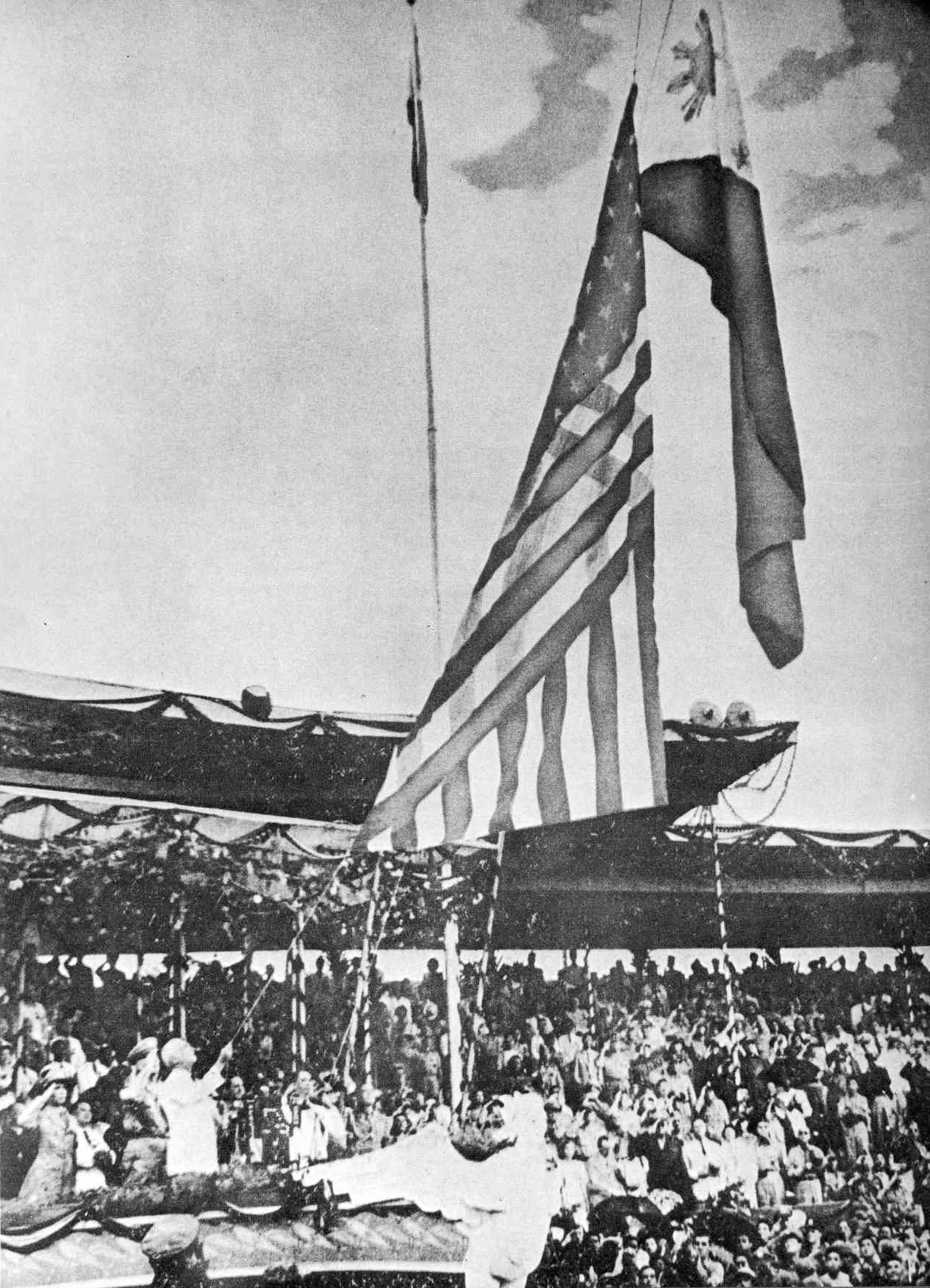
The Philippines was the first Southeast Asia country to gain independence after World War II. On July, 4, 1946, after 47 years of U.S. rule and three years of Japanese occupation, the Republic of the Philippines achieved formal independence in accordance with the terms of the Tydings-McDuffie Act, a U.S. plan that was outlined in the 1930s. The Philippines independence movement had been going on for some time. The Philippine congress met on June 9, 1945, for the first time since its election in 1941.The Japanese had formally surrendered in September 1945. Manual Roxas became president. In 1962, the official Philippine Independence Day was changed from July 4 to June 12, commemorating the date independence from Spain was declared by Emilio Aguinaldo in 1898.
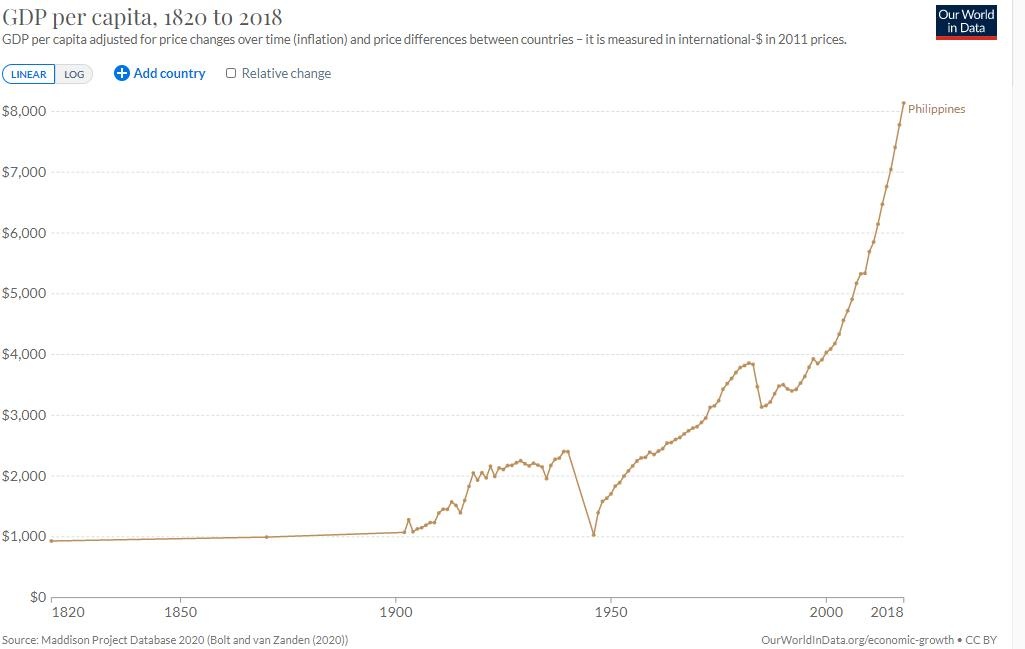
Roxas was installed as president of the Republic of the Philippines under the auspices of the United States and undertook the immense task of rebuilding a war-torn nation that had many severe problems even before the war began. After World War II the Philippines endured crippling high-interest loans under the guise U.S. 'aid', and its society and infrastructure— including more than three-quarters of its schools and universities—lay in ruins. Roxas died suddenly in April 1948 and vice president, Elpidio Quirino, became president. In a bitterly contested election in November 1949, Quirino defeated José Laurel to win a four-year term of his own.
In the early years after World War II Philippines was viewed as the major intermediary between the West and Asia as it was located in Asia but a large portion of its population spoke English and practiced Catholicism. To help get war-devastated nation back on track and serve its own self-interest the United States gave the Philippines economic aid in return for 99-year leases on military bases and free trade privileges.
Between 1946 and 1972, the Philippines was governed according to a Constitution modeled after the American one. The fact that the United States kept its promise of independence to the Philippines after World War II put some pressure on the European to do the same in their colonies.
RELATED ARTICLES:
PHILIPPINES ROAD TO INDEPENDENCE UNDER THE UNITED STATES factsanddetails.com
PHILIPPINES IN THE 1950s AND 60s: HUK REBELLION, MAGSAYSAY, GARCIA AND MACAPAGAL factsanddetails.com
FERDINAND MARCOS: HIS LIFE, LIES, EDUCATION, WAR RECORD, POLITICAL RISE factsanddetails.com
SPANISH-AMERICAN WAR (1898) factsanddetails.com
U.S. TAKES OVER THE PHILIPPINES factsanddetails.com
THE PHILIPPINES: THE UNITED STATES’ FIRST COLONY factsanddetails.com
JAPAN TAKES THE PHILIPPINES: ATTACK, FIGHTING, MACARTHUR, CORREGIDOR factsanddetails.com
JAPANESE OCCUPATION OF THE PHILIPPINES: BATAAN DEATH MARCH, PUPPET STATE, RESISTANCE factsanddetails.com
DEFEAT OF JAPAN IN THE PHILIPPINES factsanddetails.com
American Presence in the Philippines After Independence
The United States formally granted independence to the Philippines, marking the first time an imperial power had voluntarily relinquished a colony. Under General Douglas MacArthur United States established practical control of the Philippines during the last days of the war (July 1945). U.S. administration returned to the Philippines and help power until Philippines independence was declared in July 1946. Although the United States formally recognized Philippine independence it maintained a strong hold over the country. Americans were granted equal parity rights under the new Philippine Constitution, and U.S. military bases were secured under a 99-year lease that allowed intervention in matters involving national security.[Source: “Culture Shock!: Philippines” by Alfredo Roces and Grace Roces, Marshall Cavendish International, 2010]
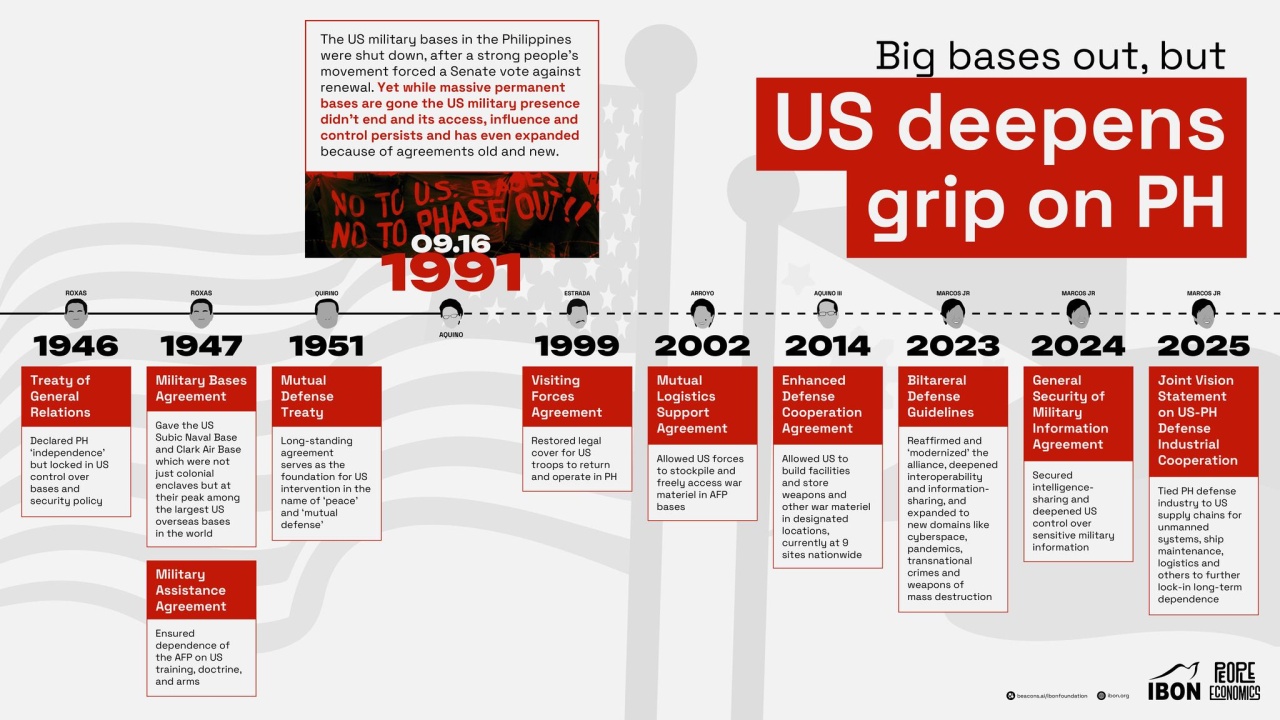
Concerned about the Philippines' ability to recover from the war's devastation and the growing exigencies of the Cold War, the United States soon incorporated the islands into its expanding military and economic sphere. On March 17, 1947, the United States and the Philippines concluded an agreement that gave the United States leases on military bases in the Philippines for ninety-nine years. The United States also monitored the Filipino government, often urging reforms to end corruption and mismanagement. The Philippines would remain. American loans, foreign aid, and trade agreements supported the Philippine economy. On August 30, 1951, a security pact was signed between the United States and the Philippines. [Source: Dictionary of American History, Gale Group Inc., 2003]
When American forces came back as liberators, they were warmly received by a population that had suffered under Japanese occupation. Resuming their earlier role, American officials selected key leaders to guide the nation’s transition. General Douglas MacArthur appointed Manuel Roxas, a former brigadier general on his staff, to a leading position. However, Roxas had also served under the Japanese-sponsored government, which cast doubts on his wartime loyalty. Despite this controversy, the issue of collaboration was largely set aside when he won the election and became the first president of the independent republic.
The United States also distributed “backpay” to recognized guerrilla fighters. Unfortunately, this financial reward did not always distinguish true patriots from opportunists. In the chaotic aftermath of war, the lines between heroes and collaborators often blurred.At the same time, a communist-led resistance movement that had strengthened during the occupation posed a new challenge, prompting American-supported efforts to suppress it. Forced underground, this movement endured and eventually evolved into the New People's Army, which continues to operate as an armed insurgent network.
The Philippines After World War II
The Philippines suffered extensive casualties and damage during World War II, making rehabilitation the new state's major problem. The new nation had to to recover economically as well as physically from the destruction caused by World War II. Peasant groups wanted to break apart the huge land holdings that had been encouraged by the Spanish and Americans. In 1955, Congress passed the first law distributing land to farmers.Communist guerrillas called the Hukbalahaps threatened the republic, and the government countered their revolutionary demands with land reforms and military action. [Source: Junior Worldmark Encyclopedia of the Nations, Thomson Gale, 2007; Sally E. Baringer, Countries and Their Cultures, Gale Group Inc., 2001]
Demoralized by the war and suffering rampant inflation and shortages of food and other goods, the Philippine people prepared for the transition to independence, which was scheduled for July 4, 1946. A number of issues remained unresolved, principally those concerned with trade and security arrangements between the islands and the United States. Yet in the months following Japan's surrender, collaboration became a virulent issue that split the country and poisoned political life. Most of the commonwealth legislature and leaders, such as Laurel, Claro Recto, and Roxas, had served in the Japanese-sponsored government. While the war was still going on, Allied leaders had stated that such "quislings" and their counterparts on the provincial and local levels would be severely punished. Harold Ickes, who as United States secretary of the interior had civil authority over the islands, suggested that all officials above the rank of schoolteacher who had cooperated with the Japanese be purged and denied the right to vote in the first postwar elections. Osmeña countered that each case should be tried on its own merits. [Source: Library of Congress *]
Resolution of the problem posed serious moral questions that struck at the heart of the political system. Collaborators argued that they had gone along with the occupiers in order to shield the people from the harshest aspects of Japanese rule. Before leaving Corregidor in March 1942, Quezon had told Laurel and José Vargas, mayor of Manila, that they should stay behind to deal with the Japanese but refuse to take an oath of allegiance. Although president of a "puppet" republic, Laurel had faced down the Japanese several times and made it clear that his loyalty was first to the Philippines and second to the Japanese-sponsored Greater East Asia Coprosperity Sphere. *
Critics accused the collaborators of opportunism and of enriching themselves while the people starved. Anticollaborationist feeling, moreover, was fueled by the people's resentment of the elite. On both the local and the national levels, it had been primarily the landlords, important officials, and the political establishment that had supported the Japanese, largely because the latter, with their own troops and those of a reestablished Philippine Constabulary, preserved their property and forcibly maintained the rural status quo. Tenants felt the harshest aspects of Japanese rule. Guerrillas, particularly those associated with the Huks, came from the ranks of the cultivators, who organized to defend themselves against Philippine Constabulary and Japanese depredations. *
Manual Roxas Becomes President Despite Being Labeled a Collaborator
The issue of collaboration centered on Roxas, prewar Nacionalista speaker of the House of Representatives, who had served as minister without portfolio and was responsible for rice procurement and economic policy in the wartime Laurel government. A close prewar associate of MacArthur, he maintained contact with Allied intelligence during the war and in 1944 had unsuccessfully attempted to escape to Allied territory, which exonerated him in the general's eyes. [Source: Library of Congress *]
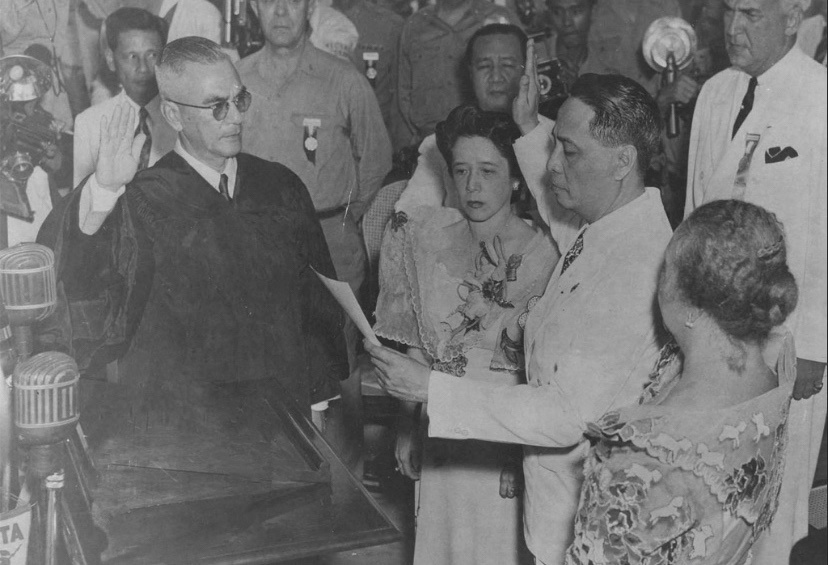
MacArthur supported Roxas in his ambitions for the presidency when he announced himself as a candidate of the newly formed Liberal Party (the liberal wing of the Nacionalista Party) in January 1946. MacArthur's favoritism aroused much criticism, particularly because other collaborationist leaders were held in jail, awaiting trial. A presidential campaign of great vindictiveness ensued, in which Roxas's wartime role was a central issue. Roxas outspent and outspoke his Nacionalista opponent, the aging and ailing Osmeña. In the April 23, 1946, election, Roxas won 54 percent of the vote, and the Liberal Party won a majority in the legislature. *
On July 4, 1946, Roxas became the first president of the independent Republic of the Philippines. In 1948 he declared an amnesty for arrested collaborators — only one of whom had been indicted — except for those who had committed violent crimes. The resiliency of the prewar elite, although remarkable, nevertheless had left a bitter residue in the minds of the people. In the first years of the republic, the issue of collaboration became closely entwined with old agrarian grievances and produced violent results. *
Independent, Democratic Philippines
Beginning with independence in 1946, the church was a source of stability to the infant nation. Throughout the period of constitutional government up to the declaration of martial law in 1972, however, the church remained outside of politics; its largely conservative clergy was occupied almost exclusively with religious matters. [Source: Library of Congress *]
Democracy functioned fairly well in the Philippines until 1972. National elections were held regularly under the framework of the 1935 constitution, which established checks and balances among the principal branches of government. Elections provided freewheeling, sometimes violent, exchanges between two loosely structured political parties, with one succeeding the other at the apex of power in a remarkably consistent cycle of alternation. Ferdinand Marcos, first elected to the presidency in 1965, was reelected by a large margin in 1969, the first president since independence to be elected to a second term. *
The economy remained highly dependent on U.S. markets, and the United States also continued to maintain control of 23 military installations. A bilateral treaty was signed in March 1947 by which the United States continued to provide military aid, training, and matériel. Such aid was timely, as the Huk guerrillas rose again, this time against the new government. They changed their name to the People’s Liberation Army (Hukbong Mapagpalaya ng Bayan) and demanded political participation, disbandment of the military police, and a general amnesty. Negotiations failed, and a rebellion began in 1950 with communist support. The aim was to overthrow the government. The Huk movement dissipated into criminal activities by 1951, as the better-trained and -equipped Philippine armed forces and conciliatory government moves toward the peasants offset the effectiveness of the Huks. *
Economic Relations with the United States after Philippines Independence
If the inauguration of the Commonwealth of the Philippines in November 1935 marked the high point of Philippine-United States relations, the actual achievement of independence was in many ways a disillusioning anticlimax. Economic relations remained the most salient issue. The Philippine economy remained highly dependent on United States markets — more dependent, according to United States high commissioner Paul McNutt, than any single state was dependent on the rest of the country. Thus a severance of special relations at independence was unthinkable, and large landowners, particularly those with hectarage in sugar, campaigned for an extension to free trade.
The Philippine Trade Act, passed by the United States Congress in 1946 and commonly known as the Bell Act, stipulated that free trade be continued until 1954; thereafter, tariffs would be increased 5 percent annually until full amounts were reached in 1974. Quotas were established for Philippine products both for free trade and tariff periods. At the same time, there would be no restrictions on the entry of United States products to the Philippines, nor would there be Philippine import duties. The Philippine peso was tied at a fixed rate to the United States dollar. [Source: Library of Congress *]
The most controversial provision of the Bell Act was the "parity" clause that granted United States citizens equal economic rights with Filipinos, for example, in the exploitation of natural resources. If parity privileges of individuals or corporations were infringed upon, the president of the United States had the authority to revoke any aspect of the trade agreement. Payment of war damages amounting to US$620 million, as stipulated in the Philippine Rehabilitation Act of 1946, was made contingent on Philippine acceptance of the parity clause. *
The Bell Act was approved by the Philippine legislature on July 2, two days before independence. The parity clause, however, required an amendment relating to the 1935 constitution's thirteenth article, which reserved the exploitation of natural resources for Filipinos. This amendment could be obtained only with the approval of three-quarters of the members of the House and Senate and a plebiscite. The denial of seats in the House to six members of the leftist Democratic Alliance and three Nacionalistas on grounds of fraud and violent campaign tactics during the April 1946 election enabled Roxas to gain legislative approval on September 18. The definition of three-quarters became an issue because three-quarters of the sitting members, not the full House and Senate, had approved the amendment, but the Supreme Court ruled in favor of the administration's interpretation . *
In March 1947, a plebiscite on the amendment was held; only 40 percent of the electorate participated, but the majority of those approved the amendment. The Bell Act, particularly the parity clause, was seen by critics as an inexcusable surrender of national sovereignty. The pressure of the sugar barons, particularly those of Roxas's home region of the western Visayan Islands, and other landowner interests, however, was irresistible. In 1955 a revised United States-Philippine Trade Agreement (the Laurel-Langley Agreement) was negotiated. This treaty abolished the United States authority to control the exchange rate of the peso, made parity privileges reciprocal, extended the sugar quota, and extended the time period for the reduction of other quotas and for the progressive application of tariffs on Philippine goods exported to the United States. *
Security Agreements Between the Philippines and the United States
The Philippines became an integral part of emerging United States security arrangements in the western Pacific upon approval of the Military Bases Agreement in March 1947. The United States retained control of twenty-three military installations, including Clark Air Base and the extensive naval facilities at Subic Bay, for a lease period of ninety-nine years. United States rather than Philippine authorities retained full jurisdiction over the territories covered by the military installations, including over collecting taxes and trying offenders, including Filipinos, in cases involving United States service personnel. Base rights remained a controversial issue in relations between the two countries into the 1990s. [Source: Library of Congress *]
The Military Assistance Agreement also was signed in March 1947. This treaty established a Joint United States Military Advisory Group to advise and train the Philippine armed forces and authorized the transfer of aid and matériel — worth some US$169 million by 1957. Between 1950 and the early 1980s, the United States funded the military education of nearly 17,000 Filipino military personnel, mostly at military schools and training facilities in the United States. Much United States aid was used to support and reorganize the Philippine Constabulary in late 1947 in the face of growing internal unrest. A contingent of Philippine troops was sent to Korea in 1950. In August 1951 the two nations signed the Mutual Defense Treaty Between the Republic of the Philippines and the United States of America. *
Image Sources: Wikimedia Commons
Text Sources: Library of Congress, Philippines Department of Tourism, Philippines government websites, Encyclopedia.com, New York Times, Washington Post, Los Angeles Times, Wikipedia, “Encyclopedia of World Cultures Volume 5: East/Southeast Asia:” edited by Paul Hockings, 1993, UNESCO, National Commission for Culture and the Arts (NCCA) the official government agency for culture in the Philippines), Lonely Planet Guides, The Guardian, National Geographic, Smithsonian magazine, The New Yorker, Time, The Conversation, BBC, CNN, Reuters, Associated Press, AFP, Google AI, and various websites, books and other publications.
Last updated February 2026