
JAPANESE OCCUPATION OF THE PHILIPPINES
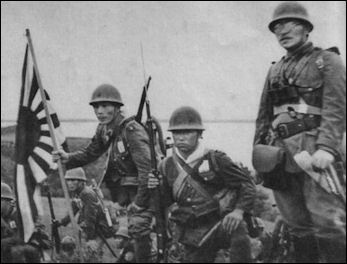
In May 1942, Corregidor, the last American-Filipino stronghold, fell to the Japan. U.S. forces in the Philippines surrendered to the Japanese, placing the islands under Japanese control. During the occupation, thousands of Filipinos fought a running guerilla campaign against Japanese forces. U.S. forces, led by General Douglas MacArthur, recaptured the Philippines in early 1945, following the Battle of Leyte Gulf, the largest naval engagement in history. In September 1945 Japan surrendered.
The Japanese held the Philippines for three years from 1942 to 1945. At least 320,000 died by the time they were driven out. During the Japanese occupation the Philippines was controlled by a puppet government headed by Jose Laurel. The Japanese herded thousands of American civilians into squalid internment camps such as the one at Manila’s University of Santo Tomas. Some others fled to the hills to join insurgents fighting the Japanese Others hid with Filipino friends. Over 10,000 civilian internees---most of them Americans living in the Philippines when war broke out---were kept at Santo Tomás, a 17th century monastery.
F. Sionil Jose wrote in the New York Times: "I was 17, a student in Manila, when the Japanese bombed Pearl Harbor on Dec. 8, 1941. That same day, the airfield in Manila and other military installations in the Philippines were also bombed. Schools were immediately closed and I returned to my hometown, Rosales, about 30 miles from Lingayen, where, within the same month, the Japanese landed. Soon after they came to Rosales. In the first month of occupation, the Japanese behaved correctly---you could say they were even cordial. Then, two months into the occupation, the sentries started slapping people for no apparent reason. Soon after, stories about the Death March following the U.S. surrender of Bataan drifted to us. In July 1942, I went to the prison camp at Capas to look for a cousin, Raymundo Alberto, who had not returned from Bataan. All of the horror stories we had heard were confirmed on that trip---I saw hundreds of Filipino prisoners sick and dying. My cousin was not there. During the occupation, food, medicine, clothing, and other basic necessities like soap and matches, became very scarce. I sometimes went to Manila to bring rice to my relatives there. On one such trip I was stopped in Moncada, in Tarlac Province. My half sack of rice was confiscated by the Japanese and I was beaten up." [Source: F. Sionil Jose, New York Times, August 13, 2010]
Although the Japanese occupation of the Philippines lasted less than three years, it affected Filipino attitudes. The Japanese were shocked by the Americanization of Filipino society and sought to reawaken Asian roots. They established a national language based on Tagalog. Furthermore, the initial Japanese military victory revealed America's military vulnerability. Even worse, it demonstrated that American interest in the Philippines was not the absolute commitment that Filipino kinship values held it to be. Nationalism was thus reawakened. [Source: “Culture Shock!: Philippines” by Alfredo Roces and Grace Roces, Marshall Cavendish International, 2010]
In some ways it seems like there are more Japanese war memorials in the Philippines than monuments honoring Filipinos that fought on the side of the Allies. ABS-CBN did a documentary on a town in central Luzon that was a major source of comfort women for Japanese soldiers, Ironically, today it is a source of Japayukis—young girls who work as entertainers in Japan.
Bataan Death March
The Bataan Death March refers to the forced march in April, 1942 of captured American and Filipino soldiers for 65 miles across the Bataan Peninsula from the seaside town of Mariveles to San Fernando, where they were loaded on railroad cars and carried 24 miles to Capas and forced to march eight miles more to a prison at Camp O'Donnell, a former Filipino Army training base, on Palpanga Province. [Source: Donovan Webster, Smithsonian magazine, March 2004]
Bataan Death March
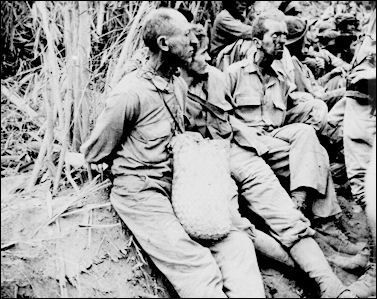
On April 9, 70,000 Allied soldiers (including 14,000 Americans and the rest mostly Filipinos) under the command of Maj. Gen. Edward P. King turned themselves in to Japan as prisoners of war. The next day they were “registered” and divided into groups of 100 to 200 and started on their forced march. Most of those who took part in the march were soldiers that remained in the Philippines after the loss of the Bataan peninsula and Corregidor.
The march lasted for six days and was conducted in sweltering heat. The prisoners were beaten and deprived of food and water. The men were already very weak before the march began from fighting four months in the jungle with little food. Many were suffering from malaria and other diseases. At least 11,000 Americans and Filipinos died of disease, heat stroke, brutally and lack of food and water on the march. Some who collapsed from exhaustion were bayoneted on the spot.
On the first day the prisoners walked all day and well into the night from Mariveeks to Balanga and were given some water and allowed to rest. In San Fernando the survivors were loaded onto old boxcars, manufactured in the 1910s, for the four-hour, 24-mile ride to the town of Capas. Dozens died from suffocation in crowed, oven-like box cars. One survivor told the Washington Post , “If you died there you couldn’t even fall to floor” because the cars were so packed. The Bataan Death March does not get a lot of coverage in the United States in part because it was a tragic defeat rather than a heroic victory and the men who endured the hardship for all intents and purposes had been abandoned to their fate.
Captain William Dyess, a fighter pilot stationed on Luzon when the Japanese invaded and captured when the American forces on Bataan surrendered, wrote:"Eventually the road became so crowded we were marched into a clearing. Here, for two hours, we had our first taste of the oriental sun treatment, which drains the stamina and weakens the spirit. The Japs seated us on the scorching ground, exposed to the full glare of the sun. Many of the Americans and Filipinos had no covering to protect their heads. I was beside a small bush but it cast no shade because the sun was almost directly above us. Many of the men around me were ill. [Source: “The Dyess Story “ by William E. Dyess, 1943; Eyewitness to History.com]
“When I thought I could stand the penetrating heat no longer. I was determined to have a sip of the tepid water in my canteen. I had no more than unscrewed the top when the aluminum flask was snatched from my hands. The Jap who had crept up behind me poured the water into a horse's nose-bag, then threw down the canteen. He walked on among the prisoners, taking away their water and pouring it into the bag. When he had enough he gave it to his horse." he joined the Death March and was interned by the Japanese.
Hardships, Death and Atrocities on the Bataan Death March
The prisoners on the Bataan Death march staggered, limped, walked and carried their comrades through steamy, disease-ridden jungles six days with virtually no food or water. Anyone who tried to scoop up water from a well risked being bayoneted or shot to death. Survivor Lester Tenney told Parade magazine, "If you stopped they killed." He had has his nose smashed in by a rifle butt and watched one Japanese officer systemically decapitate marchers with his samurai sword. Another survivor told Smithsonian magazine he saw a Japanese tanks swerve out of it way to crush a man who had collapsed from disease and exhaustion. “You stand there watching a human being get flattened and, well, that stick in your mind forever,” the survivor said.
Tenney said he observed one man who was so weak he couldn't get up get beaten senseless with rifle butts by Japanese soldiers while two other POWs were asked to dig a shallow trench and bury the unconscious man even though he was still alive. They refused. One man immediately had his blow off with a pistol shot. Two more POWs were enlisted to now dig two trenches: one of the POW with his head blown off and another for the original exhausted prisoner. The newly-enlisted gravediggers didn’t refuse. The original prisoner was still moaning as he was covered with dirt. [Source: Parade magazine]
Retired American army colonel Mel Rosen told the Washington Post he saw a Japanese soldier bayonet an American soldier as he tried to use a latrine. He said when the blade did not come out completely he used his foot to push the dying American into the latrine. “Another Japanese soldier nearby was leaning on his rifle laughing, like it was a joke,” Rosen said.
Many died from violence, starvation, dehydration and diseases such as malaria, dysentery, jaundice and dengue fever during the march itself and shortly afterwards. Thousands more died in the crude prison camp. Each day, prisoners who were too weak or sick to continue were slaughtered. Fingers were chopped off to get West Point rings as souvenirs and decapitated bodies lined the road. According to some survivors corpses lined the route at a rate of one every 10 to 20 yards. Rosen told the Washington Post, “If anybody dropped or couldn’t make it, we were not allowed to help them. The Japanese clubbed them to death, bayoneted them or beheaded them.”
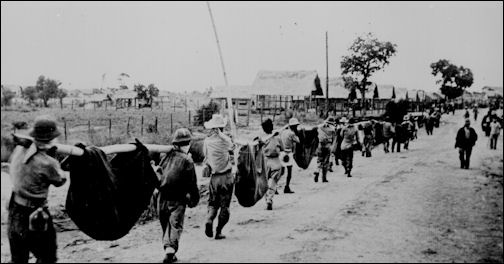
One of the most widely published photographs of the Baatan Death March shows lines of men carrying their comrades in slings. Survivors of the march said the photo must have been of something else. “That picture is not of the Death March, John Lobe an 87-year-old survivor told AP. “The Japanese would not have tolerated a bunch of slow marching guys carrying their own dead.”
Eyewitness Account of a Bataan Death March Executions
Captain William Dyess, a fighter pilot stationed on Luzon when the Japanese invaded and captured when the American forces on Bataan surrendered, wrote:"The victim, an air force captain, was being searched by a three-star private. Standing by was a Jap commissioned officer, hand on sword hilt. These men were nothing like the toothy, bespectacled runts whose photographs are familiar to most newspaper readers. They were cruel of face, stalwart, and tall. [Source: “The Dyess Story “ by William E. Dyess, 1943; Eyewitness to History.com]
'The private a little squirt, was going through the captain's pockets. All at once he stopped and sucked in his breath with .a hissing sound. He had found some Jap yen.' 'He held these out, ducking his head and sucking in his breath to attract notice. The big Jap looked at the money. Without a word he grabbed the captain by the shoulder and shoved him down to his knees. He pulled the sword out of the scabbard and raised it high over his head, holding it with both hands. The private skipped to one side.'
'Before we could grasp what was happening, the black-faced giant had swung his sword. I remember how the sun flashed on it. There was a swish and a kind of chopping thud, like a cleaver going through beef'. 'The captain's head seemed to jump off his 'shoulders. It hit the ground in front of him and went rolling crazily from side to side between the lines of prisoners.'
'The body fell forward. I have seen wounds, but never such a gush of. blood as this. The heart continued to pump for a few seconds and at each beat there was another great spurt of blood. The white dust around our feet was turned into crimson mud. I saw the hands were opening and closing spasmodically. Then I looked away.' 'When I looked again the big Jap had put up his sword and was strolling off. The runt who had found the yen was putting them into his pocket. He helped himself to the captain's possessions.'...This was the first murder
"The hours dragged by and, as we knew they must. The drop-outs began. It seemed that a great many of the prisoners reached the end of their endurance at about the same time. They went down by twos and threes. Usually, they made an effort to rise. I never can forget their groans and strangled breathing as they tried to get up. Some succeeded. Others lay lifelessly where they had fallen.
“I observed that the Jap guards paid no attention to these. I wondered why. The explanation wasn't long in coming. There was a sharp crackle of pistol and rifle fire behind us. Skulking along, a hundred yards behind our contingent, came a 'clean-up squad' of murdering Jap buzzards. Their helpless victims, sprawled darkly against the white, of the road, were easy targets.
“As members of the murder squad stooped over each huddled form, there would be an orange 'flash in the darkness and a sharp report. The bodies were left where they lay, that other prisoners coming behind us might see them. Our Japanese guards enjoyed the spectacle in silence for a time. Eventually, one of them who spoke English felt he should add a little spice to the entertainment.'Sleepee?' he asked. 'You want sleep? Just lie down on road. You get good long sleep!' On through the night we were followed by orange flashes and thudding sounds." [Source: “The Dyess Story “ by William E. Dyess, 1943; Eyewitness to History.com]
End of the Bataan Death March
Finally, after five days without food and limited water, the dwindling column arrives at its destination: San Fernando. Dyess wrote: "The sun still was high in the sky when we straggled into San Fernando, a city of 36,000 population, and were put in a barbed wire compound similar to the one at Orani. We were seated in rows for a continuation of the sun treatment. Conditions here were the worst yet. [Source: “The Dyess Story “ by William E. Dyess, 1943; Eyewitness to History.com]
“The prison pen was jammed with sick, dying, and dead American and Filipino soldiers. They were sprawled amid the filth and maggots that covered the ground. Practically all had dysentery. Malaria and dengue fever appeared to be running unchecked. There were symptoms of other tropical diseases I didn't even recognize.
“Jap guards had shoved the worst cases beneath the rotted flooring of some dilapidated building. Many of these prisoners already had died. The others looked as though they couldn't survive until morning. There obviously had been no burials for many hours. After sunset Jap soldiers entered and inspected our rows.
“Then the gate was opened again and kitchen corpsmen entered with cans of rice. We held our mess kits and again passed lids to those who had none. Our spirits rose. We watched as the Japs ladled out generous helpings to the men nearest the gate. Then, without explanation, the cans were dragged away and the gate was closed. It was a repetition of the ghastly farce at Balanga. The fraud was much more cruel this time because our need. was vastly greater. In our bewildered state it took some time for the truth to sink in. When it did we were too discouraged even to swear." In April 1943, Captain Dyess was one of three prisoners able to escape from the camp. He eventually made his way back to America. [Source: “The Dyess Story “ by William E. Dyess, 1943; Eyewitness to History.com]
What Happened to the Survivors of the Bataan Death March
About 54,000 men who participated in the Bataan Death March made it to Camp O’Donnell and were imprisoned. Most were shipped out over the next few months to other Japanese prison camps. Some were taken to Japan or other occupied areas to work as slave laborers.
Conditions were not good at Camp O’Donnell. There was little shelter and only one spigot with fresh water for almost 60,000 prisoners. Sanitation was poor. During the first three months 1,500 Americans and 20,000 Filipinos died of dysentery, malaria and malnutrition. The living were largely put to work disposing of the dead, One prisoner told the historian Hampton Sides, “Hell is not a state of mind, O’Donnell is a place.” Another said he weighed 150 pounds when he entered the camp and dropped to 80 pounds after several months. “We never got anything other than rice to eat, and didn’t get much of that. I also had cases of dysentery, malaria and dengue fever.”
Most of those who survived Camp O’ Donnell were shipped to Japan or elsewhere in the holds of cargo ships known as “hell ships” to work as slave laborers. The men on these ships survived on buckets of rice and water that were lowered to them in the holds. Human waste and corpses of the dead were pulled out each morning and thrown overboard.
Rosen told the Washington Post that in November 1942 he was shipped to a penal colony on Mindinao, where he worked in rice fields but got little to eat. Two years later he and 1,600 other men were loaded in a hell ship bound for Japan. He and 680 other prisoners were put in a 9-x-15-meter hold that soon filled with human waste. After the ship was attacked he was put in the hold of another ship. “The Japanese kept us down there with our dead and dying for four days and on the fifth day they lowered a net and said, “Pile all your dead in here.” On a third ship, “We were throwing American bodies overboard at a rate of 30, then 40, then 50 a day all the way to Japan.” Of the original 1,600 prisoners loaded onto the first ship only 200 to 300 arrived in Japan.
Of the 12,000 Americans take prisoners by the Japanese only 4,000 were alive at the end of the war. Only 513 prisoners remained alive in Philippines when it was liberated in 1944.
Japanese Puppet State in the Philippines
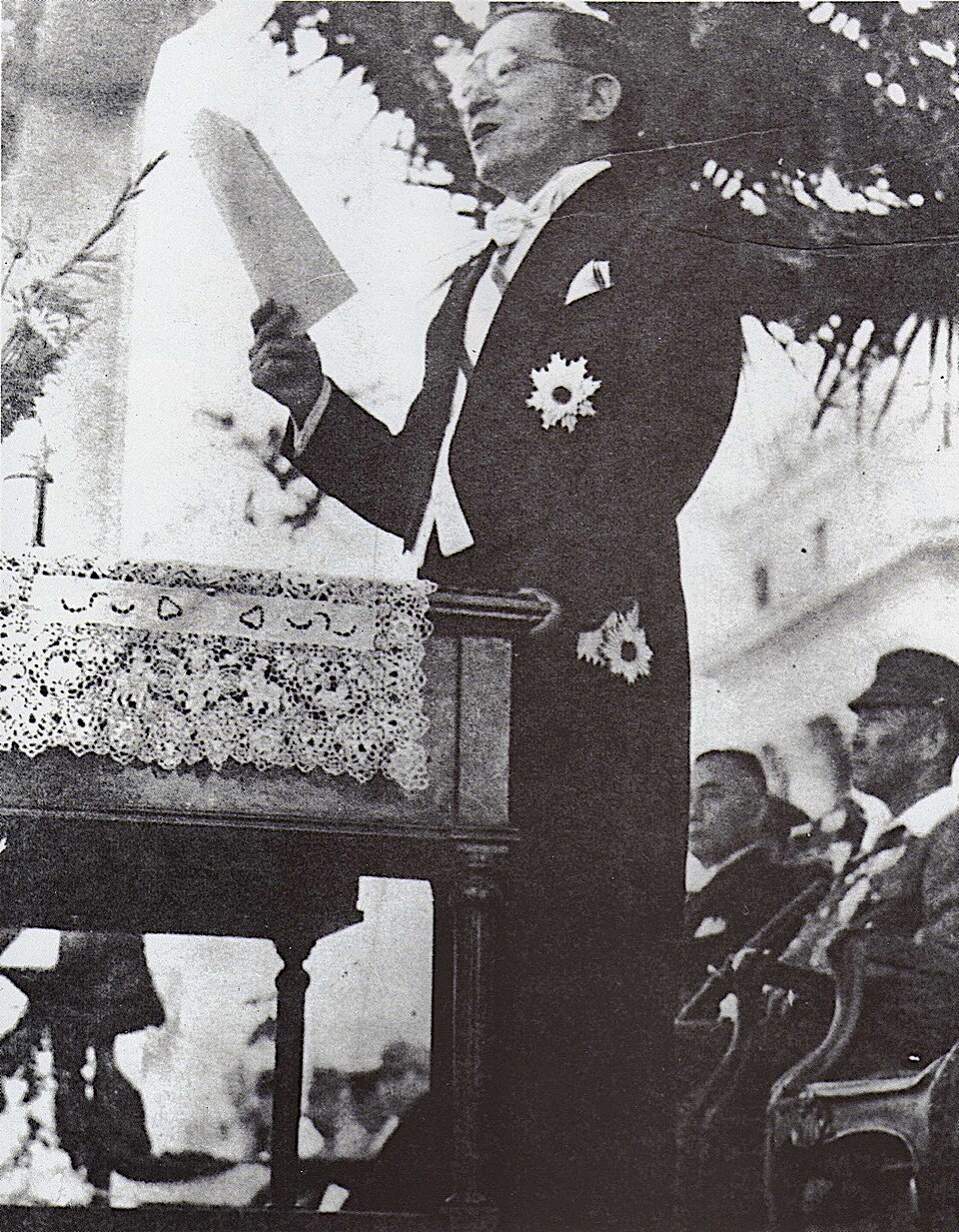
Japan's efforts to win the loyalty of the Filipino people were expressed through the establishment of a "Philippine Republic" on October 14, 1943. José P. Laurel, a former Supreme Court justice, was appointed president. However, the people suffered greatly from Japanese brutality, and the puppet government gained little support. Meanwhile, President Quezon, who had escaped with other high-ranking officials before the country fell, established a government-in-exile in Washington. After his death in August 1944, Vice President Sergio Osmeña became president. Osmeña returned to the Philippines with the first liberation forces at Leyte [Source: Columbia Encyclopedia, 6th ed., Columbia University Press]
General Artemio Ricarte, a former aide to Aguinaldo who had refused to surrender to the Americans and instead lived in exile in Japan, returned to the Philippines alongside Japanese forces during World War II. Expecting to be welcomed as a liberator, he instead encountered a new generation of American-trained Filipinos who strongly opposed the Japanese. Rather than being celebrated, Ricarte was widely regarded as a traitor. [Source: “Culture Shock!: Philippines” by Alfredo Roces and Grace Roces, Marshall Cavendish International, 2010]
Unlike the previous colonial forces, the Japanese actively encouraged Filipino languages as part of the Greater Asia Co-Prosperity Sphere, Japan's scheme of keeping Asia Asian. After the initial invasion of the Philippines the Japanese military authorities immediately began organizing a new government structure in the Philippines. Although the Japanese had promised independence for the islands after occupation, they initially organized a Council of State through which they directed civil affairs until October 1943, when they declared the Philippines an independent republic. Most of the Philippine elite, with a few notable exceptions, served under the Japanese. Philippine collaboration in Japanese-sponsored political institutions--which later became a major domestic political issue--was motivated by several considerations. Among them was the effort to protect the people from the harshness of Japanese rule (an effort that Quezon himself had advocated), protection of family and personal interests, and a belief that Philippine nationalism would be advanced by solidarity with fellow Asians. Many collaborated to pass information to the Allies. The Japanese-sponsored republic headed by President José P. Laurel proved to be unpopular. [Library of Congress]
According to one story, Japan looted tons of gold and jewels from China and shipped them to the Philippines where they were hidden in tunnels bobby trapped with mines and poison gas canisters. After the war the loot was retrieved and used to finance the Japanese post-war economic miracle. There is no evidence to back up these claims. According to another story a three-foot-high Golden Buddha, diamonds and gems and 1,000 tons of gold bars accumulated by Japanese General Tomoyuki as booty was hidden shortly before the end of World War II. A poor locksmith reportedly found the Buddha and gold in a tunnel near a hospital in 1971 only to have the loot seized by Philippine President Ferdinand Marcos and stored away in a Swiss Vault. A Swiss court in Zurich ordered Imelda Marcos, as heir to her husband's fortune, to pay the family of the locksmith $460 million.
Filipino Guerilla Fight Against the Japanese
Most Filipinos remained loyal to the U.S. and numerous the Philippines rebel groups, including the “Hukbalahap” (the Huks) communist guerilla movement, fought against the Japanese from encampments in the jungle.Filipino insurgents conducted an effective guerilla campaign against the Japanese. They were aided to some degree by Americans who had hidden in the mountains or were smuggled in. After the war the “Hukbalahap”, or the People’s Anti-Japanese Army, launched a Communist revolution against the Philippines government.
Japanese occupation of the Philippines was opposed by increasingly effective underground and guerrilla activity that ultimately reached large-scale proportions. Postwar investigations showed that about 260,000 people were in guerrilla organizations and that members of the anti-Japanese underground were even more numerous. Their effectiveness was such that by the end of the war, Japan controlled only twelve of the forty-eight provinces. The major element of resistance in the Central Luzon area was furnished by the Huks, Hukbalahap, or the People's Anti-Japanese Army organized in early 1942 under the leadership of Luis Taruc, a communist party member since 1939. The Huks armed some 30,000 people and extended their control over much of Luzon. Other guerrilla units were attached to the United States Armed Forces Far East. *
Former Army Cpl. Salome Calderon, a female soldier, “was a member of a Filipino intelligence team that spied on Japanese military positions, making it easier for Allied forces to pinpoint targets during the liberation of the Philippines. At the team’s secret headquarters in Angono, the then 17-year-old Calderon guarded intelligence reports to be transmitted to US Gen. Douglas MacArthur’s staff. [Source: Associated Press, June 7, 2009 +++]
Filipinos Who Fought for the Americans in World War II
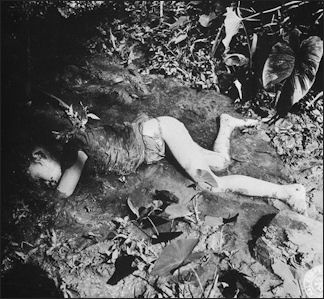
dead child in Luzon
Some 250,000 Filipinos responded to President Franklin D. Roosevelt’s call to arms enlisted in 1941 to fight with the American and help defend the Philippines, which at the time was a U.S. territory. They were promised that they could become US citizens if they chose, and receive benefits under the G.I. Bill. [Source: Associated Press, June 7, 2009 +++]
Associated Press reported: Some soldiers, like Artemio Caleda, “recalled how they risked their lives in advance units determining lines of attack and how they got sick of malaria and dysentery. Caleda said his unit rescued a downed US pilot, helped capture Japanese holdout Gen. Tomoyuki Yamashita and fought for long months in the jungles. “We did it not for the benefits that were promised to us, but to defend our country,” said Caleda, who served in the 11th Infantry Regiment, part of the Filipino Organized Guerrillas. “It was the US and multinational presence that made us a target, but it was up to us to defend our freedom and democracy.” Caleda served in an advance unit sent to surround Yamashita’s forces in Ifugao province. +++
David Nakamura wrote in Washington Post: Filipinos fought for the Americans out of a desire to defeat a common enemy, Japan, but since the end of the war, they have been pushing the U.S. government to fully recognize their contributions. Calderon's home in Angono was commandeered by the Hunters ROTC guerrilla movement resisting the Japanese army for use as a de facto headquarters. The guerrillas dropped off intelligence reports on Japanese bombing targets, and Calderon, who worked as a clerk and radio operator, helped ensure that the reports were delivered by submarine to U.S. commanders based in Australia. [Source: David Nakamura, Washington Post, January 3, 2015]
Philippines Saved 1,200 Jews during the Holocaust
About 1,200 European Jews escaped Nazi persecution by fleeing to the Philippines between 1937 and 1941. Facing escalating anti-Semitic policies such as the Nuremberg Laws and violence like Kristallnacht, many Jews were unable to enter countries such as the United States or Britain and instead sought refuge in places including Manila. Among them was Lotte Hershfield, who left Germany as a child and later recalled the Philippines as a place of “rebirth” after the trauma of Nazi oppression. [Source: Madison Park, CNN, February 3, 2015]
The rescue effort was supported by Philippine Commonwealth President Manuel L. Quezon, along with American officials and Jewish-American leaders. Because the Philippines was still under U.S. supervision, only refugees who could support themselves were admitted, including professionals such as doctors and teachers. Quezon even planned to settle thousands more Jews in Mindanao, though this was halted by the outbreak of war.
Life in Manila was initially a cultural adjustment, but many refugee children adapted, forming friendships and embracing their new tropical environment. However, their safety was again threatened when Japan occupied the Philippines in 1941 during World War II. Although some Jewish refugees avoided internment because they carried German passports, they endured bombings, shortages, and the brutal destruction of Manila, especially during the Battle of Manila.
Despite the suffering and devastation that left nearly a million Filipino civilians dead, survivors expressed deep gratitude to the Philippines for saving them from the Holocaust. The country’s role in offering refuge has since been commemorated, including a monument in Israel honoring the Filipino people. Many descendants of those rescued continue to remember the Philippines as the nation that gave their families a chance to survive.
Image Sources: National Archives of the United States; Wikimedia Commons; Gensuikan;
Text Sources: National Geographic, Smithsonian magazine, New York Times, Washington Post, Los Angeles Times, Times of London, The Guardian, Yomiuri Shimbun, The New Yorker, Lonely Planet Guides, Time, Newsweek, Reuters, AP, AFP, Wikipedia, BBC, “Eyewitness to History “, edited by John Carey ( Avon Books, 1987), Compton’s Encyclopedia, “History of Warfare “ by John Keegan, Vintage Books, Eyewitness to History.com, “The Good War An Oral History of World War II” by Studs Terkel, Hamish Hamilton, 1985, BBC’s People’s War website and various books and other publications.
Last updated February 2026