
TONDO — MANILA LARGEST SLUM
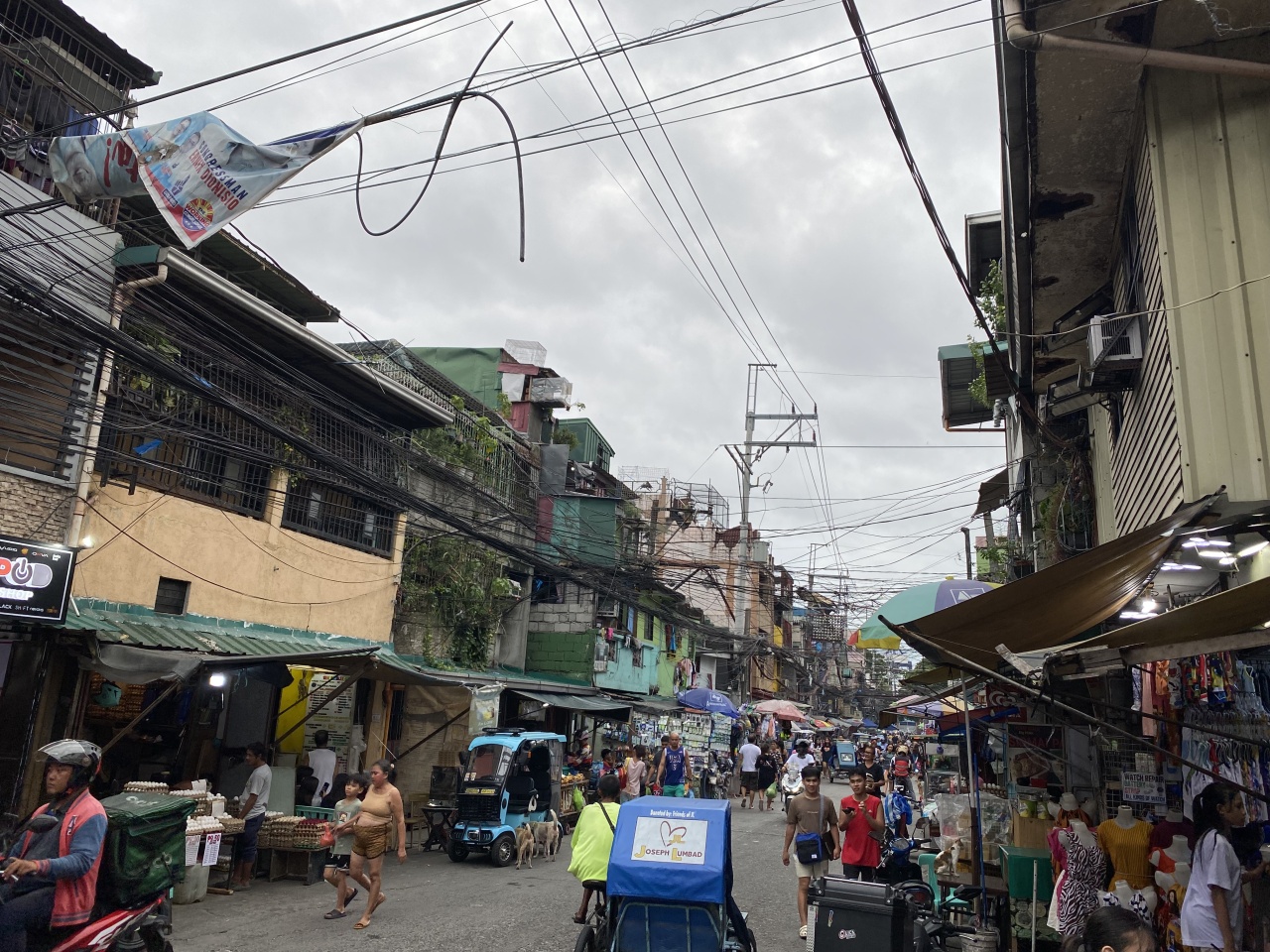
Tondo is a densely-populated district in northwestern Manila. The home of a legendarily tough men, the former site of Smokey Mountain, an entire village built on top of a rubbish dump and the setting for famous gangster movies such as 1986's "Iyo ang Tondo kanya ang Cavite." Tondo functions as a major residential and industrial area and is widely known for containing some of the country’s largest and poorest informal settlements. For decades the area has been associated with extreme urban poverty, most famously the former Smokey Mountain landfill. Despite its difficult reputation, Tondo also has a lively and resilient community, with bustling street markets, busy jeepney routes, and residents often described as welcoming and resourceful.
With an estimated population of roughly 600,000 to 637,000 people, Tondo is one of the most densely populated areas in the world. Much of the population lives in crowded neighborhoods and informal housing, and many families struggle with low incomes and limited access to basic services. As a result, the district has long been considered one of Manila’s poorest urban areas.
Tondo also has a deep historical and cultural background. Before Spanish colonization, it was the center of the Kingdom of Tondo, an important trading polity with links to China and other parts of Southeast Asia. Today, traces of this long history coexist with modern urban life, visible in the area’s energetic street culture, neighborhood festivals, and thriving local markets.
According to Wired: Manila has 36,000 people per square mile, making it one of the most densely populated cities in the world. The density is even higher in the 500 slums that line the city's rivers, railroad tracks, and garbage dumps, where you can find more than 200,000 people per square mile.” In the mid 2010s, “an unattended stove sparked a fire that raced through Tondo....By morning, 1,000 shacks and shanties lay in ruin, leaving 15,000 people homeless. "It's this close, edge-to-edge life," photographer Bernard Lang said. The next day people sifted through the rubble and lined up for food and water at a nearby church.” Near the port “hundreds of makeshift houses teeter on stilts. “They’re literally built on the sea,” Lang says. [Source: Wired, March 13, 2017]
One of the district’s most famous landmarks was Smokey Mountain, once a massive landfill that grew into a 50-meter-high mound of burning garbage. The site was officially closed as a dump in 1995, but surrounding communities continued to develop in the area. Although Tondo is sometimes portrayed as dangerous because of crime and poverty, many residents emphasize the strong sense of community, resilience, and mutual support that exists among people living there.
RELATED ARTICLES:
POVERTY IN THE PHILIPPINES: POOR, HUNGRY, INEQUALITY, CAUSES factsanddetails.com
FILIPINO SOCIETY factsanddetails.com
RICH AND POWERFUL FAMILIES IN THE PHILIPPINES factsanddetails.com
FILIPINO CHARACTER AND PERSONALITY: VALUES, EMOTIONS, FRIENDLINESS factsanddetails.com
FILIPINO HIYA (SHAME), AMOR PROPIO (SELF-ESTEEM) AND GO BETWEENS factsanddetails.com
SOCIAL RELATIONS IN THE PHILIPPINES: UTANG NA LOOB, BAYANIHAN AND PAKIKISAMA factsanddetails.com
ETIQUETTE AND MANNERS IN THE PHILIPPINES: CUSTOMS, PUBLIC ACTIONS, RESPECT factsanddetails.com
PEOPLE OF THE PHILIPPINES: FILIPINOS, IDENTITY, CHARACTERISTICS factsanddetails.com
Everyday Life in the Tondo District
Jeremy Berlin wrote in National Geographic: The paint is flaking, the floors are worn and dirty, and the basketball nets hang in tatters—yet no one seems troubled by it. Life goes on. Children laugh and play, men nap through the heat of the day, and roosters wander freely along the corridors. In one of the most densely populated cities in the world, each floor becomes a stage where everyday life unfolds in vivid detail. [Source: Jeremy Berlin, National Geographic, October 2017]
This was the scene encountered by Mariusz Janiszewski during his visit to a government housing complex in Barangay 128, located in Manila’s Tondo district. Built in the 1990s near Smokey Mountain—once infamous for holding millions of tons of garbage—the buildings are still home to many former waste workers and their families. Inside, daily routines fill the shared spaces. Boys lounge and smoke beside improvised vehicles turned into rickshaws, while groups of young people gather to play cards, sometimes using dried pasta as makeshift currency. Unlike his earlier documentary work, Janiszewski chose to remain in one place, observing patiently and allowing spontaneous, unscripted moments to unfold. He focused on stairwells and open corridors, revealing how these transitional spaces serve as living rooms, playgrounds, and workplaces.
Though each floor appeared identical at first glance, closer observation revealed distinct rhythms of life—women preparing meals, men engaged in games of chance, children absorbed in play. Weekend after weekend, the photographer returned, capturing these scenes of connection among family members, friends, and neighbors. In dim corners, children gathered around outdated computers, while elsewhere, a boy in a wheelchair was pushed along by friends, sharing in the energy of the community.
According to Mary Racelis of Ateneo de Manila University, such close-knit social ties are essential in places like Tondo. Many residents are informal settlers who have long faced marginalization and limited access to basic services. Over time, however, they have built strong networks that sustain them and create opportunities. These communities have also learned to organize, often with the support of advocacy groups, to push for improved living conditions.
Location remains critical. As Racelis notes, proximity to the city means access to jobs—something often lost when families are relocated to distant areas where survival becomes more difficult. Within Barangay 128, residents have spent decades building not just homes, but relationships and systems of support that anchor them to the place.
Daily life reflects both hardship and ingenuity. A woman runs a small tailoring business from a makeshift space, while nearby, children turn hallways into playgrounds or grooming areas. Despite the challenges, smiles are common, and the atmosphere is far from bleak. Employment opportunities are limited, with many people working in the informal sector, sometimes in precarious or illicit trades. Education offers a path to better prospects, but regardless of circumstance, the community is sustained by resilience and hope. Against the odds, people continue to find joy in everyday moments. Men rest during the day after working nights, children play in the background, and even roosters—often raised for cockfighting—wander through the hallways. In these shared spaces, life persists with warmth, humor, and an enduring sense of humanity.
Smokey Mountain
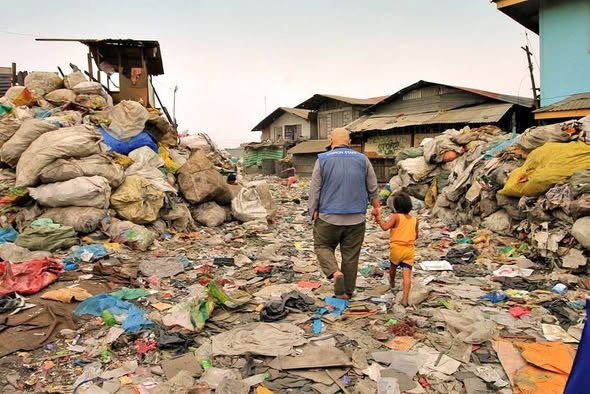
Smokey Mountain was a huge trash dump on Manila Bay once home to several thousand scavengers who lived at the dump in makeshift shanties and made their living by recycling items they found. Some years ago the residents were relocated, and the trash dump was buried and paved over, with an industrial and commercial center built on top of it. Smokey Mountain was huge — 65 meters (200 feet) high and covering 21 hectares. An an estimated 15,000 scavengers lived there in makeshift shanties and earned a living from recycling items they found. Children earned about $1 or $2 a day in the 1990s by selling items they found to recycling shops and went to school in the morning.
Smokey Mountain began as an informal garbage dump in the 1940s and grew over the years into a mountain. It got its name from the smoke created by underground methane fires caused by spontaneous combustion within the garbage. The mountain grew bigger every day and gradually edged into Manila Bay. It became a symbol of the squalid poverty that exists in the Philippines and an embarrassment to the Philippine government.
Scavengers who worked at Smokey Mountain or other dumps picked through the garbage with hook-shaped metal rods or their hands, looking for materials they could salvage and recycle. Some of the scavengers were as young as four. On average they earned between $5 and $15 a day. Scavengers who sifted through the trash sold what they found to contractors who had rights to certain areas of the dump. Sometimes Philippine Army soldiers guarded the dump with automatic rifles to make sure that fights did not break out.
By some counts 21,000 people lived on and around Smokey Mountain. A typical family lived in a shack and ate meals of yams and salt. One resident told a Japanese newspaper, “In my home province farms were destroyed by typhoons. We became desperate. We escaped to Manila, but I couldn’t find work. So we started living here.” One resident told The Wall Street Journal, “You get used to eating on the garbage, sleeping on the garbage, playing in the garbage. I even met my girlfriend there. We were both collecting cans.”
Closing Smokey Mountain
Smokey Mountain was closed in 1995 mainly because it was an embarrassment to the government who built low-cost housing in the area for the squatters who for the most part couldn't afford it. Those who still couldn’t afford paying for the homes simply moved across the road where another garbage site opened,
The original plan called for the garbage heap to be leveled and the trash incinerated, and the site was to be covered by a $2.5-billion project that included a port, an incinerator, luxury apartments, and a commercial and industrial center. A developer of the Smokey Mountain site said, “We no longer use the term ‘garbage.’ We prefer to call it matured waste.”
The original plan was scrapped after environmental groups protested the proposal and legislation was passed preventing the incineration of the trash. Other dumps would not take the trash, and proposals to dump it into Manila Bay were rejected. In the end the remains of the garbage mountain were covered with dirt, and apartments, a recreation center, and a shopping complex were built on top of it.
Beer cans and old shoes poked up out of the soil. The place stunk. The apartments were regarded by many as too dangerous to live in because large amounts of methane gas continued to seep up from the decomposing garbage. There was so much gas that three large oil companies studied the possibility of trapping it and selling it as cooking gas. Some feared the gas could build up and explode. To prevent that from happening, developers installed pipes to help the gas escape.
Relocated Residents After Closing Smokey Mountain
The government of Philippine President Fidel Ramos relocated the residents to new modern apartments and gave them job training. When the plan was announced, the residents of Smokey Mountain responded with rocks and protests, and three chairs were thrown at the president while he was giving a speech. Leaders of the protest told Time, “We want relocation to be to a place we can truly call our own, with titles to our home lots. Otherwise they will have to remove us physically.”
The scavengers were mainly angry that they were deprived of a livelihood that earned them about $11 a day, compared with maybe $5 a day they could earn at another job. After one resident moved to her new apartment, she piled up some scrap outside to make it seem like her old home. She told Time, “We don’t smell the filth, our children don’t get sick all the time, we have water. It’s just that we liked Smokey better.”
Some were taught skills such as growing orchids so they could find new ways to make money. But most couldn’t find work. Some of the relocated residents worried that they could not afford the $18 a month rent. They also could not afford to shop at the shopping center built for them. One relocated scavenger told The Wall Street Journal, “This is a cleaner life. But before we had work and money. I don’t know which is worse—a clean home with no money, or an unclean life with money.”
Some scavengers switched to collecting material on barges that dumped garbage at sea. Some children swam and waded through the filthy, foul-smelling waters of Manila Bay in search of recyclable materials.
Promised Land
After Smokey Mountain was closed, most of the 10,000 tons of garbage produced in Manila every day was deposited in a dump called Promised Land in the Payatas district of Quezon City. Promised Land was comprised of two garbage mountains about 50 feet high that together covered about 74 acres. It began in a ravine and was originally planned as a landfill beneath a housing project. It became the largest dump in the Manila area because there was nowhere else to put the trash.
Describing Promised Land, one squatter told The New York Times, “There’s always smoke, there’s always fire, even when it rains. The garbage is always glowing, even at night, and you hear popping noises. We think it’s batteries exploding. It smells worse than a bathroom, especially when the bulldozers come through. Then you really smell the smoke. You cannot breathe. Your eyes water.”
Scavengers at the Promised Land
Many Smokey Mountain scavengers moved to Promised Land, and a squatter village was established. The village grew over time as more people moved in—mostly poor farmers who had migrated to Manila. Middlemen set up shacks to buy salvaged materials, and shanty shops opened to sell soap, shoes, food, and other items.
Many children who worked at the dump went to school part time and collected trash part time. Some made about half the income of their teachers and earned enough to put their families above the poverty line. In 2001, laws were passed preventing children under the age of 14 from working at dumps.
By one estimate 80,000 squatters lived around Promised Land. Of these, about 3,000 were scavengers and 9,000 were involved in the “recycling waste chain.” The majority lived in the area because they had nowhere else to go.
Some scavengers did quite well and earned enough to rise above the poverty line. Their shacks had carpets and televisions. Posters of soccer teams hung on the walls, and some even had small gardens with flowers. They had enough money to buy their children ice cream and occasionally hold big parties to celebrate births, weddings, or school graduations. One woman who lived there for two years told The New York Times, “This is where we put down roots. So this is our home.”
Scavenger Economy at the Promised Land
There were middlemen and junk shops that specialized in specific materials—plastic bottles, cardboard boxes, copper wire, aluminum, glass, broken toys, and machine parts—earning about three cents for a Coke bottle or a kilogram of scrap iron. At the top of the hierarchy were junk dealers who had contracts with large enterprises, particularly hotels, to sort through their garbage. The contractors paid fees for truckloads of trash and controlled the scavengers who did the work.
Many squatters were little more than indentured servants to middlemen who gave them loans to get established. The squatters often could not repay the loans and had to work for the middlemen on terms set by them, while the middlemen made good profits from their labor. Even worse off were freelance scavengers who had no connection to middlemen and made a living going through trash that had already been picked over.
The most dangerous work was done by “jumpers,” usually children who leapt onto the trucks as they arrived and quickly picked through the garbage looking for valuable items before it was dumped. One jumper told The New York Times, “There’s all sorts of stuff on there. A lot of times we find watches, and all they need is a battery and they start right up.” He said the most valuable thing he found was an ink roller from an Epson printer. He was paid $3 for it but believed he could have earned more.
Trash Mountain Collapse at the Promised Land
In July 2000, a huge garbage mountain loosened by a week of monsoon rains collapsed at Promised Land. The landslide buried a squatter village and then caught fire, killing 218 people.
The week of rain, capped by a huge thunderstorm downpour, apparently created a crack in the garbage mountain, causing part of it to give way. One survivor said it was “like a big wave of surf crashing over you, only it’s not water—it’s garbage.” People ran screaming “landslide, landslide!” while cries were heard beneath the muck. Fires were caused by methane generated by the rotting, rain-soaked garbage and ignited by cooking fires.
The landslide buried an area of the squatter camp about the size of four basketball courts, covering about 100 houses. Most of the victims were squatters who lived there. They were killed by the impact, crushed by the weight of the garbage, burned by the fire, or suffocated by methane.
Survivors of the Trash Mountain Collapse
One survivor told The New York Times the landslide flowed toward her like a tsunami and then burst into flames. “I thought it was the end of the world. The smell was horrible. I thought I was going to choke. Everywhere there was mud and flames. Everything got dark... And I passed out. When I came to, there was light, and I thought, ‘Thank God, I’m alive.’ But then I realized that I only had one of my children, Brynan, the youngest. The others were dead.”
Another survivor told The Washington Post, “I left the house because I needed to sell outside, so I left my wife and child. When I came back my house was gone and my wife and child were buried underneath.”
Survivors said it was not the first garbage landslide they had experienced, and many returned to work the day after the disaster because they had no other way to feed their children.
The survivors filed a $22-million class-action lawsuit, accusing the local government and a private waste contractor of negligence. The Promised Land dump had supposedly been scheduled to close several months before the disaster, but the plan was postponed after residents at another dump protested against receiving additional garbage. Authorities tried to relocate the squatters, but most refused to leave.
Image Sources: Wikimedia Commons
Text Sources: “Encyclopedia of World Cultures Volume 5: East/Southeast Asia:” edited by Paul Hockings, 1993; “Culture Shock!: Philippines” by Alfredo Roces and Grace Roces, Marshall Cavendish International, 2010; National Geographic, Live Science, Philippines Department of Tourism, New York Times, Washington Post, Los Angeles Times, Smithsonian magazine, Encyclopedia.com, Library of Congress, The Conversation, The New Yorker, Time, BBC, CNN, Reuters, Associated Press, AFP, Lonely Planet Guides, Google AI, Wikipedia, The Guardian and various websites, books and other publications.
Last updated March 2026