
FILIPINO COMMUNICATION STYLES

Filipinos differ and ethnic background, social class, gender and age are important in determining people’s level of comfort with touching, tone of voice and gestures. Generally, Filipinos try to avoid hurting other people’s feelings, so they struggle with the word "no" when asked for a favour or request to do work (they may say "maybe", "I’ll see...", "I’ll try...", etc.). As much as possible, they express their opinions and ideas with diplomacy and humility so as not to appear arrogant. They have difficulty contending with frankness or directness. [Source: Canadian Center for Intercultural Learning]
There may be considerably less eye contact than is the case in North America. It is important to indicate understanding but should used too aggressively or overtly. There is much use of eye and body language. For example, acceptance of what is being said is usually indicated non-verbally by the merest hint of a rising of the eyebrow. [Source: Canadian Center for Intercultural Learning +++]
Filipinos call people who disrepect social norms "bastos," which means someone who is rude and has no manners — and this a very serious insult. Marielle Descalsota wrote in Business Insider: While it's important to be friendly and have fun, tourists should be mindful of how they come across to others, especially when speaking with them. In the US, people are very frank and say what they want. But in the Philippines, people are more reserved when expressing what they really think...My Bisaya language teacher told me that Filipinos often followed a set of scripts when accommodating guests in their homes. She told me that there were several rules to follow when Filipinos offered food or drinks. [Source: Marielle Descalsota, Business Insider,, June 22, 2023]
If the host asks you if you want some food, you should decline because they may not have the money to buy the snacks. And if they ask a second time, you should still decline for the same reason. But if they offer a third time, you should accept the offer because they are sincere. If you decline the third time, your host will consider it an insult. So make sure to read between the lines, and if in doubt, ask a Filipino — they'll gladly tell you the right response to the situation.
RELATED ARTICLES:
ETIQUETTE AND MANNERS IN THE PHILIPPINES: CUSTOMS, PUBLIC ACTIONS, RESPECT factsanddetails.com
FILIPINO SOCIETY factsanddetails.com
RICH AND POWERFUL FAMILIES IN THE PHILIPPINES factsanddetails.com
FILIPINO CHARACTER AND PERSONALITY: VALUES, EMOTIONS, FRIENDLINESS factsanddetails.com
FILIPINO HIYA (SHAME), AMOR PROPIO (SELF-ESTEEM) AND GO BETWEENS factsanddetails.com
CATHOLIC, ASIAN, SPANISH AND AMERICAN INFLUENCES ON FILIPINO IDENTITY AND CULTURE factsanddetails.com
SOCIAL RELATIONS IN THE PHILIPPINES: UTANG NA LOOB, BAYANIHAN AND PAKIKISAMA factsanddetails.com
PEOPLE OF THE PHILIPPINES: FILIPINOS, IDENTITY, CHARACTERISTICS factsanddetails.com
AUSTRONESIAN PEOPLE OF THE PACIFIC, INDONESIA, MALAYSIA, TAIWAN AND THE PHILIPPINES: ORIGIN, HISTORY, EXPANSION factsanddetails.com
MALAYS AND MALAY-RELATED PEOPLE: HISTORY, DEFINITIONS, ORIGINS, LIFE, CULTURE factsanddetails.com
ETHNIC GROUPS AND MINORITIES IN THE PHILIPPINES factsanddetails.com
MAIN ETHNIC GROUPS OF LUZON: TAGALOGS, ILOCANO AND BICOL factsanddetails.com
ETHNIC GROUPS OF THE CENTRAL PHILIPPINES ISLANDS: VISAYANS, CEBUANO, WARAY factsanddetails.com
MOROS: MUSLIMS IN MINDANAO AND THE SOUTHERN PHILIPPINES factsanddetails.com
LANGUAGES IN THE PHILIPPINES factsanddetails.com
RELIGION IN THE PHILIPPINES factsanddetails.com
Touching and Space in the Philippines
It is common to shake hands with both men and women, when introduced or greeting a person. But touching, especially men touching women, is not taken well by Filipinos. Carefully observe the degree of comfort and sense of space in Muslim-dominated areas. Filipinos tend to give more space between each other when conversing than is the case in the West or in South and Southeast Asia. Language is also less direct and confrontational. Most conservation between equals takes place in the passive voice—use of English in the active voice (particularly the first person singular "I") is acceptable, but may be seen as directive or aggressive, especially if one becomes animated by the topic of discussion. [Source: Canadian Center for Intercultural Learning +++]
There is a considerable amount of touching during the course of conversation, even in public settings. It is typically initiated by a socially superior individual when talking to those with lower perceived social status, and /or between close friends. There is a general awareness that foreigners, at least from North America, are less accustomed to this, so at least initially, touching is likely to be limited to more conventional business handshakes. No particular conventions need to be observed with respect to women in contrast to men. Filipinos typically point with their lips rather than their hands; the tighter the lips come together in a compressed "o", the further away the item being pointed out. +++
A blonde, blue-eyed American visiting a barrio may find himself the focus of attention of pregnant women, some of whom touch him and giggle. This does not mean that he is a sex symbol, nor is he being ridiculed. Filipinos believe that a child's physical qualities in the womb can be influenced by the mother’s peculiar prenatal cravings and obsessions. Many desire for their child to have fair skin. [Source: “Culture Shock!: Philippines” by Alfredo Roces and Grace Roces, Marshall Cavendish International, 2010]
Filipino ‘Yes’ and Other Cultural Misunderstandings
The Filipino use of “yes” can be confusing to many Westerners. While it may mean agreement, it can also imply “maybe,” “I don’t know,” “if you say so,” or simply “I do not want to refuse you directly.” Because of a strong desire to maintain harmony and avoid offending others, Filipinos often hesitate to say “no” outright. As a result, an invitation—such as one to dinner—may need to be repeated or confirmed several times before it is certain that the person truly intends to attend. An initial “yes” may simply be a polite response, leaving room for the person to decline later through a more indirect explanation. [Source: “Culture Shock!: Philippines” by Alfredo Roces and Grace Roces, Marshall Cavendish International, 2010]
These subtleties in speech reflect the complexity of Filipino social interaction. At first hearing, the language may sound straightforward, especially to those familiar with English, but deeper observation reveals a more nuanced and indirect communication style. Understanding these patterns is important for anyone trying to grasp how Filipino society functions and how people express agreement, hesitation, or disagreement.
The sound and structure of the Filipino language can also surprise outsiders. A common anecdote describes two Westerners entering an elevator behind a Filipino passenger who asks the operator, “Bababa ba?” (“Going down?”), to which the operator replies, “Bababa.” Hearing this exchange, one Westerner jokingly remarks that Filipinos seem able to carry on a conversation using only “ba-ba-ba.” In reality, the consistent vowel sounds of the language can make it easier to pronounce, although accents and pronunciations often vary by region. For example, lalake may also be pronounced lalaki, and pulisiya may be shortened to pulisya.
Filipino communication also tends to favor indirect expressions. Instead of saying “You are bad,” a person might say, “How bad you are,” softening the criticism. In everyday conversation, foreigners may also notice that Filipinos often mix English with local languages. This hybrid speech is popularly known as “Taglish,” a blend of Tagalog and English. Sentences such as “Waiter, saan yung bill ko?” (“Waiter, where is my bill?”) or “You are so galing” (“You are very talented”) are common. Casual responses like “Okay lang” (“It’s fine” or “It’s nothing”) are also widely used.
Modern Filipino speech frequently includes abbreviations and acronyms as well. Expressions such as “OA” (overacting) and “KSP” (kulang sa pansin, meaning someone who seeks attention) are part of everyday slang. These linguistic mixtures reflect the evolving and flexible nature of communication in the Philippines.
Filipino Body Language
Filipinos use a lot of non-verbal communication. Some examples are raising eyebrows or lifting the head upwards slightly to indicate "yes" or to greet friends. When a Filipino commits a social blunder, he or she may scratch the back of his lowered head as a sign of embarrassment. It is considered impolite to pass between people conversing or facing one another. If you must do so, it is customary to 1) move with the head slightly bowed and the hands clasped together in front of the body or 2) extend an arm or two arms with the hands clasped and pointing downwards, while bowing the head slightly as one passes. Waving a pointed index finger and pointing at someone are considered rude. [Source: Canadian Center for Intercultural Learning+++]
Nonverbal language, such as pointing to an object with one's lips, is a key element of communication. Friends are greeted by raising the eyebrows. A longer lift can be used to ask a question. Filipinos walk hand in hand or arm in arm with relatives and friends of either sex as a sign of affection or friendship. Women are expected not to cross their legs or drink alcohol in public. Shorts are not commonly worn by women.
1) If Filipinos don't understand a question, they open their mouths. Raised eyebrows signify recognition and agreement. 2) Laughter may convey pleasure or embarrassment; it is commonly used to relieve tension. 3) "Yes" is signified by a jerk of the head upward. "No" is signified by a jerk of the head down. Since the Filipinos rarely say no, the non-verbal sign for "no" is sometimes accompanied by a verbal yes, which would still indicate "no." 4) An abrupt backward toss of the head paired with direct eye contact is usually interpreted as a challenge and may imply the question, “What do you want?” 5)To Filipinos, standing with your hands on your hips (arms akimbo) means you are angry.
Filipino Gestures
1) To indicate two of something, raise your ring and pinkie fingers. 2) To beckon, extend arm, palm down, moving fingers in scratching motion. 3) Touch someone's elbow lightly to attract attention. Do not tap on the shoulder. 4) The "eyebrow flash" — a quick lifting of eyebrows — is a Filipino greeting. 5) The People power gesture used in the campaign to oust Marcos in 1986 was a raised index finger and a sideways pointed thumb.
Never curl your index finger back and forth (to beckon). This is an insult. This gesture is used for dogs. To get someone's attention place your palm down and move your fingers towards you. The dog call gesture is one of the worst gestures in the Philippines. It can you arrested or even get your finger broken, so that you will never attempt to try this gesture again. In Asian countries like Japan, the dog call is considered a rude gesture. In Singapore, it is indication of death. [Source: buzzle.com]
The finger (bird) is well-known in the Philippines. In other words, displaying your hand with the middle finger straight up and the index, ring and little fingers bent is an obscene gesture. "Nangangaliwa," which translates to "a busy left hand which the right hand is unaware of," is a metaphor for marital infidelity. While "left-handed" husbands are tolerated, society does not look kindly upon wifely "left turns."[Source: “Culture Shock!: Philippines” by Alfredo Roces and Grace Roces, Marshall Cavendish International, 2010]
A palm-up gesture can appear rude. Similarly, snapping fingers or clapping to summon a waiter is frowned upon. Instead, one should try to catch the person’s eye and signal with a slight raised hand. In less formal situations, a soft “pssst” may be used, though loud noises to call attention are generally considered impolite. Filipinos sometimes indicate direction in distinctive ways, such as by briefly pointing with their lips or shifting their eyes toward the intended direction rather than using a finger. [Source: “Culture Shock!: Philippines” by Alfredo Roces and Grace Roces, Marshall Cavendish International, 2010]
Eyebrows, Eye Contact and Staring in the Philippines
Sometimes Filipinos get the attention of one another by making eye contact and raising and lowering their eyebrows. Raising and lowering the eyebrows while making brief eye contact is a common nonverbal greeting in the Philippines. This quick movement serves as a recognition signal between people. When accompanied by a smile, it becomes a friendly, wordless way of saying “hello.” But remember raising the eyebrows with a smile is seen as a friendly greeting but rasing the eyebrows with a frown s seen as hotsile skepticism.[Source: “Culture Shock!: Philippines” by Alfredo Roces and Grace Roces, Marshall Cavendish International, 2010]
Eye contact is important, especially professionally. It is a good sign of self-confidence. But if a person refuses to or is reluctant to make eye contact, don’t think of the person as rude. It is merely a sign that the person you’re talking to has a certain level of shyness. A raised voice or wrong intonation may imply incompetence. [Source: executiveplanet.com]
In Filipino culture, staring is generally considered rude and may be interpreted as a challenge or sign of aggression. Prolonged or intense eye contact can be seen as provocation —especially to an intoxicated person, street tough, or armed soldier— so people often glance briefly and then look away, especially when encountering someone who appears hostile. Parents also use stern eye contact as a silent way to discipline children in public. However, foreigners may sometimes be stared at or even touched out of curiosity, particularly in places where outsiders are rarely seen. There is also a traditional belief in the “evil eye,” in which individuals known as mangkukulam are thought to cause illness or misfortune through a harmful gaze. These folk beliefs persist alongside the Philippines’ predominantly Catholic culture.
Mano: the Filipino Ritual of Showing Respect to Elders
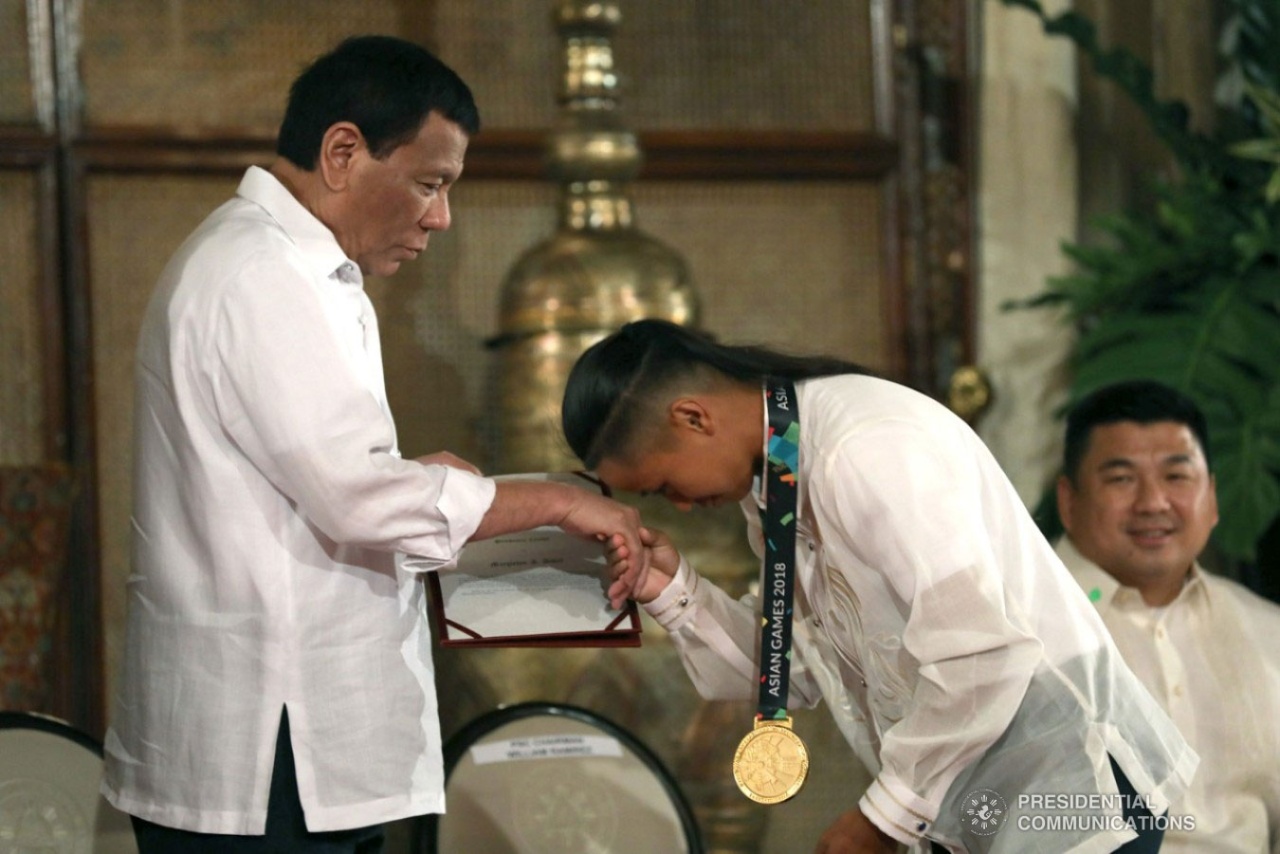
A traditional sign of respect, especially toward elders or godparents, is the gesture known as mano. In this practice, a younger person takes the elder’s hand and gently touches it to their forehead. Although this custom is now less common in large cities, it remains an important traditional expression of respect, particularly in smaller towns and rural areas. [Source:“Culture Shock!: Philippines” by Alfredo Roces and Grace Roces, Marshall Cavendish International, 2010]
Mariano Milbert wrote: “Respect for elders is very strong in the Philippines. From youth, Filipinos are taught to respect those who are older than them. Not only have the elders given birth and raised many, but in their age, they have grown wiser, more experienced, and have, by tradition earned the respect of younger generations. Several symbolic ways in which respect is given to elders is in the use of language by calling older Filipinos "Po" and older siblings, cousins, and family friends "Kuya" and "Atee". Perhaps the most fascinating and ritualistic custom of showing respect to elders is the greeting or salutation of Mano. Mano [Spanish for hand] evolved from the traditions of respect for ones elders which comes from Asian cultures coupled with the respect for the clergy during the Spanish occupation of the Philippines. [Source: http://www2.puc.edu/Faculty/Milbert_Mariano/MANO/origins.html ~]
Mano is ritualized form a young person kissing the hand of an elder. Joe Maya wrote in his blog: “Mano Po is animated by verbal and bodily movements circumscribed by two parties. The one gives or lays his hand, and the later bends a bit foreword, receives the hand and snootily place it just in the midpoint of the forehead. Strictly, it is always the right hand that is given and received. The later must receive it also by the same hand. He must come closer so that the older person will not stretch to much his arms. Consequently, kissing (the hand) seems tenable only to the less conservative western cultures. To the Filipinos, with respect to evolution of mechanism and other probable legends, this takes a formal shift by placing it on the forehead instead. The grown-up in the family or the group usually take the stance of being “kissed” and the younger do the “kissing.” [Source: joemaya123, filipinowriter.com, July 12, 2008 ==]
“The act of graceful bowing and, more often than not, followed by taking one’s hand and politely kissing it, is a highly formal gesture displayed in western cultures. This is highly carried on especially during visits, engagements and soirées. This doesn’t preclude the Spanish culture who obviously repacked it and laid it down to Filipinos. This is then clear that the development of mano po runs from the pioneering generation down to this contemporary period.==
In certain parts of Asia, it is respectful to bow to another person to show your respect for them. The bow takes several different forms throughout Asia, and is part of the origins of the Mano. One of the most influential origins of the Mano began when the Catholic friars who occupied, colonized, and converted many insisted that the Indios [the native people] kiss their hand, as a sign of power over them. At the time, the Pope who was held in high esteem, extended his hand to priests, nuns & lay people as he gave his blessings as they kissed his signet ring. This ritual was appropriated by the Catholic Friars and Priests, especially in the Philippines. As a result the Filipinos appropriated this tradition as a means to show respect to one's elders by way of the Mano. The Mano is when one slightly bows to one's elder as they take the elder's opposing hand and respectfully place it to one's own forehead. So, the Asian custom of symbolicly showing respect of the elders, with a bow, coupled with the kissing of an honored person's hand, is where the Mano has evolved as one of the Phillipine's distinct rituals. [Source: http://www2.puc.edu/Faculty/Milbert_Mariano/MANO/origins.html ~]
In the Philippines “this gesture, however, is tainted with a quasi-superstitious belief rampant in every Filipino ideal. That’s why others are quite reluctant to perform or yield-on to such ritual especially the elders, for the belief that their advance age will be hailed and aggravated by doing so. In other words, the frequent laying of hands on the forehead would hasten one’s senescence or old appearance. Another peculiar annotation to mano po is the belief that this would mount the multiplication of gray hairs especially to the old people with evidently graying hairs.” ==
Smiling in the Philippines
According to “Culture Shock!: Philippines “Filipinos are big on smiles and use them in various ways in everyday social interaction. A smile can express praise, criticism, embarrassment, a request for help, or simple friendliness. It appears in almost every situation. For instance, a waiter who accidentally spills soup on your shirt may apologize with an embarrassed smile, while a jeepney driver who cuts in front of your vehicle may smile instead of asking permission. In the heat, congestion, and frustrations of city traffic, the most practical response is often to smile back. [Source: “Culture Shock!: Philippines” by Alfredo Roces and Grace Roces, Marshall Cavendish International, 2010]
Smiling is also a way to ease tension in awkward situations. When a situation carries the possibility of conflict, people often smile to soften the moment and maintain harmony. A smile may replace words when someone wishes to avoid saying something unpleasant. If you ask for someone’s opinion and they simply smile without responding, it may be a gentle way of signaling disapproval without directly criticizing you. In this sense, a smile can function as a polite and indirect form of communication.
Similarly, smiling allows people to avoid controversy. Where a Westerner might give a blunt “no comment,” a Filipino may respond with a quiet smile instead. Because of this, smiles carry subtle meanings and play an important role in social interaction. Understanding them requires observation and familiarity with the culture.
Smiles also help people preserve dignity in embarrassing situations. If someone trips or falls in public, onlookers may smile rather than rush to show concern. This is not meant to mock the person but to avoid drawing further attention to the embarrassment. By quietly acknowledging the moment with a smile, people allow the person to recover without losing face. In Filipino culture, maintaining dignity—often described in Filipino-English as “poise”—is often considered more important than the mishap itself.
There are many variations of smiles and half-smiles, often accompanied by subtle eye contact, each suited to different social situations. Their meanings are not formally defined but are learned through experience. Psychologist George Guthrie of Pennsylvania State University, who studied Filipino child-rearing and personality, suggested that this cultural habit may have historical roots. Because Filipinos traditionally faced many uncontrollable challenges—such as typhoons, epidemics, and invasions—smiling and hoping became common responses to adversity. Showing anger or frustration was discouraged; instead, the ideal was to keep smiling and maintain the appearance that everything was under control.
Speaking and Tone of Voice in the Philippines
Tone of voice varies widely by language, dialect and region of origin within the Philippines. For example, the Ilongo speech of Panay island is regarded as "malumbing"—sweet and melodious where one cannot tell when the speaker is displeased; in contrast, Cebuanos speak Visayan and Batangenos using Tagalog talk in a more abrupt and flatter tones. [Source: Canadian Center for Intercultural Learning +++]
In Filipino culture, it is important to avoid speaking in harsh, loud, or belligerent tones. Such a manner of speaking can disturb social harmony, create disagreement, and potentially lead to conflict. In communication, not only the words themselves but also the tone and manner in which they are spoken convey meaning. When listening to Filipinos converse, one often notices that their voices are generally gentle and soft. If voices become loud, they are usually filled with laughter and good humor rather than anger. Of course, as in any society, there are individuals who are arrogant, abrasive, or boastful, but their behavior tends to stand out because it contrasts with the prevailing tone of politeness. At times, mock anger accompanied by laughter may also be used as a subtle way of expressing criticism or disagreement.[Source: “Culture Shock!: Philippines” by Alfredo Roces and Grace Roces, Marshall Cavendish International, 2010]
Openly barking orders or scolding someone in public is considered improper, especially when directed toward someone of higher status or social standing. If criticism or correction is necessary, it is more acceptable to speak firmly but privately, away from the attention of others, in order to preserve dignity and avoid embarrassment.
Certain features of Philippine languages also reflect Filipino patterns of thinking. For example, the language distinguishes between two forms of the word “we.” The term tayo includes the person being addressed, while kami excludes that person. This linguistic distinction highlights the group-oriented nature of Filipino society.
One of the harshest criticisms that can be directed at someone is the expression walang hiya, which literally means “without shame.” It refers to a person who behaves improperly and shows no regard for social expectations or personal dignity.
Image Sources: Wikimedia Commons
Text Sources: “Encyclopedia of World Cultures Volume 5: East/Southeast Asia:” edited by Paul Hockings, 1993; “Culture Shock!: Philippines” by Alfredo Roces and Grace Roces, Marshall Cavendish International, 2010; National Geographic, Live Science, Philippines Department of Tourism, New York Times, Washington Post, Los Angeles Times, Smithsonian magazine, Encyclopedia.com, Library of Congress, The Conversation, The New Yorker, Time, BBC, CNN, Reuters, Associated Press, AFP, Lonely Planet Guides, Google AI, Wikipedia, The Guardian and various websites, books and other publications.
Last updated March 2026