
BONTOC RELIGION
According to the Christian group Joshua Project most Central Bontoc and Southwestern Bontoc practice traditional animist religions. About 10 to 50 percent are Christian, with 5 to 10 percent of these being Protestant Evangelicals. Traditional religion remains strong among the Bontoc, especially spirits associated with the dead. These spirits, known as “ anito”, live in a spirit world in the mountains that is not unlike the one people live in. They are consulted on all characterized matters and relay their answers through bird calls. Lumawig is the supreme deity. [Source: “Encyclopedia of World Cultures, East and Southeast Asia” edited by Paul Hockings (G.K. Hall & Company, 1993), Joshua Project]
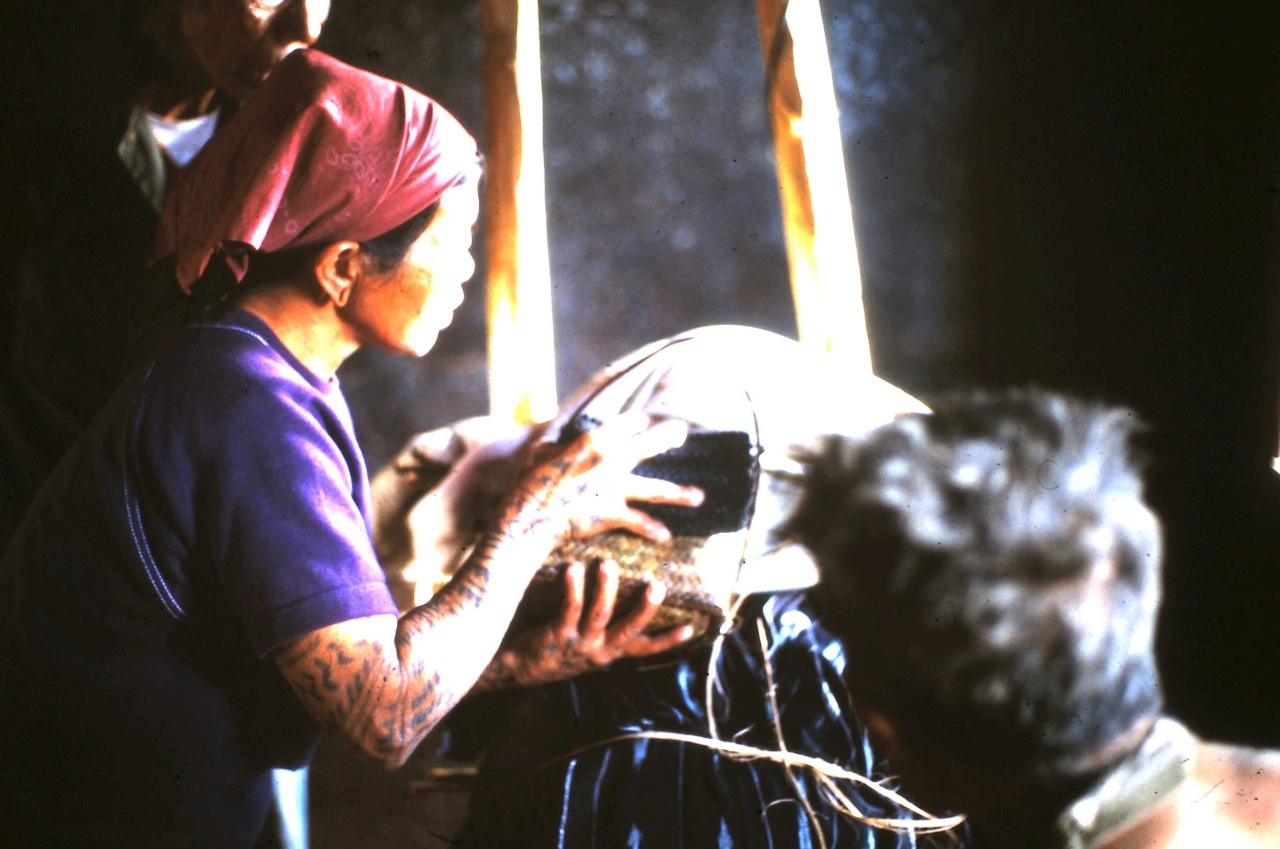
The “patay” are hereditary clan of preachers who conduct ceremonies to honor Lumawig. Healing ceremonies do not include singing or dancing and patay do not go into a trance. The Bontoc ritual of pasiking is called takba and represents an ancestor figure who is an active participant in begnas rituals.
There are many sacred sites associated with Lumawig and other Bontoc deities. According to oral tradition, Lumawig imparted five great lessons to the Bontoc people: 1) men must not steal, 2) people should not gossip, 3) men and women must not commit adultery, 4) people must be temperate in eating and drinking alcohol, and 5) everyone must live simple, industrious lives. [Source: Wikipedia]
RELATED ARTICLES:
BONTOC PEOPLE: LIFE. CULTURE, MARRIAGE factsanddetails.com
BONTOC REGION IN THE EARLY 1900s: GEOGRAPHY, HISTORY, DISEASES, FOOD factsanddetails.com
BONTOC PEOPLE IN THE EARLY 1900s: LIFE, LOVE, HOUSING, WEALTH factsanddetails.com
BONTOC HEAD HUNTING factsanddetails.com
MOUNTAIN PROVINCE IN CORDILLERA: MUMMIES, PINE FORESTS, BONTOC RICE TERRACES factsanddetails.com
RICE TERRACES OF NORTHERN LUZON factsanddetails.com
IFUGAO RICE TERRACES OF BANAUE AND BATAD factsanddetails.com
IFUGAO: HISTORY, HEADHUNTING, CULTURE factsanddetails.com
IFUGAO RELIGION: GODS, RITUALS, FUNERALS factsanddetails.com
IFUGAO SOCIETY AND LIFE factsanddetails.com
IFUGAO IN 1910 AND PARTYING WITH AND PACIFYING THEM factsanddetails.com
IGOROT — CORDILLERA PEOPLE OF NORTHERN LUZON — GROUPS AND HISTORY factsanddetails.com
IGOROT LIFE: CUSTOMS, FOOD, DRINKS, TRANSPORT factsanddetails.com
IGOROT GROUPS — KANKANAEY, ISNEG, IBALOI — AND THEIR LIFE, CUSTOMS AND CULTURE factsanddetails.com
HEAD HUNTING TRIBES OF LUZON: PRACTICES, REASONS, WARS factsanddetails.com
MAIN ETHNIC GROUPS OF LUZON: TAGALOGS, ILOCANO AND BICOL factsanddetails.com
Bontoc Creation Myth
According to the Bontoc creation myth: In the beginning there were no people on the earth. Lumawig, the Great Spirit, came down from the sky and cut many reeds. He divided these into pairs which he placed in different parts of the world, and then he said to them, "You must speak. Immediately the reeds became people, and in each place was a man and a woman who could talk, but the language of each couple differed from that of the others. Then Lumawig commanded each man and woman to marry, which they did. By and by there were many children, all speaking the same language as their parents. These, in turn, married and had many children. In this way there came to be many people on the earth. [Source: Mabel Cook Cole, Philippine Folk Tales (Chicago: A. C. McClurg and Company, 1916), pp. 99-101]
Now Lumawig saw that there were several things which the people on the earth needed to use, so he set to work to supply them. He created salt, and told the inhabitants of one place to boil it down and sell it to their neighbors. But these people could not understand the directions of the Great Spirit, and the next time he visited them, they had not touched the salt. Then he took it away from them and gave it to the people of a place called Mayinit. These did as he directed, and because of this he told them that they should always be owners of the salt, and that the other peoples must buy of them.
Then Lumawig went to the people of Bontoc and told them to get clay and make pots. They got the clay, but they did not understand the molding, and the jars were not well shaped. Because of their failure, Lumawig told them that they would always have to buy their jars, and he removed the pottery to Samoki. When he told the people there what to do, they did just as he said, and their jars were well shaped and beautiful. Then the Great Spirit saw that they were fit owners of the pottery, and he told them that they should always make many jars to sell. In this way Lumawig taught the people and brought to them all the things which they now have.
Bontoc Beliefs About Anitos
Albert Ernest Jenks wrote: The immediate surroundings of every Igorot group is the home of the anito of departed members of the group, though they do not usually live in the village itself. Their dwellings, fields, pigs, chickens, and carabaos—in fact, all the possessions the living had—are scattered about in spirit form, in the neighboring mountains. There the great hosts of the anito live, and there they reproduce, in spirit form, the life of the living. They construct and live in dwellings, build and cultivate fields, marry, and even bear children; and eventually, some of them, at least, die or change their forms again. The Igorot do not say how long an anito lives, and they have not tried to answer the question of the final disposition of anito, but in various ceremonials anito of several generations of ancestors are invited to the family feast, so the Igorot does not believe that the anito ceases, as an anito, in what would be the lifetime of a person. [Source: “Bontoc Igorot” by Albert Ernest Jenks, 1905]
When an anito dies or changes its form it may become a snake—and the Igorot never kills a snake, except if it bothers about his dwelling; or it may become a rock—there is one such anito rock on the mountain horizon north of Bontoc; but the most common form for a dead anito to take is lifa, the phosphorescent glow in the dead wood of the mountains. Why or how these various changes occur the Igorot does not understand.
In many respects the dreamer has seen the anito world in great detail. He has seen that anito are rich or poor, old or young, as were the persons at death, and yet there is progression, such as birth, marriage, old age, and death. Each man seems to know in what part of the mountains his anito will dwell, because some one of his ancestors is known to inhabit a particular place, and where one ancestor is there the children go to be with him. This does not refer to desirability of location, but simply to physical location—as in the mountain north of Bontoc, or in one to the east or south.
With the one exception of toothache, all injuries, diseases, and deaths are caused directly by anito. In certain ceremonies the ancestral anito, are urged to care for living descendants, to protect them from anito that seek to harm—and children are named after their dead ancestors, so they may be known and receive protection. In the village, the fields, and the mountains one knows he is always surrounded by anito. They are ever ready to trip one up, to push him off the high stone fields dikes or to visit him with disease. When one walks alone in the mountain trail he is often aware that an anito walks close beside him; he feels his hair creeping on his scalp, he says, and thus he knows of the anito’s presence. The Igorot has a particular kind of spear, the sinalawitan, having two or more pairs of barbs, of which the anito is afraid; so when a man goes alone in the mountains with the sinalawitan he is safer from anito than he is with any other spear.
The Igorot does not say that the entire spirit world, except his relatives, is against him, and he does not blame the spirits for the evils they inflict on him—it is the way things are—but he acts as though all are his enemies, and he often entreats them to visit their destruction on other villages. It is safe to say that one feast is held daily in Bontoc by some family to appease or win the good will of some anito.
Anito Exorcism
Albert Ernest Jenks wrote: Since the anito is the cause of all bodily afflictions the chief function of the person who battles for the health of the afflicted is that of the exorcist, rather than that of the therapeutist. Many old men and women, known as “insupak,” are considered more or less successful in urging the offending anito to leave the sick. Their formula is simple. They place themselves near the afflicted part, usually with the hand stroking it, or at least touching it, and say, “Anito, who makes this person sick, go away.” This they repeat over and over again, mumbling low, and frequently exhaling the breath to assist the departure of the anito—just as, they say, one blows away the dust; but the exhalation is an open-mouthed outbreathing, and not a forceful blowing. [Source: “Bontoc Igorot” by Albert Ernest Jenks, 1905]
One of our house boys came home from a trip to a neighboring village with a bad stone bruise for which an anito was responsible. For four days he faithfully submitted to flaxseed poultices, but on the fifth day we found a woman insupak at her professional task in the kitchen. She held the sore foot in her lap, and stroked it; she murmured to the anito to go away; she bent low over the foot, and about a dozen times she well feigned vomiting, and each time she spat out a large amount of saliva. At no time could purposeful exhalations be detected, and no explanation of her feigned vomiting could be gained. It is not improbable that when she bent over the foot she was supposed to be inhaling or swallowing the anito which she later sought to cast from her. In half an hour she succeeded in “removing” the offender, but the foot was “sick” for four days longer, or until the deep-seated bruise discharged through a scalpel opening. The woman unquestionably succeeded in relieving the boy’s mind.
When a person is ill at his home he sends for an insupak, who receives for a professional visit two manojos of unhusked rice, or two-fifths of a laborer’s daily wage. Insupak are not appointed or otherwise created by the people, as are most of the public servants. They are notified in a dream that they are to be insupak.
As compared with the medicine man of some primitive peoples the insupak is a beneficial force to the sick. The methods are all quiet and gentle; there is none of the hubbub or noise found in the Indian lodge—the body is not exhausted, the mind distracted, or the nerves racked. In a positive way the sufferer’s mind receives comfort and relief when the anito is “removed,” and in most cases probably temporary, often permanent, physical relief results from the stroking and rubbing. The man or woman of each household acts as mediator between any sick member of the family and the offending anito. There are several of these household ceremonials performed to benefit the afflicted.
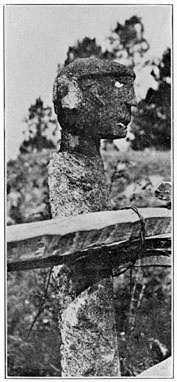
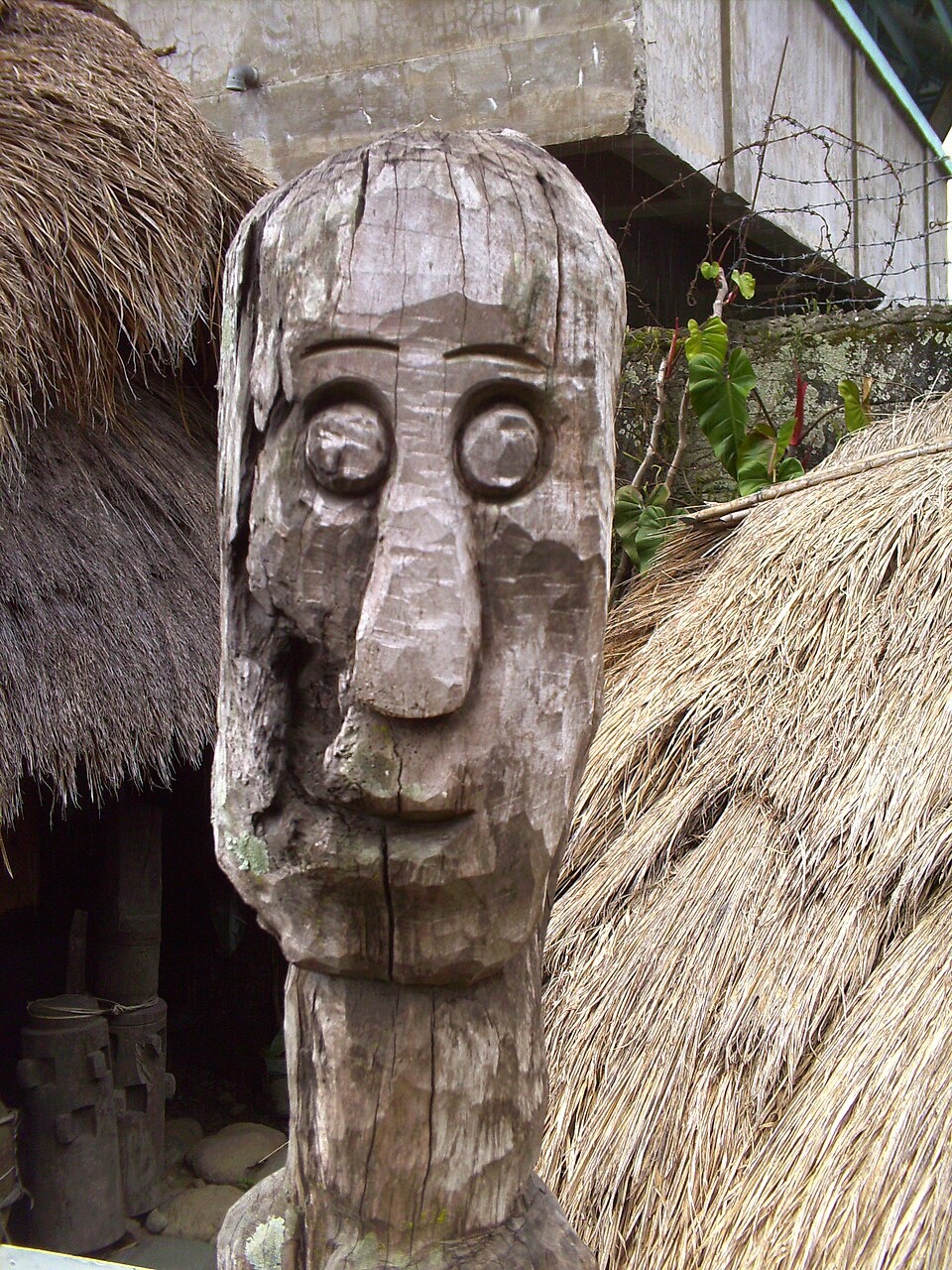
anito head post in 1905
If one was taken ill or was injured at any particular place in the mountains near the village, the one in charge of the ceremony goes to that place with a live chicken in a basket, a small amount of basi (a native fermented drink), and usually a little rice, and, pointing with a stick in various directions, says the Wa-chaowad or Ayug si a-fii(k ceremony—the ceremony of calling the soul. A common sight in the Igorot village or in the trails leading out is a man or woman, more frequently the latter, carrying the small chicken basket, the tube of basi, and the short stick, going to the river or the mountains to perform this ceremony for the sick. After either of these ceremonies the person returns to the dwelling, kills, cooks, and, with other members of the family, eats the chicken.
For those very ill and apparently about to die there is another ceremony, called “afat,” and it never fails in its object, they affirm—the afflicted always recovers. Property equal to a full year’s wages is taken outside the village to the spot where the affliction was received, if it is known, and the departing soul is invited to return in exchange for the articles displayed. They take a large hog which is killed where the ceremony is performed; they take also a large blue-figured blanket—the finest blanket that comes to the village—a battle-ax and spear, a large pot of “preserved” meat, the much-prized woman’s bustle-like girdle, and, last, a live chicken. When the hog is killed the person in charge of the ceremony says: “Come back, soul of the afflicted, in trade for these things.”
Bontoc Deities
The pre-Christian Bontoc belief system centers on a hierarchy of spirits. The highest spirit is a supreme deity called Intuntingcho. His son, Lumawig, descended from the sky to marry a Bontoc girl. Lumawig taught the Bontoc people various skills, including how to irrigate their land. The Bontoc also believe in anito, or spirits of the dead. These spirits are omnipresent and must be constantly consoled. Anyone can invoke the anito, but a seer (insup-ok) is called upon to intercede when someone is sick due to evil spirits. [Source: Wikipedia]
Intutungcho (Kabunian) — The supreme deity who dwells above the sky. Also known as Kabunian, he is the father of Lumawig and two other sons.
Lumawig — Often regarded as a supreme deity and identified as the second son of Kabunian. He is a central epic hero who taught the Bontoc their five core values that underpin an egalitarian society. Lumawig established the ator, a political and ceremonial institution marked by skulls from headhunting. He also imparted irrigation knowledge, taboos, rituals, and ceremonies after descending from the sky (chayya) and marrying a Bontoc woman. Each ator is governed by a council of elders known as the ingtugtukon, specialists in customary law (adat), who make decisions by consensus.
First Son of Kabunian — One of Kabunian’s sons, mentioned in Bontoc mythology but with limited narrative detail.
Third Son of Kabunian — Another of Kabunian’s sons, likewise referenced without extensive mythic elaboration.
Chal-chal — The god of the sun, whose son was beheaded by Kabigat.[4] He later assisted Lumawig in his search for a wife.
Kabigat — The goddess of the moon who cut off the head of Chal-chal’s son, an act believed to mark the origin of headhunting.
Son of Chal-chal — Beheaded by Kabigat but later revived by Chal-chal, who harbored no resentment toward her.
Ob-Obanan — A deity whose white hair is inhabited by insects, ants, centipedes, and other vermin that trouble humankind. He punished a rude man by giving him a basket containing all the insects and reptiles in the world.
Chacha’ — The god of warriors.
Ked-Yem — The god of blacksmiths who beheaded the two sons of Chacha’ for destroying his work. He was later challenged by Chacha’, an event that culminated in a pechen pact to end the conflict.
Two Sons of Chacha’ — Beheaded by Ked-Yem after they interfered with his work.
Fucan — The younger of two sisters encountered by Lumawig in Lanao. She married Lumawig and later adopted the name Cayapon. Her death, caused by dancing in violation of a taboo, established mortality as the fate of humankind.
Two Sons of Cayapon — The children of Lumawig and Fucan, who aided the people of Caneo before eventually being killed by them.
Batanga — The father of the two sisters whom Lumawig met in Lanao.
Chaka Ceremony
Chaka is an important ceremony for a good harvest held after rice has been transplanted. Albert Ernest Jenks wrote:The ceremony of the first day is called “Su-yâk.” Each group of kin—all descendants of one man or woman who has no living ascendants—kills a large hog and makes a feast. This day is said to be passed without oral ceremony. [Source: “Bontoc Igorot” by Albert Ernest Jenks, 1905]
The ceremony of the second day was a double one. The first was called “Wa-lit?” and the second “Mangmang.” From about 9.30 until 11 in the forenoon a person from each family—usually a woman—passed slowly up the steep mountain side immediately west of Bontoc. These people went singly and in groups of two to four, following trails to points on the mountain’s crest. Each woman carried a small earthen pot in which was a piece of pork covered with basi. Each also carried a chicken in an open-work basket, while tucked into the basket was a round stick about 14 inches long and half an inch in diameter. This stick, “lolo,” is kept in the family from generation to generation.
When the crest of the mountain was reached, each person in turn voiced an invitation to her departed ancestors to come to the Mangmang feast. She placed her olla of basi and pork over a tiny fire, kindled by the first pilgrim to the mountain in the morning and fed by each arrival. Then she took the chicken from her basket and faced the west, pointing before her with the chicken in one hand and the lolo in the other. There she stood, a solitary figure, performing her sacred mission alone. Those preceding her were slowly descending the hot mountain side in groups as they came; those to follow her were awaiting their turn at a distance beneath a shady tree. The fire beside her sent up its thin line of smoke, bearing through the quiet air the fragrance of the basi.
The woman invited the ancestral anito to the feast, saying: “Anito ad Loko, su-ma-a-kayyo ta-in-mang-mangta-ko ta-ka-kanen si muteg.” Then she faced the north and addressed the spirit of her ancestors there: “Anito ad Lagod, su-ma-a-kayyo ta-in-mang-mangta-ko ta-ka-kanen si muteg.” She faced the east, gazing over the forested mountain ranges, and called to the spirits of the past generation there: “Anito ad Barlig su-ma-a-kayyo ta-in-mang-mangta-ko ta-ka-ka-nen si muteg.” As she brought her sacred objects back down the mountain another woman stood alone by the little fire on the crest.
The returning pilgrim now puts her fowl and her basi olla inside her dwelling, and likely sits in the open air awaiting her husband as he prepares the feast. Outside, directly in front of his door, he builds a fire and sets a cooking olla over it. Then he takes the chicken from its basket, and at his hands it meets a slow and cruel death. It is held by the feet and the hackle feathers, and the wings unfold and droop spreading. While sitting in his doorway holding the fowl in this position the man beats the thin-fleshed bones of the wings with a short, heavy stick as large around as a spear handle. The fowl cries with each of the first dozen blows laid on, but the blows continue until each wing has received fully half a hundred. The injured bird is then laid on its back on a stone, while its head and neck stretch out on the hard surface. Again the stick falls, cruelly, regularly, this time on the neck. Up and down its length it is pummeled, and as many as a hundred blows fall—fall after the cries cease, after the eyes close and open and close again a dozen times, and after the bird is dead. The head receives a few sharp blows, a jet of blood spurts out, and the ceremonial killing is past. The man, still sitting on his haunches, still clasping the feet of the pendent bird, moves over beside his fire, faces his dwelling, and voices the only words of this strangely cruel scene. His eyes are open, his head unbending, and he gazes before him as he earnestly asks a blessing on the people, their pigs, chickens, and crops. The old men say it is bad to cut off a chicken’s head—it is like taking a human head, and, besides, they say that the pummeling makes the flesh on the bony wings and neck larger and more abundant—so all fowls killed are beaten to death. The chicken is later boiled.
The performance of the rite of this last day is a critical half hour for the town. If the gall of the fowl is white or whitish the unhusked rice fruitage will be more or less of a failure. The crop last year was such—a whitish gall gave the warning. If a crow flies cawing over the path of the Patay as he returns to his dwelling, or if the dogs bark at him, many people will die in Bontoc. Three years ago a man was killed by a falling bowlder shortly after noon on this last day’s ceremonial—a flying crow had foretold the disaster. If an eagle flies over the path, many houses will burn. Two years ago an eagle warned the people, and in the middle of the day fifty or more houses burned in Bontoc in the three ato of Pokisan, Luwakan, and Ungkan.
Bontoc Folk Beliefs and Superstitions
Albert Ernest Jenks wrote: All disease, sickness, or ailment, however serious or slight, among the Bontoc Igorot is caused by an anito. If smallpox kills half a dozen persons in one day, the fell work is that of an anito; if a man receives a stone bruise on the trail an anito is in the foot and must be removed before recovery is possible. There is one exception to the above sweeping charge against the anito—the Igorot says that toothache is caused by a small worm twisting and turning in the tooth. [Source: “Bontoc Igorot” by Albert Ernest Jenks, 1905]
In 1912 Cornélis De Witt Willcox wrote in “The Head Hunters of Northern Luzon”: “The highlanders believe in bird signs and omens drawn from animals generally. A party sent out to arrest a criminal had been ordered to cross the river at a designated point. Returning without their man, the chief was asked where they had crossed, and, on answering at so-and-so (a different point from the one ordered), was asked why he had disobeyed orders. It seems that a crow had flown along the bank a little way, and, flying over, had alighted in a tree and looked fixedly at the party. This was enough: they simply had to cross at this point. Sent out again the next day, a snake wriggled across the trail, whereupon the chief exclaimed joyfully that he knew now they would get their man at such a spot and by one o’clock, that the snake showed this must happen. Unfortunately it did so happen! [Source:“The Head Hunters of Northern Luzon” by Cornélis De Witt Willcox, Lieutenant-Colonel U.S. Army, Professor United States Military Academy, 1912 ]
“One of our party had ridden a white pony, and was much amused, as were all of us, to receive an offer for his tail! There is nothing else the Ilongots hold in higher estimation than white horse-hair, and here was a pony with a tail full of it! But the offer was refused; the idea of cutting off the tail was not to be entertained for one moment. Certainly, he might keep its tail: what they wanted was the hair. Would he sell the hair? No; that was only a little less bad than to sell the tail itself. On our way back to the shack in which some of us were to sleep (the school-house it was) we noticed an admiring crowd standing around the pony, tethered under the house, and all unconscious of the admiration he was exciting, most rudely presenting his hind-quarters to his admirers. But that was not his intention; the crowd—half women, by the way—wanted to be as close to the tail as possible. We left them gesticulating and pointing and commenting, much as our own women might while looking at crown jewels, but not so hopelessly; for the next morning, when we next saw the pony, nearly all the hair had been pulled out of his tail, except a few patches or tufts here or there, tougher than the rest, and serving now merely to show what the original dimensions must have been.”
Bontoc Burials and Beliefs About Death in 1905
Albert Ernest Jenks wrote: All people die at the instance of an anito. There have been, however, three suicides in Bontoc. Many years ago an old man and woman hung themselves in their dwellings because they were old and infirm, and a man from Bitwagan hung himself in the Spanish jail at Bontoc a few years ago. The spirit of the person who dies a so-called natural death is called away by an anito. The anito of those who die in battle receive the special name “pinteng”; such spirits are not called away, but the person’s slayer is told by some pinteng, “You must take a head.” So it may be said that no death occurs among the Igorot (except the rare death by suicide) which is not due directly to an anito. Since they are warriors, the men who die in battle are the most favored, but if not killed in battle all Igorot prefer to die in their houses. Should they die elsewhere, they are at once taken home. [Source: “Bontoc Igorot” by Albert Ernest Jenks, 1905]
Only heads of families are buried in the large pine coffins, which are kept ready stored beside the granaries everywhere about the village. All old, rich men are buried in a plat of ground close to the last fringe of dwellings on the west of the village, but all other persons except those who lose their heads are buried close to their dwellings in the camote sementeras.
The burial clothes of a married man are the los-adan, or blue anito-figured burial robe, and a breechcloth of beaten bark, called “chi-nang-ta.” In the coffin are placed a faa, or blue cotton breechcloth made in Titipan, the fan-chala, a striped blue-and-white cotton blanket, and the to-chong, a foot-square piece of beaten bark or white cloth which is laid on the head.
A married woman is buried in a kayin, a particular skirt made for burial in Titipan, and a white blue-bordered waistcloth or la-ma. In the coffin are placed a burial girdle, wâki(s, also made in Titipan, a blue-and-white-striped blanket called bay-a-ong, and the to-chong, the small cloth or bark over the hair.
The unmarried are buried in graves near the dwelling, and these are walled up the sides and covered with rocks and lastly with earth; it is the old rock cairn instead of the wooden coffin. The bodies are placed flat on their backs with knees bent and heels drawn up to the buttocks. With the men are buried, besides the things interred with the married men, the basket-work hat, the basket-work sleeping hat, the spear, the battle-ax, and the earrings if any are possessed. These additional things are buried, they say, because there is no family with which to leave them, though all things interred are for the use of the anito of the dead. In addition to the various things buried with the married woman, the unmarried has a sleeping hat.
Babes and children up to 6 or 7 years of age are buried in the sementera wrapped in a crude beaten-bark mantle. This garment is folded and wrapped about the body, and for babes, at least, is bound and tied close about them. Babies are buried close to the dwelling where the sun and storm do not beat, because, as they say, babes are too tender to receive harsh treatment. For those beheaded in battle there is another burial.
Bontoc Funeral in 1903
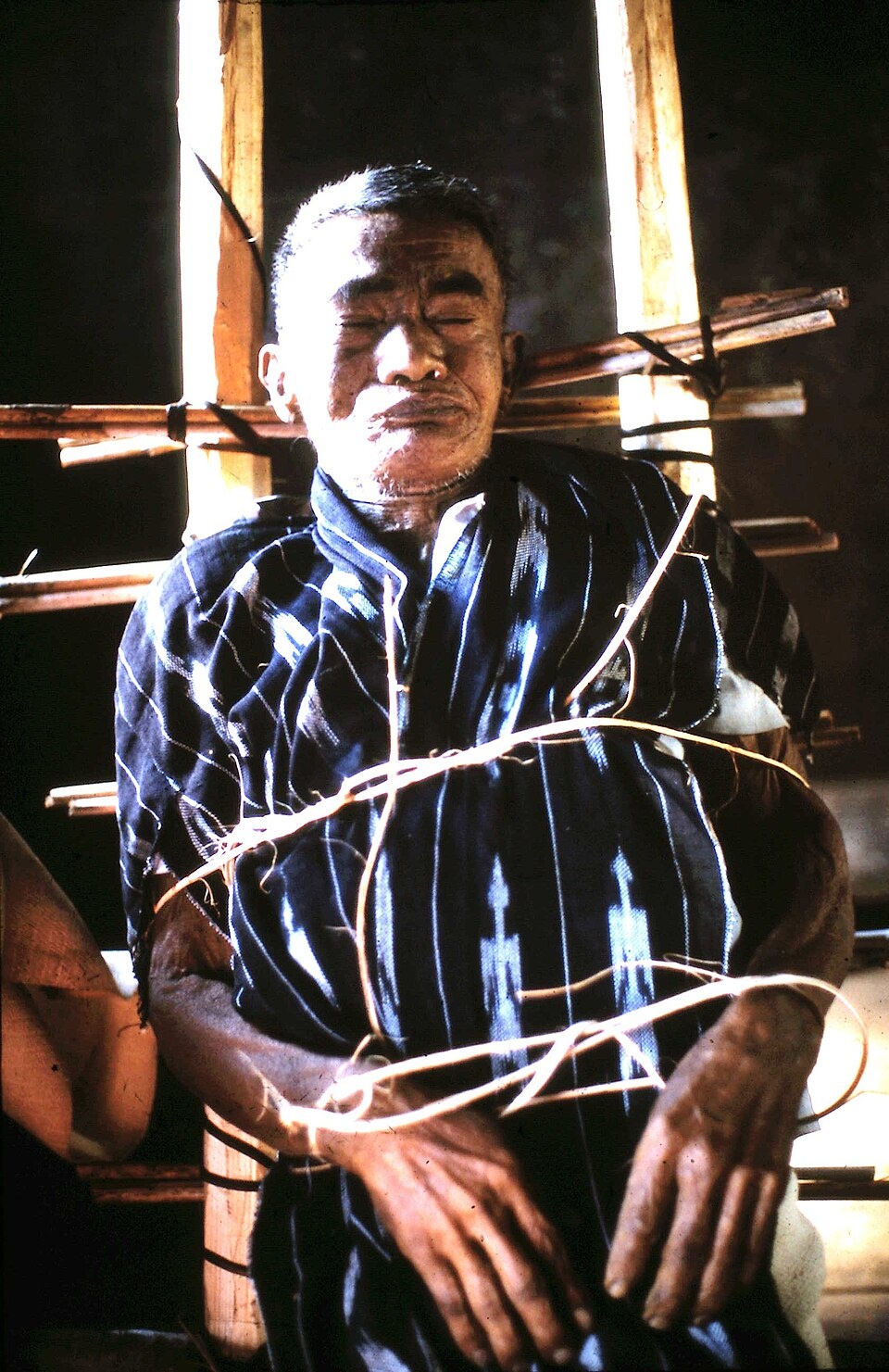
Albert Ernest Jenks wrote: On March 19, 1903, wise, rich Som-kad, of ato Luwakan, and the oldest man of Bontoc, heard an anito saying, “Come, Som-kad; it is much better in the mountains; come.” The sick old man laboriously walked from the pabafunan to the house of his oldest son, where he had for nearly twenty years taken his food, and there among his children and friends he died on the night of March 21. Just before he died a chicken was killed, and the old people gathered at the house, cooked the chicken, and ate, inviting the ancestral anitos and the departing spirit of Som-kad to the feast. Shortly after this the spirit of the live man passed from the body searching the mountain spirit land for kin and friend. They closed the old man’s eyes, washed his body and on it put the blue burial robe with the white “anito” figures woven in it as a stripe. They fashioned a rude, high-back chair with a low seat, a sung-achil, and bound the dead man in it, fastening him by bands about the waist, the arms, and head—the vegetal band entirely covering the open mouth. His hands were laid in his lap. The chair was set close up before the door of the house, with the corpse facing out. Four nights and days it remained there in full sight of those who passed. [Source: “Bontoc Igorot” by Albert Ernest Jenks, 1905]
One-half the front wall of the dwelling and the interior partitions except the sleeping compartment were removed to make room for those who sat in the dwelling. Most of these came and went without function, but day and night two young women sat or stood beside the corpse always brushing away the flies which sought to gather at its nostrils.During the first two days few men were about the house, but they gathered in small groups in the vicinity of the fawi and pabafunan, which were only three or four rods distant. Much of the time a blind son of the dead man, the owner of the house where the old man died, sat on his haunches in the shade under the low roof, and at frequent intervals sang to a melancholy tune that his father was dead, that his father could no longer care for him, and that he would be lonely without him. On succeeding days other of the dead man’s children, three sons and five daughters, all rich and with families of their own, were heard to sing the same words. Small numbers of women sat about the front of the house or close in the shade of its roof and under its cover. Now and then some one or more of them sang a low-voiced, wordless song—rather a soothing strain than a depressing dirge. During the first days the old women, and again the old men, sang at different times alone the following song, called “a-nako” when sung by the women, and “e-yae” when by the men:
Now you are dead; we are all here to see you. We have given you all things necessary, and have made good preparation for the burial. Do not come to call away [to kill] any of your relatives or friends.
Nowhere was there visible any sign of fear or awe or wonder. The women sitting about spun threads on their thighs for making skirts; they talked and laughed and sang at will. Mothers nursed their babes in the dwelling and under its projecting roof. Budding girls patted and loved and dimpled the cheeks of the squirming babes of more fortunate young women, and there was scarcely a child that passed in or out of the house, that did not have to steady itself by laying a hand on the lap of the corpse. All seemed to understand death. One, they say, does not die until the anito calls—and then one always goes into a goodly life which the old men often see and tell about.
The night following the burial all relatives stay at the house lately occupied by the corpse. On the day after the burial all the men relatives go to the river and catch fish, the small kacho. The relatives have a fish feast, called “ab-a-fon,” at the hour of the evening meal. To this feast all ancestral anito are invited. All relatives again spend the night at the house, from which they return to their own dwellings after breakfast of the second day and each goes laden with a plate of cooked rice. In this way from two to eight days are given to the funeral rite, the duration being greater with the wealthier people.
Feast and Burial During a Bontoc Funeral in 1903
Albert Ernest Jenks wrote: Before the house, which faced the west, lay the large pine coffin lid, while to the south of it, turned bottom up, was the coffin with fresh chips beside it hewn out that morning in further excavation. Children played around the coffin and people lounged on its upturned bottom. Near the front of the house a pot of water was always hot over a smoldering, smoking fire. Now and then a chicken was brought, light wood was tossed under the pot, the chicken was beaten to death—first the wings, then the neck, and then the head. The fowl was quickly sprawled over the blaze, its feathers burned to a crisp, and rubbed off with sticks. Its legs were severed from the body with the battle-ax and put in the pot. From its front it was then cut through its ribs with one gash. The back and breast parts were torn apart, the gall examined and nodded over; the intestines were placed beneath a large rock, and the gizzard, breast of the chicken, and back with head attached dropped in the pot. During the killing and dressing neither of the two men who prepared the feast hurried, yet scarcely five minutes passed from the time the first blow was struck on the wing of the squawking fowl until the work was over and the meat in the boiling pot. The cooking of a fowl always brought a crowd of boys who hung over the fragrant vessel, and they usually got their share when, in about twenty minutes, the meat came forth. Three times in the afternoon a fowl was thus distributed. Cooked pork was passed among the people, and rice was always being brought. Twice a man went through the crowd with a large winnowing tray of cooked carabao hide cut in little blocks. This food was handed out on every side, people tending children receiving double share. The people gathered and ate in the congested spaces about the dwelling. The heat was intense—there was scarcely a breath of air stirring. The odor from the body was heavy and most sickening to an American, and yet there was no trace of the unusual on the various faces. [Source: “Bontoc Igorot” by Albert Ernest Jenks, 1905]
Presently a man came with a slender stick to measure the coffin. He drove a nursing mother, with a woman companion and small child, from comfortable seats on the upturned wood. The people, including the group of old women, were driven away from the front of the house, the coffin was laid down on the ground before the door, and an unopened 8-gallon olla of “preserved” meat was set at its foot. An old woman, in no way distinguishable from the others by paraphernalia or other marks, muttering, squatted beside the olla. Two men untied the bands from the corpse, and one lifted it free from the chair and carried it in his arms to the coffin. It was most unsightly, and streams of rusty-brown liquid ran from it. It was placed face up, head elevated even with the rim, and legs bent close at the knees but only slightly at the hips. The old woman arose from beside the olla and helped lay two new breechcloths and a blanket over the body. The face was left uncovered, except that a small patch of white cloth ravelings, called “fo-ot,” was laid over the eyes, and a small white cloth was laid over the hair of the head. The burden was quickly caught up on men’s shoulders and hurried without halting to the grave. Willing bands swarmed about the coffin. At all times as many men helped bear it as could well get hold, and when they mounted the face of a 7-foot sementera wall a dozen strong pairs of hands found service drawing up and supporting the burden. Many men followed from the house one brought the coffin cover and another the carabao horns—but the women and children remained behind, as is their custom at burials.
At the grave the coffin rested on the earth a moment12 while a few more basketfuls of dirt were thrown out, until the grave was about 5 feet deep. The coffin was then placed in the grave, the cover laid on, and with a joke and a laugh the pair of horns was placed facing it at the head. Instantly thirty-two men sprang on the piles of fresh, loose dirt, and with their hands and the half dozen digging sticks filled and covered the grave in the shortest possible time, probably not over one minute and a half. And away they hurried, most of them at a dogtrot, to wash themselves in the river.
From the instant the corpse was in the coffin until the grave was filled all things were done in the greatest haste, because cawing crows must not fly over, dogs must not bark, snakes or rats must not cross the trail—if they should, some dire evil would follow. Shortly after the burial a ceremony, called “kap-i-yan si na-tü,” is performed by the relatives in the dwelling wherein the corpse sat. It is said to be the last ceremony given for the dead. Food is eaten and the one in charge addresses the anito of the dead man as follows: “We have fixed all things right and well for you. When there was no rice or chicken for food, we got them for you—as was the custom of our fathers—so you will not come to make us sick. If another anito seeks to harm us, you will protect us. When we make a feast and ask you to come to it, we want you to do so; but if another anito kills all your relatives, there will be no more houses for you to enter for feasts.” This last argument is considered to be a very important one, as all Igorot are fond of feasting, and it is assumed that the anito has the same desire.
Image Sources: Wikimedia Commons
Text Sources: “Encyclopedia of World Cultures Volume 5: East/Southeast Asia:” edited by Paul Hockings, 1993; National Geographic, Live Science, Philippines Department of Tourism, Metropolitan Museum of Art, Natural History magazine, New York Times, Washington Post, Los Angeles Times, Smithsonian magazine, Encyclopedia.com, Times of London, Library of Congress, The Conversation, The New Yorker, Time, BBC, CNN, Reuters, Associated Press, AFP, Lonely Planet Guides, Google AI, Wikipedia, The Guardian and various websites, books and other publications.
Last updated February 2026