
BONTOC MEN IN 1905
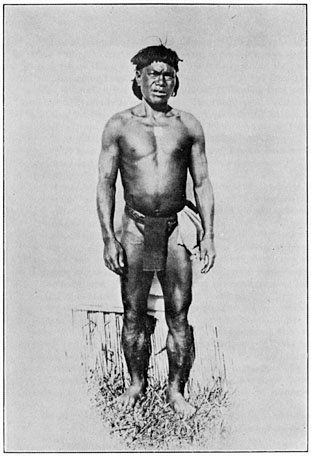
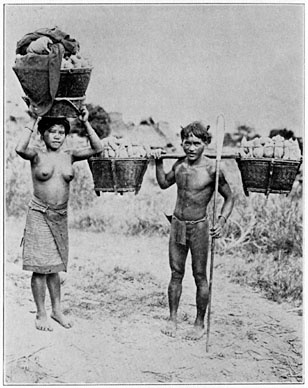
Albert Ernest Jenks wrote: The Bontoc men average about 5 feet 41/8 inches in height, and have the appearance of being taller than they are...The Bontoc men are never corpulent, and, with the exception of the very old, they are seldom poor. During the period of a man’s prime he is usually muscled to an excellent symmetry. His neck, never long, is well formed and strong and supports the head in erect position. His shoulders are broad, even, and full muscled, and with seeming ease carry transportation baskets laden with 75 to 100 pounds. [Source: “Bontoc Igorot” by Albert Ernest Jenks, 1905]
The hair of the head is black, straight, coarse, and relatively abundant. It is worn long, frequently more than half way to the hips from the shoulders. The front is “banged” low and square across the forehead, cut with the battle-ax; this line of cut runs to above and somewhat back of the ear, the hair of the scalp below it being cut close to the head. When the men age, a few gray hairs appear, and some old men have heads of uniform iron-gray color. I have never seen a white-haired Igorot. A few of the old men have their hair thinning on the crown, but a tendency to baldness is by no means the rule.
The scanty growth of hair on the face of the Bontoc man is pulled out. A small pebble and the thumb nail or the blade of the battle-ax and the bulb of the thumb are frequently used as forceps; they never cut the hair of the face. It is common to see men of all ages with a very sparse growth of hair on the upper lip or chin...Their bodies are quite free from hair. There is none on the breast, and seldom any on the legs. The pelvic growth is always pulled out by the unmarried. The growth in the armpits is scant, but is not removed.
The iris of the eye is brown—often rimmed with a lighter or darker ring. The brown of the iris ranges from nearly black to a soft hazel brown. The cornea is frequently blotched with red or yellow. The Malayan fold of the upper eyelid is seen in a large majority of the men, the fold being so low that it hangs over and hides the roots of the lashes. The lashes appear to grow from behind the lid rather than from its rim.
The teeth are large and strong, and, whereas in old age they frequently become few and discolored, during prime they are often white and clean. The people never artificially stain the teeth, and, though surrounded by betel-nut chewers with dark teeth or red-stained lips, they do not use the betel.
At the age of 20 a man seems hardly to have reached his physical best; this he attains, however, before he is 25. By 35 he begins to show the marks of age. By 45 most of the men are fast getting “old”; their faces are seamed, their muscles losing form, their carriage less erect, and the step slower. By 55 all are old—most are bent and thin. Probably not over one or two in a hundred mature men live to be 70 years old.
Twenty percent of the adults have abnormal feet. The most common and most striking abnormality is the inturning of the great toe. This occurs in all stages from the slightest spreading to that approximating forty-five degrees. It is found widely scattered among the barefoot mountain tribes of northern Luzon. The people say it is due to mountain climbing, and their explanation is probably correct, as the great toe is used much as is a claw in securing a footing on the slippery, steep trails during the rainy reason.
RELATED ARTICLES:
BONTOC PEOPLE: LIFE. CULTURE, MARRIAGE factsanddetails.com
BONTOC REGION IN THE EARLY 1900s: GEOGRAPHY, HISTORY, DISEASES, FOOD factsanddetails.com
BONTOC RELIGION: GODS, ANITOS, FUNERALS factsanddetails.com
BONTOC HEAD HUNTING factsanddetails.com
MOUNTAIN PROVINCE IN CORDILLERA: MUMMIES, PINE FORESTS, BONTOC RICE TERRACES factsanddetails.com
RICE TERRACES OF NORTHERN LUZON factsanddetails.com
IFUGAO SOCIETY AND LIFE factsanddetails.com
IGOROT — CORDILLERA PEOPLE OF NORTHERN LUZON — GROUPS AND HISTORY factsanddetails.com
IGOROT LIFE: CUSTOMS, FOOD, DRINKS, TRANSPORT factsanddetails.com
IGOROT GROUPS — KANKANAEY, ISNEG, IBALOI — AND THEIR LIFE, CUSTOMS AND CULTURE factsanddetails.com
HEAD HUNTING TRIBES OF LUZON: PRACTICES, REASONS, WARS factsanddetails.com
MAIN ETHNIC GROUPS OF LUZON: TAGALOGS, ILOCANO AND BICOL factsanddetails.com
Bontoc Women in 1905
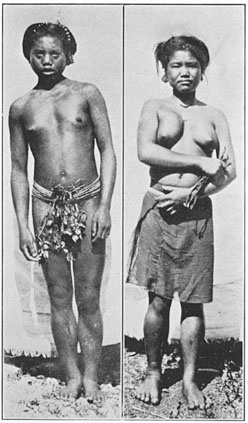
Albert Ernest Jenks wrote:The women average 4 feet 93/8 inches in height. In appearance they are short and stocky. Twenty-nine women from Bontoc and vicinity were measured; the tallest was 5 feet 4¾ inches, and the shortest 4 feet 4¾ inches. The women reach the age of maturity well prepared for its responsibilities. They have more adipose tissue than the men, yet are never fat. The head is carried erect, but with a certain stiffness—often due, in part, no doubt, to shyness, and in part to the fact that they carry all their burdens on their heads. I believe the neck more often appears short than does the neck of the man. [Source: “Bontoc Igorot” by Albert Ernest Jenks, 1905]
The shoulders are broad, and flat across the back. The breasts are large, full, and well supported. The hips are broad and well set, and the waist (there is no natural waist line) is frequently no smaller than the hips, though smaller than the shoulders. Their arms are smooth and strong, and they throw stones as men do, with the full-arm throw from the shoulder. Their hands are short and strong. Their legs are almost invariably straight, but are probably more frequently bowed at the knees than are the men’s. The thighs are sturdy and strong, and the calves not infrequently over-large. This enlargement runs low down, so the ankles, never slender, very often appear coarse and large. In consequence of this heavy lower leg, the feet, short at best, usually look much too short. They are placed on the ground straight ahead, though the tendency to inturned feet is slightly more noticeable than it is among the men.
Their carriage is a healthful one, though it is not always graceful, since their long strides commonly give the prominent buttocks a jerky movement. They prove the naturalness of that style of walking which, in profile, shows the chest thrust forward and the buttocks backward; the abdomen is in, and the shoulders do not swing as the strides are made.
The hair of the head is like that of the man’s; it is worn long, and is twisted and wound about the head. It has a tendency to fall out as age comes on, but does not seem thin on the head. The tendency to gray hairs is apparently somewhat less than it is with the men. The remainder of the body is exceptionally free from hair. The growth in the armpits and the pelvic hair are always pulled out by the unmarried, and a large percent of the women do not allow it to grow even in old age.
Bontoc Children in 1905
Albert Ernest Jenks wrote: The death rate among children is large. Of fifteen families in Bontoc, each having had three or more children, the death rate up to the age of puberty was over 60 percent. According to the Magulang census the death rate of children from 5 to 10 years of age is 63.73 percent. [Source: “Bontoc Igorot” by Albert Ernest Jenks, 1905]

The new-born babe is as light in color as the average American babe, and is much less red, instead of which color there is the slightest tint of saffron. As the babe lies naked on its mother’s naked breast the light color is most strikingly apparent by contrast. The darker color, the brown, gradually comes, however, as the babe is exposed to the sun and wind, until the child of a year or two carried on its mother’s back is practically one with the mother in color.
Some of the babes, perhaps all, are born with an abundance of dark hair on the head. A child’s hair is never cut, except that from about the age of 3 years the boy’s hair is “banged” across the forehead. Fully 30 percent of children up to 5 or 6 years of age have brown hair—due largely to fading, as the outer is much lighter than the under hair. In rare cases the lighter brown hair assumes a distinctly red cast, though a faded lifeless red. Before puberty is reached, however, all children have glossy black hair.
The iris of a new-born babe is sometimes a blue brown; it is decidedly a different brown from that of the adult or of the child of five years. Most children have the Malayan fold of the eyelid; the lower lid is often much straighter than it is on the average American. When, in addition to these conditions, the outer corner of the eye is higher than the inner, the eye is somewhat Mongolian in appearance. About one-fifth of the children in Bontoc have this Mongolian-like eye, though it is rarer among adults—a fact due, in part, apparently, to the down curving and sagging of the lower lid as one’s prime is reached and passed.
Children’s teeth are clean and white, and very generally remain so until maturity. The child from 1 to 3 years of age is plump and chubby; his front is full and rounded, but lacks the extra abdominal development so common with the children of the lowlands, and which has received from the American the popular name of “banana belly.” By the age of 7 the child has lost its plump, rounded form, which is never again had by the boys but is attained by the girls again early in puberty. During these last half dozen years of childhood all children are slender and agile and wonderfully attractive in their naturalness. Both girls and boys reach puberty at a later time than would be expected, though data can not be gathered to determine accurately the age at puberty. All the Ilocano in Bontoc village consistently maintain that girls do not reach puberty until at least 16 and 17 years of age. Perhaps it is arrived at by 14 or 15, but I feel certain it is not as early as 12 or 13—a condition one might expect to find among people in the tropics.
Bontoc Men’s and Council Houses in 1905
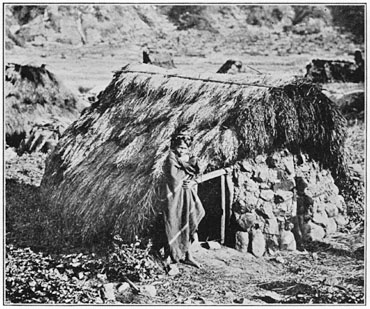
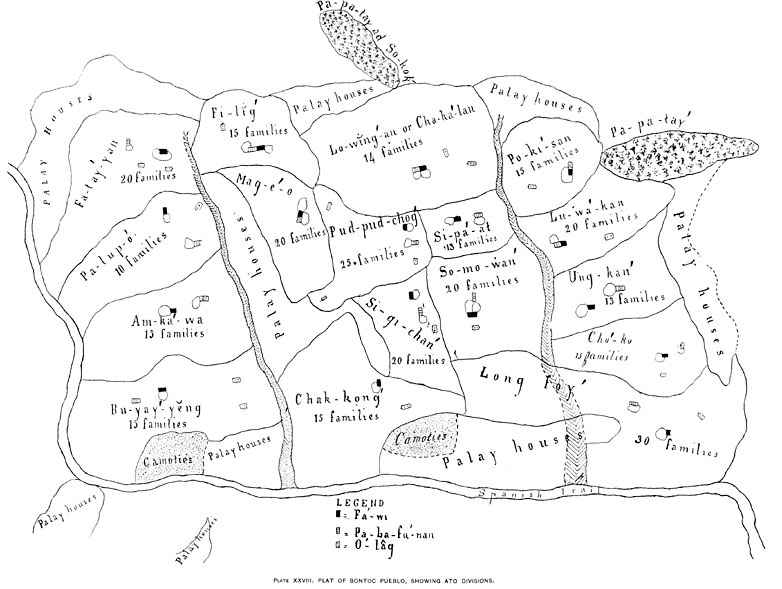
Bontoc is composed of 17 political divisions, called “ato.” Each ato has its meeting-place, consisting of a circle of small boulders, where the men assemble to discuss matters affecting the ato, such as war and peace; for the ato is the political unit, and not the village as a whole. Albert Ernest Jenks wrote: The pabafunan is the home of the various ato ceremonials. It is sacred to the men of the ato, and on no occasion do the women or girls enter it. All boys from 3 or 4 years of age and all men who have no wives sleep nightly in the pabafunan or in the fawi (a regular house). The pabafunan building consists of a low, squat, stone-sided structure partly covered with a grass roof laid on a crude frame of poles; the stone walls extend beyond the roof at one end and form an open court. The roofed part is about 8 by 10 feet, and usually is not over 5 feet high in any part, inside measure; the size of the court is approximately the same as that of the roofed section. In some pabafunan a part of the court is roofed over for shelter in case of rain, but is not walled in. Under this roof skulls of dogs and hogs are generally found tucked away. Carabao horns and chicken feathers are also commonly seen in such places. [Source: “Bontoc Igorot” by Albert Ernest Jenks, 1905]
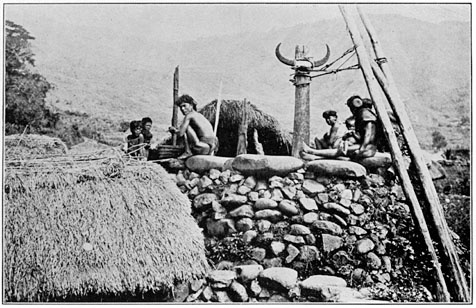
Each ato, except Chakong, has a pabafunan. When the men of Chakong were building theirs they met the village of Sadanga in combat, and one of the builders lost his head to Sadanga. Then the old men of Chakong counciled together; they came to the conclusion that it was bad for the ato to have a pabafunan, and none has ever been built. In many cases the open court is shaded by a tree. Posts are found reared above most of the courts. Some are old and blackened; others are all but gone—a short stump being all that projects above the earth. The tops of some posts are rudely carved to represent a human head; on the tops of others, as in ato Lowingan and Sipaat, there are stones which strikingly resemble human skulls. It is to the tops of these posts that the enemy’s head is attached when a victorious warrior returns to his ato. Both the roofed and court sections are paved with stone, and large stones are also arranged around the sides of the court, some more or less elevated as seats; they are worn smooth and shiny by generations of use. In the center of the court is the smoldering remains of a fire. The only opening into the covered part is a small doorway connecting it with the court. This door is barely large enough to permit a man to squeeze in sidewise; it is often not over 2½ feet high and 10 inches wide. The occupants of the pabafunan usually sleep curled up naked on the smooth, flat stones. A few people have runo slat mats, some of which roll up, while others are inflexible, and they lie on these over the stone pavement. Fires are built in all sleeping rooms when it is cold, and the rooms all close tightly with a door.
In the court of the building the men lounge when not at work in the fields; they sleep, or smoke and chat, tend babies, or make utensils and weapons. The pabafunan is the man’s club by day, and the unmarried man’s dormitory by night, and, as such, it is the social center for all men of the ato, and it harbors at night all men visiting from other villages.
Each ato has a fawi building—a structure greatly resembling to the pabafunan, and impossible to be distinguished from it by one looking at the structure from the outside. The fawi is the ato council house; as such it is more frequented by the old men than by the younger. The fawi also shelters the skulls of human heads taken by the ato. Outside the village, along certain trails, there are simple structures also called “fawi,” shelters where parties halt for feasts, etc., while on various ceremonial journeys.
The fawi and pabafunan of each ato are near together, and in five they are under the same roof, though there is no doorway for intercommunication. What was said of the pabafunan as a social center is equally true of the fawi; each is the lounging place of men and boys, and the dormitory of unmarried males.
Bontoc Olag (Girls Houses) in 1905
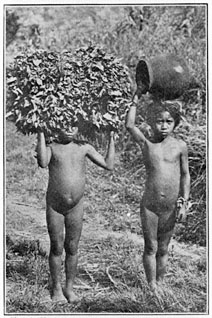
Albert Ernest Jenks wrote: The olag is the dormitory of the girls in an ato from the age of about 2 years until they marry. It is a small stone and mud-walled structure, roofed with grass, in which a grown person can seldom stand erect. It has but a single opening—a door some 30 inches high and 10 inches wide. Occupying nearly all the floor space are boards about 4 feet long and from 8 to 14 inches wide; each board is a girl’s bed. They are placed close together, side by side, laid on a frame about a foot above the earth. One end, where the head rests, is slightly higher that the other, while in most olag a pole for a foot rest runs along the foot of the beds a few inches from them. [Source: “Bontoc Igorot” by Albert Ernest Jenks, 1905]
Olag are is often built over one or more pigsties. Unlike the fawi and pabafunan, the olag has no adjoining court, and no shady surroundings. It is built to house the occupants only at night. The olag is not so distinctly an ato institution as the pabafunan and fawi. Ato Ungkan never had an olag. The demand is not so urgent as that of some ato, since there are only thirteen families in Ungkan. The girls occupy olag of neighboring ato.
Albert Ernest Jenks wrote: The olag is built where the girls desire it and is said to be commonly located in places accessible to the men; this appears true to one going over the village with this statement in mind. According to Blumentritt: “Amongst most of the tribes [Igorot] the chastity of maidens is carefully guarded, and in some all the young girls are kept together till marriage in a large house where, guarded by old women, they are taught the industries of their sex, such as weaving, pleating, making cloth from the bark of trees, etc.” There is no such institution in Bontoc Igorot society. The purpose of the olag is as far from enforcing chastity as it well can be. The old women never frequent the olag, and the lesson the girls learn there is the necessity for maternity, not the “industries of their sex”—which children of very primitive people acquire quite as a young fowl learns to scratch and get its food. [Source: “Bontoc Igorot” by Albert Ernest Jenks, 1905]
Bontoc Children Go to Olag and Men's House at a Very Early Age
Cornélis De Witt Willcox wrote in “The Head Hunters of Northern Luzon”: A remarkable thing is the family life, or lack of it rather: as soon as children are three or four years old, they leave the roof under which they were born and go to sleep, the boys in a sort of dormitory called pabajunan, occupied as well by the unmarried men, and the girls in one called olog. And, as one may ask whether pearls are costly because ladies like them or whether ladies like pearls because they are costly, so here: Is the Igorot house so poor an affair because of the olog, etc., or does the olog exist because the house is poor? [Source:“The Head Hunters of Northern Luzon” by Cornélis De Witt Willcox, Lieutenant-Colonel U.S. Army, Professor United States Military Academy, 1912 ]
The children go on sleeping in their respective pabajunan and olog until they are grown up and married. A sort of trial marriage seems to exist; the young men freely visit the olog—indeed, are expected to. If results follow, it is a marriage, and the couple go to housekeeping; otherwise all the parties in interest are free. Marriage ties are respected, adultery being punished with death; but a man may have more than one wife, though usually that number is not exceeded. However, a man was pointed out to us, who maintains in his desire for issue, but without avail, a regular harem, having no fewer than fifteen wives in different villages, he being a rich man.
Albert Ernest Jenks wrote: After the child is about 2 years of age it is not customary for it to sleep longer at the home of the parents; the girl goes nightly to the olag, and the boy to the pabafunan or the fawi. However, this is not a hard-and-fast rule, and the age at which the child goes to the olag or fawi depends much on circumstances. The length of time it sleeps with the parents doubtless depends upon the advent or nonadvent of another child. If a little girl has a widowed grandmother or aunt she may sleep for a few years with her.
During the warmer months one or two children may sleep on the stationary broad bench, the chukso, in the open part of the parents’ house. It is safe to say that after the ages of 6 or 7 all children are found nightly in the olag, pabafunan, or fawi. I have seen a group of little girls from 4 to 10 years old, immediately after supper and while some families were still eating, sitting around a small blaze of fire just outside the door of their olag. The Igorot child as a rule knows its parents’ home only as a place to eat. There is almost an entire absence of anything which may be called home life. [Source: “Bontoc Igorot” by Albert Ernest Jenks, 1905]
Love Life in the Olag
Albert Ernest Jenks wrote: Though the olag is primarily the sleeping place of all unmarried girls, in the mind of the people it is, with startling consistency, the mating place of the young people of marriageable age. A common sight on a rest day in the village is that of a young man and woman, each with an arm around the other, loitering about under the same blanket, talking and laughing, one often almost supporting the other. There seems at all times to be the greatest freedom and friendliness among the young people. I have seen both a young man carrying a young woman lying horizontally along his shoulders, and a young woman carrying a young man astride her back. However, practically all courtship is carried on in the olag. [Source: “Bontoc Igorot” by Albert Ernest Jenks, 1905]
The courtship of the Igorot is closely defined when it is said that marriage never takes place prior to sexual intimacy, and rarely prior to pregnancy. There is one exception. This is when a rich and influential man marries a girl against her desires, but through the urgings of her parents. It is customary for a young man to be sexually intimate with one, two, three, and even more girls at the same time. Two or more of them may be residents of one olag, and it is common for two or three men to visit the same olag at one time. A girl is almost invariably faithful to her temporary lover, and this fact is the more surprising in the face of the young man’s freedom and the fact that the olag is nightly filled with little girls whose moral training is had there.
Young men are boldly and pointedly invited to the olag. A common form of invitation is for the girl to steal a man’s pipe, his pocket hat, or even the breechcloth he is wearing. They say one seldom recovers his property without going to the, olag for it. When a girl recognizes her pregnancy she at once joyfully tells her condition to the father of the child, as all women desire children and there are few permanent marriages unblessed by them. The young man, if he does not wish to marry the girl, may keep her in ignorance of his intentions for two or three months. If at last he tells her he will not marry her she receives the news with many tears, it is said, but is spared the gossip and reproach of others, and she will later become the wife of some other man, since her first child has proved her power to bear children.
When the mother notices her condition she asks who the father of the child is, and on being told that the man will not marry her the mother often tries to exert a rather tardy influence for better morals. She says, “That is bad. Why have you done this?” (when the chances are that the unfortunate, girl was born into a family of but one head); “it will be well for him to give the child a field to work.” About the same time the young man informs his mother of his relations with the girl, and of her condition, and again the maker of a people’s morals seems to attempt to mold the already hardened clay. She says, “My son, that is bad. Why have you done it? Why do you not marry her?” And the son answers simply and truthfully, “I have another girl.” Without attempt at remonstrance the father gives a rice fields to the child when it is 6 or 7 years old, for that is the price fixed by the group conscience for deserting a girl with a child.
It is not usual for a married man to go to the olag, though a young man may go if one of his late mates is still alone. He is usually welcomed by the girl, for there may yet be possibilities of her becoming his permanent wife. A man whose wife is pregnant, however, seldom visits the olag, because he fears that, if he does, his wife’s child will be prematurely born and die.
Childbirth Among the Bontoc in 1905
Albert Ernest Jenks wrote: A woman is usually about her daily labors in the house, the mountains, or the irrigated fields almost to the hour of childbirth. The child is born without feasting or ceremony, and only two or three friends witness the birth. The father of the child is there, if he is the woman’s husband; the girl’s mother is also with her, but usually there are no others, unless it be an old woman. [Source: “Bontoc Igorot” by Albert Ernest Jenks, 1905]
The expectant woman stands with her body bent strongly forward at the waist and supported by the hands grasping some convenient house timber about the height of the hips; or she may take a more animal-like position, placing both hands and feet on the earth. The labor, lasting three or four hours, is unassisted by medicines or baths; but those in attendance—the man as well as the woman—hasten the birth by a gently downward drawing of the hands about the woman’s abdomen.
During a period of ten days after childbirth the mother frequently bathes herself about the hips and abdomen with hot water, but has no change of diet. For two or three days she keeps the house closely, reclining much of the time.
The Igorot woman is a constant laborer from the age of puberty or before, until extreme incapacity of old age stays the hands of toil; but for two or three months following the advent of each babe the mother does not work in the fields. She busies herself about the house and with the new-found duties of a mother, while the husband performs her labors in the fields.
The Igorot loves all his children, and says, when a boy is born, “It is good,” and if a girl is born he says it is equally “good”—it is the fact of a child in the family that makes him happy. People in the Igorot stage of culture have little occasion to prize one sex over the other. The Igorot neither, even in marriage. One is practically as capable as the other at earning a living, and both are needed in the group.
Six or seven days after birth a chicken is killed and eaten by the family in honor of the child, but there is no other ceremony—there is not even a special name for the feast. If a woman gives birth to a stillborn child it is at once washed, wrapped in a bit of cloth, and buried in a sweet potato field close to the dwelling.
Bontoc Houses in 1905
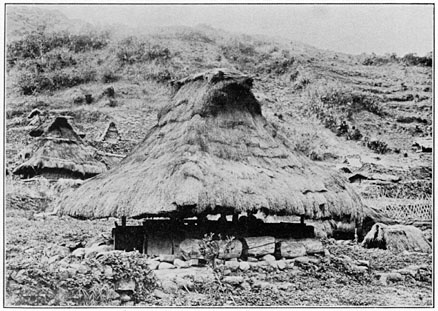
Afong is the general name for Bontoc dwellings, of which there are two kinds. The first is the fayu, the large, open, board dwelling, some 12 by 15 feet square, with side walls only 3½ feet high, and having a tall, top-heavy grass roof. It is the home of the prosperous. The other is the katyufong, the smaller, closed, frequently mud-walled dwelling of poor families, and commonly of the widows. The family dwelling primarily serves two purposes—it is the place where the man, his wife, and small child sleep, and where the entire family takes its food.
The fayu is built at considerable expense. Three or four men are required for a period of about two months to get out the pine boards and timbers in the forest. Each piece of timber for any permanent building is completed at the time it is cut from the tree, and is left to season in the mountains; sometimes it remains several years. When all is ready to construct the dwelling the owner announces his intention. Some 200 men of the village gather to erect the building, and two or three dozen women come to prepare and cook the necessary food, for, whereas no wage is paid the laborers, all are feasted at the cost of much rice and several hogs and a carabao or two. The toiling and feasting continue about ten days.
The fayu are all constructed on the same plan, though a few are larger than the one here described, and some few are smaller. The front and back walls of the house are 3 feet 6 inches high and 12 feet 6 inches long. The two side walls are the same height as the ends, but are 15 feet 6 inches long. The rear wall is built of stones carefully chinked with mud. The side walls consist each of two boards extending the full length of the structure. The front wall is cut near the middle from top to bottom with a doorway 1 foot 4 inches wide; otherwise the front wall is like the two side walls, except that it has a roughly triangular timber grooved along the lower side and fitted over the top board as a cap.
The doorposts are two timbers sunk in the ground; their tops fit into the two “caps,” and each has a groove from top to bottom into which the ends of the boards of the front wall are inserted. A few dwellings have a door consisting of a single board set on end and swinging on a projection sunk in a hole in a doorsill buried in the earth; the upper part of the door swings on a string secured to the doorpost and passing through a hole in the door.
There is no floor except the earth in the first story of the Bontoc dwelling, and from the door at the front of the building to the two rear posts of the four central ones there is an unobstructed passage or aisle. called “chalanan.” At one’s left, as he enters the door, is a small room called “chapan” 5½ feet square separated from the aisle by a row of low stones partially sunk in the earth. The earth in this room is excavated so that the floor is about 1 foot lower than that of the remainder of the building, and in its center the peculiar double wooden rice mortar is imbedded in the earth. It is in the chapan that the family rice and millet is threshed.
I know of no other primitive dwellings in the Philippines than the ones in the Bontoc culture area which are built directly on the ground. Most of them are raised on posts several feet from the earth. Some few have side walls extending to the ground, but even those have a floor raised 2, 3, or more feet from the ground and which is reached by means of a short ladder.
Parts of Bontoc Houses in 1905
At the right of the aisle, as one enters the building, is a broad shelf about 12 feet long; in width it extends from the side wall to the two right central posts. On this shelf, called “chukso,” are placed the various baskets and other utensils and implements of everyday use. Beneath it are stored the small cages or coops in which the chickens sleep at night. There are a few fayu in Bontoc in which the threshing room and cooking room are on the right of the aisle and the long bench is on the left, but they are very rare exceptions.
In the rear of the building is a board partition apparently extending from one side wall to the other. The bench at the right of the aisle ends against this partition, and on the left the stone fireplaces are built against it. This rear section is covered over with boards at the height of the outside wall, so that a low box is formed....An examination of the inside of this section shows it to be entirely walled with stones except where the narrow door cuts it. By inside measure it is only 3 feet 6 inches wide and 6 feet 6 inches long. This is the sleeping apartment, and is called ang-an?. As one crawls into this kennel he is likely to place his hands among ashes and charred sticks which mark the place for a fire on cold nights.
The left end of the angan contains two boards or beds for the man and his wife. Each board is about 18 inches wide and 4 feet long; they are raised 2 or 3 inches from the earth, and the head of the bed is slightly higher than the foot. A pole is laid across the apartment at the lower end of the sleeping boards, and on this the occupants rest their feet and toast them before the small fire. At both ends of the ang-an?, outside the store walls, is a small hidden secret space called “kûbkûb,” in which the family hides many of its choice possessions. During abundant sweet potato gathering, however, I have seen the kûb-kûb filled with sweet potatoes.
The second story of the Bontoc dwelling is supported on the four central posts. On all sides it projects beyond them, so that it is about 7 feet square; it is about 5 feet high. A door enters the second story directly from the aisle, and is reached by an 8-foot ladder. This second story is constructed, floor and side walls, of boards. The side walls cease at about the height of 2 feet where a horizontal shelf is built on them extending outside of them to the roof. It is about 2 feet wide and is usually stored with unthreshed rice and millet or with jars of preserved meats. Just at the left on the floor, as one enters the second story, is an earth-filled square corner walled in by two poles. On this earth are three stones—the fireplace, where each year a chicken is cooked in a household ceremony at the close of rice harvests.
Rising above the second story is a third. In the smaller dwellings this third story is only an attic of the second, but in the larger buildings it is an independent story. To be sure, it is entered through the floor, but a ladder is used, and its floor is of strong heavy boards. It is at all times a storeroom, usually only for cereals. In the smaller houses it amounts simply to a broad shelf about the height of one’s waist as he stands on the floor of the second story and his head and upper body rise through the hole in the floor. In the larger houses a person may climb into the third story and work there with practically as much freedom as in the second.
Wealth, Property and Possessions of Bontoc in the Early 1900s
Albert Ernest Jenks wrote: Most articles of personal property are individual. Such property consists of clothing, ornaments, implements, and utensils of out-of-door labor, the weapons of warfare, and such chickens, dogs, hogs, carabaos, food stuffs, and money as the person may have at the time of marriage or may inherit later. [Source: “Bontoc Igorot” by Albert Ernest Jenks, 1905]
Four of the richest men of Bontoc own fifty carabaos each, and one of them owns thirty hogs. Two other men and a woman, all called equally rich, own ten head of carabaos each. Others have fewer, while two of the ten richest men in the village, have no carabaos. Some of these men have eight granaries, holding from two to three hundred cargoes each, now full of unhusked rice. Carabaos are at present valued in Bontoc at about 50 pesos, and hogs average about 8 pesos. All rich people own one or more gold earrings valued at from one to two carabaos each. Page 160
The so-called richest man in Bontoc, Lak-ayeng, has the following visible personal property:
Articles Value in peso
Fifty carabaos, at 50 pesos each 2,500
Thirty hogs, at 8 pesos each 240
Eight full granaries, with 250 1-peso cargoes 2,000
Eight earrings, at 75 pesos each 600
Coin from sale of unhusked rice, hogs, etc. 1,000
Total 6,340
All household implements and utensils and all money, food stuffs, chickens, dogs, hogs, and carabaos accumulated by a married couple are the joint property of the two. Such personal property as hogs and carabaos are frequently owned by individuals of different families. It is common for three or four persons to buy a carabao, and even ten have become joint owners of one animal through purchase. Through inheritance two or more people become joint owners of single carabao, and of small herds which they prefer to own in common, pending such an increase that the herd may be divided equally without slaughtering an animal. Until recent years two, three, and even four or five men jointly owned one battle-ax.
The individual owns dwelling houses, granaries, sweet potato lands about the dwellings and in the mountains, millet and maize lands, in the mountains, irrigated rice lands, and mountain lands with forests. In fact, the individual may own all forms of real property known to the people. It is largely by the possession or nonpossession of real property that a man is considered rich or poor. ...The ten richest people in Bontoc, nine men and a woman, own, it is said, in round numbers one hundred fields each. It is claimed that each household owns its dwelling and at least two fields and one granary, though a man with no more property than this is a poor man and some one in his family must work much of the time for wages, because two average fields will not furnish all the rice needed by a family for food. Title to all buildings, building lands in the village, and irrigated rice lands is recognized for at least two generations, though unoccupied during that time. They say the right to such unoccupied property would be recognized perpetually if there were heirs.
Personal property commonly passes by transfer for value received from one party to another. Such a thing as transfer of real property from one Igorot to another for legal currency is unknown; the transfer is by barter. There is no formality to a “sale” of property, nor are witnesses employed. It is common knowledge within the ato when a sale is on, and the old men shortly know of and talk about the transaction—thenceforth it is on record and will stand. Until recent years, long after the Spaniards came, it was customary to loan money and other forms of personal property without interest or other charge. This generous custom still prevails among most of the people, but some rich men now charge an interest on money loaned for one or more years.
Image Sources: Wikimedia Commons
Text Sources: “Encyclopedia of World Cultures Volume 5: East/Southeast Asia:” edited by Paul Hockings, 1993; National Geographic, Live Science, Philippines Department of Tourism, Metropolitan Museum of Art, Natural History magazine, New York Times, Washington Post, Los Angeles Times, Smithsonian magazine, Encyclopedia.com, Times of London, Library of Congress, The Conversation, The New Yorker, Time, BBC, CNN, Reuters, Associated Press, AFP, Lonely Planet Guides, Google AI, Wikipedia, The Guardian and various websites, books and other publications.
Last updated February 2026