
FAMILIES IN INDONESIA
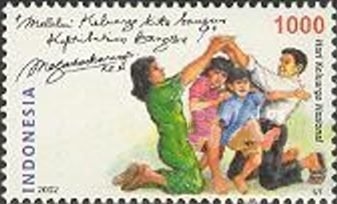
National Family Day Stamp in 2002
Family is very important to Indonesians. The most widespread domestic unit is the nuclear family consisting of a husband, wife and children, though in various societies and at various times, elders and unmarried siblings may be added to it. The Javanese, the largest ethnic group Indonesia, have a saying: "Mangan ora mangan asal ngumpul" which means “having food or having no food, the most important thing is that we are together.” The man of the household has traditionally been the head of the household but his wife often controlled family finances. Extended families often live in the same house.
Indonesia is the largest Muslim nation in the world with about 87 percent of its people reporting Islam as their primary religion. However, there are over 100 distinct groups in Indonesia, each with its own cultural identity, language, customs and values. Indonesian society generally recognizes the responsibility of the male to be the economic provider for the family. Women are taught to respect their husbands and children are taught to obey and respect both parents. It is also common for children to remain in the homes of their parents for extended lengths of time. Many young Indonesian adults live with either their parents or extended family until they marry.. [Source: International Encyclopedia of Marriage and Family, Gale Group Inc., 2003]
Within Javanese households, family roles are often clearly defined. Mothers typically manage finances and oversee daily domestic life, including disciplining children, while fathers tend to be more formally respected and are often focused on work outside the home. Although mothers play a central role in maintaining the household, they are also seen as bearing the greatest emotional burden during times of hardship.
The family as the main domestic unit is common among both urban and rural populations, and is unrelated to the presence or absence of clans in a society. An exception is the traditional rural matrilineal society of the Minangkabau people, for whom the domestic unit comprises co-resident females around a grandmother (or mother), including married and unmarried daughters and sons, living together in a large traditional house. Husbands only visit their wives' hearths and bedchambers. [Source: Clark E. Cunningham, Countries and Their Cultures, Gale Group Inc., 2001]
RELATED ARTICLES:
MARRIAGE IN INDONESIA: LAWS, TYPES, TRADITIONS factsanddetails.com
GENDER IN INDONESIA: VIEWS, ROLES, DIVISIONS factsanddetails.com
WOMEN IN INDONESIA: STATUS, WORK, ISLAM, HIJAB factsanddetails.com
CHILDREN IN INDONESIA factsanddetails.com
CHILD HEALTH, PREGNANCY AND BIRTH IN INDONESIA factsanddetails.com
RITES OF PASSAGE FOR INDONESIA CHILDREN: BIRTH RITES AND CIRCUMCISION factsanddetails.com
WEDDINGS IN INDONESIA: INVITATIONS, GIFTS, THE RECEPTION AND PHOTOGRAPHS factsanddetails.com
WEDDINGS OF DIFFERENT ETHIC GROUPS IN INDONESIA: JAVANESE, CHINESE, SUNDANESE AND BATAK factsanddetails.com
COURTSHIP, DATING AND LOVE IN INDONESIA factsanddetails.com
POLYGAMY IN INDONESIA factsanddetails.com
BALINESE FAMILY: MARRIAGE, WOMEN, RITES OF PASSAGE factsanddetails.com
JAVANESE SOCIETY: FAMILY, MARRIAGE, GENDER, CUSTOMS, CLASSES factsanddetails.com
INDONESIAN SOCIETY factsanddetails.com
CLASSES, HIERARCHIES AND STRATIFICATION IN INDONESIAN SOCIETY factsanddetails.com
ETIQUETTE AND CUSTOMS IN INDONESIA factsanddetails.com
SOCIAL CUSTOMS IN INDONESIA factsanddetails.com
For Information on Family and Kinship Among Different Ethnic Groups See Minorities and Regions:
INDONESIAN GOVERNMENT, MINORITIES, CHINESE AND CHRISTIANS factsanddetails.com
ETHNIC GROUPS ON SUMATRA factsanddetails.com
ETHNIC GROUPS ON JAVA factsanddetails.com
ETHNIC GROUPS IN NUSA TENGARRA (ISLANDS EAST OF BALI) factsanddetails.com
ETHNIC GROUPS ON SULAWESI factsanddetails.com
BORNEO AND ETHNIC GROUPS IN BORNEO factsanddetails.com
ETHNIC GROUPS IN THE MOLUCCAS AND OTHER ISLANDS factsanddetails.com
BALI factsanddetails.com
ACEH factsanddetails.com
PAPUA factsanddetails.com
Family Structure in Indonesia

In most regions, the traditional family structure sees the father as the dominant figure in the home, with the mother responsible for raising the children and caring for the household. In urban areas, however, it is now common for women to work outside the home. In 2000, women accounted for 40.8 per cent of the labour force, yet held only 12 per cent of parliamentary seats. They generally have as much access to education as men. Compared to women in other predominantly Muslim countries, Indonesian women have more rights, including in property settlements, inheritance, and divorce. Among the Minangkabau ethnic group, the mother is the dominant figure in the household and extended families group together according to matrilineal descent. [Source: Indonesia-fascination.blogspot.jp]
The structure, size and function of the Indonesian family exhibit considerable variation among the country's hundreds of different ethnolinguistic groups. Enshrined in official rhetoric and documents as a model for the nation as a whole, the family is regarded as the foundation of morality, justice and duty with regard to public behaviour. Although Indonesians in different parts of the archipelago have different traditional notions about inheritance, marriage, and filial rights and responsibilities, certain commonalities are beginning to emerge, partly as a result of the influence of national laws, institutions, and policies, as well as the increasing integration of the population into the national economy.
Some societies, such as the Karo people of Sumatra and certain Dayak groups of Kalimantan, live in large houses with multiple hearths and bedchambers belonging to related or even unrelated nuclear families. [Source: Clark E. Cunningham, Countries and Their Cultures, Gale Group Inc., 2001]
Marriage patterns have also influenced family structures. Divorce rates, which were very high in some areas during the 1960s, have declined over time, leading to more stable households and less shifting of child-rearing responsibilities among extended kin. This trend has been linked to rising education levels, later marriage ages, and improved incomes, although economic disruptions—such as the 1997–98 financial crisis—placed strain on many families.
Changes Among Families in Indonesia
One of the most significant changes since the mid-1970s was the steady decline in fertility in Indonesia. Driven by improved education, effective family-planning programs, and lower child mortality, the average number of children per woman fell from about 5.0 in 1970 to around 2.3 by 2009. The decline was most pronounced in Java and Bali. Despite smaller family sizes, population density continued to rise, reaching about 131 people per square kilometer in 2009, with much higher concentrations—over 900 per square kilometer—in Java, Madura, and Bali. [Source: Indonesia-fascination.blogspot.jp]
Since the early 1990s, Indonesian women had fewer children as infant mortality rates dropped significantly. The rate declined from 59 deaths per 1,000 live births in 1991 to 48 in 1995, 40.9 in 2000, and approximately 29.9 by 2009. Notably, this reduction in fertility was not accompanied by a preference for sons, either in birth rates or infant survival. At the same time, inheritance patterns became more equal, with the gap between what sons and daughters received narrowing through the 1980s and 1990s and nearly disappearing by 2009.
Mobility among working-age adults increased substantially, making households more dynamic in the early twenty-first century. Household size and structure changed more frequently than before, reflecting broader economic, social, and demographic shifts, as well as improvements in transportation.
Despite these transformations, Indonesian marriages largely retained traditional patterns. Wives typically managed household finances and oversaw children and domestic affairs, while husbands and unmarried young adults handled discretionary spending and maintained ties to the wider community. Polygamy was legally permitted but remained relatively uncommon. The law recognized men and women as equal partners, both responsible for maintaining the household and raising children.
Women’s participation in the workforce remained relatively stable, and divorce rates declined to below 40 percent by 2009, compared to nearly 60 percent in the 1960s. The reasons for this decline were debated, but factors such as economic uncertainty, political and social instability, and increasing religious conservatism likely played a role in keeping marriages intact. While divorce procedures varied across regions, it was generally easier for both men and women to obtain a divorce through Islamic courts, whereas judicial divorces were more difficult to secure.
Increasing urbanisation and interregional migration in the 1980s and 1990s, the desire of rural dwellers to find work in the city, inadequate urban infrastructure and limited job prospects for many school leavers put a strain on families and marriages. After 1998 and the fall of President Suharto, political instability, economic deterioration, a decrease in law and order, and communal and religious violence in some areas further strained family and kinship networks in both urban and rural areas. Nevertheless, these networks remain vital resources for supporting people in Indonesia.[Source: Clark E. Cunningham, International Encyclopedia of Marriage and Family, Gale Group Inc., 2003]
Inheritance in Indonesia
Inheritance practices in Indonesia vary widely, even within the same society. In Muslim communities, inheritance rules generally favor males, as they do in many traditional systems, although exceptions exist in matrilineal societies where property—especially land—is passed through the female line. Disputes over inheritance, like divorce cases, may be resolved through Islamic courts, civil courts, or customary village mechanisms. [Source: Clark E. Cunningham, Countries and Their Cultures, Gale Group Inc., 2001]
Although customary norms often prioritize men, in practice women frequently receive shares of inheritance. Many societies distinguish between inherited property and assets acquired during a person’s lifetime. Inherited property is usually passed along family or clan lines, while acquired assets are more often distributed among children or a surviving spouse. This distinction may also apply in cases of divorce.
Property ownership itself can take different forms. In some areas, land is held communally by kinship groups, while household goods, personal belongings, and tools are individually owned and passed down within families. Certain resources, such as rubber trees, may be privately owned, whereas rice fields remain under communal control.
As economic conditions change and the demand for cash increases, ideas about property and inheritance are evolving. These shifts are often creating tensions and disputes, which can be difficult to resolve due to weak legal systems and the declining authority of traditional leaders.
Among the Javanese, houses have traditionally been inherited by a married daughter or granddaughter. Land, fruit trees and domestic animals were divided among all children, while valuable heirlooms were passed down to the sons.
Kinship Groups in Indonesia
The basic kin unit in Indonesia is the nuclear family. There are. also kinship units that reside in the same village that gather together for certain ceremonies and celebrations. Sometimes there is another kind of group that is involved in caring for graves and honoring ancestors.
Many of Indonesia’s ethnic groups are organized around strong kinship systems based on patrilineal, matrilineal, or bilateral descent. These patterns are especially common in regions such as Sumatra, Kalimantan, Maluku, Sulawesi, and the eastern Lesser Sundas. Patrilineal descent is the most widespread, although matrilineal systems exist among groups like the Minangkabau of West Sumatra and the Tetun of West Timor. In other societies, including parts of Kalimantan and Sulawesi as well as among the Javanese, kinship is traced through both parents. [Source: Clark E. Cunningham, Countries and Their Cultures, Gale Group Inc., 2001]
Kinship ties form a fundamental source of loyalty and support across Indonesia. While obligations to extended family can be demanding, they also provide essential assistance in the absence of formal social welfare systems such as unemployment benefits, pensions, or legal aid. Family networks, along with patron-client relationships, often fulfill these roles. At the same time, these strong ties have contributed to practices such as nepotism, patronage, and paternalism in both government and private sectors.
Among the Javanese, kinship is bilateral, with equal recognition given to both maternal and paternal lines. The nuclear family—consisting of parents and children—tends to operate relatively independently, and obligations to extended kin are generally less formal than in some other Indonesian societies. Unlike certain ethnic groups, the Javanese do not maintain clans or lineage-based corporate groups.
Male Family Roles in Indonesia
Across Indonesia, men are generally regarded as the heads of households and primary providers for their families. Even in matrilineal societies such as the Minangkabau of Sumatra, public authority and decision-making often appear to rest with men, at least outwardly. In everyday life, wives frequently address their husbands formally as Bapak (or Pak), while husbands may refer to their wives as Ibu (Bu), reflecting mutual recognition of their roles as parents. [Source: Jill Forshee, “Culture and Customs of Indonesia”, Greenwood Press, 2006]
Family relationships can also reflect a degree of formality. Fathers sometimes maintain a certain distance from their children, who may approach them respectfully, while a mother’s brother can play an important role as a disciplinarian or mediator, especially in matters such as marriage arrangements. In public settings, families are expected to show respect toward men, who often take on visible leadership roles, such as receiving guests and representing the household. However, within the home, women may exercise significant influence, particularly in managing finances and household affairs. When women are skilled at earning or handling money, their authority within the family often increases.
In the urban area and some rural areas too many wives work outside of the home and could be more successful than her husband, but she will still respect him as the head of the family, she would give him credit for her success by "allowing her to have a career", "understanding from time to time she has to work overtime or go abroad by herself" etc.. In the family, decisions are made together but the husband still has the last word when it comes to really big decisions. The relationship between husband and wife might affect the workplace if the wife has to be sent out of town for a meeting, seminar or conference. The husband might not let her go for valid or non valid reasons and surprisingly to foreigners; she will usually respect his wishes. [Source: Canadian Centre for Intercultural Learning, intercultures.gc.ca]
Image Sources: Wikimedia Commons
Text Sources: “Encyclopedia of World Cultures Volume 5: East/Southeast Asia:” edited by Paul Hockings, 1993; “Culture and Customs of Indonesia” by Jill Forshee, Greenwood Press, 2006; National Geographic, New York Times, Washington Post, Los Angeles Times, Smithsonian magazine, Encyclopedia.com, Library of Congress, Indonesia Tourism website (indonesia.travel), Indonesia government websites, Live Science, The Conversation, The New Yorker, Time, BBC, CNN, Reuters, Associated Press, AFP, Lonely Planet Guides, Google AI, Wikipedia, The Guardian and various websites, books and other publications.
Last updated April 2026