
RITES OF PASSAGE FOR INDONESIA CHILDREN
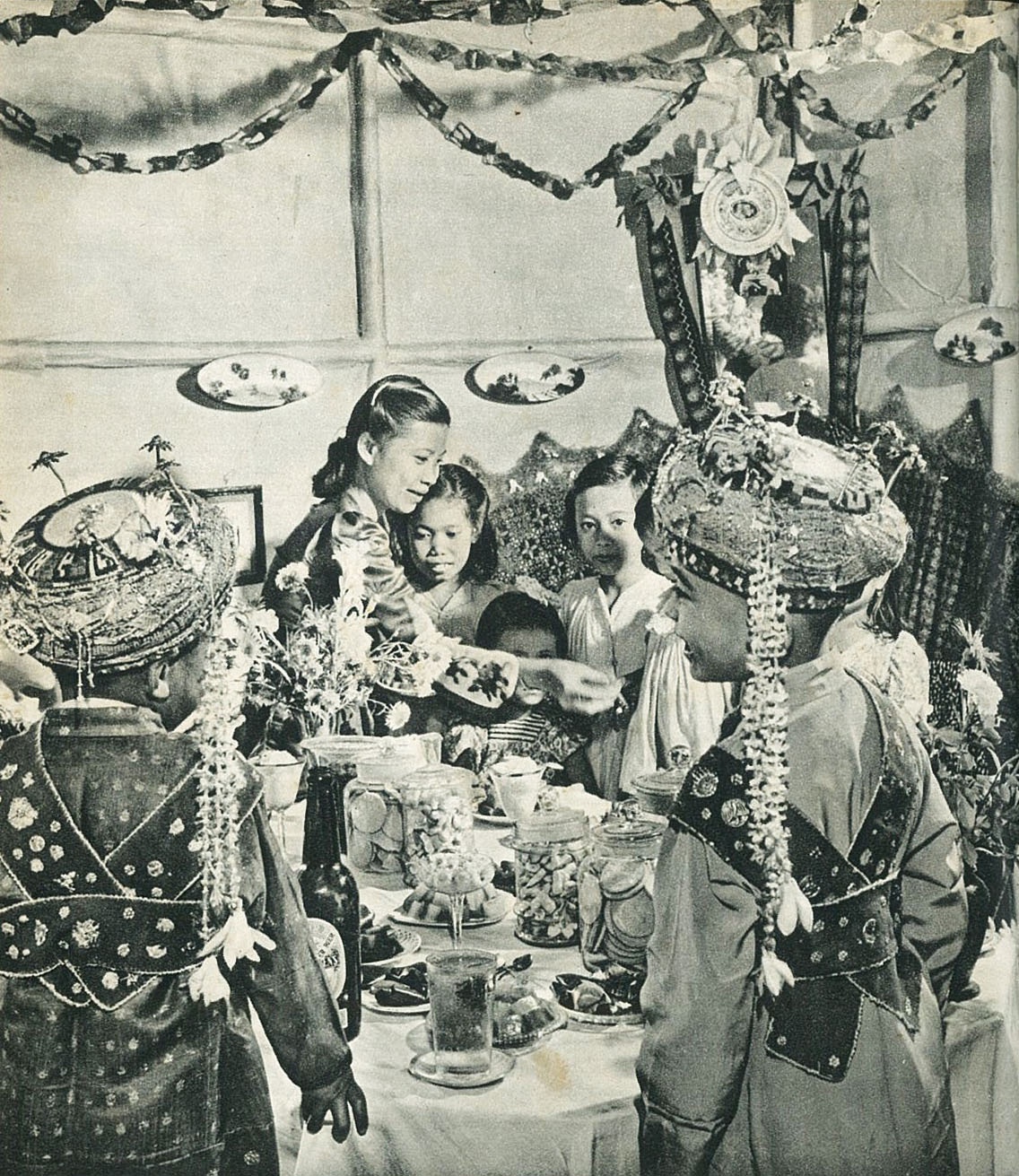
There are four main stages in the Indonesian life cycle: childhood, youth, maturity, and old age, These stages are marked by a series of rituals and social transitions that reflect a synthesis of Islamic practices and earlier indigenous traditions. [Source: Budi Susanto, Worldmark Encyclopedia of Religious Practices, Thomson Gale, 2006]
During the prenatal and early childhood periods, several important rites are observed. In many Muslim communities, a ceremony is held during the seventh month of pregnancy to invoke divine blessings for a safe birth. A second ritual commonly takes place when a family’s first child reaches approximately seven months of age, at which time the infant’s feet are symbolically placed on the ground for the first time. Although this practice originated in pre-Islamic beliefs associated with introducing the child to the earth, it has been reinterpreted within an Islamic framework as a prayer for God’s protection over the child.
The transition from childhood to youth is most clearly marked by male circumcision, typically performed between the ages of six and twelve, often around the completion of primary education. This rite signifies the boy’s entry into a liminal stage of youth, in which he is no longer considered a child but has not yet assumed the full responsibilities of adulthood. The event is frequently accompanied by large communal celebrations and holds both religious and social significance. Among Javanese communities, the transition to adolescence for girls is marked by the onset of menstruation, which is often commemorated with a communal meal known as a slametan. This ritual signifies the girl’s entry into womanhood and her changing role within society.
For both boys and girls, the youth stage is often associated with religious and moral education. Attendance at a pesantren (Islamic boarding school) has traditionally been regarded as an important preparation for maturity. Within this setting, students are expected not only to acquire religious knowledge but also to develop ethical values, including tolerance and an awareness of the interconnectedness of social and spiritual life. Such training is seen as essential for navigating Indonesia’s religious and cultural diversity.
RELATED ARTICLES:
CHILDREN IN INDONESIA factsanddetails.com
CHILD HEALTH, PREGNANCY AND BIRTH IN INDONESIA factsanddetails.com
FAMILIES AND KINSHIP IN INDONESIA factsanddetails.com
WOMEN IN INDONESIA: STATUS, WORK, ISLAM, HIJAB factsanddetails.com
GENDER IN INDONESIA: VIEWS, ROLES, DIVISIONS factsanddetails.com
MARRIAGE IN INDONESIA: LAWS, TYPES, TRADITIONS factsanddetails.com
COURTSHIP, DATING AND LOVE IN INDONESIA factsanddetails.com
BALINESE FAMILY: MARRIAGE, WOMEN, RITES OF PASSAGE factsanddetails.com
JAVANESE SOCIETY: FAMILY, MARRIAGE, GENDER, CUSTOMS, CLASSES factsanddetails.com
INDONESIAN SOCIETY factsanddetails.com
CLASSES, HIERARCHIES AND STRATIFICATION IN INDONESIAN SOCIETY factsanddetails.com
ETIQUETTE AND CUSTOMS IN INDONESIA factsanddetails.com
SOCIAL CUSTOMS IN INDONESIA factsanddetails.com
For Information on Children and Child-rearing Among Different Ethnic Groups See Minorities and Regions:
INDONESIAN GOVERNMENT, MINORITIES, CHINESE AND CHRISTIANS factsanddetails.com
ETHNIC GROUPS ON SUMATRA factsanddetails.com
ETHNIC GROUPS ON JAVA factsanddetails.com
ETHNIC GROUPS IN NUSA TENGARRA (ISLANDS EAST OF BALI) factsanddetails.com
ETHNIC GROUPS ON SULAWESI factsanddetails.com
BORNEO AND ETHNIC GROUPS IN BORNEO factsanddetails.com
ETHNIC GROUPS IN THE MOLUCCAS AND OTHER ISLANDS factsanddetails.com
BALI factsanddetails.com
ACEH factsanddetails.com
PAPUA factsanddetails.com
Javanese Child Rituals
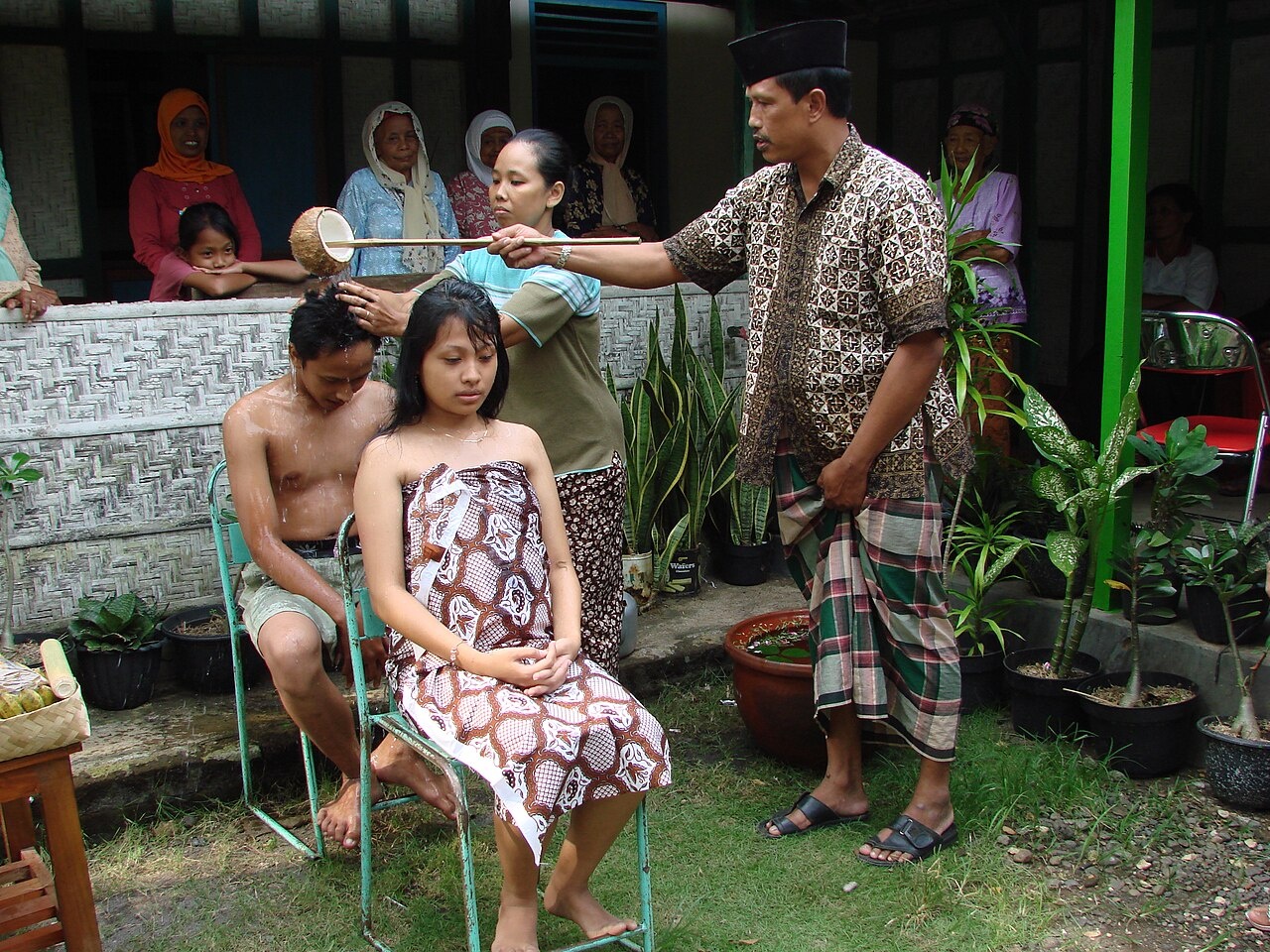
Brojolan is a coming of age ritual in which, two young yellow gading (ivory) coconuts are carved with images of the deities Kamajaya and Ratih, symbols of ideal beauty, faithfulness, and harmony in marriage. These figures represent the parents’ hopes that their child—whether male or female—will be born safely and embody similar virtues. The father-to-be, without seeing the coconuts, selects one and cuts it open with a knife. The outcome is interpreted symbolically: if the coconut splits cleanly in two, it is taken to signify a girl; if the coconut releases a spray of milk, it is interpreted as a sign of a boy. The second coconut is then carried by the mother in a cloth sling and placed on the couple’s bed. [Source: Javenese Ceremonies]
Angrem is derived from the Javanese term for “brooding” or incubating eggs, and symbolizes care, patience, and the nurturing process of bringing new life into the world. The couple sits together on a stack of batik cloths, representing eggs, in the hope that the child will be born safely and at the proper time. They then share food from the sajen (ritual offering), served on a large stone plate (cobek), which symbolically represents the placenta. The expectation is that they finish whatever they take, reinforcing ideas of responsibility and completeness.
Afterward, the coconuts and batik cloths are arranged on the couple’s bed by elders, ideally the grandparents, emphasizing the role of family continuity. The couple is expected to sleep together on this prepared bed, symbolizing readiness to care for the child with patience and unity. The following morning, the father breaks the coconuts, a gesture that conveys the importance of humility and cooperation, underscoring the belief that life should be guided by mutual support rather than individual ego.
Tedak Siten (Turun Tanah) — Ritual of a Child’s First Steps on Earth
Tedak siten is a traditional Javanese ceremony marking a child’s first contact with the ground, symbolizing readiness to begin life’s journey under divine blessing and parental guidance. The term derives from tedak (“to step”) and siten or siti (“earth”), meaning “to set foot on the earth.” [Source: Javenese Ceremonies]
The ritual is typically performed when a child reaches seven selapan (approximately 245 days after birth). A selapan refers to a 35-day cycle in the Javanese calendar, which combines the seven-day week with a five-day market cycle (pasaran): Kliwon, Legi, Pahing, Pon, and Wage. Each day is identified by a combination of these cycles, and the recurrence of a specific combination—known as a weton—holds particular significance in Javanese cultural life.
The ceremony is usually held in the morning, often in the front yard of the family home. It is attended by parents, relatives, and respected elders, who gather to offer blessings for the child’s future. Ritual offerings (sajen) are carefully prepared, symbolizing prayers for divine protection, ancestral blessings, and the avoidance of misfortune, as well as ensuring that the ceremony proceeds safely and harmoniously.
Once preparations are complete, the family and invited guests assemble at the ceremonial site, where the ritual proceeds as a communal expression of hope for the child’s well-being, prosperity, and successful integration into the social and spiritual world.
Circumcisions in Indonesia
Circumcisions are big deals in Indonesia particularly with Javanese and Muslims, among which it is closely associated with identity, hygiene, tradition and the transition to adulthood. Among males, it is nearly universal and is often regarded not only as a religious obligation but also as a cultural milestone. Even among some non-Muslim communities, male circumcision is practiced due to perceived health benefits.
Male circumcision, commonly referred to as sunat or khitan, is typically performed when boys are between the ages of five and twelve, often around primary school years. Muslim boys have traditionally been circumcised when they are around 10.
The procedure is frequently marked by celebratory events, ranging from family gatherings to large communal circumcision ceremonies. Often a group is circumcised together and there is a big party celebrating their manhood.In certain regions, such as Sumedang in West Java, the event may include elaborate cultural performances, such as kuda renggong (dancing horses), highlighting its significance as a rite of passage.
A variety of methods are used for male circumcision in Indonesia, reflecting both traditional and modern approaches. These include conventional surgical techniques, as well as newer methods such as electric cauterization (often referred to as “laser”) and clamping devices, which are favored for their efficiency, reduced pain, and faster healing times.
Indonesia Denies It Is Planning for Mandatory Male Circumcision in Papua
In February 2012, authorities in Indonesia’s remote Papua Province said that they had no plans to make male circumcision compulsory there, despite earlier media reports suggesting otherwise. Officials emphasized that while circumcision was being promoted, it would remain voluntary. “The government does not want to make male circumcision compulsory,” said Constant Karma, secretary of the Provincial AIDS Commission in Jayapura. “However, the government is promoting medical male circumcision as part of its reproductive health strategy, which includes HIV.” The clarification followed reports quoting local officials who had suggested mandatory circumcision might be introduced to reduce HIV transmission. [Source: irinnews.org, February 20, 2012]
Circumcision rates in Papua were significantly lower than in the rest of Indonesia. Only about 5 percent of ethnic Papuans were circumcised, compared to around 70 percent among non-Papuans. At the same time, HIV prevalence in Papua was much higher—about 2.4 percent among adults aged 15 to 49, compared to 0.2 percent nationally—raising concerns among health authorities.
The idea of mandatory circumcision faced strong resistance in the predominantly Christian region, where many associated the practice with Islam. Some religious leaders also questioned its effectiveness. “I don’t believe male circumcision significantly reduces the risk of HIV,” said Pastor Sadrak Simbiak, who argued that abstinence and fidelity should be the focus instead.
Despite opposition, officials said attitudes were gradually changing. “Male circumcision is not just for Muslim people and people in Papua are slowly accepting this,” Karma noted, adding that the practice had existed in some indigenous traditions before colonial times. Interest was reportedly increasing, particularly in urban areas. However, access to safe medical services remained a major challenge. Of Papua’s eight hospitals, only three were equipped to perform circumcisions, and most of the population lived in rural areas where such services were unavailable. Many people relied on community health centers that lacked the necessary facilities.
Health data underscored the urgency of the issue. Studies showed significantly higher HIV rates among uncircumcised men compared to those who were circumcised. According to global health research, medically performed circumcision in sterile conditions could reduce the risk of heterosexual HIV transmission in men by about 60 percent, reinforcing its role as part of broader HIV prevention efforts.
Female Circumcision in Indonesia
Female circumcision, or sunat perempuan, is still widely practiced in Indonesia, though it differs significantly from more severe forms of female genital mutilation found in other places. In many cases, it is symbolic or minimally invasive, involving actions such as light scraping or touching of the clitoral hood, sometimes using substances like turmeric or a small instrument. However, practices vary, and in some instances more invasive procedures have been reported.
According to UNICEF over half of women aged 15-49 who have undergone female circumcision. It is practiced by some Muslim groups in Indonesia. Though it has become uncommon in urban areas it is still widely practiced in rural areas, especially remote locations. . In some cases female circumcision is performed at birth. Often a small incision is made with the intention of drawing a few drops of blood not remove the clitotis.
In recent decades, there has been increasing medicalization of the procedure, with some parents opting to have the procedure performed by trained health workers, such as midwives, often during routine medical visits. This trend has been partly motivated by concerns over safety, although international health organizations have discouraged the practice in all forms.
The issue remains controversial within Indonesia. Religious authorities, such as the Indonesian Ulema Council (MUI), have at times supported the practice as a cultural or religious recommendation, while human rights advocates and health professionals have called for its abolition. Government policies have reflected this tension, with regulations shifting between restriction and limited allowance.
Female Circumcision Procedure in Java
Describing a female circumcision in Bandung, Java, AFP reported: Thrashing wildly, 5-year-old Reta wails as she is hoisted onto a bed during a circumcision ceremony in a school hall-turned-clinic. “No, no, no,” she cries, punching and kicking as her mother cups her tear-soaked face to soothe her. Doctors cheer encouragingly. One of them gently swipes the girl’s genital area with antiseptic and then swiftly pricks the hood of her clitoris with a fresh sewing needle, drawing no blood. The ordeal is over in seconds. [Source: AFP, March 25, 2013]
:Doctors say the procedure will have no effect on the girl, her sexual pleasure in later life or ability to bear a child. “I’m happy. My daughter is now clean,” her mother Yuli, a 27-year-old seamstress who goes by one name, said at a mass circumcision of 120 girls at the Assalaam Foundation’s Islamic school in the city of Bandung.
“She believes the ritual will nevertheless have an effect. “Many girls are getting pregnant out of wedlock these days,” she noted. “Circumcision hopefully will prevent my daughter from becoming oversexed, and will make her less amorous when she grows up.” Not everyone shares this view. One mother told AFP” “Why would any parent hurt her child? If any doctor were to mutilate my daughter, I’d be the first to protest,” reflecting the belief among some families that the ritual can be performed safely.
Mass Female Circumcision in Indonesia
Abigail Haworth wrote in The Observer: “It's 9.30am on a Sunday, and the mood inside the school building in Bandung, Indonesia, is festive. Mothers in headscarves and bright lipstick chat and eat coconut cakes. Javanese music thumps from an assembly hall. There are 400 people crammed into the primary school's ground floor. It's hot, noisy and chaotic, and almost everyone is smiling.
“Twelve-year-old Suminah is not. She looks like she wants to punch somebody. Under her white hijab, which she has yanked down over her brow like a hoodie, her eyes have the livid, bewildered expression of a child who has been wronged by people she trusted. She sits on a plastic chair, swatting away her mother's efforts to placate her with a party cup of milk and a biscuit. Suminah is in severe pain. An hour earlier, her genitals were mutilated with scissors as she lay on a school desk.
“During the morning, 248 Indonesian girls undergo the same ordeal. Suminah is the oldest, the youngest is just five months. It is April 2006 and the occasion is a mass ceremony to perform sunat perempuan or "female circumcision" that has been held annually since 1958 by the Bandung-based Yayasan Assalaam, an Islamic foundation that runs a mosque and several schools. The foundation holds the event in the lunar month of the Prophet Muhammad's birthday, and pays parents 80,000 rupiah (£6) and a bag of food for each daughter they bring to be cut. [Source: Abigail Haworth, The Observer, November 18, 2012]
For the complete article from which the material here is derived see “The day I saw 248 girls suffering genital mutilation” by Abigail Haworth theguardian.com
Indonesian Government Policy on Female Circumcision
Indonesia has maintained that severe forms of female genital cutting do not occur widely in the country and has sought to balance international health standards with local cultural and religious practices. The government banned female circumcision in 2006, but reversed the decision in 2010, arguing that the practice continued informally, often carried out by untrained traditional practitioners, which increased the risk of harm. In response to the earlier ban, the Indonesian Ulema Council (MUI) issued a 2008 fatwa permitting the practice, though it stopped short of declaring it mandatory. The ruling reflected an attempt to accommodate religious perspectives while acknowledging ongoing public debate. [Source: AFP, March 25, 2013]
Although comprehensive national data has been lacking, aid organizations have indicated that some form of female circumcision has remained relatively common. A 2003 study by the Population Council found that among reported cases, 22 percent involved excision of tissue, 49 percent involved minor incisions, and 28 percent were symbolic procedures.
Government policy has since focused on limiting the severity of the practice. A 2010 regulation permitted only minimal procedures, such as “scraping the clitoral hood without injuring the clitoris,” while criminalizing more invasive forms. However, even such minor procedures are classified by the World Health Organization as female genital mutilation.
Some religious and community organizations have adapted their practices in response to these concerns. For example, the Assalaam Foundation in Bandung reported shifting away from cutting methods toward less invasive techniques, such as symbolic pinpricks. Similarly, health officials have promoted alternatives like gently touching the area with a cotton swab, in the hope of preserving cultural meaning while reducing physical harm.
More recently, efforts have been made to address the practice through regulation and public health initiatives. A 2024 government regulation prohibited female circumcision for infants and young children under the age of five, marking a significant policy shift. At the same time, public health campaigns have encouraged safer, symbolic alternatives or the elimination of the practice altogether, particularly within clinical settings.
Pressure to Wear Hijab Leaves Some Indonesian Girls Traumatized
Ifa Hanifah Misbach was 19 when her father died, and her family told her he would not go to heaven because she refused to wear the hijab, the Muslim head covering. The experience left a deep emotional impact and shaped her later work. [Source: Kate Lamb and Yuddy Cahya Budiman, Reuters, March 18, 2021]
Misbach went on to become a psychologist in Bandung, West Java, where she counseled dozens of girls who had been ostracized, bullied, or threatened with expulsion from school for not wearing the veil. Reflecting on her own experience, she said, “The impact of religious pressures, especially to wear the jilbab, when you’re young, makes it feel like you have no breathing room. I wanted to run away.”
Her story reflected a broader pattern reported among women and girls in Indonesia, the world’s largest Muslim-majority country. While the nation’s founding ideology emphasizes religious diversity, with significant Christian, Hindu, and Buddhist minorities, observers noted a rise in religious conservatism and intolerance over the previous two decades.
According to Human Rights Watch, women and girls across Indonesia often faced “intense and constant” pressure to wear the hijab. Researcher Andreas Harsono argued that such pressure infringed on basic rights, stating, “Wearing a jilbab should be a choice, it should not be a mandatory regulation.” He added that a growing perception equated not wearing the hijab with being less pious or morally inferior.
The organization documented more than 60 discriminatory local and provincial regulations introduced since 2001 that enforced dress codes for women. A 2014 national regulation was widely interpreted as requiring female Muslim students to wear the hijab in schools. The report stated that schools often relied on psychological pressure, public shaming, and disciplinary measures to enforce compliance.
Students themselves described the intensity of these expectations. One Muslim high school student recalled being told at age 12 that “one strand of hair that is shown is equal to one step closer towards hell,” illustrating the moral and social pressures surrounding the issue.
There had been some resistance. A widely publicized case involving a Christian schoolgirl forced to wear the hijab in West Sumatra sparked national debate and led the government to issue a decree prohibiting public schools from mandating religious attire. However, rights groups noted that enforcement remained uncertain, and pressures extended beyond schools into workplaces and public services, where some women reported resigning from jobs or facing restricted access for choosing not to wear the hijab.
Image Sources: Wikimedia Commons
Text Sources:“Encyclopedia of World Cultures Volume 5: East/Southeast Asia:” edited by Paul Hockings, 1993; “Culture and Customs of Indonesia” by Jill Forshee, Greenwood Press, 2006; National Geographic, New York Times, Washington Post, Los Angeles Times, Smithsonian magazine, Encyclopedia.com, Library of Congress, Indonesia Tourism website (indonesia.travel), Indonesia government websites, Live Science, The Conversation, The New Yorker, Time, BBC, CNN, Reuters, Associated Press, AFP, Lonely Planet Guides, Google AI, Wikipedia, The Guardian and various websites, books and other publications.
Last updated April 2026