
FILIPINO CHARACTER AND PERSONALITY

Filipinos have been described as friendly, outgoing, sensitive, easily offended, nosy, garrulous, direct, hospitable, feisty, irreverent, good natured, clever, witty, gregarious, happy, generous, easy to laugh, gracious, easy to befriend, casual, fun loving, sensitive and hospitable. Personal and family honor are stressed, as well as dignity and pride. Education is highly valued and families make great sacrifices to educate their children. Hiya (shame) is instilled in Filipinos at an early age. To be shamed is the greatest form of disgrace. Filipino culture developed over centuries in tandem with and in response to Western culture introduced by the Spanish and later Americans.
Filipinos are generally more easy going than other Asians. A survey conducted by the Hong Kong-based Political and Economic Risk Constituency (PERC) ranked Filipinos as "the easiest people in Asia to get along with." In the 2006 Happy Planet Index (HPI) by a British think-tank New Economics Forum (NEF), the Philippines ranked 17th out of 178 countries, far ahead of the United States, which ranked 150. According to NEF, this report is “an index of human well-being and environmental impact”, which moves beyond crude ratings of nations according to national income, measured by gross domestic product to produce a more accurate picture of the progress of nations based on the amount of the Earth’s resources they use, and the length and happiness of people’s lives.” In the report, a list has been provided about the ranking of the countries. The NEF study measured life satisfaction, life expectancy and environmental footprint, which is the amount of land required to sustain the population and absorb its energy consumption.
Filipinos have a strong sense of family and community They are very gregarious and like to talk and hang out with family and friends. They love to fool around, gossip, make jokes and tease one another. Rumors spread quickly. Some say Filipinos are happy-go-lucky people who are often pessimistic about today but always optimistic that tomorrow will be better.
People living in urban areas are more exposed to cosmopolitan values. They tend to be less traditional and more modern. Those living in rural areas, on the other hand, still value tradition Even though life appears to be a struggle, many people are happy with their lives.
Winston posted in his blog happierabroad.com: “1) Most people are nice and good folks who are cheerful and open. It is easy to meet people and start conversations. People are always willing to enjoy life and have a good time (especially if it's on your tab of course). 2) It is the most nonjudgmental and least racist country in Asia. Filipinos are a mix of many ethnic tribes, including Chinese, Spanish and Malay. Thus it is truly multiculturally advanced and integrated. Everyone is accepted here, including misfits from other countries, as long as they are nice, courteous and law abiding. 3) People are not stuck up, but warm, open and like to enjoy life. They are not too uptight or serious about relaxing and partying. There is a very relaxed laid back attitude in the populace. They are fun and enjoy corny jokes even. [Source:Winston, happierabroad.com, December 22, 2011]
In an article on Filipino stereotypes, Alisa Krutovsky wrote in Examiner.com: 1) We [Filipinos] drive only Japanese cars, because they are reliable and practical. (Even though it’s not true to all Filipinos, many of us, and them, would agree with this one statement!) 2) Filipinos are always late...to everything. (Even though it’s regarded as a stereotype, my friend did admit the fact that she is usually late, as well.) 3) Filipino parents would get their attention, by saying, "Psst!" and "Hoy!" You are a true "Filipino", if you turn around. [Source:Alisa Krutovsky, Examiner.com, DC International Travel Examiner, December 27, 2009]
RELATED ARTICLES:
FILIPINO HIYA (SHAME), AMOR PROPIO (SELF-ESTEEM) AND GO BETWEENS factsanddetails.com
CATHOLIC, ASIAN, SPANISH AND AMERICAN INFLUENCES ON FILIPINO IDENTITY AND CULTURE factsanddetails.com
SOCIAL RELATIONS IN THE PHILIPPINES: UTANG NA LOOB, BAYANIHAN AND PAKIKISAMA factsanddetails.com
FILIPINO SOCIETY factsanddetails.com
RICH AND POWERFUL FAMILIES IN THE PHILIPPINES factsanddetails.com
ETIQUETTE AND MANNERS IN THE PHILIPPINES: CUSTOMS, PUBLIC ACTIONS, RESPECT factsanddetails.com
FILIPINO COMMUNICATION STYLES: GESTURES, BODY LANGUAGE, EYEBROWS, SPACE factsanddetails.com
PEOPLE OF THE PHILIPPINES: FILIPINOS, IDENTITY, CHARACTERISTICS factsanddetails.com
AUSTRONESIAN PEOPLE OF THE PACIFIC, INDONESIA, MALAYSIA, TAIWAN AND THE PHILIPPINES: ORIGIN, HISTORY, EXPANSION factsanddetails.com
MALAYS AND MALAY-RELATED PEOPLE: HISTORY, DEFINITIONS, ORIGINS, LIFE, CULTURE factsanddetails.com
ETHNIC GROUPS AND MINORITIES IN THE PHILIPPINES factsanddetails.com
MAIN ETHNIC GROUPS OF LUZON: TAGALOGS, ILOCANO AND BICOL factsanddetails.com
ETHNIC GROUPS OF THE CENTRAL PHILIPPINES ISLANDS: VISAYANS, CEBUANO, WARAY factsanddetails.com
MOROS: MUSLIMS IN MINDANAO AND THE SOUTHERN PHILIPPINES factsanddetails.com
LANGUAGES IN THE PHILIPPINES factsanddetails.com
RELIGION IN THE PHILIPPINES factsanddetails.com
Filipino Values
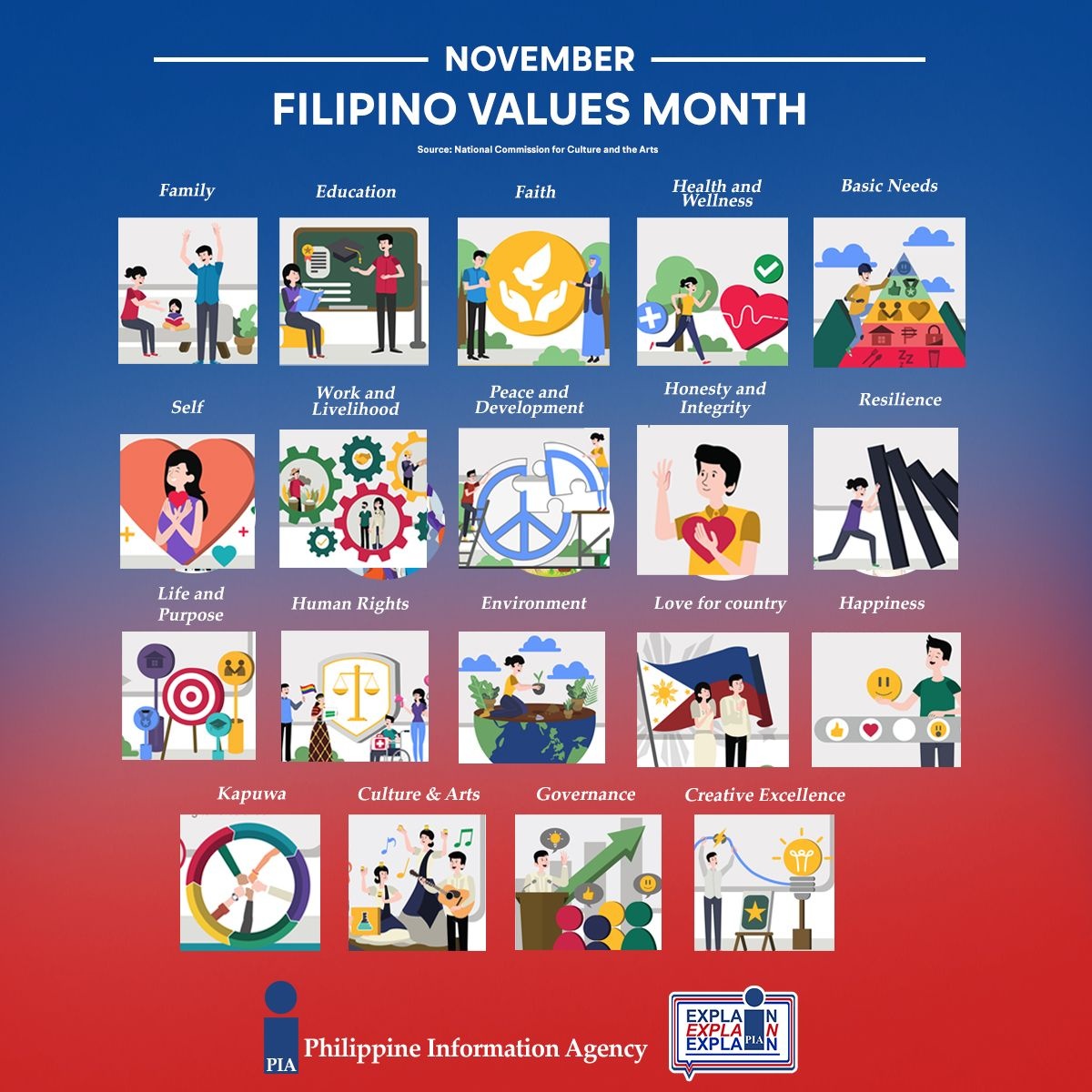
The great majority of the Philippine population is bound together by common values and a common religion. Philippine society is characterized by many positive traits. Among these are strong religious faith, respect for authority, and high regard for amor proprio (self-esteem) and smooth interpersonal relationships. Philippine respect for authority is based on the special honor paid to elder members of the family and, by extension, to anyone in a position of power. This characteristic is generally conducive to the smooth running of society, although, when taken to extreme, it can develop into an authoritarianism that discourages independent judgment and individual responsibility and initiative. [Source: Library of Congress *]
Filipinos are sensitive to attacks on their own self-esteem and cultivate a sensitivity to the self-esteem of others as well. Anything that might hurt another's self-esteem is to be avoided or else one risks terminating the relationship. One who is insensitive to others is said to lack a sense of shame and embarrassment, the principal sanction against improper behavior. This great concern for self- esteem helps to maintain harmony in society and within one's particular circle, but it also can give rise to clannishness and a willingness to sacrifice personal integrity to remain in the good graces of the group. Strong personal faith enables Filipinos to face great difficulties and unpredictable risks in the assurance that "God will take care of things." But, if allowed to deteriorate into fatalism, even this admirable characteristic can hinder initiative and stand in the way of progress. Martin Soong of CNBC wrote: Filipinos are a generous and accommodating people. You might even go as far as saying they're chronically forgiving. But do they have a more flexible moral and ethical construct.
Value orientation is the way individuals relate to objects, events and ideas. Three main obligations underlie Filipino value orientation ‘ relational (pakikipagkapwa), emotional (damdamin), and moral (karangalan). All, or one may influence work or social relationships. Three main traits underlie Filipino values and value-orientation: 1) personalism, 2) familialism, and 3) particularism (popularism). These strongly influence Filipino behaviour and decision making, and are the basis of his personal beliefs, and cultural traditions and practices. They are the basis for acceptable behaviour. [Source:Philippines Australia Business Council ^^]
1) Personalism is the emphasis Filipinos give to interpersonal relations or face-to-face encounters. Successful leadership or being a good manager necessitates a personal touch, and problem-solving is effective if handled through good personal relations. 2) Familialism emphasises the welfare and interest of the family over those of the community. The family is the basis of group action and almost all community activity centers on the family. The family, and not the individual, decides on important matters, and these are decided on the basis of family, not individual interest. The family honour, and not that of the individual, is at stake when a family member makes a mistake. 3) Particularism results from the strong family influence on individual and group behaviour. Individuals strive to promote their own and their family’s interests over community interests. Being popular among peer groups is highly desirable, hence Filipinos make special efforts to entertain friends and relatives. Knowing how to entertain people (marunong umasikaso ng kapwa) is important. Conformity to proper codes of conduct reaps the rewards of cooperation and assistance; non-conformity is punished by withdrawal of support. ^^
Filipino Traits
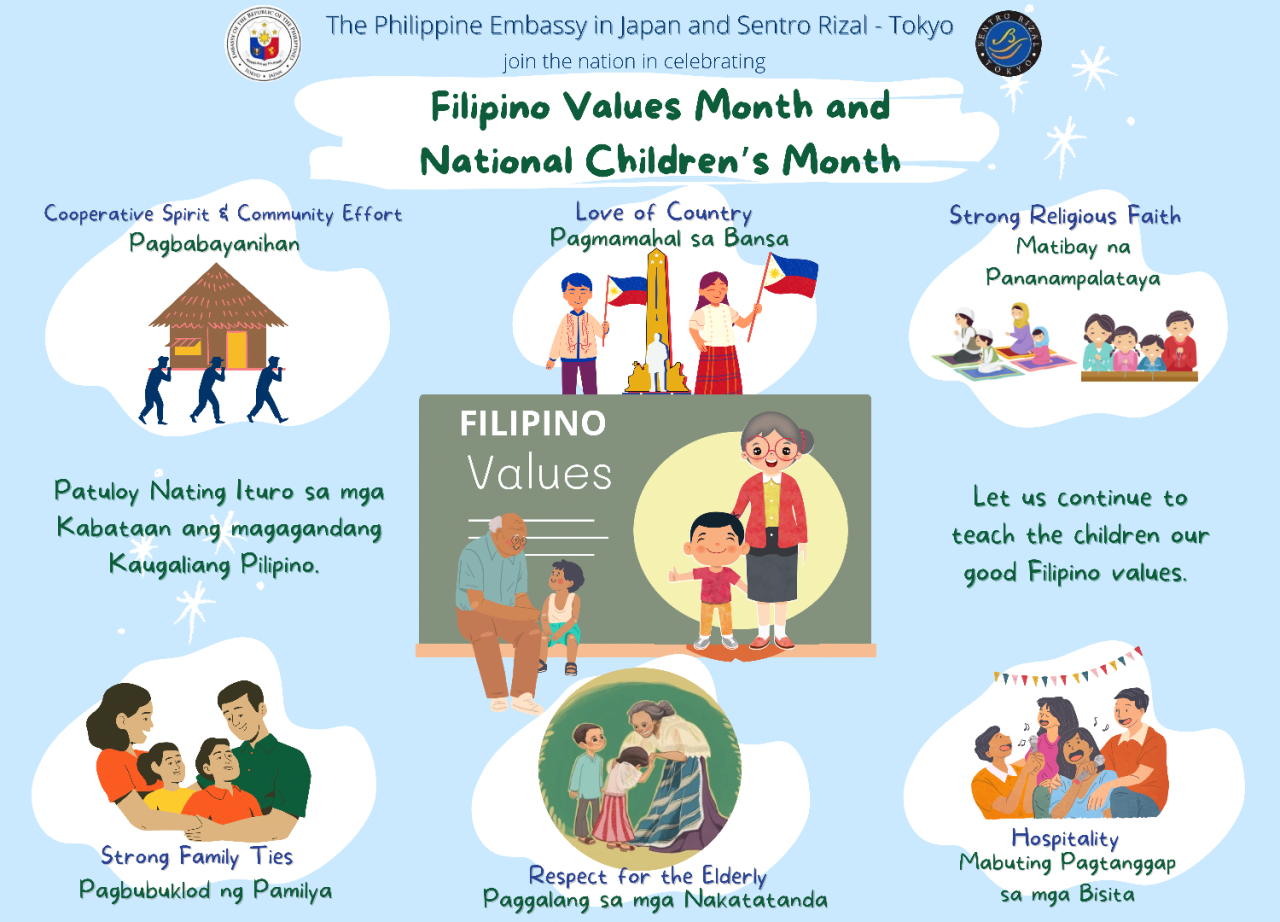
According to Thank God I'm Filipino (TGIF): 1) Filipinos are known for being late or not showing up.The Filipino’s mañana habit causes the delays in many public transactions and even corporations. This attitude can effect the engagement to wait until tomorrow or the next day especially when the person involve is not interested or not in the mood. However, one must remember that many Filipinos take their time in doing things or in making decisions.. Some are punctual for social meetings. But in fact, it is not expected to arrive exactly on time especially at a party. It is advised that you always check with the host or hostess the time of you are expected to arrive. 2) Some male Filipinos are proud and arrogant that they will not accept losing face, particularly in the crowd. They don’t like the idea of being defeated or embarrassed. In some cases, losing face or being humiliated is the cause of street brawls, drinking bouts or even killings in the country. 3) The Filipino hiya or shame trait stems from losing amor propio which is a Spanish word, meaning pride. Filipinos find it difficult to confront someone so as not to humiliate the person or cause person to lose his amor propio. ^
Some Positive Traits of Filipinos: 1) Say Opo/ Po To elders as respect in talking. 2) Filipinos Mano on the elders when greeting them, which is also a part of respect. 3) Most Filipino schools dont bully, not like in other foreign countries. 4) We believe in only one God, which is God (Most of us are Catholics) 5) We always pray, before going to eat, going to bed...etc. 6) We love to laugh. 7) Some are helpful. 8) There's no such thing as nerds here in us, and we don’t tease smart people. 9) We are friendly. 10) In the old days, if a boy wants a girl, the boy should speak to the parents first, and do everything just to accept him and to marry the girl.(that was in the OLD days). 11) The father is not the only bread winner of the family, also their children.- Most of us don’t care if your ugly or beautiful, it all depends on the personality. ^
Some Negative Traits of Filipinos: 1) Some give birth at an early age ...16. 2) Some just don’t mind their own business. 3) Have many bad habits, like drinking, smoking....etc.- 4) Some poor teenagers sell their bodies just to have money (prostitutes). 5) Most Filipinos have sad/dramatic lives. 6) There are many broken families. 7) There are a lot of holduppers, kidnappers, rapers, robbers and others which we really cannot avoid. 8) Almost all Filipino Presidents corrupt out country. 9) A lot of Bad words to choose from which Filipinos just cant avoid saying those. 10) A lot of Filipinos are hard workers.( Same as students) 11) We tend to be with our friends most of the time than to be with our parents. ^
Bahala Na”(“Come What May”)
The expression bahala na is often interpreted as a form of fatalism. Literally, it means “leave it to God” or “let circumstances take care of themselves.” In everyday life, it reflects the idea of placing trust in fate, divine guidance, or the outcome of events beyond one’s control. Bahala na enables a person to meet difficulties and shortcomings with resignation by leaving it up to the Almighty to sort things out. This attitude can also result in overconfidence that everything will work out in his interest without doing anything. [Source: Thank God I'm Filipino - TGIF, Facebook, October 8, 2010 ^]
Bahala nais shaped by the social environment in which many Filipinos operate. Decisions often involve consideration of family members, superiors, and other people whose opinions carry weight. Within such networks, an individual may feel limited in how much control he or she actually has over the final outcome. Saying bahala na can therefore express acceptance of these uncertainties and a willingness to let events unfold.
At times, the phrase can also function as a practical way of dealing with complicated or uncertain situations. When decisions become tangled with many competing interests or when the outcome depends largely on other people, bahala na may signal a pause in planning and worrying. Rather than struggle endlessly over something difficult to control, a person may choose to move forward and trust that things will work out as they should. The bahala na attitude is the outcome of the mañana habit when the tasks are left undone. This is usually shown and even expressed by people who do not care much of what lies ahead and just leave everything in fate.
Good Time Filipinos, Fiestas and Anthony Bourdain

Filipinos are a fun-loving people. Throughout the islands, there are frequent fiestas and foreign visitors are easily welcomed into people’s homes. According to Thank God I'm Filipino: “Filipinos are gregarious, friendly and hospitable. They sing and dance even when it’s storming, laugh at anything and have a communal sense of fun. National Geographic photographer Karen Kasmauski said Filipinos keep up a positive attitude often in the face of great adversity. “Filipinos know that life can change quickly, so why not celebrate it while you can? Almost anything is cause for a parade or a party; a reason for music and dancing. They seem to engage with life intuitively, in present time, instead of worrying about what might lie ahead or dwelling on the past.”
Anne C. Kwaantes wrote in Christian Classics Etheral Library: “Everyone here agrees — Filipinos love fiestas. The word "fiesta" will bring a smile to the face of almost any Filipino. After all, a fiesta is a special time with friends, a time for fellowship, food, and lots of activities. Each year brings numerous fiestas. Sometimes people are busy for weeks preparing for them. It is surprising, how even those facing many problems in their day-to-day life set them aside and participate in the festivities. [Source: Anne C. Kwaantes, Fourum, Winter 2000, Christian Classics Etheral Library, pages 6, 7]
Every Catholic town in the Philippines celebrates an annual barangay, or 'barrio', fiesta in honor of their patron Catholic saint. During this period, there are large processions and parades throughout the town, with the saints, the mayordomo or sponsor of the fiesta, and school children marching through the settlement to band music or music played on a videocassette. In addition, each family visits other neighbors and relatives to share home-cooked, special 'feast' foods during the fiesta. In many coastal or riverine communities, fishers celebrate by carrying the image of the patron saint on boats in a fluvial procession to bless the waters and fish. The sacred days of the Roman Catholic calendar also affect traditional livelihoods. For example, Good Friday, the day Jesus Christ was crucified, even today is considered a 'taboo' day for fishermen. It is an omen of terrible fates, and fishers fear for their lives if they go out fishing on that day. In the past, every Friday was deemed to be a risky day to go fishing, but these beliefs have been modified over time.
The CNN food journalist Anthony Bourdain developed a deep, personal connection to the Philippines through his Filipino staff who helped raise his daughter, Aria, and his frequent culinary travels there. He often praised Filipinos for their resilience, immense hospitality, and culinary talent, calling them "the most giving people". Bourdain wrote: Thanksgiving, Christmas, New Years, vacations and birthdays are celebrated together, our families in and out of each others' homes interchangeably. So, I have noticed some things, some features of Filipino daily life that I thought worth investigating. There's always singing, for instance. Everybody seems to sing — an affinity passed on to my daughter. Family — and church, of course, loom large (even in my otherwise atheistic household). And food. My daughter is no stranger to sisig and sinigang and adobo and holds me in disregard for being unable to procure her the delicious Filipino pastries and breads she finds at her other family's home. She knows a few phrases in Tagalog and looks at me pityingly when I don't know what she's talking about...Nothing goes to waste around here. Anything, no matter how small, that could be of use to anyone who might need it back home, gets packed in a big box and sent to the other side of the world — if not to family members, to someone in need. [Source: Anthony Bourdain, CNN, April 22, 2016]
Emotional Filipinos
Filipinos have been accused of being overly fatalistic and concerned only with the here and now. “Bahala na” is popular expression that roughly translates to “I don’t care what happens in the future, as long as I survive now.” The Filipino-American actress and singer Vanessa Hudgens told the Philippine Daily Inquirer: "Filipinos are very passionate...You look at Manny "Pacman" Pacquiao, wohoo! You don't want to mess with him. My mom, too, is extremely passionate. You don't want to piss her off. I really enjoy it because there's a little fighter inside of me. There has to be a fighter inside of you to stay in this business, or you wouldn't get anywhere." [Source: Ruben V. Nepales, Philippine Daily Inquirer, Asia News Network, March 25, 2011]
The Philippines was ranked as the most emotional society in the world, with Latin American countries dominating the top of the list, in a three-year study conducted by Gallup in more than 150 countries. In another study Filipinos were ranked as the 6th most positive people in the world, Panama was the most positive country with Paraguay coming in second and Thailand came in sixth. [Source: Agence France Presse, November 24, 2012 ]
The Singapore-based Malaysia journalist Seah Chiang Nee wrote: When a person “meets a German or a Japanese, the tone should be serious and purposeful – not a back-slapping “Hail Fellow thee!” way which he can use on a friendly Filipino or Malaysian. If he gets too familiar with people in Germany or Japan, they would probably think that’s he’s too flippant and not someone to be trusted. The reason, I explained, was that the Germans and the Japanese were generally very serious, disciplined, industrious and humourless. Treating Filipinos too seriously, on the other hand, could have the opposite effect, impressing upon them that you are too uppity. [Source: Seah Chiang Nee, Star, December 8, 2012]
Most Filipinos are generally open about their emotions (as long as in their judgment, they are appropriate and positive). But they do not normally express anger in public so as not to appear rude. Public display of affection such as holding hands and putting arms around the shoulders of one’s significant other are acceptable. There are few social sanctions with respect to modest displays of affection in public. Rural areas tend to more conservative. There is much greater tolerance of public signs of affection between people of the same sex than in western countries. [Source: Canadian Center for Intercultural Learning+++]
Public displays of anger and other strong emotions are not well regarded, but do occur, particularly by (social) "superiors" when interacting with (social) "inferiors" (e.g. employers—employees, landowners-tenants/ agricultural labourers). The socially "inferior" target of such anger or emotion is unlikely to defend himself or herself, will often deeply resent such outbursts. Foreigners in "superior" positions —particularly Americans (including Canadians) and other non-Asians—may well be subconsciously held to higher standards than their Filipino counterparts with respect to use of strong emotions in public.
One person posted on happierabroad.com: “If a Filipino is angry he does not think about the consequences of his actions, he just starts a fight. Sometimes there are stabbings. Then they end up in jail for a long time. Many crimes are just crimes of passion and the people had no control. I have even noticed that with stateside Filipinos- they do not think of consequences. Here in Angeles City some American guy got into a fight with street vendors and taunted them. They went totally berserk and stabbed him 9 times. They are all in jail now for life. The guy is dead. [Source: Winston, happierabroad.com, December 22, 2011]
In April 2007, an American Peace Corps volunteer, Julia Campbell, 40, of Fairfax, Va., disappeared during a solo hike to Ifugao province's famed mountainside rice terraces. Initially it was thought that she might have fallen and been carried away a rushing stream but later her killers confessed on television to what he did. Associated Press reported: “The man suspected of killing a Peace Corps volunteer who was beaten to death and buried in a shallow grave gave himself up. Juan Duntugan claimed he was fuming about a running feud with a neighbor when Julia Campbell bumped into him from behind, causing him to drop a bundle of clothes he was carrying. "My mind went blank," Duntugan told ABS-CBN television. "I did not know who she was or what she was. I got a rock and I hit her on the head. [Source: Associated Press, April 27, 2007 ]
Hospitality, Honesty and Resiliency of the Filipino People
National Geographic photographer Karen Kasmauski said, “Filipinos are such warm, hospitable people. Whenever I go there, I always feel like that I’m a special guest. People welcome me into their homes, to their weddings, their funerals, their religious celebrations. Because so many Filipinos emigrate to other countries they know what it feels like to be a stranger in a foreign country; they know hard it can be. So when a visitor comes to their country, they want to be welcoming. And their strong sense of family and community extends to everyone.”
According to Thank God I'm Filipino:“Being a hard-working people, the Filipinos are also honest. In general, they would prefer to work hard for an honest day’s pay than to find an easier way like stealing or cheating. As in the case of overseas Filipino workers or OFWs, they are mostly domestic helpers and though given a job which requires a lot of trust from the employer as they are left alone with their belongings or children, it is rare that Filipinos would do anything to betray or lose the trust that is given to them. We see so many Filipinos working in the homes of other families precisely because they can be trusted. But even in our own country, Filipinos have displayed honesty in various forms, may it be from a taxi driver returning a dropped phone or wallet. Filipinos would choose to do the right thing, though sometimes this is not necessarily true. [Source: Thank God I'm Filipino - TGIF, Facebook, October 8, 2010]
“The Philippines is a hotspot for disasters, natural and otherwise. Couple that with poverty, and one would think that Filipinos have the most reason for being a depressed people. However, we have demonstrated time and again that Filipinos can bounce back from a tragedy, emerging stronger and better than before. In the middle of a disaster, Filipinos can still manage to smile and be hopeful that the next morning brings new hope. We have shown the world that by working together as a nation, we have what it takes to recover from a bad situation. This is something that all of us should be proud of, no matter where in the world we are. With all of these good traits (and more!), one would really be proud to say, “I am a Filipino.” Filipinos have shown the world that by working together, we have what it takes to recover from a bad situation—and this is a trait that we should all be proud of.” [Ibid]
Filipino Aggression, Callousness and Emphasis on Appearances
Filipinos can be aggressive and threatening. Sometimes and in some places the Philippines can be a dangerous place. There are stories in newspaper articles about Filipino men killing other men for staring at them or making fun of the way they sing “My Way” at a karaoke.
The manner of Filipino doctors can be strange and off-putting to Westerners. They may appear overly jovial of to to be enjoying themselves when they tell someone they have a very serious health problem. They doctors are not beeing callous; rather it is the accepted bedside manner in Philippines. [Source: “Culture Shock!: Philippines” by Alfredo Roces and Grace Roces, Marshall Cavendish International, 2010]
Another commonly used expression is balimbing, named after the many-sided star fruit. The term refers to a person who shifts loyalties for personal advantage. The metaphor suggests someone who is not merely two-faced but many-sided, changing positions depending on circumstances. In Philippine political discourse, the label has often been used to criticize individuals who switch allegiances between rival factions.
Filipinos place considerable importance on appearances. A clear distinction is often made between a person’s public image (mukha, literally “face”) and the inner self. Because of this, personal problems are rarely discussed openly. For example, a husband would not normally confide in others about his wife’s shortcomings, since doing so might reflect poorly on him as well. Similarly, one might maintain a long association with a colleague who has several mistresses without ever raising the issue. Even unhappy marriages may continue to present a stable public image, as preserving appearances is considered important. [Source: “Culture Shock!: Philippines” by Alfredo Roces and Grace Roces, Marshall Cavendish International, 2010]
At times, this emphasis on outward image can lead to superficiality, where appearances are treated as more important than genuine achievement. Filipinos have several terms that criticize this behavior, such as balatkayo (hypocrisy or disguise), pabalat-bunga (literally “fruit skin,” implying something that looks good on the outside but lacks substance), and pakitang-tao (a show put on for public approval). Because of this awareness, people also place high value on loob, meaning the inner self or true character, which is believed to reveal a person’s real intentions and moral qualities.
Bad Side of Filipinos According to One ExPat
Winston posted in his blog happierabroad.com: “Many people are rude and inconsiderate without manners or civilized behavior. They cut in line in front of you, interrupt when you're talking to a salesperson, are pushy when they want you to buy something, etc. Beggars will touch you and stand in your way and demand donations. Trike drivers will cat call you as if you were their pet. I've seen construction workers use electric drills and saw wood right in the middle of a crowded restaurant, totally oblivious to the fact that they are annoying the hell out of the customers! (fortunately they were ordered to stop eventually) But boy I've never seen such clueless people. [Source:Winston, happierabroad.com, December 22, 2011 ]
People have a "do whatever you feel like and to hell with the consequences" attitude, which can be fun but sometimes hazardous too. They are prone to act out without inhibition. People have a strong sense of loyalty and duty to family, but not a strong conscience, sense of ethics, morality or fairness. Lying is not considered wrong, but a normal tactic. There is no guilt when one does wrong. There is a mentality that everyone has "an equal opportunity to ripoff each other".
“Filipinos do not even feel guilty about wasting their own food, leaving it out to spoil or leaving uneaten rice in the cooker to spoil, which they will do over and over again. Thus there is no shame at all in wasting even their own resources. It is not uncommon for a Filipina to get taken to a restaurant, order a meal and then take only one or two bites, throwing the rest away, not even taking it home, all because they aren't paying for it. It's a total disregard for waste. Filipinos themselves will playfully admit that they typically behave like children in that when they want something, they want it NOW, without regard to expenses or consequences. So basically you would be dealing with "adult children". “There is a lack of common sense in that mistakes are often repeated over and over again, as if they never learn from them. For example, if food is left out to spoil and has to be thrown away, they don't try to prevent it from happening again, but simply do it again and again. If during a party, someone puts their beer bottle on a narrow wooden plank, which common sense tells you will fall in only a matter of time, and it does fall as predicted, they simply do it again next time. When mothers give their toddler kids drink and food to hold, which they then spill all over the ground, the mother does not learn from that, but simply repeats the mistake again, resulting in the same consequence.
“And if kids get hurt or maimed from playing with fireworks and throwing them in front of people on public streets, they simply do it again and again, like they don't care. This is not just a lack of common sense, but a form of madness without regard for consequences too. It also shows a lack of regard for safety and wasting resources.
Filipinos Definitely Love to Get and Hate to Give
Winston posted in his blog happierabroad.com: “Filipinos definitely love to GET and HATE to give. This explains in part why salaries are so low in the Philippines that many have to go abroad to work or resort to receiving funds from overseas relatives or foreigners. They are so low because everyone hates giving and is super stingy, while of course they are always happy to receive as much as possible from others. This creates an obvious imbalance in their society that leads to problems. [Source:Winston, happierabroad.com, December 22, 2011 ]
“The basic hypocrisy here is that everyone is always wanting to get but no one wants to give. This creates an imbalance that leads to consequences. To them, there is no shame at all in taking, but there is in giving. When Filipinos do give, it's always very little, and if it goes beyond that, there will be extreme reluctance and an attempt to make you feel guilty for forcing them to give. Giving goes against their nature. This is why foreigners who live in the Philippines or have done business there will tell you that "When money is flowing from you to them (Filipinos) they will be nice and friendly to you. But when money is flowing from them to YOU, they will see you as a devil."
“Many Filipinos feel NO SHAME at all in receiving things, even at great expense to the giver, but in fact have an OVEREAGERNESS and INSATIABLE appetite for it. They receive with a child-like glee, as if they were children jumping up and down in front of Santa Claus waiting for their gifts. Try this: When you are in a department store, go to a sales associate and point to some fancy expensive item and jokingly say, "How about I buy that for you?!" Notice how they light up with glee and delight as they say "Oh really?! You buy that for me?" as though he/she were a child, totally forgetting the nonsensical nature of a total stranger buying an expensive gift for another stranger for no reason. That's because their desire to receive without shame or guilt supersedes everything without inhibition. It's the nature of their character. There is no shame or guilt in seeing you waste your money either, even if you're poor or on a budget. They are always very willing to receive things from you, even if it bankrupts you.
“Many are also not shy to ask you directly for a gift either, hence the popular cultural line they give you when you are about to travel: "Don't forget my pasalubong (gift)." Even jokes like that are revealing in regards to a culture's mentality. Such greediness is the worst in Manila and Angeles City, but not as bad in the rest of the country or the provinces. In this area, there is a double standard in that while it is ok for a Filipino to want to receive things for FREE, and take advantage of any FREE thing they can get, it is considered out of line and rude for a foreigner to expect to get anything for free. Instead, foreigners are supposed to enjoy paying for everything, not expecting anything for free. Yet a Filipino is allowed to gleefully want and expect free things, especially from foreigners, as though it were an entitlement they had been waiting for, like a child waiting all year for Santa to visit his home.”
Running Amok and Juramentado
Some psychologists have suggested that the phenomenon known as “running amok” is linked to cultural patterns found in parts of Southeast Asia, including the Philippines and the wider Malay world. In societies where open displays of anger or hostility are often discouraged in order to maintain social harmony, resentment may sometimes be suppressed rather than expressed directly. In Filipino terms, this hidden resentment is described as nagtatanim ng galit, literally “planting or seeding anger.” Over time, this bottled-up frustration may build until it erupts in an uncontrollable outburst of violence. Traditionally, a person described as “amok” might suddenly attack those nearby—sometimes even relatives—often using a knife or bolo. Afterward, the individual might appear confused or unaware of what had happened, which observers historically distinguished from the Western idea of someone “going berserk.” [Source: “Culture Shock!: Philippines” by Alfredo Roces and Grace Roces, Marshall Cavendish International, 2010; Wikipedia]
See Separate Article: KORO, LATAH AND RUNNING AMOK factsanddetails.com
Among some Muslim communities in the southern Philippines, a related but different historical phenomenon developed that became known in Spanish accounts as the juramentado. In this case, the act was not random or impulsive. Instead, it involved a ritualized vow to carry out a violent attack against enemies—usually colonial soldiers or authorities—with the expectation that the attacker would be killed afterward. The term juramentado comes from Spanish and means “one who has taken an oath.” In local Islamic tradition, the act was sometimes connected with the idea of parrang sabil, interpreted as fighting in the path of God.
Historical accounts describe elaborate preparations for such attacks. The individual might seek the approval or blessing of a religious leader, say farewell to his family, and undergo ritual purification, including washing the body, shaving the eyebrows, and dressing in white clothing associated with burial rites. These preparations symbolized acceptance of death and the belief that the act would bring spiritual reward.
The phenomenon was most commonly associated with the Moro peoples of Mindanao and the Sulu Archipelago, particularly during periods of conflict with Spanish and later American colonial forces. For centuries, Moro communities resisted outside control and developed a reputation as formidable seafarers and warriors. Although they were often outmatched by modern firearms and military equipment, they relied on mobility, local knowledge, and daring tactics to challenge colonial armies.
It is important to distinguish between the two concepts. In popular usage, “amok” refers to a sudden, uncontrolled burst of violence directed at anyone nearby. By contrast, a juramentado attack was deliberate, ritualized, and aimed at specific enemies, often motivated by a mixture of political resistance, religious belief, and the pressures of colonial conflict. Both terms, however, reflect how historical observers tried to explain extreme acts of violence within the cultural and political contexts of the Philippines.
See Separate Article: MINDANAO BLOOD FEUDS AND JURAMENTADO (FILIPINO RUNNING AMOK) factsanddetails.com
Regional Differences in the Philippines
Identification with one’s group is regarded as strong and remains strong even when the groups go over seas. Tagalogs are regarded as proud, boastful and talkative. Pampangans are considered independent, self-centered and materialistic. Ilocanos are seen as hardworking, aggressive and worried about the future. And Visayans are seen as fun-loving, musical and courageous. Batangueños are known as the "salesmen of the Philippines."
Filipinos have a strong sense of regionalism. Strong ties bind those who come from the same province or those who speak the same dialect. They support each other because they consider themselves as "brothers or sisters". Sometimes, it is whom you know that counts when facilitating papers or when trying to get quick and positive results. [Source: Canadian Center for Intercultural Learning+++]
There are strong ties between Filipinos of the same area of origin and ethnic group and language. In Metro Manila, businesses and settlements may be organized in such groups. Although most Filipinos can converse in Tagalog (the basis of the national Filipino language), the majority of Filipinos grow up speaking other Malay based languages. It is only at the high school level that Filipino (Tagalog) becomes the common language of instruction and at the tertiary level English is the normal language of instruction. While most major Malay based ethnic groups do accept each other well, people prefer to interact socially and live close to workers from their own ethnic group. +++
Although many Chinese Filipinos do not speak any Chinese dialects or are not aware of their Chinese genealogical origins, there is some resentment of the success of Chinese-Filipino business and commercial enterprises and, in particular, of the Chinese community’s support for financing its own businesses and the high rates of interest some frequently charge on informal loans and loans for consumption purposes. +++
There are many diverse pockets of indigenous tribal groups in the remote hilly and mountainous areas of the Philippines. These peoples speak languages unrelated to Malay and have different ethnic origins than mainstream Malay culture Filipinos. In the Cordillera mountain provinces of Northern Luzon they are collectively known as Igorots; elsewhere in Luzon there are Aeta communities; in Mindoro Mangyan communities live in much of the uplands; in the Visayan islands of the central Philippines these indigenous minorities are referred in somewhat derogatory fashion as "Negritos" +++
Image Sources: Wikimedia Commons
Text Sources: “Encyclopedia of World Cultures Volume 5: East/Southeast Asia:” edited by Paul Hockings, 1993; “Culture Shock!: Philippines” by Alfredo Roces and Grace Roces, Marshall Cavendish International, 2010; National Geographic, Live Science, Philippines Department of Tourism, New York Times, Washington Post, Los Angeles Times, Smithsonian magazine, Encyclopedia.com, Library of Congress, The Conversation, The New Yorker, Time, BBC, CNN, Reuters, Associated Press, AFP, Lonely Planet Guides, Google AI, Wikipedia, The Guardian and various websites, books and other publications.
Last updated March 2026