
ISLAM INTRODUCED TO THE PHILIPPINES
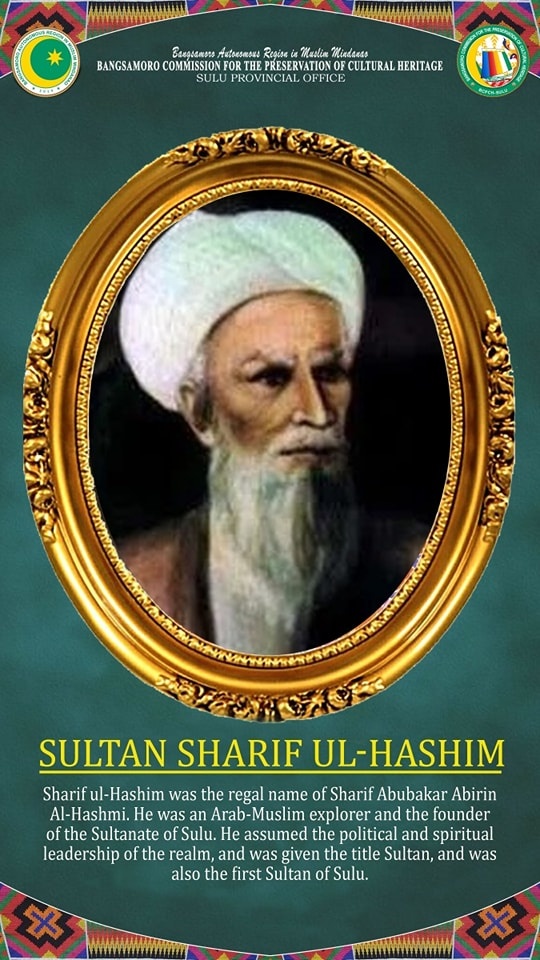
Islam came to the southern Philippines in the 15th century from Malaysia and Sumatra via Brunei and Borneo. The religion spread to Palawan and Manila but was halted by the arrival of the Spanish. Islam has endured on the southern island of Mindanao and the Sulu archipelago between Borneo and Mindanao.
Islam was brought to the Philippines by traders and proselytizers from the Indonesian islands. By 1500 Islam had gained a foothold in much of coastal Philippines and was established in the Sulu Archipelago and spread from there to Mindanao; it had reached the Manila area by 1565. Muslim immigrants introduced a political concept of territorial states ruled by rajas or sultans who exercised suzerainty over the datu. Neither the political state concept of the Muslim rulers nor the limited territorial concept of the sedentary rice farmers of Luzon, however, spread beyond the areas where they originated. When the Spanish arrived in the sixteenth century, the majority of the estimated 500,000 people in the islands still lived in barangay settlements. *
Philippine Muslims regard themselves as descendants of the Royal Sultanate of Sulu. The Royal Sultanate of Sulu was an Islamic kingdom that ruled the islands and seas in the southern Philippines and northern Borneo long before the arrival of the Spanish. The Muslim sultanate of Brunei was a very powerful kingdom in the16th century. It ruled over all of Sarawak, Sabah and Borneo as well as part of the Sulu Islands and the Philippines.
The Spanish viewed the Muslims as natural enemies, identified with their Muslim rivals at home, the Moors of Morocco. There was some Muslim-Christian elements to the early conflicts with the Spanish. The “Moro Wars” continued off and on for 300 years after the Spanish arrived. The Christian Spanish had drove Muslims off the northern islands by the early 1600s. Later the Spanish attacked Muslim city-states on Mindanao and established a Jesuit base in eastern Mindanao in Zamboanga. The Muslims were excellent boatmen. After declaring “jihad” (holy war) against the Christians, they were able to defend their Islamic territories and raid Christian outposts. It wasn’t until the introduction of steamships in the 1800s that the power of the southern Muslim sultanate was brought under control by the Spanish.
RELATED ARTICLES:
MOROS: MUSLIMS IN MINDANAO AND THE SOUTHERN PHILIPPINES factsanddetails.com
MORO (MUSLIM ETHNIC GROUPS) ON MINDANAO factsanddetails.com
LUMAD (INDIGENOUS ETHNIC GROUPS) OF MINDANAO factsanddetails.com
TASADAY OF THE PHILIPPINES: STONE-AGE TRIBE, A HOAX, OR SOMEWHERE BETWEEN factsanddetails.com
ETHNIC GROUPS IN SULU ISLANDS factsanddetails.com
SAMA-BAJAU SEA PEOPLE: ORIGIN, HISTORY, LANGUAGE, RELIGION factsanddetails.com
SAMA-BAJAU LIFE AND SOCIETY: FAMILIES, VILLAGES, CULTURE, LIFE AT SEA factsanddetails.com
SAMA-BAJAU GROUPS OF THE PHILIPPINES, BORNEO AND INDONESIA factsanddetails.com
ETHNIC GROUPS OF THE CENTRAL PHILIPPINES ISLANDS: VISAYANS, CEBUANO, WARAY factsanddetails.com
ETHNIC GROUPS ON PALAWAN factsanddetails.com
ETHNIC GROUPS AND MINORITIES IN THE PHILIPPINES factsanddetails.com
MAIN ETHNIC GROUPS OF LUZON: TAGALOGS, ILOCANO AND BICOL factsanddetails.com
Early Filipino Sultanates
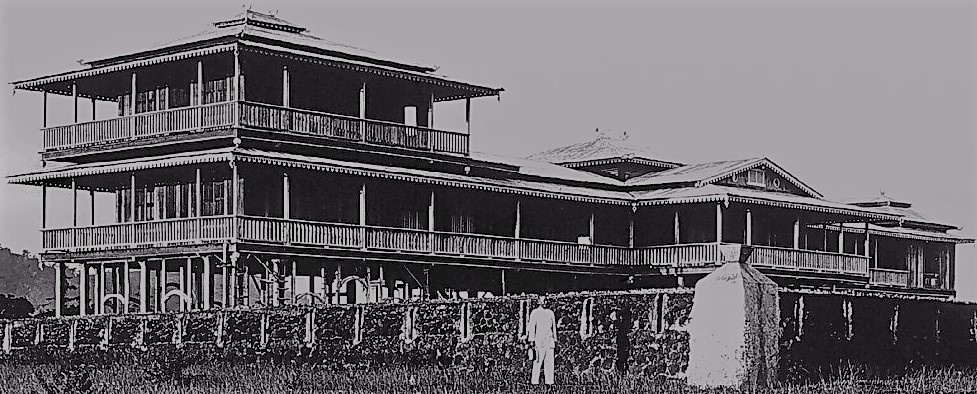
Sulu Sultanate was a Sunni Muslim Tausug state that exercised authority over the Sulu Archipelago, coastal parts of southern Mindanao, and sections of Palawan in the Philippines, as well as areas of northeastern Borneo, including parts of modern-day Sabah and North Kalimantan. It grew wealthy from the spice trade, pearling, weapons sales and the slave market. As head of an Islamic polity, the sultan embodied both political and religious authority. Official genealogies traced his lineage to the Prophet Muhammad, and he was expected to exemplify moral virtue and piety. Mirroring the political hierarchy was a religious structure that converged in the person of the sultan and extended downward through the kadi (judge), ulama (scholars), imam, hatib (preacher), and bilal (caller to prayer), who served as legal advisers and mosque officials at various levels of society. [Source: Wikipedia, Clifford Sather, “Encyclopedia of World Cultures Volume 5: East/Southeast Asia:” edited by Paul Hockings, 1993]
The sultanate was founded either in 1405 or in 1457 by Sharif ul-Hashim, a Johore-born explorer and Sunni religious scholar. Upon establishing rule in Buansa, Sulu, he assumed the regnal name Paduka Mahasari Maulana al-Sultan Sharif ul-Hashim. Under his leadership, the polity consolidated Islamic authority in the region. In 1578, the Sulu Sultanate asserted its independence from the Bruneian Empire. The Sulu Sultanate is possibly referenced in the Javanese epic Kakawin Nagarakretagama, written in 1365, where a polity called Solot is listed among the territories within the Tanjungnagara (Kalimantan–Philippines) region said to fall under the mandala sphere of influence of the Majapahit Empire. Until the mid-nineteenth century, the Sulu Sultanate conducted extensive trade with China in pearls, birds’ nests, trepang (sea cumcumber), camphor, and sandalwood.
Sultanate of Maguindanao emerged in the late 15th or early 16th century when Shariff Mohammed Kabungsuwan of Johor introduced Islam to Mindanao. After marrying Paramisuli, an Iranun princess, he established the sultanate, which came to dominate much of coastal Mindanao. It remained influential until the 19th century and maintained active trade and diplomatic relations with Chinese, Dutch, and British merchants. Its principal exports included rice, wax, tobacco, clove and cinnamon bark, coconut oil, sago, beans, tortoiseshell, bird’s nests, and ebony. [Source: Wikipedia]
Confederate States of Lanao were founded in the 16th century under the broader influence of Shariff Kabungsuwan’s Islamization efforts and were closely connected were the Sultanate of Maguindanao. Unlike the more centralized sultanates of Sulu and Maguindanao, Lanao developed a decentralized political system divided into the Four Principalities (Pat a Pangampong a Ranao), composed of sixteen royal houses with defined territories. This structure emphasized shared authority, unity, patronage, and kinship among ruling clans. By the 16th century, Islam had expanded beyond Mindanao to parts of the Visayas and Luzon, reshaping the political and religious landscape of the region.
See Separate Articles: ETHNIC GROUPS IN SULU ISLANDS factsanddetails.com; MORO (MUSLIM ETHNIC GROUPS) ON MINDANAO factsanddetails.com
Spain’s Battle with Islam in the Philippines
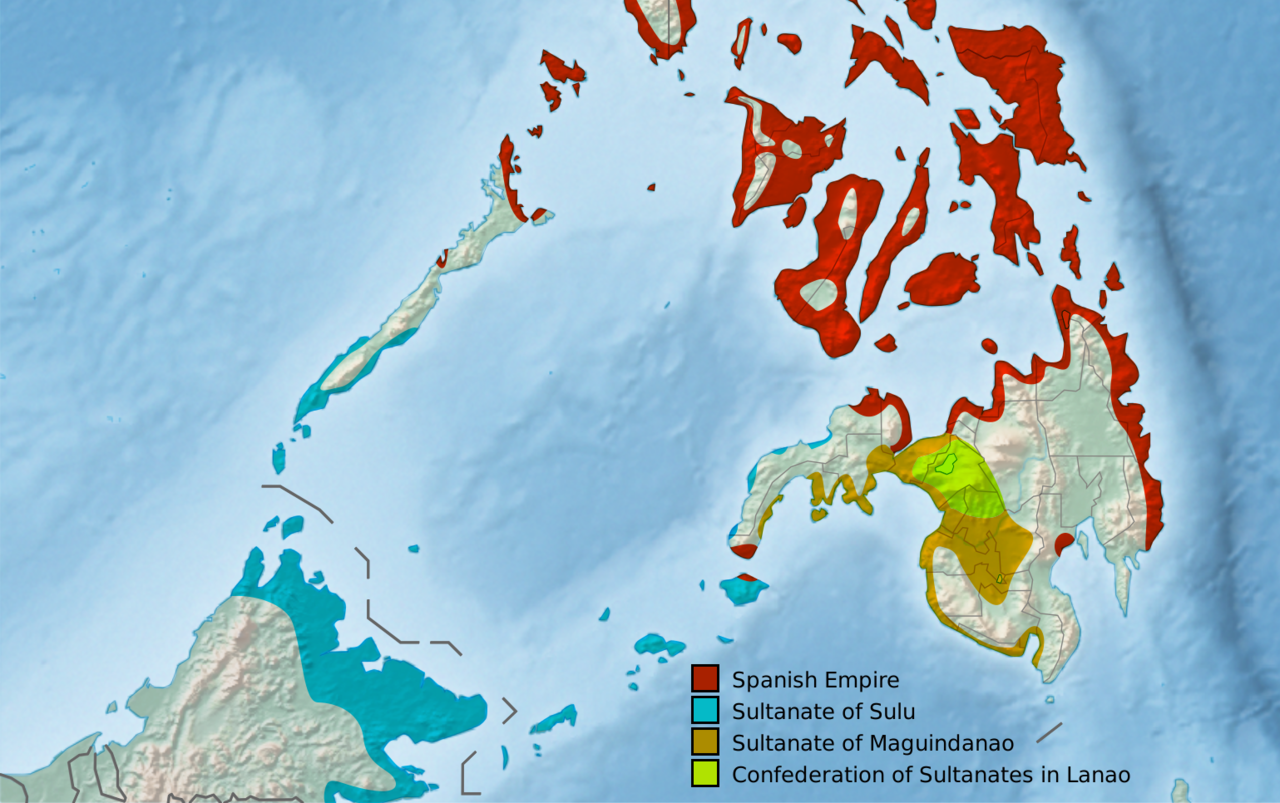
The Spanish were unsuccessful in converting Muslim Sultanates to Christianity, and in fact warred with Muslim Filipinos throughout their 300 year colonial rule from 1521 - 1898. Legaspi conquered a Muslim Filipino settlement in Manila in 1570. Islam had been present in the southern Philippines since some time between the 10th and 12th century. It slowly spread north throughout the archipelago, particularly in coastal areas. Had it not been for Spanish intervention, the Philippines would likely have been a mostly Muslim area. [Source: Professor Susan Russell, Department of Anthropology, Center for Southeast Asian Studies Northern Illinois University, seasite.niu.edu]
According to Lonely Planet: ““The indigenous islanders - who by tradition were loath to work together anyway - were no match for the Spanish and their firearms. Spain's greatest challenge came from an old enemy - Islam. To Spain's horror (having recently booted out the Moors at home), the Muslims had a big head start: Islamic missionaries from Malacca had established towns in Mindoro and Luzon almost a century before the Spanish arrived. Legazpi finally succeeded in taking the strategic Muslim settlement of Maynilad (now Manila) in 1571, hastily proclaiming it the capital and building over the kuta (fort) of Rajah Sulayman. This was eventually to become Fort Santiago. [Source: Lonely Planet =]
So began a 300-year-long religious war that still smoulders in Mindanao, the spiritual home of Islam in the Philippines. The Spanish recruited newly Christianised Filipinos to help fight the Moros (as Muslim Filipinos were dubbed), many of whom earned a violent living as pirates. Meanwhile, Spain was courting the Chinese through trade. Throughout the 16th and 17th centuries, Spain's galleons - many of them built in Cavite near Manila - also specialised in taking spices, silk, porcelain and gold to the New World, and returning with Mexican silver. Moro pirates dodged many a cannonball to claim a share of these riches. “
Later History of Muslims in the Philippines
Mindanao and other predominately Muslim islands in the southern Philippines were never conquered during 381 years of Spanish and American rule. One Muslim told the Los Angeles Times, “We do not consider ourselves Filipinos. Filipinos are those who surrendered to the Spaniards. We never surrendered.” European intervention broke the power of the Sulu sultanate. Following the imposition of American colonial ruler in 1899, the sultanates of Sulu and Mindanao were brought under the administration of Manila.
Alfredo Roces and Grace Roces wrote: The Spanish referred to Muslims in the Philippines as Moros, identifying them as the Moorish infidels who conquered and ruled Spain for centuries until the Reconquest...Throughout the Spanish period, Muslims launched raids on Christianised coastal areas, terrorising inhabitants, pillaging and plundering and capturing victims for Dutch slave markets. Christian Filipinos looked to saints for protection, the favourite being Santiago Apostol, known to the Spaniards as Santiago Matamoros (‘Killer of Moors’). Tall, mute watchtowers still stand on some Philippine coastlines as relics of turbulent days when the threat of Muslim raids was ever present, and the alarm cry “Hay Moros en la costa” (“The Moors are coming”) entered Philippine colloquial expression. The Spanish reinforced antagonism against the Muslims by popularising and disseminating their own Islamophobia. Moro-moro (plays) were part of Philippine fiestas and depicted the battle between Christians and Moors in Spanish history. [Source: “Culture Shock!: Philippines” by Alfredo Roces and Grace Roces, Marshall Cavendish International, 2010]
Americans in Mindanao
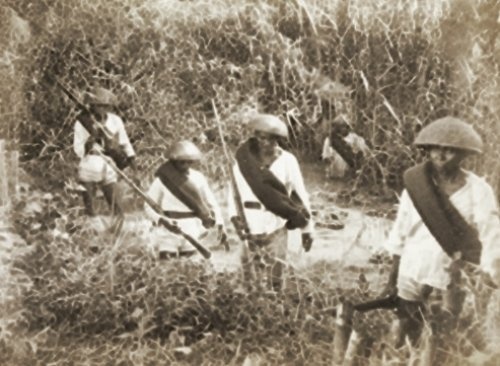
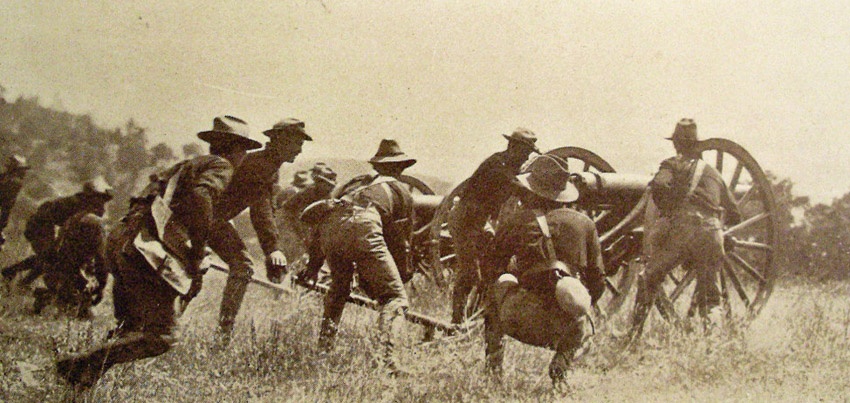
The Americans arrived in Mindanao in 1898 and were able to subdue the island within a few years with the last major battle fought in Cotabato in 1905. An uneasy peace prevailed after that. The Americans urged people from other parts of the Philippines to move to Mindanao but at time few took up the offer.
When Spain ceded the Philippines to the United States in 1898, General John Pershing was put in charge of the “pacification campaign” to put down rebel movements. It was during this period that Muslim “juramentados”—men who attack American with a sword—were born (see Below). One Philippines professor told the New York Times, “They were considered the original suicide bombers because they won’t hesitate to die as long as they could kill the enemy.”
In 1907 more than a thousand Muslims were killed in what some historians have described as a massacre. More attacks followed and more Muslims died. Many Muslims in southern Philippines are aware of these deaths and feel they have not been avenged and the United States has not paid for them.
In 1912, the American Cornélis De Witt Willcox wrote: “The Moros of Mindanao and Jolo would have resumed their piratical excursions to the northward, burning, killing, and carrying off slaves. If this be questioned, then let us recollect that as recently as 1897 they carried off slaves from the Visayas, a sporadic case, probably, but giving evidence that the disease of piracy is to-day merely latent. Given an opportunity, it will break out again. Under independence, the large, beautiful, and fertile island of Mindanao would be left to its own devices, would be lost to civilization. Upon this point we need have no doubt whatever. The issue of Filipino control of Mindanao was very clearly raised, when Mr. Dickinson, the late Secretary of War, visited Mindanao in August of 1910. [Source:“The Head Hunters of Northern Luzon” by Cornélis De Witt Willcox, Lieutenant-Colonel U.S. Army, Professor United States Military Academy, 1912 ]
“Upon this occasion Mr. Dickinson, in response to a Filipino plea for immediate independence, with consequent control of the Moros, made a speech in which he declared the unwillingness of the Government to entrust to the 66,000 Filipinos living in Mindanao the government of the 350,000 Moros of this province.
At the close of this speech, four datus (chiefs), present with 2,000 of their people, and controlling the destinies of 40,000 souls, swore allegiance to the United States; and, requesting that, if the Americans ever withdrew from Mindanao, the Moros should be placed in control, firmly announced, at the same time, their intention to fight if the Americans should ever take their departure.... For the Christianized Filipinos can never hope to cope with the active, warlike pirates of Moroland. So far as this part of the Archipelago is concerned, a grant of independence means the re-establishment of slavery, the recrudescence of piracy, the reincarnation of barbarism. How great a pity this would be may be inferred from the fact that Mindanao forms nearly one-third of the Archipelago in area, and exceeds Java in arable land. Now, Java supports a population of over 25,000,000.”
Juramentado: Filipino Running Amok?
In the Philippines, amok also means unreasoning murderous rage by an individual. In 1876, the Spanish governor-general of the Philippines José Malcampo coined the term juramentado for the behavior (from juramentar - "to take an oath"), surviving into modern Filipino languages as huramentado. It has historically been linked with the Moro people of Mindanao, particularly in the island of Jolo in connection with societal and cultural pressures. [Source: Wikipedia +]
Juramentado, in Philippine history, refers to a male Moro swordsman who attacked and killed targeted Christian police and soldiers, expecting to be killed himself, the martyrdom undertaken as an unorthodox form of personal jihad. Unlike an amok, who commits acts of random violence against Muslims and non-Muslims alike, a juramentado was a dedicated, premeditated, and sometimes highly skilled killer who prepared himself through a ritual of binding, shaving, and prayer in order to accomplish brazen public religious murder armed only with edged weapons. +
For generations warlike Moro tribes had successfully prevented Spain from fully controlling the areas around Mindanao and the Sulu Archipelago, developing a well-earned reputation as notorious seafaring raiders, adept naval tacticians, and ferocious warriors who frequently demonstrated extraordinary personal bravery in combat. While Moro forces could never match opponents' firepower or armor, such bands used intelligence, audacity and mobility to raid strongly defended targets and quickly defeat more vulnerable ones. One extreme asymmetric warfare tactic was the Moro juramentado. +
Christians Take Over Muslim Land
Until fairly recently Mindanao and other islands in the south were occupied almost completely by Muslims. After World War II, the Muslim-controlled areas of Mindanao were viewed as a frontier that could be settled by Christians from the northern islands. After independence in 1946, Christian settlers from the northern and central islands began migrating to Mindanao . The newly-arrived Christians generally settled where the land was most fertile and became richer while Muslim remained poor.
To end the Huk uprising in the 1950s, President Magsaysay resettled some of the Philippines’ non-Muslim poor on Mindanao and gave them title to the land they settled on. Later more people from the overcrowded islands in the north were resettled on "unused" jungle Mindanao, a move that eventually tipped the balance of landownership and political power in favor of the Christians. Muslims were denied title to land they had occupied for generations. One Muslim told Newsweek, "We became squatters in our own lands." By 1970, immigrants outnumbered local Muslim groups.
Muslim have suffered from neglect and underdevelopment. One Muslim leader told the Los Angeles Times, “Governments have promised us everything. But look around and what is the ‘everything’ they’ve delivered? Do you see roads? Electricity? Economic development? Factories? The everything is nothing.”
Muslim Situation Under Marcos
Under Marcos, timber concession in Mindanao were given to Marcos cronies and foreign companies. Muslim saw little of the money made from these ventures. More Catholics moved in. They were more likely to get jobs in local enterprises than Muslims. Muslims and Christians formed paramilitary groups. As Christians gained more control in the southern provinces in the 1970s, the number of attacks by Muslim groups increased.
A pivotal event in the Muslim struggle occurred in 1968 when at least 28 Muslim terrorist recruits were massacred after they mutinied against officers training a secret Muslim army to invade the neighboring Malaysian state of Sabah. This event inspired the first Muslim insurgents to take up arms against the Philippine government.
In 1970, land disputes escalated to armed conflict around the Cotabato area between Muslims and non-Muslims. Government forces intervened and the conflict grew into civil war that spread across Mindanao and into the Sulu archipelago. The conflict reached its peak in the mid 1970 and resulted in the dislocation of thousands of people. Major fighting ended in the late 1970s but unrest and outbreaks of violence continued to occur.
Libya has traditionally played a roll in training and educating Philippine Islamic militants and has helped negotiate peace agreements. In 1976, Imelda Marcos flew to Libya and meet with Muammar Gaddafi for five hour in his tent and eventually produced a peace agreement called the Tripoli Agreement which granted limited autonomy to Muslims in 13 provinces and 10 cities in the southern Philippines but was ultimately rejected by the the Muslim groups. Malaysia has acted an intermediary in negotiations between the Philippine government and Muslim groups.
Image Sources: Wikimedia Commons
Text Sources: “Encyclopedia of World Cultures Volume 5: East/Southeast Asia:” edited by Paul Hockings, 1993; National Geographic, Live Science, Philippines Department of Tourism, Metropolitan Museum of Art, Natural History magazine, New York Times, Washington Post, Los Angeles Times, Smithsonian magazine, Encyclopedia.com, Times of London, Library of Congress, The Conversation, The New Yorker, Time, BBC, CNN, Reuters, Associated Press, AFP, Lonely Planet Guides, Google AI, Wikipedia, The Guardian and various websites, books and other publications.
Last updated February 2026