
FILIPINO CATHOLIC TRADITIONS

The main Filipino Catholic rites and traditions of baptism, Holy Communion, funerals, weddings, Christmas and Holy Week ceremonies are more or less in line with those of other Catholics. Baptism (“binyang”), confirmation (“kumpil”) and marriage (“kasal”) are the most important life cycle events and they often involve unions of different families and are very important in the general social life.
Holy Communion is a religious ceremony performed to establish a partnership and relationship with God. It is commonly received by third-grade students, usually between the ages of six and seven. Before the ceremony, Filipino children are taught by a brother or sister about religious prayers, mortal sins, and the sacrifices and forgiveness of Christ. During the ceremony, the children are dressed in formal white clothing and receive Christ’s body and blood in the form of bread wafers dipped in wine after the homily. After completing the ceremony, the children are able to receive communion together with the adult members of the church during the Eucharistic Mass. [Source: Larissa Ubungen, larissaubungen.wordpress.com, December 9, 2012]
Funeral ceremonies include the vigil, funeral liturgies, and the rite of committal. They help family and friends accept the reality of death, offer final tributes, and express grief. During the ceremony, relatives and friends sprinkle holy water on the corpse while saying prayers as a sign of farewell. Through this ritual, Filipinos learn to accept loss and cope with the pain of losing a loved one.
In traditional Filipino weddings, the bride wears a custom-made white gown with a veil covering her face and follows the tradition of including “something blue, something borrowed, something old, and something new.” The groom wears a Barong Tagalog, a formal embroidered shirt often made from pineapple fibers. The ceremony includes various wedding items and participants, such as bridesmaids, a ring bearer, and symbolic objects like wedding rings, arrhae (coins), candles, veils, and a wedding cord. The ceremony symbolizes the couple’s lifelong commitment and devotion to one another.
Holy Week ceremonies are religious festivals celebrated during the last week of Lent and the week before Easter. These rituals serve as acts of repentance and spiritual renewal. Filipinos practice penance through fasting, the Way of the Cross, Passion plays known as Sinakulo, and by reading or chanting the Pasyon. Some individuals perform more extreme acts of devotion, such as self-flagellation, carrying a cross, or even voluntary crucifixion. Through these practices, participants reflect on their faith and seek to deepen their spirituality.
RELATED ARTICLES:
CATHOLICISM IN THE PHILIPPINES: LIFE. INFLUENCE, SAINTS, POPE VISITS factsanddetails.com
For article on the Catholic Church in general see CATHOLICS factsanddetails.com
CATHOLIC CHURCH AND PHILIPPINES POLITICS: CARDINAL SIN, DUTERTE, CORRUPTION FIGHTERS factsanddetails.com
RELIGION IN THE PHILIPPINES factsanddetails.com
CHRISTIANIZATION OF THE PHILIPPINES: MISSIONARIES, SUCCESS, FRIAROCRACY factsanddetails.com
HOMEGROWN RELIGIONS IN THE PHILIPPINES: IGLESIA NI KRISTO, AGLIPAYAN CHURCH, KINGDOM OF JESUS CHRIST factsanddetails.com
MOROS: MUSLIMS IN MINDANAO AND THE SOUTHERN PHILIPPINES factsanddetails.com
HISTORY OF MUSLIMS IN THE SOUTHERN PHILIPPINES factsanddetails.com
FOLK RELIGIONS IN THE PHILIPPINES: GHOSTS, WITCHES. DEMONS, HOLY MOUNTAINS factsanddetails.com
MYTHS, LEGENDS AND CREATION STORIES IN THE PHILIPPINES factsanddetails.com
SUPERSTITIONS IN THE PHILIPPINES factsanddetails.com
IFUGAO RELIGION: GODS, RITUALS, FUNERALS factsanddetails.com
BONTOC RELIGION: GODS, ANITOS, FUNERALS factsanddetails.com
FUNERALS IN THE PHILIPPINES factsanddetails.com
HOLIDAYS, FIESTAS, NEW YEAR GUNFIRE AND CHRISTMAS IN THE PHILIPPINES factsanddetails.com
FAMOUS FESTIVALS IN THE PHILIPPINES: HOLY WEEK, BLACK NAZARENE AND GETTING NAILED TO A CROSS factsanddetails.com
Prayer Ladies and Other Unorthodox Filipino Catholic Customs
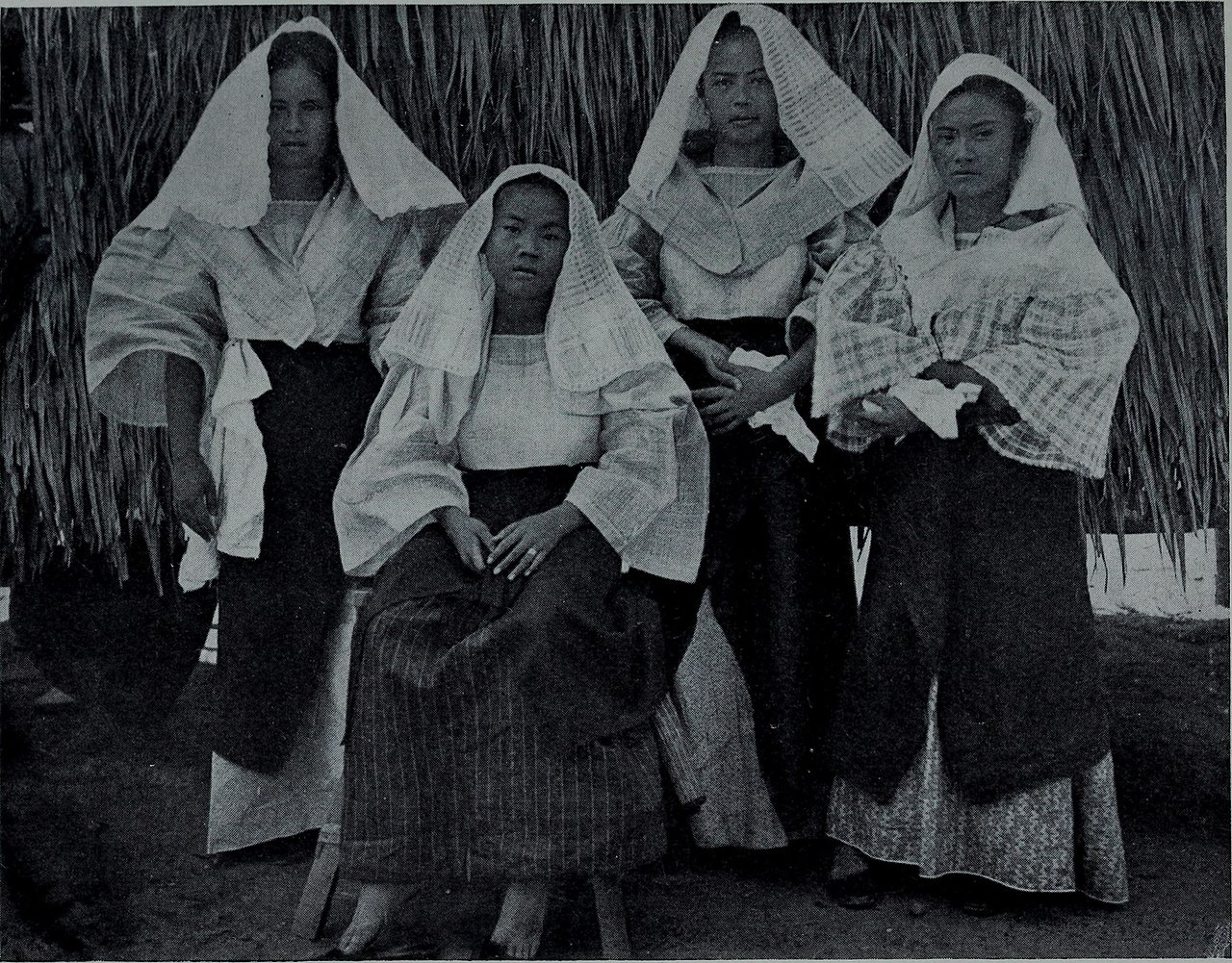
Filipino Catholicism has a few elements not found elsewhere. At the Quiapo Church in Manila, for example, Catholics crawl across the floor on their knees in hopes of receiving a miracle or hire “prayer ladies” to say their praying for them. Outside the church hawkers sell candles, amulets, herbals cures, and during the Christmas season, pancakes.
Prayer ladies can be hired for a s little as a few pesos. One of them told the Los Angeles Times, “God does not care who the prayer is coming from, as long as the person who paid for the prayer is sincere.” The ladies wear normal clothes are hard for casual observers to spot. They pray from plastci chairs rather than pews and can be hired to pray for anything: good health, love from a special person, good grades, help kicking drugs, protection from terrorists. Sometimes the ladies serve as make-shift priests, listening to the confessions and problems of their customers.
Many of the people who hire prayer ladies also pray themselves and say they hire the ladies because of their skill in praying and the belief that offering as many prayers as possible from as many people as possible increases the chance of a prayer being answered. One prayer lady told the Los Angeles Times, “Most of my prayers are answered.” People “often come back to me to thank me, especially if they passed the bar or medical exam.”
Santo Niño
While Ferdinand Magellan was in Cebu in 1521, the wife of the local ruler Rajah Humabon—described as a queen by Magellan’s chronicler Antonio Pigafetta—became fascinated with a small statue of the Child Jesus. Magellan’s party eventually gave the image to her as a gift. Forty-four years later, in 1565, when Spain sent an expedition led by Miguel López de Legazpi to colonize the Philippines, a Spanish soldier searching for valuables in Cebu discovered a statue of the Holy Child inside a box surrounded by flowers. The figure resembled those made in Flanders. Although it was never confirmed whether it was the same statue left by Magellan, Legazpi’s companions recognized it as a Christian symbol and used it in missionary efforts. The statue remains in Cebu today and is venerated as the Santo Niño de Cebú. [Source: “Culture Shock!: Philippines” by Alfredo Roces and Grace Roces, Marshall Cavendish International, 2010]
Devotion to the Santo Niño continues to be vibrant in the Philippines. One example is the Ati-Atihan Festival, a major celebration honoring the image of the Child Jesus. Over time the statue became the focus of intense popular devotion. Interestingly, many devotees focus their reverence on Christ as a child rather than on Christ as the crucified Savior. In some folk practices during fiesta periods, devotees symbolically threaten to immerse the image in water if it fails to bring rain. Each year across the country, images of the Santo Niño are ceremonially bathed and dressed as part of devotional rituals.
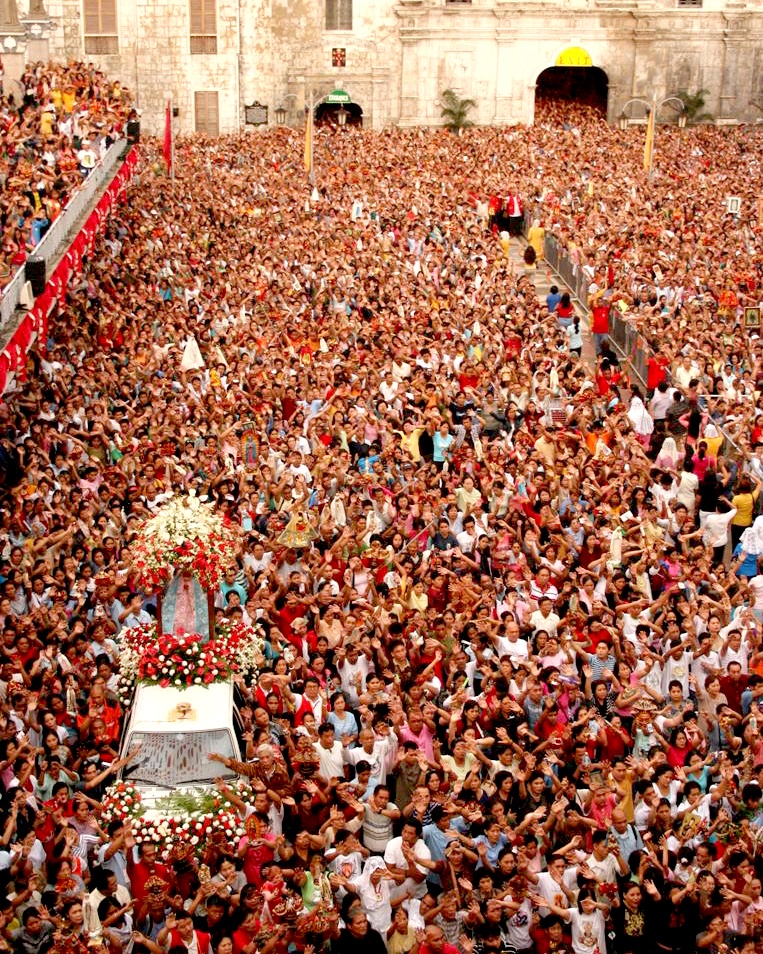
After establishing Spanish authority in Cebu, Legazpi later captured Manila. According to tradition, a sailor wading through water discovered another religious image among the roots of pandan plants. This time it was a statue of a woman. It was soon regarded as miraculous and eventually enshrined in the church of Ermita in Manila as Nuestra Señora de Guía. The statue’s origin has long been debated. Some scholars believe it represents the Chinese goddess of mercy, Guanyin, while others argue that it may have been a native idol or a Christian icon brought by Portuguese traders, noting similarities with Marian images in Macau.
Another important Marian devotion developed around the image of Nuestra Señora del Rosario de La Naval. During the annual Feast of La Naval de Manila, the statue is carried on a large carriage through parts of Manila. The celebration commemorates a famous Spanish naval victory during the colonial era and became one of the most significant religious festivals in the city.
Descriptions of these statues often note their use of local hardwood and the presence of Asian features in the carving, suggesting cultural blending. Some have even argued that such images indicate that Christianity may have had a presence in the Philippines before the arrival of the Spaniards. Legazpi himself reported encountering a Japanese man wearing a Christian cap who identified himself as a Christian named Pablo. These stories highlight how the early spread of Christianity in the Philippines did not entirely sever ties with earlier beliefs and traditions. Over time, a distinctive form of Filipino folk Catholicism emerged—rich in Marian devotion and characterized, as historian John Leddy Phelan observed, by an atmosphere filled with the miraculous and the supernatural.
Santo Niño de Atocha (Holy Child of Atocha)
Filipinos venerate the Santo Niño de Atocha (Holy Child of Atocha), a beloved image that portrays the Child Jesus as a wandering pilgrim, locally known as Santo Niño de Palaboy (wandering child). Unlike the original Spanish depiction, which shows the child seated, the Filipino version commonly presents him standing, dressed in red or green garments, and carrying a basket of goodies. This form of the Child Jesus is venerated alongside the more prominent devotion to the Santo Niño de Cebú, reflecting the deep Filipino reverence for the Santo Niño.
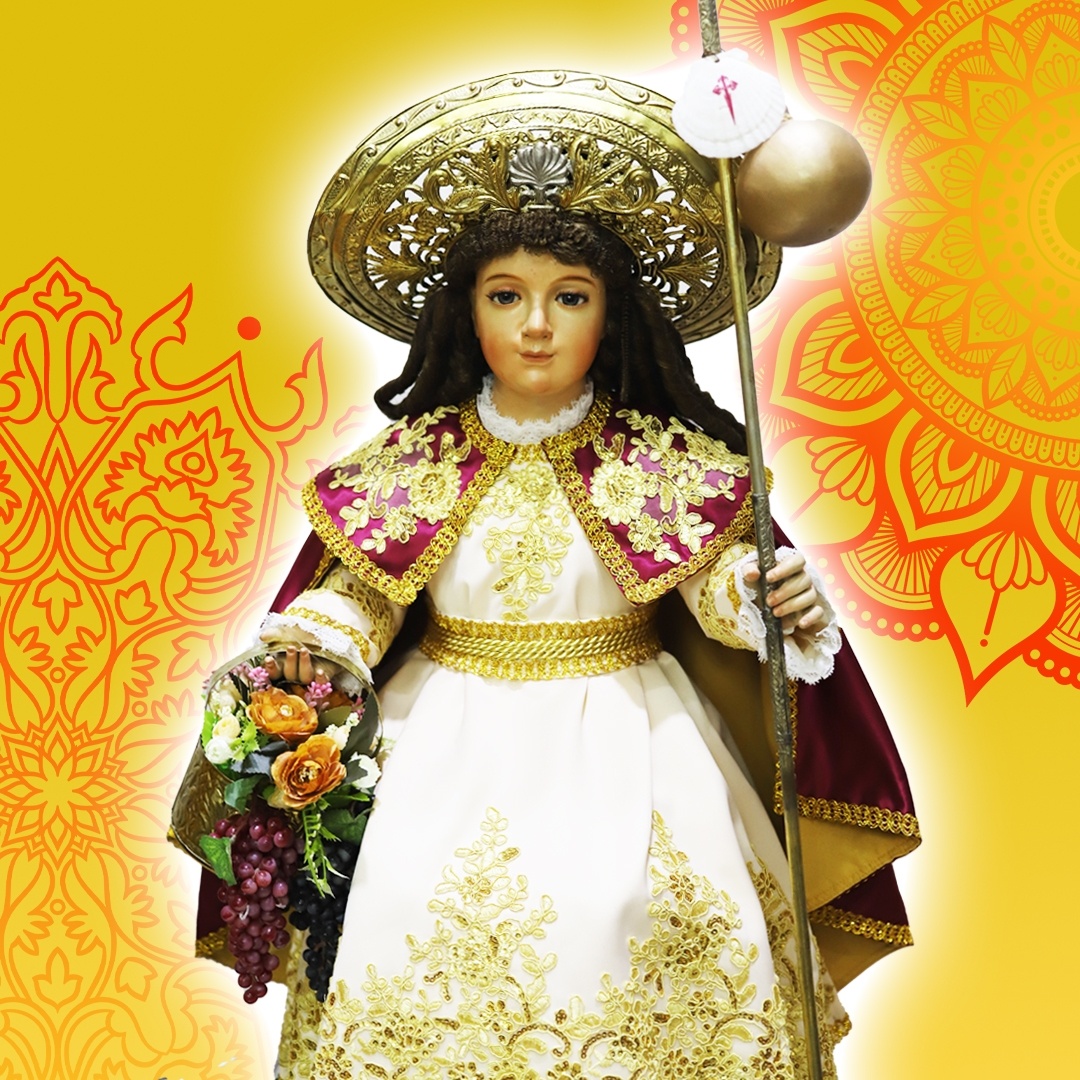
Santo Niño de Atocha is typically represented as a young traveler. He is often shown wearing a pilgrim’s hat, holding a staff, and carrying a small basket filled with food or gifts. These elements symbolize his role as a helper and provider, especially for those in need. The image emphasizes humility and compassion, portraying the Child Jesus as one who journeys among the people.
Devotion to the Santo Niño de Atocha includes the belief that he is a “night-walking” infant who leaves his place at night to visit the poor, the sick, and those in distress. Many devotees share stories of prayers answered through his intercession, reinforcing the idea that he actively helps those who call upon him in faith. In Filipino folklore, the image is often associated with a wandering child who protects families, helps recover lost items, or brings comfort during hardship. Some devotees even recount finding signs—such as dirt or thistles on his clothing—suggesting that he has been out walking. Traditionally, the image is dressed in red garments when placed in homes and green garments when displayed in businesses, symbolizing protection and blessing. Although the Santo Niño de Cebú remains the primary national devotion, the Santo Niño de Atocha continues to hold a cherished place in Philippine Catholic spirituality.
Devotion to the Santo Niño de Atocha began in Spain and is closely linked to Our Lady of Atocha, whose title appears in the Cantigas of King Alfonso X of Castile in the 13th century. According to tradition, during the Moorish rule of Spain beginning in 711, Christian captives were imprisoned in the town of Atocha near Madrid. The Moors forbade most townspeople from bringing food and water to the prisoners, allowing only children under twelve to assist them. Families of the captives prayed fervently to God and invoked Our Lady of Atocha for help. One day, a young boy dressed as a pilgrim appeared, carrying a basket of food and a gourd of water. He was permitted to visit the prisoners daily, and miraculously, his provisions never ran out. The townspeople came to believe that this child was the Child Jesus in disguise. When they later noticed that the shoes of the Infant in the statue of Our Lady of Atocha were dusty and worn, they concluded that He had truly been walking to aid the captives, and they repeatedly replaced His shoes as they became worn again.
The original statue of the Santo Niño de Atocha was brought from Spain to the town of Fresnillo in Zacatecas, Mexico, where it is now venerated at the Santuario de Plateros. In artistic representations, the Holy Child is portrayed as a pilgrim. He often wears a brimmed hat with a plume and a cape adorned with the scallop shell of St. James, a traditional symbol of pilgrimage. In one hand, He carries a pilgrim’s staff with a water gourd attached, sometimes along with shackles or stalks of wheat symbolizing prisoners and sustenance. In the other hand, He holds a basket that may contain bread, flowers, or appear empty despite being believed spiritually full. The Child is sometimes shown barefoot or wearing sandals, signifying His nightly journeys to help the needy. While many images depict Him seated, others emphasize His role as a wandering helper whose shoes wear out from constant travel.
Baptism in the Philippines
In the Philippines, baptism and christening are generally understood to refer to the same event: the religious ceremony that welcomes a child into the Catholic Church or another Christian denomination. Baptism is the formal theological term for the sacrament that cleanses sin and officially initiates a person into the Church. Christening, on the other hand, is commonly used in everyday language to describe the ceremony, especially when referring to the naming and baptism of an infant. Although there can be technical distinctions—since baptism may also refer to adult initiation or immersion—in Filipino cultural practice the two terms are used interchangeably.
Catholic Baptism ceremonies are religious ceremonies done to cleanse our spirits and become part of Christ. A short church mass is held which serves as an orientation for the family, godparents, and parents. After the homily, the holy water is poured on the head of the infant and the father saying the words “I baptize you in the name of the Father, and of the Son, and of the Holy Spirit” as a sign of cleansing his or her spirit. Baptism Ceremonies are important for Filipino Catholics because it is a step for welcoming the infants to being a Catholic. [Source: Larissa Ubungen, larissaubungen.wordpress.com, December 9, 2012]
In the Philippines, Catholic christening involves a priest baptizing a baby in private or simultaneously with other children. In a mass christening, the priest goes from one child to another, blessing them with holy water and performing the baptismal rite, as the parents and godparents respond in behalf of the children. It is customary to have several godfathers and godmothers, as parents believe that the more godparents a child has, the more assured he/she is of a good future. Sponsors (god parents) are charged a certain amount of money. When the family of the baptized picks up the baptismal certificate a few days later they are charged an additional fee. Many families have a party or reception at home or fancy restaurants. It is always a big occasion for Pinoys. [Source: christianfilipina.com/forum] [Source: ehow.com]
Before the celebration, the parents of the child must choose their respective godparents which are chosen to be the next parents who can guide the godchild from religious education. The short church mass is held which serves as an orientation for the family, godparents, and parents. Baptism Ceremonies are important for Filipino Catholics because it is a step for welcoming the infants to being a Catholic.
Participants in the baptism ceremony first gather at the church and complete the required registration forms for the baptism. During registration, arrangements for the ceremony are finalized, including the level of elaborateness desired for the ritual. Traditionally, the ninong or godfather is responsible for paying the church fees associated with the baptism. The cost varies depending on how simple or elaborate the ceremony is, such as the location within the church or additional ceremonial elements. Guests typically dress in semi-formal attire (party attire). [Source: “Culture Shock!: Philippines” by Alfredo Roces and Grace Roces, Marshall Cavendish International, 2010]
During the ceremony itself, the priest performs the baptism while one of the sponsors holds the child. By custom, if the baby is a girl the godmother carries the child, while if the baby is a boy the godfather performs this role. After the religious rite, family and guests usually proceed to a celebratory feast hosted by the parents. In more elaborate celebrations, sponsors may throw a “shower” of coins for guests, especially children, to collect. Children enthusiastically scramble for the coins, while adults participate only lightly, often picking up a few coins for good luck and sometimes passing them on to the children.
Filipino Baptisms and Godparents
The baptismal ceremony among Catholics marks an infant's first rite of passage into the Roman Catholic faith. In the Philippines it is customary for parents to arrange for their infant to have up to five sets of godparents at this ceremony. Godparents are perceived to be part of the family, as they are expected to provide added social security for the child throughout his or her life. [Source: Kathleen M. Nadeau, Worldmark Encyclopedia of Religious Practices, Thomson Gale, 2006]
In the Philippines, godparents traditionally assume certain responsibilities during a child’s baptism. One of their roles is to cover the fees for the church rites, although these costs are generally modest and vary depending on how elaborate the ceremony is, such as whether it takes place at the main altar or includes additional elements like ringing bells. It is also customary for godparents to give the child a gift. Among wealthier families, popular gifts include silver cups, spoon-and-fork sets, gold earrings for girls, or embroidered baby clothes, though practical gifts for the baby are also common. After the ceremony, the child’s parents usually host a feast, which may range from a simple family gathering to a large celebration with many guests. [Source: “Culture Shock!: Philippines” by Alfredo Roces and Grace Roces, Marshall Cavendish International, 2010]
A traditional practice associated with baptisms is the scattering of coins, known locally as sabog. Some godparents throw small coins as a symbolic wish for prosperity and good fortune for the child. Participants, especially children and teenagers, eagerly gather the coins, while adults usually refrain out of hiya—a cultural value emphasizing modesty and the avoidance of appearing greedy.
During the baptismal ceremony, a sponsor carries the child while the priest performs the rite. In principle, the godfather and godmother share equal importance. However, tradition often gives slightly greater significance to the sponsor who shares the child’s gender—a godfather for a boy and a godmother for a girl. In earlier times, only one sponsor was chosen according to the child’s gender, but today it is common for children to have both a godfather and a godmother, and sometimes several sponsors, reflecting the importance of extended social relationships.
The system of godparenthood is closely tied to the Filipino compadre network, which creates bonds between families. Foreigners, particularly Westerners, are often invited to serve as sponsors because they are widely respected and their participation is considered an honor. Since refusing such an invitation might cause hiya, it is usually easier to accept. However, foreigners are generally not expected to fully participate in the deeper obligations of the kinship network, and their ceremonial role alone is considered sufficient.
See Godparents Under FAMILIES IN THE PHILIPPINES: factsanddetails.com
Filipino Baptismal Celebration
One Filipino woman wrote in her blog: “I am currently planning for Guijo's baptism, and this prompted me to look back at his older sister Narra's baptism held two years ago on August 8, 2009. What we had then, was a distinctly Filipino baptismal celebration. The church we chose was the historic national treasure: Barasoain church in Malolos, Bulacan - hometown of my husband Oliver's Carsi Cruz side of the family. Barasoain's baptistry is located deep inside the church, all the way to the back, in a concealed chamber behind the altar, and getting to it is like traveling back to the Spanish colonial era. One has to pass through thick adobe arches, and walk on sturdy adobe paths, through silent courtyards populated by wise old plants. [Source: nikki-mama.blogspot.jp, September 24, 2011 */]
“Most of our guests came from Manila and the church offered charming attractions - its architectural features, a museum with historic artifacts, and a baptismal ceremony officiated in beautiful Tagalog with Bulakenyo flair. Like most other Filipino couples, we asked a good number of our friends and family to be ninongs and ninangs. Narra had 8 pairs of godparents. Narra's christening gown was made of piña fiber which was elaborately embroidered. It was done in the romantic old style of puffed sleeves, and extra long length, and came with matching booties and cap. It came from the Tesoro's line of Filipiniana formal wear, and we were fortunate to get it as a gift from our generous Ninang Alice Tesoro Guerrero.” */
The reception was held at a nearby restaurant. “Oliver's mother, my mom-in-law Mama Rubi Socorro Carsi Cruz started the family restaurant called Taberna Maloleña in the first floor of the Carsi Cruz summer home in Malolos, just a block away from Barasoain church. The food offerings during the reception included signature family recipes, including my all time favorite Kare-Kare and my sis-in-law's award winning shrimp lumpia, as well as my favorite deserts of mini turon with langka and sesame seeds topped with a dollop of cream - yummy! */
“Looking back, I found that baptismal celebration simply enjoyable. I did not stress out with the preparations at all - no invitations were needed (we just sent text messages by phone) - we didn't spend on decorations anymore - and not even a cake or souvenirs. We didn't really go for a theme party, but we ended up with a Filipiniana feel because of the location, the food, the architecture, and I think even the lack of party planning - this lent the event an old school sense of celebrating sans the newer party fads. What we did have were all the essentials: a solemn ceremony in a picturesque church, a lot of great tasting heritage dishes from the family's culinary treasure box, and a good many hours of spending time with family and friends chatting the afternoon and evening away in a quiet corner of Malolos. I have fond memories of that day, August 8 2009 (which also marked our first wedding anniversary - Oliver and I were married on 08-08-08). */
Guidelines for Baptismal Rites at a Philippine Church
Baptism Requirements: Registration : At least three weeks before the Baptism date. Submit the following upon registration: 1) Photo copy of the child’s Birth Certificate: 2) (for non- parishioners only) Permit from the parent’s church to have their child’s Baptism outside of their own parish. Present the following upon registration or during the seminar: 1) Original copy of Parents’ Catholic Marriage Contract; 2) Confirmation Certificate of Sponsors, if single and Catholic Marriage Contract, if married. Fee (Non-refundable): Php 300.00 for the principal sponsors (first pair) inclusive of the cost of baptismal candles and certificate; Php 100.00 for every additional sponsor (200.00 per pair). [Source: sjbmakati.com]
Parents who want their child baptized should be married in the Catholic Church. If parents want their child to grow in the Catholic faith, they should live this faith and follow the discipline of the Catholic Church. Parishioners who are married civilly or not married at all should see the Parish Priest for an interview before the seminar. Non-parishioners are advised to have the baptism in their respective parishes.
Sponsors (godparents) must be Catholics who have received the sacraments of Christian initiation: Baptism, Confirmation and Holy Eucharist, and are practicing Catholics (active in the celebration of the Sacraments – Eucharist and Reconciliation. Foremost of all, the sponsors must be willing to undertake the responsibility of partnership with the parents, in the Catholic upbringing of the child into a mature and committed Christian. A maximum of five (5) pairs of sponsors are allowed.
Seminar: Parents and all Sponsors are required to attend the Baptismal seminar. Baptismal seminars are scheduled on Saturdays from 2:30pm to 5:pm (please refer to schedule below). Parents and Sponsors may choose one Saturday to attend, provided, this is at least three weeks before the scheduled Baptism.
The Sacrament of Baptism is a celebration of the parish community. It is celebrated within the Holy Mass on a Sunday designated for Baptism, from 2:00pm to 3:30 pm (please refer to schedule below). In Baptism your child becomes a member of the Church. Our parish community is glad to welcome and be present in this meaningful beginning of your child’s journey in Faith. In this context, Baptism becomes more meaningful when more people pray for your child. To show the communitarian dimension of the sacrament, the parish does not encourage individual/special baptism except for serious reasons (medical, emergency cases, security, etc.) “For convenience” is not a serious reason.
Dress Code: Proper church decorum is strictly enforced. All are expected to dress properly and decently for church. Ladies wearing attires with plunging/revealing necklines, bare backs, or short skirts, and men wearing “sandos” and shorts will not be allowed to enter the church.
Catholics Urged to Have Babies Baptized as Soon as Possible
In April 2012, an official of the Catholic Bishops Conference of the Philippines told parents they should get their babies baptized within three months of their birth. Philip C. Tubeza wrote in the Philippine Daily Inquirer, “Fr. Genaro Diwa, executive secretary of the CBCP Commission on the Liturgy, said parents should not wait until they are “financially ready” to have their children baptized. “What is becoming the normal thinking of us Filipinos is that what qualifies one for baptism is when you are financially ready,” Diwa said. “What becomes the qualification is if the feast is already ready, which is not good. It destroys the whole experience of Christian initiation.” [Source: Philip C. Tubeza, Philippine Daily Inquirer, April 7, 2012]
In February, Lingayen-Dagupan Archbishop Socrates Villegas also issued a circular which urged parents to have their children baptized three months after they are born. “I think there is wisdom in the circular letter of the bishop to remind his Christian community that they should desire for the faith of the child and not for the perks of the celebration of baptism, which is like it is reduced to a mere social gathering to invite politicians and personalities,” Diwa said. “I think that is the whole spirit of the circular letter—to focus on the essential of baptism. Although the family still has no financial capacity, they should already seek baptism for the child,” he added.
In his circular, Villegas said that he had “sadly noticed a diminishment in the proper understanding” of the sacrament of baptism. “First, we wish to stress emphatically that the baptisms of infants must be scheduled a few weeks but not later than three months after birth. Ideally, as soon as the mother has recovered her strength after the child’s delivery, the baby must be rushed to the Church for baptism,” Villegas said. “Secondly, we must bring back the primacy of baptism as a spiritual birth of a child into the family of God. It must not be reduced to a mere social event necessitating a party or banquet,” he added.
The archbishop also insisted that a baby’s parents and godparents should be dressed in white for the ceremony. “The proper color for baptism is white. It is advisable for parents and godparents to be dressed in white in order to signify the cleansing from original sin that they seek for the infant in their arms,” Villegas said. He also reminded parents about the admonition of Pope Benedict XVI about giving names to children. “The Pope urges parents not to give their children names that are not included in the Christian martyrology and to refrain from choosing different names, even if these are in fashion,” Villagas said. “Every baptized person acquires the character of ‘child’ starting with their Christian name, an unmistakable sign that the Holy Spirit gives birth ‘anew ‘ to infant from the womb of the Church,” he added, quoting the Pope.
'Asia's First' Catholic Exorcism Center Built in Manila
In June 2022, The Roman Catholic Archdiocese of Manila has begun constructing a special facility dedicated to exorcism and spiritual deliverance in the Philippines. Known as the Saint Michael Center for Spiritual Liberation and Exorcism, the project broke ground in Makati City on May 17 and has been described by church officials as the first center of its kind in Asia, and possibly in the world. [Source: Ryan General, Nextshark,June 14, 2022]
The center will house the offices of several church ministries dealing with unusual spiritual cases, including the Commission on Extraordinary Phenomena, the Ministry of Exorcism, and the Ministry on Visions and Phenomena. It will also serve as the official headquarters of the Philippine Association of Catholic Exorcists, which is affiliated with the International Association of Exorcists in Italy and operates under the Catholic Bishops' Conference of the Philippines.
During the groundbreaking ceremony, Francisco Syquia, director of the exorcism office, explained that the center aims to help those suffering from severe spiritual distress, particularly poor individuals who are often neglected. According to him, the ministry focuses on people believed to be spiritually oppressed or in need of deliverance.
Church officials said the project became possible after more than seven years of planning, fundraising, and prayer. Supporters and benefactors were thanked for their contributions, and the organizers expressed hope for continued assistance as construction progresses.
Exorcism is a religious rite intended to expel evil spirits or demonic forces from individuals believed to be possessed. Although most commonly associated with the Catholic Church, similar practices exist in other religions. According to Catholic teaching, an exorcism may be performed only by a priest who has received authorization from a bishop. In modern practice, the Church also requires medical or psychological evaluation to rule out mental illness before the rite is carried out.
Image Sources: Wikimedia Commons
Text Sources: “Encyclopedia of World Cultures Volume 5: East/Southeast Asia:” edited by Paul Hockings, 1993; “Culture Shock!: Philippines” by Alfredo Roces and Grace Roces, Marshall Cavendish International, 2010; National Geographic, Live Science, Philippines Department of Tourism, New York Times, Washington Post, Los Angeles Times, Smithsonian magazine, Encyclopedia.com, Library of Congress, The Conversation, The New Yorker, Time, BBC, CNN, Reuters, Associated Press, AFP, Lonely Planet Guides, Google AI, Wikipedia, The Guardian and various websites, books and other publications.
Last updated March 2026