
FILIPINO CREATION MYTHS
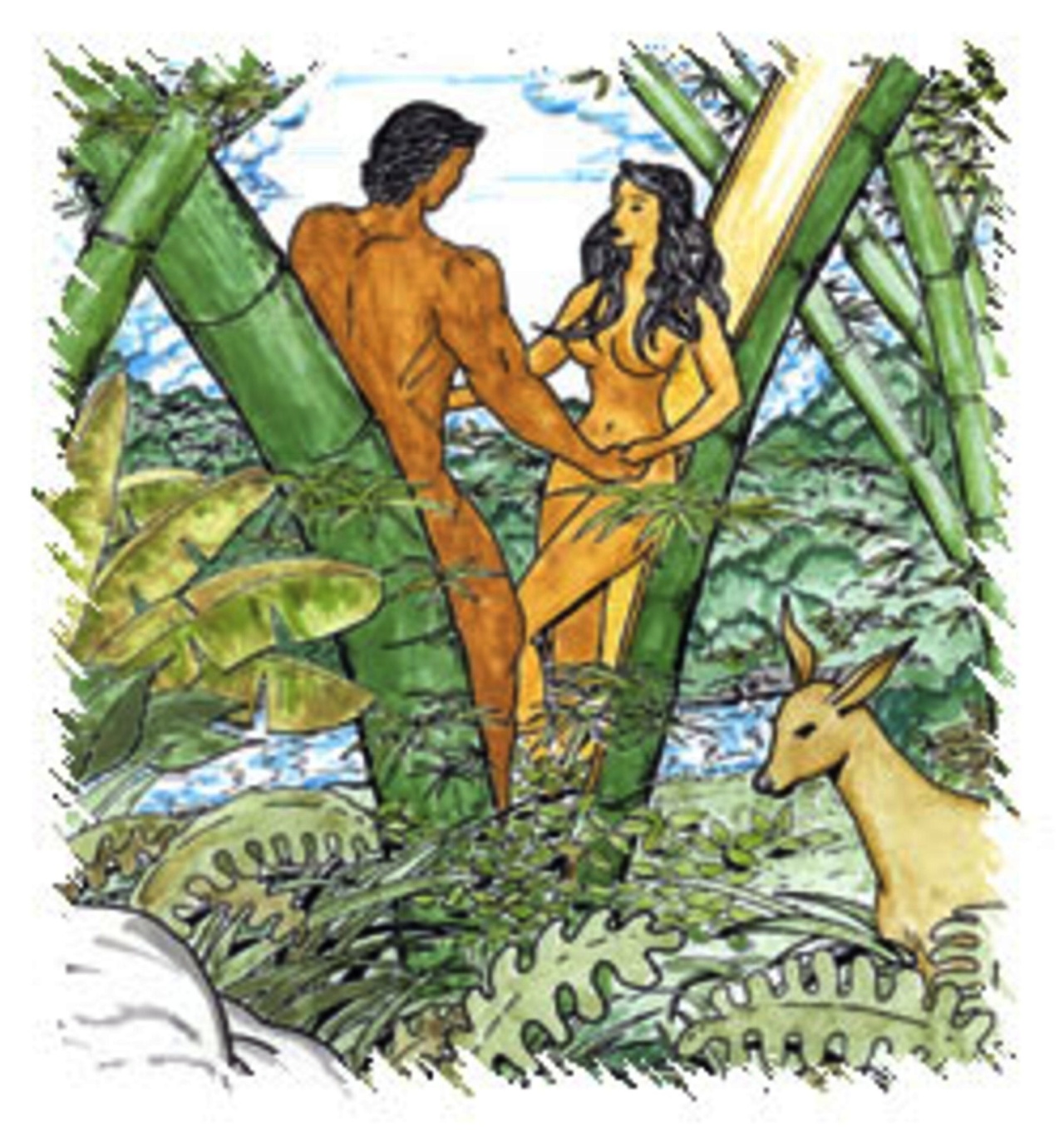
The Visayan Creation Myth explains how the Sun, the Moon, the islands, and human beings were formed.A long time ago, there were two Gods - Maguayan, ruler of water, and Kaptan, ruler of the sky. One day, the two Gods decided to marry their children. Three sons were born from this union - Likalibutan was extremely brave and strong, Liadlao was made of gold and was always cheerful, and Libulan, made of copper, was timid and weak. Lisuga was the only daughter, she was made of silver and was very beautiful, gentle and sweet. Sadly, they were orphaned at a young age, but their grandparents took care of them and protected them from evil. Eventually, the siblings grew up to be strong and beautiful. [Source: buzzle.com +/+]
One day, Likalibutan, proud of his strength and power, decided to attack Kaptan's sky kingdom. Scared of their brother, Liadlao and Libulan were coerced into joining him and they left for the sky kingdom. An enormous steel gate was blocking their way, but Likalibutan summoned the wind and knocked it down. When Kaptan came to know of this, he got furious and fired them with lightning bolts. A lightning bolt landed on each of the three brothers. Likalibutan's rock-like body fragmented into a thousand pieces and fell down in the sea, Liadlao and Libulan melted into balls of gold and copper, respectively. +/+
Worried for her brothers, Lisuga came searching for them, but Kaptan, still fuming, attacked her as well. Her silver body too, was scattered into a million pieces. Kaptan then called Maguayan, accusing him of planning the whole thing. But Maguayan had been sleeping through the entire ordeal and didn't have the slightest clue. Kaptan eventually calmed down, and both the gods deeply mourned the loss of their grandchildren. Sadly, even with all their powers, they couldn't bring the siblings to life. So, they gave each of them light, except for Likalibutan. Luminous with this light, Liadlao became the Sun, Libulan, the Moon and Lisuga's fragmented body can be seen today as the stars. Kaptan planted a seed on a fragment of Likalibutan's body. A bamboo tree sprouted out of this seed and from this tree, Sikalak, a man and Sikabay, a woman, emerged. This man and woman are the ancestors of all the people in the world. +/+
RELATED ARTICLES:
FOLK RELIGIONS IN THE PHILIPPINES: GHOSTS, WITCHES. DEMONS, HOLY MOUNTAINS factsanddetails.com
SUPERSTITIONS IN THE PHILIPPINES factsanddetails.com
IFUGAO RELIGION: GODS, RITUALS, FUNERALS factsanddetails.com
BONTOC RELIGION: GODS, ANITOS, FUNERALS factsanddetails.com
RELIGION IN THE PHILIPPINES factsanddetails.com
CHRISTIANIZATION OF THE PHILIPPINES: MISSIONARIES, SUCCESS, FRIAROCRACY factsanddetails.com
HOMEGROWN RELIGIONS IN THE PHILIPPINES: IGLESIA NI KRISTO, AGLIPAYAN CHURCH, KINGDOM OF JESUS CHRIST factsanddetails.com
MOROS: MUSLIMS IN MINDANAO AND THE SOUTHERN PHILIPPINES factsanddetails.com
HISTORY OF MUSLIMS IN THE SOUTHERN PHILIPPINES factsanddetails.com
CATHOLICISM IN THE PHILIPPINES: LIFE. INFLUENCE, SAINTS, POPE VISITS factsanddetails.com
CATHOLIC PRACTICES IN THE PHILIPPINES: PRAYER LADIES, SANTOS, BAPTISMS factsanddetails.com
For article on the Catholic Church in general see CATHOLICS factsanddetails.com
CATHOLIC CHURCH AND PHILIPPINES POLITICS: CARDINAL SIN, DUTERTE, CORRUPTION FIGHTERS factsanddetails.com
FUNERALS IN THE PHILIPPINES factsanddetails.com
HOLIDAYS, FIESTAS, NEW YEAR GUNFIRE AND CHRISTMAS IN THE PHILIPPINES factsanddetails.com
FAMOUS FESTIVALS IN THE PHILIPPINES: HOLY WEEK, BLACK NAZARENE AND GETTING NAILED TO A CROSS factsanddetails.com
Philippines Creation Story

According to description written by John Maurice Miller, author of Philippine Folklore Stories (1904), “Thousands of years ago there was no land nor sun nor moon nor stars, and the world was only a great sea of water, above which stretched the sky. The water was the kingdom of the god Maguayan, and the sky was ruled by the great god Captan. Maguayan had a daughter called Lidagat, the sea, and Captan had a son known as Lihangin, the wind. The gods agreed to the marriage of their children, so the sea became the bride of the wind. Three sons and a daughter were born to them. The sons were called Licalibutan, Liadlao, and Libulan; and the daughter received the name of Lisuga. [Source: John Maurice Miller, Philippine Folklore Stories (Boston: Ginn and Company, 1904), pp. 57-64]
Licalibutan had a body of rock and was strong and brave; Liadlao was formed of gold and was always happy; Libulan was made of copper and was weak and timid; and the beautiful Lisuga had a body of pure silver and was sweet and gentle. Their parents were very fond of them, and nothing was wanting to make them happy. After a time Lihangin died and left the control of the winds to his eldest son Licalibutan. The faithful wife Lidagat soon followed her husband, and the children, now grown up, were left without father or mother. However, their grandfathers, Captan and Maguayan, took care of them and guarded them from all evil. After a time, Licalibutan, proud of his power over the winds, resolved to gain more power, and asked his brothers to join him in an attack on Captan in the sky above. At first they refused; but when Licalibutan became angry with them, the amiable Liadlao, not wishing to offend his brother, agreed to help. Then together they induced the timid Libulan to join in the plan.
When all was ready the three brothers rushed at the sky, but they could not beat down the gates of steel that guarded the entrance. Then Licalibutan let loose the strongest winds and blew the bars in every direction. The brothers rushed into the opening, but were met by the angry god Captan. So terrible did he look that they turned and ran in terror; but Captan, furious at the destruction of his gates, sent three bolts of lightning after them. The first struck the copper Libulan and melted him into a ball. The second struck the golden Liadlao, and he too was melted. The third bolt struck Licalibutan, and his rocky body broke into many pieces and fell into the sea. So huge was he that parts of his body stuck out above the water and became what is known as land. In the meantime the gentle Lisuga had missed her brothers and started to look for them. She went toward the sky, but as she approached the broken gates, Captan, blind with anger, struck her too with lightning, and her silver body broke into thousands of pieces.
Captan then came down from the sky and tore the sea apart, calling on Maguayan to come to him and accusing him of ordering the attack on the sky. Soon Maguayan appeared and answered that he knew nothing of the plot as he had been asleep far down in the sea. After a time he succeeded in calming the angry Captan. Together they wept at the loss of their grandchildren, especially the gentle and beautiful Lisuga; but with all their power they could not restore the dead to life. However, they gave to each body a beautiful light that will shine forever. And so it was that golden Liadlao became the sun, and copper Libulan the moon, while the thousands of pieces of silver Lisuga shine as the stars of heaven. To wicked Licalibutan the gods gave no light, but resolved to make his body support a new race of people. So Captan gave Maguayan a seed, and he planted it on the land, which, as you will remember, was part of Licalibutan's huge body.
Soon a bamboo tree grew up, and from the hollow of one of its branches a man and a woman came out. The man's name was Sicalac, and the woman was called Sicabay. They were the parents of the human race. Their first child was a son whom they called Libo; afterwards they had a daughter who was known as Saman. Pandaguan was a younger son and he had a son called Arion.
Pandaguan was very clever and invented a trap to catch fish. The very first thing he caught was a huge shark. When he brought it to land, it looked so great and fierce that he thought it was surely a god, and he at once ordered his people to worship it. Soon all gathered around and began to sing and pray to the shark. Suddenly the sky and sea opened, and the gods came out and ordered Pandaguan to throw the shark back into the sea and to worship none but them. All were afraid except Pandaguan. He grew very bold and answered that the shark was as big as the gods, and that since he had been able to overpower it he would also be able to conquer the gods. Then Captan, hearing this, struck Pandaguan with a small thunderbolt, for he did not wish to kill him but merely to teach him a lesson. Then he and Maguayan decided to punish these people by scattering them over the earth, so they carried some to one land and some to another. Many children were afterwards born, and thus the earth became inhabited in all parts.
Pandaguan did not die. After lying on the ground for thirty days he regained his strength, but his body was blackened from the lightning, and all his descendants ever since that day have been black. His first son, Arion, was taken north, but as he had been born before his father's punishment he did not lose his color, and all his people therefore are white. Libo and Saman were carried south, where the hot sun scorched their bodies and caused all their descendants to be of a brown color. A son of Saman and a daughter of Sicalac were carried east, where the land at first was so lacking in food that they were compelled to eat clay. On this account their children and their children's children have always been yellow in color. And so the world came to be made and peopled. The sun and moon shine in the sky, and the beautiful stars light up the night. All over the land, on the body of the envious Licalibutan, the children of' Sicalac and Sicabay have grown great in numbers. May they live forever in peace and brotherly love!
Tagalog Creation Story
The Tagalog are the dominate ethnic group in the Philippines. Summarizing their creation story, Mabel Cook Cole wrote in “Philippine Folk Tales” (1916): “When the world first began there was no land, but only the sea and the sky, and between them was a kite (a bird something like a hawk). One day the bird which had nowhere to light grew tired of flying about, so she stirred up the sea until it threw its waters against the sky. The sky, in order to restrain the sea, showered upon it many islands until it could no longer rise, but ran back and forth. Then the sky ordered the kite to light on one of the islands to build her nest, and to leave the sea and the sky in peace. [Source: pitt.edu/~dash, Mabel Cook Cole, Philippine Folk Tales (Chicago: A. C. McClurg and Company, 1916), pp. 187-188]
Now at this time the land breeze and the sea breeze were married, and they had a child which was a bamboo. One day when this bamboo was floating about on the water, it struck the feet of the kite which was on the beach. The bird, angry that anything should strike it, pecked at the bamboo, and out of one section came a man and from the other a woman. Then the earthquake called on all the birds and fish to see what should be done with these two, and it was decided that they should marry. Many children were born to the couple, and from them came all the different races of people.
After a while the parents grew very tired of having so many idle and useless children around, and they wished to be rid of them, but they knew of no place to send them to. Time went on and the children became so numerous that the parents enjoyed no peace. One day, in desperation, the father seized a stick and began beating them on all sides. This so frightened the children that they fled in different directions, seeking hidden rooms in the house — some concealed themselves in the walls, some ran outside, while others hid in the fireplace, and several fled to the sea.
Now it happened that those who went into the hidden rooms of the house later became the chiefs of the islands; and those who concealed themselves in the walls became slaves. Those who ran outside were free men; and those who hid in the fireplace became negroes; while those who fled to the sea were gone many years, and when their children came back they were the white people.
Story of Bathala, Malakas and Maganda
Bathala is the supreme God of Tagalogs. In ancient times, Bathala was the caretaker of the Earth, and he often thought of creating living beings. But, the Earth was empty, and so he couldn't create any mortals. One day, Bathala met Ulilang Kaluluwa, another God in the form of a serpent, who lived in the clouds. After fighting for three days and three nights, Ulilang Kaluluwa was defeated and killed. Bathala did not give him a proper burial and instead, burned his body on earth. [Source: buzzle.com +/+]
After a few years, Galang Kaluluwa, a winged God, who loved to travel, wandered into the house of Bathala. Galang Kaluluwa and Bathala got along well and lived happily as good friends for many years. But one day, Galang Kaluluwa suffered from a terrible illness and couldn't recover. He expressed his desire to be buried in the place where Ulilang Kaluluwa was burned. From the grave of these two mighty Gods emerged a tall tree, bearing a big, round nut. The trunk of the tree reminded Bathala of Ulilang Kaluluwa's body, whereas the leaves reminded him of Galang Kaluluwa's feathers. He husked the nut, and was surprised to find that the hard nut was full of sweet water and nourishing meat. Bathala realized then, that he was ready to create the mortals and he made the vegetation, animals and human beings.
Another creation myth is the story of Malakas and Maganda - the Filipino version of Adam and Eve. At one time, there was just the sky, the sea, and a crow flying between them. The crow got tired of flying, but could find no place to sit, and stirred up the sea. When the waters of the sea reached the sky, it threw rocks, to keep it down. These rocks then became the islands of the Philippines. The crow flew down and lived peacefully on one of the islands; when one day a bamboo struck its feet. Hurt and angry, the crow started pecking the bamboo until it split in two - thus Malakas, meaning strong, and Maganda, meaning beautiful, were born. Malakas and Maganda married and had numerous children. One day, fed up with the constant racket of the children, they started beating them up. Terrified, the children fled all over the place, and became the different people living on the Islands.
Legends from the Philippines
The Legend of Makhiya tells us about the origin of the touch-me-not (Mimosa Pudica) plant. Maria, a very shy girl, lived with her parents Mang Dondong and Aling Iska, in a small village. Maria would spend hours tending to her garden, which was renowned for its lovely flowers. One day, bandits raided the village, and fearing for her life, Maria's parents hid her in the garden. While Aling Iska was praying to God for her daughter's safety, the bandits broke into the house and hit them both on the head. After pillaging the house, the bandits fled. When Mang Dondong and Aling Iska regained consciousness, they ran to the garden to look for Maria, but couldn't find her. They searched for her everywhere, and started to despair, when something pricked Mang Dondong's feet. Both of them knelt down to take a better look at the tiny plant closing its leaves. At that moment they realized, that their shy Maria has been transformed by the Gods into the plant. They named the plant Makahiya (Tagalog for shyness) and took immense care of it. [Source: buzzle.com +/+]
Legend of Sampaloc Lake: Sampolac Lake is the biggest lake in San Pablo, and it is named after a giant tamarind (sampolac) tree. Though there are many different versions of this legend, the basic premise remains the same. There was an orchard owned by a rich couple, filled with the most delicious tamarind trees. One day, a fairy decided to test their hospitality, and came to the orchard, dressed as a poor, old woman. She begged the couple to give her a few fruits as she was very hungry. The selfish couple, instead of helping the woman, let their dogs loose on her. The old woman was bitten by the dogs and badly hurt. She touched a giant tamarind tree and cursed, "Your greed shall be punished". As the woman was walking away, the sky darkened and a ferocious storm broke out. The downpour continued late in the night, the next morning though, the sky was clear and blue. The couple came to tend their orchard and were bewildered to find their entire orchard gone. Instead, there was water everywhere. When they looked down into the water, they could still see their precious trees at the bottom of the lake. +/+
Legend of Mount Mayon: Mount Mayon is an active volcano, named after Daragang Magayon, a beautiful girl in this legend. This is a tragic love triangle between Daragang Magayon, her lover Panginorin, and her admirer Pagtuga. Magayon, daughter of the Rawis' tribal chief Makusog, was known for her exquisite beauty and grace. So renowned was she, that suitors from faraway lands came to vie for her hand. One of her admirers was Pagtuga, an arrogant and snobbish hunter. To win her, he would present her with extravagant gifts, but none of them pleased her. Panginorin, the chief of Karilaga, hearing of her beauty, decided to visit the Rawis, just to catch a glimpse of her. When he saw her, he was immediately smitten and courted her with much devotion. Touched by his affection, Magayon too fell in love. Panginorin, then, rammed a spear in front of her house, denoting his intention to marry her, as per the custom. +/+
The wedding was just a few days away, when Pagtuga blackmailed Magayon that if she doesn't marry him, he will kill Makusog, her father. When Panginorin came to know of this, he attacked Pagtuga. The brutal fight ended when Pagtuga was slain by Panginorin. A joyous Magayon rushed to his side, when a stray arrow hit her. Panginorin too, was struck by a spear. Sadness spread over the entire kingdom, and the lovers were placed in a grave and buried. As days past by, people noticed that the land on which Magayon and Panginorin were buried, was slowly rising, forming the Mount Mayon. The legend says that, now Panginorin lives in the clouds and Magayon in the mountain, and when the peak of Mayon is shrouded by clouds, the couple is kissing. The rain that follows this, is said to be the tears of Panginorin. Some days, the ground shakes, and they say, this is the angry Pagtuga trying to take his gifts back from Magayon. +/+
Origin Myth of the Bagobo of Mindanao
In the beginning there lived one man and one woman, Toglai and Toglibon. Their first children were a boy and a girl. When they were old enough, the boy and the girl went far away across the waters seeking a good place to live in. Nothing more was heard of them until their children, the Spaniards and Americans, came back. After the first boy and girl left, other children were born to the couple; but they all remained at Cibolan on Mount Apo with their parents, until Toglai and Toglibon died and became spirits. Soon after that there came a great drought which lasted for three years. All the waters dried up, so that there were no rivers, and no plants could live. [Source: Mabel Cook Cole, Philippine Folk Tales (Chicago: A. C. McClurg and Company, 1916), pp. 133-134]
"Surely," said the people, "Manama is punishing us, and we must go elsewhere to find food and a place to dwell in." So they started out. Two went in the direction of the sunset, carrying with them stones from Cibolan River. After a long journey they reached a place where were broad fields of cogon grass and an abundance of water, and there they made their home. Their children still live in that place and are called Magindanau, because of the stones which the couple carried when they left Cibolan.
Two children of Toglai and Toglibon went to the south, seeking a home, and they carried with them women's baskets (baraan). When they found a good spot, they settled down. Their descendants, still dwelling at that place, are called Baraan or Blaan, because of the women's baskets. So two by two the children of the first couple left the land of their birth. In the place where each settled a new people developed, and thus it came about that all the tribes in the world received their names from things that the people carried out of Cibolan, or from the places where they settled.
All the children left Mount Apo save two (a boy and a girl), whom hunger and thirst had made too weak to travel. One day when they were about to die the boy crawled out to the field to see if there was one living thing, and to his surprise he found a stalk of sugarcane growing lustily. He eagerly cut it, and enough water came out to refresh him and his sister until the rains came. Because of this, their children are called Bagobo.
Blaan Creation Myth
According to Blaan Story of the Creation: In the very beginning there lived a being so large that he cannot be compared with any known thing. His name was Melu, and when he sat on the clouds, which were his home, he occupied all the space above. His teeth were pure gold, and because he was very cleanly and continually rubbed himself with his hands, his skin became pure white. The dead skin which he rubbed off his body was placed on one side in a pile, and by and by this pile became so large that he was annoyed and set himself to consider what he could do with it. [Source: Mabel Cook Cole, Philippine Folk Tales (Chicago: A. C. McClurg and Company, 1916), pp. 139-140]
Finally Melu decided to make the earth; so he worked very hard in putting the dead skin into shape, and when it was finished he was so pleased with it that he determined to make two beings like himself, though smaller, to live on it. Taking the remnants of the material left after making the earth he fashioned two men, but just as they were all finished except their noses, Tau Tana from below the earth appeared and wanted to help him. Melu did not wish any assistance, and a great argument ensued. Tau Tana finally won his point and made the noses which he placed on the people upside down. When all was finished, Melu and Tau Tana whipped the forms until they moved. Then Melu went to his home above the clouds, and Tau Tana returned to his place below the earth.
All went well until one day a great rain came, and the people on the earth nearly drowned from the water which ran off their heads into their noses. Melu, from his place on the clouds, saw their danger, and he came quickly to earth and saved their lives by turning their noses the other side up. The people were very grateful to him, and promised to do anything he should ask of them. Before he left for the sky, they told him that they were very unhappy living on the great earth all alone, so he told them to save all the hair from their heads and the dry skin from their bodies and the next time he came he would make them some companions. And in this way there came to be a great many people on the earth.
According to a another Blaan creation story: In the beginning there were four beings (Melu, Fiuweigh, Diwata, and Saweigh), and they lived on an island no larger than a hat. On this island there were no trees or grass or any other living thing besides these four people and one bird (Buswit). One day they sent this bird out across the waters to see what he could find, and when he returned he brought some earth, a piece of rattan, and some fruit. Melu, the greatest of the four, took the soil and shaped it and beat it with a paddle in the same manner in which a woman shapes pots of clay, and when he finished he had made the earth. Then he planted the seeds from the fruit, and they grew until there was much rattan and many trees bearing fruit. [Source: Mabel Cook Cole, Philippine Folk Tales (Chicago: A. C. McClurg and Company, 1916), pp. 141-142.]
The four beings watched the growth for a long time and were well pleased with the work, but finally Melu said, "Of what use is this earth and all the rattan and fruit if there are no people?" And the others replied, "Let us make some people out of wax." So they took some wax and worked long, fashioning it into forms, but when they brought them to the fire the wax melted, and they saw that men could not be made in that way.
Next they decided to try to use dirt in making people, and Melu and one of his companions began working on that. All went well till they were ready to make the noses. The companion, who was working on that part, put them on upside down. Melu told him that the people would drown if he left them that way, but he refused to change them. When his back was turned, however, Melu seized the noses, one by one, and turned them as they now are. But he was in such a hurry that he pressed his finger at the root, and it left a mark in the soft clay which you can still see on the faces of people.
Image Sources: Wikimedia Commons
Text Sources: “Encyclopedia of World Cultures Volume 5: East/Southeast Asia:” edited by Paul Hockings, 1993; “Culture Shock!: Philippines” by Alfredo Roces and Grace Roces, Marshall Cavendish International, 2010; National Geographic, Live Science, Philippines Department of Tourism, New York Times, Washington Post, Los Angeles Times, Smithsonian magazine, Encyclopedia.com, Library of Congress, The Conversation, The New Yorker, Time, BBC, CNN, Reuters, Associated Press, AFP, Lonely Planet Guides, Google AI, Wikipedia, The Guardian and various websites, books and other publications.
Last updated March 2026