
HOMEGROWN RELIGIONS IN THE PHILIPPINES
About 9.5 percent of the Christian population of the Philippines is non-Catholic. These include Protestants (5.4 percent) and the Philippine Independent (Aglipayan) Church (2.6 percent) and Iglesia ni Cristo (2.3 percent), which some consider Protestant sects.
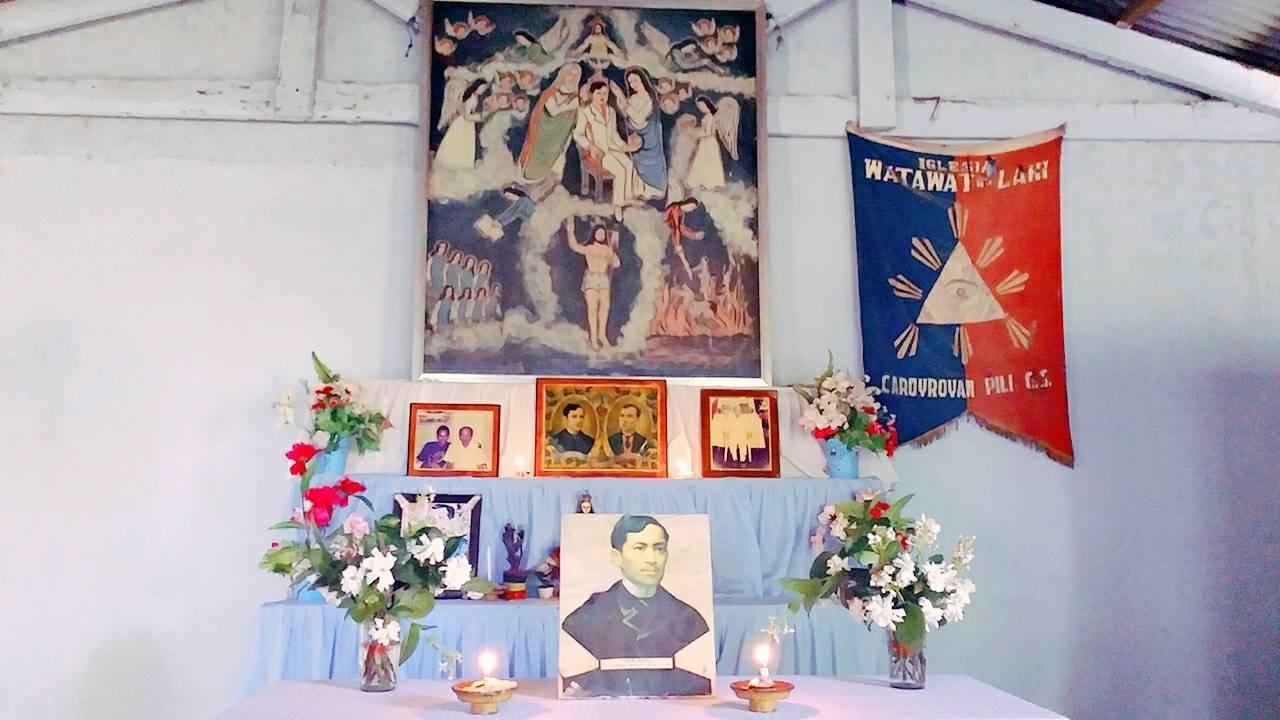
Followers of The Flag of the Race (Iglesia Atawat ng Lahi) sect believe that executed Filipino hero Jose Rizal is a direct reincarnation of Christ and he will return one day to save the faithful from poverty and suffering. The cult is based in the Calamba area and has an estimated 250,000 followers.
The Unification church of Sun Myung Moon (“Moonies”) is active in the Philippines. Nearly 1,000 Filipina women "married" in a mass wedding to Korean men were barred from leaving the country because the Unification church did not present valid marriage licenses and other documents. The church threatened to sue to Philippines government for "moral harassment" and in response the Philippines government refused to allow the South Korean grooms to return to the Philippines.
RELATED ARTICLES:
RELIGION IN THE PHILIPPINES factsanddetails.com
CHRISTIANIZATION OF THE PHILIPPINES: MISSIONARIES, SUCCESS, FRIAROCRACY factsanddetails.com
CATHOLICISM IN THE PHILIPPINES: LIFE. INFLUENCE, SAINTS, POPE VISITS factsanddetails.com
CATHOLIC PRACTICES IN THE PHILIPPINES: PRAYER LADIES, SANTOS, BAPTISMS factsanddetails.com
For article on the Catholic Church in general see CATHOLICS factsanddetails.com
CATHOLIC CHURCH AND PHILIPPINES POLITICS: CARDINAL SIN, DUTERTE, CORRUPTION FIGHTERS factsanddetails.com
MOROS: MUSLIMS IN MINDANAO AND THE SOUTHERN PHILIPPINES factsanddetails.com
HISTORY OF MUSLIMS IN THE SOUTHERN PHILIPPINES factsanddetails.com
FOLK RELIGIONS IN THE PHILIPPINES: GHOSTS, WITCHES. DEMONS, HOLY MOUNTAINS factsanddetails.com
MYTHS, LEGENDS AND CREATION STORIES IN THE PHILIPPINES factsanddetails.com
SUPERSTITIONS IN THE PHILIPPINES factsanddetails.com
IFUGAO RELIGION: GODS, RITUALS, FUNERALS factsanddetails.com
BONTOC RELIGION: GODS, ANITOS, FUNERALS factsanddetails.com
FUNERALS IN THE PHILIPPINES factsanddetails.com
HOLIDAYS, FIESTAS, NEW YEAR GUNFIRE AND CHRISTMAS IN THE PHILIPPINES factsanddetails.com
FAMOUS FESTIVALS IN THE PHILIPPINES: HOLY WEEK, BLACK NAZARENE AND GETTING NAILED TO A CROSS factsanddetails.com
Propensity of Filipinos to Accept Weird Religious Beliefs
In 1912, Cornélis De Witt Willcox wrote in “Early in 1909, a miscreant who had been parading himself in women’s clothes as a female Jesus Christ, upon exposure by a native doctor, out of revenge got together a band of nineteen men, and with their help proceeded to cut the doctor to pieces. This occurred within a day’s march of Manila. The example just given suggests another Filipino trait, the readiness with which the more ignorant will swallow any and all religious nostrums, and form absurd sects, usually for the financial or other material benefit of their leaders. [Source:“The Head Hunters of Northern Luzon” by Cornélis De Witt Willcox, Lieutenant-Colonel U.S. Army, Professor United States Military Academy, 1912]
“In yet another case, a murderous bandit of Tayabas Province, a Tagálog province, whom we caught and very properly hanged, used to promise as a reward for any deed of special villainy in which he might be interested, a bit of independencia (independence), and then would show a box with the word painted on it, declaring that it contained a supply sent down to him from Manila. He never failed to find men to do his will. Our purpose in citing these examples, whose number might be indefinitely multiplied, is not to show that the poor, ignorant Filipino is especially criminal of disposition, but to point out the ease with which he can be led by other men. If, under evil influence, he will altruistically, as it were, consent to almost any crime, obviously he can be induced to consent to almost anything else. His consent or acquiescence can not be taken to indicate appreciation of the issue.
Protestant Sects in the Philippines
The El Shaddai movement is believed to have 5 million followers. El Shaddai is a Hebrew word for God. The movement was founded in 1992 by Mariano "Brother Mike" Velarde, a popular television evangelist that tells his faithful that God can help them make money. Donations to the group are often "invested" in things like jobs and cures. Verlander is a television evangelist that draws more than a half million people to his rallies and acted as a spiritual advisor to former President Joseph Estrada.
The Jesus Miracle Crusade is an evangelical group that has a nightly television show with millions of viewers. It holds large rallies in stadiums and does a lot of faith healing. The movement is strong in Mindanao, where it was founded in 1975. The sect received a lot of attention in the early 2000s when some its members were kidnapped by Abu Sayyaf and were rescued by Philippines troops.
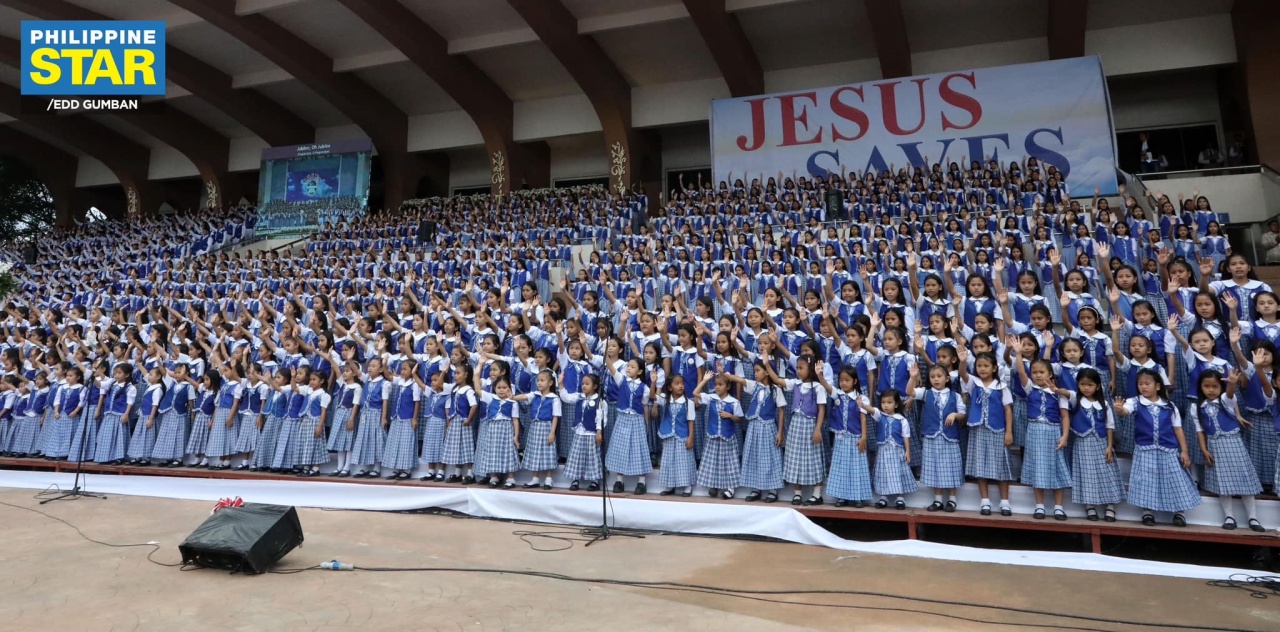
Describing one Jesus Miracle Brigade event, Mahlon Meyer wrote in Newsweek, “They raise their arms, palms outward, as if to receive divine energy. On the pulpit, in the center of the arena, a stringy-haired woman tells how she was cured of cervical cancer and near-blindness through prayer. She then bursts in to tears and cries out, ‘Hallelijah!’...A band starts up in a tent.”
In the early 2000s, eleven people were hacked to death in a clash between Christian groups on a southern Philippine island in Surigao del Norte province. Police said the victims were members of the Puluhan cult and its rival the Philippine Benevolent Missionary Association (PBMA). The fight occurred after the Puluhan cult took about 200 PBMA members hostage.
Iglesia Filipina Independiente (Independent Philippine (Aglipayan) Church)
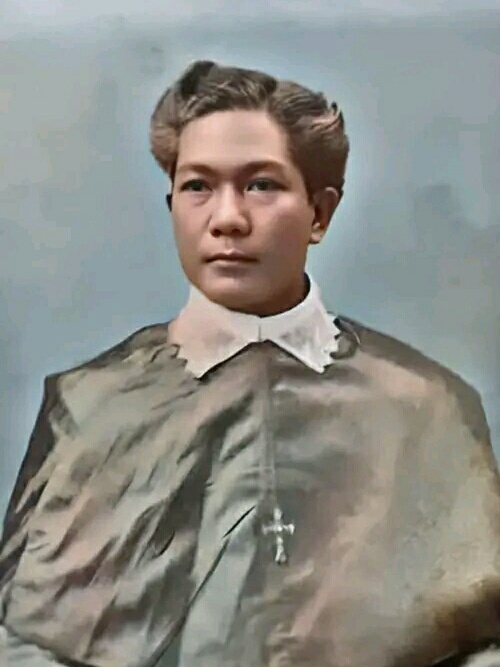
About 2.6 percent of Filipinos belong to the Iglesia Filipina Independiente (Independent Philippine Church, Aglipayan church, or Philippines Independent, Church). Organized in 1902 in reaction to the control of the Roman Catholic Church by the Spanish clergy, it was cofounded by Isabelo de los Reyes y Florentino, an author, activist, and senator imprisoned for criticizing the Spanish colonial regime during the revolution, and Gregorio Aglipay y Labayan, a Philippine Roman Catholic priest excommunicated in 1899 for participating in the Philippine independence movement. In 1903, Aglipay accepted de los Reyes's request to serve as the supreme bishop of the new church. Aglipay held this position until his death in 1940. [Source: Kathleen M. Nadeau, Worldmark Encyclopedia of Religious Practices, Thomson Gale, 2006]
Iglesia Filipina Independiente blends elements of Anglican Christianity and Unitarianism with Catholicism and is regarded as Catholic offshoot. It received the support of revolutionary leader Emilio Aguinaldo during the revolt against Spain and subsequent conflicts with American forces and rode the tide of antifriar nationalism in absorbing Filipino Roman Catholic clergy and forcibly seizing church property at the beginning of the twentieth century. One out of every sixteen diocesan priests and one out of four Philippine Catholics followed Aglipay into the Iglesia Filipina Independiente in those years of violent national and religious catharsis. The Iglesia Filipina Independiente, formally organized in 1902, thus enjoyed approximately five years of rapid growth, before a temporary decline in Philippine nationalism sent its fortunes into precipitous decline. [Source: Library of Congress 1991*]
Many followers returned to Catholicism, especially after Americans and then Filipinos replaced Spanish priests. Among those who remained in the new church, a crippling schism emerged over doctrinal interpretation, especially after 1919 when members were suddenly instructed to discard earlier church statements concerning the divinity of Christ. To some extent, the schism was caused by Aglipay himself, who shifted his theological views between 1902 and 1919. At first, he deemphasized doctrinal differences between his church and Roman Catholicism, and most of the independent church's priests followed Roman Catholic ritual — saying Mass, hearing confession, and presiding over folk religious-Catholic ceremonies just as always. Later, Aglipay moved closer to Unitarianism. *
The Philippine Independent Church continues to follow Roman Catholic forms of worship, though Unitarianism has strongly influenced its doctrine. In 1938 the church formally split. The faction opposing Aglipay later won a court decision giving it the right to both the name and property of the Iglesia Filipina Independiente. Followers of Aglipay, however, continued to argue that they represented true Aglipayanism. In the early l990s, those Aglipayans who rejected the Unitarian stance and adhered to the concept of the Trinity were associated with the Protestant Episcopal church of the United States. *
The Unitarian faction left the church in 1946. Under Isabelo de los Reyes, Jr. (who was elected bishop in 1946), the church adopted a new declaration of faith and articles of religion that were Trinitarian in 1947. In 1948, the Protestant Episcopal Church in the United States consecrated three bishops of the Philippine Independent Church, and the two churches entered into a close association. In 1961, the Philippine Independent Church was accepted into full communion with the Church of England and the Old Catholic churches.
Iglesia ni Kristo (Church of Christ)
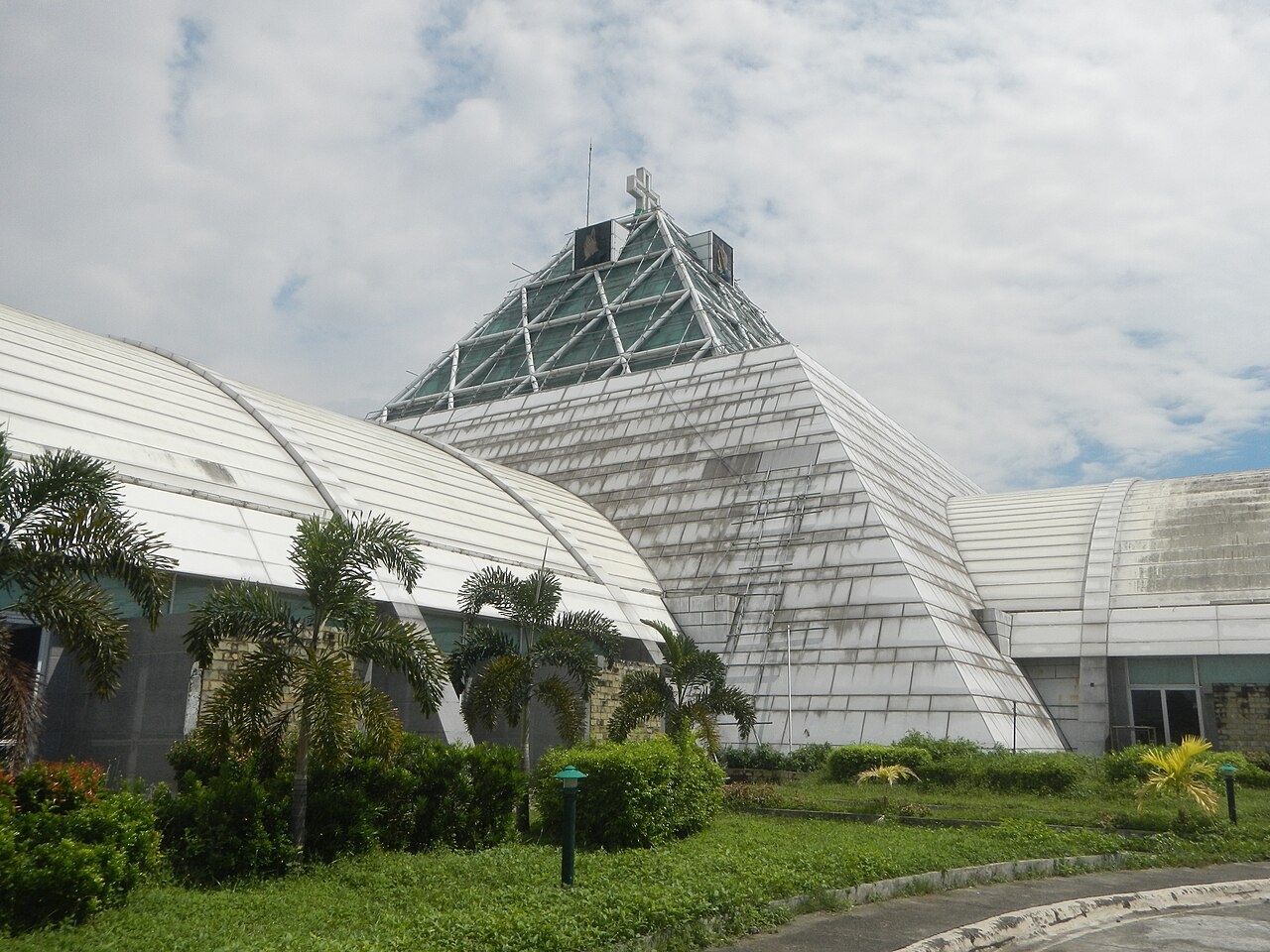
About 2.3 percent of Filipinos belong to the Iglesia ni Christo (Iglesia ni Kristo, Church of Christ), a Protestant group established locally in the Philippines. Cecil Morella of AFP wrote: “INC was established in 1914 in Manila by Felix Manalo, a charismatic man who was raised a Catholic, became a Protestant preacher then founded his own religion in which he proclaimed himself the last messenger of God. Today its unique cathedrals topped by soaring spires can be seen in most cities and villages across the Philippines, while its missionary work has created congregations in more than 100 other countries. [Source: Cecil Morella, AFP, July 26, 2014]
In the 1990s, all over Luzon, the Visayan Islands, and even northern Mindanao, unmistakable Iglesia ni Kristo (Church of Christ) places of worship, all similar in design and architecture, were being constructed for a rapidly growing membership. Founded by Felix Manalo Ysagun in 1914, the Iglesia ni Kristo did not attract much notice until after World War II, when its highly authoritarian organization and evangelical style began to fill a need for urban and rural families displaced by rapid changes in Philippine society. The church, led by clergy with little formal education, requires attendance at twice-weekly services conducted in local Philippine languages, where guards take attendance and forbid entrance to nonmembers. Membership dues, based on ability to pay, are mandatory. Members are expected to be "disciplined, clean, and God-fearing." Gamblers and drunks face the possibility of being expelled. The church forbids (on penalty of expulsion) marriage to someone of another faith and membership in a labor union. The Iglesia ni Kristo also tells its members how to vote and is even respected for its ability to get out the vote for candidates of its choice. [Source: Library of Congress, 1991 *]
There are a number of reasons why so many Filipinos have joined such an authoritarian church, not the least of which is the institution's ability to stay the decline of traditional Philippine vertical patron-client relationships, especially in urban areas. The church also has been successful in attracting potential converts through its use of mass rallies similar to Protestant revival meetings. The message is always simple and straightforward — listeners are told that the Iglesia ni Kristo is the mystical body of Christ, outside of which there can be no salvation. Roman Catholicism and Protestant churches are denounced — only through membership in the Iglesia ni Kristo can there be hope for redemption. *
Although the original appeal of the Iglesia ni Kristo was to members of the lower socioeconomic class, its puritanical precepts encouraged social mobility; and many of its members were climbing the economic ladder. Whether the church would be able to maintain its puritanical, authoritarian stance when more of its members reached middle-class status was difficult to predict. The church gave neither a count nor an estimate of its membership, but the rapid construction of elaborate buildings, including a campus for an Iglesia ni Kristo college adjacent to the University of the Philippines, would indicate that it was expanding. *
Iglesia ni Kristo Beliefs, Politics and Money
Cecil Morella of AFP wrote: “The INC is at odds with the Catholic Church on many fundamental issues of doctrine, and numerous outsiders perceive it as a much more conservative brand of Christianity. INC's teachings are based on a rigid following of the Bible, and the church insists only its members qualify for salvation. Men and women must be separated in church for services, and they are only allowed to date or marry fellow INC members. Once married, they can never separate. Christmas and many Catholic fiestas that are hugely popular in the Philippines are not celebrated by INC members. [Source: Cecil Morella, AFP, July 26, 2014 ^]
“INC also has a reputation for carrying out much more intense missionary work than the Catholic Church. "One has to respect how much more aggressive the INC is in expanding and sustaining itself," Louie Checa Montemar, a political science lecturer at Catholic De La Salle University in Manila, told AFP. ^
“The INC typically creates the biggest headlines in the Philippines when it flexes its considerable financial and political muscle. Its political strength is built upon a ruling that all members must vote in national elections according to the verdict of the church's leader. INC refuses to disclose how many members it has — although local media estimate it to be well above two million, giving it a powerful bloc vote that ensures politicians pay them close attention. "They have a preponderant influence on the government itself and on politics relative to their size," Ramon Casiple, head of the Manila-based think tank Institute for Political and Electoral Reform, told AFP. "Nobody wants to go against the Iglesia... in a close (election) fight." And while INC does not officially demand tithings, its policy of encouraging members to donate significant portions of their incomes to the church has undeniably paid rich dividends. ^
Iglesia ni Kristo (Church of Christ) Celebrates Its 100 Anniversary
In July, 2014, Cecil Morella of AFP wrote: “A Philippine Christian church renowned for its discipline, money and political power will mark its 100th anniversary with more than one million followers expected to join the celebrations. The Iglesia ni Cristo (Church of Christ) members will congregate at a giant complex especially built for the occasion near Manila, in an event that will showcase the religion's stunning success at home and abroad. "The pace of the spread of Iglesia... has exploded," church spokesman Edwil Zabala told AFP during a tour of the "City of Victory" complex, which includes a 55,000-seat indoor stadium, to promote the centenary. [Source: Cecil Morella, AFP, July 26, 2014 ^]
“The new arena on Manila's northern outskirts that will be the focal point of the celebrations cost $175 million. Like every other church and INC building, it was completely financed by the "offerings of the brethren", according to spokesman Zabala. Its ability to mass its people is also stunning, with prayer rallies and evangelical missions in Manila regularly drawing hundreds of thousands of people over recent years. INC officials said they were preparing to welcome more than one million followers for church services led by INC leader Eduardo Manalo, the founder's grandson. ^
“Joyse Camit, a 49-year-old Manila office worker, will be among those celebrating. She was converted from Catholicism as a teenager along with the rest of her family after two years of INC home visits. "I love the discipline, and the idea of leading your life based solely on the Bible's teachings," Camit said. ^
Kingdom of Jesus Christ (KOJC)
The Kingdom of Jesus Christ (KOJC or KJC) — officially the Kingdom of Jesus Christ, The Name Above Every Name, Inc. — is a Philippine-based nontrinitarian Restorationist church. It was founded by Pastor Apollo Quiboloy, who calls himself the "Appointed Son of God." Quiboloy is in prison, accused of sexually abusing children, forcing then to have sex with him "in the name of God", aided by his close, ultra-religious allies. [Source: Wikipedia, Time magazine]
The KOJC is headquartered in a 30 hectare (75 acres) complex, which houses some 40 buildings, including a cathedral, a school and even a hangar. Quiboloy preaches from a glass table that is set against giant photographs of his lush hilltop estate called the “Garden of Eden Restored”. [Source BBC, August 26, 2024]
The KOJC doesn't like being labeled a church, It believes that its founder, Apollo Quiboloy, is the "Appointed Son of God." One story about Quiboloy's birth says that God came to his mother as a cloud to announce that he was his son. Church members, also called "Kingdom citizens," believe that salvation is only for church members. This belief is different from mainstream Christianity.
Around 1998, KOJC established the Children's Joy Foundation (CJF), which, according to court records and its website, was created to provide residential care, medical services, psychosocial support, education, and emergency assistance to disadvantaged children in the Philippines. CJF later began operating in the United States in 2007.
The KOJC says it has 8 million members around the world. However, former member Arlene Stone says this is not true. She says there are only 7,000 to 8,000. The Philippine National Police also supports this claim. They say there are only 8,000 active members. In the Philippines, the KOJC is not among the explicitly recorded religious affiliations for respondents in the 2020 census by the Philippine Statistics Authority.
Apollo Quiboloy
Apollo Quiboloy is the founder of the Kingdom of Jesus Christ (KOJC), where he proclaims himself the “Appointed Son of God.” Formerly affiliated with the United Pentecostal Church of the Philippines, he reportedly spent five years in seclusion in Tamayong and later in Sitio Kitbog at the foot of Mount Matutum in South Cotabato before establishing his church. Quiboloy has said that divine revelations received through dreams inspired him to found KOJC. [Source: Chad de Guzman, Time, February 22, 2024]
Apollo Carreon Quiboloy was born on April 25, 1950, the youngest out of nine children, in Davao City to Kapampangan parents, who were natives from Lubao, before migrating to Mindanao after World War II. Quiboloy's father, José, was originally a Protestant and member of the Christian and Missionary Alliance, before moving to Oneness Pentecostal with his four sons. His family were locally known as pastor-leaders during the early years of the United Pentecostal Church of the Philippines (UPCP) in Davao. Apollo's sibling, Jose, later became the Assistant General Superintendent of the UPCP before moving for independent work at the Greater Manila area.[Source: Wikipedia]
Apollo claims to have started experiencing spiritual visions at the age of 14, during a visit to Malungon, South Cotabato (now Sarangani). According to his website, he envisioned encounters with the Lord and the earth being burnt in a bowl of fire. These visions also include captions such as "...the sun shall be turned into darkness, and the moon into blood before that great and notable day of the Lord come" and "If ye shall seek me ye shall find me in my way". Quiboloy would recall these visions as the Second Coming of Jesus.
As a young man Quiboloy didn’t envision preaching as his future career, originally expressing desires to become a nautical engineer and pilot. However, because of the benefits that came with Bible college including free board and meals, fully paid tuition fees and a free boat ride to Manila, he continued to study theology at the United Pentecostal Bible Institute (later the Apostolic Center for Theological Studies), graduating in 1972. He preached for the UPCP after completing college and gained moniker as a "Preaching Machine". In 1973, the UPCP nominated Quiboloy to represent them at the International Youth Corps World Conference held at Seoul, South Korea.The denomination would also elect Quiboloy as UPCP's national youth president in 1974.
According to The Telegraph: Quiboloy claims to have set up the group in Davao after hearing God whisper to him “I will use you” while attending an event by Billy Graham, the American pastor, in South Korea in 1973. He attracted followers through radio, televangelism and social media. When he was not in Davao, he has been seen travelling on his private jet. In 2021, the US department of justice charged him with sexual trafficking of children and other serious crimes including fraud and coercion, money laundering and bulk cash smuggling. Prosecutors alleged he had sex with women and underage girls who faced threats of abuse and “eternal damnation” if they refused. [Source Nicola Smith, The Telegraph, August 27, 2024]
Quiboloy also owns the media network Sonshine Media Network International, which operates television and radio stations. Former President Rodrigo Duterte often appearred on the network even after leaving office in 2022. Quiboloy is said to have served as a spiritual adviser to Duterte and is friends with his daughter Sara Duterte, the Vice President of the Philippines.
Quiboloy founded the Kingdom of Jesus Christ church in 1985 and rose to prominence as televangelism gained popularity in the Philippines. Quiboloy has been a close supporter of Duterte, who regularly appeared on a church-linked media network when he was mayor of Davao. In a Facebook post, Sara Duterte, accused police of abusing their power and of harassing church members during the raid on the compound. [Source Kathleen Magramo, CNN, August 27, 2024]
According to the BBC: rise to national prominence has mirrored that of Mr Duterte. Both started in Davao, where the former president served as mayor. When Mr Duterte was elected president in 2016, Mr Quiboloy's profile rose even higher. But that started to diminish when Mr Duterte left office in 2022. Outside of his alliance with Mr Duterte, Mr Quiboloy has also gained considerable clout by endorsing politicians during elections. When he endorsed Arroyo's choice of successor in the 2010 elections, Mr Quiboloy claimed to have seen the candidate's name in a vision that included then US President Barack Obama. [Source BBC, August 26, 2024]
Charges Against Apollo Quiboloy
Apollo Quiboloy has long been surrounded by controversy. In 2014, some Indigenous communities in the Philippines accused him of land grabbing, an allegation that members of his religious sect denied, maintaining that he was not involved. Quiboloy, who faces multiple charges in the United States related to an alleged sex trafficking scheme, is wanted by the Federal Bureau of Investigation (FBI). He has claimed that a $2 million bounty was placed on him and that American operatives are continuously monitoring his properties. The FBI has denied the existence of such a bounty, while the United States Embassy in the Philippines has stated it is confident he will be brought to justice. [Source: Chad de Guzman, Time, February 22, 2024]
A superseding indictment unsealed in November 2021 by the United States District Court for the Central District of California charged Quiboloy and two church administrators with participating in a sex trafficking conspiracy from 2002 to 2018. Prosecutors allege that girls and young women between the ages of 12 and 25 were recruited to serve as “pastorals,” or personal assistants, and were coerced into sexual relations through threats of physical and verbal abuse and spiritual condemnation.
He was indicted on charges including conspiracy to engage in sex trafficking by force, fraud, and coercion; sex trafficking of children; sex trafficking by force, fraud, and coercion; conspiracy; and bulk cash smuggling. A federal arrest warrant was issued on November 10, 2021, and the FBI released wanted posters for Quiboloy and two associates in February 2022. His camp has rejected the allegations, describing them as malicious accusations.
In December 2022, the United States Department of the Treasury froze the assets of Quiboloy and more than 40 other individuals over alleged links to human rights abuses and corruption. His legal counsel criticized the move as politically motivated.
Illegal Activities of the Kingdom of Jesus Christ
Administrators and leaders for the Kingdom of Jesus Christ arranged dozens of false marriages so workers at a fraudulent charity could stay in the United States, prosecutors in California, Virginia and the U.S. Justice Department said. According to the New York Times: The three leaders — Guia Cabactulan, 59, Marissa Duenas, 41, and Amanda Estopare, 48 — brought church members to the United States under false pretenses, often telling them that they were invited to be special guests at a concert supporting the church’s ministry, federal prosecutors said. [Source: Neil Vigdor, New York Times, January 29, 2020]
But once the church members arrived in the United States, their passports were immediately taken away by the three church administrators, who then forced them to collect donations for the Children’s Joy Foundation, a nonprofit run by the church that claims to help impoverished children in the Philippines, according to a criminal complaint.
The church raised about $20 million from 2014 through mid-2019, but most of the money went back into the church’s coffers and to pay for luxury goods for church leaders that included a Bentley, a bulletproof Cadillac Escalade, an Armani suit and real estate, the complaint said. The church also owns a mansion in Calabasas, Calif.
The workers received little to no pay and were required to meet steep fund-raising quotas. Top performers, known as “assets,” were then forced into sham marriages with other church members, or made to obtain student visas so they could stay in the country, prosecutors said. Investigators said church leaders had arranged 82 such marriages in the past 20 years.
Those who failed to meet quotas faced punishments that included paddling or being forced to spend three to five days in isolation in a walled section of the compound while being denied food and listening to prerecorded sermons by church leaders, according to the complaint. One victim told investigators that church leaders “shaved her head and made her wear an orange shirt with ‘SOS’ on the back, which stood for ‘Son of Satan,’” Anne M. Wetzel, the F.B.I. special agent in charge of the investigation, wrote in the criminal complaint.
2024 KOJC Compound Standoff
In the early morning of August 24, 2024 about 2,000 police officers from Regions XI, XII, and XIII launched a large-scale operation to search the 30-hectare (75-acre) KOJC compound of Davao City. Led by regional police chief Nicolas Torre III, the composite team sought to arrest Apollo Quiboloy and four others. After negotiations with his lawyer, Israelito Torreon, authorities entered the property, which contains 42 buildings and underground facilities near Francisco Bangoy International Airport. Police acknowledged the compound’s complex layout made the search difficult. [Source: Wikipedia]
The 2,000 officers that stormed the KOJC headquarters were initially unable to find Quiboloy or locate the entrance to the bunker that he was hiding in so they turned to digging equipment in a bid to unearth it. They had brought drilling equipment and radar equipment used to detect heartbeats behind walls, which appeared to show the presence of 20 to 30 people around 30 meters below the ground. The sprawling compound was reported to house a labyrinthine network of underground tunnels and passages. It also has a hangar with a taxiway leading to the neighbouring Davao international airport. Police Colonel Jean Fajardo, a spokesman for the Philippine national police, said: “We are having a few difficulties because the signal we are monitoring using the ground-penetrating radar is moving. We are following the signal and we’re still confident that we will find the source. There are many secret passages and routes that lead to hallways. These are the challenges we are facing, and one or two days are not enough to complete the search.” During the search, two people, who police believe to be human-trafficking victims, were rescued. [Source Nicola Smith, The Telegraph, August 27, 2024]
The operation heightened tensions inside and outside the compound. Tear gas was reportedly used, and several individuals were hospitalized due to trauma, while others fainted. One church member died after suffering cardiac arrest while manning a watchtower. Police met fierce and at times violent resistance from his followers, who threw stones at officers, disrupted access to the nearby airport. and blocked access to the compound on the Carlos P. Garcia National Highway by setting up barricades and burning tires. Police fired tear gas as they tried to disperse the crowd. Photos released by police showed officers with bloodied faces and wearing bandages receiving treatment for their injuries. [Source Kathleen Magramo, CNN, August 27, 2024]
The standoff left more than 100 people injured, including around 60 police officers and dozens of church members. Complaints were filed against 29 KOJC members for obstruction of justice, violating public assembly laws, and assaulting authorities, though they were later released on bail. The incident drew national attention, highlighting the tensions between law enforcement and the influential religious group.
Arrest of Quiloloy
On September 8, Interior Secretary Benhur Abalos announced that Quiboloy had been captured, ending the manhunt. Authorities later clarified that Quiboloy and his four aides surrendered to the Intelligence Service of the Armed Forces of the Philippines and were transferred to Camp Crame in Quezon City. [Source: Wikipedia]
Quiboloy and four accomplices were wanted by both the FBI and local law enforcement on sexual abuse and human trafficking involving girls as young as 12. Quiboloy has been on the run for at least three years before he was arrested. He said he would "not be caught alive" and said that the "devil" was behind his legal problems. He has said that he did not want the FBI Investigation to "meddle" in his case. "I am not hiding from the charges because I am guilty. That's not true. I am just protecting myself," he said. [Source BBC, August 26, 2024; Kathleen Magramo, CNN, August 27, 2024]
During the standoff, Vice President Sara Duterte visited the wake of the deceased church member and later attended KOJC’s 39th anniversary event, expressing support for the church. She criticized the government for “grave abuse of police power” in trying to arrest Quiboloy. She asked members of the religious group to forgive her for having urged them to vote for Marcos during the 2022 elections. Meanwhile, tensions continued over alleged police activities within the compound. A Davao court initially issued a temporary protection order (TPO) directing police to halt actions that threatened KOJC members’ safety, but the Department of Justice maintained the search was lawful. A week later, the Court of Appeals nullified the TPO, ruling the lower court had acted without authority. Police admitted they had not yet covered even half of the vast compound due to its size and the lack of a blueprint.
Image Sources: Wikimedia Commons
Text Sources: “Encyclopedia of World Cultures Volume 5: East/Southeast Asia:” edited by Paul Hockings, 1993; “Culture Shock!: Philippines” by Alfredo Roces and Grace Roces, Marshall Cavendish International, 2010; National Geographic, Live Science, Philippines Department of Tourism, New York Times, Washington Post, Los Angeles Times, Smithsonian magazine, Encyclopedia.com, Library of Congress, The Conversation, The New Yorker, Time, BBC, CNN, Reuters, Associated Press, AFP, Lonely Planet Guides, Google AI, Wikipedia, The Guardian and various websites, books and other publications.
Last updated March 2026