
CHRISTIANIZATION OF THE PHILIPPINES
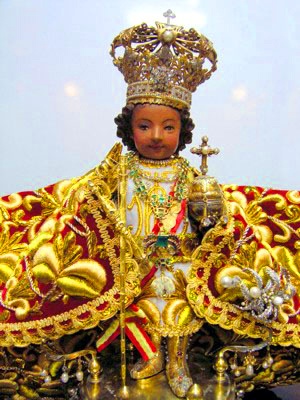
Santo Niño de Cebú, the oldest Christian artifact in the Philippines; In 1521, Ferdinand Magellan gave this statue to a Cebuano chieftain that converted to Christianity
Spain held on to the Philippines at least in part for religious reasons, since the colony brought little economic profit. Missionaries urged the Spanish king to fulfill his duty to spread Christianity. When the Spaniards arrived, Islam was already spreading and had firmly established itself in the southern islands. In response, missionaries divided the archipelago into mission areas and began building parishes, mission stations, and smaller outposts. They taught the faith using local languages instead of Spanish, which helped speed conversion. Within a relatively short time, many major indigenous groups became Christian. [Source: Nicholas P. Cushner, Encyclopedia of Latin American History and Culture, Gale, 2008]
When the Spanish took over the Philippines , they brought their long tradition of Catholicism with them. It was part of the Spanish conquest to convert all the natives to Christ through their Catholic tradition. Today as a result, the Catholic church still remains a very powerful force in the Philippines. For example, divorce is illegal there because of the Catholic church’s influence in the government and law-making. Filipinos still celebrate and participate in many Catholic holidays and customs. Practically everywhere you go you will see big Catholic cathedrals. In many homes, you’ll see pictures of the virgin Mary or the last supper, and many people carry around rosaries with them. On public transportation are plastered posters of Jesus and Mary and religious sayings. Because of the Spanish conquest, there is a strong tradition of Christianity among the Filipino people. [Source: by Rebecca, Philippines Baguio Mission, 2009-2011, the missionary website, preparetoserve.com \=/]
From its inception, Catholicism was deeply influenced by the prejudices, strategies, and policies of the Catholic religious orders. Known collectively as friars, the orders of the Augustinians, Dominicans, Franciscans, and others, and the Jesuits turned out to be just about the only Caucasians willing to dedicate their lives to converting and ministering to Spain's subject population in the Philippines. They divided the archipelago into distinct territories, learned the vernaculars appropriate to each region, and put down roots in the rural Philippines where they quickly became founts of wisdom for uneducated and unsophisticated local inhabitants. Because most secular colonial officials had no intention of living so far from home any longer than it took to turn a handsome profit, friars took on the roles of the crown's representatives and interpreters of government policies in the countryside. [Source: Library of Congress *]
The close relationship between church and state proved to be a liability when the Philippines was swept by nationalistic revolt in the late nineteenth century and Filipino priests seized churches and proclaimed the Independent Philippine Church (Iglesia Filipina Independiente). After the American occupation, Protestant missionaries came and established churches and helped to spread American culture. *
RELATED ARTICLES:
SPANISH ARRIVE IN THE PHILIPPINES: EXPEDITIONS, LEGAZPI, TAKING CONTROL factsanddetails.com
PHILIPPINES UNDER SPANISH RULE: LIFE, COLONIZATION, CHINESE factsanddetails.com
TRADE AND PLANTATIONS IN THE PHILIPPINES UNDER THE SPANISH factsanddetails.com
MANILA GALLEONS: SPANISH TRADE BETWEEN THE PHILIPPINES AND MEXICO factsanddetails.com
MOROS: MUSLIMS IN MINDANAO AND THE SOUTHERN PHILIPPINES factsanddetails.com
HISTORY OF MUSLIMS IN THE SOUTHERN PHILIPPINES factsanddetails.com
PHILIPPINES BEFORE THE ARRIVAL OF THE SPANISH factsanddetails.com
PRE-COLONIAL FILIPINO STATES factsanddetails.com
MAGELLAN IN THE PHILIPPINES factsanddetails.com
Introduction of Christianity to the Philippines
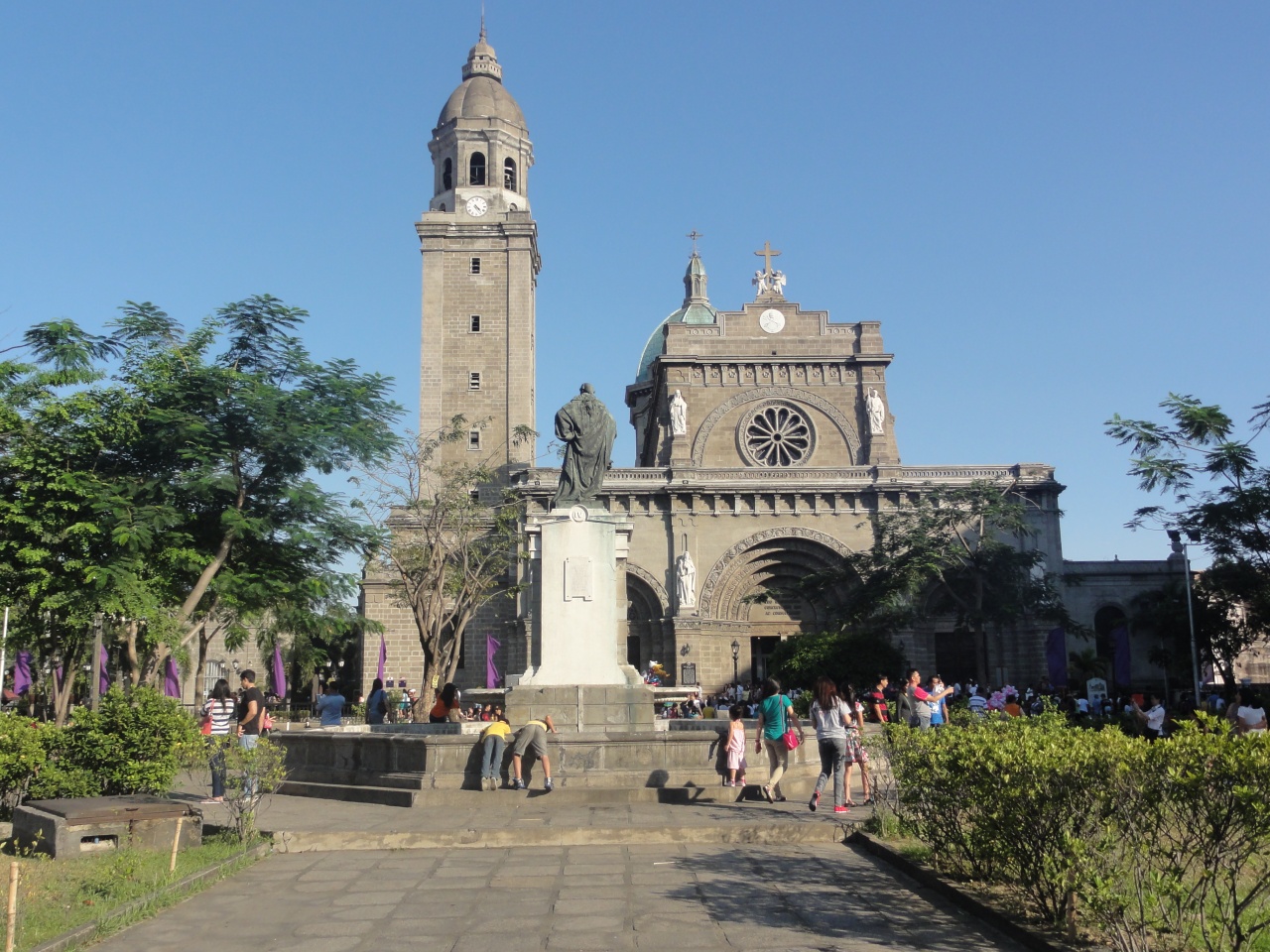
Initially, the primary goal of the Spanish in the Philippines was to convert the Filipinos to Christianity. One Jesuit priest wrote, “Lord Philip II...said that for one sole monastery in the Philippines in which the Holy Name of God was conserved, he would expend all the revenues of the kingdoms.” The Spanish colonizers introduced Roman Catholicism to Luzon and the Visayas, but were unsuccessful in Mindanao, where Muslims staved off Spanish efforts. Catholicism caught on remarkably quick and Filipinos became passionate Catholics.
Early Spanish contact with the Philippines was motivated by political ambition, economic competition, and religious goals. Spain sought to rival Portugal by claiming new territories, acquiring wealth, and spreading Christianity across the globe. Both Catholic powers aimed to dominate the lucrative spice trade, especially cloves, nutmeg, and mace, which were found in the Indonesian Archipelago south of the Philippines. Amid this European rivalry, Spanish expansion into the southern Philippine islands brought them into direct conflict with local societies that had already strongly embraced Islam. These Muslim communities actively resisted Christian intrusion, challenging Spanish efforts to extend political control and religious conversion in the region.[Source: George Bryan Souza, Tobacco in History and Culture: An Encyclopedia, Gale Group, Inc., 2005]
Spanish colonialism had, from its formal inception in 1565 with the arrival of Miguel López de Legazpi, as its principal raison d'être the conversion of the inhabitants to Christianity. When Legazpi embarked on his conversion efforts, most Filipinos were still practicing a form of polytheism, although some as far north as Manila had converted to Islam. For the majority, religion still consisted of sacrifices and incantations to spirits believed to be inhabiting field and sky, home and garden, and other dwelling places both human and natural. Malevolent spirits could bring harm in the form of illness or accident, whereas benevolent spirits, such as those of one's ancestors, could bring prosperity in the form of good weather and bountiful crops. Shamans were called upon to communicate with these spirits on behalf of village and family, and propitiation ceremonies were a common part of village life and ritual. Such beliefs continued to influence the religious practices of many upland tribal groups in the modern period. [Source: Library of Congress *]
The religious system that conquistadors and priests imported in the sixteenth and seventeenth centuries was superimposed on this polytheistic base. Filipinos who converted to Catholicism did not shed their earlier beliefs but superimposed the new on the old. Saints took primacy over spirits, the Mass over propitiation ceremonies, and priests over shamans. This mixing of different religious beliefs and practices marked Philippine Catholicism from the start. *
The relatively peaceful conquest of the Philippines by the Spanish in 1573 is sometimes “credited to the surviving spirit of Las Casas." So as not to repeat the mistakes the Spanish made in Latin America, Philip II ordered his soldiers, administrators and religious zealots not to brutalize the local people. Bartolomé de las Casas (1474-1566), a Spaniard who born in Seville who came to the New World as a conquistador in 1502, was most influential early supporter of the cause of Indian rights. He acquired his first slave as a university student at Salamance, Spain and later used slaves to run a mine and his own estate in Cuba. He continued to own slaves after he took the holy orders in 1512 and it wasn't until 1514, when he was preparing a sermon, that he suddenly became awakened to his wrong-doing when he read in the Bible: "he that sacrificeth of a thing wrongfully gotten, his offering is ridiculous, and the gifts of unjust men are not accepted." After this experience he was a changed man. He was convinced that "everything done to the Indians thus far was unjust and tyrannical" and decided at the age of 40 to devote is life to "the justice of those Indian peoples, and to condemn the robbery, evil and injustice committed against them."
Spanish Missionaries and Religious Orders in the Philippines
The first missionaries to arrive in the Philippines were five members of the Order of Saint Augustine who came with Miguel López de Legazpi in 1565. They were followed by fifteen Franciscans in 1578. In 1581, the Society of Jesus (Jesuits) and the Order of Preachers began their missionary work, and the Order of Augustinian Recollects arrived in 1606. [Source: Nicholas P. Cushner, Encyclopedia of Latin American History and Culture, Gale, 2008]
Different missionary movements within the Catholic Church moved into different parts of the Philippines. By the mid 17th century the Augustinians had settled in southern and western Luzon and on Panay and Cebu islands. The Dominicans settled in northern Luzon. The Franciscans in southern Luzon and the Jesuits were on Leyte, Bohol, Negros and Marinduque. The religious orders also promoted education. The Dominicans founded the University of Santo Tomas in Manila, which later became a university. The Jesuits established the Colegio de Manila in 1595 and opened six additional schools throughout the islands.
David Gutierrez wrote in the History of the Order of St. Augustine: “The period between about 1500 and 1750 brought a dramatic change in world history. During this time, Christianity became the first religion to spread around the world. Why did this happen? One reason was the energy unleashed by the Reformation and the Counter-Reformation. In particular, much Catholic missionary work grew out of the Counter-Reformation. Religious Orders were dedicated to making converts to Catholicism. The second major reason for the spread of Christianity was the Age of Exploration. By the 1500s, Europeans were travelling by sea to almost every part of the globe. Missionaries followed the European conquerors, traders, and colonists. [Source: David Gutierrez, History of the Order of St. Augustine, August 9, 2012]
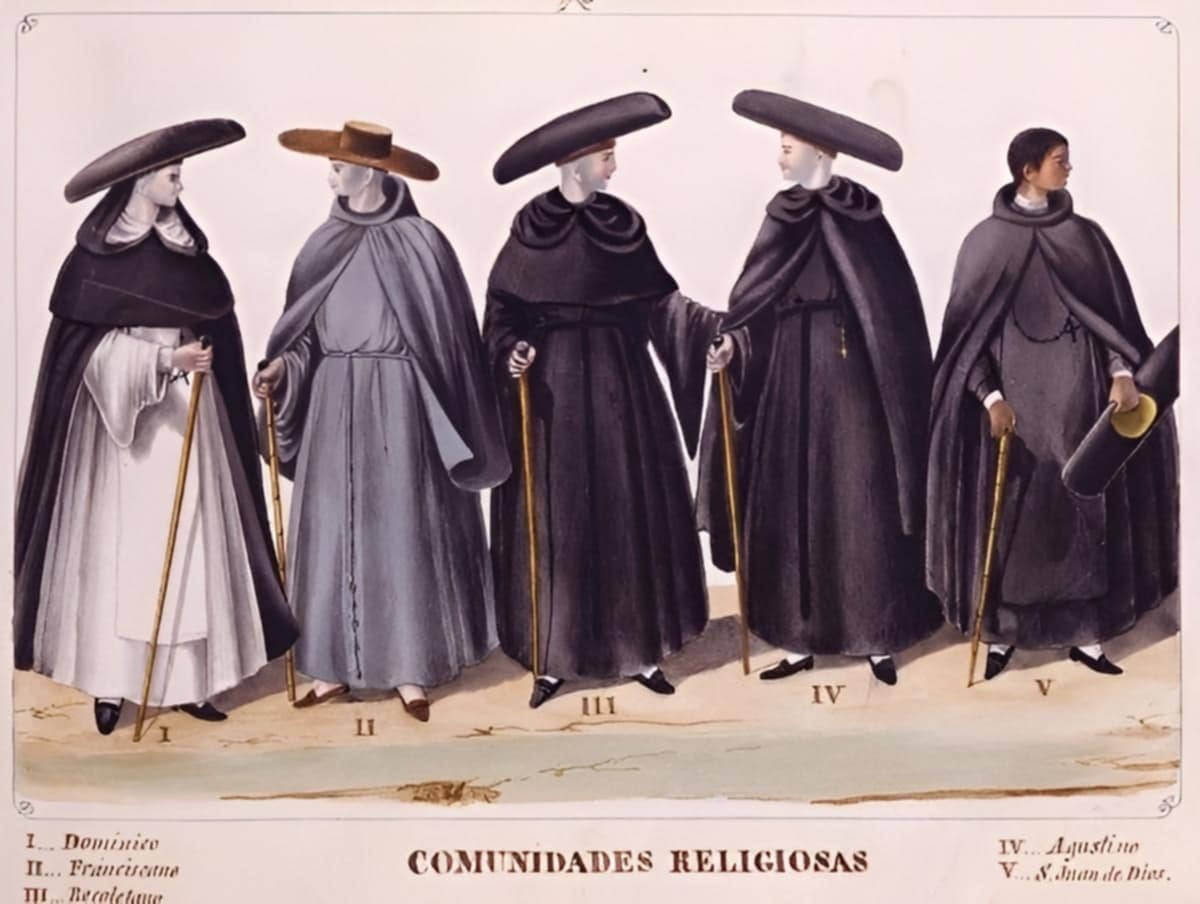
The power of religious orders remained one of the great constants, over the centuries, of Spanish colonial rule. Even in the late nineteenth century, the friars of the Augustinian, Dominican, and Franciscan orders conducted many of the executive and control functions of government on the local level. They were responsible for education and health measures, kept the census and tax records, reported on the character and behavior of individual villagers, supervised the selection of local police and town officers, and were responsible for maintaining public morals and reporting incidences of sedition to the authorities. Contrary to the principles of the church, they allegedly used information gained in confession to pinpoint troublemakers. Given the minuscule number of Spanish living outside the capital even in the nineteenth century, the friars were regarded as indispensable instruments of Spanish rule that contemporary critics labeled a "friarocracy" (frialocracia). [Source: Library of Congress]
Augustinians Establish Themselves in the Philippines
David Gutierrez wrote in the History of the Order of St. Augustine: “In the Order of St. Augustine in the 16th century, it was the Augustinian Province of Castile that aggressively moved and participated in the missionary activity of the Church. In the year 1527, when Juan Gallego was elected as Provincial of the said circumscription, he took the initiative to promote missionary activity. For this reason he was also known as the creator of the missionary ideal in the Order. Though he was tasked to lead the first Augustinian missionary to Mexico, he was not able to carry this out for he died in 1534. [Source: David Gutierrez, History of the Order of St. Augustine, August 9, 2012 =]
“After some time of studies and application to obtain the necessary permission, seven religious men (Augustinians) were appointed to initiate this new endeavour. They were “all men of great intelligence and talent and almost all of recognized holiness.” They embarked at Seville on March 3, 1533 and arrived in Mexico on June 7 of the same year where they were welcomed as guests by the Dominicans for more than a month until they had their own house. Mexico served as a base of operations for missionaries in this century, and what have been mentioned about evangelizing, humanitarian and cultural work in Mexico also applies to the Augustinian missions in Latin America and the Philippines. =
“On first attempt on November 1, 1542, the Augustinians travelled from Mexico to the Philippine Islands. They stayed for a short time and did not establish any missions at that time. On September 24, 1559, King Philip of Spain wrote a letter to Andres de Urdaneta, a former captain in his father’s service and later an Augustinian friar, asking him to take part in the expedition which was to sail from Mexico “to discover the islands of the setting of the sun.” The King added: “according to the great knowledge which you say you have about the things of that land, and understanding as you do about navigation, and being a good cosmographer, it would be of great importance that you should set out in those aforesaid ships, to see what you may discover for your expedition and for the service of our Lord.” With this letter, the king sent another to the Provincial of the Augustinians in Mexico informing him of the content of the letter to Urdaneta. The king also expressed his wish that the Provincial send other Augustinians along with Urdaneta, that they might start Christianizing the islands that they would discover. Thus, the first five famous Augustinians joined the expedition and set sail for the Orient. =
“They all arrived to the island of Cebu on April 27, 1565. On May 5, they began the construction of the first foundation which the missionaries dedicated to the Child Jesus, in honor of the statue of our Saviour which Pigaffeta, the historian of Magellan’s expedition, had given to the ruler of Cebu and his wife in 1521, and which the Augustinians found upon their arrival. As to date, the Augustinians have been in the Philippines for 470 years. Jürgen Moltmann once said: “Historical awareness differentiates between the present past and the past present, and puts us in the position to discover the future in the past, to pick up past possibilities again to link them with the present future.” =
'Christianization' Strategies Employed by the Spanish in the Philippines
Professor Susan Russell wrote: “In little more than a century, most lowland Filipinos were converted to Roman Catholicism. There are a number of reasons why Spanish missionaries were successful in this attempt: 1) Mass baptism - the initial practice of baptizing large numbers of Filipinos at one time enabled the initial conversion to Christianity. Otherwise, there is no way that such a small number of Spanish friars, or Catholic priests, could have accomplished this goal. It is said that many Filipinos associated baptism with their own indigenous 'healing rituals', which also rely on the symbolism of holy water — very typical of Southeast Asian societies. [Source: Professor Susan Russell, Department of Anthropology, Center for Southeast Asian Studies Northern Illinois University, seasite.niu.edu ]
“2) Reduccion policies - in areas where Filipinos lived scattered across the landscape in small hamlets, the Spanish military employed a resettlement policy that they had used successful in Central and Latin America. This policy was called reduccion, and essentially meant a forced relocation of small, scattered settlements into one larger town. The policy was designed for the convenience of administration of the Spanish colony's population, a way for a small number of armed Spanish constabulary to control more easily the movements and actions of a large number of Filipinos. It was also designed to enable Spain to collect taxes from their Christianized converts. Throughout Spanish rule, Christianized Filipinos were forced to pay larger taxes than indios, or native, unChristianized peoples. The reduccion policy also made it easier for a single Spanish Catholic friar to 'train' Filipinos in the basic principles of Christianity. In reality, the policy was successful in some areas but impossible to enforce. Spanish archives are full of exasperated colonial officials complaining about how such settlements were 'all but abandoned' in many cases after only a few weeks.
“3) Attitude of the Spanish clergy in the early phase - Spanish friars were forced to learn the native language of the peoples they sought to convert. Without schools that trained people in Spanish, the Spanish friars had no choice but to say Christian mass and otherwise communicate in the vernacular languages of the Philippines. There are over 200 native languages now; it is unknown how many existed in the beginning of Spanish rule. In the first half, or 150 years of Spanish rule, friars often supported the plight of local peoples over the abuses of the Spanish military. In the late Spanish period, in contrast, Spanish priests enraged many Filipinos for failing to a) allow otherwise 'trained' Filipino priests to ascend into the higher echelons of the Catholic Church hierarchy in the Philippines; b) return much of the land they had claimed as 'friar estates' to the Philippine landless farmers; and c) recognizing nascent and emerging Filipino demands for more autonomy and a greater say in how the colony was to be managed.
4) Adaptation of Christianity to the local context - Filipinos were mostly animistic in their religious beliefs and practices prior to Spanish intervention. In most areas they revered the departed spirits of their ancestors through ritual offerings, and also believed in a variety of nature spirits. Such beliefs were central to healing practices, harvest rites, and to maintaining a cosmological balance between this world and the afterlife. Spirits were invisible, but also responsible for both good and bad events. Spirits could be blamed for poor harvests, illness, and bad luck generally. Yet Filipinos believed that proper ritual feasting of the spirits would appease them, and result in good harvests, healthy recovery of the ill, and the fertility of women.
The legacy of Spanish conquest and colonial rule in the Philippines, as is true of all colonial attempts to 'master' or manage indigenous populations, is mixed. On the one hand, Spanish clergy were very destructive of local religious practices. They systematically destroyed indigenous holy places and 'idols', or statues and representations of indigenous spirits, gods or goddesses. They also tried to stamp out all examples of native scripts and literature for fear that Filipinos were using exotic symbols to foment rebellion. The Spanish also imposed new 'moralities' on Filipinos by discouraging slave holding, polygamy, gambling, and alcohol consumption that were a natural part of the indigenous social and religious practices. At the same time, Hispanic rule left a legacy of syncretic, rather than totally destructive, elements. Spanish clergy introduced some very European features of Catholic practice that blended well with indigenous ritual practices. Spanish Catholic priests relied on vivid, theatrical presentations of stories of the Bible in order to help Filipinos understand the central messages of Christianity. Today, this colonial legacy lives on whenever Filipino Catholics re-enact through religious dramas the passion of Christ, or Christ's martyrdom, during Holy Week.
Bajo Las Campanas (“Under the Church Bells”)
In their efforts to convert the population, Spanish missionaries encouraged Filipinos to settle in organized communities, a system known as bajo las campanas (“under the church bells”). This policy led to the creation of towns centered around the church, ensuring that residents remained within hearing distance of its bells—a symbol of both spiritual and communal life. Typically, the size of the church bells reflected the size of the community itself. [Source: “Culture Shock!: Philippines” by Alfredo Roces and Grace Roces, Marshall Cavendish International, 2010]
The structure of many Philippine towns today still reflects this Spanish influence. At the heart of the town lies a central plaza, with the church positioned at one end and the municipio, or government building, at the other. Flanking the plaza are the homes of prominent residents. Both traditional indigenous houses and Spanish colonial homes shared certain features: they were often single-storey but elevated, with space beneath used for storage, and designed with high ceilings and wall openings to allow for ventilation in the tropical climate.
Friarocracy of the Philippines
The power of religious orders remained one of the great constants, over the centuries, of Spanish colonial rule. Even in the late nineteenth century, the friars of the Augustinian, Dominican, and Franciscan orders conducted many of the executive and control functions of government on the local level. They were responsible for education and health measures, kept the census and tax records, reported on the character and behavior of individual villagers, supervised the selection of local police and town officers, and were responsible for maintaining public morals and reporting incidences of sedition to the authorities. Contrary to the principles of the church, they allegedly used information gained in confession to pinpoint troublemakers. Given the minuscule number of Spanish living outside the capital even in the nineteenth century, the friars were regarded as indispensable instruments of Spanish rule that contemporary critics labeled a "friarocracy" (frialocracia). [Source: Wikipedia]
Controversies over visitation and secularization were persistent themes in Philippine church history. Visitation involved the authority of the bishops of the church hierarchy to inspect and discipline the religious orders, a principle laid down in church law and practiced in most of the Catholic world. The friars were successful in resisting the efforts of the archbishop of Manila to impose visitation; consequently, they operated without formal supervision except that of their own provincials or regional superiors. Secularization meant the replacement of the friars, who came exclusively from Spain, with Filipino priests ordained by the local bishop. This movement, again, was successfully resisted, as friars through the centuries kept up the argument, often couched in crude racial terms, that Filipino priests were too poorly qualified to take on parish duties. Although church policy dictated that parishes of countries converted to Christianity be relinquished by the religious orders to indigenous diocesan priests, in 1870 only 181 out of 792 parishes in the islands had Filipino priests. The national and racial dimensions of secularization meant that the issue became linked with broader demands for political reform. *
The economic position of the orders was secured by their extensive landholdings, which generally had been donated to them for the support of their churches, schools, and other establishments. Given the general lack of interest on the part of Spanish colonials — clustered in Manila and dependent on the galleon trade — in developing agriculture, the religious orders had become by the eighteenth century the largest landholders in the islands, with their estates concentrated in the Central Luzon region. Land rents — paid often by Chinese mestizo inquilinos, who planted cash crops for export — provided them with the sort of income that enabled many friars to live like princes in palatial establishments. *
Central to the friars' dominant position was their monopoly of education at all levels and thus their control over cultural and intellectual life. In 1863 the Spanish government decreed that a system of free public primary education be established in the islands, which could have been interpreted as a threat to this monopoly. By 1867 there were 593 primary schools enrolling 138,990 students; by 1877 the numbers had grown to 1,608 schools and 177,113 students; and in 1898 there were 2,150 schools and over 200,000 students out of a total population of approximately 6 million.
The friars, however, were given the responsibility of supervising the system both on the local and the national levels. The Jesuits were given control of the teacher-training colleges. Except for the Jesuits, the religious orders were strongly opposed to the teaching of modern foreign languages, including Spanish, and scientific and technical subjects to the indios (literally, Indians; the Spanish term for Filipinos). In 1898 the University of Santo Tomás taught essentially the same courses that it did in 1611, when it was founded by the Dominicans, twenty-one years before Galileo was brought before the Inquisition for publishing the idea that the earth revolved around the sun. *
The friarocracy seems to have had more than its share of personal irregularities, and the priestly vow of chastity often was honored in the breach. In the eyes of educated Filipino priests and laymen, however, most inexcusable was the friars' open attitude of contempt toward the people. By the late nineteenth century, their attitude was one of blatant racism. In the words of one friar, responding to the challenge of the ilustrados, "the only liberty the Indians want is the liberty of savages. Leave them to their cock-fighting and their indolence, and they will thank you more than if you load them down with old and new rights." *
Jews and Spanish Inquisition in The Philippines
Marranos, or Spanish Jews who had converted to Christianity, sometimes just for appearance sake, were present in Manila among the early Spanish settlers. Because of suspicions about secret Jewish practices, they came under the watch of the Spanish Inquisition. The first public auto-da-fé in Manila was held in 1580, although it is unclear whether any of the seven accused were Jews. [Source: Encyclopaedia Judaica, Thomson Gale, 2007]
In 1593, two Marrano brothers, Jorge and Domingo Rodriguez, longtime residents of Manila, were tried at an auto-da-fé in Mexico City, since the Philippines did not have its own independent Inquisition tribunal. They were sentenced to imprisonment. By the end of the 17th century, at least eight Marranos from the Philippines had been prosecuted by the Inquisition.
Image Sources: Wikimedia Commons
Text Sources: Library of Congress, Philippines Department of Tourism, Philippines government websites, Encyclopedia.com, New York Times, Washington Post, Los Angeles Times, Wikipedia, “Encyclopedia of World Cultures Volume 5: East/Southeast Asia:” edited by Paul Hockings, 1993, UNESCO, National Commission for Culture and the Arts (NCCA) the official government agency for culture in the Philippines), Lonely Planet Guides, The Guardian, National Geographic, Smithsonian magazine, The New Yorker, Time, The Conversation, BBC, CNN, Reuters, Associated Press, AFP, Google AI, and various websites, books and other publications.
Last updated February 2026