
MAGELLAN
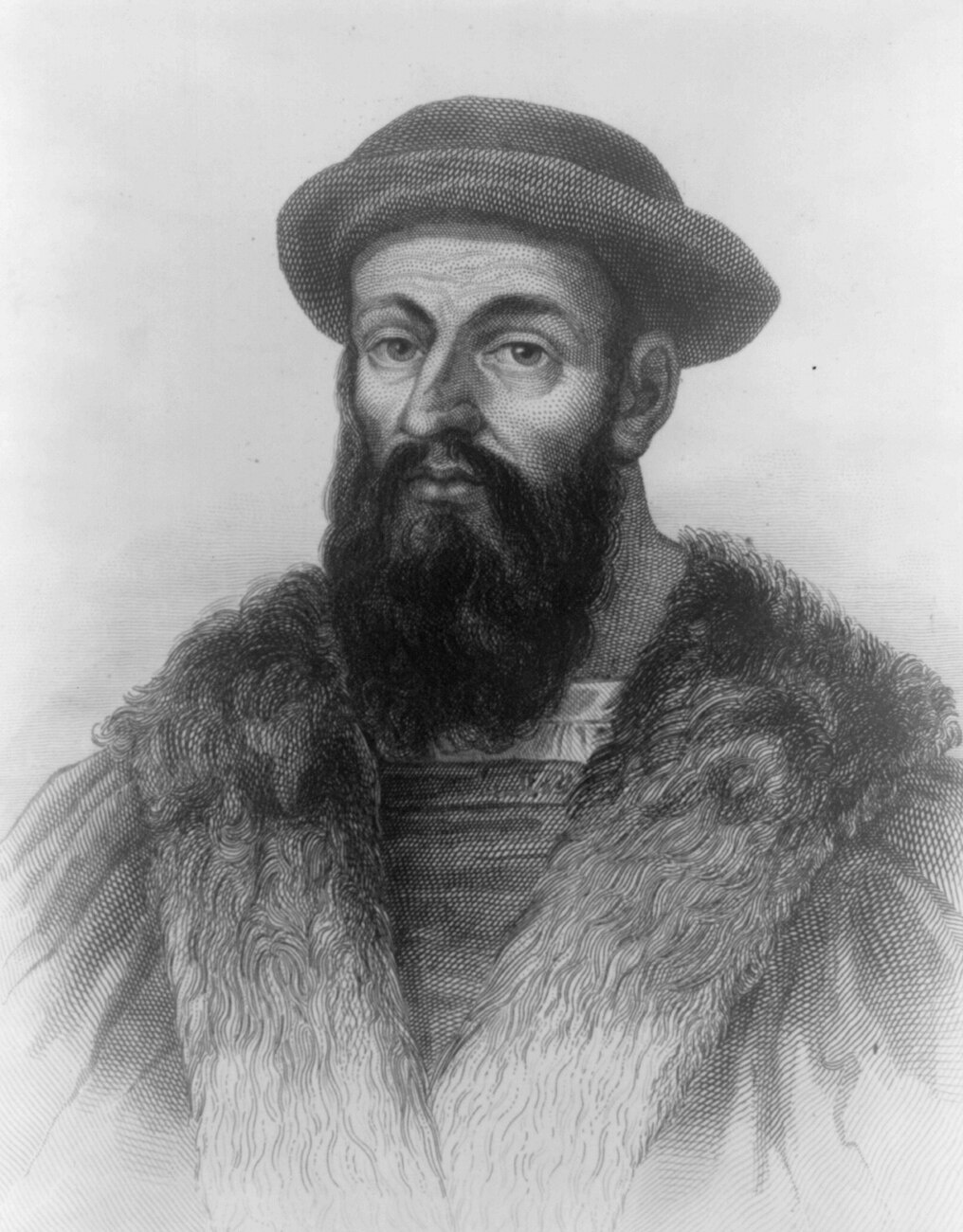
During the round the world voyage by his ships and crew, Portuguese explorer Ferdinand Magellan (1480?-1521) landed on Homonhon Islet (Limasawa Island), near Samar Island in the present-day Philippines, at dawn on March 16, 1521. Although he was Portuguese be sailed for Spain and claimed the islands he encountered for Spain and named them the "Islas de San Lazaro" (St. Lazarus' Islands) because he arrived at the archipelago on the feast day of Saint Lazarus of Bethany. His expedition first sighted the island of Samar before landing on Homonhon Island, marking the first documented European contact with the archipelago. The name the Philippines is credited to the Spanish conquistador Ruy Lopez de Villalobos, who sailed from Mexico to the Philippines in 1542.
Magellan was the leader of a group of sailors that the circled the globe in the early 16th century, an amazing feat that perhaps will not be equaled until a human being lands on Mars. Magellan himself did not complete the trip. Of the 300 or so men and five ships that left Portugal with Magellan only one ship made it back to its embarkation place and only 18 men made it back there alive.
Magellan sailed the Pacific East to West on a Spanish (Castilian) expedition of world circumnavigation starting in 1519. That year he sailed down the east coast of South America, found and sailed through the strait that bears his name. In November 1520, he entered the Pacific. Magellan then sailed north and caught the trade winds which carried him across the Pacific. In a vivid illustration of the emptiness of the Pacific, Magellan sailed across the entire ocean before touching land in the Mariana Islands of western Micronesia in 1521. After Magellan was killed in the what is now the Philippines, one surviving ship went west across the Indian Ocean and the other went north in the hope of finding the westerlies and reaching Mexico. The Pacific was often called the Sea of Magellan in his honor until the eighteenth century.
"No other had so much natural wit, boldness, or knowledge," is how one man described Magellan. W said he was an "able and ruthless" Portugese soldier-adventurer-seaman with battle-lame leg. "Magellan's feat," wrote historian Daniel Boorstin, "by any measure — moral, intellectual, or physical — would excel even that of Gama or Columbus or Vespucci. he would face rougher seas, negotiate more treacherous passages and find his way across a broader ocean.”
RELATED ARTICLES:
MAGELLAN: LIFE, DEATH, EVENTS AND THE FIRST VOYAGE AROUND THE WORLD factsanddetails.com
PHILIPPINES BEFORE THE ARRIVAL OF THE SPANISH factsanddetails.com
PRE-COLONIAL FILIPINO STATES factsanddetails.com
MAGELLAN IN THE PHILIPPINES factsanddetails.com
SPANISH ARRIVE IN THE PHILIPPINES: EXPEDITIONS, LEGAZPI, TAKING CONTROL factsanddetails.com
CHRISTIANIZATION OF THE PHILIPPINES: MISSIONARIES, SUCCESS, FRIAROCRACY factsanddetails.com
PHILIPPINES UNDER SPANISH RULE: LIFE, COLONIZATION, CHINESE factsanddetails.com
TRADE AND PLANTATIONS IN THE PHILIPPINES UNDER THE SPANISH factsanddetails.com
MANILA GALLEONS: SPANISH TRADE BETWEEN THE PHILIPPINES AND MEXICO factsanddetails.com
MOROS: MUSLIMS IN MINDANAO AND THE SOUTHERN PHILIPPINES factsanddetails.com
HISTORY OF MUSLIMS IN THE SOUTHERN PHILIPPINES factsanddetails.com
Magellan in the Philippines
Magellan landed on Homonhon Islet (Limasawa Island), near Samar Island in the present-day Philippines, at dawn on March 16, 1521. He claimed the islands for Spain, named them the Islas del Poniente (Western Islands) and held the Philippines first Catholic mass on April 14, 1521 on Cebu, where he planted a cross on the spit where a local ruler was converted along with the 800 of his people. Local believed that the cross possessed magical powers and over the centuries that followed took pieces of it
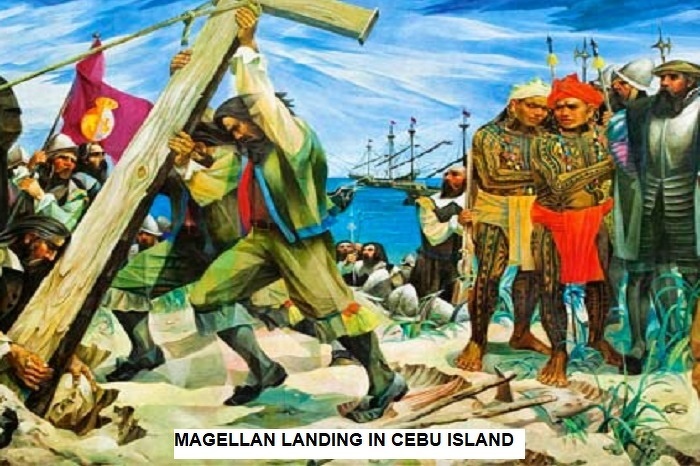
Magellan spent about a month in the Philippines. He held the Philippines first Catholic mass on April 14, 1521 on Cebu, where he planted a cross on the spit where a local ruler was converted along with the 800 of his people. Local believed that the cross possessed magical powers and over the centuries that followed took pieces of it
Magellan was welcomed to the islands of Samar, Leyte, and Limasawa. Within a week of arriving on Cebu he converted 400 islanders including Humabon and Juana, the island's king and queen. Professor Susan Russell wrote: “Magellan's arrival in Cebu represents the first attempt by Spain to convert Filipinos to Roman Catholicism. The story goes that Magellan met with Chief Humabon of the island of Cebu, who had an ill grandson. Magellan (or one of his men) was able to cure or help this young boy, and in gratitude Chief Humabon allowed 800 of his followers to be 'baptized' Christian in a mass baptism. [Source: Professor Susan Russell, Department of Anthropology, Center for Southeast Asian Studies Northern Illinois University, seasite.niu.edu]
Alfredo Roces and Grace Roces wrote: When Magellan first landed, he encountered the standard kinship feud between two chiefs. In order to ingratiate himself with one of them, Rajah Humabon, and to display the military invincibility of Spain, Magellan offered to destroy the group under Lapu Lapu. It was a fatal error. Magellan’s men miscalculated the tides, not realising that the shore was out of reach of Spanish naval guns. As a result, troops had to wade through knee-deep water in heavy armour, making themselves sitting ducks for the fast moving multitudes armed with spears and swords. Magellan was killed, the survivors lost face with their host who, seeing the vulnerability of the Spanish, butchered as many as he could lure to shore. This caused the survivors to scuttle one ship, and flee in the remaining two. The interesting note here is the kinship rivalry, a characteristic still very much a part of the Philippine social landscape. Chances are Lapu Lapu and Raja Humabon continued their feud regardless. [Source: “Culture Shock!: Philippines” by Alfredo Roces and Grace Roces, Marshall Cavendish International, 2010]
Magellan's Battle in the Philippines

On present-day Mactan island off the island of Cebu a local king pretended to covert to Christianity to enlist Magellan's crew "to fight and burn the houses of Mactan to make the King of Mactan kiss the hands of the King of Cebu...because he did not send a bushel of rice and a goat as tribute."
Pigafetta wrote: the "lord of the aforesaid island...sent one his sons to present the captain-general two goats, saying he would keep all promises with him, but because of the lord...Cilapulapu (who refused to obey the King of Spain) he had not been able to...And he begged that on the following night he [Magellan] would send but one boat with some men to fight."
In the fight that ensued 60 armor-clad Europeans were pitted against 2,000 near-naked Mactanians. Pigafetta wrote: "The captain-general resolved to go there with three boats...[with]...sixty men armed with corselets and helmets...and we so managed that we arrived...The captain...[told]...the lord of the place and his people that, if they agree to obey the King of Spain and recognize the Christian king as their lord, and give us tribute, they should all be friends. But if they acted otherwise they should learn by experience how our lances pierced. They replied they had lances of bamboo hardened in the fire and stakes dried in the fire, and that we were to attack them when we would...
"When day came, we leapt into the water, being forty-nine men...the other eleven men remained to guard the boats... Immediately they perceived us, they came about is with loud voices and cries, two divisions on our flanks, and one around and before us. When the captain saw this he divided us in two, and thus we began to fight. the hackbutmen and crossbowmen fired at long range for nearly half an hour, but in vain [our shafts] merely passing through their shields, made of strips of wood unbound, and their arms...When those people saw this...they fired so many arrows and lances...we could hardly defend ourselves.
"Then they came so furiously against us that they sent a poisoned arrow through the captain's leg. Wherefore he ordered us to withdraw slowly...And those people shot at no other place but our legs, for the latter were bare...Our large pieces of artillery, which were in the ships could not help us, because they were firing at too long a range...And the followed us, hurling poisoned arrows...very close to [Magellan's] head. “
Magellan's Death in the Philippines
Magellan was killed on Mactan Island off Cebu Island by a local leader named Lapu Lapu. A plaque on Mactan reads: "Here Lapu Lapu and his men repulsed the Spanish invaders, killing their leader, Ferdinand Magellan, Thus Lapu Lapu became the first Filipino to have repelled European aggression." Of the 300 or so men that left Portugal with Magellan on his ship only 14 made it back alive.
Pigafetta wrote: "But as a good captain and a knight he still stood fast...fighting thus for more than an hour. And as he refused to retire further, an Indian threw a bamboo lance in his face, and immediately killed him with his lance, leaving it in his body...All those people threw themselves on him, and one of them with a large javelin...thrust it into his left leg, whereby he fell downward. On this all at once rushed upon him will lances of iron and of bamboo."
"They slew our mirror, our light, our comfort, and our true guide. When they wounded him, he turned back many times to see whether we were all in the boats. Then, seeing him dead, we wounded made the best of our way to the boats, which were already pulling away. But for him, not one of us in the boats would have been saved, for while he was fighting the rest retired."
Seeing that there was no chance in rescuing anything other than his dead body the men fled to their boats, and no European ever laid on eyes on Magellan again. The men tried to trade as "much merchandise as they desired" for the bodies, but the islanders refused. "They intended to keep him as a perpetual memorial."
Lapu Lapu is an enduring cultural hero in the Philippines. His defeat of Magellan has been immortalized in movies, comic books and popular songs. Every year the triumphant defeat of the Spanish is reenacted on the island of Mactan. Russell wrote: Lapu Lapu’s “resistance to Western intrusion makes this story an important part of the nationalist history of the Philippines. Many historians have claimed that the Philippines peacefully 'accepted' Spanish rule; the reality is that many insurgencies and rebellions continued on small scales in different places through the Hispanic colonial period.”
Santo Niño, Magellan’s Gift to the Philippines
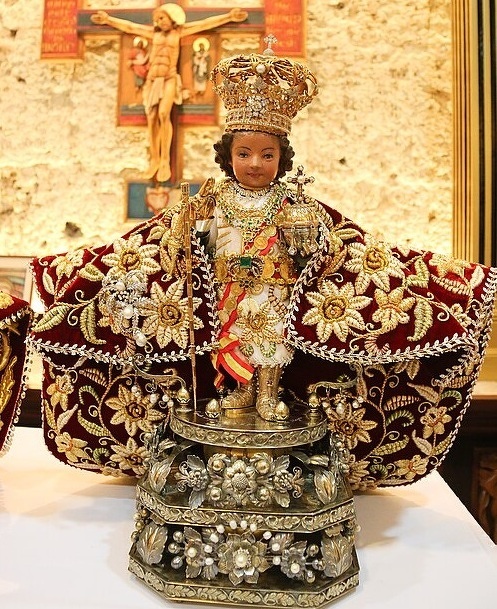
The image of the Santo Niño de Cebu is the oldest Christian image in the Philippines. The wooden image, made by Flemish artisans, was brought to the Philippines by Magellan in 1521, just like the Magellan cross. Magellan gave the Santo Niño (the Child Jesus) image to Queen Juana of Cebu as a baptismal gift. [Source: Angels in Stone by Pedro Galende, philippines.hvu.nl]
Forty-four years later, in 1565, a large part of Cebu was destroyed by a fire. The fire was set on purpose by the Spaniards as a punishment for hostile activities of the Cebu king Cebuanos. In one of the burned houses, a Spanish soldier found the image of Santo Niño. Remarkably it was unscratched! Since then, the miraculous image has been treated by the Cebuanos as its patron saint. At present, the miraculous image is kept in the Parish convent. A replica, adorned with gold and precious stones and enshrined in glass, is housed inside the Basilica Minor del Santo in present-day Cebu City.
The church was built near the place where the Santo Niño was found in the burned house. On this place the Spaniards built three churches. The first two churches were built out of wood and nipa. These burned down. The present church dates was built 1735. In 1965 it was given the name "Basilica Minor del Santo Niño".
Image Sources: Wikimedia Commons
Text Sources: Source: Most information in this article is from a National Geographic article by Alan Villiers, June 1976 and the book "The Discoverers" by Daniel Boorstin. Also, “Encyclopedia of World Cultures, Volume 2: Oceania,” edited by Terence E. Hays, 1991, Wikipedia, New York Times, Washington Post, Los Angeles Times, Times of London, Lonely Planet Guides, Library of Congress, The Guardian, National Geographic, Smithsonian magazine, The New Yorker, Reuters, Associated Press, AFP, BBC, CNN, and various books, websites and other publications.
Last updated February 2026