
PENAN SOCIETY
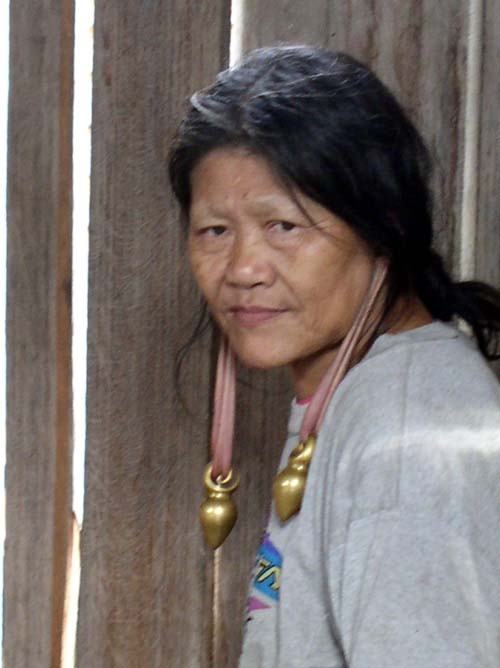
Penan society is organized around nuclear families and camp groups. The Penan have no descent groups and headmen if they exist have little power. Patrilineal lines are more important than matrilineal ones. Children take their father’s name. Penan live under a set of customs known as “molong” that are geared in part for maintaining a balance and harmony with nature and preserving resources for future generations. People who have spent long periods of time with the Penan have never seen them argue.
Sharing is a central value and survival tactic for the Penan. All wild game and forest products collected are shared equally within the community. When food is scarce, a hunter will march for hours to bring food for the group. This ensures the survival of children, the elderly, the sick, the less fortunate, and the community as a whole.
The Penans are gentle, shy, and timid, which contrasts with the their reputation as “wild men of Borneo. They are the only tribe in Sarawak that never practiced headhunting. They avoid conflict and negotiate if there is a misunderstanding. ^^ [Source: A. J. Abalahin, “Worldmark Encyclopedia of Cultures and Daily Life,” Cengage Learning, 2009 ^^]
Gender: The Penan are well known for being highly egalitarian, with minimal gender division. However, there is a clear division of labor in certain areas. Among nomadic Penan, for example, women never hunt, and men do most of the foraging. Women primarily stay in the encampment, while men roam the forest to hunt and collect forest products. At home, Penan women are expected to raise children, prepare food, gather wood and water, and weave baskets and mats from rattan and bamboo strips. However, a Penan woman can exercise her influence by communicating her desires to her husband, who will then communicate them to others. Furthermore, she can express her desires to the community when necessary. [Source: P. Bala, A. J. Abalahin, “Worldmark Encyclopedia of Cultures and Daily Life,” Cengage Learning, 2009]
RELATED ARTICLES:
PENAN: RELIGION, CULTURE, HISTORY factsanddetails.com
PENAN AND THE MODERN WORLD factsanddetails.com
DAYAKS: HISTORY, LANGUAGE, RELIGION factsanddetails.com
DAYAKS IN THE 1840s factsanddetails.com
DAYAK LIFE AND CULTURE: FAMILY, ART, FOOD, LONGHOUSES factsanddetails.com
DIFFERENT DAYAK GROUPS: KENYAH, KAYAN, MONDANG factsanddetails.com
NGAJU DAYAKS: LIFE, CULTURE, RELIGION, ART factsanddetails.com
IBAN PEOPLE: HISTORY, RELGION, CULTURE, HEADHUNTING factsanddetails.com
IBAN PEOPLE: LIFE, SOCIETY, VILLAGES, FOOD factsanddetails.com
TRIBAL PEOPLE OF BORNEO: LONGHOUSES, SAGO, ART factsanddetails.com
BORNEO ETHNIC GROUPS AND INDIGENOUS PEOPLES factsanddetails.com
KALIMANTAN (INDONESIAN BORNEO): GEOGRAPHY, DEMOGRAPHY, GROUPS factsanddetails.com
CENTRAL AND EASTERN SARAWAK (NORTHERN factsanddetails.com
Penan Customs and Etiquette
When greeting someone, a Penan will turn away his or her gaze and avoid eye contact with a stranger. Their normal way of greeting someone is to shake hands lightly. It is taboo to mention someone's real name in their presence. Therefore, they use expressions such as "brother" (pade), "father" (mam), "respected man" (lakei dja-au), and "respected woman." [Source: A. J. Abalahin, “Worldmark Encyclopedia of Cultures and Daily Life,” Cengage Learning, 2009 ^^
Some Penan greet each other by touching fingers and then touching their hair. Calling someone “padee”, or brother, is a proper salutation. Their language has one word for “he,” “she” and “it” and six for we. Sharing is an obligation so there is no word for thank you. Thee are hundreds of words related to trees but no word for forest.
It is impolite to walk directly toward another person. The Penan bend slightly and bow when passing by someone or a group of people. A bow is usually also made before a meal. Stepping over food served for a meal is taboo because it pollutes the meal, as well as the host and the person who stepped over it. ^
In the forest, if one group goes ahead of another group messages are left behind as to where they going with patterns made with sticks and leaves. Messages are left to warn others of possible dangers.
Some customs such as 'The walkabout" are shared by the aborigines of Australia. One biologist told the New York Times, “It is their credo to take care of the weakest one...I was always the slowest in our group. But whenever I lagged behind, there would be some Penan person lurking behind a tree, making an excuse that he needed a cigarette or a rest.”
Penan Family
Nomadic Penan families are generally smaller than those of settled Penan and other Sarawak peoples, largely because of high infant mortality associated with the hardships of a mobile forest life. On average, nomadic families have about three children, compared with around five among settled Penan. A typical family consists of a mother, father, and one or more children, and may sometimes include grandparents. [Source: P. Bala, A. J. Abalahin, “Worldmark Encyclopedia of Cultures and Daily Life,” Cengage Learning, 2009]
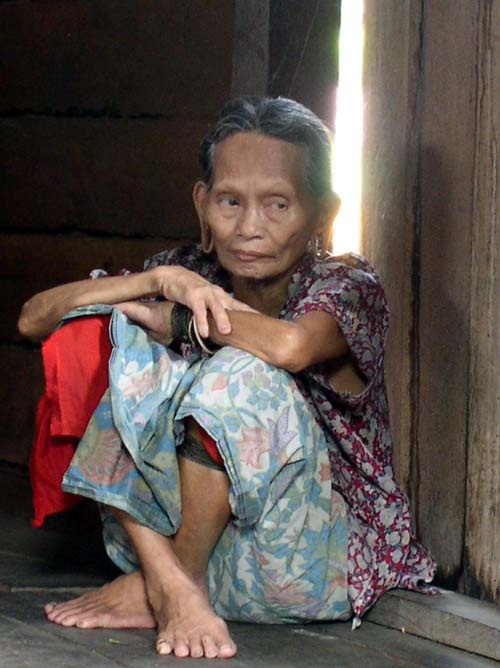
Women do not hunt; most foraging and hunting is done by men, while women focus on life within the encampment. Their responsibilities include childcare, food preparation, collecting firewood and water, and weaving baskets and mats from rattan and bamboo. Women usually influence community decisions through their husbands, though they may speak directly to the group when necessary.
Each Penan family keeps around a dozen dogs, which are essential for hunting and tracking game. Dogs are neither pets nor food. Other animals, such as young bears, monkeys, or bats, are sometimes kept as pets for children. Animals that have been fed are never killed for food, and the idea of raising animals for meat or milk is considered unthinkable.
Childbirth typically takes place at home with the assistance of a midwife or an experienced elder. There are no formal ceremonies marking birthdays or life stages. Children are educated informally from an early age, learning through observation and experience. Sharing and respect for elders are core values, and selfishness is strongly condemned; even small amounts of food are divided so everyone receives a share.
From childhood, Penan learn survival skills essential to forest life. Boys acquire hunting skills, including making blowpipes and darts, by accompanying their fathers and grandfathers, while girls learn weaving and gathering by working with their mothers and grandmothers. Both boys and girls learn to identify plants and animals, navigate the forest, make fire, build shelters, and fashion tools.
Penan Marriage
Marriage usually occurs around the age of sixteen, once individuals are capable of supporting a family. No ceremony is required; with parental consent, a couple simply begins living together. Although polygyny and polyandry were once practiced, monogamy is now the norm. A couple is considered married as soon as they establish their own household.
Marriage is usually done without a ceremony, preferably to member of one’s group, and used to be sealed with a the payment of a bride-price of blowguns, swords or money but now this is rarely done. The East Penan allow marriage to first cousins; the West Penan do not. Polygyny is allowed but rare. Divorce can be initiated by either party. Post-marriage residence is generally with the wife’s group if it is different from the husband’s group.
Women are believed to be born without a soul until they are married. Until they possess a soul they are not responsible for their actions and thus they can lead an uninhibited sexual life until they are married. Women are not supposed to have children until they have a soul. Unnwanted pregnancies are aborted using special plants. When a women is ready to get married it is up to her prospective husband to procure her soul. To get one the husband must hunt himself a head. *
Penan Life
Nomadic Penan subsist mainly through hunting and gathering and are widely regarded as expert hunters and trackers with deep knowledge of the forest. A central element of Penan culture is their extensive knowledge of the forest. They use around thirty different medicinal plants to treat wounds, headaches, stomach ailments, rashes, poisoning, and other illnesses. Some remedies act slowly, while others are highly effective; for example, mouth and tongue rashes in children may disappear within minutes after treatment with specific plant stems. Various vines and barks are crushed for use as soap, and more than twenty plant species are used to dye rattan. The Penan also distinguish over thirty varieties of rattan, each suited to particular weaving purposes.[Source: A. J. Abalahin, “Worldmark Encyclopedia of Cultures and Daily Life,” Cengage Learning, 2009 ]
Among the Penan food has traditionally been shared: The staple of nomadic and settled Penan has traditionally been sago, a paste derived from Sago palm trees, which grow extensively in the swampy lowlands and sporadically in the hills, and fruit from rain forest trees. They also have hunted bearded pigs, bear, snakes and several species of deer and monkey. Fish are caught with a hook and line or poison made from derris root. The West Penan make iron tools.
The Penan can tell time by the behavior of animals. One kind of monkey drinks at 5:30pm. A type bird calls at 5:00am, noon 6:00pm and 8:00pm. If they became ill they knew what plants to take. They bound and sutured their wounds and women gave birth in the jungle. Many Penan smoke hand-rolled cigarettes and cook fish and monkeys over an open fire and keep monkeys on chains as pets. Only some fruit is harvested from a tree at one time to make sure there is some left behind for other Penan, and animals. Sago pulp is trampled under foot while water is added and strained through a rattan mat and then dried into a powder.
The Penan have traditionally traded with the Kenyan people at their longhouses three times a years, providing them with things like wild latex, hornbill feathers, mats and pangolin scales in return for spearheads, knives, cookware, jewelry and matches. Goods the Penan receive in trade are not shared. Land is not owned but there is a sense of property when it comes to possessions. Some Penan used to use beads for currency. Some beads are hundreds of years old, collected over the generations from Portuguese, Chinese, Arabian and local traders. Sometimes a bride's entire dowry was made up of beads, and some of the beads worn today are believed to have been excavated from 2,300-year-old graves.
Lifestyle of Nomadic Penan
Nomadic Penan live primarily in the forest, as opposed to settled Penan reside in longhouses and practice agriculture. Nomadic groups depend on hunting and gathering forest resources such as fruits, mushrooms, game, and wild sago, whereas settled Penan are farmers who cultivate hill rice and raise chickens and pigs for household use. Some settled communities have also adopted cash crops, including rubber, pepper, oil palm, and cocoa, and live in permanent villages with access to markets and modern infrastructure.
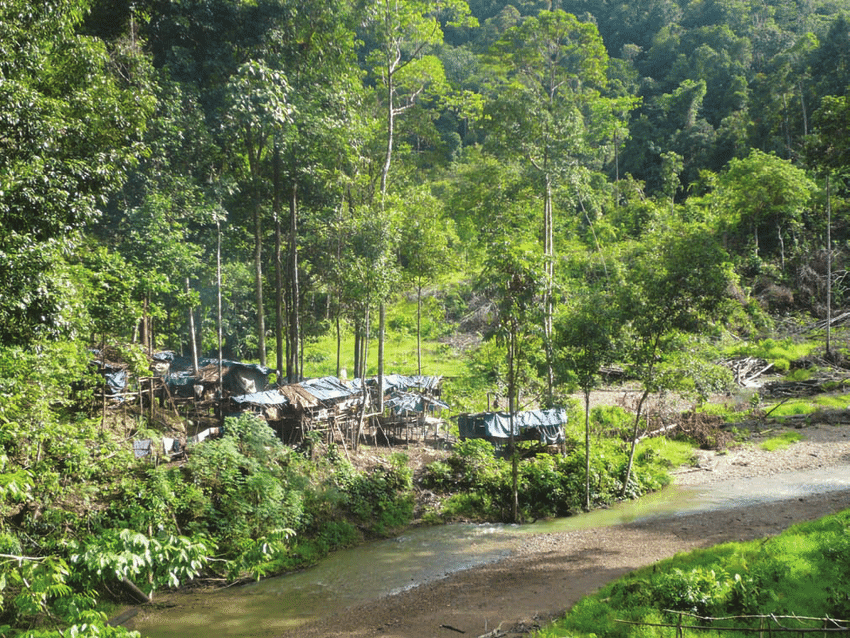
In contrast, nomadic Penan have no permanent dwellings. They build simple temporary shelters, known as selap, designed to last only three or four weeks before the group moves on. These huts are made from wooden poles, palm-leaf roofing, and split bamboo or small sticks for flooring, all tied together with rattan. Shelters may be clustered closely together or spaced widely apart, depending on circumstances.
A nomadic Penan settlement typically consists of around 30 people, though numbers can range from fewer than ten to more than a hundred. Camps are usually established on hilltops to reduce the danger from falling trees, requiring water to be carried from lower ground in bamboo containers. Groups relocate when nearby sago palms are depleted or when game and other forest products become scarce.
Nomadic Penan own very few material possessions, most of which are carried in rattan backpacks. These include hunting weapons such as spears and blowpipe darts, machetes in wooden sheaths, basic cooking pots, several rattan baskets, and a small number of woven mats. The possessions of typical nomadic group includes a kettle, a wok, an ax, some ragged clothes, a tin box and a key, two flashlights, a cassette player, three tapes, eight dogs and two monkeys. [Source: National Geographic]
“The most important thing about being in the forest is to look after your own self so there will be no problem,” a young nomadic Penan told Smithsonian magazine. “The first thing in the forest is smell. It can tell you something. You smell what food is being cooked. The smell of a tree fallen, the smell of an animal that pissed three hours ago. I can smell the durian fruit in your plastic bag....The knowledge about the nature, you can ask every man anywhere, but there is no one who can teach you. Even Penan don’t know how to teach you the experience we have. It’s so deep.” [Source: Alex Shoumatoff, Smithsonian magazine, March 2016]
Penan Villages and Houses
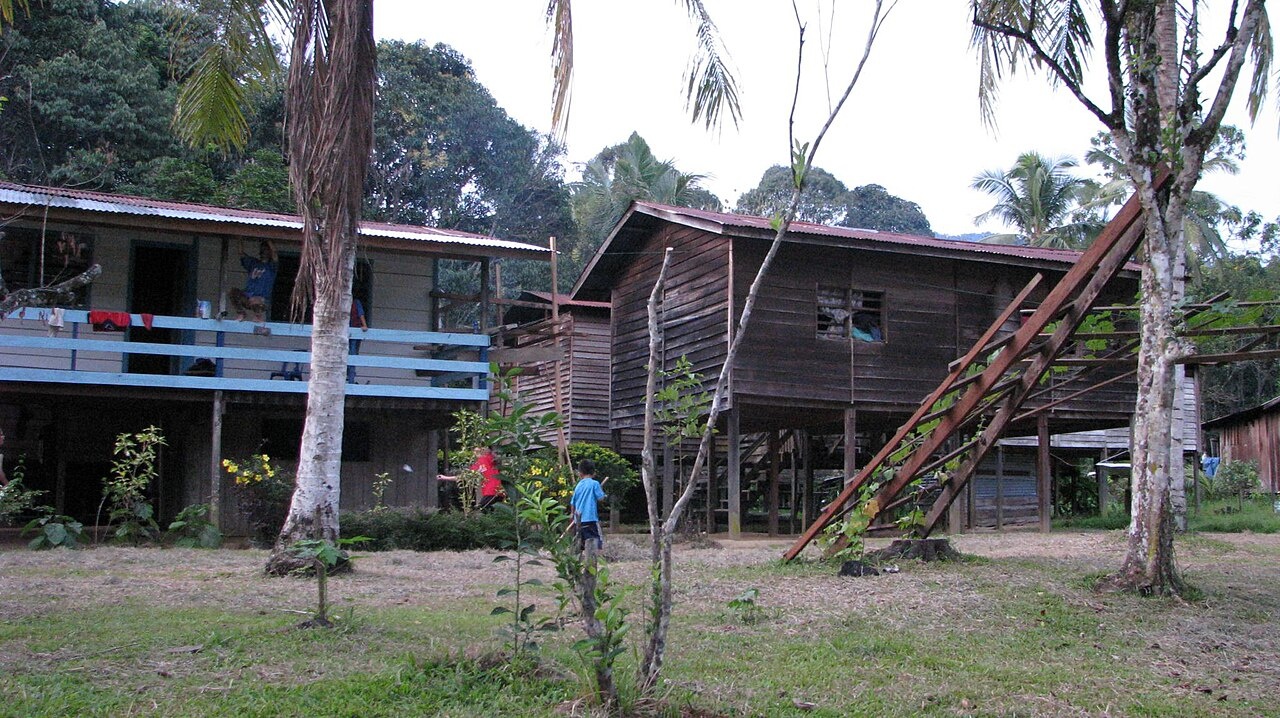
Eastern Penan have traditionally built semi-permanent camps inside a given territory and radiated from them using temporary camps. The base camp was used as a storage area. Western Penan, by contrast, settled for as long as two years with one or two families spreading out from the camp into forest to gather forest products, leaving the sick and elderly behind. The Eastern Penan build their houses on pilings. The Western Penan build their houses on the ground.
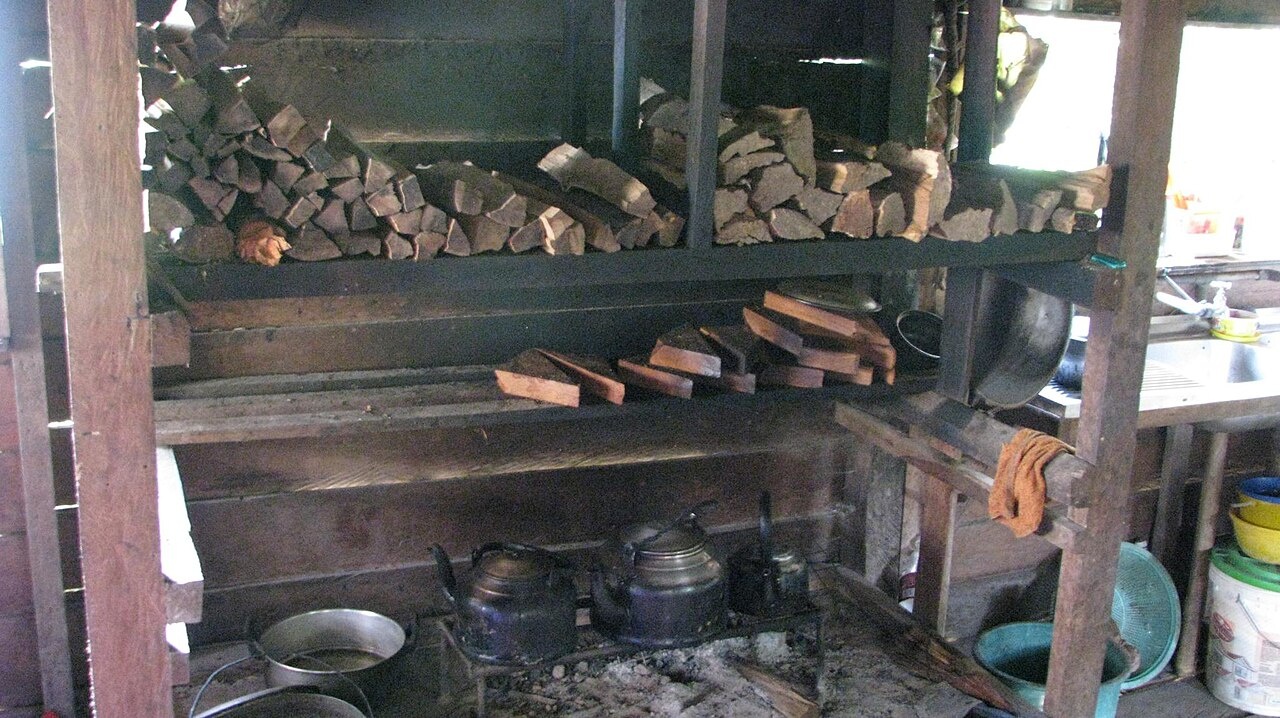
Alex Shoumatoff wrote in Smithsonian magazine: The majority of Penan, and all the other Orang Ulu, now live in settlements. They supplement their diets by hunting in the forest, but they come home to modern longhouses with zinc roofs. In this village, a long concrete walkway leads to a small shop selling junk food, cigarettes and soda. We’re welcomed into a flat occupied by an extended family. There’s a large room floored with linoleum, where several kids and women are watching TV. Beans boil on a gas stove. A woman washes vegetables in the sink. In back are an outhouse and several large barrels of water with a faucet for doing laundry. Across the river is thick rainforest. A bird keeps letting out a four-note call that sounds like a bell chime, or a ringing cellphone. Heading back to the longhouse, I pass a large clearing where a babui, or a Bornean bearded pig, is chasing a boy on a dirt bike. ... A new community consists of several dozen free-standing houses built in a variety of styles, from shacks to a few well-built two-story structures with gardens and fences. Many residents own dirt bikes, which they use to cross the narrow suspension bridge across the Mago River. [Source: Alex Shoumatoff, Smithsonian magazine, March 2016]
Some Penan live in longhouse settlements in different locations that are occupied and abandoned depending on the season. After a two week trek through the rain forest, the Blair brothers visited one these settlements in the 1980s along a whiskey-colored stream that was occupied by 35 families. The longhouses are built on stilts for protection from insects. Many families keep hunting dogs. [Source: "Ring of Fire" by Lawrence and Lorne Blair, Bantam Books, New York ♢]
Instead of using tents, every night Penan nomads set up camps with houses that, in twenty minutes, are built "entirely from scratch.” The floor, frame, stilts are built with saplings and bamboo poles. The roof and walls are made from overlapping palm leaves. The insect-repelling bark from a particular species of tree is used for the floor covering and palm leaves are draped on top of the frame to keep rain out. Nomadic Penan live in these makeshift houses of sticks and palm leaves for a short time and move on to new locations. ♢
Nomadic Penan Camp
Alex Shoumatoff wrote in Smithsonian magazine: We see four huts raised on poles lashed with strands of rotan, or rattan palm vines, from the forest. At the front of each hut’s pole floor, a fire burns in an earthen hearth and pots hang over the flames, a stack of machete-split wood off to one side. The interior of the hut is for eating, sleeping, sitting and talking, and weaving baskets and bracelets. [Source: Alex Shoumatoff, Smithsonian magazine, March 2016]
There are 23 people here. All of them are under 35 except a stout, strong-faced woman in her 50s named Choeling who is weaving nine-yard strands of rotan that cascade down the side of her hut. Her husband, the group’s headman, died last year. The current headman is married to her daughter, who is here with her own five daughters. These people are strikingly good-looking, glowing with fitness and well-being. The headman, Sagung, has a wispy mustache and elaborate dragon tattoos on his arms and torso, along with dozens of woven bracelets, some plastic rings and a wristwatch. He looks like a martial arts master from central casting.
In the other two huts are a young couple with an infant, and three young women with their babies. Three teenage boys are migrating among the four huts. In fact, everybody is constantly visiting each other’s huts. It’s a cozy scene, the way humans have lived from time immemorial, though there are some modern amenities as well: a CD player, flashlights, flip-flops, store-bought clothes and disposable diapers from Long Bedian, the trading center we passed several hours back.
Half a dozen emaciated dogs are snoozing under the huts. They spring to life when it’s time to go out with the hunters, or when they smell something cooking and know scraps and bones might be thrown their way. This camp is only three days old. Anticipating our arrival, the Penan built it nearer the road than they usually do so it would be easier for us to find. The kids are full of beans and constantly playing in the huts, in the forest, down by the stream. Some of them have runny noses and mildly elevated temperatures, and their mothers ask if I have medicine.
Penan Food and Clothes
Semi-settled Penan obtain part of their food from cultivated crops such as rice and tapioca, while nomadic Penan rely entirely on the forest for subsistence. Their staple food is wild sago palm, supplemented by hunted game and gathered forest produce. Using blowpipes and hunting dogs, they move through the forest in search of sago, while also hunting, fishing, and collecting wild fruits. Game animals include mousedeer, bearded pig, several species of monkeys, barking deer, birds, and occasionally bear and python. Wild boar is especially valued because it provides both protein and fat. Fish and shrimp from rivers also form an important part of the diet. [Source: A. J. Abalahin, “Worldmark Encyclopedia of Cultures and Daily Life,” Cengage Learning, 2009 ^^]
Among nomadic Penan a typical breakfast is barking deer, also known as muntjac, and a thick, gelatinous porridge of sago palm. People use wooden utensils with four prongs, which they dip into the porridge, swirling it, dunking the blob that gloms onto it into venison juice. Lunch maybe is sago porridge with small tree snails. Sago flour is most commonly cooked with water until it thickens into a paste, which is eaten communally from a single pan using wooden implements. It may also be baked, fried in lard, or used to thicken soups. Sago accompanies meat in much the same way that potatoes do in Western diets.
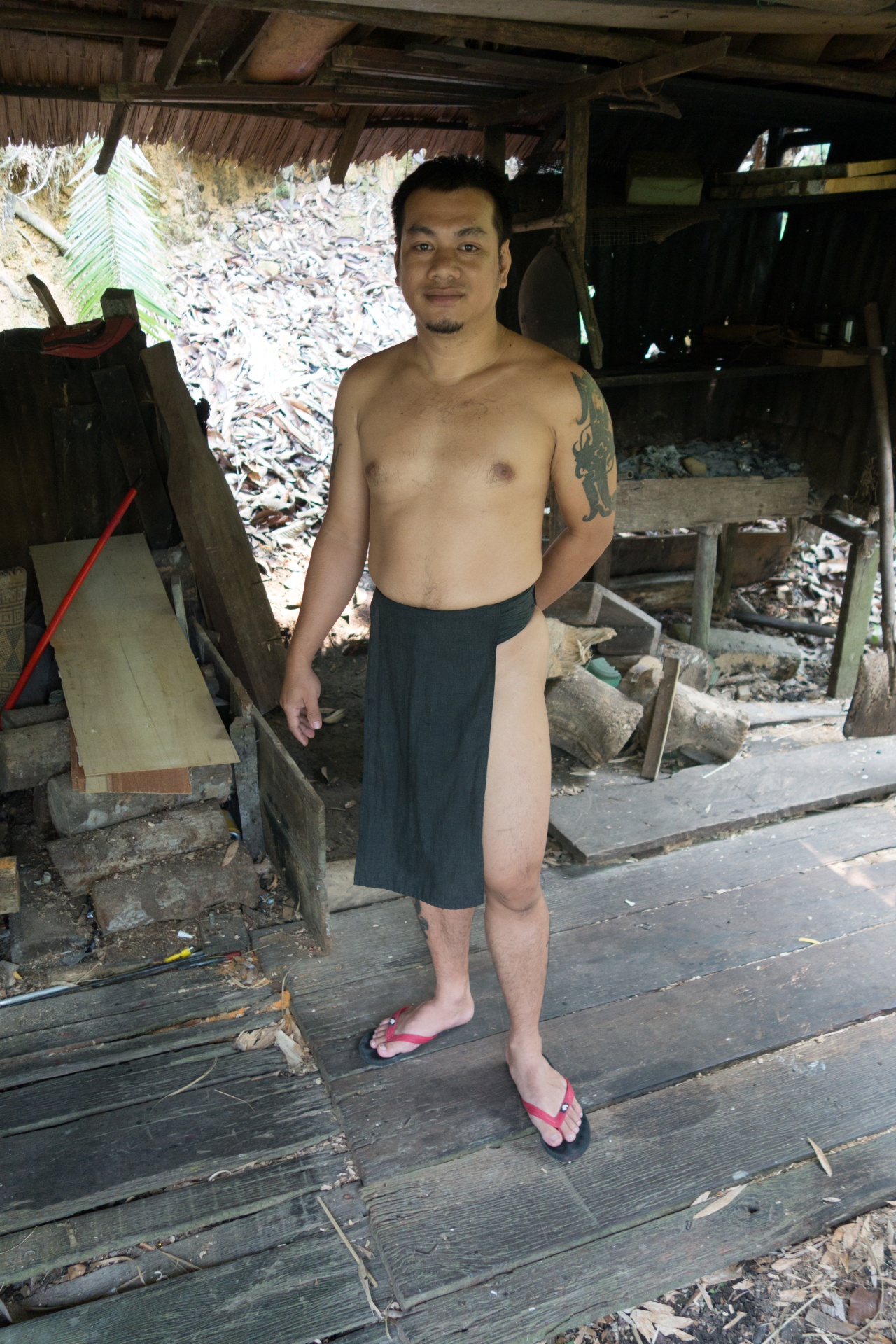
The Penan were never completely unclothed, though the loincloth, or chawat, was traditionally the main and sometimes sole garment. Formerly made of bark cloth, loincloths are now usually of cotton, obtained through trade with neighboring peoples such as the Kayan, Kenyah, Kelabit, as well as Malay and Chinese traders along the coast. Today, few Penan go barefoot, and only some elders continue to wear traditional dress, including the chawat, leg and wrist bands, and enlarged earlobes. Most Penan now wear Western-style clothing such as T-shirts, trousers, shorts, and shirts.
Penan Forest Gathering
In addition to hunting, the Penan gather a wide range of forest foods, including nuts, fruits, mushrooms, and edible leaves. Their diet includes more than one hundred kinds of fruit and around thirty species of fish. Penan nomads do not wander aimlessly through the forest, their journeys are carefully thought out along well-established tracks that connect areas with rich game and fish with stands of wild sago palms. They also have a practice, called “molong”, of claiming ownership of wild plants and trees.
The Penan have an expression: "From the forest we get our life.” The forest also provides the Penan with “gahara” (an aromatic wood used as an incense and in medicine in China), bezoar stones (monkey gallstones used in Chinese medicine), rattan, edible birds nests, heart of palms, wild mushrooms, “buaa nakan “fruits, wild ferns, wild-bee honey, and camphor tree resin. Some of these items are traded for clothes, cooking pots, shotgun shells, iron tools and fabric.
Describing an outing in the forest with semi-nomadic Penan, Eric Hanson wrote in Natural History magazine, "Katong picked jackfruit, marked a tree that held honey a beehive full of honey, and stopped to a replant a durian seedling in a sunny spot. Paya collected rattan to make a backpack and a lump of tree resin to use as a light at night. Tingang...cut a vine that contained drinking water that tasted of sassafras. He showed me a leaf used as sandpaper and another one, combining properties of stinging nettles and poison oak. There was a root used as an anti-inebriant and for curing hangovers, a slender root that serves as an antidote for scorpion and snake bites, a fleshy stem that is chewed as a cure for headache or upset stomach, and an aromatic leaf applied to sore joints. Paya also gathered a leaf that produces fragrant soapy bubbles when crushed and rubbed between the hands with water. "As we moved through the forest , Katong identified birdsongs, interpreted animal tracks, predicted what month the diprocarp trees would begin to drop their seeds this year (and attract the wild boar), and estimated what time it was (within ten minutes, according to my watch) by the sound of the cicadas. By the time we arrived in camp, the Penan were loaded down with enough food and supplies to last for several days."
Penan Gathering Trip
Alex Shoumatoff wrote in Smithsonian magazine: After lunch and a nap, we set out into the forest. Sagung’s 10-year-old daughter brings along the silvered leaf monkey and showers it with affection. Imprinting on its new, furless caregivers, the animal seems decidedly less traumatized by the death of its parents, who are now in the Ba Marongs’ stomachs. [Source: Alex Shoumatoff, Smithsonian magazine, March 2016]
Sagung’s father and some of the children have gone ahead of us and left messages along the way, using bent and split branches. A branch bending slightly up to the right tells us the direction the advance party has taken. The next sign, a branch with crossed leaves in its fork, means the sign-sender is accompanied by two others, both family members. The next sign is in a split sapling, a larger cross and a series of cuts: Hurry, don’t waste time. A branch cut into four prongs, like a sago porridge swirler, leads us to a sago palm, which another sign declares molong — it’s been claimed by Sagung’s family. Sagung tells me the Ba Marong have a hundred of these signs. His father left them for us; the children no longer know them. Even forest-dwelling Penan kids spend much of their time visiting friends who live in longhouses, watching TV and using other modern amenities. Learning the old ways isn’t high on their priority list.
Sagung hacks down the sago palm’s multiple stems with their pinnate leaflets, cuts out a section of its yellowish white heart and chops it up. He passes around pieces. It’s the best palmito I have ever had. Ambrosial.
Farther up the path, Sagung finds an agarwood tree and cuts out a yard-long section of its mold-blackened pith. The perfumed resin extracted from this tree has been esteemed for its fragrance and medical properties in China, India and the Middle East for thousands of years. In the U.S., the best-grade agarwood can fetch $5,000 a pound. The pith will bring Sagung good money when he sells it locally. One of the main reasons for the high cost of agarwood is that there is relatively little left in the wild. It’s listed by the Convention on International Trade in Endangered Species of Wild Fauna and Flora (CITES) as a potentially threatened species.
Penan Hunting and Fishing
The Penan hunt with spears, blowguns outfit with poison darts and, when they are available, fire arms. Mostly they hunt gibbons and macaques, although wild pigs are the most desired prey. They also take snakes and monitor lizards. Hunting is done by male hunters, who leave their women and children in villages and head off into the rain forest, sometimes for months at a time. They sweep out of the villages in larger and larger concentric circles, sleeping in shelters along the way and subsisting on berries, fruit and game. [Source: "Ring of Fire" by Lawrence and Lorne Blair, Bantam Books, New York ♢]
Penan men hunt with blown guns carved from a heavy wood resistant to jungle humidity which bows lesser woods out of alignment. The eight-foot-long blowguns have a metal blade attached to one end which helps the hunters aim and claim big game when the blowgun is used as a spear. The darts are tipped with tadjun, a poisonous plant, which kills the animal, or the strychnos fruit (the source of strychnine), which in the does they use only paralyzes the animal, or a poison from the Ipoh tree. ♢
Many Penan hunt using dogs. Depending on the prey, hunting may be carried out alone, in pairs, or in small groups. Most Penan hunters work alone, but on occasion they work together in group to track and flush out large game. Hunting deer and wild boar require coordinated group hunts with dogs. One of the problems with hunting with a blowgun is that even if you hit a monkey sometimes it will get lodged between a branch and won't fall all the way to the ground. Fishing is usually undertaken by women, using several techniques. One method involves throwing stones to imitate the splash of falling fruit, attracting fruit-eating fish into nets. Another method uses plant-based poisons released into slow-moving streams, causing fish to float to the surface where they are easily collected.
Alex Shoumatoff wrote in Smithsonian magazine: Sagung and one of the young men have already gone off with the dogs and their shotguns. Why not blowguns? “They are taking shotguns because they want to make it faster,” Nelson says. “They don’t want to waste time in the forest with you here. If they have bullets, they prefer the shotgun.”... I ask about the clouded leopard, the biggest of Borneo’s spotted cats, protected under Malaysian law. There are still some, but not many. Sagung killed one last year. He is wearing one of its teeth around his neck. Pythons are everywhere, in the forest and in the rivers, Nelson says. Sagung’s father-in-law once had a python wrapped around his leg. It tried to kill him, but luckily he had his machete. [Source: Alex Shoumatoff, Smithsonian magazine, March 2016]
The hunters return with a big dead babui and four dead silvered leaf monkeys. They also bring back a live silvered leaf infant and lash it to a post of Sagung’s hut. It looks on with what I can only imagine is horror and sorrow as its parents’ bodies are thrown on the lashed-pole floor and butchered. Sagung’s father guts the pig and scoops out the copious amount of blood and innards into a bowl. Then the five animals are roasted in their skin and smoked on a big fire that Sagung makes in the middle of the camp. Food for everybody for the next few days. (A vegetarian, I’ll be sticking to the canned goods and produce I brought with me from the grocery store in Miri.)
Penan Molong
Raising domesticated animals is a concept that is revolting to nomadic Penan. They hate the idea of killing animals they have allowed into their circle They never kill animal unless they need them as food and never kill adult animals that are accompanied by young.
Alex Shoumatoff wrote in Smithsonian magazine:After the Penan kill an animal, they adopt its orphaned babies as pets until they are old enough to return to the forest. The orphan is known as molong, which has several other meanings. If you molong a sago palm, you lay claim to it for your family’s exclusive use. The Penan also use molong to describe the conservationist principle of taking no more than you need. If the forest is going to provide for you, you can’t clean it out. [Source: Alex Shoumatoff, Smithsonian magazine, March 2016]
Ian Mackenzie, an ethnographer and linguist who has lived with the Penan on and off for almost 25 years, warns that this ecological definition of molong is an entirely Western projection. Indeed, when the Penan use the word in this way, it can be hard to tell whether they’re reflecting a foreign notion of the “ecologically noble savage.” But based on everything I observed, Penans have absorbed this definition of molong into their own culture, the way they merged the Christian God with their own traditional pantheon of spirits. They may have adopted this concept initially for the benefit of foreign tourists, but acculturated Penans now insist it’s the most important value they have to offer the world.
Image Sources: Wikimedia Commons
Text Sources: “Encyclopedia of World Cultures Volume 5: East/Southeast Asia:” edited by Paul Hockings, 1993; National Geographic; New York Times, Washington Post, Los Angeles Times, Lonely Planet Guides, Library of Congress, Smithsonian magazine, The New Yorker, Time, Reuters, AP, AFP, Wikipedia, BBC, CNN, and various books and other publications.
Last Updated January 2026