
PENAN AND THE MODERN WORLD
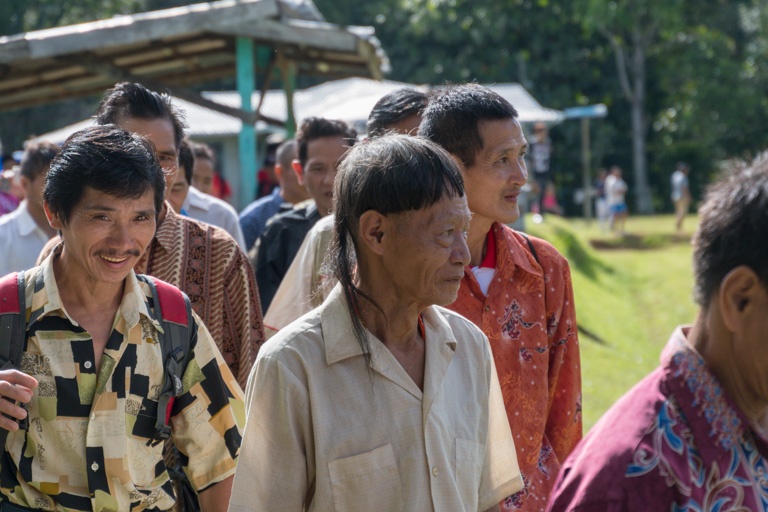
Like many other indigenous peoples worldwide, the Penan's traditional way of life is under threat from modernization. Government policies that promote settled agriculture and systematic logging may force these forest dwellers to abandon their way of life. The nomadic Penan have been affected by large-scale selective logging since the late 1970s. They are finding it increasingly difficult to survive in the forests due to relentless encroachment by logging companies and the establishment of palm oil and acacia wood plantations. They must adapt to a new lifestyle that is spreading along newly built roads into the most remote areas. Their formerly self-sufficient lifestyle is slowly being replaced by one of dependence. [Source: A. J. Abalahin, “Worldmark Encyclopedia of Cultures and Daily Life,” Cengage Learning, 2009 ^^]
Traditionally, the Penan were nomadic hunter-and-gatherers, but today most live in settled villages, but still depend on the forests for their livelihood. Many Penan were not introduced to the idea of the cash economy and day labor until the 1970s. They have traditionally bartered forest products for manufactured good traded to them at great profit by settled people. On their lifestyle in the modern world one Penan elder told Bruno Manser, “Our land provides us with food for free, and so, without a sen in our pockets, we have enough. What is it about the the people in the town with their shops? What do they have to install fans and air -conditioning in their apartments? They live in the heat because they have destroyed their forest. Here under the big trees, is cool shadow, We don’t want to change places with them.”
The government has tried with great difficulty to get the Penan to change their nomadic ways. The Penan are known for their distrust of outsiders. In some places the Penan are prevented from hunting by some government laws. Workers from logging companies have harassed them and killed animals in their hunting grounds for sport. Prime Minister Mahathir of Malaysia once said, “There is nothing romantic about these helpless, half-starved and disease-ridden people and we will make no apologies for endeavoring to uplift their living condition. One of his ministers said, “We don’t mind preserving the Sumatra rhino in the jungle, but not the Penan.”
The Penan are quickly being assimilated. Most wear Western clothes. Many attend church on Sunday and send their children to government schools. Many Penan want their children to go to school and mix with non-Penan groups. They also want access to modern medicines and clinics. Many young Penan are attracted by modern life. The process began in earnest in the 1950s, when Christian missionaries moved into Penan areas and began converting the Penan to Catholicism and Protestantism. Many have settled not because they want to but because there are no animals and food in the forest anymore.
RELATED ARTICLES:
PENAN: RELIGION, CULTURE, HISTORY factsanddetails.com
PENAN LIFE AND SOCIETY: FOOD, CUSTOMS, VILLAGES factsanddetails.com
DAYAKS: HISTORY, LANGUAGE, RELIGION factsanddetails.com
DAYAKS IN THE 1840s factsanddetails.com
DAYAK LIFE AND CULTURE: FAMILY, ART, FOOD, LONGHOUSES factsanddetails.com
DIFFERENT DAYAK GROUPS: KENYAH, KAYAN, MONDANG factsanddetails.com
NGAJU DAYAKS: LIFE, CULTURE, RELIGION, ART factsanddetails.com
IBAN PEOPLE: HISTORY, RELGION, CULTURE, HEADHUNTING factsanddetails.com
IBAN PEOPLE: LIFE, SOCIETY, VILLAGES, FOOD factsanddetails.com
TRIBAL PEOPLE OF BORNEO: LONGHOUSES, SAGO, ART factsanddetails.com
BORNEO ETHNIC GROUPS AND INDIGENOUS PEOPLES factsanddetails.com
KALIMANTAN (INDONESIAN BORNEO): GEOGRAPHY, DEMOGRAPHY, GROUPS factsanddetails.com
CENTRAL AND EASTERN SARAWAK (NORTHERN factsanddetails.com
Bruno Manser and the Penan

Bruno Manser, a Swiss cowherd, went to the rainforests of Borneo and lived with the Penan for six years, from 1984 to 1990, and lived as the Penan did, hunting with a blowpipe, eating snake and monkey meat and running around without shoes and a shirt. He became so adept at climbing trees even his Penan friends marveled at as his skill. During his six years in the forest he nearly died twice: once from a nasty bout of malaria and other time from a bite from a pit viper that left behind a wound that became gangrenous and was operated on with a fishhook.
Manser became a leading advocate for Penan rights and a leader in their struggle to save their rain forest home from large timber companies. He gave lectures and organized protests and staged publicity stunts such as descending by motorized paraglider into Sarawak to give a minster there a toy lamb during a Muslim holiday. Prince Charles was among this who praised his courage. In Malaysia, his activities got him deported. Government officials in Sarawak claimed that Manser did the Penan more harm than good by slowing their assimilation into mainstream Malaysian life.
Alex Shoumatoff wrote in Smithsonian magazine: After seeing their game depleted, their rivers polluted and their tana, or customary hunting grounds, destroyed, Mansur started helping the Penan organize peaceful blockades against logging trucks. Rumors spread that the Malaysian authorities had put a bounty on his head. Manser was captured by police officers but escaped by leaping out of their vehicle and diving into a thundering cataract. Returning to Europe in 1990, he devoted the next ten years to rallying outside support for the Penan cause. For a while, the world took notice. In 1991, Al Gore, then a U.S. senator, condemned the logging activities in Sarawak, and in a speech at Kew Gardens, Prince Charles described the treatment of the Penan as part of a global “collective genocide.” Manser went on a 60-day hunger strike in front of the Federal Palace of Switzerland, in an attempt to inspire a ban on unsustainably harvested timber imports. Ultimately, though, none of those actions had much of an impact on Sarawak.[Source: Alex Shoumatoff, Smithsonian magazine, March 2016]
In May 2000, Manser slipped into Sarawak by crossing the border illegally from Kalimantan in Indonesia. That was the last time anybody knew his whereabouts. There is a chance he may have fallen or been bitten by a king cobra. Many who knew him think that is improbably and say it is more likely he was murdered by thugs working for the logging companies.
Penan Way of Life Threatened by Logging and Oil
The Penan have complained that their way of life is under threat from extensive logging of their traditional hunting grounds, oil exploration and drilling near their rivers and as well as the spread of palm oil and timber plantations. For decades the Penan people have seen their customary forests felled for logging, plantations, dams, roads, and other big infrastructure projects with the Sarawak government refusing to recognize their land rights.
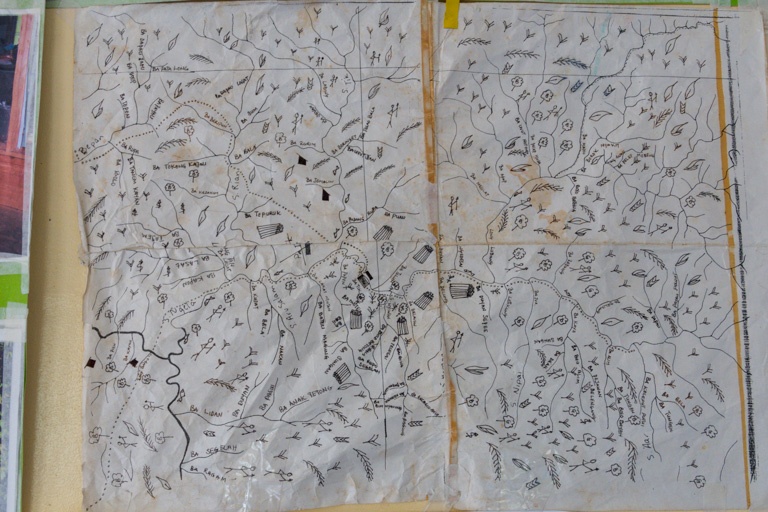
Reporting from Data Bila, Sarawak, M. Jegathesan of AFP wrote: “Deep in the Borneo jungle, 70-year-old Ara Potong stiches a rattan mat and wonders how much longer he can continue to survive on the bounty of the fast-disappearing forest. The grey-haired Penan tribesman, with the stretched earlobes distinctive to his people, deftly slices the thin rattan to fashion a mat that will be traded for basic goods like rice, sugar, salt and oil. "Logging has damaged the jungles. Now it is difficult to find rattan. We need it to make mats," says Ding Liang, another elderly resident of the Penan settlement, as he watches Ara work. "Even wild boars and monkeys are becoming rare. We do not have enough to eat. Our river is murky. Please tell the world our plight," he tells AFP. [Source: M. Jegathesan, AFP, December 16, 2007 \^/]
“Data Bila is located 150 kilometres (95 miles) southeast of Miri, an oil-rich coastal town in Sarawak. Data Bila is part of the Ulu Baram region that was famous for its teeming flora and fauna, but where many species are now becoming threatened. It is also home to an indigenous population comprising the Penans, Kelabit, Kenyah and Kayans — yet as the logging firms encroach ever further, their way of life is also in jeopardy. \^/
“The Penan were traditionally a nomadic people but many have now established settlements along the Baram river. Once it brought them fresh water and fish, but logging operations upstream have now turned it dark and silted. \^/
Logging in Sarawak
Vijay Joshi of Associated Press wrote: “About 70 percent of Sarawak is covered by forests, which are home to 24 minority indigenous tribes including the Penan. Timber is Sarawak's second biggest export after oil and gas. The state government began giving concessions to logging companies in the 1960s, and widespread cutting of trees began in the 70s and 80s. It was not until the late 1990s that the government issued strict guidelines on controlled felling of trees. The move was too late, said Abin who described bulldozers clear-cutting swaths of forests with trees as old as 500 years. According to the Bruno Manser Fund, a Swiss-based activist group, more than 90 percent of Sarawak's primeval rainforests have been logged in the last 30 years. Re-growth has restored the greenery but the new trees are not of the same quality.[Source: Vijay Joshi, Associated Press, December 15, 2007 +++]
Much of the logging is done by Samling, Malaysia's second biggest logging company. Listed on the Hong Kong Stock Exchange in 2007, it earned $2.6 billion from wood exports in 2006. “The company insists it practices sustainable logging. It has also voluntarily agreed to oversight by the private Malaysian Timber Certification Council in a large section of its 1.4 million hectare (3.46 million acre) concessions that will expire in 2018. The council provides an internationally-accepted certification of good logging practices, which includes dividing a logging area into 25 blocks and harvesting them once in 25 years. This is supposed to give the forest time to regenerate. Experts say the gap should be at least 45 years. +++
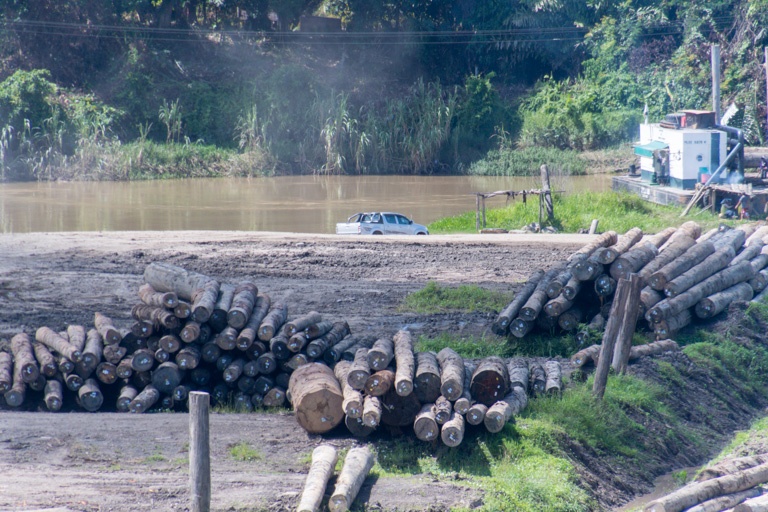
"By and large, it is fair to say that logging in this region is not sustainable," said Junaidi Payne of conservation group WWF's Borneo program. "The rate at which the forest is being cut is way beyond the rate at which it is regenerating." Many of Samling's European customers of its plywood and sawn timber rely on MTCC's seal of approval, which expires in 2009.
The MTCC certification also requires Samling to negotiate with tribes in the event of a conflict even though the company has the right to knock down the Penan blockade because it is on legal concession land, said James Ho, vice president of operations at Samling. "We never bulldoze any area. It is not our policy because we need a good relationship with all stakeholders," he said. "After all the forest is our life. We cannot possibly destroy it." +++
Impact of Logging in Sarawak on the Penan
Raymond Abin, of the Borneo Research Institue in Miri, said: "Many Penans have been forced out of the forest to settle in settlement camps. Their social and economic activities depend on hunting and sale of handicraft. Rattan is already depleted due to logging." Despite the "benefits" of development, malnutrition remains a big problem, the social activist says. "And if you look at the state development plan, it is very scary. The lowlands are for oil palm cultivation and the highlands for forest plantations. Hence, the indigenous people will be pushed further into the interior." \^/
Vijay Joshi of Associated Press wrote: “But opinion is divided among the impoverished tribes, some of whom live in settlements so remote they can be reached only on foot after days of walking through jungle trails. To them, the logging roads are a lifeline to civilization. In the absence of development, they see the logging companies as the bearer of basic needs such as clean water, electricity, toilets, schools and transportation. "I want children to go to high school. I don't want them to stay here in the village where there is no school. Maybe when they come back they become doctor or teacher," said Seluma Jalong, a tribeswoman who taught herself to speak passable English. Jalong, 36, lives in Long Main village, which is reached from the logging road after a five-hour walk and boat ride.” [Source: Vijay Joshi, Associated Press, December 15, 2007]
Malaysia's Penan Stage Protests Against Sarawak Logging
M. Jegathesan of AFP wrote: “By the 1980s they had had enough, and began erecting blockades to highlight the damage the timber business caused. Most were demolished — some violently — but the protest goes on. A few weeks ago, Penans in the settlement of Long Benalih erected a new blockade across a proposed logging trail to prevent Malaysia timber giant Samling Global constructing a road into its concession area. The structure is only flimsy and could easily be swept aside, but it is a potent symbolic gesture, and one which can jeopardise certification needed to prove timber was obtained legally and sustainably.[Source: M. Jegathesan, AFP, December 16, 2007 \^/]
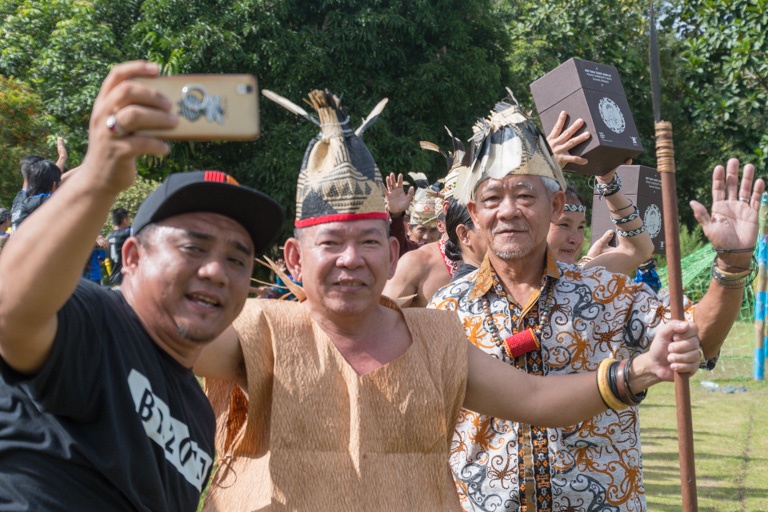
"We have the blockade to preserve and prevent damage to the land," Long Benalih's headman Saun Bujang said in a statement posted on the blockade, first set up in 2003 and periodically demolished and rebuilt. "We oppose logging and construction of the timber road because it destroys our way of life and the forest products we depend on." \^/
“Ajang Kiew, chairman of the Sarawak Penan Association, says most timber players in Sarawak have little regard for the native people and the forests, although Samling stands above the rest by selectively logging mature timber. "Logging destroyed my ancestral burial grounds in the 1980s and 1990s," the 54-year-old tells AFP. "If you come to my village you only see red soil. The water is murky," he says. Ajang is also worried about the disappearing sago palm — a staple diet eaten with meat from wild boar or barking deer. \^/
“Ajang has been jailed three times in the past two decades and sacked by the government as village headman for helping build blockades. "The jungle is like a mother to us. It gives us food and protection. I am sad when the forest is destroyed. Our culture will disappear if the forests disappears. My heart bleeds when they cut the trees," he says. \^/
Logging Company Defend Itself
Samling told Associated Press it does not encroach on the customary rights of the tribes, and allows them free access to forage for food. It has donated nearly 2 million ringgit (US$588,000; €420,000) to the tribes as well as developing other projects, said Samling spokeswoman Cheryl Yong. She said Samling employs 11,000 people in Malaysia of which 33.5 percent are indigenous people. Ngau and Abin, the Malaysian activists, acknowledge that Samling has been more pro-active in helping the tribes than the other big five privately-held timber companies. "Since we listed globally we want to be transparent. We know we are under scrutiny," said Ho.[Source: Vijay Joshi, Associated Press, December 15, 2007]
M. Jegathesan of AFP wrote: “Samling insists the allegations of forest destruction are baseless."We have tried to negotiate with Long Benalih community but we have not been able to make any progress. This blockade is being put up in our timber concession area and we have not started any harvesting in the disputed area," says spokeswoman Cheryl Yong.[Source: M. Jegathesan, AFP, December 16, 2007]
“Samling's vice-president of forest division James Ho, who is based in Miri, insists the sago plants and rattan vines so critical to the Penan way of life are not damaged in its concession areas. "Sago plants do not have commercial value. We don't touch such plants. We practice sustainable forest management. Only trees with commercial value of certain size are cut. We follow the laws," he says. "We do not destroy the forest. We only harvest mature trees. We are a listed company in Hong Kong and we want to be transparent." "Unfortunately by being transparent, we are subjected to more scrutiny," he tells a group of international media which the company brought to Sarawak to witness its activities. Ho says the Penan of Long Benalih are being influenced by outsiders, and that many others actually welcome the roads, piped water and other benefits of development that the logging brings.” \^/
Samling, a Malaysian timber company, has large concessions in the Upper Baram region of Sarawak. According to environmentalists it has been able to use the controversial MTCC-certification to deflect attention from its destructive logging and plantation activities in other areas. It should be reminded that the MTCC-certified area, which is often used as a showcase, covers less than 4 percent of Samling's logging concessions in Sarawak. If this area still has large tracts of primeval forest, it is mainly thanks to the persistent defiance of the loggers by the local communities. [Source: BMF, December 18, 2007]
Protests Against Logging by Sarawak Tribal People
Reporting from the rainforest in Sarawak, Vijay Joshi of Associated Press wrote: Like a slithering red snake, the dirt road cuts through the jungles shrouding an endless row of hills. At the first sign of humanity, the logging road stops abruptly: a crude barrier of branches tied together by dry palm fronds and a handwritten warning: "When We Say No, We Mean No." In the middle of the ancient rainforest in Borneo, this simple blockade erected by a jungle tribe has become the symbolic frontline in the battle to protect forests from a logging industry eager to harvest the bounty that feeds much of the world's thirst for timber. [Source: Vijay Joshi, Associated Press, December 15, 2007 +++]
"Logging has been the biggest disaster for the forests, and its indigenous people," said Raymond Abin of the Borneo Resources Institute in Sarawak. The blockade "is the last resort of the natives after all processes of negotiations and consultations failed," he said. Leading the campaign in Sarawak are former headhunting tribes, who say logging is destroying their ancestral lands and snatching their customary rights over the forests. There are other concerns that logging has damaged Borneo's multimillion-year-old ecosystem and is pushing rare plant and animal species such as wild orchids and clouded leopard toward extinction. +++
“The forests are "what you inherited from your ancestors. During the headhunting days they sacrificed their lives to defend it," said Harrison Ngau Laing, a lands rights lawyers who represents some of the tribes. Laing, himself a tribesman, said some 100 legal cases have been filed by the tribes against logging companies and the government. None has been resolved. +++
“Long Benalih, where some 28 Penan families live, is one community. The leaders of Long Benalih set up the blockade in November 2007 on the road being built by Samling. Ajaing Kiew, a Penan leader who lives in Apoh, a few hundred kilometers (miles) from the blockade site, said his area has already been flattened by logging."It is sad to look. There is nothing of the forest. That side is already red earth. At least there is forest left here," he said, accompanying two reporters to the blockade site. Kiew stopped to pick out medicinal plants. "This one," he said bending down to touch a two-leaf plant, "is to relieve back pain. And this must be placed on a wound. It sucks out all the poison in the body." "There is an urgent need to preserve the remaining old-growth forests for future generations," said BMF's Lukas Straumann. +++
End of Penan Nomadism?
Alex Shoumatoff wrote in Smithsonian magazine: Sagung asks for money to build a longhouse. I’m taken aback to learn that this group of nomadic Penan wants to move into a stationary dwelling. Sagung explains that he wants to establish a permanent presence on this land. It makes me wonder to what extent this camp has been a Potemkin village. During our visit, I’ve seen a stylishly dressed Chinese man, a representative of a timber firm, driving back and forth along the ridge. According to my guide, the company has already felled many of the trees in the Ba Marong territory, and it wants to pay them the equivalent of $30 apiece to come in and do a second cut. Sagung claims he isn’t going to give in, but more and more Penan groups are accepting offers like this. [Source: Alex Shoumatoff, Smithsonian magazine, March 2016]
I suspect that the Ba Marongs’ wandering lifestyle is losing its appeal for other reasons, too. The members of this group move fluidly between the forest and their friends’ longhouses down the road. After they’ve experienced what life is like with electricity, television and running water, it’s not hard to understand why they might be hankering after a longhouse of their own. That doesn’t mean they won’t be gone for days at a time hunting babui and gathering sago palm, fruit and nuts in the forest. But there’s a reason so few Penans still live like the Ba Marong in raised pole huts. According to Mackenzie, that number has dropped from 300 to fewer than 50 during the past ten years. In another generation, that way of life will probably be gone.
Where will a Penan man go if the forest is destroyed? “He will try to find another place where there is still forest.” What if there is no more forest anywhere? “We don’t know, but it could be the end of the world.” This is what the Penan believe. If their forest goes, it will be not only the end of them and the vast diversity of creatures who live there. The balei, the spirits who travel around the nine worlds of the Karawara, will also have nowhere to gather water and honey.
Image Sources: Wikimedia Commons, Mongabay
Text Sources: “Encyclopedia of World Cultures Volume 5: East/Southeast Asia:” edited by Paul Hockings, 1993; National Geographic; New York Times, Washington Post, Los Angeles Times, Lonely Planet Guides, Library of Congress, Smithsonian magazine, The New Yorker, Time, Reuters, AP, AFP, Wikipedia, BBC, CNN, and various books and other publications.
Last Updated January 2026