
2024 ELECTIONS IN INDONESIA
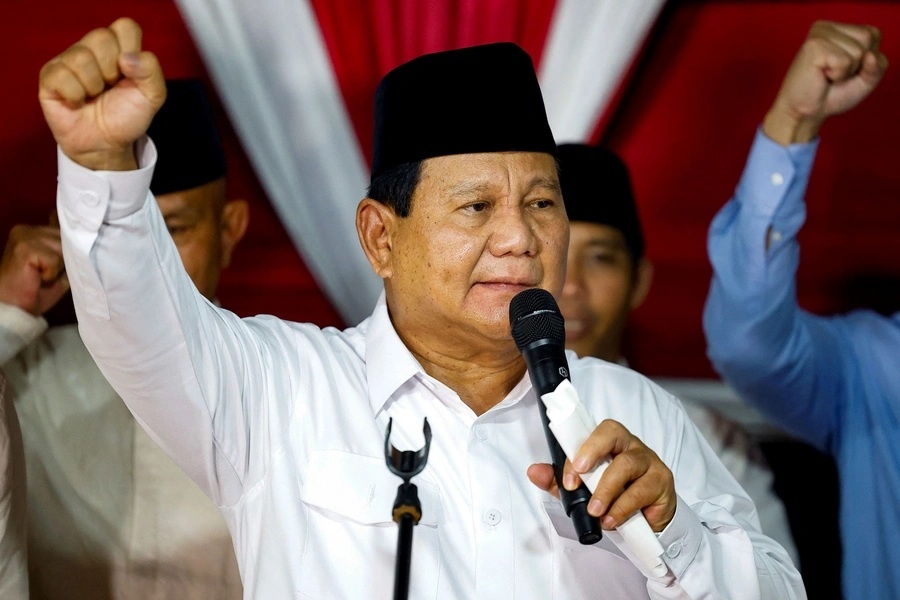
Indonesia held general elections on February 14, 2024 to choose the president and vice president as well as members of the People’s Consultative Assembly (MPR), which comprises the House of Representatives (DPR), the Regional Representative Council (DPD), and provincial and local legislatures (DPRD). [Source: Wikipedia]
In the 2024 elections there were 820,000 polling stations and almost 10,000 candidates and that number doesn’t include local elections. In parliamentary elections, 580 seats in the House of Representatives (DPR) were up for grabs, with more than 9,900 candidates. Around 670 candidates ran for the 152 seats in the Regional Representative Council (DPD), designed to represent the regions, In the local parliaments in each of the 38 provinces and 416 districts, there were are over 2,700 separate electoral contests being held for around 20,500 seats. All are the responsibility of Indonesia’s independent election commission (the Komisi Pemilihan Umum, or simply KPU) to administer impartially and efficiently. [Source: Stephen Sherlock, Australian National University, February 13, 2024]
Stephen Sherlock wrote in The Conversation: It is a massive undertaking to organise an election of this size, from procuring polling station equipment to managing a huge election staff to ensuring the public trusts the integrity and fairness of the vote. The election commission does a remarkable job making sure the vote happens on time and the ballot counting occurs quickly and without tampering. To get an idea of the size of the task facing the KPU, let’s look at the presidential election first. There are 204 million registered voters in Indonesia, so the KPU has to print and distribute this many ballots across the country for the presidential vote alone, with a few million extra in case polling stations run short.
The commission is then required to deliver, count and return the ballots to over 820,000 domestic polling stations, in addition to more than 3,000 stations overseas. Since there may be a second-round, runoff election, the KPU must be ready to repeat the whole exercise in a few months. This time it would need a different set of ballot papers showing the two final candidates. But things get really complicated when it comes to the contests for Indonesia’s various national and regional parliaments, even though these get relatively little attention compared to the presidential poll.
The 2024 election was notable for several historic firsts. It marked the first time since the start of the Reform era in 1998 that a single party—PDI-P—emerged as the largest force in the DPR for three consecutive elections. At the same time, it was the first election since 2004 in which the party of the winning presidential candidate did not secure the most parliamentary seats: Prabowo’s Gerindra party finished third, though it remained part of a strong governing coalition.
RELATED ARTICLES:
2014 ELECTION IN INDONESIA: ROCK STARS, RALLIES AND SMEAR CAMPAIGNS factsanddetails.com
JOKO WIDODO: HIS LIFE. CAREER, FAMILY, INTERESTS AND RISE TO POWER factsanddetails.com
JOKO WIDODO AS PRESIDENT: HIS FOLKSY STYLE, ACHIEVEMENTS AND CRITICS factsanddetails.com
REFORMASI AND THE POST–SUHARTO ERA factsanddetails.com
MEGAWATI SUKARNOPURTI (PRESIDENT OF INDONESIA 2001-2004): LIFE, POLITICAL CAREER, FAILURES factsanddetails.com
SUHARTO: HIS LIFE, PERSONALITY AND RISE TO POWER factsanddetails.com
INDONESIA UNDER SUHARTO: NEW ORDER, DEVELOPMENT, FOREIGN POLICY factsanddetails.com
VIOLENT CRACKDOWN ON COMMUNISTS IN INDONESIA IN 1965-66: KILLERS, VICTIMS, REASONS factsanddetails.com
CORRUPTION AND FAMILY WEALTH UNDER SUHARTO factsanddetails.com
OUSTER OF SUHARTO IN 1998: PRESSURES, EVENTS, RESIGNATION factsanddetails.com
INDONESIAN ELECTIONS IN 2004 AND 2009 factsanddetails.com
SUSILO BAMBANG YUDHOYONO (PRESIDENT OF INDONESIA 2004-2014): LIFE, CAREER, INTERESTS factsanddetails.com
INDONESIA UNDER YUDHOYONO (2004-2014) factsanddetails.com
2024 Presidential Elections
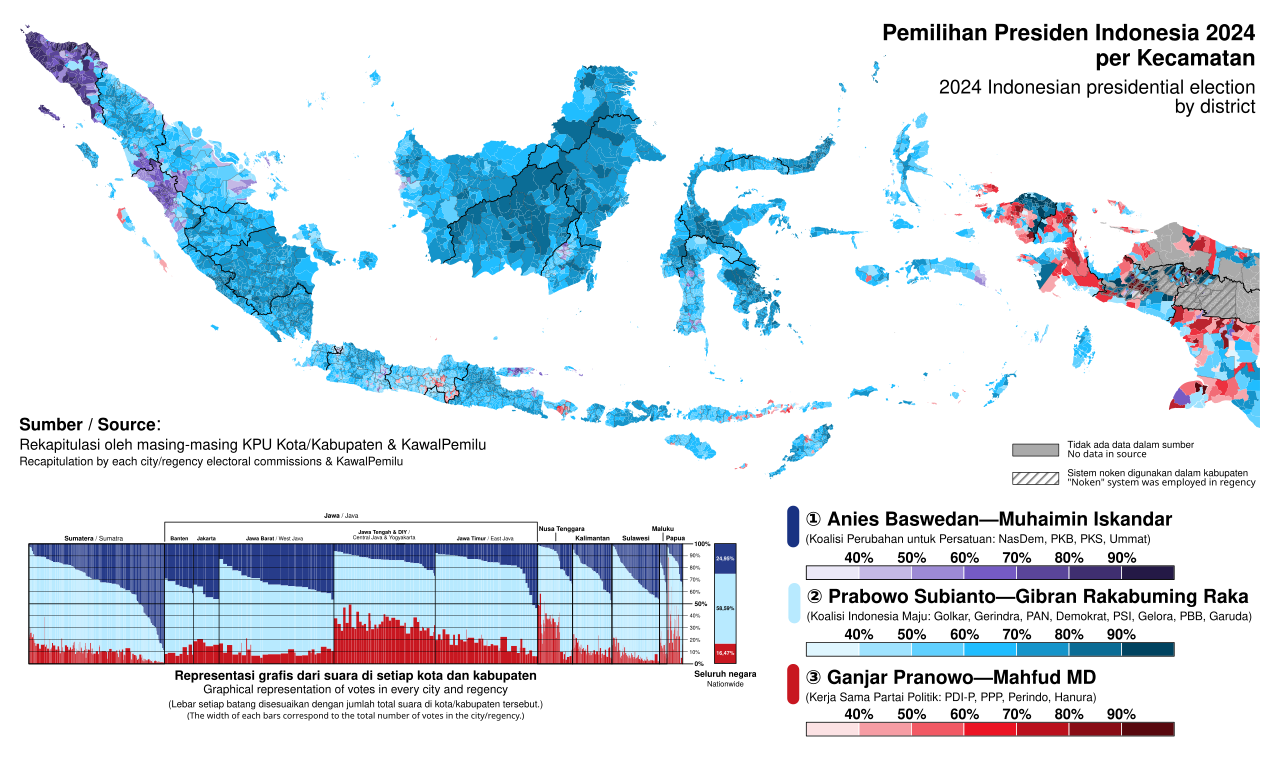
Three candidates ran for President in 2024: Defense Minister and retired army general Prabowo Subianto, paired with Surakarta Mayor Gibran Rakabuming Raka; former Jakarta governor Anies Baswedan, running with House deputy speaker Muhaimin Iskandar; and former Central Java governor Ganjar Pranowo, partnered with Coordinating Minister for Political, Legal, and Security Affairs Mahfud MD. [Source: Wikipedia]
2024 Presidential Elections
Candidate — Running mate — Party — Votes — percent
Prabowo Subianto — Gibran Rakabuming — Gerindra Party — 96,214,691 — 58.59
Anies Baswedan — Muhaimin Iskandar — Independent — 40,971,906 — 24.95
Ganjar Pranowo — Mahfud MD — Indonesian Democratic Party of Struggle — 27,040,878 — 16.47
Total — 164,227,475 — 100.00
Valid votes — 164,227,475 — 97.51
Invalid/blank votes — 4,194,536 — 2.49
Total votes — 168,422,011 — 100.00
Registered voters/turnout — 204,422,181 — 82.39
Prabowo won the presidency outright in the first round, securing a majority of the vote and avoiding a runoff. His total of 96.2 million votes was the highest ever received by a candidate in a democratic Indonesian election, surpassing Joko Widodo’s 85.6 million votes in 2019. “Although we are grateful, we must not be arrogant, we must not be euphoric, we must remain humble. This victory must be a victory for all Indonesian people,” Prabowo declared after it was clear he had won the election. “I will lead together with Gibran to nurture, protect and defend all the people of Indonesia, regardless of tribe, ethnic group, race and religion and social background, the people of Indonesia are our responsibility to protect.” Gibran, who took the stage after Prabowo, acknowledged the impact of youth voters in during the election, telling supporters that in “the future we will involve young people.” [Source: Heather Chen, Angus Watson, Sophie Jeong and Kathleen Magramo, CNN, February 15, 2024]
Prabowo Officially Declared President-Elect after Court Rejects Legal Challenges
In late April 2024, over two months after the election took place, Indonesia’s electoral commission officially declared Prabowo Subianto president-elect after the constitutional court rejected legal challenges to his election victory. Prabowo won 58.6percent of the vote, defeating rivals Anies Baswedan and Ganjar Pranowo, who alleged state interference and unfair rule changes but said they would respect the court’s ruling. He was sworn in as president in October, 2024.[Source: Rebecca Ratcliffe, The Guardian, April 25, 2024]
At the declaration ceremony, Prabowo called for unity and cooperation to tackle poverty and corruption, and said he sought to broaden his governing coalition in the new parliament by courting parties that backed his election rivals, pledging to represent all Indonesians. At the time his alliance holds held 48 percent of parliamentary seats, and his aides said he aimed to secure a majority. [Source: Ananda Teresia, Reuters, April 24, 2024]
After the election, Prabowo held talks with parties such as NasDem and PKB, which supported rival candidate Anies Baswedan; winning either would give him a majority similar to President Jokowi’s broad coalition. PDIP, which backed Ganjar Pranowo, will remain the largest party, and Prabowo plans to meet its leader Megawati Sukarnoputri. Meanwhile, PDIP had expelled Jokowi for supporting Prabowo, a move widely seen as reflecting tensions over Jokowi’s efforts to maintain political influence after leaving office.
Candidates in the 2024 Presidential Elections
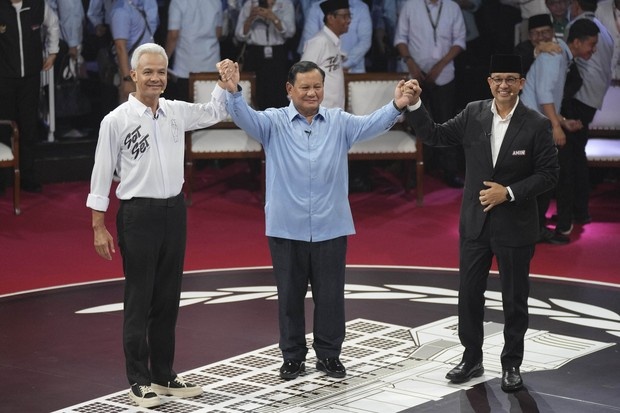
The presidential election featured a three-way contest led by 72-year-old former general and serving defence minister Prabowo Subianto, widely seen as part of Indonesia’s old political elite, against two first-time presidential contenders: former Central Java governor Ganjar Pranowo and former Jakarta governor Anies Baswedan. The winner was set to succeed President Joko Widodo, who had governed Indonesia for a decade and was constitutionally barred from seeking a third term. [Source: AFP, February 14, 2024; Stephen Sherlock, Australian National University, February 13, 2024]
Prabowo entered the race for the third time, this time running alongside Widodo’s eldest son, Gibran Rakabuming Raka, then 36, as his vice-presidential candidate. As leader of the populist and nationalist Greater Indonesia Movement Party (Gerindra), which he founded in 2008, Prabowo emerged as the clear frontrunner in opinion polls. His campaign largely promised continuity with Widodo’s policies, particularly in infrastructure development and economic management, themes that had underpinned Indonesia’s steady growth in recent years.
Anies Baswedan, 54, a former education minister and Jakarta governor, was the only candidate not formally affiliated with a political party. After initially polling in last place, he rose to second position in several surveys. Ganjar Pranowo, 55, a former governor of Central Java, was nominated by Widodo’s ruling Indonesian Democratic Party of Struggle (PDI-P), the country’s largest party, but slipped from second to third place in later polling.
Widodo remained personally popular at the close of his presidency, though he faced criticism over perceived efforts to entrench a political dynasty. Controversy intensified after an October court ruling lowered the minimum age requirement for presidential and vice-presidential candidates who had previously held public office. The decision, delivered by then–chief justice Anwar Usman, Widodo’s brother-in-law, enabled Gibran Rakabuming Raka to join Prabowo’s ticket.
Although Prabowo consistently led the polls, there was uncertainty during the campaign over whether he would secure an outright majority in the first round. Under Indonesia’s electoral rules, failure to obtain more than 50 percent of the vote would have triggered a runoff between the top two candidates.
Issues in the 2024 Elections
New Capital: A key issue in the election was whether President Widodo’s successor would carry forward his signature policy of relocating the national capital from overcrowded and sinking Jakarta to Nusantara, a purpose-built city on the island of Borneo. The project, expected to cost billions of dollars, was scheduled to begin operating as Indonesia’s new political center in August. Both Prabowo Subianto and Ganjar Pranowo pledged to continue development of the new capital, while Anies Baswedan argued that priority should instead be given to fixing the chronic problems of existing major cities such as Jakarta, large parts of which were projected to be underwater by 2050. [Source: AFP, February 14, 2024;
Youth Vote: Younger voters played a decisive role in the campaign. More than half of eligible voters—around 106 million people—were under the age of 40, according to data from the General Elections Commission. All three candidates made extensive use of social media platforms, including the popular Chinese-owned app TikTok, turning online campaigning into a major battleground for youth support. At the same time, these digital campaigns contributed to the spread of disinformation across social media.
Relations with United States and China: The election also unfolded against the backdrop of intensifying rivalry between the United States and China, raising questions about how Widodo’s successor would manage Indonesia’s foreign policy. Jakarta had long adhered to a “free and active” doctrine, maintaining neutrality while engaging with all major powers. The incoming president was set to take office as China became increasingly assertive in defending its claims in the strategic South China Sea. Prabowo Subianto repeatedly reaffirmed his commitment to Indonesia’s non-aligned stance, stating that he sought to preserve balanced relations with all global powers.
Jokowi Dynasty in the Making as Prabowo Picks Jokowi's Son as Running Mate?
Four months before the election, Prabowo chose President Joko Widodo’s eldest son, Gibran Rakabuming Raka, as his running mate for the 2024 election. The move is widely seen as boosting Prabowo’s prospects by boostiing his status aming young voters and tapping into Jokowi’s strong popularity, despite controversy over a court ruling that altered eligibility rules to allow the 36-year-old Gibran, mayor of Surakarta where his father started his political career as mayor, to run.[Source: Reuters, October 22, 2023]
Gibran was ineligible because of his age until the Constitutional Court ruled a week before hewas chosesn as vice president that anyone elected to regional posts can contest the 2024 election regardless of age. The ruling sparked outrage in Indonesia, the world's third-largest democracy. Critics have slammed the integrity of a court where Jokowi's brother-in-law is chief justice. [Source: Reuters, October 17, 2023]
A senior ally of Widodo has defended him against accusations of election interference, confirming that Jokowi supports Prabowo as the candidate most likely to continue his economic agenda. Minister Luhut Pandjaitan dismissed claims that Jokowi improperly influenced a court ruling that enabled his son to run as Prabowo’s vice-presidential candidate, arguing the decision was legitimate despite ethical concerns raised against a judge. [Source: Reuters, February 8, 2024]
Luhut said Jokowi backs Prabowo to ensure continuity of key policies, especially the development of downstream industries such as nickel processing, and denied that the support was driven by Jokowi’s son being on the ticket. While critics view Jokowi’s stance as an attempt to protect his legacy and retain influence, Luhut praised Prabowo’s leadership and urged the public not to focus on allegations from his past.
There accusations that Widodo was using his popularity to build a political dynasty despite earlier promises to break with Indonesia’s nepotistic past. Barred from a third term but still highly popular, Jokowi is accused of leveraging his influence to elevate his sons, most notably by backing his eldest son, Gibran as vice-presidential running mate to Prabowo. Critics say these moves amount to heavy political intervention and risk undermining democratic reforms, even as Jokowi insists he is impartial. His support has boosted Prabowo’s campaign, while sidelining his own party’s candidate, Ganjar Pranowo. Despite concerns about fairness and dynastic politics, Jokowi’s popularity remains strong, though former allies warn his actions have created political turmoil and cast a shadow over his reformist legacy. [Source: Jack Moore, AFP, January 30, 2024]
Debates and Rallies Before Indonesia's 2014 Presidential Elections
Indonesia’s three presidential contenders meet in the first of five televised debates in mid- December 2023. The first debate covered the issues of governance, tolerance and corruption, giving the candidates a platform to spell out their policies and respond to recent political controversies. Activists say the debates should also focus on worsening corruption, particularly after a 2019 revision weakened Indonesia’s anti-corruption agency. [Source: Kate Lamb, Reuters, December 12, 2023]
Describing the last round of rallies before the three-day cooling off period before the presidentia election, Reuters reported: Hundreds of thousands of supporters of Indonesia's presidential contenders packed final rallies in the capital Jakarta and the Central Java city of Solo of the world's biggest single-day election. [Source: Ananda Teresia and Bernadette Christina, Reuters, February 10, 2024]
A light-blue wave took over Jakarta's main sports complex as hundreds of thousands of Prabowo's supporters gathered, many wearing T-shirts in his signature colour. High-schooler Alfiatnan, 18, said she would vote for Prabowo because this was his third attempt at the presidency. "I think there's no harm giving opportunity to someone who is trying. His optimistic spirit influenced me to choose him."
Supporters at Anies' rally in the capital filled an 82,000-capacity stadium, chanting Islamic prayers. Some stayed overnight to secure a spot to see the former Jakarta governor. "I arrived here yesterday on purpose because if I had come today, I'm afraid I couldn't have gotten inside," said Ida Zubaedah, 50. "I need to be inside because I want to see Anies." Anies fired up the crowd, urging them to "fight with conscience" any intimidation before or on voting day. "Hearing that in the next few days there will be operations, intimidation, opinions being led so that voting will be done in one round for a certain candidate, I believe Indonesian people... will show they are the ones who determine their future," he said, without naming anyone or presenting any evidence.
In Solo, Ganjar rode a cart filled with produce pulled by oxen, underscoring his man-of-the-people style, greeting thousands of supporters braving the rain. Ganjar, Central Java's former governor, called on people to vote for him to show "true resistance" against the use of state resources during campaigning, without naming any of his rivals. At another rally in Central Java, Ganjar's running mate, Mahfud MD, said Indonesian democracy was "in crisis" and "heading into darkness" because corruption was rising, law had been misused and "the constitution has been played."
Eve of Indonesia’s 2024 Presidential Election
Around 25,000 police officers were deployed to maintain security during an election widely seen as a test of Indonesia’s democratic gains since the end of authoritarian rule 25 years earlier. Outgoing President Joko Widodo (Jokowi), who oversaw a decade of steady economic growth and relative political stability, faced criticism over alleged political interference and efforts to build a political dynasty. [Source: Reuters, February 13, 2024]
Although Jokowi did not formally endorse any of the three presidential candidates, he made highly publicized appearances with former special forces commander Prabowo Subianto, while his eldest son ran on the same ticket as Prabowo’s vice-presidential candidate. The election took place in the mineral-rich G20 economy of around 270 million people, which had positioned itself as a potential future hub for multinational investment in the electric vehicle supply chain.
Indonesia entered a cooling-off period ahead of voting day, during which candidates were barred from campaigning. Election officials distributed ballot boxes and papers to remote regions, sometimes requiring hours of travel by boat, helicopter, or even ox-drawn carts. The national weather agency warned of the risk of extreme weather in West Java on polling day, and the election commission postponed voting in ten villages in Karanganyar district, Central Java, because of flooding.
Jokowi’s perceived tacit support for Prabowo prompted accusations that he had violated election rules, claims he denied. Under Indonesian law, sitting presidents are allowed to campaign for candidates provided they do not use state resources and take official leave; traditionally, however, incumbents have remained neutral. The presidential office rejected allegations of political meddling.Meanwhile, hundreds of students staged loud street protests, accusing Jokowi’s administration of democratic backsliding. Their demonstrations echoed the pivotal student protests of 1998, which helped bring down longtime strongman Suharto and ushered in Indonesia’s democratic era.
2024 Legislative Elections in Indonesia
The legislative elections were highly competitive, with 24 parties—including six contesting only in Aceh—fielding more than 250,000 candidates for over 20,000 seats nationwide.
In the legislative contests, eight parties crossed the parliamentary threshold. The Indonesian Democratic Party of Struggle (PDI-P) remained the largest party in the DPR despite losing seats, while Golkar recorded the biggest seat gains. The United Development Party (PPP), meanwhile, failed to reach the 4 percent threshold and lost representation in the national parliament for the first time. [Source: Wikipedia]
The results also confirmed longer-term trends. Gerindra increased its parliamentary representation for a fourth straight election since its debut in 2009, while the National Democratic Party (NasDem) achieved its third consecutive seat gain since first entering parliament in 2014.
2024 Legislative Elections Results
All 580 seats in the House of Representatives (291 seats needed for a majority)
Party — Leader — Vote percent — Seats — +/–
PDI-P — Megawati Sukarnoputri — 16.72 — 110 — −18
Golkar — Airlangga Hartarto — 15.29 — 102 — +17
Gerindra — Prabowo Subianto — 13.22 — 86 — +8
PKB — Muhaimin Iskandar — 10.62 — 68 — +10
NasDem — Surya Paloh — 9.66 — 69 — +10
PKS — Ahmad Syaikhu — 8.42 — 53 — +3
Demokrat — Agus Harimurti Yudhoyono — 7.43 — 44 — −10
PAN — Zulkifli Hasan — 7.24 — 48 — +4
Turnout — 82.03 percent (Increase 0.34pp)
Image Sources: Wikimedia Commons
Text Sources: New York Times, Washington Post, Los Angeles Times, Lonely Planet Guides, Library of Congress, The Guardian, National Geographic, Smithsonian magazine, The New Yorker, Time, Reuters, AP, AFP, , Wikipedia, BBC, CNN, and various books and other publications.
Last updated December 2025