
CLOVIS PEOPLE

Clovis bifacial
The Clovis culture, or Clovis people, refers to an archaeological culture that lived in North America from around 13,050 to 12,750 years years ago, They were initially associated with the Blackwater Draw site, near Clovis, New Mexico, where stone tools were found alongside the remains of Columbian mammoths in 1929. Clovis sites have been found throughout North America. The most distinctive part of the Clovis culture toolkit are Clovis points which are flute projectile points with a lance-like shape. Clovis points are typically large, sometimes exceeding 10 centimeters (3.9 inches) in length, and were multifunctional, often used as cutting tools. Other stone tools used by the Clovis culture include bifacial tools, scrapers, and knives Among the bone tools were shaft wrenches, beveled rods and possible ivory points. [Source: Wikipedia]
Laura Anne Tedesco wrote for the Metropolitan Museum: “As the Pleistocene, or Ice Age, was ending and the earth was drying out, there was a profound change in the environment across North America. Hunters in North America pursued large animals for food. Skilled at the task, these Americans left evidence of activities throughout much of the continent where many of their living sites and hunt sites are now known. Blackwater Draw in eastern New Mexico, which evidences human activity from about 9500 to 3000 B.C., is one of the most important of the early hunter locations. Large animals were attracted to it for water—water sources being productive places for hunting—and the weapons with which the animals were brought down were principally of stone. [Source: Laura Anne Tedesco, Independent Scholar, Metropolitan Museum of Art, metmuseum.org, October 2000, revised September 2007 \^/]
“Discovered in the 1930s, Blackwater Draw defined the then newly discovered Clovis culture of North America (ca. 9500 B.C.). The name Clovis is derived from the modern town near Blackwater Draw. Currently documented to be among the earliest inhabitants of the North American continent. Clovis people of North and Central America likely lived in small, related bands of nomadic hunters. Most of what is currently known about Clovis culture is derived from spectacular kill-sites where the fractured and butchered bones of large prey, such as the mammoth at Blackwater Draw, have been found with the distinctive Clovis spear points. However, some Clovis camp sites have been discovered and from these more modest locations other varieties of smaller, beautifully crafted tools have been recovered. The variety of tools suggests that Clovis people were engaged in a wide range of activities to survive in Ice Age America. Several locations of Clovis caches have been found. Rare and valuable goods, such as raw materials for making tools and red ocher—possibly used in rituals—have been recovered from these caches. These buried goods were probably left for future recovery by the traveling bands, like a pirate's buried treasure.” \^/
RELATED ARTICLES:
EARLIEST EVIDENCE OF HUMANS TO AMERICA factsanddetails.com ;
WHEN AND HOW THE FIRST HUMANS CAME TO AMERICA: THEORIES AND EVIDENCE factsanddetails.com ;
MIGRATION ROUTE OF THE FIRST HUMANS IN AMERICA factsanddetails.com ;
SINGLE WAVE VS MULTIPLE PULSE THEORY AND MIGRATION OF EARLY PEOPLE TO AMERICA factsanddetails.com ;
FIRST AMERICANS: DNA, ASIA AND ASIANS factsanddetails.com ;
EARLIEST MODERN HUMANS IN WHAT IS NOW ALASKA AND CANADA factsanddetails.com ;
EARLIEST MODERN HUMANS IN WHAT IS NOW THE CONTINENTAL U.S. factsanddetails.com ;
WHITE SANDS 23,000-21,000 YEAR-OLD HUMAN FOOTPRINTS factsanddetails.com ;
EARLIEST MODERN HUMANS IN SOUTH AMERICA factsanddetails.com ;
EARLIEST MODERN HUMANS IN SOUTHERN SOUTH AMERICA factsanddetails.com ;
FIRST HUMANS AND SETTLEMENTS IN THE AMAZON factsanddetails.com ;
SOLUTREAN HYPOTHESIS factsanddetails.com
RECOMMENDED BOOKS:
“Clovis The First Americans?: by F. Scott Crawford (2012)
Amazon.com;
“Across Atlantic Ice: The Origin of America's Clovis Culture”
by Dennis J. J. Stanford, Bruce A. Bradley, Michael Collins Amazon.com;
“From Kostenki to Clovis: Upper Paleolithic—Paleo-Indian Adaptations (Interdisciplinary Contributions to Archaeology) by Olga Soffer (1993) Amazon.com;
“Origin: A Genetic History of the Americas” By Jennifer Raff, an associate professor of anthropology at the University of Kansas (Twelve, 2022); Amazon.com;
“First Peoples in a New World: Populating Ice Age America” by David J. Meltzer, an archaeologist and professor of prehistory in the Department of Anthropology at Southern Methodist University in Dallas, (Cambridge University Press, 2021); Amazon.com;
“The Indigenous Paleolithic of the Western Hemisphere” by Paulette F. C. Steeves (2023) Amazon.com;
“First Migrants: Ancient Migration in Global Perspective” by Peter Bellwood Amazon.com;
“Ancestral DNA, Human Origins, and Migrations” by Rene J. Herrera (2018) Amazon.com;
“Who We Are and How We Got Here: Ancient DNA and the New Science of the Human Past” by David Reich (2019) Amazon.com;
“Our Human Story: Where We Come From and How We Evolved” By Louise Humphrey and Chris Stringer, (2018) Amazon.com;
"The Settlement of the Americas: A New Prehistory" by Thomas D. Dillehay ( Basic Books, 2000 Dated) Amazon.com;
”Strangers in a New Land: What Archaeology Reveals About the First Americans”
by J. M. Adovasio, David Pedler (2016) Amazon.com;
“Paleoindian Mammoth and Mastodon Kill Sites of North America by Jason Pentrail (2021) Amazon.com;
Clovis Points and Tools
Glenn Hodges wrote in National Geographic: “In 1908 a cowboy in Folsom, New Mexico, found the remains of an extinct subspecies of giant bison that had roamed the area more than 10,000 years ago. Later, museum researchers discovered spearpoints among the bones—clear evidence that people had been present in North America much earlier than previously believed. Not long after, spearpoints dating to 13,000 years ago were found near Clovis, New Mexico, and what became known as Clovis points were subsequently found at dozens of sites across North America where ancient hunters had killed game. [Source: Glenn Hodges, National Geographic, January 2015 /~]
Nikhil Swaminathan wrote in Archaeology magazine: Michael Collins, a Texas State University archaeologist, had precious cargo with him in the form of more than 70 stone tools that he’d found during his 15 years of digging at a site in central Texas, roughly midway between Dallas and San Antonio, called Gault. His collection was scrupulously organized into two groups — one that he believes are more than 13,000 years old and a second that he believes were made more recently. The tools — blades, scrapers, and bifaces (typically crafted carefully on both sides) — initially appear to share similarities, as if all are part of the same lineage. But three points in the “newer” collection exhibit striking work — “stemmed” ends and fluting — of a caliber not seen in the other cache. These points, to which the term “beautiful” is often applied, are Clovis points. [Source: Nikhil Swaminathan, Archaeology magazine, September-October 2014]
Laura Anne Tedesco wrote for the Metropolitan Museum: ““The Clovis people hunted using exquisitely crafted spears made from stone. Elegant as well as useful, these spears are known also by the name Clovis. Found at Blackwater Draw, Clovis points were made by pressure flaking handsomely colored chert, agate, chalcedony, or jasper. These effective hunting tools and weapons are distinctively shaped. Bifacial (that is, flaked on both sides), they have a large central, or "channel," flake removed from the bottom. This detail has given them the name of fluted points, and they are peculiarly American. The fluted detail of the points would have allowed them to be more easily mounted onto split wooden spear shafts, and also probably increased their streamline and stability as implements that would have been hurled at formidable prey. Following Clovis, the Folsom complex (ca. 8500 B.C.) also produced an elegant fluted point, one with a longer channel flake. It too was used in the hunting of big game, primarily bison. [Source: Laura Anne Tedesco, Independent Scholar, Metropolitan Museum of Art, metmuseum.org, October 2000, revised September 2007 \^/]
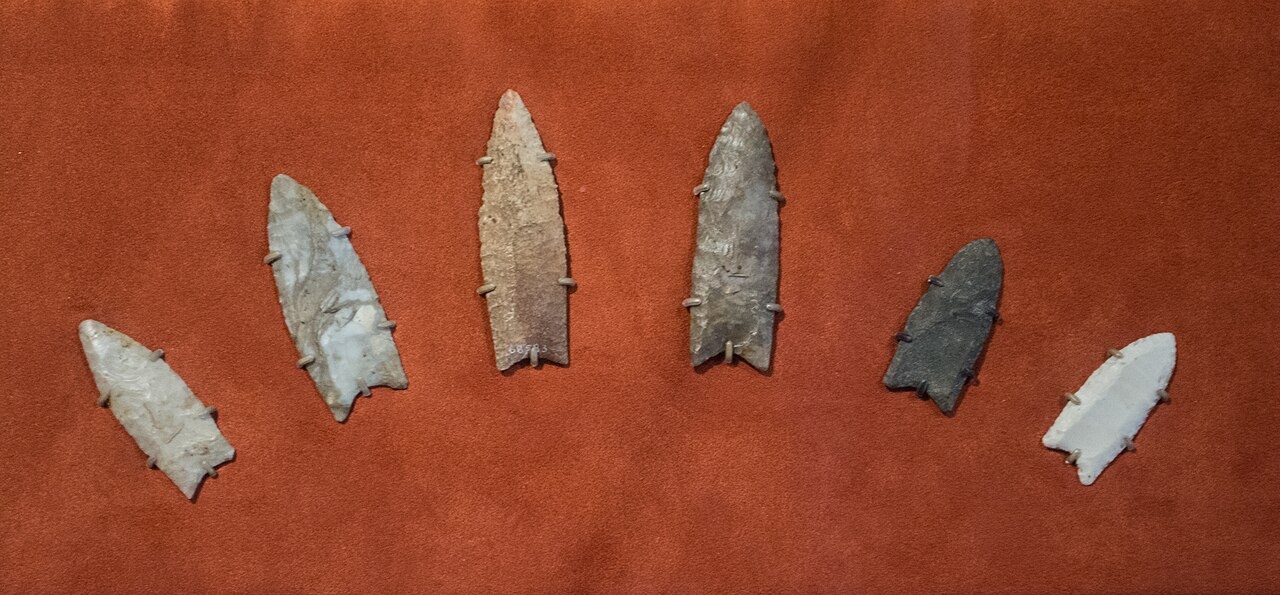
“Clovis-like points have been unearthed across the United States, Canada, and Central America. They are remarkably similar despite the vast geographic territory where they have been found. Typically a singular type of artifact takes on unique regional characteristics. Clovis points do not appear to follow this archaeological convention, and it may have been because they were extremely effective hunting implements as well as items exchanged in long-distance trade networks. The finer raw materials used to fashion Clovis points were also occasionally traded across vast distances. \^/
Examples of Clovis tools include 1) a large (approximately 2.5-x-12.2 centimeters) tabular core late-interval biface made of brown chert along with the beveled end of an osseous rod; 2) a nearly complete projectile point of dendritic chert; 3) a mid-interval biface of translucent quartz, displaying relatively heavy red ochre residue; and an "end-beveled" osseous rod, also exhibiting red ochre residue. [Source: Live Science, February 13, 2014]
Clovis Theory
It was long theorized that the Clovis people initially migrated into Alaska from Siberia, crossing the 600-mile-wide corridor along the Bering Strait that was then dry due to water confined in massive glaciers. Their migrations as big-game hunters led the Clovis down from Alaska, through Canada into the North American plains as they followed herds of steppe bison, mammoth, and horse. These animals reached extinction around the same time Clovis hunters were becoming established in North America; whether the animals' extinction was due to the efficiency and tenacity of Clovis hunters, concurrent climate change, or a combination of both, is debated. [Source: Laura Anne Tedesco, Independent Scholar, Metropolitan Museum of Art, metmuseum.org, October 2000, revised September 2007 \^/]
A lot of these ideas have been debunked or dismissed. Describing how Clovis Theory came into existence, Guy Gugliotta wrote in Smithsonian Magazine: “For decades the most compelling evidence of this standard view consisted of distinctive, exquisitely crafted, grooved bifacial projectile points, called “Clovis points”. With the aid of radiocarbon dating in the 1950s, archaeologists determined that the Clovis sites were 13,500 years old. This came as little surprise, for the first Clovis points were found in ancient campsites along with the remains of mammoth and ice age bison, creatures that researchers knew had died out thousands of years ago. But the discovery dramatically undermined the prevailing wisdom that human beings and these ice age “megafauna” did not exist in America at the same time. Scholars flocked to New Mexico to see for themselves. [Source: Guy Gugliotta, Smithsonian Magazine, February 2013 /||]
“The idea that the Clovis peoplewere the first Americans quickly won over the research community. “The evidence was unequivocal,” said Ted Goebel, at the Center for the Study of the First Americans. Clovis sites, it turned out, were spread all over the continent, and “there was a clear association of the fauna with hundreds, if not thousands, of artifacts,” Goebel said. “Again and again it was the full picture.” Furthermore, the earliest Clovis dates corresponded roughly to the right geological moment—after the ice age warming, before the great cold snap. The northern ice had receded far enough so incoming settlers could curl around to the eastern slope of North America’s coastal mountains and hike south along an ice-free corridor between the cordilleran mountain glaciers to the west and the huge Laurentide ice sheet that swaddled much of Canada to the east. “It was a very nice package, and that’s what sealed the deal,” Goebel said. “Clovis as the first Americans became the standard, and it’s really a high bar.” /||\
“When they reached the temperate prairies, the migrants found an environment far different from what we know today—both fantastic and terrifying. There were mammoths, mastodons, giant sloths, camels, bison, lions, saber-toothed cats, cheetahs, dire wolves weighing 150 pounds, eight-foot beavers and short-faced bears that stood more than six feet tall on all fours and weighed 1,800 pounds. Clovis points, finely made and strong, were well suited for hunting large animals. /||\
“The hunters spread through the United States and Mexico, the story went, pursuing prey until too few animals remained to support them in the last cold snap. Radiocarbon dates show that most of the megafauna became extinct around 12,700 years ago. The Clovis points disappeared then as well, perhaps because there were no longer any large animals to hunt. The Clovis theory, over time, acquired the force of dogma. “We all learned it as undergraduates,” archaeologist Michael Waters of Texas A&M University recalled. Any artifacts that scholars said came before Clovis, or competing theories that cast doubt on the Clovis-first idea, were ridiculed by the archaeological establishment, discredited as bad science or ignored.” /||\

Pre-Clovis Sites
Pre-Clovis People
Annalee Newitz wrote in ars technica: “For more than a decade, evidence has been piling up that humans colonized the Americas thousands of years before the Clovis people. The Clovis, who are the early ancestors of today's Native Americans, left abundant evidence of their lives behind in the form of tools and graves. But the mysterious pre-Clovis humans, who likely arrived 17,000 to 15,000 years ago, have left only a few dozen sources of evidence for their existence across the Americas, mostly at campsites where they processed animals during hunting trips.[Source: Annalee Newitz, ars technica, September 29, 2016. PLoS One, 2016. DOI: 10.1371/journal.pone.0162870 )*(]
“Archaeologists are still uncertain how the pre-Clovis people arrived in the Americas. They came after the end of the ice age but at a time when glaciers and an icy, barren environment would still have blocked easy entrance into the Americas via Northern Canada. So it's extremely unlikely that they marched over a land bridge from Siberia and into the Americas through the middle of the continent—instead, they would have come from Asia via a coastal route, frequently using boats for transport. That would explain why many pre-Clovis sites are on the coast, on islands, or on rivers that meet the ocean. These early settlers were hunter-gatherers who used stone tools for a wide range of activities, including hunting, butchery, scraping hides, preparing food, and making other tools out of bone and wood. Many of the pre-Clovis stone tools look fairly simple and were made by using one stone to flake pieces off the other, thus creating sharp edges. “ )*(
Laura Geggel wrote in Live Science: Several 15,500-year-old stone spearheads may be the oldest weapons on record in North America. These up to 4-inch-long (10 centimeters) spears are so old they may even predate the Clovis people, who were long thought to be the first group to populate the Americas. But some archaeologists are skeptical of the techniques used to date the spearheads, which were found near Austin, Texas. Because there was no organic matter near the spearheads to use for radiocarbon dating, the scientists used optically stimulated luminescence (OSL), which shows how long ago quartz grains in the sediment were exposed to sunlight. That's not the gold-standard technique typically used to date such artifacts, however, experts previously told Live Science. [Source: Laura Geggel, Live Science, December 25, 2018]
Debra L. Friedkin Site in Texas: Earliest Pre-Clovis Site
Located about 64 kilometers (40 miles) northwest of Austin, Texas, just north of Buttermilk Creek, the Debra L. Friedkin archaeological site has yielded weapons and tools that possibly date back to 15,500 years ago. Archaeologists have unearthed 100,000 artifacts — including blades, scrapers and a circular core from which stone utensils were struck — from the site. . They also found thousands of chert pieces — scraps and flakes created during tool production — that are at least 13,500 years old. The site is controversial because 11 spearpoints found there that archaeologists estimated to be 15,500 years old were dated with optically stimulated luminescence instead of radiocarbon-dating techniques. Optically stimulated luminescence, which estimates the last time a quartz grain has been exposed to sunlight, was chosen, because water had carried away any nearby organic material that could have been used to get radiocarbon dates. [Source: Sascha Pare, Live Science, October 9, 2023]

Buttermilk Creek Complex tools: (a) Lanceolate point preform; (b) chopper/adze; (c) discoidal flake core; (d) radially broken flake with notch; (e) graver; (f) flake tool with retouch on a radially broken edge; (g,h) flake tools with marginal edge retouch; (i) polished hematite; (j) bifacially retouched flake; (k) radially/bend broken flake; (l) radially broken biface; (m,n) blade midsections; (o–s), bladelets. Reproduced with permission from [68]; courtesy Michael R. Waters.
For a while the Debra L. Friedkin was considered a candidate for being the earliest place of demonstrable human habitation in the Americas. In 2011 Waters announced that he and his team had unearthed evidence of extensive human occupation dating to as early as 15,500 years ago—some 2,500 years before the first Clovis hunters arrived. Glenn Hodges wrote in National Geographic: The Friedkin site lies in a small valley in the Texas hill country, where a tiny perennial stream now called Buttermilk Creek, along with some shade trees and a seam of chert, a type of rock useful for toolmaking, made the area an attractive place for people to live for thousands of years. [Source: Glenn Hodges, National Geographic, January 2015 /~]
““There was something unique about this valley,” Waters says. It was long thought that the earliest Americans were primarily big-game hunters, following mammoths and mastodons across the continent, but this valley was an ideal place for hunter-gatherers. People here would have eaten nuts and roots, crawdads and turtles, and they would have hunted animals such as deer and turkeys and squirrels. In other words, people probably weren’t here on their way to somewhere else; they were here to live. /~\
“But if Waters is right that people were settled here, in the middle of the continent, as early as 15,500 years ago, when did the first arrivals cross into the New World from Asia? That’s unclear, but it appears that people may have been settled in other parts of the continent at the same time. Waters says the pre-Clovis artifacts he’s found at Buttermilk Creek—more than 16,000 of them, including stone blades, spearpoints, and chips—resemble artifacts found at sites in Virginia, Pennsylvania, and Wisconsin. “There’s a pattern here,” he says. “I think the data clearly show that people were in North America 16,000 years ago. Time will tell if that represents the initial occupation of the Americas or if there was something earlier.”
Buttermilk Creek Complex Pre-Clovis People
Guy Gugliotta wrote in Smithsonian Magazine: “At the Buttermilk Creek Complex archaeological site north of Austin, Texas, in a layer of earth beneath a known Clovis excavation, researchers led by Waters over the past several years found 15,528 pre-Clovis artifacts—most of them toolmaking chert flakes, but also 56 chert tools. Using optically stimulated luminescence, a technique that analyzes light energy trapped in sediment particles to identify the last time the soil was exposed to sunlight, they found that the oldest artifacts dated to 15,500 years ago—some 2,000 years older than Clovis. The work “confirms the emerging view that people occupied the Americas before Clovis,” the researchers concluded in Science in 2011. In Waters’ view, the people who made the oldest artifacts were experimenting with stone technology that, over time, may have developed further into Clovis-style tools. [Source: Guy Gugliotta, Smithsonian Magazine, February 2013 /||]
“Waters recently landed other blows to the Clovis orthodoxy in collaboration with Thomas Stafford, president of the Colorado-based Stafford Research Laboratories. In one series of experiments using accelerator mass spectrometry (AMS), a dating technique that is more precise than earlier radiocarbon measurements, they reanalyzed a mastodon rib from a skeleton previously recovered in Manis, Washington, and found to have a projectile point lodged in it. The original radiocarbon tests had surrounded the discovery in controversy because they showed it to be 13,800 years old—centuries older than Clovis. The new AMS tests confirmed that age estimate date, and DNA?analysis showed that the projectile point was mastodon bone. /||\
“Deploying AMS technology, Waters and Stafford also retested many known Clovis samples from around the country, some collected decades earlier. The results, Waters said, “blew me away.” Instead of a culture spanning about 700 years, the analysis shrunk the Clovis window to 13,100 to 12,800 years ago. This new time frame required the Siberian hunters to negotiate the ice-free corridor, settle two continents and put the megafauna on the road to extinction within 300 years, an incredible feat. “Not possible,” Waters said. “You’ve got people in South America at the same time as Clovis, and the only way they could have gotten down there that fast is if they transported like ‘Star Trek.’ ” /||\
“But Haynes, of the University of Nevada-Reno, disagrees. “Think of a small number of very mobile people covering a lot of ground,” he suggests. “They could have been walking thousands of kilometers per year.” Goebel, of the Texas A&M Center for the Study of the First Americans, characterizes his attitude toward pre-Clovis finds as “acceptance with reservation.” He said he’s disturbed by “nagging” shortcomings. Each of the older sites appears to be one-of-a-kind, he said, without a “demonstrated pattern across a region.” With Clovis, he adds, it is clear that the original sites were part of something bigger. The absence of a consistent pre-Clovis pattern “is one of the things that has hung up a lot of people, including myself.” /||\
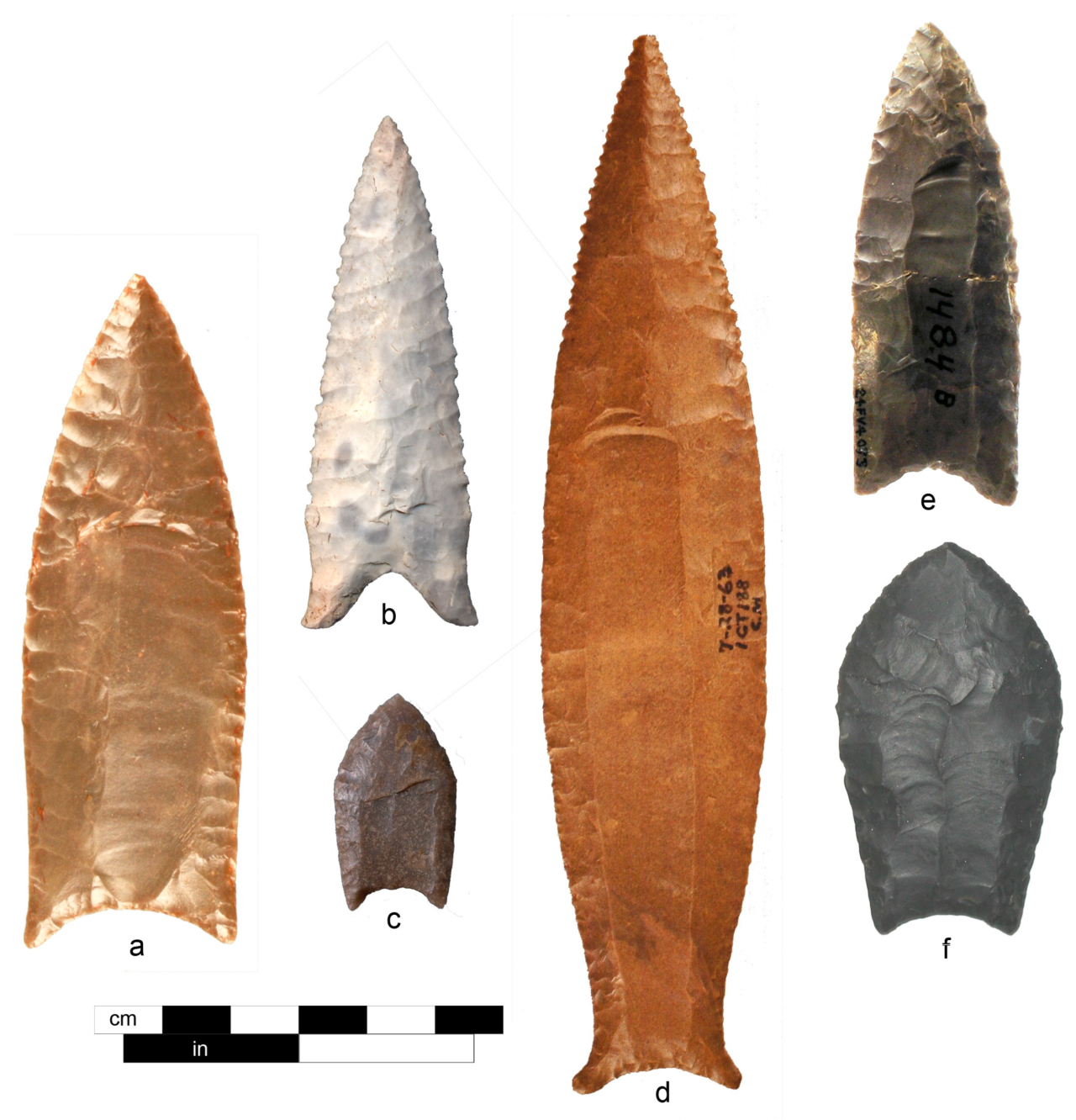
Examples of Paleoindian fluted projectile points from eastern North America and a Folsom point from western North America: (a) Clovis; (b) Dalton; (c) Folsom; (d) Cumberland; (e) Gainey/Bull Brook; (f) Crowfield. Reproduced with permission from [102]; figure by Matthew Boulanger.
Pre-Clovis Butchered Mammoths
Nikhil Swaminathan, September-October 2014]“In 1964, while draining a marshy field on the Schaefer Farm, an hour north of Chicago, an earthmover jolted to a halt when it struck a buried mammoth femur, throwing its operator from his seat. The mammoth remains would end up in the nearby Kenosha Public Museum. More than 20 years later, an amateur archaeologist noticed cut marks on another set of mammoth bones in the museum’s collection, indicating they had been butchered. That prompted archaeologist Dan Joyce, the museum’s director, to reinvestigate the Schaefer site. [Source: Nikhil Swaminathan, Archaeology magazine, September-October 2014]
“Beginning his excavations in 1992, he found, under two-and-a-half feet of ancient soils, roughly 80 percent of a completely butchered mammoth. Because the animal had been inundated by the waters of a long-dried-up lake shortly after it was butchered, its bones were well preserved. Many bore V-shaped cut marks typical of what would be made by humans using prehistoric tools. Joyce also found fragments of two stone blades with the remains. Preliminary dating says the bones are roughly 13,000 years old. “We had a Clovis date, so we thought we had a Clovis site,” Joyce says. But when the bones were redated the next year using a more sophisticated technique that purified the collagen protein in them, that assessment went out the window. The new dates came back clustered around 14,500 years ago.
“If the analysis wasn’t enough to convince Joyce, what was found three-quarters of a mile away at the Hebior Farm confirmed it. There, in 1994, a team led by David Overstreet, an archaeologist at Marquette University in Milwaukee, found 90 percent of a similarly butchered mammoth, along with a more complete set of butchering tools. The bones from Hebior would be dated to 150 to 200 years before the Schaefer bones. “Both Schaefer and Hebior are pre-Clovis, but they’re a Clovis subsistence style, so they’re almost bridging the gap,” says Joyce, referring to the Clovis people’s reputation as hunters of mammoths, bison, and other big game. “Are they more properly called ‘proto-Clovis,’ something that develops into Clovis?”
Manis Mastodon Kill Site
According to Archaeology magazine: Researchers determined that a mastodon living in the Pacific Northwest 13,900 years ago was wounded when it was struck by a spear. The elephant-like animal’s remains were first discovered in the 1970s at the Manis Mastodon site on the Olympic Peninsula in Washington state. CT scanning and 3-D software analysis in 2023 revealed that tiny bone fragments embedded in its rib were pieces of a projectile fashioned from the leg bone of another mastodon. This represents the oldest known bone spearpoint in the Americas and the earliest evidence of mastodon hunting. [Source: Archaeology Magazine, May 2023]
The mastodon kill site on Emanuel Manis’ property was discovered when he was digging through six feet of peat to make a small pond. Manis found two fossilized tusks that he thought had belonged to an elephant. When Washington State University archaeologist Carl Gustafson excavated the pond site in 1977, he quickly recovered one of the animal’s ribs with a bone projectile point in it. It was later determined from analysis of the animal’s tooth that the bones belonged to a mastodon. [Source: Nikhil Swaminathan, September-October 2014]

Important Clovis sites
“Organic material found near the remains was dated to roughly 14,000 years ago. Controversy ensued, with members of the archaeological community refuting the dating because it hadn’t been done on the actual bones. In addition, multiple theories emerged as to how the bone fragment had come to be embedded in the mastodon rib, including an antelope attack.
“Enter Texas A&M’s Mike Waters, who, in 2011, announced that he’d dated purified collagen in the bone, and that it was 13,800 years old. CT scans and 3-D projections of the rib with the projectile in it show that the bone fragment is, in fact, a spear point. For Waters, Manis wasn’t an isolated exercise in taking a second look at forgotten sites. As a case in point, he and his former graduate student, Jesse Halligan, now at the University of Wisconsin-Lacrosse, have recently re-excavated Page-Ladson, a sinkhole on the Florida panhandle that thousands of years ago would have been above sea level. There, in the 1980s and 1990s, archaeologists discovered that ancient people likely killed a mastadon in the sinkhole. They found several flakes from stone tools and a mastodon tusk with cut marks on it. Dating nearby seeds returned ages of about 14,400 years old. But, as with the Manis find, colleagues turned a blind eye to the results. Last summer, however, Halligan found a large fragment of a biface in the same layer as the previous finds. Radiocarbon dates on twigs and seeds found around it could confirm the earlier work at the site. “My philosophy is you can reinvestigate these sites that have promise and see if they pan out,” Waters says. “Sometimes you win, sometimes you lose.”
Clovis People Sites
Blackwater Draw in eastern New Mexico is the original Clovis people site. Situated close to a ravine and discovered in 1929, the site was called Clovis due to its proximity to a town of that name. Throughout the 1930s, it yielded stone artifacts, hearths and bones belonging to extinct animals — including mammoths — showing evidence of butchery dating to 13,000 years ago. Spearpoints discovered there came to define the people and culture. These distinctive spearpoints were chipped from stone into finger-long projectiles that are now known as "Clovis points" and were found associated with animal bones. Ancient archaeological sites across the Americas are defined in relation to Clovis, with "pre-Clovis" sites referring to evidence that humans came from Asia far earlier than 13,000 years ago.[Source: Sascha Pare, Live Science, October 9, 2023]
According to Archaeology magazine: The Clovis people, among the first to spread across North America, are known to have hunted and dined on the continent’s erstwhile mammoth population. Recent finds at the site of El Fin del Mundo in Sonora have added the gomphothere, an elephant relative with four tusks, to their menu. Alongside bones from two gomphotheres, archaeologists found distinctive Clovis points and other tools. Almost 14,000 years old, it is one of the oldest and southernmost Clovis sites. [Source: Samir S. Patel, Archaeology magazine, November-December 2014]
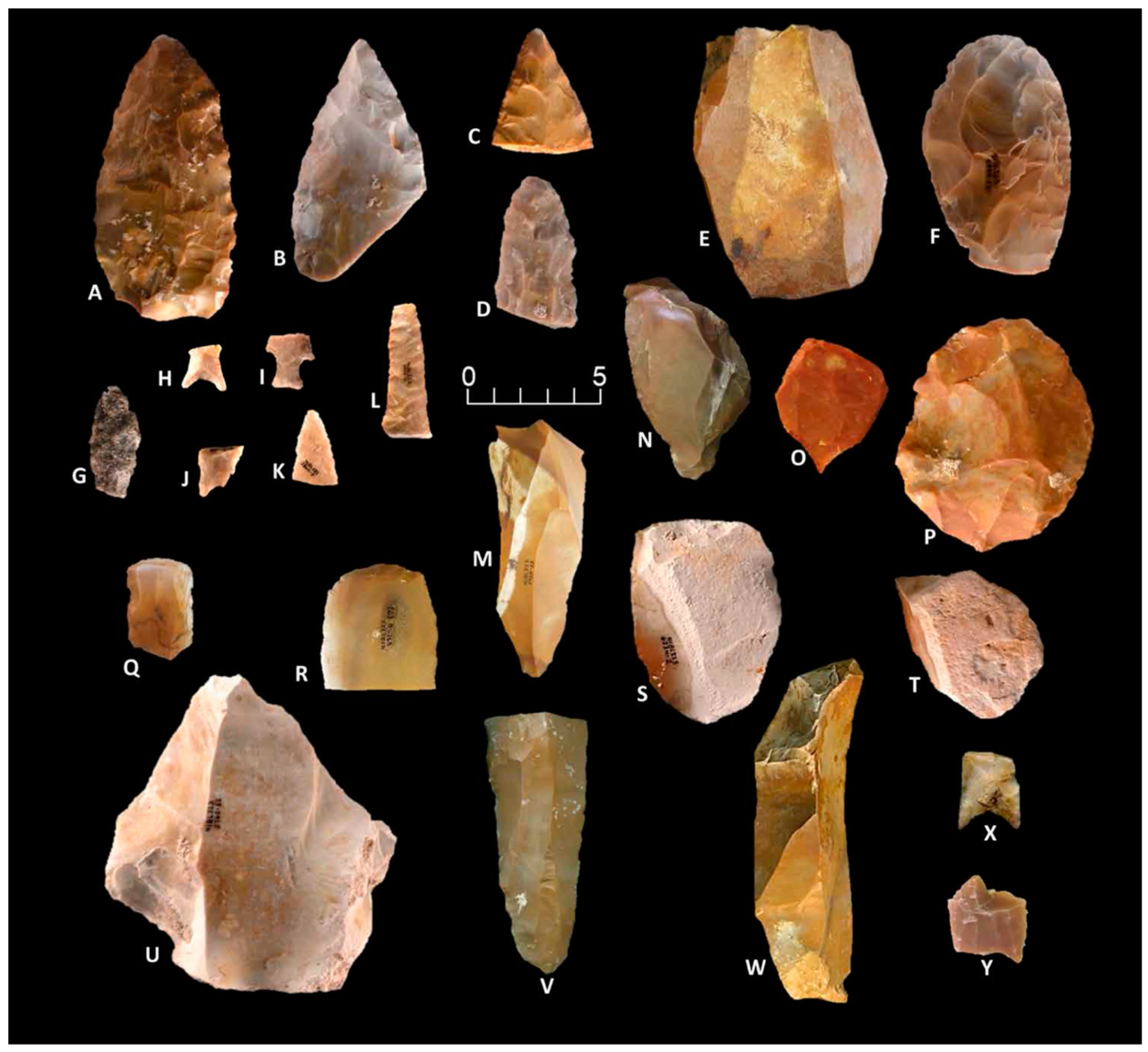
Gault Assemblage artifacts: (A–D,F,L) bifaces; (E) blade core; (G) quartz projectile point; (H–J) projectile points; (K) projectile-point tip; (M,V,W) blades; (N) unifacial tool; (O,T) gravers; (P) discoidal biface; (Q) end scraper; (R–U) modified-flake tools; (X,Y) lanceolate projectile points (units in cm). Reproduced from [126]; courtesy Michael B. Collins.
Clovis People Hunted Canadian Camels
Bruce Dorminey wrote in smithsonian.com: “In a southwestern corner of what is now Alberta, Canada, camels once roamed. They went extinct at the end the last Ice Age, and their disappearance has generally been attributed to changes in climate and vegetation. But new research suggests that human predators may have contributed to the Western camel’s (Camelops hesternus) demise. A paper in American Antiquity shows that, at a time when ice sheets still covered most of northern Canada, Clovis people on the Western plains were hunting camel for food. “Our evidence shows that we have to consider that humans may have had some role in their extinction,” said Brian Kooyman, an archeologist at the University of Calgary, and the paper’s lead author. [Source: Bruce Dorminey smithsonian.com, March 13, 2012 ^|^]
“The study makes the first direct association between Clovis projectile points, stone tools and the remains of a butchered camel. The remains, which radiocarbon dating showed to be about 13,000 years old, were found preserved in windblown sand and silts at Wally’s Beach, an archeological site 108 miles south of Calgary. “Tracks indicate that they were the second-most common animal at Wally’s Beach and a common part of the fauna,” said Len Hills, a geoscientist at the University of Calgary and collaborator on the study. “Abundant camel tracks at the site clearly show a substantial population.” ^|^
“Kooyman says this particular camel was likely killed with spears after being ambushed at the top of an embankment leading into a river valley. Hunters may have hidden in nearby shrubs before isolating the animal from the herd. The hunters then chopped their prey into units of eight vertebrae each, while severing and snapping the camel’s torso into sides of ribs. ^|^
“But did camels make up a significant part of these people’s diet? “This is the only site where we have proof of camel use,” said Kooyman. “So far at the site, we have seven killed horses and one camel, so here it is likely they made up about one-eighth of the meat diet.” At present, there is no evidence that the hunters ever spared the animals in an effort to harness them as pack animals or for human transport, nor that they ever used the camels for anything other than food. But as Kooyman notes, it’s likely these early hunters would have used camel hides for clothing, since life on these post-glacial plains would still have been windy and cold.” ^|^
Evidence of Clovis Mastodon and Mammoth Hunting
Professor Christopher R. Moore wrote: Archaeologists have uncovered a sparse scattering of stone tools left at the campsites of Paleo-American Clovis hunter-gatherers who lived around the time of the megafauna extinctions. These include iconic Clovis spearpoints with their distinctive flutes — concave areas left behind by removed stone flakes that extend from the base to the middle of the point. People most likely made the points this way so they could easily affix them to a spear shaft. [Source: Christopher R. Moore, Research Professor at the South Carolina Institute for Archaeology and Anthropology, University of South Carolina, The Conversation, June 14, 2023
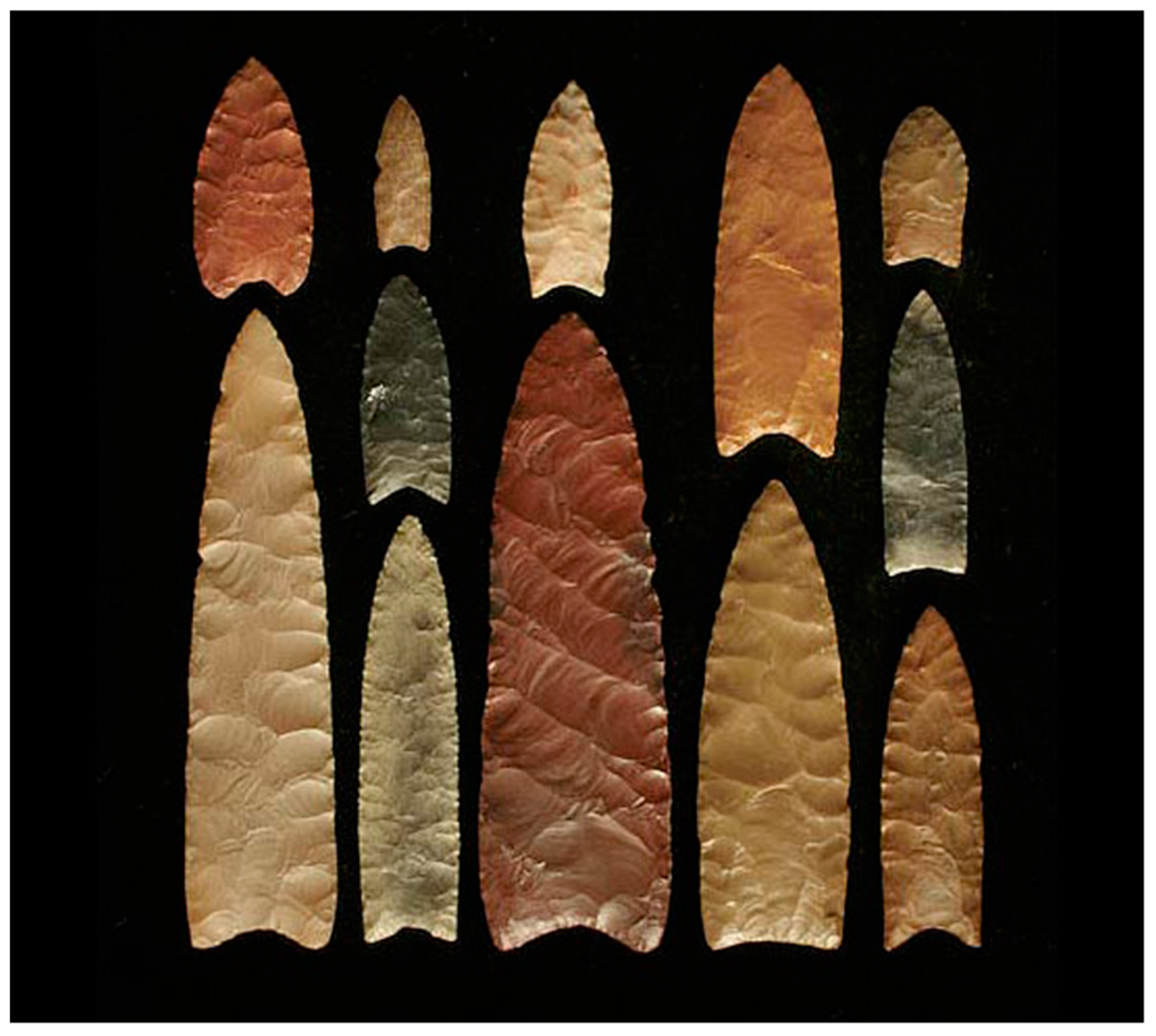
Clovis points from various North American sites.
Based on sites excavated in the western United States, archaeologists know Paleo-American Clovis hunter-gatherers who lived around the time of the extinctions at least occasionally killed or scavenged Ice Age megafauna such as mammoths. There they’ve found preserved bones of megafauna together with the stone tools used for killing and butchering these animals. These sites are crucial for understanding the possible role that early Paleo-Americans played in the extinction event. Unfortunately, many areas in the Southeastern United States lack sites with preserved bone and associated stone tools that might indicate whether megafauna were hunted there by Clovis or other Paleo-American cultures. Without evidence of preserved bones of megafauna, archaeologists have to find other ways to examine this question.
Forensic scientists have used an immunological blood residue analysis technique called immunoelectrophoresis for over 50 years to identify blood residue sticking to objects found at crime scenes. In recent years, researchers have applied this method to identify animal blood proteins preserved within ancient stone tools. They compare aspects of the ancient blood with blood antigens derived from modern relatives of extinct animals. Residue analysis does not rely on the presence of nuclear DNA, but rather on preserved, identifiable proteins that sometimes survive within the microscopic fractures and flaws of stone tools created during their manufacture and use. Typically, only a small percentage of artifacts produce positive blood residue results, indicating a match between the ancient residue and antiserum molecules from modern animals.
A previous blood residue study of a small number of Paleo-American artifacts in South Carolina and Georgia failed to provide evidence that these people had hunted or scavenged extinct megafauna. The researchers found evidence of bison and other animals such as deer, bear and rabbit, but no evidence of Proboscidean (mammoth or mastodon) or of an extinct species of North American horse.
My colleagues and I realized we needed a much larger sample of Paleo-American stone tools for testing. Since Clovis points and other Paleo-American artifacts are rare, I relied heavily on local museums, private collectors, collections housed at state universities and even military installations to amass a sample of 120 Paleo-American stone tools from all over North Carolina and South Carolina. The blood residue analysis provided unambiguous proof that the tools had had contact with ancient animal blood proteins. The results included the first direct evidence on ancient stone tools of the blood of extinct mammoth or mastodon (Proboscidean) and the extinct North American horse (Equidae) on Paleo-American artifacts in eastern North America. This evidence is significant because it proves that these animals were present in the Carolinas, and they were hunted or scavenged by early Paleo-Americans.
In addition to Proboscidean and horse, bison (Bovidae) blood residues were most common, adding to earlier blood residue research suggesting a focus on bison hunting by Clovis and other Paleo-American cultures. Bison in North America did not go extinct but instead became smaller, most likely as a result of climate change as the last ice age ended and the climate warmed. The results also indicate that Proboscideans and horses were around when Clovis people were here — only a few hundred years before their eventual extinction in North America. Another interesting finding is that while Proboscidean blood residues are found on Clovis artifacts, blood residues for horses (Equidae) are found on both Clovis and Paleo-American points that are slightly more recent younger than Clovis. This may suggest the extinction of Proboscidean was complete in the Carolinas by the end of the Clovis period, and the extinction of ice-age horse species took longer.

mastadon hunt
Was the Demise of Clovis People Caused by a Comet Impact?
Zach Zorich wrote in Archaeology magazine: “It's commonly believed that North America's Clovis culture came to an end around 12,900 years ago, when their characteristic spear points disappeared from the archaeological record. At the same time a number of large animal species such as mammoths and saber-toothed tigers became extinct. [Source: Zach Zorich, Archaeology magazine, January-February 2011]
In 2006, a team led by geologist Richard Firestone of Lawrence Berkeley National Laboratory put forth a theory that a comet struck the Earth around this time, engulfing the continent in forest fires and causing the mass extinctions as well as the demise of the Clovis culture. They deduced this from the existence of a one-millimeter-thick soil layer at several Clovis sites that contains a high concentration of particles that appear to have extraterrestrial origins.
In 2011, archaeologists Vance Holliday of the University of Arizona and David Meltzer of Southern Methodist University offered a point-by-point refutation of this premise, saying that evidence of the extraterrestrial particles does not show up at many Clovis sites, and that a careful examination of the archaeological record shows that the population in North America did not drop at the time of the purported comet impact. As for the Clovis culture itself, Holliday and Meltzer think a new interpretation of radiocarbon dates indicates the people gradually stopped making the spear points they are associated with and simply began making another kind. Perhaps they didn't disappear at all.
See Abrupt End to Climate Change 12,900 Years Ago Caused by Meteors? Under GLOBAL WARMING: HISTORY, POLITICS AND COUNTRIES factsanddetails.com
Image Sources: Wikimedia Commons, The Conversation, Quarternary
Text Sources: National Geographic, New York Times, Washington Post, Los Angeles Times, Smithsonian magazine, Nature, Scientific American. Live Science, Discover magazine, Discovery News, Natural History magazine, Archaeology magazine, The New Yorker, Time, Newsweek, BBC, The Guardian, Reuters, AP, AFP, and various books and other publications.
Last updated June 2024