
EARLY HUMANS IN SOUTHERN SOUTH AMERICA
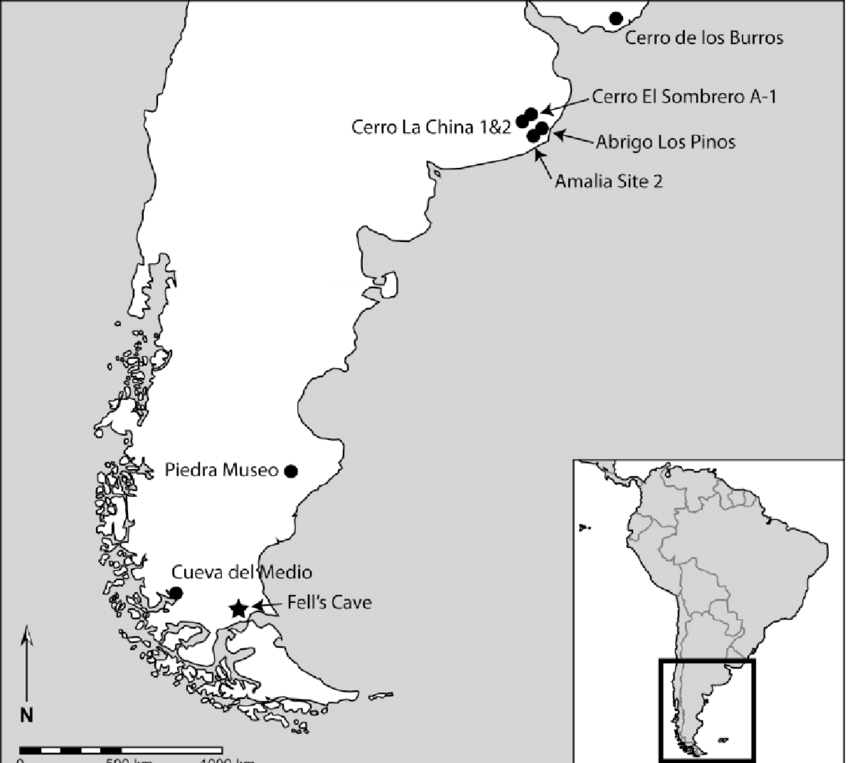
The first people to occupy the American continents probably arrived from Asia, having crossed the Bering land bridge between Siberia and Alaska, and then migrated southward towards South America. Many of “the very earliest sites that document the Americas first inhabitants occur in the southern region of South America. Laura Anne Tedesco wrote for the Metropolitan Museum of Art: ““As human populations migrated to the Americas from Asia, the world's climate was undergoing considerable change. These changes forced the nomadic hunters to adapt to new ways of life and new sources of food. In South America, human populations had to deal with the harsh rigors of the prevailing climate and, perhaps as a consequence, occupied different parts of the great continent at intervals depending on the availability of food and adequate shelter. In some regions, the occupants coexisted with such soon-to-be-extinct animals as mastodons and giant ground sloths, and the tools they used were of wood, bone, and stone. Diverse parts of what is now Chile were inhabited, with living sites within the marshes at Monte Verde (10,500-9500 B.C.) in the south-central region, and drier areas such as Fell's Cave (9000-8000 B.C.) in Patagonia. [Source: Laura Anne Tedesco, Independent Scholar, Metropolitan Museum of Art, metmuseum.org, October 2000, revised September 2007) \^/]
“Fell's Cave, a rock shelter in the valley of the Río Chico not far from the Strait of Magellan, was initially occupied by hunters around 10,000 B.C. who left behind an impressive layer of refuse. Sealed by hundreds of pounds of debris from the fall of the shelter overhang, the hunter's refuse included firepots with the broken bones of native horse, sloth, and guanaco, as well as stone and bone tools. Among the stone tools were fishtail spearpoints, a form of stone point found in many places in South America. Fishtail points are flaked bifacially (that is, worked on both sides) and have pronounced shoulders above a clearly shaped stem. Some are fluted with small channels removed from the bottom. In 1936-37, the discoveries in Fell's Cave represented the first evidence of early humans in South America. Since then, older sites such as Monte Verde have been identified. \^/
“Monte Verde in Chile, which was occupied some 14,500 years ago, provides a slightly different view of life for the early inhabitants of South America. Due to the quality of preservation at Monte Verde, natural materials such as wood, fiber, and cordage remain. Even a human footprint has been found there. This range of artifacts crafted from perishable materials is typically lost to archaeologists. Their preservation due to the extremely wet conditions at Monte Verde indicate that baskets, fishing nets, and tents made from hides were among the range of belongings used by the thirty or so people who lived there. These campers were likely able fishermen and gatherers of wild plants, which would have supplemented their diet of hunted animals. They also crafted exquisite leaf-shaped spearpoints. These weapons and hunting tools are not dissimilar from the examples illustrated here from Fell's Cave, which suggests that the two sites, while separated in time by more than 4,000 years, were part of a long-standing and connected tradition of thriving in the new world.” \^/
RELATED ARTICLES:
EARLIEST MODERN HUMANS IN SOUTH AMERICA factsanddetails.com ;
EARLIEST EVIDENCE OF HUMANS TO AMERICA factsanddetails.com ;
WHEN AND HOW THE FIRST HUMANS CAME TO AMERICA: THEORIES AND EVIDENCE factsanddetails.com ;
MIGRATION ROUTE OF THE FIRST HUMANS IN AMERICA factsanddetails.com ;
SINGLE WAVE VS MULTIPLE PULSE THEORY AND MIGRATION OF EARLY PEOPLE TO AMERICA factsanddetails.com ;
FIRST AMERICANS: DNA, ASIA AND ASIANS factsanddetails.com ;
EARLIEST MODERN HUMANS IN WHAT IS NOW ALASKA AND CANADA factsanddetails.com ;
EARLIEST MODERN HUMANS IN WHAT IS NOW THE CONTINENTAL U.S. factsanddetails.com ;
WHITE SANDS 23,000-21,000 YEAR-OLD HUMAN FOOTPRINTS factsanddetails.com ;
CLOVIS PEOPLE: SITES, POINTS, PRE-CLOVIS, MAMMOTHS factsanddetails.com ;
FIRST HUMANS AND SETTLEMENTS IN THE AMAZON factsanddetails.com ;
SOLUTREAN HYPOTHESIS factsanddetails.com
RECOMMENDED BOOKS:
“Origin: A Genetic History of the Americas” By Jennifer Raff, an associate professor of anthropology at the University of Kansas (Twelve, 2022); Amazon.com;
“First Peoples in a New World: Populating Ice Age America” by David J. Meltzer, an archaeologist and professor of prehistory in the Department of Anthropology at Southern Methodist University in Dallas, (Cambridge University Press, 2021); Amazon.com;
“The Indigenous Paleolithic of the Western Hemisphere” by Paulette F. C. Steeves (2023) Amazon.com;
“First Migrants: Ancient Migration in Global Perspective” by Peter Bellwood Amazon.com;
“Ancestral DNA, Human Origins, and Migrations” by Rene J. Herrera (2018) Amazon.com;
“Who We Are and How We Got Here: Ancient DNA and the New Science of the Human Past” by David Reich (2019) Amazon.com;
“Our Human Story: Where We Come From and How We Evolved” By Louise Humphrey and Chris Stringer, (2018) Amazon.com;
"The Settlement of the Americas: A New Prehistory" by Thomas D. Dillehay ( Basic Books, 2000 Dated) Amazon.com;
”Strangers in a New Land: What Archaeology Reveals About the First Americans”
by J. M. Adovasio, David Pedler (2016) Amazon.com;
“Paleoindian Mammoth and Mastodon Kill Sites of North America by Jason Pentrail (2021) Amazon.com;
“Clovis The First Americans?: by F. Scott Crawford (2012)
Amazon.com;
“Across Atlantic Ice: The Origin of America's Clovis Culture”
by Dennis J. J. Stanford, Bruce A. Bradley, Michael Collins Amazon.com;
“From Kostenki to Clovis: Upper Paleolithic—Paleo-Indian Adaptations (Interdisciplinary Contributions to Archaeology) by Olga Soffer (1993) Amazon.com;
Monte Verde, Chile (18,500-14,800 Years Old)
In the 1990s. artifacts reliably dated to between 12,000 and 14,000 years ago were found in bogs near Monte Verde, near Puerto Montt, in the Los Lagos region of southern Chile, about 1,000 kilometers (600 miles) south of Santiago. Since then artifacts and remains have been dated to 18,500-14,800 years before present by carbon dating . Since these artifacts were found so far from the Bering Strait, the route believed to have been taken by the first Americans, scientists believe that first people to migrate out of Asia arrived in Alaska perhaps 20,000 years ago. If they arrived later than that made their way down the west coast of the Americas to Chile relatively fast. [Source: Rick Gore, National Geographic, October, 1997]
The Monte Verde dating has held up against arguments that perhaps floods moved the artifacts into older sediments or the sediments were contaminated by eroded ash from volcanic eruptions. The oldest previously known sights where identified with the Clovis people, a group of early Americans named after a site in New Mexico. Numerous 12,000-year-old Clovis sites have been found on both the eastern and western sides of North America. Beautifully- crafted leaf-shape projectile points, blades and burins, dating from 13,000 to 9,000 B.C. , have been found in Venezuela, Peru, Mexico, Idaho and Nevada.
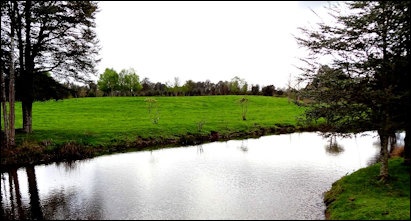
Monte Verde
David Meltzer, an archaeologist at Southern Methodist University told National Geographic, "How could people possibly have raced down from Alaska in a few hundred years? They were pioneering a landscape that was becoming increasingly unfamiliar as they moved south. They had to find water and figure out which plants and animals were edible, useful, harmful or even fatal. They had to cross formidable barriers and cope with new diseases. And they had to do all this while raising families on a vast continent devoid of other people. All of that takes time." Geneticists confirm this belief by pointing out that the languages and genetic material of native Americans is too diverse to be only 12,000 years old.
Scientist theorize the early Americans arrived in Chile one of three ways: 1) overland through a break in the glaciers that covered most of Canada; 2) skirting the glaciers using boats to follow the coast; or 3) taking a boat across the sea from Asia. Most scientist dismiss the third theory on the grounds that boat technology was not advanced enough to cross the ocean 12,000 years ago Early Australians, however, used boats to arrive in northen Australia about 60,000 years ago but they only needed to cross areas of of open sea that were about 50 miles in distance,
Archaeology and Research at Monte Verde
The Monte Verde site was preserved by a rising water table that transformed the site into a bog and preserved it. Scientists found a five-inch footprint, probably made by a child. Nikhil Swaminathan wrote in Archaeology magazine: “When local Chilean lumbermen noticed large animal bones on the eroding margins of a creek, they had no idea that they had stumbled onto one of the oldest known examples of human occupation in the Americas. Over a decade of primary excavations at Monte Verde, Vanderbilt University archaeologist Tom Dillehay, then at Austral University of Chile, found the remains of a year-round habitation on what thousands of years ago was an open sandbar, preserved under what had become a peat bog. [Source: Nikhil Swaminathan, September-October 2014]
In the late 1970s, an excavation led by Tom Dillehay, currently at Vanderbilt University in Nashville, Tennessee, turned up stone pebble tools and wood and bone artifacts dated at more than 13,000 years old. Remnants of living quarters and three human footprints discovered there also appeared to be from the same period. The revelation would lead to more than two decades of controversy about the integrity of the site, until, in 1997, a group of nine prominent archaeologists traveled to Monte Verde to assess its legitimacy.
After sitting through a series of presentations — from, among others, Dillehay, then at Austral University of Chile, and Michael Collins, an archaeologist at Texas State, who spoke about the stone tools discovered there, and James Adovasio, who had studied the ropes used on a tent structure that had been found — and taking a visit to the site, the panel was satisfied that the site contained evidence of occupation dating back 14,500 years, some 1,500 years before the date of the earliest Clovis site in the Americas. [Source: Nikhil Swaminathan, Archaeology magazine, September-October 2014] Today, the archaeological community has largely come to accept that people were living at Monte Verde before the emergence of Clovis technology.
Technology and Food of the Monte Verde People
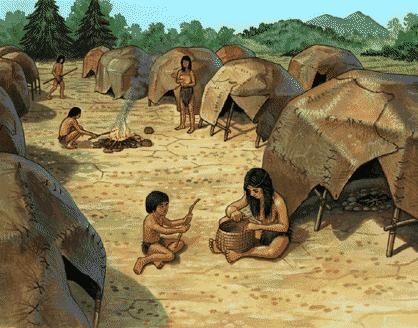
Artifacts found at Monde Verde have include a wooden lance, tent stakes, a digging stick, grooved timber, a fire drill board, slate drills, basalt arrowheads, reed twine, mastodon rib fire pokers, and perfectly round stones that may have been used in slings or bolas. The ancient residents of Monte Verde were believed to have lived in hide-draped huts with a wishbone shaped foundation made of sand and gravel cemented together with animal fat.
Guy Gugliotta wrote in Smithsonian Magazine: “The 50-foot-long main structure, made of wood with a hide roof, was divided into what appeared to be individual spaces, each with a separate hearth. Outside was a second, wishbone-shaped structure that apparently contained medicinal plants. Mastodons were butchered nearby. The excavators found cordage, stone choppers and augers and wooden planks preserved in the bog, along with plant remains, edible seeds and traces of wild potatoes. [Source: Guy Gugliotta, Smithsonian Magazine, February 2013 /||]
Archaeologists collected 22 varieties of medicinal plants near the hut including the boldo plant, a leafy bush whose leaves have hallucinogenic and analgesic properties. Indians in Chile still brew the boldo plant in a tea used for treating stomach ailments. The Monte Verde people chewed boldo with two kinds of seaweed. Scientists believe they traded to get it because it did not grow locally but was found in forests 150 miles north.
Archaeologists also found remnants of 45 edible plants, including wild potatoes, bamboos, mushrooms and juncus seeds as well as mastodon meat. More than a fifth of the plants were not found locally, which again offers evidence of some kind of trading. The harvesting of juncus seeds once scientist said "approaches agriculture."
Monte Verde II and Its 18-Meter-Long Structure
Monte Verde II is one of four excavated areas in the Monte Verde archaeological complex. A study published in 2023 dates artifacts and structures there to 14,550 years old. The site contains the ruins of a, 18-meter (60-foot) -long wood frame that may have supported a tent-like structure, as well as wooden artifacts, stone tools, hearths, food remains and animal bones — including those of half a dozen mastodon. Inside the wood frame, archaeologists discovered hundreds of microscopic flecks of hide tissue embedded in the ground, suggesting the floor was covered with animal skins. [Source: Sascha Pare, Live Science, October 9, 2023]
Nikhil Swaminathan wrote in Archaeology magazine: “The 18-meter tent-like structure may have housed up to 30 people. Support posts within the construction could possibly have demarcated individual living areas. In front of the residence were the remains of two hearths. Nearby, among preserved meat and firewood, were three human footprints still visible in the hardened clay. Artifacts found in the area include wooden slabs (for grinding), the burned tip of a long lance, rudimentary pebble tools used for scraping and cutting, and biface fragments. Wood charcoal from the hearths, when tested, returned an average date of slightly more than 14,500 years ago. [Source: Nikhil Swaminathan, September-October 2014]
“Dillehay has continued to work at the site, showing that the people of Monte Verde were not just big-game hunters. They also appeared to have used 10 different species of seaweed from the Pacific coast — a little more than 50 miles west of the site — for both food and medicine. In another section of the site, at a level below the spot where the tentlike living quarters sit, Dillehay found 26 stones. At least six appear to be man-made artifacts, and one has burn marks. There are also burned patches of ground, but he is hesitant to call these hearths. Dates returned from this evidence suggest that there may have been people at Monte Verde 15,000 years earlier than previously believed. But Dillehay himself says, “I don’t yet see any reason to believe people were in the Americas and that far south 30,000 years ago.”
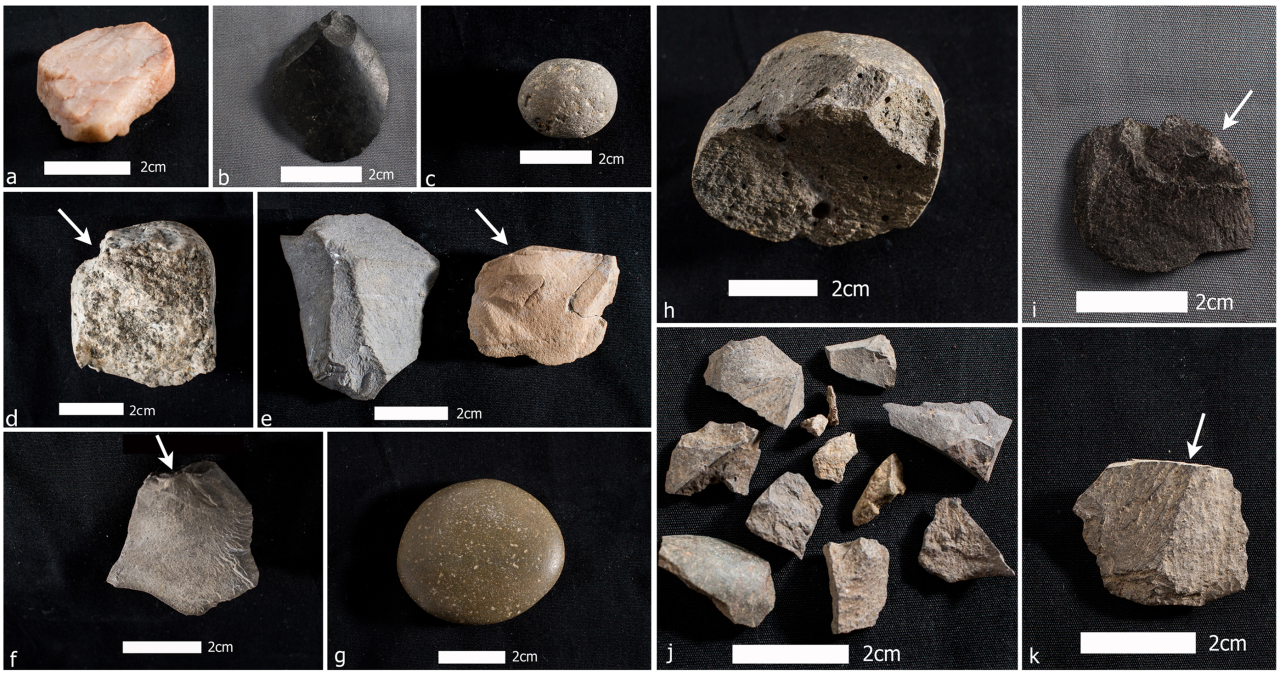
Monte Verde tools
Evidence of People Living 14,000 and 12,000 Years Ago in the Peruvian Andes
In 2014 Dilleha did a presentation on a site in northern Peru called Huaca Prieta, where he’s found charcoal and animal bones along with stone tools dating back as far as 14,200 years ago.
Malcolm Ritter of Associated Press wrote: The air was thin, the nights were cold, the sun could easily burn the skin. But about 12,000 years ago, small groups of hunter-gatherers found a home very high up in the Peruvian Andes. Now, their stone tools and other artifacts have revealed their presence at about 4,500 metres above sea level, about as high as the Matterhorn and much higher than Machu Picchu. They lived there nearly 1,000 years earlier than any other known human habitation anywhere above even 4,000 metres, researchers report. [Source: Malcolm Ritter, The Associated Press, October 23, 2014 /+]
“Among the bogs, wetlands and grasslands of the treeless plateau, the ancient people found plentiful deer and wild ancestors of llamas and alpacas to hunt for food and clothing between 12,000 and 12,500 years ago. There were rock shelters to live in, and deposits of obsidian for making stone tools. While the plants weren't edible, some contained combustible resin and made for "really nice warm fires," says researcher Kurt Rademaker. "I can't say why people first went there," said Rademaker, an author of a report released Thursday by Science. "But once they did go there, there were plenty of reasons to stay." /+\
“Rademaker is a researcher at the University of Tuebingen in Germany and a visiting assistant professor at the University of Maine in Orono. He led a research team that uncovered two sites of high-altitude Andes settlement in southern Peru, within about 160 kilometres of the Pacific coast and roughly west of Lake Titicaca. Both sites included workshops for making stone tools. Hundreds of tools were found there, including scrapers that were evidently used to make clothing from hides. Sharpened points were probably used for spears. Bone and shell beads, used for adornment, were also recovered. /+\
“Rademaker said he doubts people lived there year-round, noting the rainy season from December to March. "You're cold," he said. "You're being rained on and snowed on and sleeted on all day long. It makes for misery." John Rick, an archaeologist at Stanford University who didn't participate in the study, called the work "a major advance." He said he had found an Andean site at about the same elevation that appeared to be about as old, but its age could not be as confidently established as in the new work. So the new study provides the first solid data showing extensive human settlement in the Andes that high and that long ago, he said.” /+\

Pikimachay
Pikimachay is an archaeological site in the southern Peruvian Andes that has been dated to 14,000 years ago by dating stone and bone artifacts found in a cave of the Ayacucho complex. Piki Mach'ay is Quechua for "flea cave" and machay can mean "drunkenness" or "to get drunk". Located in the Ayacucho Valley of Peru, it has produced radiocarbon dates that give a human presence ranging from 22,200 to 14,700 years ago, but this evidence has been disputed and a more conservative date 12,000 years B.C. seems more reasonable. [Source: Wikipedia] Richard S. MacNeish was the first archaeologist to explore Pikimachay. Evidence of long-term human occupation has been found at the site, though that evidence still remains controversial. The Ayacucho complex is a culture defined by several cave sites including Jaya Mach'ay ("pepper cave"). Artifacts discovered at Pikimachay site include unifacial chipped tools, such as basalt and chert tools, choppers, and projectile points, and bone artifacts of horses, camelids (Camelidae), giant sloths (Megatherium) dating from 15,000 to 11,000 years B.C..
Pikimachay yielded some of the oldest plant remains in Peru, including an 11,000-year-old bottle gourd. Strata from later periods at the site revealed fishtail point arrows, manos, and metates. Plant remains indicate that, before 3,000 years B.C., amaranth, cotton, gourds, lucuma, quinoa, and squash were cultivated in the Ayacucho Basin. By 4,000 years B.C. corn (Zea mays) and common beans were grown. Chili remains date from 5,500 to 4,300 years B.C.. The large amounts of guinea pig bones suggest possible domestication, and llamas may have been domesticated by 4,300 to 2,800 years B.C..
Piedra Museo
Piedra Museo is an archaeological site in Santa Cruz Province, Argentina, near the 9000-year-old Cuevo de Los Manos, that has been dated to 11,000 years ago. Spear heads and human fossils were found there. The site was discovered around 1910 by Argentine naturalist Florentino Ameghino, who wrote the first detailed anthropological study of Argentina in 1878. A further 1995 excavation by University of La Plata archaeologist Dr. Laura Miotti who did a carbon dating analysis of human fossil remains dated to approximately 11,000 years ago. [Source: Wikipedia]
Located 250 kilometers (150 miles) from Pico Truncado, in Deseado Department, Piedra Museo is among the oldest archaeological sites uncovered in the Americas. Its discoveries included spear heads that contained traces of Mylodon and Hippidion, among other animals known to have been extinct since at least 10,000 BC. Its original inhabitants, the Toldense people, were hunter gatherers that subsisted on these animals and other prey, such as rhea and guanacos.
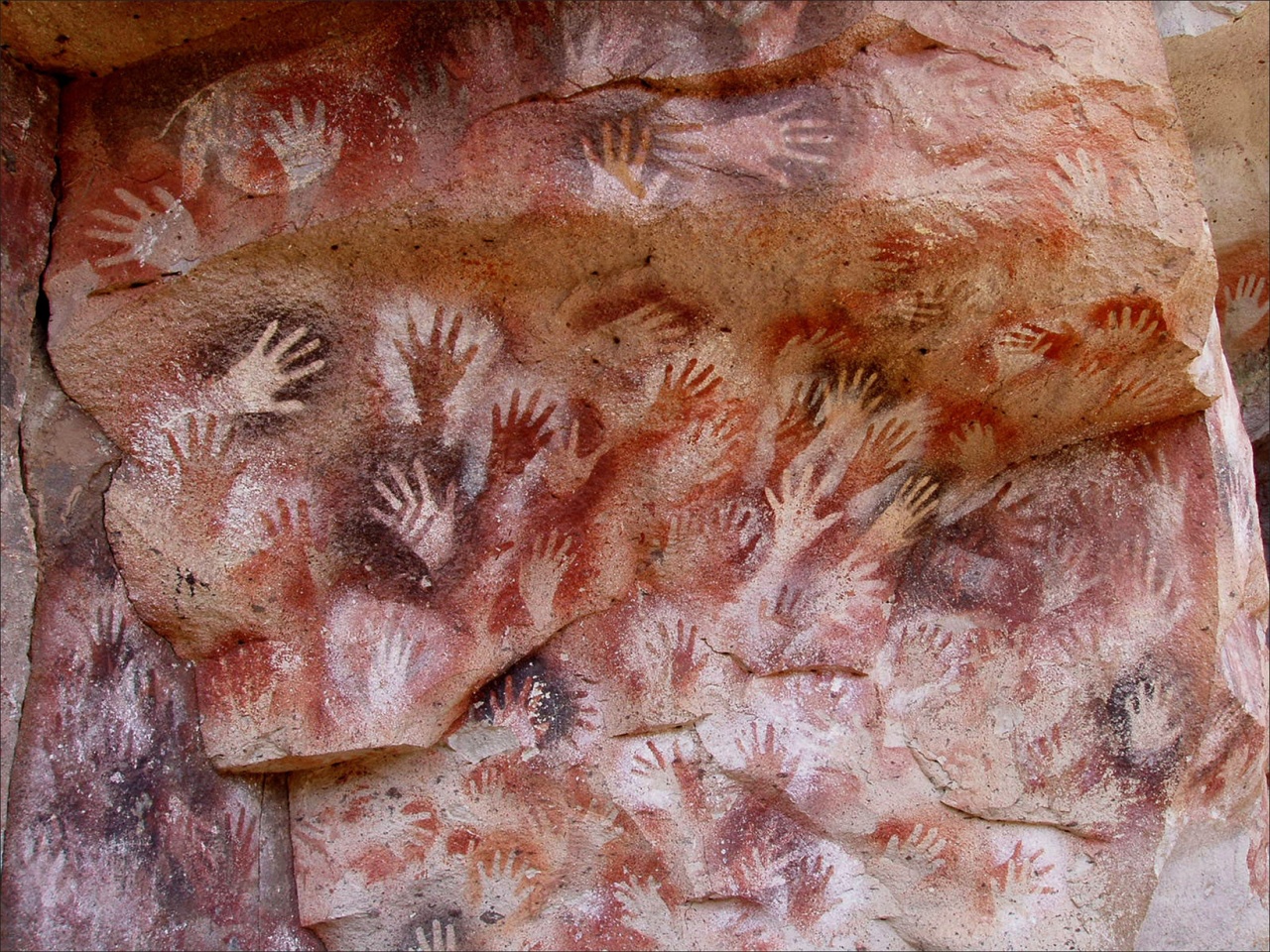
Cueva de las Manos (Cave of Hands) Santa Cruz, Argentina
Piedra Museo is near the Cueva de las Manos (Cave of Hands), which has been dated 7,500 B.C. One of the major prehistoric sites of South American hunter-gatherer groups during the Early Holocene epoch, the cave contains a number of painted animal figures, a range of geometric shapes, and a sensational panel of rock art hand paintings — mostly stencilled
Arroyo Seco 2 — a 14,000-Year-Old Camp in Argentina
At the site of Arroyo Seco 2 in Argentina, archaeologists have uncovered bits of stone tools and animal bones with telltale butchery marks dating to as long as 14,000 years ago. Among extinct megafauna these people ate were giant ground sloths, car-sized glyptodonts, and toxodons, rhino-like hooved animals with prominent incisors. [Source: Samir S. Patel, [Source: Archaeology magazine, January-February 2017]
Annalee Newitz wrote in ars technica: “A fresh examination of one such campsite, a 14,000-year-old hunter's rest stop outside the city of Tres Arroyos in Argentina, has given us a new understanding of how the pre-Clovis people might have lived. At the campsite, known as the Arroyo Seco 2 site, archaeologists have found more than 50 such tools made from materials like chert and quartzite. They're scattered across an area that was once a grassy knoll above a deep lake, which is rich with thousands of animal bone fragments that have been carbon dated to as early as 14,000 years ago. There are even a couple-dozen human burials at the site, dated to a later period starting roughly 9,000 years ago. The spot has the characteristic look of a hunter's camp, used for processing animals, that was revisited seasonally for thousands of years. [Source: Annalee Newitz, ars technica, September 29, 2016 )*(]
“Writing in PLoS One, the researchers describe a number of reasons why a bunch of sharp-edged rocks and broken animal bones point to a 14,000-year-old human occupation of Argentina. First of all, there are far too many animal bones from a diversity of species grouped in one place for it to be accidental. Yes, there are some natural traps where we find massive numbers of prehistoric bones, but those are almost always in holes or depressions in the ground—and this area was on a rather high hill during the Pleistocene. Second, the stones aren't just sharp-edged in a way that suggests flaking; many also show signs of wear and tear from scraping hide.
"A large majority of the flaked edges were used transversely on dry skin," the researchers write. "Consequently, it is likely that the skins were brought to the site in a state of intermediate processing." Also, most of the stone used for the tools, including quartzite and chert, can only be found over 110 kilometers from Arroyo Seco. So that piece of evidence also points to human hunter-gatherers carrying tools with them over great distances. )*(
“One question remains. How can we be sure the tools at the site really are 14,000 years old? Archaeologists infer some of this from carbon dates on the animal bones, which have been tested by several labs around the world. The problem is that the site's stratigraphy, or historical layers, are difficult to read due to erosion at the site. So even if a tool appears right next to a bone in a given layer, it may have come from later and been moved around by wind and water. That said, there is evidence that some of the early bones were broken by stone tools. A 14,000-year-old bone from Equus neogeus, an extinct American horse, bears distinct marks from a hammerstone. "This bone was intentionally broken while still fresh," note the researchers.” )*(
Diet and Hunting of Arroyo Seco 2 People in Argentina
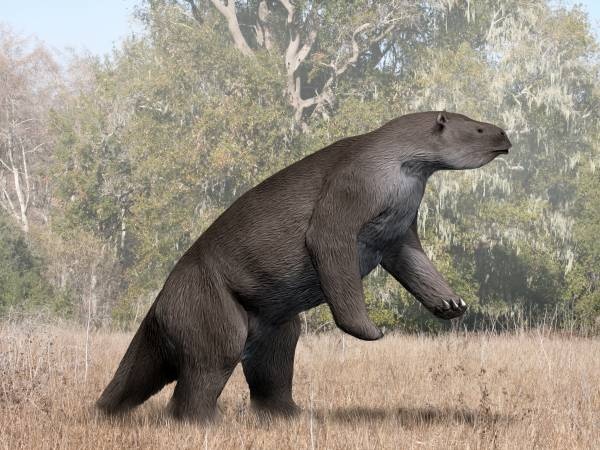
Annalee Newitz wrote in ars technica: “With a firm connection between the human tools and the animal bones found at Arroyo Seco, we can begin to piece together what everyday life was like for these people—at least at mealtime. Analysis of more than 600 bone fragments out of thousands found at the site revealed that a large amount of these people's meat came from animals that no longer exist. Various extinct horse species were a major part of the pre-Clovis diet, as were other extinct mammals like giant ground sloths, camels, mammoths, and giant armadillos. When these people arrived in South America, they found a land that no human had ever colonized. Many of these species would have been easy pickings for well-organized bands of hunters with sophisticated languages, tools, and tactics. Some paleoecologists hypothesize that these animals went extinct partly due to human hunting, and this campsite definitely provides evidence that extinct animals were part of the pre-Clovis diet for millennia. That said, Arroyo Seco contains far more bones from guanaco (a local relative of the camel) and rodents than it does from extinct mammals. [Source: Annalee Newitz, ars technica, September 29, 2016 )*(]
“The absence of certain bones can tell us about how these people lived, too. Though there are bones from megafauna like the giant sloth Megatherium, we see no skulls, chest, or pelvic bones from the animal. The researchers speculate that's because hunters would have done an initial butchery at the site where they killed or scavenged the animal and then transported parts of it to be processed at camp: Given the body mass of this species (between 4 and 5 tons), it would have been extremely difficult to transport the entire carcass and even challenging to transport complete hindquarters weighing between 600 and 750 kg, and forequarters weighing between 250 and 300 kg. Taking into consideration these values, the best hypothesis is that the Megatherium was hunted or scavenged near the site, the skeleton was butchered into smaller parts, and these units were then transported to their current location at the site. The larger bones were transported with portions of meat already removed, and the bone may have been used for other purposes such as bone quarrying. )*(
“Of the extinct mammals that humans processed at Arroyo Seco, the most common seems to be horse. When people arrived in the Americas, it was full of at least two species of extinct horses. But by the time of the Inca and other great civilizations of South America, those animals were long gone. It wasn't until Europeans arrived with their steeds that the continent was once again populated with horses. Still, we can look back and imagine what it must have been like for those pre-Clovis people, entering a world where no human had ever gone before, full of animals that are legendary to us today. In many ways, they lived on a different planet than the one we inhabit now. At the edge of a now mostly vanished lake, on a knoll, those people fed their families, made tools, and strategized about how to hunt for game bigger than anything on land in the modern world. They returned year after year for centuries. Eventually, they buried their dead there among the animal bones left by their ancestors.” )*(
Did 8,200-Year-Old Patagonian Cave Art Pass on Motifs for 100 Generations?
A cave in Patagonia houses the oldest known pigment-based rock art in South America and contains hundreds of drawings that span 100 generations. At one time, archaeologists dated the art as being only several thousand years old. But a new analysis has revealed that some of it is 8,200 years old according to a study published on February 14, 2024 in the journal Science Advances. "It turned out to be several millennia older than we expected," study lead author Guadalupe Romero Villanueva, an archaeologist with the Argentine National Research Council (CONICET) and the National Institute of Anthropology and Latin American Thought (INAPL), told Live Science. "We got surprised." [Source: Jennifer Nalewicki, Live Science, February 15, 2024]
Jennifer Nalewicki wrote in Live Science: To determine the date of the massive artwork, which depicts humans, animals and other designs, archaeologists chipped away several small pieces of black pigment from the drawings. Since the pigment was made from plant material, researchers used radiocarbon dating to determine the age of the cave art. "It's usually really hard to date rock art unless it has an organic component, otherwise there really isn't any material that you can date," study co-author Ramiro Barberena, an archeologist at Temuco Catholic University in Chile and CONICET, told Live Science. "[The cave] is not the oldest occupation in South America, but it is the oldest directly radiocarbon-dated pigment-based rock art in South America."
Throughout the entire cave site, archaeologists counted 895 unique paintings grouped into 446 motifs, or segments. While research remains inconclusive as to which cultures created the dramatic imagery, researchers think that the elaborate work may have been used to pass along information between the illustrators and other communities, as well as future generations. "These [drawings] span more or less across 3,000 years within a single motif," Barberena said. "We propose that there was a transmission of information across multiple human generations, which inhabited the same region and the same site." While it's unclear if the cave art was created as part of a "ceremony or an intergroup meeting, we think it was part of a human strategy to build social networks across dispersed groups, which contributed to making these societies more resilient against a very challenging ecology," Barberena added.
Around 10,000 to 8,000 years ago, Patagonia was known for being very dry and hot, according to the study. "There were large parts of the landscape without water, but in order to survive as hunter-gatherers, they would have needed to stay connected," Barberena said. "It would've been hard to make it on your own, so an exchanging of information was important."
While there are other rock art sites in the region, the researchers said that the cave has the highest concentration, by far. "It's amazing the amount of rock art we found there," Romero Villanueva said. "In the surrounding landscape there are several rock art sites, but none of them have the amount of the diversity in shapes and colors found here. So, it's evident that this place was likely a hot spot for communication in the past and crucial for the survivability of these societies." Even though this is the oldest pigment-based cave art found on the continent, it's not the oldest in the world. That record belongs to a 45,500-year-old drawing of a warty pig scrawled onto a cave wall in Indonesia.
Did Early American Hunters Cause Mass Extinctions of Large Animals
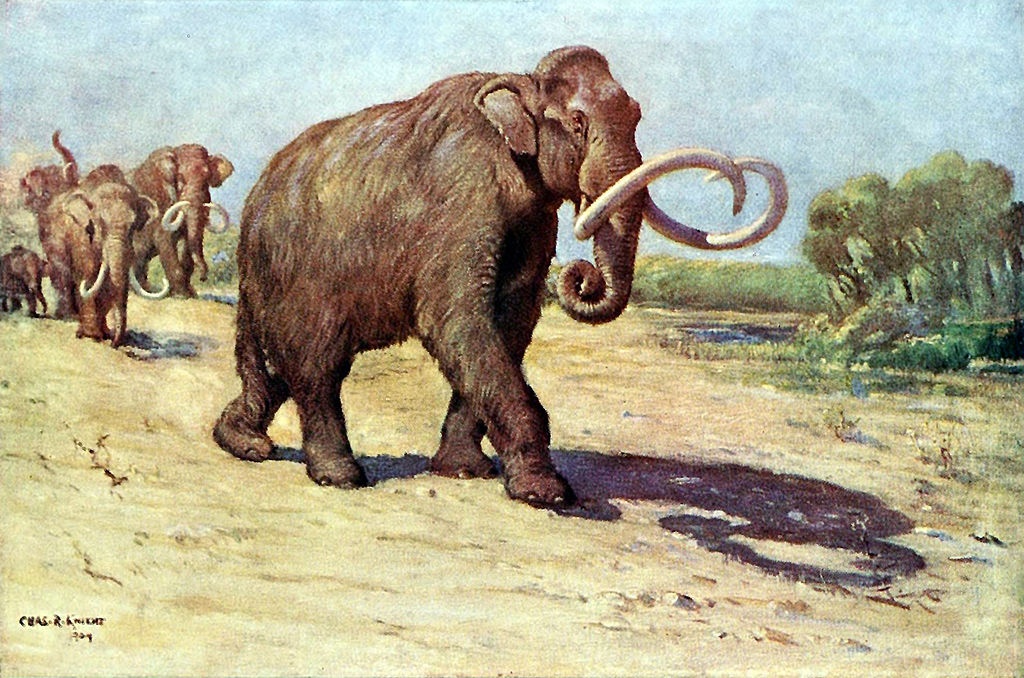
Until about 7000 B.C., it is believed that the inhabitants of the Americas largely subsisted on hunting animals — including mammoths — and gathering wild plants. They developed progressively more efficient hunting methods: lances, spear throwers, darts and bows and arrows with channeled and fluted points. Between 10,000 B.C. and 5,000 B.C. 32 animals, including giant bison, oxen, elephant, pigs, antelope, horses, giant turtles. camels, mammoth, mastodon, giant ground sloths and giant rodents, became extinct. The reason for these extinction is believed to be climate changes and possibly overhunting by early Americans. The animals may have been easy prey for early human hunters because they had never had been hunted by humans and had little fear of them. The extinction of animals is believed to have played a part in the migrations of Mesoamericas — first to the North America and then across the continents themselves. As time when on meat became a luxury and hunters had to travel over large distances to find animals.
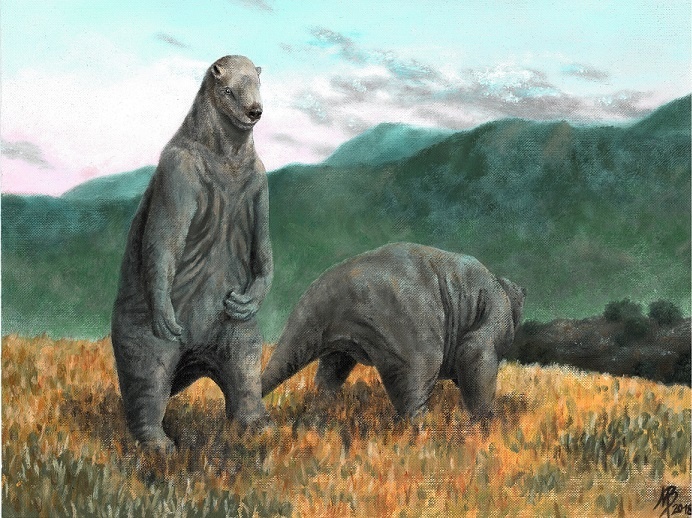
Brooks Hays of UPI wrote: “The growth of early human societies in South America looks a lot like an invasive species' conquest of new habitat. Today, humans are less constrained by the limits of nature. Thousands of years ago, however, the availability of local resources strictly governed the growth of human settlements and societies. Researchers at Stanford University plotted the population growth and distribution of early South American societies using data from dozens of archaeological sites, including more than 1,000 radiocarbon dates. Scientists found that the ebb of flow mimicked that of invasive species. [Source: Brooks Hays, UPI, April 7, 2016 /=/]
“The findings — detailed in the journal Nature – revealed two unique phases of population growth, the first occurring between 14,000 and 5,500 years ago. The initial phase featured a dramatic population explosion, with early settlers spreading out across the continent. As biologists see with many invasive species, these early humans suffered a decline as a result of over-exploitation. The rapid early growth of these human populations bumped up against the upper limits of the available resources. This recession with the loss of megafauna species like sloths, mammoths and saber-toothed cats — some of the largest mammals Earth has known. /=/
“The subsequent growth phase happened between 5,500 to 2,000 years ago and featured exponential growth. Researchers say this growth was the result of the transition to sedentary societies – a transition made possible by intense agricultural production and trade. The patterns of growth seen in South America are distinct from those in North America, Europe and Australia, but can still offer insight into the nature of population growth today. /=/
Image Sources: Wikimedia Commons except Monte Verde tools, Plos One
Text Sources: National Geographic, Wikipedia, Live Science, Discover magazine, Discovery News, Natural History magazine, Archaeology magazineNew York Times, Washington Post, Los Angeles Times, Smithsonian magazine, Nature, Scientific American, BBC, The Guardian, Reuters, AP, AFP, and various books and other publications.
Last updated June 2024