
EARLIEST EVIDENCE OF MODERN HUMANS IN SOUTH AMERICA

The oldest controversial human site in South America and the Americas period is Pedra Furada Brazil. The site has been dated to 41,000–56,000 years before present by radio carbon dating charcoal from the oldest layers. There are doubts about whether humans are indeed responsible for the tools and other purported human things found there. There are also issues with the dating. [Source: Wikipedia +]
The oldest verified site in South America is Monte Verde Chile. It has been dated to 18,500-14,800 years before present by carbon dating of remains from the site. Pikimachay in Peru has been dated to 14,000 years ago by dating stone and bone artifacts found in a cave of the Ayacucho comple. El Abra in the Amazon region of Colombia has been dated to 12,500 years ago by dating stone, bone and charcoal artifacts. Piedra Museo in Argentina has been been dated to 11,000 years ago. Spear heads and human fossils were found there.
Kristina Killgrove wrote in Live Science:a set of human footprints Human-modified sloth bones from Brazil dates to 27,000 years ago, well before the peak of the ice age about 20,000 years ago. However, many archaeologists find the lines of evidence for human presence circumstantial and would prefer to see directly dated skeletons or genetics to confirm these dates. [Source: Kristina Killgrove, Live Science, July 15, 2023]
RELATED ARTICLES:
EARLIEST MODERN HUMANS IN SOUTHERN SOUTH AMERICA factsanddetails.com ;
FIRST HUMANS AND SETTLEMENTS IN THE AMAZON factsanddetails.com ;
EARLIEST EVIDENCE OF HUMANS TO AMERICA factsanddetails.com ;
WHEN AND HOW THE FIRST HUMANS CAME TO AMERICA: THEORIES AND EVIDENCE factsanddetails.com ;
MIGRATION ROUTE OF THE FIRST HUMANS IN AMERICA factsanddetails.com ;
SINGLE WAVE VS MULTIPLE PULSE THEORY AND MIGRATION OF EARLY PEOPLE TO AMERICA factsanddetails.com ;
FIRST AMERICANS: DNA, ASIA AND ASIANS factsanddetails.com ;
EARLIEST MODERN HUMANS IN WHAT IS NOW ALASKA AND CANADA factsanddetails.com ;
EARLIEST MODERN HUMANS IN WHAT IS NOW THE CONTINENTAL U.S. factsanddetails.com ;
WHITE SANDS 23,000-21,000 YEAR-OLD HUMAN FOOTPRINTS factsanddetails.com ;
CLOVIS PEOPLE: SITES, POINTS, PRE-CLOVIS, MAMMOTHS factsanddetails.com ;
SOLUTREAN HYPOTHESIS factsanddetails.com
RECOMMENDED BOOKS:
“Origin: A Genetic History of the Americas” By Jennifer Raff, an associate professor of anthropology at the University of Kansas (Twelve, 2022); Amazon.com;
“First Peoples in a New World: Populating Ice Age America” by David J. Meltzer, an archaeologist and professor of prehistory in the Department of Anthropology at Southern Methodist University in Dallas, (Cambridge University Press, 2021); Amazon.com;
“The Indigenous Paleolithic of the Western Hemisphere” by Paulette F. C. Steeves (2023) Amazon.com;
“First Migrants: Ancient Migration in Global Perspective” by Peter Bellwood Amazon.com;
“Ancestral DNA, Human Origins, and Migrations” by Rene J. Herrera (2018) Amazon.com;
“Who We Are and How We Got Here: Ancient DNA and the New Science of the Human Past” by David Reich (2019) Amazon.com;
“Our Human Story: Where We Come From and How We Evolved” By Louise Humphrey and Chris Stringer, (2018) Amazon.com;
"The Settlement of the Americas: A New Prehistory" by Thomas D. Dillehay ( Basic Books, 2000 Dated) Amazon.com;
”Strangers in a New Land: What Archaeology Reveals About the First Americans”
by J. M. Adovasio, David Pedler (2016) Amazon.com;
“Paleoindian Mammoth and Mastodon Kill Sites of North America by Jason Pentrail (2021) Amazon.com;
“Clovis The First Americans?: by F. Scott Crawford (2012)
Amazon.com;
“Across Atlantic Ice: The Origin of America's Clovis Culture”
by Dennis J. J. Stanford, Bruce A. Bradley, Michael Collins Amazon.com;
“From Kostenki to Clovis: Upper Paleolithic—Paleo-Indian Adaptations (Interdisciplinary Contributions to Archaeology) by Olga Soffer (1993) Amazon.com;
Taima-Taima and Migrations from North America to South America
Some DNA evidence provides clues about the migration from North America to South America. Laura Geggel wrote in Live Science: People who were genetically similar to the Clovis people journeyed down to South America by 11,000 years ago, another study published this year in the journal Cell found. But these people then mysteriously vanished around 9,000 years ago. It's unclear why, but perhaps another ancient people replaced them, the researchers said. The same study also revealed that ancient people who lived on the Channel Islands, off the coast of California, shared ancestry with ancient people who lived in the southern Peruvian Andes at least 4,200 years ago. [Source: Laura Geggel, Live Science, December 25, 2018]
Taima-Taima is one one of the northernmost very old archaeological sites in South America. It near the Atlantic Ocean in northern Venezuela about 20 kilometers east of Santa Ana de Coro, in the Falcón State. It has been dated to about 14,000 years ago and is perhaps older. The site was investigated starting in 1964 by José Cruxent, followed by Alan Bryan, Rodolfo Casamiquela, Ruth Gruhn, and Claudio Ochsenius. It has been cited as evidence for people arriving to South America earlier than previously believed. Cruxent discovered a Notiomastodon pelvic bone that was pierced by a stone spearpoint. Geological and radiocarbon dating of the bone and the spearpoint yielded date of 13,000 years ago. Fossils of Xenorhinotherium (an extinct animal similar to camels), have been found in Taima-Taima. [Source: Wikipedia]
At Taima-Taima, José Cruxent discovered El Jobo projectile points, which are believed to be the earliest such artefacts in South America, going back to perhaps 16,000 years ago. This was a major discovery. The bi-pointed El Jobo points were found in the valley of Pedregal River, and were mostly distributed in north-western Venezuela; from the Gulf of Venezuela to the high mountains and valleys. The population using them were hunter-gatherers that seemed to remain within a certain circumscribed territory.El Jobo points were probably used for hunting large mammals. The Joboid series of points have been grouped into four successive complexes. The earliest was Camare, then Las Lagunas, El Jobo, and Las Casitas. The Camare and Las Lagunas complexes lack stone projectile points. The Camare tool complex has been dated to 22,000-20,000 years ago. El Jobo tool complex has been dated to 16,000-9,000 years ago.
DNA Studies on the Relationship Between North and South Americans
Some studies have suggested that the first Americans diverged genetically from their Siberian and East Asian ancestors about 25,000 years ago. These people traveled across the Bering Strait Land Bridge and eventually split into distinct North and South American populations. By about 13,000 years ago, people of the Clovis culture, known for its use of distinctive, pointy stone tools, came to occupy much of North America. But by this time, people were already living as far south as Monte Verde, Chile. They had been there since a least 14,500 years ago, according to archaeological findings there. Still it is not totally clear how the Clovis culture were linked to populations in South America. [Source: Laura Geggel, Live Science, November 9, 2018]
According to an ancient DNA analysis published online November 8, 2018 in the journal Cell prehistoric people from different populations made their way across the Americas thousands of years ago. People genetically linked to the Clovis culture, one of the earliest and best-known cultures in North America, migrated into South America as far back as 11,000 years ago but then mysteriously disappeared around 9,000 years ago. The 2018 study says that another ancient group of people replaced them, but it is certain how or why this occurred, and the population turnover happened across the entire continent of South America.
Laura Geggel wrote in Live Science: To unravel the genetic mysteries of the these ancient Americans, the researchers reached out to indigenous peoples and government agencies all over Central and South America, asking for permission to study the remains of ancient peoples that have been discovered over the years. In all, the international team of scientists was given permission to do genomewide analyses on 49 ancient people whose remains were unearthed in the following Central and South American countries: Belize, Brazil, Peru, Chile and Argentina. The oldest of these people lived about 11,000 years ago, marking this as a study that takes a big step forward from previous research, which only included genetic data from people less than 1,000 years old, the researchers said.
Their findings showed that DNA associated with the North American Clovis culture was found in people from Chile, Brazil and Belize, but only between about 11,000 to 9,000 years ago. "A key discovery was that a Clovis culture-associated individual from North America dating to around 12,800 years ago shares distinctive ancestry with the oldest Chilean, Brazilian and Belizean individuals," study co-lead author Cosimo Posth, postdoctoral researcher of archaeogenetics at the Max Planck Institute for the Science of Human History in Germany, said in a statement. "This supports the hypothesis that the expansion of people who spread the Clovis culture in North America also reached Central and South America." [In Photos: New Clovis Site in Sonora]
Curiously, around 9,000 years ago, the Clovis lineage disappears, the researchers found. Even today, there is no Clovis-associated DNA found in modern South Americans, the researchers said. This suggests that a continentwide population replacement happened at that time, said study co-senior researcher David Reich, a professor of genetics at Harvard Medical School and a Howard Hughes Medical Institute investigator. Following this mysterious disappearance, there is a surprising amount of genetic continuity between people who lived 9,000 years ago and those living today in multiple South American regions, the researchers said.
Although these findings shed light on early Americans, it's far from complete. The researchers acknowledge that they don't have human remains that are older than about 11,000 years old, "and thus we could not directly probe the initial movements of people into Central and South America," they wrote in the study. Moreover, although the study looked at 49 people who lived between about 11,000 and 3,000 years ago, the research would be more comprehensive if more ancient individuals from different regions were included, the researchers said.
"We lacked ancient data from Amazonia, northern South America and the Caribbean, and thus cannot determine how individuals in these regions relate to the ones we analyzed," Reich said in the statement. "Filling in these gaps should be a priority for future work."
California-Peruvian Connection
The 2018 Cell study also revealed an unexpected connection between ancient people living in California's Channel Islands and the southern Peruvian Andes at least 4,200 years ago. It appears that these two geographically distant groups have a shared ancestry, the researchers found. [Source: Laura Geggel, Live Science, November 9, 2018]
Laura Geggel wrote in Live Science: It's unlikely that people living in the Channel Islands actually traveled south to Peru, the researchers said. Rather, it's possible that these groups' ancestors sallied forth thousands of years earlier, with some ending up in the Channel Islands and others in South America. But those genes didn't become common in Peru until much later, around 4,200 years ago, when the population may have exploded, the researchers said.
"It could be that this ancestry arrived in South America thousands of years before and we simply don't have earlier individuals showing it," study co-lead researcher Nathan Nakatsuka, a research assistant in the Reich lab at Harvard Medical School, said in the statement. "There is archaeological evidence that the population in the Central Andes area greatly expanded after around 5,000 years ago. Spreads of particular subgroups during these events may be why we detect this ancestry afterward."
Very Old South American Artifacts and Solutrean Hypothesis
Nikhil Swaminathan wrote in Archaeology magazine: Stone tools found at the Toca da Tira Peia rockshelter, in Serra da Capivara National Park in central Brazil, have been dated to 22,000 years ago. At Pedro Furada, another rockshelter in the same park, excavators say they’ve found tools and fire pits dating back 50,000 years. If either claim is confirmed, it would suggest that the first Americans arrived in the southern hemisphere, possibly via boat from west Africa, where the Atlantic is at its shortest width, around 1,600 nautical miles. [Source:Nikhil Swaminathan, Archaeology magazine, September-October 2014]
“If there’s a new buzzword in the archaeological study of the peopling of the Americas, it is “boats.” Part of reimagining the settling of the New World is to stop considering traveling by land as the only way people could have arrived there. “We so radically underestimated the roles of boats and water transports for all time horizons, not just the more recent past,” Adovasio explains. After all, roughly 50,000 years ago aboriginal Australians completed the trip from East Africa to Oceania. More specifically, they got there via Asia, “and they sure didn’t walk,” says Collins. Evidence shows — and this is an important understanding to factor in when considering all of these migrations — that the “trip” took them 20,000 years.
The Solutrean hypothesis claims that the earliest human migration to the Americas took place from Europe, during the Last Glacial Maximum. This hypothesis contrasts with the mainstream view that the North American continent was first reached after the Last Glacial Maximum, by people from North Asia, either by the Bering land bridge (i.e. Beringia), or by maritime travel along the Pacific coast, or by both. [Source: Wikipedia +]
See Separate Article: SOLUTREAN HYPOTHESIS AND THE FIRST HUMANS IN FLORIDA AND U.S. EAST COAST factsanddetails.com
Pedra Furada — 50,000 Year Old Site in Brazil?
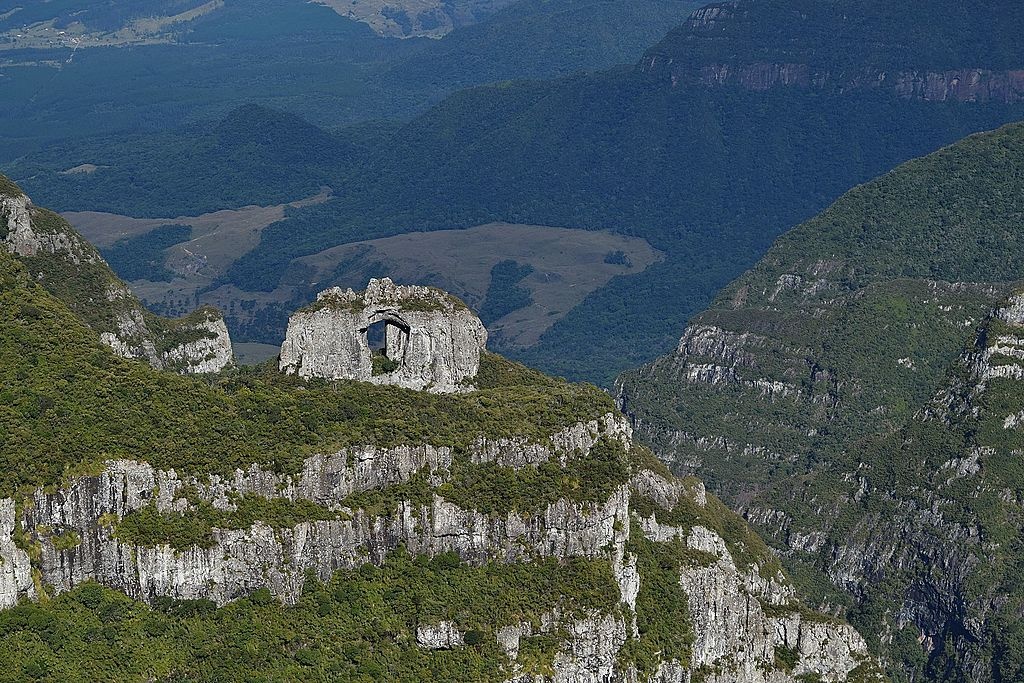
Pedra Furada (meaning “Pierced Rock” in Portuguese) refer to collection of over 800 archaeological sites, including some rock shelters, located in Serra da Capivara National Park, in Brazil's Piauí state. It is one of the most controversial archaeological sites in the Americas. Cave paintings there site indicate humans were there at some point in prehistory but the paintings are not that old and some of the early evidence of humans has been doubted.[Source: Sascha Pare, Live Science, October 9, 2023]
Excavations at Pedra Furada in the 1970s and 1980s uncovered stone artifacts and hearths that suggested the site was occupied by humans 32,000 years ago and even as far back as 50,000 years ago. But a 2022 study found that capuchin monkeys living in the national park are capable of creating objects out of stone that closely resemble those found at Pedra Furada. This finding — along with a lack of firm evidence of human presence, such as hearths or food remains — suggests the site was not populated by humans until much later.
The oldest of hundreds of rock paintings at Pedra Furada have been dated from about 11,000 years ago. Charcoal from very ancient fires and stone shards that may be interpreted as tools suggest the possibility of a human presence prior to the arrival of Clovis people in North America 13,000 years ago. Brazilian archaeologist Niède Guidon, the main source of the claims told the New York Times that occupation of the Americas could go back 100,000 years and the first settlers “might have come not overland from Asia but by boat from Africa.” She told The Guardian: "I don't have any doubt that the oldest traces of humans yet discovered are here in Brazil.....I think it's wrong that everyone came running across Bering chasing mammoths - that's infantile. I think they also came along the seas. I don't see why they couldn't have come across the Atlantic." [Source: The Guardian, Wikipedia +]
Archeological Work at Pedra Furada
Alex Bellos wrote in The Guardian: A thinly inhabited, semi-arid area of sandstone rock shelters, 500 miles west of the coastal city Recife, Pedra Furada contains hundreds of prehistoric sites, including 340 stone walls full of ancient paintings. Researchers are still finding new remains at the rate of 40 a year. But it is not the vast number of archaeological discoveries that has the academic world excited. It is their age. Brazilian excavators, led by Guidon, claim to have proved the existence of the oldest Americans. Ms Guidon claims that charcoal that she says is the remnant of camp fires has been carbon dated to 50,000 years ago. [Source: Alex Bellos, The Guardian, February 11, 2000]
In 1973, a Brazilian and French team excavating a site located in the southeastern portion of what is now the Serra da Capivara National Park discovered the first finds. The discovery was reported by the Brazilian archaeologist Niède Guidon, who published her findings in 1986. She has since conducted extensive excavations and published other findings. Pedra Furada includes a collection of rock shelters used for thousands of years by human populations. The first excavations yielded charcoal deposits with Carbon-14 dates of 48,000 to 32,000 years ago. Repeated analysis has confirmed this dating, carrying the range of dates up to 60,000 ago. A review of the site by archaeologist Tom Dillehay in 1994 suggested that the charcoal remains may have been from natural fires and were not necessarily indicative of human occupation. +
Guidon has established 15 distinct levels, classified in three cultural phases, called Pedra Furada, that includes the oldest remains; and Serra Talhada, from 12,000 to 7,000 BP, with tools such as knives, scrapers, flakes used "as is" or with some retouch and lithic cores, all made of quartz or quartzite. Third is Agreste late phase. The site also has hundreds of rock paintings dated from 5,000 to 11,000 years ago. More recently, the site of Toca da Tira Peia, also in Serra da Capivara National Park, was shown to have signs of human presence dating to 22,000 years ago. +
Controversy Over Pedra Furada
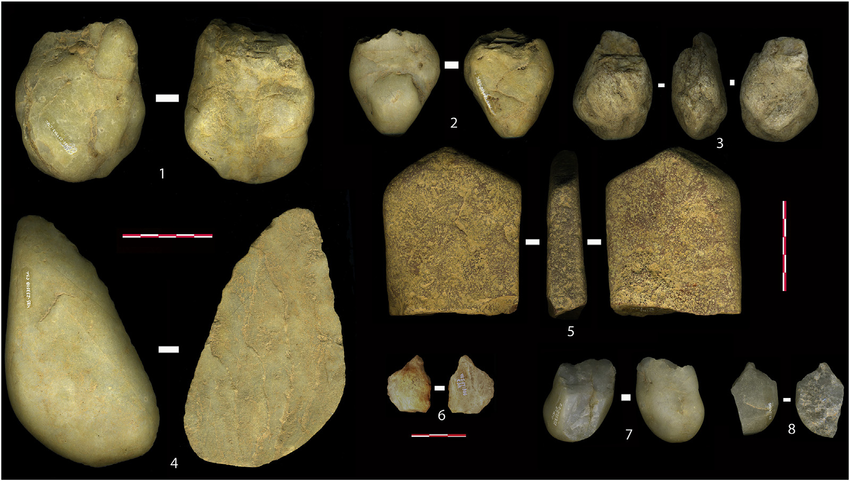
"Tools" found at Pedra Furada
Pedra Furada provides potential evidence for the proponents of the long chronology theory, which states that the first group of people entered the Americas at a much earlier date than the dates associated with the crossing of the Bering Strait, possibly 21,000–40,000 years ago, with a much later mass secondary wave of immigrants. This evidence is considered controversial and not widely accepted by experts in the field. [Source: Wikipedia +]
For a long time Pedra Furada split “archaeologists into two emotionally charged camps and threatening to rewrite the history of the continent's colonisation. On accusations that carbon layers could have been created naturally, Guidon said that, "The carbon is not from a natural fire. It is only found inside the sites. You don't get natural fires inside the shelters." French palaeolithic archaeologist Jacques Pelegrin, believes there is a possibility for natural processes creating flaked stones that could mimic the Pedra Furada specimens because of their simplicity, but he finds this very unlikely in this case because of continuous human presence in the site. Michael R. Waters, a geoarchaeologist at Texas A&M University noted the absence of genetic evidence in modern populations to support Guidon's claim. +
In 2000, Alex Bellos wrote in The Guardian: “Ms Guidon's research has divided the academic community into two sides - roughly between US archaeologists, who refuse to accept it, and the south Americans and Europeans, who do. Stephen Shennan, professor of archaeology at University College London, says that there has been a degree of nationalism because the north Americans cannot believe that they do not have the oldest site. "There is a feeling that it's a blow against US imperialism. The evidence is open to different interpretations, so people tend to choose their favourite interpretation in terms of their biases. David Meltzer, of the Southern Methodist University in Dallas, Texas asks "...if we have [pre-Clovis] humans in South America, then by golly, why don't we have them in North America too?" Responding to this Guidon suggested a sea voyage across the Atlantic as a potential route for the first migration.
Did Monkeys Make the Pedra Furada Stone Tools?
One of the primary debates regarding Pedra Furada has been whether or not the artifacts and hearths are instead geofacts that were made naturally, or alternatively, made by monkeys. Wild bearded capuchin monkeys (Sapajus libidinosus) in Serra da Capivara National Park have been observed smashing stones against rocks embedded in the ground. The resulting 'shaped' rocks and flakes are similar to early hominid tools and flakes. It has been suggested that similar behavior, by earlier simians, might account for what have been regarded as human tools at Pedra Furada. James Adovasio of Florida Atlantic University believes that the tools identified by Guidon as human made are rocks that fell from a cliff and broke when they hit the ground. “The Pedra Furada stuff is not even up to capuchin standards,” he said. [Source: Wikipedia +]

"tool use" by a capuchin monkey
In an article published in the journal The Holocene in November 2023, researchers said they firmly believed that ancient stone tools made at Pedra Furada were made by capuchin monkeys, not early humans. "We are confident that the early archeological sites from Brazil may not be human-derived but may belong to capuchin monkeys," wrote archaeologist Agustín M. Agnolín and paleontologist Federico L. Agnolín. The article said that archeologists uncovered what they believe to be ancient stone tools, made from locally occurring quartz and quartzite cobbles. The oldest of the stone tools discovered appeared to be up to 50,000 years old. [Source: Joshua Zitser, Business Insider,, January 7, 2023]
And according to Agnolín and Agnolín, the researchers behind The Holocene article, there is now a convincing amount of evidence to suggest that the tools weren't human-made. "Our review of the evidence suggests that the ancient sites in Brazil do not actually belong to the first Americans, but are actually the product of monkey activity," Federico L. Agnolín told Argentina's National Scientific and Technical Research Council (CONICET).
According to Business Insider: The researchers compared the tools found at Pedra Furada to those that capuchin monkeys make today. "The result was surprising: there was no difference between the supposed human tools from 50,000 years ago and those produced by monkeys today," Agustín M. Agnolín told CONICET. The researchers looked to past research and observations of capuchin monkey populations which show that the primates use small stones as hammers and large, flatter rocks as anvils to crack open nuts and seed pods. "The result is that the rocks used often break, generating rock fragments that are very similar to those produced by humans when carving stone tools," said Agustín M. Agnolín, per CONICET'S news release.
In addition to this, the researchers said in The Holocene article that there wasn't evidence to suggest a trace of human presence, noting the lack of hearths or traces of dietary remains. "Our study shows that the tools from Pedra Furada and other nearby sites in Brazil were nothing more than the product of capuchin monkeys breaking nuts and rocks some 50,000 years before the present," Federico L. Agnolín told CONICET.
In 2017 scientists at Serra da Capivara National Park, the home of Pedra Furada, reported watching Capuchin monkeys smash stones against each other, splitting off sharp-edged flakes that resembled cutting tools early hominins. The monkeys smacked the rocks together, for reasons that aren’t clear, but may involve licking the broken surfaces for silicon, an essential trace nutrient. Sometimes the rocks broke in ways that created flakes or left broken rocks with sharp edges suitable for cutting or scraping. The monkeys didn't use them like that but the researchers wrote that “the production of archaeologically identifiable flakes and cores, as currently defined, is no longer unique to the human lineage.” [Source: Samir S. Patel, Archaeology magazine, January-February 2017]
See Separate Article: TOOL USE BY ANIMALS factsanddetails.com
Santa Elina Rock Shelter’s 26,000-Year-Old Sloth Pendants
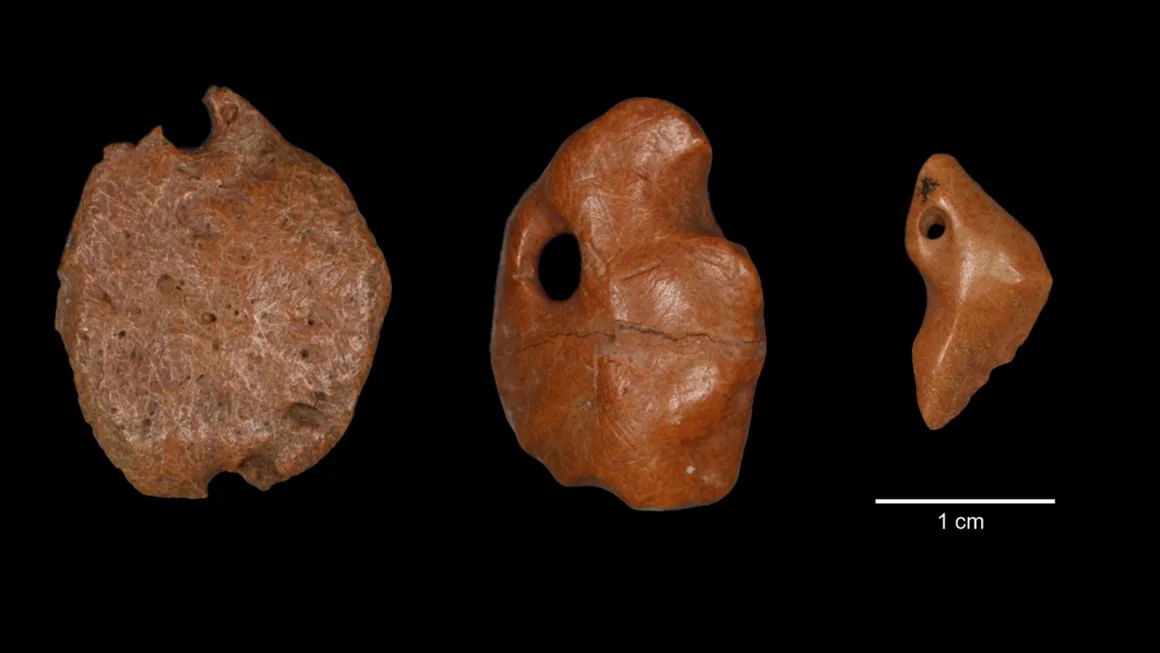
Santa Elina Rock Shelter’s sloth pendants
Santa Elina rock shelter in the Mato Grosso state in central Brazil that makes the claim to be one of the oldest places in the Americas inhabited by humans based on the dating of three pendants made from giant sloth bone to between 25,000 and 27,000 years ago, building on earlier studies describing hundreds of stone artifacts and 1,000 examples of rock art indicated humans were there over 20,000 years ago. The pendants are made of sloth osteoderms — bony deposits that form the protective armor over the skin of animals such as armadillos — and feature tiny, smooth holes likely drilled and polished by humans. The finding were published July 12, 2023 in the journal Proceedings of the Royal Society B. While some experts argue that these holes could not have been created by natural processes, others maintain that the evidence isn't strong enough to prove that humans occupied the site so early. [Source: Sascha Pare, Live Science, October 9, 2023]
The Santa Elina rock shelter has been studied by archaeologists since 1985. Previous research at the site noted the presence of thousands of sloth osteoderms, with three of the osteoderms showing evidence of human-created drill holes. Kristina Killgrove wrote in Live Science: The study documents these sloth osteoderms in exquisite detail to show that it is extremely unlikely that the holes in the bones were made naturally. [Source: Kristina Killgrove, Live Science, July 12, 2023]
Using a combination of microscopic and macroscopic visualization techniques, the team discovered that the osteoderms, and even their tiny holes, had been polished, and noted traces of stone tool incisions and scraping marks on the artifacts. Animal-made bite marks on all three osteoderms led them to exclude rodents as the creators of the holes. "These observations show that these three osteoderms were modified by humans into artefacts, probably personal ornaments," the researchers wrote in their paper.
Study co-author Mírian Pacheco, a lecturer in paleontology at the Federal University of São Carlos, Brazil, told Live Science that "it is virtually impossible to define the real meaning these artifacts had for the occupants of Santa Elina." However, the shape and large number of osteoderms "may have influenced the making of a specific type of artifact such as a pendant," she said. "Our evidence reinforces the interpretation that our colleagues working on Santa Elina have been talking about for 30 years," Thaís Pansani, a paleontologist at the Federal University of São Carlos in Brazil, said to Live Science — namely, that "humans were in Central Brazil at least 27,000 years ago."
The finding shows that ancient people used sloth remains in a variety of ways, said Matthew Bennett, a geologist at Bournemouth University in the U.K. who has researched human-sloth interactions in North America but was not involved in this project. "This is an exciting piece of work which may, in time, support the idea of peopling of the Americas during the Last Glacial Maximum," the coldest part of the last ice age, Bennett told Live Science. However, many sites in South America have not yet been fully studied, meaning the debate about humans' arrival in the Americas is far from over. "We believe that there should be more evidence waiting to be found in the rock shelters and caves of Brazil in places little or not explored," Pansani said.
Toca da Tira Peia — 22,000 Years Old?
Toca da Tira Peia is a rock shelter site in Coronel José Dias, Piauí state, near the Serra da Capivara National Park, Brazil, It is thought to contain evidence of prehistoric human presence in South America dating to 22,000 years ago. The Peia rockshelter was discovered in 2008. There are four well preserved sediment layers, the youngest of which dates to 4,000 years ago. The site has been dated through optically stimulated luminescence technique. A total of 113 knapped stone tools and artifacts have been recovered. [Source: Wikipedia]
Luis Alberto Borrero wrote in "Ambiguity and Debates on the Early Peopling of South America" in PaleoAmerica (March 2016): "Digging turned up 113 stone artifacts consisting of tools and tool debris in five soil layers. Using a technique that measures natural radiation damage in excavated quartz grains, the scientists estimated that the last exposure of soil to sunlight ranged from about 4,000 years ago in the top layer to 22,000 years ago in the third layer."
According to researchers excavating Toca da Tira Peia, the site offers some advantages to the other sites such as Pedra Furada in regard to dating. As opposed to the Pedra Furada sites, Toca da Tira Peia doesn't have so many naturally occurring pebbles that can be confused with those that “were brought and knapped by human beings”. Also, the authors claim that the Toca da Tira Peia artifacts “are in their original position; they had not been subject to movements since their burial”.
9,000-Year-Old Decapitated Skull Covered with Amputated Hands Found in Brazil
In 2015, scientists said they had found a decapitated skull covered in amputated hands under limestone slabs in a cave in Brazi. Charles Q. Choi wrote in Live Science: “These 9,000-year-old bones may be evidence of the oldest known case of ritual beheading in the New World, raising new questions as to how this grisly practice began in the Americas, the researchers said in a new study. Decapitation was likely common in the New World, according to the scientists. For example, in South America, heads of defeated enemies were often used as war trophies — the Arara people in the Brazilian Amazon used skulls of defeated enemies as musical instruments, the Inca turned skulls into drinking jars, and the Jivaro people of Ecuador shrunk heads to imprison the souls of foes. The Uru-Uru Chipaya people in Bolivia also once employed skulls in modified Christian rituals, and the Chimú culture in Peru incorporated decapitation as a standard procedure in human sacrifices. "Few Amerindian habits impressed the European colonizers more than the taking and displaying of human body parts, especially when decapitation was involved," said study lead author André Strauss, an archaeologist at the Max Planck Institute for Evolutionary Anthropology in Germany. [Source: Charles Q. Choi, Live Science, September 23, 2015 +++]
“Until now, the oldest reported instance of ritual beheading in South America took place 3,000 years ago in Peru, and the oldest known case in North America happened about 6,000 to 8,000 years ago in Florida. Now, scientists have discovered a case of ritual decapitation in Brazil that dates back about 9,000 years. "This is the oldest case of decapitation found in the New World," Strauss told Live Science. The archaeologists spent several field seasons at Lapa do Santo, excavating the burials. +++
“The scientists investigated an environmentally protected tropical region in east-central Brazil known as Lagoa Santa, which means "Holy Lake" in Portuguese. The area, which is covered in savanna-type vegetation as well as forests, was explored heavily in the 19th century by researchers looking for evidence of interactions between prehistoric humans and giant animals, such as saber-toothed cats and ground sloths. The scientists focused on a site called Lapa do Santo, or "saint's rock shelter." It was here that the researchers previously found the oldest evidence of rock art in South America, which included pictures of penises, engraved on the bedrock there, that are about 9,400 years old. +++
“Excavations at Lapa do Santo revealed signs of human occupation dating back about 12,000 years. Stone tools and animal bones found at the shelter suggest the prehistoric groups that lived there subsisted on plants they gathered and small and midsize animals they hunted. In 2007, the researchers discovered 9,000-year-old fragments of human remains at Lapa do Santo, including a skull, jaw, the first six vertebrae of the neck and two severed hands. The bones were buried about 22 inches (55 centimeters) below the surface, under limestone slabs, which suggests they were part of a deliberate ritual entombment, the researchers said. The amputated hands were laid palm-side down over the face of the skull, with the left hand pointing upward and covering the right side of the face, while the right hand pointed downward and covered the left side of the face. Until now, only relatively simple burials had been uncovered in Lagoa Santa, Strauss said. +++
“In addition, the disembodied heads found in South America were typically discovered in the Andes mountain range, suggesting that decapitation began as an Andean practice. This new finding suggests that ritual beheading may have started elsewhere, the researchers said. It remains unclear why this ritual decapitation at Lapa do Santo took place. The chemical nature and physical features of the bones suggest they came from a member of the group that lived there, the researchers said, meaning the body likely was not a war trophy of an outsider. Instead, the people at this site may have used these remains to express their ideas regarding death and the universe, Strauss said.” The scientists detailed their findings online on September 23, 2015 in the journal PLOS ONE. +++
Image Sources: Wikimedia Commons except Santa Elina Rock Shelter’s sloth pendants from CNN and Pedra Furuda Tools from Researchgate
Text Sources: National Geographic, New York Times, Washington Post, Los Angeles Times, Smithsonian magazine, Nature, Scientific American. Live Science, Discover magazine, Discovery News, Natural History magazine, Archaeology magazine, The New Yorker, Time, Newsweek, BBC, The Guardian, Reuters, AP, AFP, and various books and other publications.
Last updated June 2024