
SINGLE WAVE MIGRATION THEORY VERSUS MULTIPLE PULSES THEORY FOR THE FIRST AMERICANS
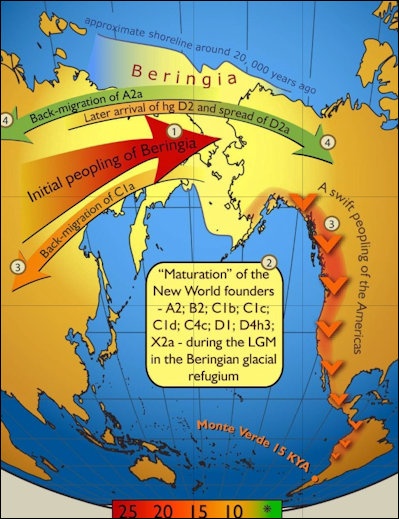
There are two theories about the migration process of the first American: 1) it was a single migratory event, the so called single wave theory, or 2) it occurred in multiple pulses, waves or migrations. The evidence gathered so far seems to suggest it was a single event or at least a dominant single event, with some sideshow migrations that didn’t leave much of a DNA impact. Tests on mitochondrial DNA taken from the few examples of ancient American DNA, Joel Achenbach wrote in the Washington Post, “have a genetic marker common today across the Americas, one that scientists say evolved in a prehistoric population that had been isolated for thousands of years in Beringia, the land mass between Alaska and Siberia that formed a bridge between the continents during the Ice Ages. Thus, according to the report, the Native Americans and the Paleoamericans are the same people, descended from the same Beringia population. They just look different because of recent evolution. [Source: Joel Achenbach, Washington Post, May 15, 2014]
“Most scientists have assumed that the first humans to come to the Americas traveled from Eurasia across the Bering land bridge that existed before the oceans rose after the Ice Ages. But there is great debate about whether this represented a single migratory event or multiple pulses of people from different parts of Eurasia and via different routes, including a coastal migration. One maverick theory, based on archeological finds, contends that people came from Europe, following the edge of the ice around the North Atlantic.
“Adding to the mystery is that the Paleoamericans, such as Naia, didn’t look like later Native Americans. Naia had a small, projecting face, with narrow cheekbones, wide-set eyes and a prominent forehead. Native Americans of later millennia tended to have broader, longer, flatter faces, and rounder skulls, said James Chatters, an independent researcher based in Washington state.
“The distinct morphology of the Paleoamericans is most famously found in the “Kennewick Man,” a 9,000-year-old skeleton discovered two decades ago along the Columbia River in Washington state. Facial reconstruction resulted in someone who looked a bit like the actor Patrick Stewart (“Star Trek: The Next Generation,” “X-Men”). Scientists theorized that he could have been related to populations in East Asia that spread along the coast and eventually colonized Polynesia. Under that scenario, more recent Native Americans could be descended from a separate migratory population.”
“Deborah Bolnick, an anthropologist at the University of Texas at Austin, said the new genetic tests support the hypothesis of a single ancestral population for Native Americans. “It’s a lineage that we see across the Americas,” she said, “and a variety of different studies, different lines of evidence over several decades — archaeological studies, genetic studies, morphological studies — all suggest that Native Americans can be traced to a Beringian source population.”
RELATED ARTICLES:
EARLIEST EVIDENCE OF HUMANS TO AMERICA factsanddetails.com ;
WHEN AND HOW THE FIRST HUMANS CAME TO AMERICA: THEORIES AND EVIDENCE factsanddetails.com ;
MIGRATION ROUTE OF THE FIRST HUMANS IN AMERICA factsanddetails.com ;
FIRST AMERICANS: DNA, ASIA AND ASIANS factsanddetails.com ;
EARLIEST MODERN HUMANS IN WHAT IS NOW ALASKA AND CANADA factsanddetails.com ;
EARLIEST MODERN HUMANS IN WHAT IS NOW THE CONTINENTAL U.S. factsanddetails.com ;
WHITE SANDS 23,000-21,000 YEAR-OLD HUMAN FOOTPRINTS factsanddetails.com ;
CLOVIS PEOPLE: SITES, POINTS, PRE-CLOVIS, MAMMOTHS factsanddetails.com ;
EARLIEST MODERN HUMANS IN SOUTH AMERICA factsanddetails.com ;
EARLIEST MODERN HUMANS IN SOUTHERN SOUTH AMERICA factsanddetails.com ;
FIRST HUMANS AND SETTLEMENTS IN THE AMAZON factsanddetails.com ;
SOLUTREAN HYPOTHESIS factsanddetails.com
RECOMMENDED BOOKS:
“Origin: A Genetic History of the Americas” By Jennifer Raff, an associate professor of anthropology at the University of Kansas (Twelve, 2022); Amazon.com;
“First Peoples in a New World: Populating Ice Age America” by David J. Meltzer, an archaeologist and professor of prehistory in the Department of Anthropology at Southern Methodist University in Dallas, (Cambridge University Press, 2021); Amazon.com;
“The Indigenous Paleolithic of the Western Hemisphere” by Paulette F. C. Steeves (2023) Amazon.com;
“First Migrants: Ancient Migration in Global Perspective” by Peter Bellwood Amazon.com;
“Ancestral DNA, Human Origins, and Migrations” by Rene J. Herrera (2018) Amazon.com;
“Who We Are and How We Got Here: Ancient DNA and the New Science of the Human Past” by David Reich (2019) Amazon.com;
“Our Human Story: Where We Come From and How We Evolved” By Louise Humphrey and Chris Stringer, (2018) Amazon.com;
"The Settlement of the Americas: A New Prehistory" by Thomas D. Dillehay ( Basic Books, 2000 Dated) Amazon.com;
”Strangers in a New Land: What Archaeology Reveals About the First Americans”
by J. M. Adovasio, David Pedler (2016) Amazon.com;
“Paleoindian Mammoth and Mastodon Kill Sites of North America by Jason Pentrail (2021) Amazon.com;
“Clovis The First Americans?: by F. Scott Crawford (2012)
Amazon.com;
“Across Atlantic Ice: The Origin of America's Clovis Culture”
by Dennis J. J. Stanford, Bruce A. Bradley, Michael Collins Amazon.com;
“From Kostenki to Clovis: Upper Paleolithic—Paleo-Indian Adaptations (Interdisciplinary Contributions to Archaeology) by Olga Soffer (1993) Amazon.com;
Did the First Americans Come from China in Two Waves, Beginning Over 20,000 Years Ago?
A DNA study published in May 2023 in Cell Reports revealed that some of the first arrivals in America came from China during two distinct migrations: the first during the last ice age, and the second shortly after. "Our findings indicate that besides the previously indicated ancestral sources of Native Americans in Siberia, the northern coastal China also served as a genetic reservoir contributing to the gene pool," Yu-Chun Li, one of the report authors, told AFP. [Source: Issam Ahmed, AFP, May 10, 2023]
AFP reported: Li added that during the second migration, the same lineage of people settled in Japan, which could help explain similarities in prehistoric arrowheads and spears found in the Americas, China and Japan. It was once believed that ancient Siberians, who crossed over a land bridge that existed in the Bering Strait linking modern Russia and Alaska, were the sole ancestors of Native Americans. More recent research, from the late 2000s onwards, has signaled more diverse sources from Asia could be connected to an ancient lineage responsible for founding populations across the Americas, including Bolivia, Brazil, Chile, Ecuador, Mexico and California. Known as D4h, this lineage is found in mitochondrial DNA, which is inherited only from mothers and is used to trace maternal ancestry.
The team from the Kunming Institute of Zoology embarked on a ten-year hunt for D4h, combing through 100,000 modern and 15,000 ancient DNA samples across Eurasia. They eventually landed on 216 contemporary and 39 ancient individuals who came from the ancient lineage. By analyzing the mutations that had accrued over time, looking at the samples' geographic locations and using carbon dating, they were able to reconstruct the D4h lineage's origins and expansion history. The results revealed two migration events. The first was between 19,500 and 26,000 years ago during the Last Glacial Maximum, when ice sheet coverage was at its greatest and climate conditions in northern China were likely inhospitable.
The second occurred during the melting period, between 19,000 and 11,500 years ago. Increasing human populations during this period might have triggered migrations. In both cases, the scientists think the travelers were seafarers who docked in America and traveled along the Pacific coast by boats. This is because a grassy passageway between two ice sheets in modern Canada, known as the "inland ice-free corridor," was not yet opened.
In the second migration, a subgroup branched out from northern coastal China to Japan, contributing to the Japanese people, especially the indigenous Ainu, the study said, a finding that chimes with archeological similarities between ancient people in the Americas, China and Japan. Li said a strength of the study was the number of samples they discovered, and complementary evidence from Y chromosomal DNA showing male ancestors of Native Americans lived in northern China at the same time as the female ancestors, made them confident of their findings. "However, we don't know in which specific place in northern coastal China this expansion occurred and what specific events promoted these migrations," he said. "More evidence, especially ancient genomes, are needed to answer these questions."
DNA Suggests America was 'Settled in Three Waves', with the First Wave Predominating
DNA suggests was 'settled in three waves'. The first wave of migrants arrived in North America before 14,500 years ago, likely by crossing the Bering Strait land bridge or boating across the strait when conditions were right during the last ice age. But as that ice age ended and glaciers melted, sea levels rose, flooding the land bridge. After that, archaeological evidence suggests that the next major wave of people arrived about 5,000 years ago, likely by boat. People continued arriving in the Americas after that. About 800 years ago, the ancestors of the modern-day Inuit and Yup'ik showed up, and within 100 years, the paleo group from 5,000 years ago had vanished, according to archaeological evidence. [Source: Laura Geggel, Live Science, June 7, 2019]
The results of the biggest survey of Native American DNA announced in 2012 concluded that the American World was settled in three major waves with the majority of today's indigenous Americans descending from a single group of migrants that crossed from Asia to Alaska about 15,000 years ago or more. Previous genetic data suggested that America was colonised by a single migrant wave. The findings were published by an international team of researchers in the journal Nature. "For years it has been contentious whether the settlement of the Americas occurred by means of a single or multiple migrations from Siberia," said co-author Prof Andres Ruiz-Linares from University College London (UCL). "But our research settles this debate: Native Americans do not stem from a single migration. Our study also begins to cast light on patterns of human dispersal within the Americas." [Source: BBC, 12 July 2012 |::|]
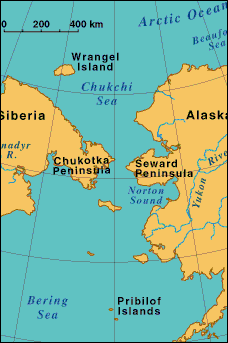
Bering Strait today
The BBC reported: “The team analysed data from 52 Native American and 17 Siberian groups, studying more than 300,000 variations in their DNA known as Single Nucleotide Polymorphisms, or SNPs. This allowed them to examine patterns of genetic similarities and differences between the population groups. The second and third migrations have left an impact only in Arctic populations whose languages belong to the Eskimo-Aleut family and in the Canadian Chipewyan who speak a language that belongs to the Na-Dene family. However, even these populations have inherited most of their genome (the DNA sequence contained in the nuclei of cells) from the earliest migration.|::|
“Eskimo-Aleut speakers derive more than 50 percent of their DNA from what the researchers call "First Americans", and the Chipewyan around 90 percent. This reflects the fact that the two later streams of migration from Asia mixed with the populations descended from the first wave. "There are at least three deep lineages in Native American populations," said co-author David Reich, professor of genetics at Harvard Medical School. "The Asian lineage leading to First Americans is the most anciently diverged, whereas the Asian lineages that contributed some of the DNA to Eskimo-Aleut speakers and the Na-Dene-speaking Chipewyan from Canada are more closely related to present-day East Asian populations." Evidence from mitochondrial DNA (mtDNA), the genetic information in the mitochondria that power cells, supports descent from a single founding group of colonisers, who crossed from Siberia into America across the Bering land bridge. But a three-stage migration has been proposed before, based on a controversial interpretation of language relationships and physical features of the teeth of Native American groups. |::|
“The team also found that once in the Americas, people expanded southward along a route that hugged the coast, with populations splitting off along the way. After their divergence, there was little gene flow among Native American groups, especially in South America. Two glaring exceptions to this simple dispersal were also discovered. First, Central American Chibchan-speakers have ancestry from both North and South America, reflecting a migration back from South America to Central America. Second, the Naukan and coastal Chukchi from north-eastern Siberia carry distinctive "First American" DNA. Thus, Eskimo-Aleut speakers migrated back to Asia, bringing Native American genes. |::|
“The team's analysis was complicated by the influx into the hemisphere of European and African immigrants since 1492 and the 500 years of genetic mixing that followed. To address this, the authors developed methods that allowed them to focus on the sections of peoples' genomes that were of entirely Native American origin.” |::|
DNA From a 12,600-Year-Old Baby Boy Found in Montana Indicates Asian Ancestry
DNA was recovered from of a baby boy who was buried in Montana 12,600 years ago, providing insights into the ancestry of native peoples of the Americas. Malcolm Ritter of Associated Press wrote: “It’s the oldest genome ever recovered from the New World. Artifacts found with the body show the boy was part of the Clovis culture. The boy’s genome showed his people were direct ancestors of many of today’s native peoples in the Americas, but he was more closely related to those in Central and South America than to those in Canada. [Source: Malcolm Ritter, Associated Press, February 17, 2014 =|=]
“The DNA also indicates the boy’s ancestors came from Asia, supporting the standard idea of ancient migration to the Americas by way of a land bridge that disappeared long ago. The burial site, northeast of Livingston, Mont., is the only one known from the Clovis culture. The boy was between 1 year and 18 months old when he died of an unknown cause. He was buried with 125 artifacts, including spear points and elk antler tools. Some were evidently ritual objects or heirlooms. The artifacts and the skeleton were covered with powdered red ochre, a natural pigment, indicating a burial ceremony. The skeleton was discovered in 1968 next to a rock cliff, but it’s only in recent years that scientists have been able to recover and analyze complete genomes from such ancient samples. =|=
Ker Than wrote in National Geographic: “Comparison studies of the ancient DNA showed that it was similar to the genomes of ancient people living in Siberia and the ancestors of East Asians. The team also discovered a deep genetic affinity between the boy's genetic material and those of 52 Native American populations living in South America and Canada. "The Anzick remains share a common ancestry with almost every modern Native American group that we looked at," Waters said.” [Source: Ker Than, National Geographic, February 12, 2014]
DNA from 12,000-Year Old Yucatan Girl Supports the Single Wave Theory
In the May 15, 2014 issue of the journal Science, scientists announced the results of DNA extraction from a teenage girl fell into a deep hole and died in Mexico's Yucatan Peninsula 12,000 to 13,000 years ago. The remains of the girl, nicknamed Naia, were found by scuba divers at the bottom of Hoyo Negro, a large dome-shaped underwater cave. Her DNA links her to Asians as wells modern native peoples of the Americas. Malcolm Ritter of Associated Press wrote: T”he girl's nearly complete skeleton was discovered by chance in 2007 by expert divers who were mapping water-filled caves north of the city of Tulum, in the eastern part of the Yucatan Peninsula. The divers named the skeleton Naia, after a water nymph of Greek mythology, and joined up with a team of scientists to research the find. The girl was 15 or 16 when she met her fate in a cave, which at that time was dry, researchers said. She may have been looking for water when she tumbled into the chamber some 12,000 or 13,000 years ago, said lead study author James Chatters of Applied Paleoscience, a consulting firm in Bothell, Washington. Her pelvis was broken, suggesting she had fallen a long distance, he said. [Source: Malcolm Ritter, Associated Press, May 15, 2014]
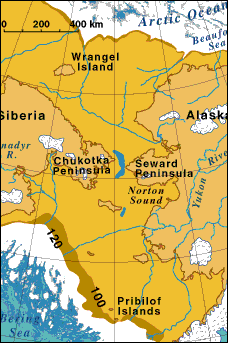
Beringia in the Ice Age
Naia was found with fossils of two saber-toothed cats, six bears, three cougars and two ground sloths. The Science article concludes, “The differences in craniofacial form between Native Americans and their Paleoamerican predecessors are best explained as evolutionary changes that postdate the divergence of Beringians from their Siberian ancestors.”“This is truly an extraordinary discovery,” said Yemane Asmerom, a geochemist at the University of New Mexico who co-wrote the report. He compared the cave, to the Awash Valley of Ethiopia — the site of the 1974 discovery of “Lucy,” an early human ancestor. [Source: Joel Achenbach, Washington Post, May 15, 2014]
Malcolm Ritter of Associated Press wrote: “The analysis of her remains, reported by scientists in the United States, Canada, Mexico and Denmark, addresses a puzzle about the settling of the Americas. Most scientists say the first Americans came from Siberian entered the Americas sometime after 17,000 years ago from that land mass, called Beringia. And genetic evidence indicates that today's native peoples of the Americas are related to these pioneers. But the oldest skeletons from the Americas — including Naia's — have skulls that look much different from those of today's native peoples. To some researchers, that suggests the first Americans came from a different place. [Source: Malcolm Ritter, Associated Press, May 15, 2014]
“Naia provides a crucial link. DNA recovered from a molar contains a distinctive marker found in today's native peoples, especially those in Chile and Argentina. The genetic signature is thought to have arisen among people living in Beringia, researchers said. That suggests that the early Americans and contemporary native populations both came from the same ancestral roots in Beringia — not different places, the researchers concluded. The anatomical differences apparently reflect evolution over time in Beringia or the Americas, they said.
“The finding does not rule out the idea that some ancient settlers came from another place, noted Deborah Bolnick, a study author from the University of Texas at Austin. Dennis O'Rourke, an expert in ancient DNA at the University of Utah who didn't participate in the work, said the finding is the first to show a genetic link to Beringia in an individual who clearly had the anatomical signs of a very early American. He said he considered the notion of multiple migrations from different places to be "quite unlikely."”
Earlier, “other researchers reported that DNA from a baby buried in Montana more than 12,000 years ago showed a close genetic relationship to modern-day native peoples, especially those in Central and South America. An author of that study, Mike Waters of Texas A&M University, said the Mexican finding fits with the one in Montana. There are so few such early skeletons from the Americas, he said, that "every single one of them is important." However, Richard Jantz, a retired professor of forensic anthropology at the University of Tennessee in Knoxville, said he still believes early settlers arrived by boat from east Asia before any migration occurred via Beringia. That's based on anatomical evidence, he said. The argument in the new paper "leaves a lot of unanswered questions," he said.”
Study of Blackfoot Native American Show They Broke Off from Other Groups 18,000 Years Ago
In a study, published April 3, 2023 in the journal Science Advances, a team of researchers led by two members of the Native American group called Blackfoot Confederacy investigated the genetic history of their tribes, which live in in the Great Plains of Montana and southern Alberta, and found the confederacy have a lineage that goes back 18,000 years, meaning they could have broken off from other groups that first inhabited the Americas before they left Asia or not long after they arrived in America. [Source: Kristina Killgrove, Live Science, April 13, 2024]
Kristina Killgrove wrote in Live Science: The research team took samples for whole-genome sequencing from seven skeletons that were carbon-dated to between 1805 and 1917, a period in which interactions between Blackfoot people and Euroamericans were increasing because of the fur trade. While DNA preservation was not ideal, as the samples came from skeletons that had been exposed on a burial platform, all the remains produced mitochondrial DNA information, or genetic data passed down from the maternal side. Additionally, six present-day tribal members were whole-genome sequenced.
The genetic information revealed that the historical Blackfoot Ancestors and the present-day Blackfeet/Kainai shared a large fraction of their genome, suggesting a biological relationship. This continuity of genes was expected, but the team also found that this lineage was different from previously reported North and South American Indigenous groups. Based on statistical modeling, the team believes that the Blackfoot people split from other groups in the Late Pleistocene, around 18,000 years ago, as multiple population waves from a single source fanned out into the vast geographic land of the Americas.
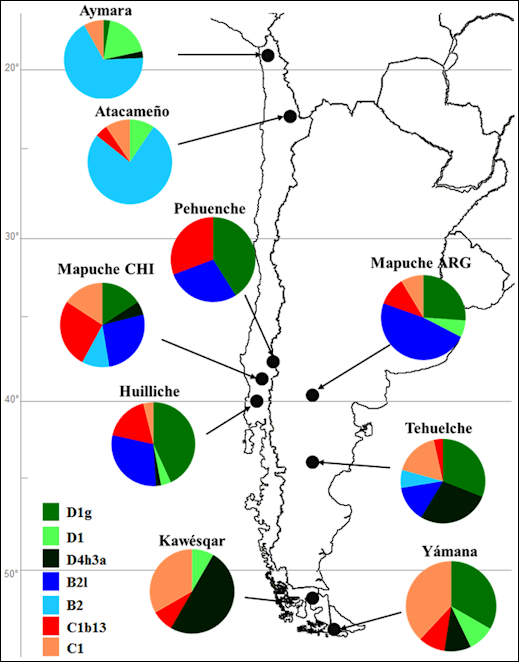
haplogroup MtDNA lineage map for southern South American populations
7,500-Year-Old DNA from Central Asians Suggests Early Humans Moved Back and Forth Between Asia and America
According to a study published in the journal Current Biology on January 12, 2023, genetic makeup of a very old hunter-gatherer population indicates early humans migrated back and forth between Asia and North America. The pattern were uncovered by analyzing the remains of 10 prehistoric individuals found in the Altai region of Russia and Mongolia. The remains date back to 7,500 years ago and include the skeleton of a 6,500-year-old shaman found in a cave with religious attire. With the exception of the shaman, the DNA revealed the individuals belonged to a previously unknown early human population — now called the Altai — that were a a mixture of two groups that occupied Siberia during the Ice Age, the study explained. [Source: Brendan Rascius, Miami Herald,, January 14, 2023]
Brendan Rascius wrote in the Miami Herald: The Altai, a hunter-gatherer community, were found to be genetically linked to many successive populations across Siberia, Central Asia and East Asia, indicating a high degree of mobility amongst these Neolithic humans, the study said. In addition to fanning out across the Asian continent, relatives of the Altai journeyed thousands of miles to the Bering Land Bridge, where some crossed over into North America. Several phases of “Native American-related gene flow” occurred in both directions, according to the study. As a result of this considerable movement, current Native American populations share an “extra genetic affinity” with the Altai population.
“Such connection across long geographic distances is remarkable,” Cosimo Posth, professor of paleogenetics and co-author of the study, wrote in a news release from the University of Tübingen in Germany. “This suggests that human migrations and admixtures were the norm and not the exception also for ancient hunter-gatherer societies.”
Additionally, the remains of the shaman, which include a complete skull, contain an entirely distinct genetic profile despite being discovered near the Altai remains. In fact, his remains were found more than 900 miles to the west of the population he was genetically tied to, further suggesting a high degree of mobility amongst Neolithic populations, according to the study. “This shows that people with very different genetic profiles were living in the area,” Ke Wang, a co-author of the study who works at Fudan University in China, stated in the release. The shaman’s “grave goods appear different from other archaeological sites, implying movements of both culturally and genetically diverse individuals into the Altai region.”
DNA Shows Links Between Americas and Oceanians and Supports Multiple Pulses Migration
Pallab Ghosh of the BBC News wrote: “Two separate genetic analyses have found evidence for a surprising genetic link between the native populations of the Americas and Oceania. The DNA of some native Amazonians shows significant similarity to indigenous inhabitants of Australia and Melanesia. The two research groups, however, offer contrasting interpretations of how the Americas were first peopled. The studies have been published in the journals Science and Nature. [Source: Pallab Ghosh, BBC News, 22 July 2015 |::|]
“There is agreement that the first people to populate the Americas came though Siberia - along a land bridge connecting it with Europe and Asia. But just where these people came from and when they arrived has been a matter of some debate. By analysing the DNA of modern native Americans and ancient human remains, the group writing in Science concluded that all present-day Native Americans arrived in a single migration no earlier than 23,000 years ago. |::|
“Then, they argue, Native Americans split into two branches around 13,000 years ago: one that is now dispersed across North and South America while the other is restricted to North America. "Our paper shows that the simplest possible model seems by and large to be true, with [that] one notable exception," Prof Rasmus Nielsen from the University of California, Berkley, told BBC News. "[So] the fanciful ideas that somehow the Americas were populated by people coming from Europe and all kinds of other places are wrong." |::|
“The analysis also rules out a theory, favoured by some, of a staggered migration from Siberia: the first more than 30,000 years ago which was stemmed for 15,000 years because of ice blocking the route, and then a second wave when the route was clear. But, in agreement with the study in Nature, Prof Nielsen's team does report traces of "Australo-Melanesian" ancestry in certain populations, including those of the Aleutian islands (off Alaska) and the Surui people of the Brazilian Amazon. |::|
Prof David Reich, from Harvard Medical School, led the separate study in Nature. He told the BBC that "both studies show that there have been multiple pulses of migration into the Americas". According to Prof Reich, the discovery of Oceanian ancestry among certain Native American groups indicates that the Americas were peopled by a more diverse set of populations than previously accepted. "The simplest possible model never predicted an affinity between Amazonians today and Australasians," he said. "This suggests that there is an ancestral population that crossed into the Americas that is different from the population that gave rise to the great majority of Americans. And that was a great surprise," he said. |Prof Reich believes that the most plausible explanation is that there was a separate migration from Australasia, possibly around 15,000 years ago. This group, he speculates, was probably more widely dispersed across North America but was eventually pushed out by other native American groups. Prof Nielsen, however, has a different interpretation. He believes that the traces of Australasian DNA stem from a later migration, around 8,000 years ago, which progressed around the Pacific coast.” |::|
DNA Reveals New Group of Native Americans: the Beringians
Genetic analysis of bones from a baby girl who died at the end of the last ice age, around 11,500 years ago, in Alaska shows she belonged to a previously unknown ancient group of Native Americans — dubbed the Beringians. Ian Sample wrote in The Guardian: “The child, a mere six weeks old when she died, was found in a burial pit next to the remains of a stillborn baby, perhaps a first cousin, during excavations of an 11,500-year-old residential camp in Tanana River Valley in Central Alaska. The remains were discovered in 2013, but a full genetic analysis has not been possible until now. Researchers tried to recover ancient DNA from both of the infants but succeeded only in the case of the larger individual. They had expected her genetic material to resemble modern northern or southern lineages of Native Americans, but found instead that she had a distinct genetic makeup that made her a member of a separate population. [Source: Ian Sample, The Guardian, January 3, 2018 |=|]
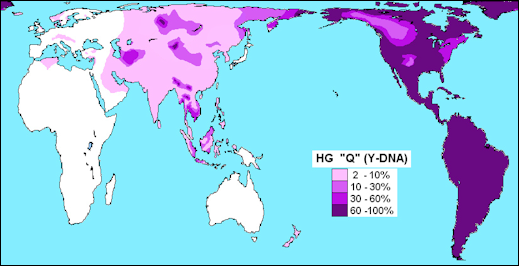
Haplogroup Q Y-DNA worldwide distribution
“The newly-discovered group, named “ancient Beringians”, appears to have split off from the founding population of Native Americans about 20,000 years ago. While the ancestors of other Native Americans pushed south into the continent as the ice caps thawed, the ancient Beringians remained in the north until they eventually died out. “This is a new population of Native Americans,” said Eske Willerslev, an evolutionary geneticist at the University of Copenhagen, whose team recovered the girl’s DNA from a dense part of her skull known as the petrous bone. Details of the work are published in Nature.
“Working with scientists at the University of Alaska and elsewhere, Willerslev compared the genetic makeup of the baby, named Xach’itee’aanenh t’eede gaay or “sunrise child-girl” by the local community, with genomes from other ancient and modern people. They found that nearly half of the girl’s DNA came from the ancient north Eurasians who lived in what is now Siberia. The rest of her genetic makeup was a roughly even mix of DNA now carried by the northern and southern Native Americans.” |=|
Beringians and the Single Wave Theory
Ian Sample wrote in The Guardian: “Using evolutionary models, the researchers showed that the ancestors of the first Native Americans started to emerge as a distinct population about 35,000 years ago, probably in north-east Asia. About 25,000 years ago, this group mixed and bred with ancient north Eurasians in the region, the descendants of whom went on to become the first Native Americans to settle the New World. [Source: Ian Sample, The Guardian, January 3, 2018 |=|]
“During the last ice age, so much water was locked up in the ice caps that a land bridge reached from Asia to North America across what is now the Bering Strait. Willerslev believes the ancestors of Native Americans travelled to the continent in a single wave of migration more than 20,000 years ago. Those who settled in the north became the isolated ancient Beringians, he said, while those who moved south, around or through the ice sheets, split into the north and south Native Americans about 15,700 years ago. |=|
“But there is another possibility. Ben Potter, an archaeologist on the team from the University of Alaska in Fairbanks, suspects that the Beringians split from the ancestors of other Native Americans in Asia before both groups made their way across the land bridge to North America in separate migrations. “The support for this scenario is pretty strong,” he said. “We have no evidence of people in the Beringia region 20,000 years ago.” |=|
“The families who lived at the ancient camp may have spent months there, Potter said. Excavations at the site, known as Upward Sun River, have revealed at least three tent structures that would have provided shelter. The two babies were found in a burial pit beneath a hearth where families cooked salmon caught in the local river. The cremated remains of a third child, who died at the age of three, were found on top of the hearth at the abandoned camp. |=|
“Connie Mulligan, an anthropologist at the University of Florida, said the findings pointed to a single migration of people from Asia to the New World, but said other questions remained. “How did people move so quickly to the southernmost point of South America and settle two continents that span a huge climatic and geographic range?” she said. |=|
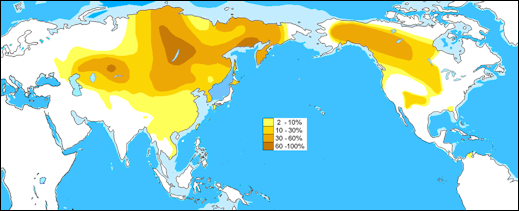
Haplogroup V-M217 Y-DNA worldwide distribution
“David Reich, a geneticist at Harvard University, said the work boosted the case for a single migration into Alaska, but did not rule out alternatives involving multiple waves of migration. He added that he was unconvinced that the ancient Beringian group split from the ancestors of other Native Americans 20,000 years ago, because even tiny errors in scientists’ data can lead to radically different split times for evolutionary lineages. “While the 19,000-21,000 year date would have important implications if true and may very well be right, I am not convinced that there is compelling evidence that the initial split date is that old,” he said. |=|
Image Sources: Wikimedia Commons
Text Sources: National Geographic, New York Times, Washington Post, Los Angeles Times, Smithsonian magazine, Nature, Scientific American. Live Science, Discover magazine, Discovery News, Ancient Foods ancientfoods.wordpress.com ; Times of London, Natural History magazine, Archaeology magazine, The New Yorker, Time, Newsweek, BBC, The Guardian, Reuters, AP, AFP and other publications.
Last updated June 2024