
POLITICAL PARTIES IN THE PHILIPPINES

Political parties in the Philippines are generally shaped more by personalities, alliances, and shifting loyalties than by clear ideological platforms. Rather than competing over detailed policy programs, many parties function as vehicles for prominent political figures. In the Philippines, political parties often have played traditionally played a secondary role to individual personalities. Family dynasties, celebrity endorsements, social media influence and political alliances carried more weight than party platforms. Lawmakers frequently shifted allegiances to align with the incoming president, though rival factions and ideological differences ensured that an opposition bloc remained. [Source: Martin Petty, Reuters, May 5, 2022]
Philippine political parties are essentially nonideological vehicles for personal and factional political ambition. Political parties are not that strong in the Philippines. Rewriting the constitution to eliminate term limits and establishing a strong two-party system are the reforms that are discussed most often. Politicians move from party to party as the needs of their constituencies dictate because the political parties have no ideologies. [Source: everyculture.com]
In the Philippine system, it is common for politicians to switch party affiliation, often aligning themselves with the sitting president to maintain access to political influence and resources. As a result, governing coalitions frequently become “supermajorities,” leaving only a small minority bloc in opposition.
The main political parties in the Philippines control a large share of seats in the House of Representatives, often forming broad governing coalitions. The current political landscape has been influenced by the alliance — and subsequent tensions — between the camps of President Ferdinand Marcos Jr. of the Partido Federal ng Pilipinas and former President Rodrigo Duterte of PDP-Laban. Although the two factions cooperated in 2022, their relationship has since evolved amid shifting political interests.
RELATED ARTICLES:
POLITICS IN THE PHILIPPINES: POWERFUL FAMILIES, RICH BACKERS, PATRONAGE, CELEBRITY factsanddetails.com
POLITICIANS, THE CATHOLIC CHURCH AND PROTESTS IN THE PHILIPPINES factsanddetails.com
ELECTION AND POLITICAL VIOLENCE IN THE PHILIPPINES factsanddetails.com
MAGUINDANAO MASSACRE: EVENTS, KILLERS, POLITICS, TRIAL factsanddetails.com
ELECTIONS IN THE PHILIPPINES: ELECTORAL SYSTEM, IRREGULARITIES, CAMPAIGNS factsanddetails.com
2022 PHILIPPINE ELECTIONS factsanddetails.com
GOVERNMENT OF THE PHILIPPINES: HISTORY, SYMBOLS, CONSTITUTION factsanddetails.com
BRANCHES OF THE PHILIPPINES GOVERNMENT: EXECUTIVE (PRESIDENT), LEGLISLATURE, JUDICIARY factsanddetails.com
PEOPLE POWER AND THE FALL OF MARCOS factsanddetails.com
FERDINAND MARCOS: HIS LIFE, LIES, EDUCATION, WAR RECORD, POLITICAL RISE factsanddetails.com
FERDINAND MARCOS AS PRESIDENT: EARLY PROMISE, RESISTANCE, WASTE factsanddetails.com
MARTIAL LAW YEARS UNDER FERDINAND MARCOS factsanddetails.com
INDEPENDENCE FOR THE PHILIPPINES AFTER WORLD WAR II factsanddetails.com
PHILIPPINES IN THE 1950s AND 60s: HUK REBELLION, MAGSAYSAY, GARCIA AND MACAPAGAL factsanddetails.com
MARCOS’S PLUNDER AND WEALTH factsanddetails.com
Main Political Parties in the Philippines
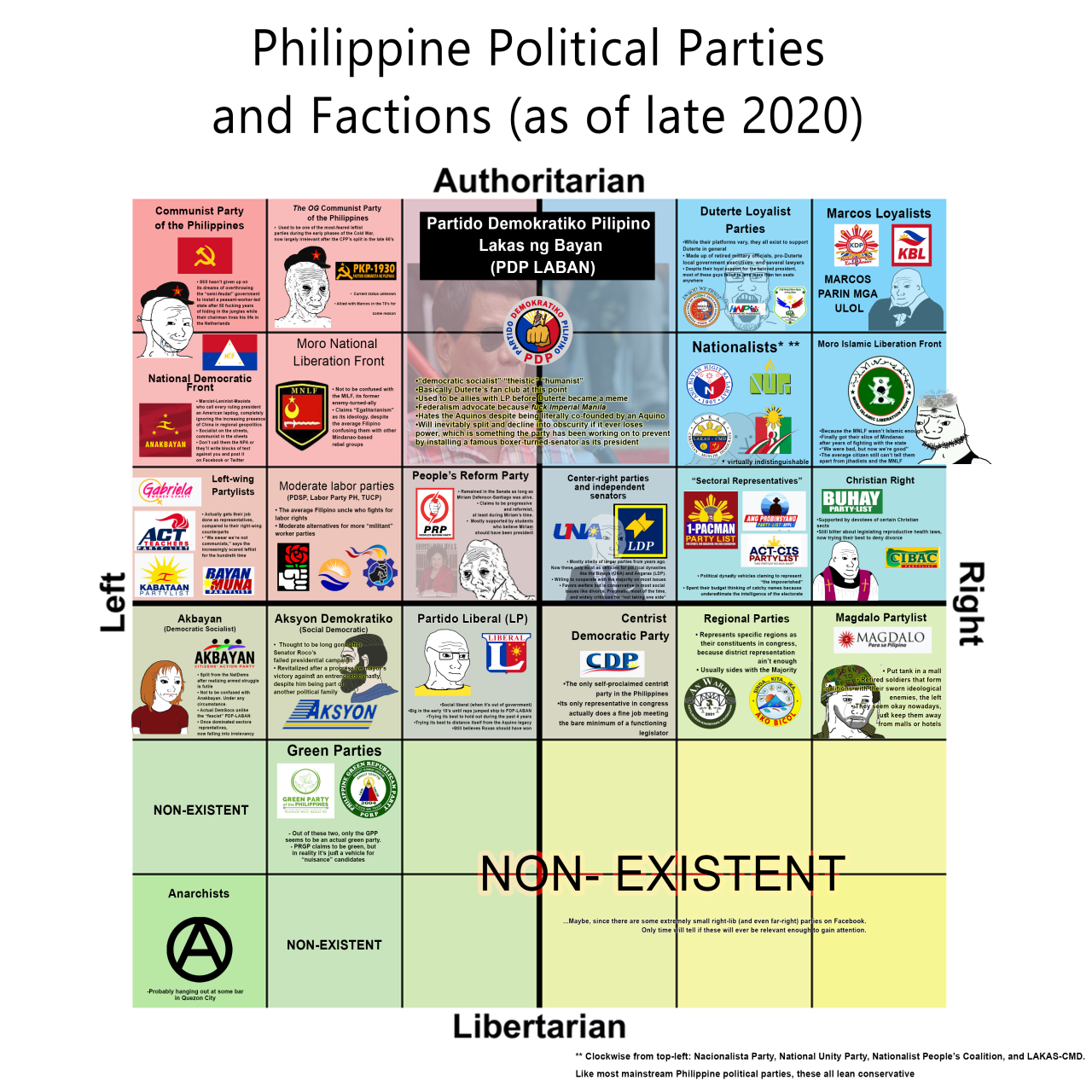
Since the 2022 elections, the dominant parties have included the Nacionalista Party (NP), the Nationalist People’s Coalition (NPC), the National Unity Party (NUP) and Lakas–Christian Muslim Democrats (Lakas-CMD). Among the lesser political parties are Democratic Action (Aksyon Demokratiko), the Alliance for Change (Hugpong ng Pagbabago or HNP) and Katipunan ng Nagkakaisang Pilipino (KANP).
Main Political Parties in the 2020s:
Nacionalista Party (NP) is one of the oldest parties in Philippines, It maintains a strong, consistent presence in Congress.
Nationalist People's Coalition (NPC) is A major party, often forming coalitions with the ruling party.
National Unity Party (NUP) is a significant coalition member in recent administrations.
Lakas-CMD (Lakas ng EDSA-Christian Muslim Democrats) is the party of many prominent political figures, including Speaker Martin Romualdez and Former President Macapagal-Arroyo. It is regarded as a conservative party.
Partido Federal ng Pilipinas (PFP) is the party of President Ferdinand Marcos Jr..
PDP-Laban (Partido Demokratiko Pilipino-Lakas ng Bayan) is the party of former President Rodrigo Duterte.
Liberal Party was once a dominant political force. It has largely been in the opposition since 2016. It was the party of Benigno Aquino III, president of the Philippines and has traditionally been regarded as a democratic-elitist party. Founded in 1946, the Liberal Part, survived fourteen years of dormancy (1972 to 1986), largely through the staunch integrity of its central figure, Senate president Jovito Salonga, a survivor of the Plaza Miranda grenade attack of September 1971. In 1991 Salonga also was interested in the presidency, despite poor health and the fact that he is a Protestant in a largely Catholic country.
Parties with the most seats in the House of Representatives as of 2025 (317 seats, all directly elected): Lakas-CMD party (103 seats), National Unity Party (NUP) (32 seats), Nationalist People's Coalition (NPC) (31 seats), Partido Federal ng Pilipinas (PFP) (27 seats), Nacionalista Party (NP) (22 seats), Liberal Party (LP) (6 seats), others (28 seats), independents (11 seats). [Source: CIA World Factbook, 2025]
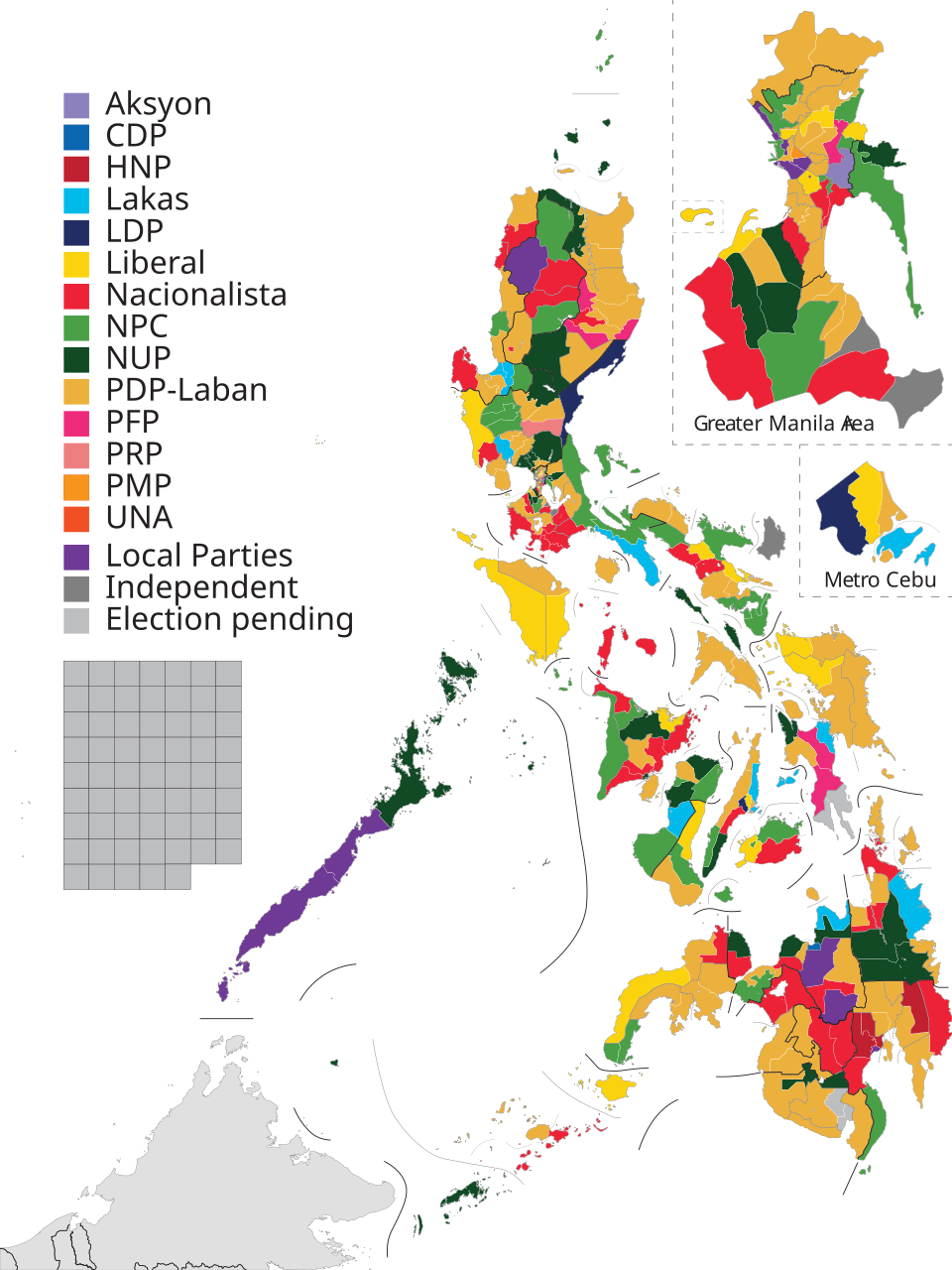
Parties with the most seats in the Senate as of 2025 (24 seats, all directly elected); Nationalist People's Coalition (NPC) (2 seats); Nacionalista Party (NP) (3 seats); Partido Demokratiko Pilipino-Laban (PDP-Laban) (2 seats); Lakas- CMD party (1 seat); Katipunan ng Nagkakaisang Pilipino (KANP) (1 seat); Liberal Party (1 seat); Independents (2 seats). [Source: CIA World Factbook, 2025]
Political parties and leaders in the mid 2010s: 1) Laban ng Demokratikong Pilipino (Struggle of Filipino Democrats) or LDP led by Edgardo Angara; 2) Lakas ng EDSA-Christian Muslim Democrats or Lakas-CMD led by Manuel "Mar" Roxas; 3) Liberal Party or LP led by Manuel Roxas; 4) Nacionalista Party or NP led by Manuel "Manny" Villar; 4) Nationalist People's Coalition or NPC led by Frisco San Juan; 5) PDP-Laban led by Aquilino Pimentel; 6) People's Reform Party led by Miriam Defensor Santiago; 7) Puwersa ng Masang Pilipino (Force of the Philippine Masses) or PMP led by Joseph Estrada]. The United Nationalist Alliance or [UNA] - PDP-Laban and PMP coalition for the 2013 election. Political pressure groups and leaders: Black and White Movement led by Vicente Romano; Kilosbayan led by Jovito Salonga] [Source: CIA World Factbook]
Weak Parties and Side Switching in the Philippines
In the 2016, Rodrigo Duterte won the Presidency despite the fact that his PDP-Laban secured just three of the 297 seats in the House of Representatives, and party president Koko Pimentel was its only representative in the 24-member Senate. The party was so small that Filipinos jokingly referred to it as a “motorcycle party.” Yet within days of Duterte’s victory in the Presidental elections in May 2016, politicians from across the political spectrum hurried to align themselves with him. The wave of defections was so strong it left Congress with little effective opposition to restrain the president. [Source: Clarissa Batino, Norman P Aquino, Bloomberg, June 15, 2016]
Such shifts are common in Philippine politics. In 2010, lawmakers similarly abandoned Gloria Macapagal Arroyo’s party to join the Liberal Party of then newly elected president Benigno Aquino III.
Although Aquino’s Liberal Party won more than a third of the seats in the lower house, Duterte quickly secured enough pledges of support to command a supermajority—two-thirds of the chamber—even before taking office on June 30, according to House Speaker-designate Pantaleon Alvarez.
The consolidation of support around Duterte makes it easier for him to push forward his ambitious agenda, including restoring the death penalty, cracking down on smuggling, loosening restrictions on foreign ownership, and shifting to a federal system of government. It may also provide him with enough congressional backing to avoid the impeachment attempts and constitutional challenges that troubled some of his predecessors.
Why Parties Are Weak and Side Switching Occurs in the Philippines
Part of the explanation for the country’s fluid political alliances lies in the constitution adopted after the 1986 People Power revolt that removed Ferdinand Marcos from power. The charter encouraged a multiparty system and limited presidents to a single six-year term in an effort to prevent the rise of another dictator. Since Corazon Aquino took office three decades ago, every president has won with less than an absolute majority of the vote. Duterte secured 39 percent—less even than Aquino’s 42 percent in 2010. [Source: Clarissa Batino, Norman P Aquino, Bloomberg, June 15, 2016]
Real political parties don’t really exist because what we have are caricatures,” Ramon Casiple, executive director of the Institute for Political and Electoral Reform in Manila, told Bloomberg. According to him, parties rarely shape decisions; instead, political personalities and powerful families call the shots. It was Duterte himself—not a party apparatus—who ultimately decided to run for president.
The unintended consequence of this system has been to encourage politicians to shift allegiance to whoever wins the presidency and controls government resources. Those who refuse risk marginalization in both the executive branch and Congress, potentially losing funding for projects in their districts. “If you’re with the president’s party, you get more funds for your constituents,” Congressman Teddy Baguilat, a member of the Liberal Party since 2001, told Bloomberg. “If you fail, your district will suffer and so will your political mileage.” Baguilat noted that while he sympathizes with the minority opposition, he must consult party leaders before making any move.
Political Parties After the Ouster of Marcos
Political parties grew in profusion after the Marcos martiallaw regime (1972-81) was ended. There were 105 political parties registered in 1988. As in the pre-Marcos era, most legal political parties were coalitions, built around prominent individuals, which focused entirely on winning elections, not on what to do with the power achieved. There was little to distinguish one party from another ideologically, which was why many Filipinos regarded the political system as irrelevant. [Source: Library of Congress *]
The party system in the early 1990s closely resembled that of the premartial law years when the Nacionalista and Liberal parties alternated in power. Although they lacked coherent political programs, they generally championed conservative social positions and avoided taking any position that might divide the electorate. Each party tried to appeal to all regions, all ethnic groups, and all social classes and fostered national unity by never championing one group or region. Neither party had any way to enforce party discipline, so politicians switched capriciously back and forth. The parties were essentially pyramids of patronclient relationships stretching from the remotest villages to Manila. They existed to satisfy particular demands, not to promote general programs. Because nearly all senators and representatives were provincial aristocrats, the parties never tackled the fundamental national problem — the vastly inequitable distribution of land, power, and wealth. *
Ferdinand Marcos mastered that party system, then altered it by establishing an all-embracing ruling party to be the sole vehicle for those who wished to engage in political activity. He called it the New Society Movement (Kilusang Bagong Lipunan). The New Society Movement sought to extend Marcos's reach to far corners of the country. Bureaucrats at all levels were welladvised to join. The New Society Movement offered unlimited patronage. The party won 163 of 178 seats in the National Assembly in 1978 and easily won the 1980 local elections. In 1981 Marcos actually had to create his own opposition, because no one was willing to run against him. *
Pro-Government Parties After Marcos
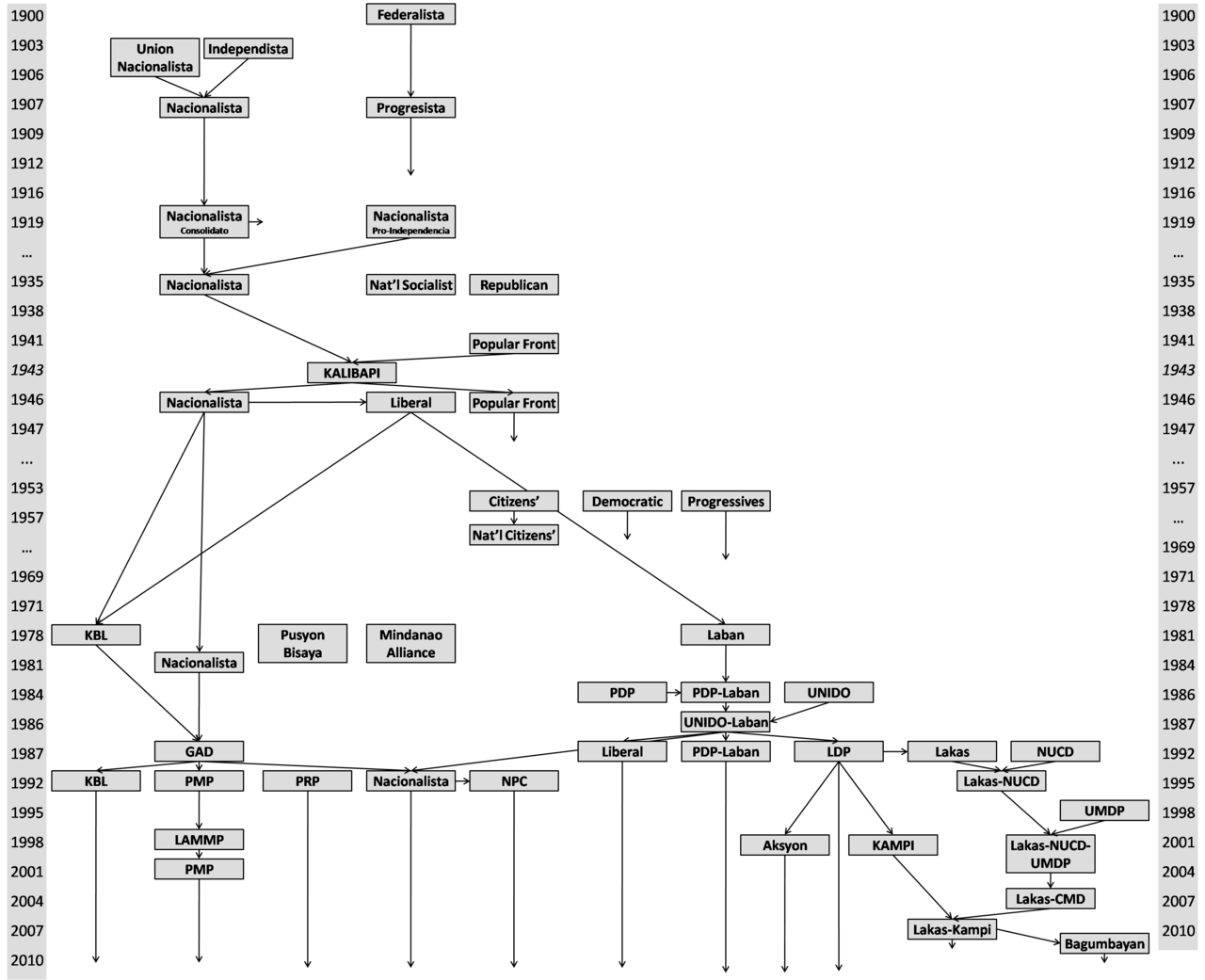
In 1978 the imprisoned former senators Benigno Aquino and Lorenzo Tañada organized a political party named Lakas ng Bayan (Strength of the Nation; also known by its abbreviated form, LABAN, meaning fight). LABAN won 40 percent of the Manila vote in parliamentary elections that year but was not given a single seat in Marcos's New Society Movement-dominated parliament. After Aquino went into exile in the United States, his wife's brother, former Congressman Jose Cojuangco, managed LABAN. Cojuangco forged an alliance with the Pilipino Democratic Party (PDP), a regional party with strength in the Visayas and Mindanao, that had been organized by Aquilino Pimentel, the mayor of Cagayan de Oro City. The unified party was thereafter known as PDP-LABAN, and it — along with UNIDO conducted Corazon Aquino's presidential campaign against Marcos. [Source: Library of Congress *]
In its early years, PDP-LABAN espoused a strongly nationalist position on economic matters and United States base rights, aspiring to "democratize power and socialize wealth." Later, after Aquino became president, its rhetorical socialism evaporated. In the late 1980s and early 1990s, PDP-LABAN had the distinct advantage of patronage. Aquino named Pimentel her first minister of local government, then summarily dismissed every governor and mayor in the Philippines. Pimentel replaced them with officers in charge known personally to him, thereby creating an instant pyramid of allies throughout the country. Some, but not all, of these officers in charge won election on their own in the January 1988 local elections. *
PDP-LABAN was not immune from the problems that generally plagued Philippine political parties. What mainly kept the party together was the need to keep Aquino in power for her full sixyear term. In June 1988 the party was reorganized as the Struggle of Filipino Democrats (Laban ng Demokratikong Pilipino). Speaker of the House Ramon Mitra was its first president, but he resigned the presidency of the party in 1989 in favor of Neptali Gonzales. *
In 1990 Aquino announced the formation of a movement called Kabisig (Arm-in-Arm), conceived as a nongovernmental organization to revive the spirit of People's Power and get around an obstinate bureaucracy and a conservative Congress. By 1991 its resemblance to a nascent political party worried the more traditional leadership, particularly Mitra. Part of Aquino's governing style was to maintain a stance of being "above politics." Although she endorsed political candidates, she refused to form a political party of her own, relying instead on her personal probity, spirituality, and simple living to maintain popular support. *
Opposition Parties After Marcos
The New Society Movement fell apart when Marcos fled the country. A former National Assembly speaker, Nicanor Yniguez, tried to "reorganize" it, but others scrambled to start new parties with new names. Blas Ople, Marcos's minister of labor, formed the Nationalist Party of the Philippines (Partido Nationalista ng Pilipinas) in March 1986. Enrile sought political refuge in a revival of the country's oldest party, the Nacionalista Party, first formed in 1907. Enrile used the rusty Nacionalista machinery and an ethnic network of Ilocanos to campaign for a no vote on the Constitution, and when that failed, for his election to the Senate. Lengthy negotiations with mistrustful political "allies" such as Ople and Laurel delayed the formal reestablishment of the Nacionalista Party until May 1989. Enrile also experimented with a short-lived Grand Alliance for Democracy with Francisco "Kit" Tatad, the erstwhile minister of information for Marcos, and the popular movie-star senator, Joseph Estrada. In 1991 Enrile remained a very powerful political figure, with landholdings all over the Philippines and a clandestine network of dissident military officers. [Source: Library of Congress *]
Vice President Laurel had few supporters in the military but long-term experience in political organizing. From his family base in Batangas Province, Laurel had cautiously distanced himself from Marcos in the early 1980s, then moved into open opposition under the banner of a loose alliance named the United Nationalist Democratic Organization (UNIDO). Eventually, the UNIDO became Laurel's personal party. Aquino used the party's organization in February 1986, although her alliance with Laurel was never more than tactical. UNIDO might have endured had Aquino's allies granted Laurel more patronage when local governments were reorganized. As it was, Laurel could reward his supporters only with positions in the foreign service, and even there the opportunities were severely limited. The party soon fell by the wayside. Laurel and Enrile formed the United Nationalist Alliance, also called the Union for National Action, in 1988. The United Nationalist Alliance proposed a contradictory assortment of ideas including switching from a presidential to a parliamentary form of government, legalizing the Communist Party of the Philippines, and extending the United States bases treaty. By 1991 Laurel had abandoned these ad hoc creations and gone back to the revived Nacionalista Party, in a tentative alliance with Enrile. *
In 1991 a new opposition party, the Filipino Party (Partido Pilipino), was organized as a vehicle for the presidential campaign of Aquino's estranged cousin Eduardo "Danding" Cojuangco. Despite the political baggage of a long association with Marcos, Cojuangco had the resources to assemble a powerful coalition of clans. *
In September 1986 the revolutionary left, stung by its shortsighted boycott of the February election, formed a legal political party to contest the congressional elections. The Partido ng Bayan (Party of the Nation) allied with other leftleaning groups in an Alliance for New Politics that fielded 7 candidates for the Senate and 103 for the House of Representatives, but it gained absolutely nothing from this exercise. The communists quickly dropped out of the electoral arena and reverted to guerrilla warfare. As of 1991, no Philippine party actively engaged in politics espoused a radical agenda.
Image Sources: Wikimedia Commongs
Text Sources: New York Times, Washington Post, Los Angeles Times, Times of London, Lonely Planet Guides, Library of Congress, Philippines Department of Tourism, Compton’s Encyclopedia, The Guardian, National Geographic, Smithsonian magazine, The New Yorker, Time, Newsweek, Reuters, AP, AFP, Wall Street Journal, The Atlantic Monthly, The Economist, Foreign Policy, Wikipedia, BBC, CNN, and various books, websites and other publications.
Last updated March 2026