
BRANCHES OF THE PHILIPPINES GOVERNMENT
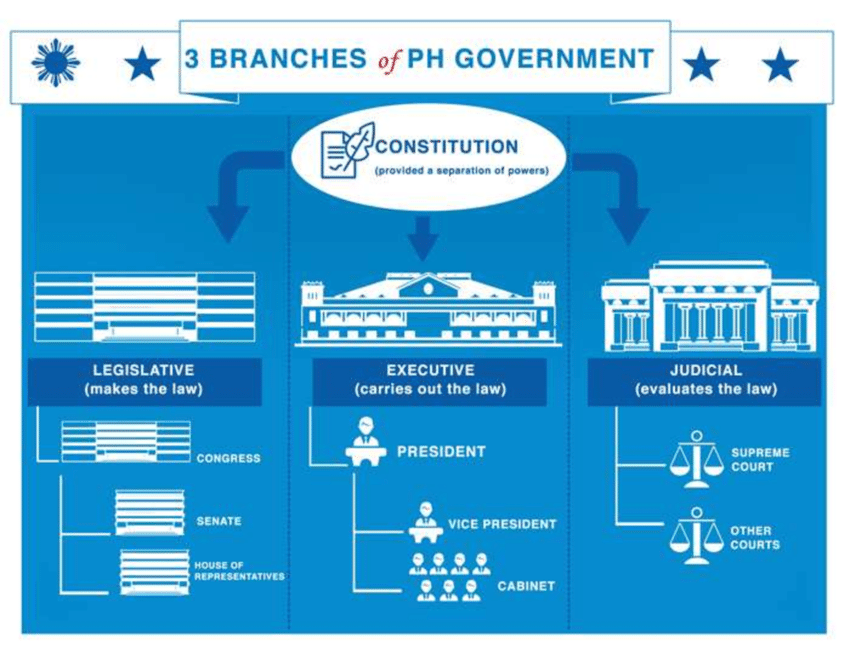
Embracing the concept of separation of powers, the constitution provides for a government that is divided into executive, legislative, and judicial departments. The executive branch is led by a president, who is simultaneously head of government and chief of state. There is a separately elected vice president. The constitution empowers a bicameral legislature and an independent judiciary, The presidency currently defined in the 1987 constitution is not as strong as it was under the 1973 constitution used in the Marcos era. [Source: Library of Congress *]
The Philippines republican form of government that was developed during the commonwealth period when the Philippines was a possession of the United States. The separation of powers is based on the theory of checks and balances. .and includes legislative and judicial limits on the power of the president The president cannot abolish Congress, and Congress can override a presidential veto with a two-thirds majority vote. Moreover, the president needs Congressional support in order to implement policies and programs. The Supreme Court rules on the constitutionality of presidential decrees.
Executive power is vested in a president elected by popular vote for a six-year term, with no eligibility for reelection. The president is assisted by a vice president, elected for a six-year term, with eligibility for one immediate reelection, and a cabinet, which can include the vice president. Legislative power rests with a two-chamber legislature. The senate has 24 members elected for six-year terms. A house of representatives is elected from single-member districts for three-year terms. [Source: Junior Worldmark Encyclopedia of the Nations, Thomson Gale, 2007]
RELATED ARTICLES:
GOVERNMENT OF THE PHILIPPINES: HISTORY, SYMBOLS, CONSTITUTION factsanddetails.com
ELECTIONS IN THE PHILIPPINES: ELECTORAL SYSTEM, IRREGULARITIES, CAMPAIGNS factsanddetails.com
2022 PHILIPPINE ELECTIONS factsanddetails.com
ELECTION AND POLITICAL VIOLENCE IN THE PHILIPPINES factsanddetails.com
MAGUINDANAO MASSACRE: EVENTS, KILLERS, POLITICS, TRIAL factsanddetails.com
POLITICS IN THE PHILIPPINES: POWERFUL FAMILIES, RICH BACKERS, PATRONAGE, CELEBRITY factsanddetails.com
POLITICAL PARTIES IN THE PHILIPPINES factsanddetails.com
POLITICIANS, THE CATHOLIC CHURCH AND PROTESTS IN THE PHILIPPINES factsanddetails.com
PEOPLE POWER AND THE FALL OF MARCOS factsanddetails.com
FERDINAND MARCOS: HIS LIFE, LIES, EDUCATION, WAR RECORD, POLITICAL RISE factsanddetails.com
FERDINAND MARCOS AS PRESIDENT: EARLY PROMISE, RESISTANCE, WASTE factsanddetails.com
MARTIAL LAW YEARS UNDER FERDINAND MARCOS factsanddetails.com
INDEPENDENCE FOR THE PHILIPPINES AFTER WORLD WAR II factsanddetails.com
PHILIPPINES IN THE 1950s AND 60s: HUK REBELLION, MAGSAYSAY, GARCIA AND MACAPAGAL factsanddetails.com
MARCOS’S PLUNDER AND WEALTH factsanddetails.com
Executive Branch of the Philippines
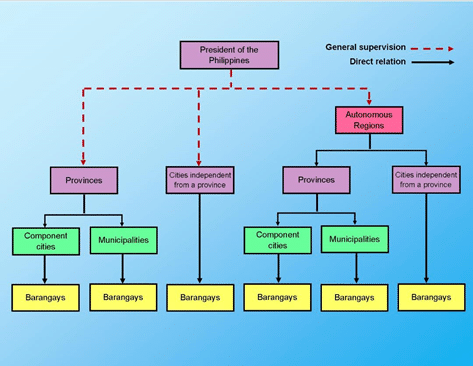
The Philippines President is head of the executive branch. The executive functions of the government are carried out through the Cabinet of Ministers. Department heads, who comprise the cabinet, are appointed by the president and must be approved by the Commission on Appointments and oversee day to day affairs of the government. The cabinet in 2005 consisted of heads of 22 departments and offices.The Cabinet is lead by secretaries rather than ministers. They earned less than $1,000 a month in 2000.
The constitution contains many clauses intended to preclude repetition of abuses such as those committed by Marcos. The president's spouse cannot be appointed to any government post (a reaction to Imelda Marcos's immoderate accumulation of titles and powers). The public must be informed if the president becomes seriously ill (a reaction to the belated discovery of numerous kidney-dialysis machines in Marcos's bedroom in Malacañang). The president is prohibited from owning any company that does business with the government. And the armed forces must be recruited proportionately from all provinces and cities as far as is practicable, in order to prevent a future president from repeating Marcos's ploy of padding the officer corps with people from his home province. [Source: Library of Congress *]
Constitutional safeguards also prevent the president from ruling indefinitely under emergency powers. Martial law may be proclaimed, but only for sixty days. The president must notify Congress of the institution of martial law within forty-eight hours, and Congress can revoke martial law by a simple majority vote. The president may not abolish Congress. The Supreme Court may review and invalidate a presidential proclamation of martial law. Of course, Congress can grant the president emergency powers at any time. *
In 1991 the president's cabinet consisted of the executive secretary (who controlled the flow of paper and visitors reaching the president), the press secretary, the cabinet secretary, and the national security adviser, and the secretaries of the following departments: agrarian reform; agriculture; budget and management; economic planning; education, culture, and sports; environment and natural resources; finance; foreign affairs; health; interior and local governments; justice; labor and employment; national defense; public works and highways; science and technology; social welfare and development; tourism; trade and industry; and transportation and communications. Cabinet members directed a vast bureaucracy — 2.6 million Filipinos were on the government payroll in 1988. *
Head of Government in the Philippine — The President
The President is the head of state, chief executive, and commander in chief of the armed forces. The president must be a natural-born citizen of the Philippines, at least forty years of age, and a resident of the Philippines for at least ten years immediately preceding the election. The president is elected to a six year term. He or she can serve a maximum of one term. In elections there are also separate ballots for the president and vice president. Only Congress can officially declare the president and vice president after election votes are counted.
The president is empowered to control all the executive departments, bureaus, and offices, and to ensure that the laws are faithfully executed. Presidential nominations of heads of executive departments and ambassadors are confirmed by a Commission on Appointments, consisting of twelve senators and twelve representatives. The president may grant amnesty (for example, to former communists, Muslim rebels, or military mutineers) with the concurrence of a majority of all the members of Congress and, as chief diplomat, negotiate treaties, which must be ratified by two-thirds of the Senate. [Source: Library of Congress *]
The salary of the president in 2000 was only $13,000. In the inauguration ceremony, the President places his or her hand on the Bible and solemnly swears to “faithfully and conscientiously perform my duties as President of the Philippines.” The impeachment process is similar to that of the United States. To oust a president two thirds of the senate must vote to oust him or her. The impeachment process can begin with the signing of a complaint with by a third of the House of Representatives. During the failed impeachment bids of President Arroyo’, the House of Representatives’ Justice Committee dismiss the complaints on technicalities, in one case by a vote of 42-8.
The president also supervises all local government units. The president has the power to issue executive orders, grant pardons, and exercise eminent domain. In addition to having the power to veto any bill, the president sets the legislative agenda for Congress. The president appoints justices to the Supreme Court upon recommendation of the Judicial and Bar Council but otherwise, at least in theory, the judiciary is independent. [Source: World Press Encyclopedia, Gale Group Inc., 2003; Wikipedia]
In 2025, the Philippine Congress enacted the Government Optimization Act (Republic Act No. 12231), which granted the president the authority to reorganize executive branch agencies. The law permits the merging, abolishing, or transferring of functions among offices to streamline operations, improve efficiency, and reduce redundancy within the national government. [Source: Wikipedia]
Palace and Yacht of the Philippine President
The President of the Philippines lives and works at the Malacañang Palace complex in San Miguel, Manila, along the Pasig River. It was built for the Spanish governors and later used by the American governors. While the main palace serves as the principal workplace, presidents typically reside in the nearby Bahay Pangulo (formerly Bahay Pangarap), a residential building within the same compound
Malacanang Palace is where Ferdinand and Imelda Marcos held court for 20 years before they were thrown out in the People Power demonstration in 1986. Built by a Spanish aristocrat and enlarged and refurbished by the Marcoses, it was subjected to exorcism by a Roman Catholic priest when Aquino came to power, and then turned it into a tourist attraction to bring attention to the excesses of the Marcos regime.
For many years Malacanang Palace was the most popular tourist attraction in the Philippines. Visitors were particularly interested in viewing Imelda Marcos's 508 floor-length gowns, 15 mink coats, 888 handbags, her famous 1,220 pairs of shoes (including one battery-powered pair that glowed in the dark), and 65 parasols as well as thousands of personalized Ferdinand Marcos golf balls and his and hers bullet proof vests. In 1997, President Ramos decided enough was enough. He ordered the removal of Imelda's possessions and a conversion of the palace into a stuffy museum on the Philippine presidency. The number of visitors to the palace plummeted. Although Malacanang Palace is not as interesting as it once was, it is worth a visit. You can still get a sense of what it was like in the Marcos years. One exhibit room is in Imelda's bedroom. Another is in her walk-in closet. Some of her shoes are now on display in a local shoe museum.
After he was elected president in May 2016, Rodrigo Duterte announced his intention to sell the Philippine presidential yacht, BRP Ang Pangulo, to raise funds for war veterans, hospital improvements, and higher salaries for doctors to discourage them from working abroad. He said the vessel would go to the highest bidder but did not specify an asking price. The 77-meter yacht was built in 1958 by Japan’s Ishikawajima-Harima Heavy Industries and was acquired by the Philippine government in 1959 as part of Japan’s war reparations. Former president Corazon Aquino had previously attempted to sell the yacht in 1986 for $5.5 million, but the effort failed. The vessel was damaged by fire during a 2006 refit and was renamed BRP Pag-Asa under President Gloria Macapagal Arroyo. In 2011, President Benigno Aquino III restored its original name, BRP Ang Pangulo, to preserve the heritage and prestige associated with the Philippine presidency. [Source: Yacht Harbour, June 1, 2016]
Vice President on the Philippines
The vice president holds limited executive authority unless the presidency became vacant, but running mates are important in mobilizing regional and political support. While the vice president may be re-elected an unlimited number of times (but only limited to two consecutive terms[2 The vice president is elected separately and sometimes belongs to a different political camp than the president. [Source: Wikipedia, Martin Petty, Reuters, May 5, 2022]
The vice president , who under the Philippine Constitution, may be appointed to the cabinet without legislative confirmation. The vice president has the same term of office as the president and is elected in the same manner. The vice president also may serve as a member of the cabinet. Unlike the president, the vice president may serve two consecutive six-year terms. The president and vice president do not run on the same ticket and may be political opponents. [Source: Library of Congress]
The vice president is usually but not always a member of the president's cabinet and can be appointed without the Commission on Appointments' approval. In the event of a vacancy in the vice presidency, the president appoints a member of Congress (typically a fellow party member) as the new vice president. This appointment must then be validated by a three-fourths vote of Congress. [Source: Wikipedia]
The president and vice president are not elected as a team. Thus, they may be ideologically opposed, or even personal rivals. In one case the vice president was a rival of the president who became president after the president was ousted. In 2001, when millions of Filipinos took to the streets and said 'enough' of President Joseph Estrada. Following the withdrawal of support by the armed forces, Estrada was forced out of office on January 20, 2001 and Vice-president, Gloria Macapagal-Arroyo (popularly called 'GMA') was sworn in as president.
Legislative Branch of the Philippines
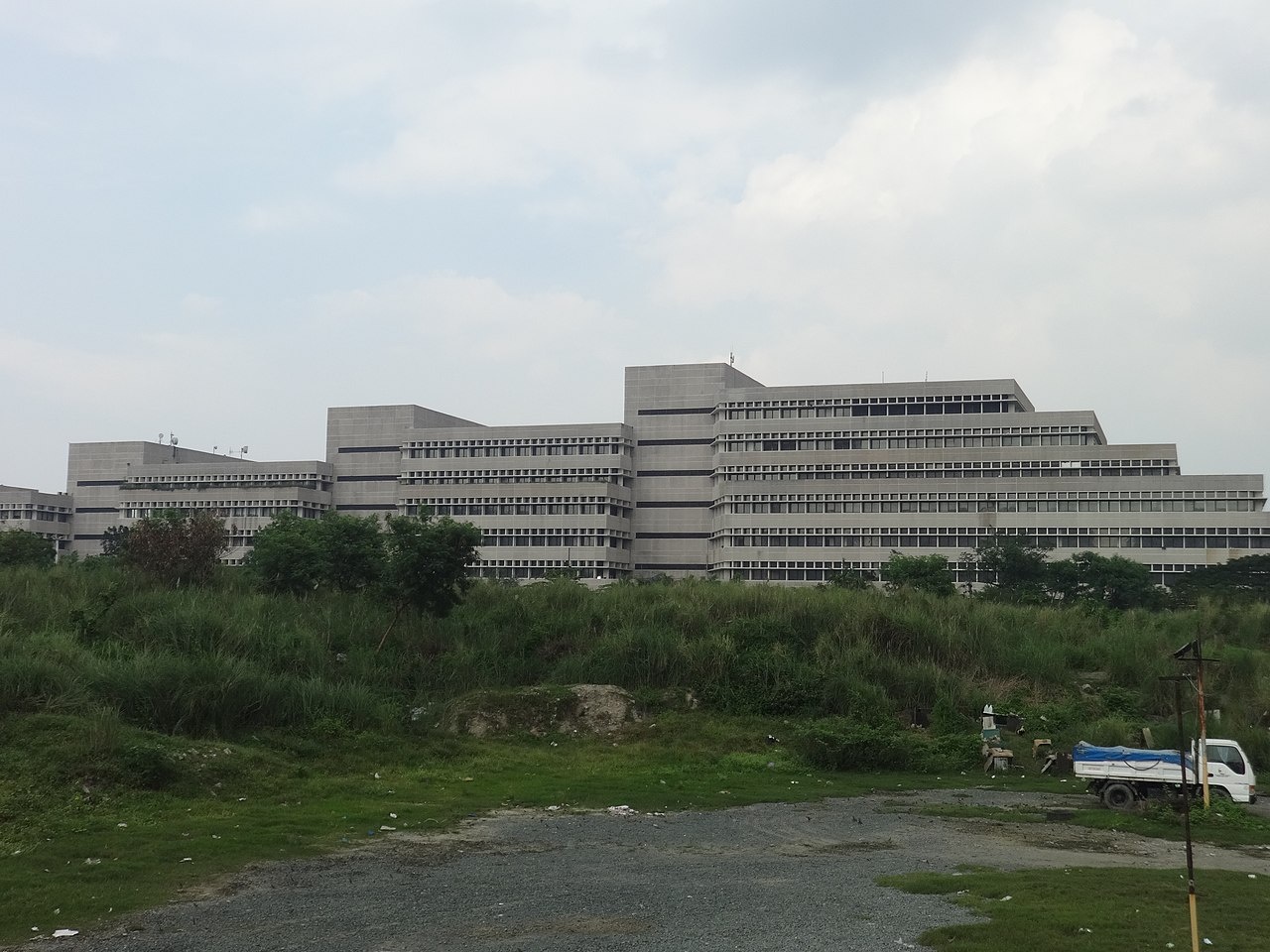
The Philippines is unusual among developing countries in having a strong, bicameral legislature. The constitution establishes a 24-seat Senate and a House of Representatives with 200 elected representatives and up to 50 more appointed by the president. Senators are chosen at large, and the twenty-four highest vote-winners nationwide are elected. Senators must be native-born Filipinos at least thirty-five years old. The term of office is six years, and senators cannot serve more than two consecutive terms. [Source: Library of Congress *]
House of Representatives members are elected in single-member districts, reapportioned within three years of each census. Representatives must be native-born Filipinos and at least twenty-five years of age. Their term of office is three years. They may not serve for more than three consecutive terms. In addition, President Aquino was to be empowered to appoint to the House of Representatives up to twenty-five people from "party lists." This stipulation was intended to provide a kind of proportional representation for small parties unable to win any single-member district seats. However, Congress did not pass the necessary enabling legislation. The president also is allowed to appoint up to twenty-five members from so-called sectoral groups, such as women, labor, farmers, the urban poor, mountain tribes, and other groups not normally well-represented in Congress, "except the religious sector." Making these appointments would have provided an opportunity for Aquino to reward her supporters and influence Congress, but she has left most such positions unfilled. All members of both houses of Congress are required to make a full disclosure of their financial and business interests. *
The constitution authorizes Congress to conduct inquiries, to declare war (by a two-thirds vote of both houses in joint session), and to override a presidential veto with a two-thirds vote of both houses. All appropriations bills must originate in the House, but the president is given a line-item veto over them. The Senate ratifies treaties by a two-thirds vote. *
The leader of the Senate— the Senate president— stands next in the line of succession for the presidency after the country's vice president. Generally, the Senate had a reputation as a prestigious body with a truly national outlook, in contrast to the House of Representatives, which had more parochial concerns. The internal operation of Congress has been slowed by inefficiency and a lack of party discipline. Legislation often has been detained in the forty-three House and thirty-six Senate committees staffed with friends and relatives of members of Congress. Indicative of the public frustration with Congress, in 1991 the National Movement for Free Elections (NAMFREL) and the Makati Business Club formed a group called Congresswatch to monitor the activities of sitting congress members and promote accountability and honesty.
Legislature of the Philippines

The bicameral Philippines Congress (Kongreso) is made up of 318 -seat (2025) House of Representatives (Kapulungan Ng Nga Kinatawan, lower chamber) and a 24-seat Senate (Senado, upper chamber). The Senate has a lot of power and has traditionally been dominated by the elite landowning families. Senators can serve two consecutive six-year terms They are chosen through a national rather than local vote and thus are expected to have a national vision and not be tied down by local interests. Elections for 12 Senators are held every three years. The House of Representatives is made up of Congressmen and women elected from districts. They can serve up to three three-year terms and also are often members of the landowning elite.
The two chambers have roughly equal powers, and every bill or resolution that has to go through both houses needs the consent of both chambers before being passed for the President's signature. By means of a two-thirds majority vote, Congress can override presidential vetoes and declare a state of war. [Source: Wikipedia]
The first free congressional elections in nearly two decades were held on May 11, 1987. The pre-martial law Philippine Congress, famous for logrolling and satisfying individual demands, was shut down by Marcos in 1972. The 1973 constitution created a rubber-stamp parliament, or National Assembly, which only began functioning in 1978 and which was timid in confronting Marcos until some opposition members were elected in May 1984.In the 1987 elections, more than 26 million Filipinos, or 83 percent of eligible voters, cast their ballots at 104,000 polling stations. [Source: Library of Congress *]
Philippines Senate
The Senate and House of Representatives are is located in different places. The Senate is in Pasay in Metro Manila. The leader of the Senate is the president of the Senate. Senators must be native-born Filipinos and at least 35 years old. One-half of the Senators are elected every three years. They are elected at large by popular vote to serve six-year terms. Senators may be re-elected, but they cannot run for a third consecutive term.
The Senate of the Philippines is the upper house of Congress. Once a bill is approved by the House of Representatives, it is sent to the Senate for consideration. In order to become law, a bill must first be approved by the Senate and then sent to the president for signature. Only the Senate has the power to ratify treaties and try impeachment cases. [Source: Wikipedia]
Adrian Chen wrote in The New Yorker: The historian Alfred McCoy has described the Philippine Senate as “a collection of basketball players, television personalities, movie stars, and failed coup plotters.” One member of the Justice Committee investigating the extrajudicial killings was Antonio Trillanes IV, who has led two coup attempts. Another, Panfilo Lacson, who headed an élite Manila police squad in the nineties, was accused of massacring eleven unarmed bank robbers. Senator Manny Pacquiao, the boxing star and Duterte ally, led an effort to depose De Lima as leader of the Senate hearings. Her replacement was Senator Richard Gordon, who recently suggested giving Duterte the power to suspend habeas corpus. After the Matobato hearing, a journalist texted me, “What you witnessed was another installment of our national telenovela.” [Source: Adrian Chen, The New Yorker, November 21, 2016]
Philippines House of Representatives
The House of Representatives of the Philippines is the lower house of Congress. It consists of district and sectoral representatives. Each bill must be approved by the House before being sent to the Senate. Furthermore, all franchise and money bills must originate in the House. The House of Representatives also has the power to impeach certain officials. House of Representatives members must be native-born Filipinos and at least 25 years of age. House of representatives Districts are reapportioned within three years of each census. The House is led by the speaker of the House. [Source: Wikipedia]
Members of the House are officially referred to as representatives (mga kinatawan) and are sometimes informally called congressmen or congresswomen (mga kongresista). Members are elected to three-year terms and may be re-elected, but they cannot serve more than three consecutive terms without an interruption of at least one term (e.g., serving one term in the Senate ad interim). Approximately 80 percent of congressmen are district representatives who represent specific geographical areas. The 20th Congress, which convened in 2025 has 318 members— 254 congressional district representatives and 64 party-list representatives. Party-list representatives, who make up no more than 20 percent of the total number of representatives, are elected through the party-list system.
The House of Representatives is located in Quezon City in Metro Manila. In the mid 2010s the the House of Representatives contained 287 seats — 230 members in one tier representing districts and 57 sectoral party-list members in a second tier representing special minorities elected on the basis of one seat for every 2 percent of the total vote but with each party limited to three seats). A party represented in one tier may not hold seats in the other tier; all House members are elected by popular vote to serve three-year terms. The constitution limits the House of Representatives to 250 members; the number of members allowed was increased, however, through legislation when in April 2009 the Philippine Supreme Court ruled that additional party members could sit in the House of Representatives if they received the required number of votes. [Source: CIA World Factbook]
In 2005 there were 238 members in the House of Representatives, of whom 214 (80 percent) were elected for three-year terms from legislative districts apportioned among the 20provinces, cities, and the Metropolitan Manila area in accordance with the population, on the basis of a uniform and progressive ratio. The other 24 members (limited by the constitution to 20 percent of the total) were presidential appointees elected through a party-list system of registered national, regional, and sectoral parties or organizations. In 2004, 212 members were elected. Up to 52 more may be appointed by the president from "party lists" and "sectoral lists." [Source: Worldmark Encyclopedia of Nations, Thomson Gale, 2007]
Judicial Branch in the Philippines
The Philippines has an independent judiciary,. Judicial power in the Philippines is vested in the Supreme Court of the Philippines and in the lower courts established by law. The highest court — the Supreme Court — consists of a chief justice and 14 associate justices). Justices are appointed by the president on the recommendation of the Judicial and Bar Council, a constitutionally-created, 6-member body that recommends Supreme Court nominees. Justices serve until age 70. [Source: CIA World Factbook]
The Supreme Court as the highest court of appeal. The Supreme Court also is empowered to review the constitutionality of presidential decrees. It is not necessary for the entire court of 15 justices to convene in all cases. Below the Supreme Court are several lower collegiate courts that exercise appellate jurisdiction. These include the Court of Appeals, which reviews decisions of trial courts and certain quasi-judicial agencies; the Court of Tax Appeals, which handles tax-related cases; and the Sandiganbayan, a special court that primarily hears cases involving graft and corruption committed by public officials. [Source: Wikipedia]
The regular trial courts consist of the Regional Trial Courts, which have general jurisdiction over civil and criminal cases. At the first level are the Metropolitan Trial Courts, Municipal Trial Courts, Municipal Trial Courts in Cities, and Municipal Circuit Trial Courts, each of which handles less serious criminal offenses and smaller civil cases within their respective territorial jurisdictions. In addition, Sharia Courts operate in certain areas of the country to apply Islamic law in specific cases involving Muslim Filipinos. These include the Sharia District Courts and the Sharia Circuit Courts, which have jurisdiction over matters such as marriage, divorce, and inheritance under the Code of Muslim Personal Laws.
The national Court of Appeals is divided into 17 divisions. There is an informal local system to settle certain disputes outside the formal court system. In 1985 a separate court system founded on Islamic law (sharia) was established in the southern Philippines with jurisdiction over family and contractual relations among Muslims. Three district magistrates and six circuit judges oversee the Islamic law system. A special court—the Sandiganbayan or anti-graft court—focuses exclusively on investigating charges of judicial corruption. [Source: Library of Congress, 2006]
The 1981 Judicial Reorganization Act provides for four main levels of courts and several special courts. At the local level are metropolitan trial courts, municipal trial courts, and municipal circuit trial courts. The next level consists of regional trial courts, one for each of the nation's thirteen political regions, including Manila. Courts at the local level have original jurisdiction over less serious criminal cases while more serious offenses are heard by the regional level courts, which also have appellate jurisdiction. At the national level is the Intermediate Appellate Court, also called the court of appeals. Special courts include Muslim circuit and district courts in Moro (Muslim Filipino) areas, the court of tax appeals, and the Sandiganbayan. The Sandiganbayan tries government officers and employees charged with violation of the Anti-Graft and Corrupt Practices Act. [Source: Library of Congress, 1991 *]
Image Sources: Wikimedia Commons
Text Sources: New York Times, Washington Post, Los Angeles Times, Times of London, Lonely Planet Guides, Library of Congress, Philippines Department of Tourism, Compton’s Encyclopedia, The Guardian, National Geographic, Smithsonian magazine, The New Yorker, Time, Newsweek, Reuters, AP, AFP, Wall Street Journal, The Atlantic Monthly, The Economist, Foreign Policy, Wikipedia, BBC, CNN, and various books, websites and other publications.
Last updated February 2026