
ELECTION VIOLENCE IN THE PHILIPPINES

Campaign, election and political violence is a serious problem in the Philippines. There are clashes between supporters of rival politicians, attacks and arson at voting stations, gunfights at rallies, assassinations of candidates and assassinations by candidates. The problem is particularly acute in remote areas where insurgents, outlaws and armed militias often exert more control than the government.
There is often violence around elections in the Philippines, consequently there is a nationwide ban on private citizens carrying firearms outside homes or workplaces during the election period. Candidates are also not permitted to use security personnel not approved by Comelec. [Source: Jonathan Head, BBC, May 8, 2016]
More than a hundred people were killed in election-related violence in 1988. Elections had to be postponed in six Muslim provinces, two Ilocano provinces, two New People's Army-dominated provinces, and Ifugao because of unsettled conditions. The Commission on Elections assumed direct control of many towns, including some parts of Manila. The formerly unwritten rule of Filipino politics that political killings be confined to followers and henchmen and not to the candidates themselves now seemed to have been broken: Thirty-nine local candidates were killed in the 1988 campaign. Aquino remained aloof from the 1988 local elections, but many candidates claimed her backing. Personalities and clan rivalries seemed to take precedence over ideological issues.* Something like 116,000 soldiers and 26,000 police were assigned to prevent violence at the 1998 election.
Elections in the 2000s were particularly violent, compounded by long-running Islamist and communist insurgencies that heightened political tensions. The 2004 presidential elections left 189 people dead and 279 wounded. [Source: RTE, May 9, 2007]
At least 46 people were killed in the three months leading up to the May 2013 midterm elections, according to police. On election day, assailants fired a grenade at a school in southern Marawi City where voting was underway, but missed and hit a house, wounding three people. In nearby Sulu province, armed followers of a mayoral candidate clashed with marines, who had replaced local police. [Source: Hrvoje Hranjski, Associated Press, May 13, 2013]
RELATED ARTICLES:
MAGUINDANAO MASSACRE: EVENTS, KILLERS, POLITICS, TRIAL factsanddetails.com
POLITICS IN THE PHILIPPINES: POWERFUL FAMILIES, RICH BACKERS, PATRONAGE, CELEBRITY factsanddetails.com
POLITICAL PARTIES IN THE PHILIPPINES factsanddetails.com
POLITICIANS, THE CATHOLIC CHURCH AND PROTESTS IN THE PHILIPPINES factsanddetails.com
GOVERNMENT OF THE PHILIPPINES: HISTORY, SYMBOLS, CONSTITUTION factsanddetails.com
BRANCHES OF THE PHILIPPINES GOVERNMENT: EXECUTIVE (PRESIDENT), LEGLISLATURE, JUDICIARY factsanddetails.com
ELECTIONS IN THE PHILIPPINES: ELECTORAL SYSTEM, IRREGULARITIES, CAMPAIGNS factsanddetails.com
2022 PHILIPPINE ELECTIONS factsanddetails.com
PEOPLE POWER AND THE FALL OF MARCOS factsanddetails.com
FERDINAND MARCOS: HIS LIFE, LIES, EDUCATION, WAR RECORD, POLITICAL RISE factsanddetails.com
FERDINAND MARCOS AS PRESIDENT: EARLY PROMISE, RESISTANCE, WASTE factsanddetails.com
MARTIAL LAW YEARS UNDER FERDINAND MARCOS factsanddetails.com
INDEPENDENCE FOR THE PHILIPPINES AFTER WORLD WAR II factsanddetails.com
PHILIPPINES IN THE 1950s AND 60s: HUK REBELLION, MAGSAYSAY, GARCIA AND MACAPAGAL factsanddetails.com
100 dead in 2007 Philippines Election Violence
About a week before elections were scheduled to take place, the death toll from election-related violence in the Philippines reached 100 as the country prepared for the May 14, 2007 polls. Authorities reported that since campaigning began in January, 53 candidates and 47 civilians had been killed. Election periods in the country are frequently marked by bloodshed, with rival political groups often relying on private militias to intimidate opponents and voters.[Source: RTE, May 9, 2007]
In response to the escalating violence, the military was deployed to several hotspots. The province of Nueva Ecija was placed under special military control by the Commission on Elections after a series of killings. In one incident, a 45-year-old councilor was shot multiple times while on his way to work. Shortly afterward, the driver of a mayoral candidate was shot in the leg and later died from blood loss.
Activists accused members of the military and police of campaigning against anti-government candidates. A group of retired generals calling themselves “Bantay Boto” (Vote Guards) alleged that some military officials were colluding with election authorities to manipulate results in about a dozen provinces in favor of allies of then-President Gloria Macapagal Arroyo. They claimed that as many as 14 million of the estimated 45 million votes could have been affected.
Voters were set to choose 12 senators, all 230 members of the House of Representatives, and thousands of local officials, including mayors and provincial governors. n a separate incident, three people were killed and 33 injured in a bomb explosion in Tacurong City in the southern Philippines. Police blamed the attack on Jemaah Islamiah, an Islamist group linked to al-Qaeda, and said it was not connected to the elections.
Violence During the 2010 Philippines Election
The BBC reported: Despite high security, voting was marred by the deaths of at least 12 people in political violence. The deaths came after a bloody campaign period in which more than 30 people died. Another 57 died in a mass killing in November. In the latest reported violence, the AFP news agency said communist insurgents had ambushed an election convoy in the south of the country, killing six people and wounding 12. [Source: BBC, May 11, 2010]
At least seven people were killed and eight wounded on Monday, in addition to about 30 people gunned down in the last three months in violence tied to the election, police said. A marine and a civilian acting as a congressional candidate's bodyguards were killed in a clash outside a police station in Bacoor township in Cavite province, south of Manila. Troops and gunmen exchanged fire in southern Maguindanao province, where 57 people were massacred in the country's worst election-related attack last year, said army Lieutenant General Raymundo Ferrer. Two civilians were killed in fighting between armed followers of rival candidates for vice mayor, he said. About 130 deaths preceded the last vote in 2007.
Twenty-Two Killed Ahead of Philippine Village Elections in 2013
In October 2013, Associated Press reported: “At least 22 candidates and supporters have been killed in election-related violence over the past month ahead of this week’s village polls across the Philippines, police said. Twenty-seven other people have been wounded in violence linked to election rivalries, mostly in shootouts, national police spokesman Senior Superintendent Reuben Theodore Sindac said. At least 588 people have been arrested for violating an elections gun ban, with police confiscating nearly 500 firearms, 4,000 rounds of ammunition, 191 knives and 68 grenades. Fifteen people were killed in village election violence in 2010, Sindac said. [Source: Associated Press, October 28, 2013]
Government troops and police have gone on full alert for the daylong balloting, especially in about 6,000 of 42,028 villages nationwide considered security hotspots due to a history of electoral violence or past attacks by Muslim and communist insurgents or al-Qaida-linked militants. “Our elections in the past have always been marred by untoward incidents,” military spokesman Lt. Col. Ramon Zagala said, adding that government forces would guard against “spoilers to this democratic exercise.”
In the latest violence, unidentified men opened fire on a police car carrying an elections officer and policemen, setting off a gunbattle that wounded the poll official, two policemen and a civilian in Palanas town in central Masbate province, police said. Police arrested the son of a candidate for village chairman and 16 other supporters, some of them armed with shotguns and pistols, for allegedly threatening a rival candidate in southern South Cotabato province, police said. Officials have postponed elections in central Bohol province, which was devastated by a strong earthquake on Oct. 15 that killed more than 200 people, and in southern Zamboanga city, where Muslim rebels occupied coastal villages and took scores of residents hostage in a three-week standoff last month that killed more than 200 combatants and civilians.
Village Chiefs Killed in Election Violence
In January 2010, Associated Press reported: “Gunmen barged into the home of a village leader in the central Philippines, killing him in front of his family in the latest violence ahead of May elections, the military said. Danny Amor was shot several times in the back with silencer-fitted pistols as he had dinner at home with his family in Masbate province's San Jacinto township, said Maj. Harold Cabunoc, an army spokesman. Cabunoc said politics was believed behind the killing, the second poll-related murder in the province in three days. The head of a village leaders' association was shot dead days earlier in Esperanza township. Wednesday, National Police Chief Jesus Verzosa put Masbate province under special police watch because of the province's history of poll violence. Nearly a third of Philippine cities and municipalities have been identified as potential hotspots for election unrest. [Source: Associated Press, January 22, 2010]
In 2007, the Philippine Daily Inquirer reported: “Two elected village chiefs were killed in separate incidents hours after voting ended in barangay (village) and Sangguniang Kabataan (Youth Council) elections. The latest reports have increased the number of cases of election-related violence to 50, police said. A Philippine Daily Inquirer report from Shariff Kabunsuan said that in Sultan Kudarat, Samsodin Lumbos, a newly proclaimed village chief of Balut, was shot to death by unidentified suspects. Another Inquirer report from Tacloban City said Marcos Anquillo, who was reelected village chief of Zone 3 and a village watchman, identified as Roger Reyes, were shot dead earlier on the same day. The Inquirer report from Shariff Kabunsuan quoted Superintendent Ismael Ali, Shariff Kabunsuan police director, as saying that Lumbos was killed near the Sultan Kudarat Municipal Hall around 11:30 p.m. Monday. "The victim had just been proclaimed winner defeating an administration candidate when he was shot dead in a dark portion near the municipal hall," Ali said. He said the incident was the second election-related killing in the province. On Oct. 18, reelectionist Senditan barangay chairman Hadji Akmad Abdullah and village councilor Monib Ali were killed in an ambush by unidentified gunmen. [Source: Joey A. Gabieta, Edwin Fernandez, Charlie Señase, Philippine Daily Inquirer, October 30, 2007]
Political Violence in Mindanao
In 2010, Chico Harlan wrote in the Washington Post, “In November 2009, several members of Mindanao’s mightiest political family, the Ampatuans, orchestrated the massacre of 57 people - friends and supporters of a rival politician, as well as at least 30 journalists. A subsequent discovery lent credence to the widespread claims that the Armed Forces of the Philippines (AFP) and the national police had favored the Ampatuans, willing to overlook their misdeeds as long as they helped in the fight against the MILF. According to a government report, weapons used in the massacre had been originally licensed to the army and police. [Source: Chico Harlan, Washington Post, October 30, 2010 =/=]
“During a three-mile trip Lt. Col. Benedict Arevalo, “riding in an eight-vehicle convoy, scanned both sides of the road, pointing to buildings carved by old firefights. He talked about this lush island’s warring factions as if describing a headache that cannot be relieved: The government battles the MILF rebels, leaving the cease-fire as mere rhetoric. Families take sides, building their own guerrilla groups. The government favors particular families, allowing them to stockpile arms to fight the rebels. Families without government support grow resentful, forming alliances with the rebels. =/=
“It’s a decades-old struggle. Arevalo’s father, a former military official, spent the 1970s trying to negotiate peace here. Muslims settled the area well before the Spaniards’ arrival in the 16th century, and they outlasted American control at the turn of the 20th century, becoming a minority only in the 1960s, when the Manila government pushed for Christian resettlement in Mindanao. Though the Philippines in 1996 granted the Muslims an autonomous region, the MILF seeks more land. “Over there, that’s MILF territory,” Arevalo said, pointing to his left. “We’re talking by the thousands. They’re just one kilometer away. We do not go to those areas.” =/=
“In three previous barangay elections, roughly 120 candidates had been killed. Arevalo had his own reasons for concern. In September, the government arrested two key MILF officials. Based on army intelligence - humidity-curled reports that Arevalo carried on a clipboard - the MILF now plotted revenge. It had buried five to eight roadside bombs, the reports said, within Mindanao’s troubled Maguindanao province, and Arevalo was a likely target. =/=
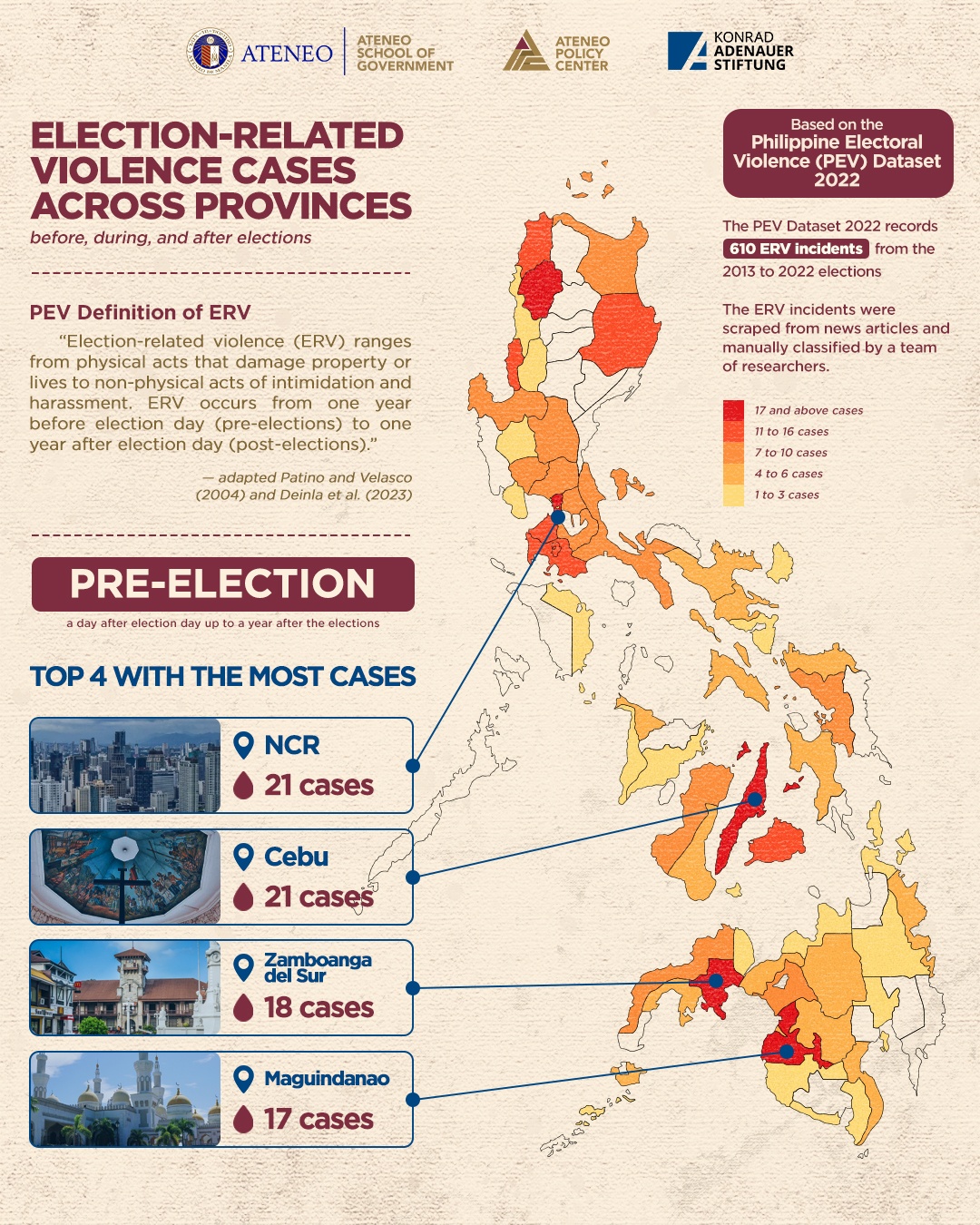
Four people were killed in violent clashes between the rival Sabal and Buisan clans in Maguindanao following the May 9 elections, in which Mayor Muntasir Sabal retained his post against a Buisan-backed challenger. A Buisan family member was killed before the vote, and three more people died in fighting that erupted days later, forcing about 15,000 residents to flee the town of Talitay. Authorities said the feud was intensified by ties on both sides to the Moro Islamic Liberation Front (MILF) and the Moro National Liberation Front (MNLF), former insurgent groups that have signed peace agreements with the government but whose members have not fully disarmed. While the military deployed troops, they avoided direct engagement to preserve the ceasefire, as religious leaders and MILF representatives sought to broker peace. [Source: AFP, May 16, 2016]
Maguindanao Massacre
Maguindanao has a long history of clan-related political violence, including the 2009 massacre in which 58 people were killed during an election dispute. On the morning of November 23, 2009, a group of people including 31 reporters accompanied the family of Esmael Mangudadatu, a rival of the Ampatuans, a powerful political clan, to witness the filing of his election papers for the forthcoming gubernatorial election in Maguindanao, a province on the island of Mindanao in the southern Philippines.
According to Reuters, “The convoy was attacked, leaving 58 dead in a massacre described by the International Crisis Group as “one of the worst acts of political violence in modern Philippine history, and the largest number of journalists slain on a single day ever, anywhere in the world.” About 100 armed men ambushed the convoy of vehicles on a lonely stretch of highway and drove them to the top of a hill before killing them all. Several women were raped before they were killed. Andal Ampatuan Sr., the patriarch whose family ruled poor and troubled southern Maguindanao for nearly a decade and hadclose ties to former president Gloria Macapagal Arroyo, was charged with murder in February 2010, along with 197 others including his sons, other relatives, soldiers, police officers and members of a civilian militia. [Source: Thin Lei Win, Reuters, July 2, 2013]
The Maguindanao massacre, also known as the Ampatuan massacre after the town where the mass graves were discovered, was one of the deadliest incidents of political violence in Philippine history. The 58 victims were traveling to submit a certificate of candidacy for Esmael Mangudadatu, then vice mayor of Buluan, when they were abducted and savagely murdered. Mangudadatu was running against Andal Ampatuan Jr., the mayor of Datu Unsay and son of then-Maguindanao governor Andal Ampatuan Sr.. The Ampatuans were a powerful Muslim political clan in Mindanao, and the rivalry was part of the broader 2010 national and local elections. Those killed included Mangudadatu’s wife and two sisters, as well as journalists, lawyers, campaign aides, motorists, and other civilians—some of whom were either witnesses or mistakenly believed to be members of the convoy.[Source: Wikipedia +]
See Separate Article: MAGUINDANAO MASSACRE: EVENTS, KILLERS, POLITICS, TRIAL factsanddetails.com
Effort to End Political Violence in the Philippines
In January 2010, in an attempt to forestall violence ahead of the polls, the Philippines initiated a five-month, nationwide ban on carrying guns in public, and at least 357 violators have been arrested so far, including 52 police and military personnel found with weapons while not in uniform or on duty.
Chico Harlan wrote in the Washington Post, “The government in Manila has tried to ensure safe elections, setting up checkpoints throughout the country to clamp down on illegal guns and banning liquor sales the day before the vote. In Mindanao, though, the partial downfall of the Ampatuan clan opened a power vacuum. Of the Philippines’ 42,025 townships (or “barangays”), the government had designated 2,655 hot spots where violence was likely. More than half were in Mindanao. [Source: Chico Harlan, Washington Post, October 30, 2010 =/=]
Effort to End Political Violence in Mindanao
In 2010, Chico Harlan wrote in the Washington Post, “Lt. Col. Benedict Arevalo headed to a ramshackle town hall to join about 100 local candidates who had gathered to sign an agreement promising not to kill one another in the final days of campaigning before local elections. About 70 percent of the population owns guns here on the Philippines’ main southern island of Mindanao, and politics seems a lot like combat, as candidates from feuding families and clashing religions battle for even the smallest chunks of power. For decades, the Philippine army had crafted its own alliances, picking sides in the political fights rather than refereeing them, and Arevalo represented the military’s new push for neutrality. [Source: Chico Harlan, Washington Post, October 30, 2010 =/=]
“Arevalo, assigned to this bloody section of the Philippines in December, describes his territory as “lawless.” Its challenges, which include an Islamic rebel group (the Moro Islamic Liberation Front, or MILF), have prompted the United States to station troops in Mindanao since 2002. Local elections, Arevalo knew, would reawaken skepticism about the military’s ability to step away from its own history. At the peace signing Thursday, he had the chance to defuse some of those doubts. “We want to remove the AFP from the warring families and take a more objective position,” said Col. Mayoralgo De La Cruz, whose 1st Mechanized Infantry Brigade also patrols the area. “As much as possible, we are not taking sides.” =/=
“At the town hall, about 200 hundred local residents and small-time politicians passed through an entrance gate, guarded by a dozen soldiers. Local election official Norhda Dipatuan introduced the peace agreement “in the name of Allah, most gracious and merciful.” She then asked the candidates to separate MILF disputes from political disputes, and called for a “politically neutral environment where fellow candidates are free to campaign without fear of harassment or violent acts from rival candidates.” Some nodded their heads. =/=
“At the peace covenant, Arevalo directly addressed the MILF, as if hoping his voice would carry beyond the walls. He said he knew where the group’s leaders live. He said the army was exercising restraint. And he asked for orderly, fair elections. Arevalo recognized the pact as a half-step. In some barangays, 10 people were running for the top “chairman” positions. On street stalls and rickety wooden houses, candidates hung their posters - often nothing more than an unsmiling head shot. But few campaigned, fearing for their security.” =/=
Violence Against Team Attempting to End Political Violence in Mindanao
In 2010, Chico Harlan wrote in the Washington Post, “One current barangay captain, Maruan Edzla, 25, said he inherited his position in 2006, taking over for his father, who was shot by three MILF rebels. Thursday afternoon, Edzla signed the peace covenant. So did one of his rival candidates. Two did not. As Arevalo returned to his convoy, he said that a hundred candidates swearing peace helps him “narrow down the number of people you have to worry about.” [Source: Chico Harlan, Washington Post, October 30, 2010 =/=]
“Arevalo’s convoy headed back to the battalion camp in the darkness, a bad time to head anywhere in Mindanao. At 6:25 p.m., two quick explosions shook the two-lane road, and everything was bathed in dust. The Humvee leading the convoy pulled a U-turn, returning to the spot of the blasts, and soon Arevalo’s men were out of the vehicle, gunfire coming from both sides of the road. For two minutes, weapons boomed and echoed, and then it was all over. Several convoy vehicles’ windows had been splintered by shrapnel and gunfire. A bullet fragment had slipped through the Humvee door, spider-webbing the bulletproof glass and nipping the driver, Jackson Martinez, on the cheek. But that was the lone army injury. =/=
“For the rest of the night and into morning, Arevalo and his men obsessed over re-creating the sequence of events. They guessed that 15 enemies had been waiting in the hillsides, scattering after the attack. Bomb squad experts found two craters and fragments of two cellphones, used for remote detonation. Army officials determined that the first blast came from a 105mm howitzer, the next from a 66mm mortar round. Their remnants were covered in yellow plastic bags. “It’s the MILF. It’s the MILF,” Arevalo said.”They’ll deny it. . . . But the cellphone - this is the signature of the special ops group of the MILF.” =/=
“In the incident report Arevalo would later approve, the AFP attributed the attack to the MILF - a revenge ambush for last month’s arrests. In private moments, Arevalo would acknowledge that he was likely the target. But the only certainty was the ambush’s end result. During the firefight, a civilian vehicle stuck just behind the military convoy couldn’t get away in time. Errant shots from one of the hillsides, according to soldiers, killed two of the vehicle’s passengers: Salik Talipasan and Ustadz Nasser. Talipasan was a local barangay chairman, running for reelection. Hours before his death, he had signed the peace covenant.” /
Murder of Politicians in the Philippines
Political violence is not confined to candidates running in elections that threaten the oligarchy status quo. It can strike sitting politicians—and innocent bystanders. In December 2013, Al Jazeera reported: Gunmen shot and killed a town mayor and three others at the airport in Manila, prompting travelers to flee for their safety, according to authorities. Ukol Talumpa, the mayor of Labangan, Zamboanga del Sur, was killed alongside his wife, an 18-month-old baby, and one other person," reported Al Jazeera's Jamela Alindogan from Manila on Friday. Four other people were wounded in the incident, said Jose Honrado, the airport manager. [Source: Al Jazeera, December 20, 2013]
Honrado said Talumpa was waiting for a ride with his family outside an airport terminal when gunmen on a motorcycle shot him and others at close range. The airport security force chased the gunmen, but they escaped in their vehicle amid the heavy late-morning traffic outside the terminal. Honrado added that the authorities did not know the identity of the attackers nor the motive for the attack. "Government agencies are trying their best to determine the perpetrators and bring them to justice," he said. Talumpa, a member of the political opposition, won a hotly contested mayoral election in Labangan last May.
In March 2024, a Filipino congressman, Arnolfo Teves Jr., was arrested in Dili, East Timor deported to the Philippines to face criminal charges that he masterminded the March 2023 killings of Negros Oriental Gov. Roel Degamo and eight others at Degamo’s home in Pamplona town. At least six gunmen wearing military-style uniforms reportedly entered the compound and opened fire, killing nine people and wounding 17 others, including a doctor and two soldiers. The attackers fled in sport utility vehicles, and several suspects were later arrested. [Source: Associated Press, March 22, 2024]
Teves has denied involvement, claiming he was set up. He also faces separate allegations related to a 2019 triple killing and violations of gun and explosives laws after authorities found assault weapons and ammunition in his family’s compound. President Ferdinand Marcos Jr. described the killing of Degamo, a political ally, as “purely political” and condemned the violence.
Image Sources: Wikimedia Commons
Text Sources: New York Times, Washington Post, Los Angeles Times, Times of London, Lonely Planet Guides, Library of Congress, Philippines Department of Tourism, Compton’s Encyclopedia, The Guardian, National Geographic, Smithsonian magazine, The New Yorker, Time, Newsweek, Reuters, AP, AFP, Wall Street Journal, The Atlantic Monthly, The Economist, Foreign Policy, Wikipedia, BBC, CNN, and various books, websites and other publications.
Last updated February 2026