
POLITICIANS IN THE PHILIPPINES
Personality and image count for a lot on Philippines politics. Presidential candidates have included high school drop out movie stars. In some cases they have had no public service experience before running for office. It is common in Philippine politics for movie stars, basketball players and comedians to be elected to public office. The two top vote getters in a 1992 Senate election were a former action-movie star and slapstick comedian. In the 1998 election, more than 100 candidates in national elections were former entertainers. Former police chief and Manila mayor Alfredo Lim was nicknamed "Dirty Harry" for having little respect for civil liberties.
According to everyculture.com: “Men of rank in the military also move into the political arena. Joseph Estrada, whose term as president is 1998–2004, entered the public eye as a popular film star. He then became the mayor of a large city and went on to become vice president in the Ramos administration. Previous presidents have had political or military backgrounds, with the exception of Corazon Aquino, the president from 1986 to 1992, who became politically active after her husband was assassinated. [Source: everyculture.com]
It is also not unusual for Philippines politicians to have a criminal record. Ferdinand Marcos was accused of killing a man.The top politician on the island of Palawan, Edward Hagedorn. who has been greatly praised for his can do achievements, himself grew up as a petty criminal and became a gambling lord who was jailed for allegedly killing two policeman in a shootout and abandoned his wife and child to live with a showgirl he met at a bar. Using managment skills that he may have picked as a gangster he got roads paves, cracked down on illegal logging and fishing, and delivered on promises of bringing low-cost housing, clinics and garbage collection to remote villages. Hagedorn became so famous his life was made into a film staring future presidential candidate Edward Poe.
"Malakas" implies someone who is powerful and uses their power for personal gain. Malakas also refers to someone who is close to or influential with a powerful figure or institution. The ruthless and wanton use of political office or power is epitomized by one politician’s unfortunate and widely quoted comment: "What are we in power for?" Being law-abiding or unwilling to intimidate people with power is considered mahina, or weak. Palakasan is a system in which the most politically influential survive. [Source: “Culture Shock!: Philippines” by Alfredo Roces and Grace Roces, Marshall Cavendish]
RELATED ARTICLES:
POLITICS IN THE PHILIPPINES: POWERFUL FAMILIES, RICH BACKERS, PATRONAGE, CELEBRITY factsanddetails.com
POLITICAL PARTIES IN THE PHILIPPINES factsanddetails.com
ELECTION AND POLITICAL VIOLENCE IN THE PHILIPPINES factsanddetails.com
MAGUINDANAO MASSACRE: EVENTS, KILLERS, POLITICS, TRIAL factsanddetails.com
ELECTIONS IN THE PHILIPPINES: ELECTORAL SYSTEM, IRREGULARITIES, CAMPAIGNS factsanddetails.com
2022 PHILIPPINE ELECTIONS factsanddetails.com
GOVERNMENT OF THE PHILIPPINES: HISTORY, SYMBOLS, CONSTITUTION factsanddetails.com
BRANCHES OF THE PHILIPPINES GOVERNMENT: EXECUTIVE (PRESIDENT), LEGLISLATURE, JUDICIARY factsanddetails.com
PEOPLE POWER AND THE FALL OF MARCOS factsanddetails.com
FERDINAND MARCOS: HIS LIFE, LIES, EDUCATION, WAR RECORD, POLITICAL RISE factsanddetails.com
FERDINAND MARCOS AS PRESIDENT: EARLY PROMISE, RESISTANCE, WASTE factsanddetails.com
MARTIAL LAW YEARS UNDER FERDINAND MARCOS factsanddetails.com
INDEPENDENCE FOR THE PHILIPPINES AFTER WORLD WAR II factsanddetails.com
PHILIPPINES IN THE 1950s AND 60s: HUK REBELLION, MAGSAYSAY, GARCIA AND MACAPAGAL factsanddetails.com
MARCOS’S PLUNDER AND WEALTH factsanddetails.com
Speaker Jose de Venecia: the Consumate Filipino Politician
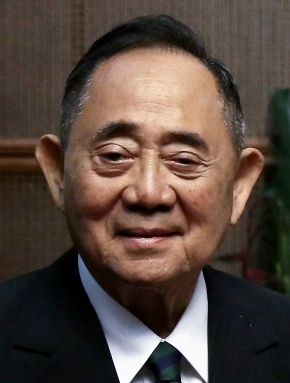
Jose de Venecia in 2017
"Trapo" is an acronym for "TRAditional POlitician" and refers to public officials who returned after the Marcos dictatorship to restore the discredited political system Marcos used to justify military rule. Unfortunately, there is an abundance of trapos, but no real alternative type of public official has emerged. Incidentally, trapo is Tagalog for "rags." [Source: “Culture Shock!: Philippines” by Alfredo Roces and Grace Roces, Marshall Cavendish]
Bong Austero wrote in his blog: “Speaker Jose de Venecia says he now wants to spend the last years of his life building his legacy to the Filipino people. The speaker is 70 years old. He is the longest-serving speaker of the House of Representatives. He could have been president of this country had it not been for the fact that someone more popular and more in touch with the common man was also running for the post in that particular election. He lost to Joseph Estrada, the actor. His running mate, Gloria Macapagal Arroyo, however, won the vice presidency. Estrada would eventually get booted out of office, tried, and convicted for plunder. And as fate would have it, De Venecia’s running mate became President. [Source: bongaustero.blogspot.jp, October 22, 2007 /=]
“For quite sometime, De Venecia’s political fortunes were in limbo. But he eventually bounced back from the pits and reclaimed his seat as speaker of the House of Representatives, proof of the man’s resilience and tenacity as a political animal. This is a man who has fought many battles; a man who speaks with the wisdom of not only the aged, but of someone who has been a constant fixture in the political scene in the last four or five decades. In another time and place, when someone of De Venecia’s stature and experience speaks of moral regeneration and of the urgency of reclaiming the country’s pride and honor, we should be compelled to sit up and listen. /=\
“Sadly, this does not seem to be the case today. It has become difficult to empathize with the man. Not only because in all his TV appearances last week the speaker came across as a forlorn figure, of someone betrayed and on the brink of defeat. There was no fire in his eyes and his rhetoric lacked conviction. This is sad because what De Venecia is saying is true. This country needs moral regeneration. But corruption has not only become systemic and widespread, brazen and so unspeakably scandalous. We also know theoretical solutions and intellectual discussions won’t be enough. What we need are drastic and more effective courses of action. /=\
“It is difficult to empathize with De Venecia and his cause because despite the grand pronouncements, it is clear that the man is simply fighting for political survival. This is evident in the way De Venecia continues to hem and haw about where his political loyalties now reside. Despite thinly veiled threats about possible courses of actions that he might take if the current dispensation continues to marginalize him, we know that his main motivation is self-preservation. He wants to retire as speaker and this is only possible if he plays his cards right. It’s a political zarzuela. De Venecia is saying all the right things but unfortunately fails to buttress his rhetoric with the necessary actions indicative of moral courage. Thus, we can be forgiven for not trusting him at this point.” /=\
Crime and Politicians in the Philippines
Former President Joseph Estrada was convicted of corruption and former President Gloria Macapagal Arroyo went on trial for vote fraud and graft. In the past, a convicted pedophile ran for Congress from behind bars and won. Martin Soong of CNBC wrote: It's not so much that the rich and powerful (most politicians in the Philippines are both) are above the law. It's more that they're able to make the law work for them. Legally, someone has to be "convicted with finality," and have no avenue left to appeal, to be disqualified from running for office. But money buys high-priced lawyers who're able to stall legal proceedings, which buys politicians time to get elected. Once in power, they use their office and position to influence judges. [Source: Martin Soong, CNBC, May 8, 2016]
Sajid Ampatuan was among those charged in Maguindanao massacre, which left 58 people dead. He spent more than five years in a Manila jail, awaiting trial and was released on bail in 2015 based on insufficient evidence. In 2016, the ran for mayor of one of the towns in Maguindanao. The mastermind of the Maguindanao massacre was Andal Ampatuan Sr., a member of Lakas–Kampi–CMD political party and a key ally of President Gloria Macapagal Arroyo in Mindanao. His son, Zaldy Ampatuan, served as governor of the Autonomous Region in Muslim Mindanao (ARMM) and chaired the party in the region.
Andal Ampatuan Sr. held the governorship of Maguindanao from 1998 onward, winning three consecutive terms without opposition. Eighteen of the province’s mayors were members of the clan. He attributed his dominance to popular support, claiming that constituents themselves urged him to field his sons for office. In the 2004 presidential election, Arroyo captured 69 percent of Maguindanao’s vote, and in 2007 her coalition achieved a 12–0 sweep of the province’s senatorial race. Barred by term limits from seeking reelection, Andal Ampatuan Sr. began grooming his son, Andal Ampatuan Jr., to succeed him as governor. The Ampatuans maintained power with Arroyo’s backing, allegedly receiving support for a private militia reportedly numbering up to 5,000 men, which was used as a proxy force against Muslim separatist rebels. Human rights groups claimed Arroyo overlooked the clan’s violent reputation in exchange for delivering votes during national elections.
Grace Poe — the Abandoned, Adopted Daughter of a Movie Star
Grace Poe, the adopted daughter of film icon Fernando Poe Jr. placed second in the 2016 Philippines Presidential elections, rising to national prominence on the strength of both her personal story and her famous surname. Her father died shortly after narrowly losing the 2004 presidential election, a defeat many of his supporters attributed to fraud.[Source: Teresa Cerojano, Associated Press, April 6, 2016; Donald Kirk, Forbes, April 24, 2016]
Poe’s life began in circumstances that seemed almost mythical. As a newborn, she was discovered in a baptismal font inside a cathedral, found in a basin of holy water and named “Grace” by a bishop who said she had been saved “by the grace of God.” She was later adopted by Fernando Poe Jr. and his wife and raised in one of the country’s most celebrated show business families. Fernando Poe Jr., often called the “King of Philippine Movies,” built his reputation in the 1970s and 1980s portraying tough, justice-seeking heroes who defended the poor against corrupt elites. On and off screen, he was closely associated with actor-turned-politician Joseph Estrada. The elder Poe’s enduring popularity would later become a powerful force in his daughter’s political ascent.
A relative newcomer to politics, Poe was elected to the Senate in 2013. She campaigned on themes of social justice and opposition to cronyism — familiar promises in Philippine politics — while pledging to cut taxes, fight crime and provide free education from kindergarten through college for poor families. In a country where presidents have traditionally come from powerful political clans and landed elites, her humble beginnings resonated strongly with voters.
Although the identity of Poe’s biological parents remains unknown, she received an elite education in the Philippines before studying at Boston College. She later lived for about a decade in suburban Washington, D.C. Her popularity dipped at one point when critics highlighted her decision to become a naturalized U.S. citizen — a status she later renounced when she returned to public service in the Philippines. Rumors also persisted for years that Poe was the illegitimate daughter of Marcos and a relative of her adoptive mother — allegations she and her family have consistently denied.
Poe’s candidacy nearly unraveled when opponents argued that, as a foundling, she might not meet the constitutional requirement of being a natural-born Filipino. The Supreme Court of the Philippines ultimately ruled that she was qualified to run. Critics also questioned her loyalty due to her former U.S. citizenship, though she had already surrendered her American passport to accept a government post. Her husband and children remain U.S. citizens.
On the campaign trail, Poe promised a free lunch program for public day care and elementary students, expanded job opportunities for women and greater support for farmers. She also vowed to improve the country’s notoriously slow internet speeds, upgrade infrastructure and amend constitutional economic provisions that discourage foreign investment. In interviews, she emphasized unity, saying Filipinos deserved a leader who would bring the country together.
Is Grace Poe Powerful Narrative the Reason for Her Success?
Grace Poe’s narrative — as a foundling who rose to prominence — helped propel her into the front ranks of the presidential race. Many of her supporters remained sympathetic over her father’s loss in 2004 to Gloria Macapagal Arroyo, whose presidency was later dogged by corruption allegations. [Source: Teresa Cerojano, Associated Press, April 6, 2016; Donald Kirk, Forbes, April 24, 2016]
Poe was 47 when she ran for President. She frequently invoked lines from her father’s films in campaign speeches, echoing his underdog characters who battled entrenched interests on behalf of the oppressed. Fernando Poe Jr. had mounted his own presidential bid in 2004 but died months after the contested election, never carrying his cinematic battles fully into political life.
Her appeal was evident among working-class supporters. At a rally in Manila, a laundrywoman named Eliza Oledan said she admired Poe because her father had been her idol and because of Poe’s promise of free college education — a pledge that struck home after one of Oledan’s children was forced to leave school for financial reasons.
When asked whether her life story was boosting her campaign, Poe acknowledged the importance of a compelling narrative but said what mattered most was understanding the struggles of ordinary citizens and ensuring that no one would be left behind. Political analyst Temario Rivera of the University of the Philippines attributed her popularity to her relatively unblemished reputation, her rapport with ordinary voters and the enduring appeal of her father’s legacy. The foundling story, he noted, was especially powerful in a society where many remain poor and marginalized.
Detractors pointed to her limited political experience, though supporters countered that inexperience had not prevented leaders elsewhere — including former U.S. President Barack Obama — from succeeding. Still, Poe faced criticism over backing from a wealthy businessman allegedly linked to controversial taxes imposed on coconut farmers during the dictatorship of Ferdinand Marcos.
Catholic Church and Politics in the Philippines
During the Spanish colonial period, the Catholic Church was extensively involved in colonial administration, especially in rural areas. With the advent of United States control, the Catholic Church relinquished its great estates. Church and state officially were separated, although the church, counting more than 80 percent of the population as members, continued to have influence when it wanted to exert it. For much of the Marcos administration, the official church, led by archbishop of Manila, Cardinal Jaime Sin, adopted a stance of "critical collaboration." This meant that although Sin did not flatly condemn Marcos, he reserved the right to criticize. Below the cardinal, the church was split between conservative and progressive elements, and some priests joined the communistdominated National Democratic Front through a group named Christians for National Liberation. Cardinal Sin was instrumental in the downfall of Marcos. He brokered the critical, if temporary, reconciliation between Aquino and Laurel and warned the Marcoses that vote fraud was "unforgivable." In radio broadcasts, he urged Manileños to come into the streets to help the forces led by Enrile and Ramos when they mutinied in February 1986. The church, therefore, could legitimately claim to be part of the revolutionary coalition. [Source: Library of Congress *]
Aquino is a deeply religious woman who has opened cabinet meetings with prayers and sought spiritual guidance in troubled times. Although there were reports that the Vatican in late 1986 had instructed Cardinal Sin to reduce his involvement in politics, Aquino continued to depend on him. The Catholic Bishops Conference of the Philippines issued a pastoral letter urging people to vote yes in the 1987 constitutional plebiscite. In March 1987, Sin announced that he was bowing out of politics, but two months later he broadcast his support for ten Aquino-backed candidates for the Senate and recommended that voters shun candidates of the left. In 1990 Sin defined his attitude toward the government as one of "critical solidarity." *
The church was very pleased with provisions of the 1987 Constitution that ban abortion and restore a limited role for religion in public education. The Constitution is essentially silent on the matter of family planning. The church used its very substantial influence to hinder government family-planning programs. Despite the fact that the population grew by 100,000 people per month in the late 1980s, Cardinal Sin believed that the Marcos government had gone too far in promoting contraception. He urged Aquino to "repeal, or at least revise" government family-planning programs. In August 1988, the bishops conference denounced contraception as "dehumanizing and ethically objectionable." For churchmen, this was an issue not to be taken lightly. One bishop called for the church to "protect our people from the contraceptive onslaught" and the bishops conference labelled rapid population growth a "nonproblem." In 1989 the United States Department of Commerce projected the Philippine population at 130 million by the year 2020 — in a country the size of California. *
Catholic Leaders and Politics in the Philippines
The Catholic church is one of the strongest institutions in the Philippines and major player in Philippine politics. Support of the Catholic church, and the military, are key to political survival and success in the Philippines. The Catholic is very involved in fighting poverty and in some cases some of its members have been involved in supporting poor tenant farmers in their battles against their rich landlords.
Priests and bishops and other religious leaders are powerful figures in the Philippines. Local priest and ministers are so highly respected that requests from them take on the power of mandates. A family considers having a son or daughter with a religious career as a high honor. Personal friendships with priests, ministers, and nuns are prized. Clerics take an active role in the secular world. An example is Brother Andrew Gonzales, the current secretary of DECS. [Source: everyculture.com]
The Catholic Church and, to a lesser extent, the Protestant churches engaged in a variety of community welfare efforts. These efforts went beyond giving relief and involved attempts to alter the economic position of the poor. Increasingly in the 1970s, these attempts led the armed forces of President Marcos to suspect that church agencies were aiding the communist guerrillas. In spite of reconciliation efforts, the estrangement between the churches and Marcos grew; it culminated in the call by Cardinal Jaime Sin for the people to go to the streets to block efforts of Marcos to remain in office after the questionable election of 1986. The resulting nonviolent uprising was known variously as People's Power and as the EDSA Revolution. [Source: Library of Congress, 1991 *]
The good feeling that initially existed between the church and the government of President Aquino lasted only a short time after her inauguration. Deep-seated divisions over the need for revolutionary changes again led to tension between the government and some elements in the churches. *
Catholics fall into three general groups: conservatives who are suspicious of social action and hold that Christian love could best be expressed through existing structures; moderates, probably the largest group, in favor of social action but inclined to cooperate with government programs; and progressives, who do not trust the government programs, are critical both of Philippine business and of American influence, and feel that drastic change is needed. In the past, progressives were especially disturbed at atrocities accompanying the use of vigilantes. They denied that they were communists, but some of their leaders supported communist fronts, and a few priests actually joined armed guerrilla bands. There appeared to be more progressives among religious-order priests than among diocesan priests. *
Cardinal Sin
Cardinal Jaime L. Sin was the top Catholic figure in the Philippines for decades until his death in 2005. Arguably one of the most powerful men in the Philippines and one of the most powerful Catholic clerics in the world, he was mentioned as a possible successor to Pope John Paul II. The son of Chinese immigrants, Cardinal Sin is well-known for his sense of humor, his name and his jokes about his name. When asked what his chances are of becoming the Pope, he says, "First of all, my name is bad." He often greets guest to his residence with "Welcome to the House of Sin" and is notorious for his bawdy comments.
Hrvoje Hranjski of Associated Press wrote: Cardinal Sin “shaped the role of the church during the country's darkest hours after dictator Ferdinand Marcos imposed martial law starting in 1972 by championing the cause of civil advocacy, human rights and freedoms. Sin's action mirrored that of his strong backer, Pope John Paul II, who himself challenged communist rulers in Eastern Europe. Three years after Benigno Aquino Sr., a senator opposing Marcos, was gunned down on the Manila airport tarmac in 1983, Sin persuaded Aquino's widow, Corazon, to run for president. When massive election cheating by Marcos was exposed, Sin went on Catholic-run Radio Veritas in February 1986 to summon millions of people to support military defectors and the Aquino-led opposition. Marcos fled and Aquino, a deeply religious woman, was sworn in as president. Democracy was restored, but the country remained chaotic. [Source: Hrvoje Hranjski, Associated Press, January 3, 2013 ]
Cardinal Sin influence goes back to the Marcos era. Once when he sitting between Marcos and his wife Imelda in the back seat of the presidential limousine, Marcos asked him why he was so quiet. "Because," he said, "I feel like I am being crucified between two thieves." Marcos reportedly thought comment was funny but Imelda wouldn't speak to the cardinal for three months after that.
Michelle O'Donnell wrote in the New York Times, “Cardinal Jaime L. Sin, the powerful Roman Catholic archbishop of Manila, used his influence to champion the rights of the poor and rally the widespread popular resistance that brought down the presidencies of Ferdinand E. Marcos and Joseph Estrada Cardinal Sin led the nearly 40 million Catholics in the Philippines for almost three decades, through political upheaval that brought martial law, repressive dictatorship and democratic rule. A round-faced, bespectacled man, he was known for his sense of humor that included poking fun of his own name. But it was through his withering and unwavering public criticism of the Marcos regime in the 1980's that Cardinal Sin became an international figure. [Source: Michelle O'Donnell, New York Times, June 21, 2005 +++]
“At a time when reform-minded clergy in other developing countries were targets of assassination, Cardinal Sin tirelessly used his pulpit first as bishop, then archbishop, to attack Mr. Marcos' martial law, corruption and policies that oppressed the poor. Yet unlike Archbishop Oscar Romero of El Salvador, a contemporary who also worked to empower the poor and was fatally shot as he delivered a homily in 1980, Cardinal Sin seemed insulated from personal harm. "If you compare him to Romero, he spoke out as much as Romero did," said the Rev. Paul L. Locatelli, the president of Santa Clara University. "He saw justice as making sure that the poor had a voice." But he was not witho Under the cardinal's tenure, the church was shaken by accusations of sexual misconduct by some of its priests, according to The Associated Press. Two years ago, Catholic bishops apologized for grave cases of sexual misconduct by priests and pledged to act on complaints. +++
During his long career, the cardinal was not without his critics. He staunchly opposed artificial means of birth control, which some critics said left the country overpopulated and mired in poverty. Under the cardinal's tenure, the church was shaken by accusations of sexual misconduct by some of its priests, according to The Associated Press. Two years ago, Catholic bishops apologized for grave cases of sexual misconduct by priests and pledged to act on complaints. +++
Protests and Demonstrations in the Philippines
Describing a Manila protest against President Gloria Macapagal Arroyo in 2006, Nicola Menzie of CBS wrote: “Riot police used water cannons and truncheons to break up a rally by more than 1,500 protesters as they demanded President Arroyo be removed from office. The protesters appeared emboldened by the success of similar protests in Thailand that led to Prime Minister Thaksin Shinawatra's resignation from office. The demonstrators reported several injuries as a result of police using wooden sticks, fiberglass shields and water cannon spray in order to force them away from a bridge leading to the presidential palace. Rallies have been banned in the area, which has been the scene of recent clashes between police and demonstrators. Leftist groups have vowed to continue protests and are calling for Arroyo's ouster over corruption and vote-rigging allegations. [Source: Nicola Menzie, CBS, April 6, 2006]
The next day, Fight Back! News reported: “Riot police in the Philippines attacked and broke up a demonstration by human rights activists marching near an international parliamentarians' conference. The protesters were gathering at the Malate Church in Manila en route to the Philippine International Convention Center. The police injured various people, including Catholic priests from the organization Promotion for Church People’s Response (PCPR). Baton-wielding police charged into the protesters near the conference site for the Inter-Parliamentary Union (IPU) assembly where about 1,400 lawmakers from 145 countries were meeting. Human rights activists led by several priests and nuns marched on the conference to protest widespread human rights violations in the Philippines under the Arroyo government, including a number of recent killings of political activists. [Source: Fight Back! News, April 12, 2005]
Filipinos Grow Disillusioned with People Power Protests
The Philippine middle-class, instrumental in the overthrow of presidents Marcos and Estrada, is fed up with political turbulence and wants stability, political analysts say. In 2005, Alan Sipress wrote in the Washington Post, “Jennifer Santos's eyes gleamed as she recalled her days as a young housewife staring down government tanks ordered to the streets by longtime dictator Ferdinand Marcos. For the better part of a week in 1986, she and tens of thousands of other Filipinos, carrying flowers and rosary beads, camped along the capital's gritty Edsa Boulevard until Marcos fell. She remembered with less enthusiasm returning to the boulevard four years ago when another graft-tainted leader, Joseph Estrada, left office after a single night of protests. "By the next morning," Santos recounted, "I was in Starbucks drinking coffee, and we had a new president." [Source: Alan Sipress, Washington Post, July 10, 2005 ^/^]
“Now, that president, Gloria Macapagal Arroyo, is facing a crescendo of calls to step down due to allegations she cheated in national elections last year. But like the vast majority of other Edsa veterans, Santos, 44, is not very interested in joining the few protesters on the streets. "I got tired. It happens over and over again," Santos said. "Our political system never changes." Across Manila, disappointment in Arroyo is surpassed only by a weary recognition that the Philippines' celebrated protest movement known as "people power" has run its course, and that no new political savior is at hand to rally the masses. ^/^
“Only several thousand flag-waving demonstrators joined the main anti-Arroyo rally in Manila's business district. Local office workers appeared almost oblivious to the event. The six-lane Edsa Boulevard was clogged with traffic. Not a protester was in sight and the adjacent plaza at the heroic People Power monument was empty. ^/^
“Luzviminda A. Santos, 52, a compact woman with intense brown eyes and shoulder-length black hair streaked with gray, was invited by several friends to join a small anti-Arroyo demonstration Saturday morning outside the local Santo Domingo church. She told them she would try to make it, but instead stayed home drinking coffee and watching the dizzying political developments on television. "I said to myself, 'What for?' " Four years ago, Santos said, she was among the first to reach Edsa Boulevard and demand Estrada's ouster. But this time there was little idealism, and the ascension of Arroyo, a product of the wealthy landed classes, was an immediate letdown. "Everyone is fatigued now with people power. It can't snowball to people power again," she said. But now, she said her family is less interested in the current political showdown than the basketball game Sunday between the country's two premier universities. She predicted the Manila sports coliseum would attract more people this weekend than any demonstration. "Are there people in Edsa now?" she asked. "Is anything happening now? I don't even care." ^/^
Image Sources: Wikimedia Commons
Text Sources: New York Times, Washington Post, Los Angeles Times, Times of London, Lonely Planet Guides, Library of Congress, Philippines Department of Tourism, Compton’s Encyclopedia, The Guardian, National Geographic, Smithsonian magazine, The New Yorker, Time, Newsweek, Reuters, AP, AFP, Wall Street Journal, The Atlantic Monthly, The Economist, Foreign Policy, Wikipedia, BBC, CNN, and various books, websites and other publications.
Last updated March 2026