
GOVERNMENT OF THE PHILIPPINES
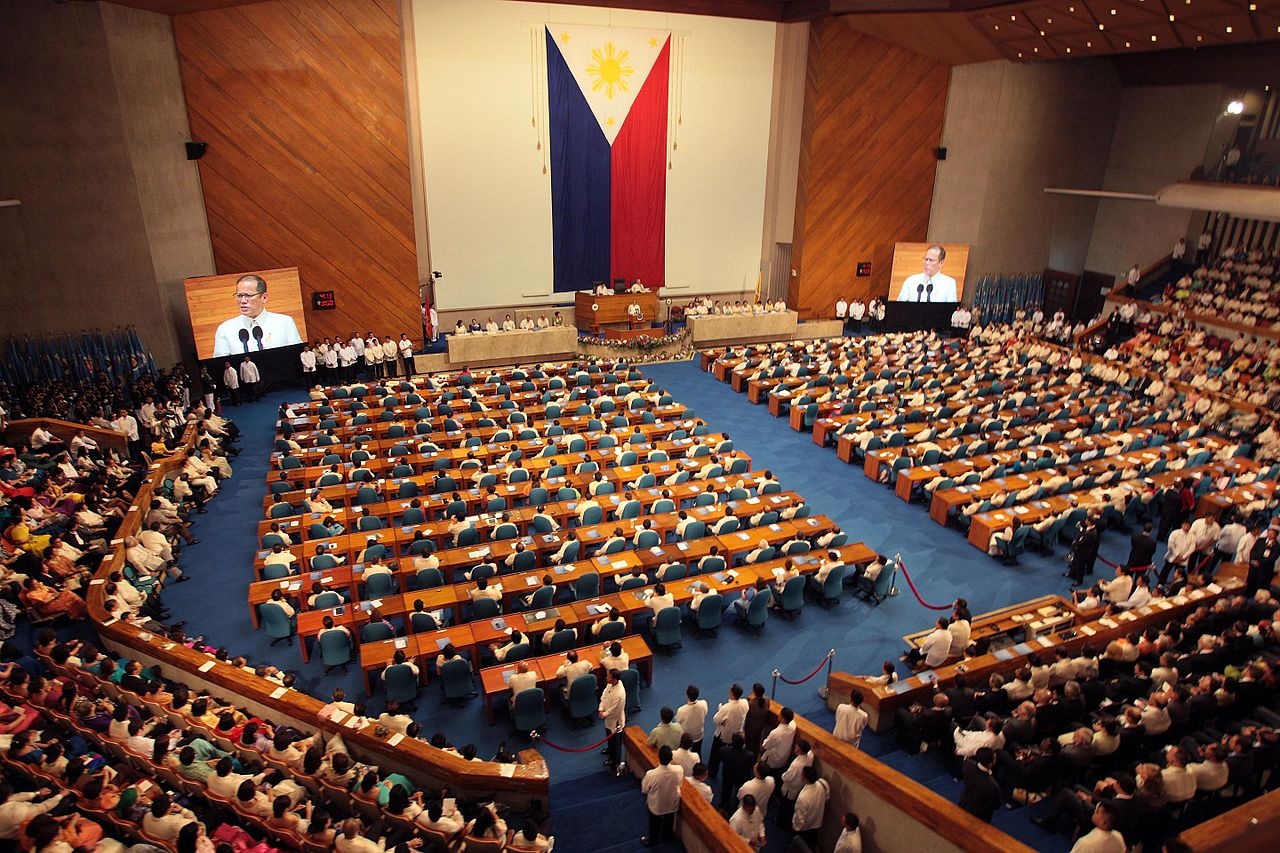
The Philippines is a Republic with an elected president and bicameral legislature, the Congress. A republic is a form of government where power is held by the people — rather than a private concern or property of rulers — and exercised either directly or through elected representatives, with an elected head of state (usually a president) rather than a hereditary monarch.
The Philippines is governed under the constitution of 1987. The president, who is both head of state and head of the government, is elected by popular vote for a single six-year term. Members of the 24-seat Senate are popularly elected for six-year terms. The House of Representatives consists of 318 members (2025), who are popularly elected for three-year terms. There is an independent judiciary headed by a supreme court. Administratively, the republic is divided into 82 provinces and 149 chartered cities. [Source: Columbia Encyclopedia, 6th ed., Columbia University Press]
The Philippines government is modeled after the U.S. government. It has a President, Vice President and Congress with a Senate and a House of Representatives. The main difference between the two systems is that the Philippine constitution limits the Presidents to one six year term (he or she can not be reelected for a second term); senators to two consecutive six-year terms and representatives to three three-year terms. There are also separate ballots for the President and Vice President.
In February 1987, the Philippines adopted a new constitution that instituted the presidential-style republican form of democracy, which resembles the U.S. model much more than the European parliamentary system. One key difference between the Philippine and U.S. systems is that the Philippines is a unitary republic, whereas the United States is a federal republic, with significant powers reserved for the states. In the Philippines, by contrast, the national government is not challenged by local authority. The ratification of the 1987 constitution—the fourth in the nation’s history—by national referendum signaled the country’s return to democracy following the autocratic rule of Fernando Marcos (1965–86). Politics in the Philippines is somewhat tumultuous. In February 2006, the president declared a state of emergency after quashing the attempted coup staged by the political opposition. [Source: Library of Congress, 2006]
Filipinos are a freedom-loving people. They have waged two peaceful, bloodless revolutions against what were perceived as corrupt regimes. The Philippines is a vibrant democracy with a lively press, as evidenced by 12 English national newspapers, 7 national television stations, hundreds of cable TV stations, and 2,000 radio stations. However, political and judicial institutions in the Philippines are regarded as weak. The functioning of government has been hampered by coup threats, insurgencies, street protests, and impeachment proceedings. To relieve the "chronic gridlock" in the Filipino legislative system, the U.S. national Security Council has suggested that the Philippines switch from a Congressional to a parliamentary system.
Government in the Philippines is unitary, not federal. Local governments are subordinated to the national government. The central government supervises administrative details for the provinces, cities, and towns, but these local jurisdictions choose their own officials and manage most of their own affairs. Independence: June 12, 1898 (independence proclaimed from Spain); July 4, 1946 (from the US). National holiday: Independence Day, June 12. June 12, 1898 was date of declaration of independence from Spain.
RELATED ARTICLES:
BRANCHES OF THE PHILIPPINES GOVERNMENT: EXECUTIVE (PRESIDENT), LEGLISLATURE, JUDICIARY factsanddetails.com
ELECTIONS IN THE PHILIPPINES: ELECTORAL SYSTEM, IRREGULARITIES, CAMPAIGNS factsanddetails.com
2022 PHILIPPINE ELECTIONS factsanddetails.com
ELECTION AND POLITICAL VIOLENCE IN THE PHILIPPINES factsanddetails.com
MAGUINDANAO MASSACRE: EVENTS, KILLERS, POLITICS, TRIAL factsanddetails.com
POLITICS IN THE PHILIPPINES: POWERFUL FAMILIES, RICH BACKERS, PATRONAGE, CELEBRITY factsanddetails.com
POLITICAL PARTIES IN THE PHILIPPINES factsanddetails.com
POLITICIANS, THE CATHOLIC CHURCH AND PROTESTS IN THE PHILIPPINES factsanddetails.com
PEOPLE POWER AND THE FALL OF MARCOS factsanddetails.com
FERDINAND MARCOS: HIS LIFE, LIES, EDUCATION, WAR RECORD, POLITICAL RISE factsanddetails.com
FERDINAND MARCOS AS PRESIDENT: EARLY PROMISE, RESISTANCE, WASTE factsanddetails.com
MARTIAL LAW YEARS UNDER FERDINAND MARCOS factsanddetails.com
INDEPENDENCE FOR THE PHILIPPINES AFTER WORLD WAR II factsanddetails.com
PHILIPPINES IN THE 1950s AND 60s: HUK REBELLION, MAGSAYSAY, GARCIA AND MACAPAGAL factsanddetails.com
MARCOS’S PLUNDER AND WEALTH factsanddetails.com
Flag and Symbols of the Philippines
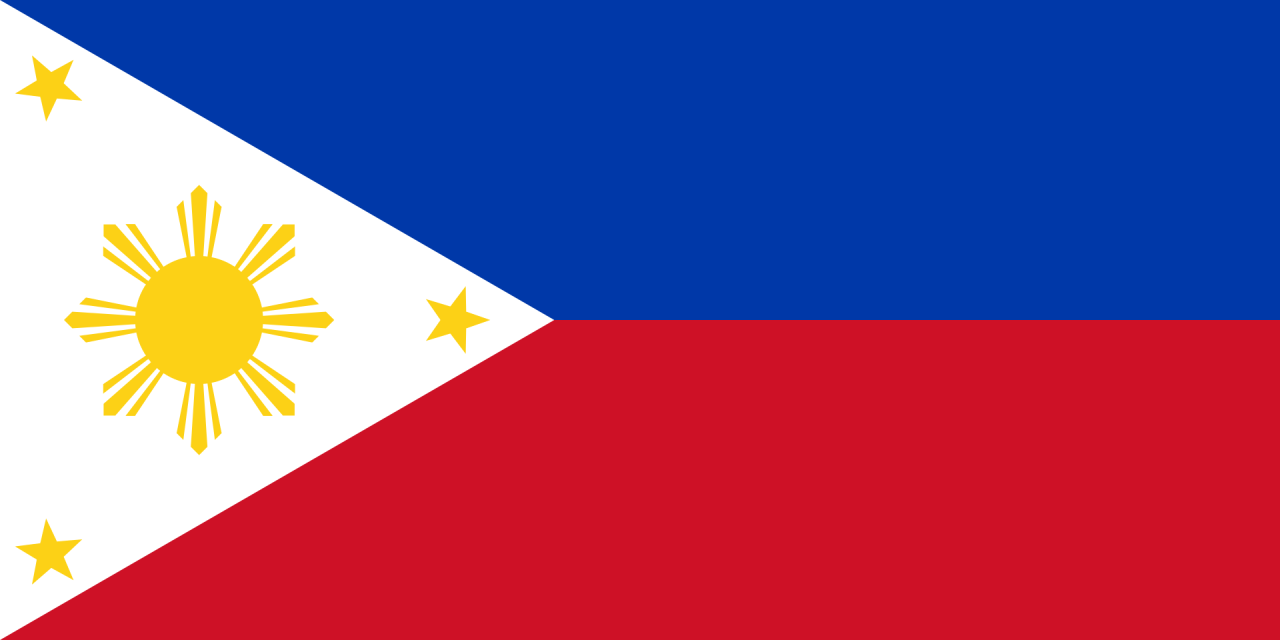
Flag: The flag of the Philippines has two equal horizontal bands of blue (top) and red with a white equilateral triangle based on the hoist side; in the center of the triangle is a yellow sun with eight primary rays (each containing three individual rays), and in each corner of the triangle is a small yellow five-pointed star. Blue stands for peace and justice, red symbolizes courage, the white equal-sided triangle represents equality; the rays recall the first eight provinces that sought independence from Spain, while the stars represent the three major geographical divisions of the country: Luzon, Visayas, and Mindanao; the design of the flag dates to 1897.
The sun in the flag represents liberty. The flag was carried in the rebellion against Spain in 1896, adopted in 1920 and became the national emblem in 1946. In time of war it is flown upside down with the red band at the top. Flag ceremonies take place once a week at all governmental offices. Schools have a flag ceremony each morning. All traffic stops while the flag is being honored.
National symbols have been emphasized since independence to create a sense of nationhood. The Philippine eagle, the second largest eagle in the world, is the national bird. Doctor Jose Rizal is the national hero. Rizal streets and statues of Rizal are found in most towns and cities. Several municipalities are named for Rizal. The national anthem is sung, a national pledge is recited in Filipino, and the provincial hymn is sung. [Source: everyculture.com]
National anthem: "Lupang Hinirang" (Chosen Land): lyrics/music: Jose PALMA (revised by Felipe Padilla de Leon)/Julian Felipe. The music was adopted 1898, original Spanish lyrics adopted 1899, Filipino (Tagalog) lyrics adopted 1956; although the original lyrics were written in Spanish, later English and Filipino versions were created; today, only the Filipino version is used.
Philippines Democracy
The Philippines, Taiwan, Thailand and South Korea have relatively free-wheeling democracies. The Philippines government has been described as a corrupt democracy. Candidates are routinely heckled and jeered. Singapore’s Lee Kuan Yew once said the Philippines needs more discipline and less democracy. Additionally, the Philippines is hardly a true democracy in that a fairly small oligarchy and group of families has been dominating the country’s political and economic landscape for more than a century.
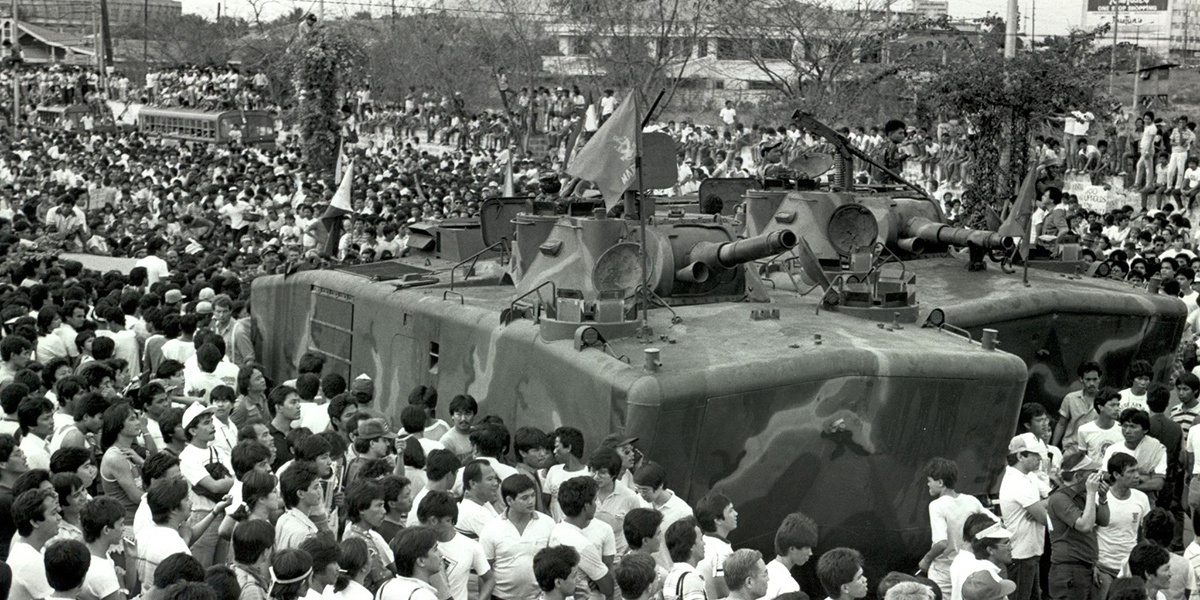
On democracy in the Philippines at time when the government was stymied by street protests and legislative gridlock, Seth Mydans wrote in the New York Times, ““Pure democracy" is what some people are calling it — massed, peaceful crowds of outraged citizens rising up, with cheers and chants and thrilling courage, to force an abusive leader from his perch on power. It happened in the Philippines in 1986 with the ouster of Fredinand E. Marcos, when it gained the nickname people power. But popular revolts like this can create new problems of their own. It is a risky thing to break the rules, even in the best of causes. Precedent is powerful, as the Philippines have since discovered, and rule-breaking can be tempting when the democratic process bogs down. [Source: Seth Mydans, New York Times, January 7, 2004 /*/]
“As in the Philippines, a disenfranchised elite may fight back to hold on to influence and wealth. The public, feeling empowered, may seek to repeat its role in overriding the government. The military, which has the final say in any undemocratic shift in power, becomes more dangerous. In the Philippines, the military played a comparable role in forcing Mr. Marcos from office, and the country has remained a jittery place ever since, subject to continuing coup threats, coup rumors and coup attempts. There have also been a "people power 2" and a "people power 3" in the Philippines, both in 2001. One of these forced out an unpopular but democratically elected president, Joseph Estrada, when a Senate impeachment process failed to remove him. /*/
“The democratic system had let them down, Filipinos said, and needed a course correction. Again, it was the generals who had the final word, and Mr. Estrada's successor, Gloria Macapagal Arroyo, has been dogged by a restive military and by angry supporters of Mr. Estrada. "We've had problems with legitimacy here since Edsa 1," said a political scientist, Alex Magno, speaking by telephone from Manila and using the local name for the uprising in 1986. "Every group thinks it can speak for the people by mounting a mutiny or mounting a riot." /*/
“If democracy is defined simply as an exercise of public will, people power might indeed be called its purest form, like those talent shows in which the winner is determined by a meter registering the volume of applause. It could also be called — as it has been by those on the losing end — mob rule or anarchy or coup. /*/
Failures of Philippines Democracy
Richard Javad Heydarian wrote in the Huffington Post: The demise of Marcos dictatorship in 1986 provided a perfect opportunity for the country to rebuild its foundations. After all, as the late Benedict Anderson explains, “uncontrolled and parasitic plundering of state and private resources” under the Marcos dictatorship “tilted the Philippines on its long plunge from being the most ‘advanced’ capitalist society in Southeast Asia in the 1950s to being the most depressed and indigent in the 1980s.” [Source: Richard Javad Heydarian, Huffington Post, April 12, 2016]
For the past three decades, the Filipino people have been promised freedom, prosperity and peace — but to no avail. The country’s peripheries continue to be racked by insurgency and mayhem; foreign powers are chipping away at its maritime borders; political dynasties have ruthlessly carved up the country into fiefdoms; poverty and underemployment rates are still in double-digit; and systematic corruption continues to persist on all levels of government.
It’s hard to defend or retain faith in Philippines’ cacique democracy when the country, after years of above-average growth rate, is still home to one of the largest slums in the world and suffers from the highest unemployment rate in Southeast Asia. Newly-created wealth isn’t trickling down.
Rural areas aren’t doing any better. For more than half-a-century, farmers have been promised their own land to tilt, and yet the Philippines continues to have among the world’s most stunted land reform programs. As Joe Studwell, in How Asia Works, argues: “Nowhere in Asia has produced more plans for land reform than the Philippines. But equally no ruling elite in Asia has come up with as many ways to avoid implementing genuine land reform as Filipino one.”
The country’s infrastructure conundrum is no less daunting. Residents of Metro-Manila have had to bear the daily struggle of coping with what is considered as the worst traffic jam on earth, according to the 2015 Global Driver Satisfaction Index. What has the government been doing to resolve this? Well, according to The Economist, “Manila’s transport plans have been terrible—among the most foolish adopted by any great city.”
Yes, there is growth, but it is concentrated. Indeed, there is formal political freedom, but it can’t be actualized by mostly impoverished citizenry. The status quo isn’t sustainable. The post-Marcos Philippines has been hobbled by a toxic combination of sheer incompetence, cynical neglect, and chronic corruption. And this has paved the way for strongman figures to regain the momentum.
Lack of Stability in the Philippines After Marcos
During and after President Ferdinand Marcos's imposition of martial law from 1972 to 1981, the Philippines changed from an American-style presidential system to a modified parliamentary system. After the election of Cory Aquino after Marcos’s ouster, however, a new constitution was drafted and approved in a 1982 plebiscite. Under this constitution, the American-style presidential system was reinstated. The powers of the three branches of government (the president, legislature, and judiciary) are balanced, ensuring that no one branch predominates. [Source: Cities of the World, Gale Group Inc., 2002. Adapted from an August 1994 U.S. State Department report.
The 1986 “People Power” uprising, formally known as the People Power Revolution, forced Marcos into exile and restored democratic rule. Yet the decades that followed were marked by instability, including repeated coup attempts, another mass uprising that ousted President Joseph Estrada, and persistent impeachment efforts against President Gloria Macapagal Arroyo. For many Filipinos, the promise of democracy has fallen short, leading some to question the effectiveness of East Asia’s oldest democratic system. [Source: Alan Sipress, Washington Post, February 25, 2006 +/]
“Without parties that command loyalty from their members, politicians race to the side of popular leaders, then betray them at the sign of weakness. Moreover, ordinary Filipinos have little way to channel their interests through the electoral system. This explains why crowds repeatedly flood into the streets to demand change, as they did in ousting President Joseph Estrada five years ago. Politics are frantic, with civic groups, research institutes and TV talk shows competing in a national shout-fest. But the ballast of a modern political system, a professional civil service, is lacking, and the feeble bureaucracy is easily buffeted by electoral turbulence.”
“The lack of political institutions has made Philippine politics less stable than other countries,” Felipe Miranda, a pollster and political scientist at the University of the Philippines, told The Washington Post. “Disillusionment has come about because there has been a betrayal of democratic elections. The majority of people would say democracy has largely failed.”
Is the U.S. to Blame for Philippine Government Problems?
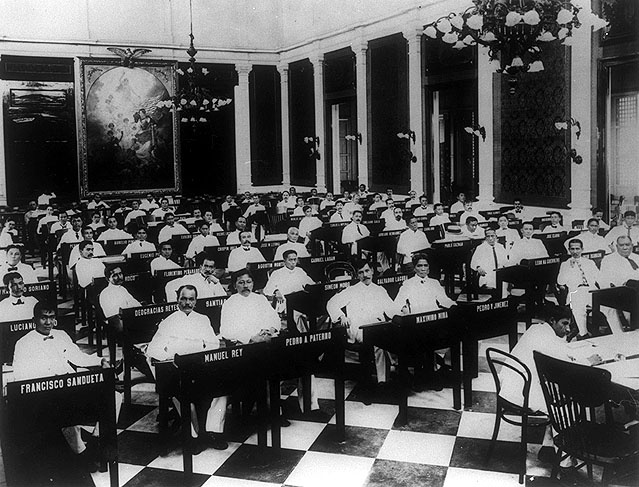
Many Philippine analysts argue that the roots of the country’s chronic political instability lie in a system established during four decades of American colonial rule — and in the powerful family dynasties that flourished under it. Over time, democracy has come to resemble a fierce rivalry among dominant clans such as the Aquino family, the Arroyo family, and the Marcos family. Political parties often play a secondary role, while many ordinary citizens feel reduced to spectators in contests between entrenched elites. [Source: Alan Sipress, Washington Post, February 25, 2006 +/]
The economic consequences have been significant. Persistent political crises have discouraged both domestic and foreign investment, and national leaders have frequently focused on political survival rather than sustained development strategies. “In theory, it’s American-style politics because we have a Xeroxed system,” said Imee Marcos, a three-term member of Congress and daughter of former president Ferdinand Marcos. “But democratic processes don’t work the way they’re meant to,” she added. “It’s ties of kinship and blood relations.”
After the United States took control of the Philippines from Spain in 1898, it established a national assembly modeled on the U.S. Congress, with representatives elected from single-member districts. Initially, voting rights were limited to literate property owners, enabling landed families to dominate local politics. These clans leveraged access to public funds, credit, and patronage networks to entrench their authority, turning elected office into a legacy passed from one generation to the next.
American influence extended beyond politics. U.S. colonial administrators overhauled the education system, sending hundreds of American teachers to establish public schools and promote English as the language of instruction. Over time, Philippine culture absorbed many American influences — from music and sports to television and beauty pageants — creating deep cultural parallels between the two countries.
Yet while the Philippines increasingly mirrored aspects of American society, its electoral system did not produce comparable political stability or economic prosperity. According to a study by the Philippine Center for Investigative Journalism, roughly two-thirds of members of the House of Representatives today come from political dynasties, underscoring how deeply family networks continue to shape the nation’s democratic landscape.
Philippines Constitution
There have been several previous constitutions; The latest was ratified under the Aquino government on February 2, 1987, and became effective on February 11, 1987 (2013). The first constitution, based on the United States Constitution, was written in 1935 and amended in 1940 and 1946. When President Marcos declared martial law in 1972, that constitution was replaced by another one providing for a head of state, a prime minister, and a unicameral legislature. Marcos’s constitution declared the that Marcos would remain the President and Prime Minster indefinitely and rule over a rubber-stamp parliament. It gave the president power to dissolve the legislature, appoint the prime minister, and declare himself prime minister. The new constitution was approved in a national referendum in 1987 was similar to the 1935 constitution but included term limitations of Senators, Congressmen and the President. [Sources: everyculture.com, CIA World Factbook, Library of Congress]
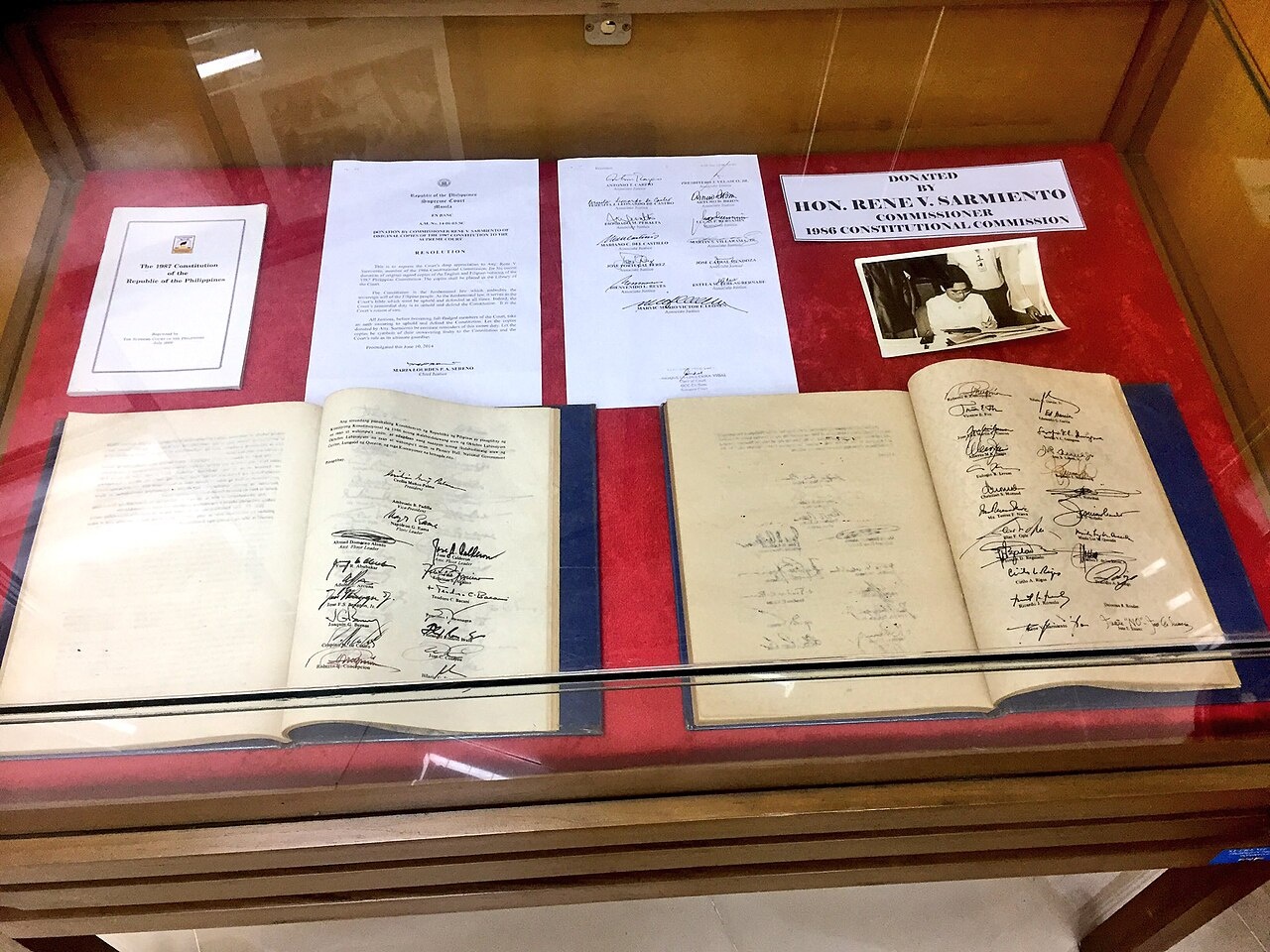
The Philippines has a long history of democratic constitutional development. The Malolos Constitution of 1898-99 reflected the aspirations of educated Filipinos to create a polity as enlightened as any in the world. That first constitution was modeled on those of France, Belgium, and some of the South American republics. Powers were divided, but the legislature was supreme. A bill of rights guaranteed individual liberties. The church was separated from the state, but this provision was included only after a long debate and passed only by a single vote. The Malolos Constitution was in effect only briefly; United States troops soon installed a colonial government, which remained in effect until the establishment of the Philippine Commonwealth in 1935. *
The 1935 constitution, drawn up under the terms of the Tydings-McDuffie Act, which created the Philippine Commonwealth, also served as a basis for an independent Philippine government from 1946 until 1973. The framers of the Commonwealth Constitution were not completely free to choose any type of government they wanted, since their work had to be approved by United States president Franklin D. Roosevelt, but as many were legal scholars familiar with American constitutional law, they produced a document strongly modeled on the United States Constitution. In fact, the 1935 constitution differed from the United States document in only two important respects: Government was unitary rather than federal, local governments being subject to general supervision by the president, and the president could declare an emergency and temporarily exercise near-dictatorial power. This latter provision was used by Marcos after September 1972, when he declared martial law. *
The 1935 constitution seemed to serve the nation well. It gave the Philippines twenty-six years of stable, constitutional government during a period when a number of other Asian states were succumbing to military dictatorship or communist revolution. By the late 1960s, however, many Filipinos came to believe that the constitution only provided a democratic political cloak for a profoundly oligarchic society. A constitutional convention was called to rewrite the basic law of the land. *
The delegates selected to rewrite the constitution hoped to retain its democratic essence while deleting parts deemed to be unsuitable relics of the colonial past. They hoped to produce a genuinely Filipino document. But before their work could be completed, Marcos declared martial law and manipulated the constitutional convention to serve his purposes. The 1973 constitution was a deviation from the Philippines' commitment to democratic ideals. Marcos abolished Congress and ruled by presidential decree from September 1972 until 1978, when a parliamentary government with a legislature called the National Assembly replaced the presidential system. But Marcos exercised all the powers of president under the old system plus the powers of prime minister under the new system. When Marcos was driven from office in 1986, the 1973 constitution also was jettisoned. *
Creation of the Philippines Freedom Constitution of 1986
After Aquino came to power, on March 25, 1986, she issued Presidential Proclamation No. 3, which promulgated an interim "Freedom Constitution" that gave Aquino sweeping powers theoretically even greater than those Marcos had enjoyed, although she promised to use her emergency powers only to restore democracy, not to perpetuate herself in power. She claimed that she needed a free hand to restore democracy, revive the economy, gain control of the military, and repatriate some of the national wealth that Marcos and his partners had purloined. Minister of Justice Neptali Gonzales described the Freedom Constitution as "civilian in character, revolutionary in origin, democratic in essence, and transitory in character." The Freedom Constitution was to remain in effect until a new legislature was convened and a constitutional convention could write a new, democratic constitution to be ratified by national plebiscite. The process took sixteen months. *
Although many Filipinos thought delegates to the Constitutional Commission should be elected, Aquino appointed them, saying that the Philippines could not afford the time or expense of an election. On May 25, 1986, she selected forty-four names from hundreds suggested by her cabinet and the public. She appointed respected, prominent citizens and, to be on the safe side, prohibited them from running for office for one year after the constitution's ratification. Delegates had the same profile as those who had drawn up the constitutions of 1898 and 1935: they were wealthy and well educated. They represented a range of political stances: some were leftists and some were ardent nationalists, but moderate conservatives held a majority. There were thirty lawyers, including two former Supreme Court justices. A nun, a priest, and a bishop represented the interests of the Catholic Church. Eight commissioners had also served in the aborted constitutional convention of 1972. Five seats on the fifty-member commission were reserved for Marcos supporters, defined as members of Marcos's New Society Movement, and were filled by former Minister of Labor Blas Ople and four associates. One seat was reserved for the Iglesia ni Kristo (Church of Christ), which, however, declined to participate. One of Aquino's appointees, leftist movie producer Lino Brocka, resigned, so the final number of commissioners was forty-eight. *
The commission divided itself into fourteen committees and began work amidst great public interest, which, however, soon waned. Long, legalistic hearings were sometimes poorly attended. Aquino is known to have intervened to influence only one decision of the commission. She voiced her support of a loophole in the constitution's antinuclear weapons provision that allowed the president to declare that nuclear weapons, if present on United States bases, were "in the national interest."The commissioners quickly abandoned the parliamentary government that Marcos had fancied, and arguments for a unicameral legislature also were given short shrift. Most delegates favored a return to something very much like the 1935 constitution, with numerous symbolic clauses to appease "cause- oriented" groups. The most controversial proposals were those pertaining to the Philippine claim to Sabah, presidential emergency powers, land reform, the rights of labor, the role of foreign investment, and United States military base rights. Special attention focused on proposals to declare Philippine territory a nuclear-free zone. *
Aquino had asked the Constitutional Commission to complete its work within ninety days, by September 2, 1986. Lengthy public hearings (some in the provinces) and contentious floor debates, however, caused this deadline to be missed. The final version of the Constitution, similar to a "draft proposal" drawn up in June by the University of the Philippines Law School, was presented to Aquino on October 15. The commission had approved it by a vote of forty-four to two. *
Aquino scheduled a plebiscite on the new constitution for February 2, 1987. Ratification of the constitution was supported by a loose coalition of centrist parties and by the Catholic Church. The constitution was opposed by both the Communist Party of the Philippines — Marxist Leninist (referred to as the CPP) and the leftist May First Movement (Kilusang Mayo Uno) for three reasons: It was tepid on land reform, it did not absolutely ban nuclear weapons from Philippine territory, and it offered incentives to foreign investors. But the communists were in disarray after their colossal mistake of boycotting the election that overthrew Marcos, and their objections carried little weight. The constitution faced more serious opposition from the right, led by President Aquino's discontented, now ex-defense minister, Juan Ponce Enrile, who reassembled elements of the old Nacionalista Party to campaign for a no vote to protest what he called the "Aquino dictatorship."
Aquino toured the country campaigning for a yes vote, trading heavily on her enormous personal prestige. The referendum was judged by most observers to turn more on Aquino's popularity than on the actual merits of the Constitution, which few people had read. Her slogan was "Yes to Cory, Yes to Country, Yes to Democracy, and Yes to the Constitution." Aquino also showed that she was familiar with traditional Filipino pork-barrel politics, promising voters in Bicol 1,061 new classrooms "as a sign of my gratitude" if they voted yes. *
The plebiscite was fairly conducted and orderly. An overwhelming three-to-one vote approved of the Constitution, confirmed Aquino in office until 1992, and dealt a stunning defeat to her critics. Above all else the victory indicated a vote for stability in the midst of turmoil. There was only one ominous note — a majority of the military voted against the referendum. Aquino proclaimed the new Constitution in effect on February 11, 1987, and made all members of the military swear loyalty to it. *
Articles and Provisions of the Philippines Constitution
The constitution, one of the longest in the world, establishes three separate branches of government called departments: executive, legislative, and judicial. A number of independent commissions are mandated: the Commission on Elections and the Commission on Audit are continued from the old constitution, and two others, the Commission on Human Rights and the Commission on Good Government, were formed in reaction to Marcos's abuses. The Commission on Good Government is charged with the task of repossessing ill-gotten wealth acquired during the Marcos regime. [Source: Library of Congress *]
Some ambitious Filipino politicians hoped that the new Constitution would invalidate the 1986 presidential election and require that a new election be held. Their hopes were dashed by the "transitory provisions" in Article 17 of the new constitution that confirmed Aquino in office until June 30, 1992. Other officials first elected under the new constitution also were to serve until 1992. *
Article 3, the bill of rights, contains the same rights found in the United States Constitution (often in identical wording), as well as some additional rights. The exclusionary rule, for example, prohibits illegally gathered evidence from being used at a trial. Other rights include a freedom-of-information clause, the right to form unions, and the requirement that suspects be informed of their right to remain silent. *
The church and state are separated, but Catholic influence can be seen in parts of the Constitution. An article on the family downplays birth control; another clause directs the state to protect the life of the unborn beginning with conception; and still another clause abolishes the death penalty. Church-owned land also is tax-exempt. *
The explosive issue of agrarian reform is treated gingerly. The state is explicitly directed to undertake the redistribution of land to those who till it, but "just compensation" must be paid to present owners, and Congress (expected to be dominated by landowners) is given the power to prescribe limits on the amount of land that can be retained. To resolve the controversial issue of United States military bases, the Constitution requires that any future agreement must be in the form of a treaty that is ratified by two-thirds of the Senate and, if the Congress requires, ratified by a majority of the votes cast in a national referendum. *
Many provisions lend a progressive spirit to the Constitution, but these provisions are symbolic declarations of the framers' hopes and are unenforceable. For example, the state is to make decent housing available to underprivileged citizens. Priority is to be given to the sick, elderly, disabled, women, and children. Wealth and political power are to be diffused for the common good. The state shall maintain honesty and integrity in the public service. To be implemented, all of these declarations of intent required legislation. *
Philippines Proclivity Towards Strongmen
There was talk about “strongman nostalgia” when Bongbong Marcos, son of the late dictator Ferdinand, mounted a strong bid for the vice presidency in 2016 and then won presidency in 2022. He had downplayed the significance of the 1986 EDSA “People Power” Revolution that ousted Marcos Sr. and suggested that his father’s rule might have transformed the Philippines into something like Singapore had it continued—claims widely disputed by experts. Together, the parallel rise of Duterte and Marcos Jr. underscored a broader debate within Philippine society over democracy, memory, and the allure of authoritarian-style leadership. [Source: Jonathan Kaiman and Sunshine de Leon, Los Angeles Times, May 8, 2016; Martin Soong, CNBC, May 8, 2016; Richard Javad Heydarian, Huffington Post, April 12, 2016]
In 2016, Rodrigo Duterte became president contender despite not belonging to the country’s traditional political elite. Unlike many past leaders, he was not a scion of an established national dynasty, raising speculation that his candidacy might signal a break from the dominance of a handful of powerful families that had shaped Philippine politics since independence. His blunt, profanity-laced campaign style and reputation as a tough mayor of Davao distinguished him from more conventional candidates.
Duterte’s appeal, however, extended beyond his outsider status. His rise reflected a broader sense of frustration and nostalgia among parts of the electorate for decisive, strongman leadership. Despite the corruption and repression associated with the regime of Ferdinand Marcos, many younger Filipinos—whose median age is about 22—have no personal memory of that era. For some voters, promises of order and swift justice resonated more strongly than concerns about democratic process.
Although the administration of Benigno Aquino III, Duterte’s predecessor, had improved economic growth and helped shed the country’s image as the “sick man of Asia,” structural problems persisted. Corruption, weak law enforcement, and the concentration of wealth and political power within a small elite remained widespread. Rapid economic growth did not benefit all Filipinos equally; roughly a quarter of the population continued to live at or below the poverty line, and development was concentrated in urban centers rather than poorer rural regions, particularly in the south, where unrest and insurgency endured.
Against this backdrop, Duterte promised dramatic results, pledging to end criminality and corruption within six months of taking office. His campaign suggested that many voters were willing to prioritize decisive action over strict adherence to legal and political norms. Analysts cautioned, however, that entrusting sweeping authority to a single leader posed risks, especially within a political system shaped by entrenched interests and recurring institutional weaknesses.
Lynn T. White III, an emeritus professor at Princeton University and author of “Philippine Politics: Possibilities and Problems in a Localist Democracy”, said policy positions often matter less in Philippine elections than personality and reputation. “Policies don’t necessarily determine who wins, and you get people like Duterte running as strongmen candidates, as Marcos or Estrada did,” he said, comparing such figures to Andrew Jackson in the United States, Alberto Fujimori in Peru, and Thaksin Shinawatra in Thailand. He added that candidates known for toughness or even violence can be highly effective in democratic systems, noting parallels with the rise of Donald Trump in the United States.
Women in Government in the Philippines
Under the Philippines constitution women are promised the same voting rights as men. Since Marcos was ousted in 1986 the Philippines has had two women presidents: Cory Aquino and Gloria Macapagal-Arroyo. The Philippines leads Southeast Asia in women’s political representation and is considered a regional model for gender parity in public office. In the 2026 Women’s Power Index, the country ranked 70th out of 193 United Nations member states, with a score of 30.8. Women currently hold 27.81 percent of seats in the national legislature and about 29 percent of local government positions, placing the Philippines among the strongest performers in ASEAN in terms of female representation. [Source: Google AI]
Women legislators in the Philippines are widely recognized for their strong engagement in policy work, particularly on gender-related and social legislation. Studies by research institutions such as the Philippine Institute for Development Studies and the Philippine Commission on Women point to women lawmakers’ consistent role in advancing reforms related to equality, social welfare, and inclusive development. International assessments have consistently highlighted the country’s progress. In the 2025 Global Gender Gap Report, the Philippines ranked first in Asia for gender equality. In the 2023 edition of the same report, it placed 30th worldwide in political empowerment, reflecting relatively strong participation of women in government compared with many other countries. A 2024 global index ranked the Philippines 71st overall, suggesting sustained, though still incomplete, progress toward equal representation.
Women’s representation in parliament has fluctuated over time. Between 2012 and 2024, the proportion of seats held by women in the national legislature varied, reaching a high of 29.79 percent in 2016. But even so women are still not very well represented in Philippine government. In 2001, only 24 of the 216 members of Congress were women. Arroyo had three women in her cabinet. Despite gains, challenges persist. Women are still underrepresented in top-tier national positions. As of 2023, women held only about 13 percent of seats in the Senate.
Many women who enter politics and have success in it come from established political families, highlighting the continued influence of dynasties in shaping access to power. Some of the most powerful women in Philippine politics—including Aquino, Arroyo, and Imelda Marcos —got to where they are or were through their ties their husbands, fathers or other family members. Sara Duterte, the Vice President of the Philippines since 2022, is the daughter of former President Rodrigo Duterte. Imee Marcos, an influential senator, is the sister of Bongbong Marcos, the President since 2022 and the daughter of Ferdinand and Imelda Marcos.
Image Sources: Wikimedia Commons
Text Sources: New York Times, Washington Post, Los Angeles Times, Times of London, Lonely Planet Guides, Library of Congress, Philippines Department of Tourism, Compton’s Encyclopedia, The Guardian, National Geographic, Smithsonian magazine, The New Yorker, Time, Newsweek, Reuters, AP, AFP, Wall Street Journal, The Atlantic Monthly, The Economist, Foreign Policy, Wikipedia, BBC, CNN, and various books, websites and other publications.
Last updated February 2026