
ADOLESCENT SEX IN THE PHILIPPINES

In Tagalog communities, boys who are not circumcised may be teased and called suput (“tight”), implying they are not yet ready for sex. Some early accounts suggest that marriages could be arranged at a very young age. At the same time, a few historical writers claimed that young people had a fair amount of freedom before marriage, though these observations may reflect outsider perspectives and biases. [Source: “Growing Up Sexually, Volume” I by D. F. Janssen, World Reference Atlas, 2004]
Guthrie and Jacobs (1966) provide an elaborate account of sexual development in the Philippines. Javier (1969) discusses the segregation of the sexes beginning in preschool in the Central Plains of the Philippines. Whitam and Mathy (1986) offer insight into sexual development among Filipinos, including attraction in childhood sex play, gender of first sexual contact, age of first sexual contact and attraction, and realization of sexual orientation, as compared to Brazilian, Guatemalan, and North American heterosexuals and homosexuals.
Many Christian colleges and universities may expel students who become pregnant outside of marriage. Most public, non-sectarian universities offer limited sex education, often confined to basic biology and government-mandated family planning programs introduced in 1972. The University of the Philippines is an exception, as its sex education tends to be more comprehensive and liberal. This is due to faculty who are more open to discussing sensitive and controversial topics. [Source: Jose Florante J. Leyson, M.D., Encyclopedia of Sexuality, 2001]
RELATED ARTICLES:
SEX IN THE PHILIPPINES: HISTORY, INFLUENCES, STORIES factsanddetails.com
BIRTH CONTROL IN THE PHILIPPINES: CONTRACEPTIVES, CATHOLICS, REPRODUCTIVE HEALTH LAW factsanddetails.com
MARRIAGE IN THE PHILIPPINES factsanddetails.com
COURTSHIP, DATING AND LOVE IN THE PHILIPPINES factsanddetails.com
DIVORCE IN THE PHILIPPINES: BAN, LAWS, ANNULMENTS, IMPACTS factsanddetails.com
SEX EDUCATION, PORNOGRAPHY, COUNSELING AND SEX RESEARCH IN THE PHILIPPINES factsanddetails.com
PROSTITUTION IN THE PHILIPPINES factsanddetails.com
SEX CRIMES IN THE PHILIPPINES factsanddetails.com
CHILD PROSTITUTION AND PORNOGRAPHY IN THE PHILIPPINES factsanddetails.com
LGBTQ, HOMOSEXUALITY AND TRANSGENDER IN THE PHILIPPINES factsanddetails.com
APPEARANCE IN THE PHILIPPINES: BEAUTY, HYGIENE, TATTOOS factsanddetails.com
CLOTHES IN THE PHILIPPINES: MEN'S, WOMEN'S, TRADITIONAL GARMENTS factsanddetails.com
Sexual Practices of Adolescents in the Philippines
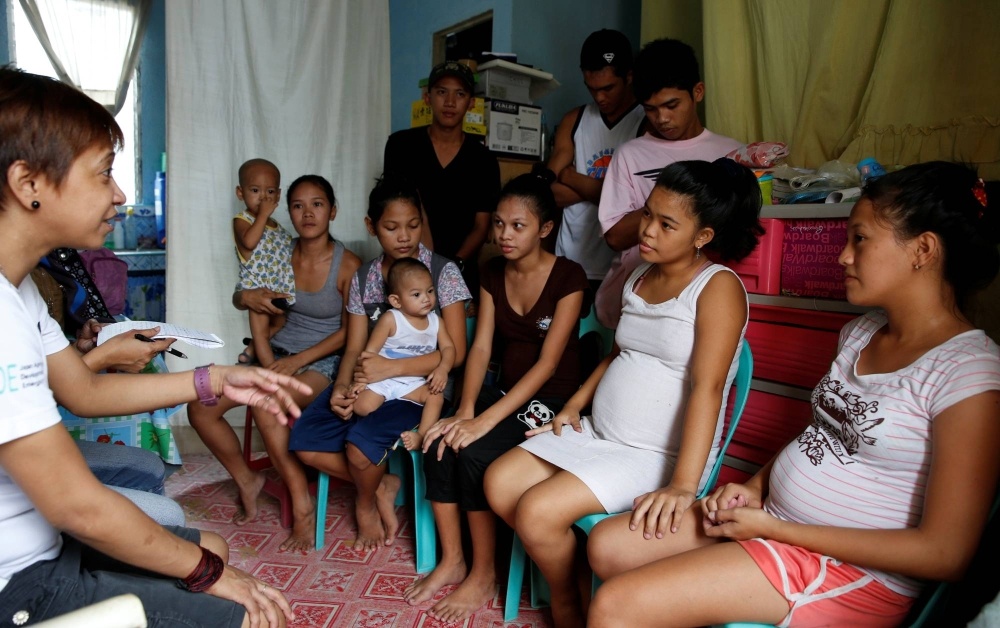
Dr. Jose Florante J. Leyson wrote in the Encyclopedia of Sexuality: In Filipino society in the late 1990s: " it is not unusual for preteenage boys to engage in exploratory “sex” games with other boys and girls. Such exploratory play allows the child to reassure him/herself of the normality of his or her body. This kind of childhood sexual rehearsal games was more common in the past and in rural areas, when violence and drugs were not as devastating as they are now in the urban areas. In some cases, boys would observe couples kissing and hugging in the park. Occasionally, they sit in the balconies of movie theaters where couples are engaging in heavy petting. In the rural areas and barrios, boys commonly compare their bodies with a friend, relative, or schoolmates. Generally speaking, parents and other adults have a mildly negative response when they discover child sexual play, ranging from warnings to spankings. [Source: Jose Florante J. Leyson, M.D., Encyclopedia of Sexuality, 2001 |~|]
“Our knowledge of the sexual attitudes and behaviors of the Filipino youth is limited to a very few anecdotal reports, most of which deal with middleand upper-class urban teenagers rather than the rural poor and urban street children. In this very limited context, my personal experience was the basis of my premedical school thesis on “First Night Sexual Experience of Young Boys - 1968.” This study consisted of personal interviews with 80 adolescents in the rural areas of Cebu during social dances and summer festivals. The majority of these teenagers were interested in obtaining information regarding nocturnal emissions, love, sexual intercourse, and, for women, contraception and pregnancy. Most of the males’ ideas on sexuality were derived from older boys, brothers, and their uncles. On the other hand, the girls were too timid or shy to answer the sexuality questions. |~|
“During the author’s return visit to the Philippines in July 1995 as an invited speaker at a college sociocultural conference, he arranged an impromptu meeting with middle and high school students, grades seven through ten. They informed me that most of their teachers believed that they were too young to hear about sex education. The teachers did not allow questions from their students during the lecture on “family education.” Most instructors were too insecure and embarrassed, and so were unable to facilitate any in-depth dialogue. In Catholic Filipino society, the Christian dogma still has a strong influence on the teachers’ moral and religious values, so that, despite the presence of a government-mandated educational climate, sexuality remains taboo in public discussion. Unfortunately, these teenagers were afraid to elaborate further, confessing only that it is attitudes like this, repeated in their conservative homes, that make them view society and family cynically. |~|
Premarital Sex in the Philippines
Dr. Jose Florante J. Leyson wrote in the Encyclopedia of Sexuality: Sexual attitudes and behavior differ from one group of Filipino youth to another, depending on their social class, educational level, and place of residence. In metropolitan and large cities, Manila, Quezon, Cebu, Iloilo, Davao, Dumaquete, and Zamboanga, adolescents and young adults are exposed to the cosmopolitan life and consequently receive more information on sex and sexuality. They are also freer to experience numerous options than are less educated youths. Youth in small towns have narrower and more restricted ideas on sexuality, because of the family’s and Church’s strong control and influence. Furthermore, youngsters in big cities have easy access to adult magazines and entertainment, in which sexuality is openly discussed or shown, even though their parents and the Church try to hide such information from them. The majority of urban youth knows about contraceptives and can acquire these from pharmacies or from friends without problems. Despite the guilt and shame associated with sex, middle- and upper-class urban youth often engage in sexual contacts with girlfriends, household maids, and even prostitutes. For the youths of the poverty belts around the big cities, the situation is compounded by the lack of money and self-control. Even if they would prefer to use a contraceptive, they cannot afford them and there are no places where they can get them free. Oral contraceptives are only given free to married women for family planning purposes by government-run city and municipal health clinics. Although condoms were distributed freely in public high schools in the early 1990s on a mandate from the Secretary of Health as part of an STD and HIV prevention program, this practice was later discontinued because of a public outcry that it was ineffective and because of the Church’s persistent objections. [Source: Jose Florante J. Leyson, M.D., Encyclopedia of Sexuality, 2001 |~|]
“The situation for rural (barrios) youth is quite different. They learn and receive information about sex and sexual behavior from observing farm animals, from magazines, from clandestine “boys only” meetings, and from the relations between parents and other family members in homes where there is little privacy. The prevailing Catholic dogma on sexual morality is written deep in the unconsciousness of every boy and girl. Only a few years ago, 98 percent of the youth associated premarital sex with guilt and sin. Only recently has this begun to change. In 1994, the Youth Adult Sexuality Survey (Zablan 1994) revealed that about 18 percent accepted premarital sex, although a majority of 80 percent still believed it was a sin and morally unacceptable. |~|
“Only a few general surveys about the sexual life of younger Filipinos exist; most of what is known is based on anecdotal reports. The author’s experiences are with interviews of preselected groups of the youth population conducted during periodic sojourns back to the Philippines. The samples mainly consist of middle-class youth, ages 17 to 22, who were encouraged to bring to the meeting problems related to their sexual lives and development. Repeatedly, they expressed regret that these aspects of their lives that engender so much anguish and fears could not be explicitly discussed in the intimacy of their household. |~|
“It is becoming increasingly clear that first premarital sexual activities are initiated at an earlier age, especially for those in metropolitan areas, where the basic family structure often disintegrates because of a lack of parental supervision, with both parents working or the father absent and perhaps working overseas. Young males pursuing college and graduate studies in the city are often detached from parental supervision and frequently succumb to the lure of metropolitan temptations, go-go bars, and adult entertainment houses. Twenty to 25 percent have their first sexual experiences with prostitutes, either out of peer pressure or curiosity. In a few cases, youths in smaller communities who impregnate their girlfriends may be forced to marry them or make an amicable financial arrangement with parental approval. The woman usually keeps the child in her parents’ home instead of giving it up for adoption. In the Muslim communities, premarital sex is absolutely prohibited. But young girls, ages 14 to 16, can be betrothed through the usual (parental) marriage arrangement, mainly to affluent and much older bridegrooms. |~|
“Among girls, the memories of being deflowered were somewhat different from those of the boys. Because of guilt and shame, the majority of young females did not bother to get prior information about sexual intercourse and the possible consequences of their first sexual encounters. They perceived their first intercourse as the fulfillment of young love, motivated by peer pressure to keep their boyfriends, and at the same time as a “challenge” to parental authority or a gross transgression of a religious or social taboo. For the well-educated and sophisticated city dwellers, it was a calculated act to get rid of the old-fashioned social taboo (virginity), which they perceived as an obstacle to entering into a more mature and fulfilling sexual life, or plainly to catch the men of their dreams. It is interesting to note that, compared with the United States and other industrialized nations, Filipino teenagers are probably less sexually active; thus teenage pregnancy is less of a problem than elsewhere. |~|
Most of the children born to single mothers are kept in the teenager’s mother’s home, instead of being given up for adoption. In the 1970s, a pregnant teenager was a social outcast and was subjected to severe parental scorn. However, in the 1990s, because of Western influence and financial difficulties, a pregnant teenager is somewhat more tolerated, and her parents are less condemning and more accepting of any financial help the teenage father might offer. |~|
Marital Sex in the Philippines
Dr. Jose Florante J. Leyson wrote in the Encyclopedia of Sexuality: There are no credible published data on marital sexual satisfaction or on the status of Filipino marital life. According to the author’s informal survey and radio-talk-show interviews in 1995, 15 to 20 percent of Filipinos are unhappily married. Women, more often than men, reported having sexual intercourse not because they desired it, but to please their spouses. Whereas 35 percent of males would like to increase the frequency of sexual intercourse, especially those in their 20s and 30s, most of the women were satisfied with the frequency of sex; only 5 percent of the females were interested in more frequent sex. These gender differences may be explained as the result of a greater pressure on males for sexual performance to maintain their macho image and maintain total control over women. [Source: Jose Florante J. Leyson, M.D., Encyclopedia of Sexuality, 2001 |~|]
“A majority of women complained of the brief duration of foreplay and premature ejaculation. Sexual intercourse is limited almost exclusively to penetration, which is more common among the less educated, more devotedly religious couples, and the older age groups. The average duration of foreplay is about five minutes, that of coitus about five to six minutes. On the other hand, the more educated, sophisticated, younger age group, and the “unchurched” have a longer duration of sexual foreplay and coitus, about twenty-two minutes. Although premature ejaculation is not uncommon among males, very few men seek medical help. Husbands generally do not consider premature (early) ejaculation a problem. |~|
“In the Christian community, sexual activity is not prohibited during any religious event or celebration. In some cases, Christian women make the personal choice of not having sex during their menstrual period. On the other hand, Muslim custom does not allow any sexual activity during the menstrual period, between sundown Friday and sundown Saturday, and during Ramadan, the month-long period of daytime fasting. |~|
“It is difficult to gather data on female orgasm because of religious repression and personal shyness. It is believed that Filipinas’ sexual satisfaction is based on cultural and religious grounds. The husband’s satisfaction is primary and the wife’s orgasm clearly secondary. Young, educated, and less religious or unchurched women have a higher orgasmic rate as compared to their older, less-educated, (oftentimes) more religious, and shy counterparts. It is believed that for a majority of women who experienced orgasms, it was more a result of psychological and religious expectation and not so much because of oral or manual genital stimulation. However, the barrage of media and Western influences has increased the proportion of Filipinas who prefer both psychic and physical stimulation. Filipinas are bombarded by the mass media and performing arts with messages about more openness in sexual matters, greater gender equality, information about new techniques for lovemaking, new roles within the couple, and new opportunities for extramarital relationships. These issues are also conversation matter among friends and families, at business meetings, and at almost any social-civic gatherings.” |~|
Half of Filipino Men Worry about Premature Ejaculation – Survey
Filipino men say that sexually satisfying their partners is important, but as many as half worry about premature ejaculation (PE) or their inability to control their ejaculation. Ibarra C. Mateo wrote in gmanetwork.com: “According to the Asia-Pacific PE Prevalence and Attitude Study, one in every three men in the region is suffering from PE, considered the most common sexual dysfunction in men—yet one that remains under-detected, under-diagnosed and under-treated.
Another study, the 2013 Asia-Pacific Sexual Behaviors and Satisfaction Survey, revealed that 91 percent of Filipino men “find it highly important that they sexually satisfy their partners” and that they “want to make their partner feel happy, loved, and satisfied.” However, this second study also found out that seven out of 10 (or 72 percent) Filipino men surveyed were concerned about not being able to sexually satisfy their partners. Almost half (or 46 percent) of the surveyed Filipino men in the same study were also anxious about ejaculating too early or not being able to control when to ejaculate.[Source: Ibarra C. Mateo, gmanetwork.com, July 15, 2014 /+/]
“Filipino men and their counterparts in the Asia-Pacific region have good reasons to worry about PE. One out of five men with PE in the region (or 20 percent) disclosed that PE “can lead to relationship breakdown or divorce.” Dr. Juliano Panganiban, Philippine Urological Association (PUA) past president, said 83 percent of Filipino men and 82 percent of Filipino women surveyed “agree that mutual sexual satisfaction plays a very extremely important role in a successful relationship.” /+/
“The 2013 Asia-Pacific Sexual Behaviors and Satisfaction Survey polled more than 3,500 men and women aged 18-45 years old in Australia, China, Hong Kong, South Korea, Malaysia, Philippines, Singapore, Taiwan, and Thailand. The study was aimed at “understanding the impact of premature ejaculation has on couples’ relationships and sexual satisfaction.” The survey was conducted between March 18, 2013 and April 2, 2013, used the five-question Premature Ejaculation Diagnostic Tool (PEDT), which is a validated research instrument for diagnosing PE. /+/
“In a recent media briefing on PE, Dr. George Lee Eng Geap, a consultant urological surgeon at the Gleneagles Hospital Kuala Lumpur in Malaysia, said the medication Dapoxetine “significantly improves control over ejaculation, enabling men to control and delay ejaculating thus enhancing sexual satisfaction of the couple while reducing personal distress and interpersonal difficulty.” Dapoxetine, so far the only drug specifically developed to manage PE and approved by the Food and Drug Administration (FDA) for the treatment of PE, is now available in the Philippines. /+/
“PE is characterized by “a lack of perceived control over ejaculation as well as negative personal consequences, such as distress or interpersonal difficulty, which leads to a decrease in sexual satisfaction and overall quality of life for both men and their partners.” Lee added that men with PE are “often reluctant to discuss their condition or are in denial.” “Their partners, on the other hand, avoid raising the topic for fear of hurting the man’s feelings. This communication gap hinders PE diagnosis and treatment,” Lee said. Dr. Ulysses Quanico, president of the PUA, said “very few couples and even fewer men dare speak about PE because of the social stigma attached to it.” /+/
“Lee told reporters that the chemical serotonin plays a central role in PE. Serotonin is a neurotransmitter and a chemical messenger in the brain and nervous system. Studies have shown that adequate levels of serotonin in the junctions between neurons or brain cells, which are called synapses, help delay ejaculation, Lee said. Men with PE have low levels of serotonin in the synapses. PE is recognized as a medical condition by global health organizations such as the World Health Organization, the International Society of Sexual Medicine, European Association of Urology, and the American Psychological Association.” /+/
See Bangungut: Sudden Unexpected Death in Sleep (SUDS) Under FILIPINO MEN: MACHISMO, HENPECKED HUSBANDS AND SUDDEN UNEXPECTED DEATH factsanddetails.com
Extramarital Sex and the Law in the Philippines
Most legal separation cases stem from extramarital relationships. While adultery is strongly condemned by the Catholic Church and widely frowned upon in Philippine society, a gap exists between moral judgment and legal definition. Under Philippine law, a man is not automatically guilty of adultery; instead, he may be charged with concubinage, which requires specific conditions: keeping a mistress in the conjugal home, engaging in sexual relations under scandalous circumstances, or cohabiting with another woman outside the marital residence. [Source: Jose Florante J. Leyson, M.D., Encyclopedia of Sexuality, 2001]
Having sexual intercourse with a woman who is not one’s wife does not, by itself, constitute concubinage. Nor does fathering a child with another woman automatically violate the law. In contrast, a wife commits adultery simply by engaging in sexual relations with a man who is not her husband, regardless of the circumstances. These provisions in the Penal Code highlight not only gender inequality but also unequal treatment of unfaithful spouses. The maximum penalty for a husband found guilty of concubinage is four years’ imprisonment, while the concubine may face destierro, or banishment from the man’s residence. A wife convicted of adultery, however, may be imprisoned for up to six years. Critics argue that this disparity violates constitutional guarantees of gender equality and effectively tolerates male infidelity as long as it remains discreet—reflecting a persistent double standard in societal attitudes toward sexual behavior.
In some Muslim communities, adultery is met with severe social consequences. Offenders may be ostracized or, in rare rural cases, subjected to extrajudicial punishments such as public stoning. These acts are often carried out discreetly under a community-enforced moral code, with little intervention from formal authorities and a collective silence that prevents investigation or testimony.
In 1997, Senator Miriam Defensor Santiago sought to address this imbalance by proposing a bill that would classify all forms of extramarital sex—regardless of gender or sexual orientation—under a single offense of adultery. Amendments in the House reframed the proposal as ‘marital infidelity,’ eliminating distinctions between concubinage and adultery and removing considerations of where the act occurred. The proposed law imposed a uniform penalty of up to six years’ imprisonment. However, some groups, including the Women’s Legal Bureau, opposed criminalization, arguing that legal penalties cannot enforce marital fidelity.” [Source: Jose Florante J. Leyson, M.D., Encyclopedia of Sexuality, 2001]
Critics of such laws argue that they fail to consider the complexities behind infidelity. A woman leaving an abusive relationship or seeking personal fulfillment elsewhere is treated no differently from a man maintaining multiple mistresses. As a result, the law may punish individuals trapped in loveless or harmful marriages. Some legal advocates have instead proposed divorce legislation or the decriminalization of sexual infidelity. Senator Santiago, however, warned that such measures might send a ‘subliminal message’ encouraging permissive attitudes toward relationships.”
Extramarital Affairs in the Philippines
A 1996 survey of 485 married men in Metro Manila found that 51 percent admitted to having extramarital affairs. These findings point to a deeply rooted machismo culture, where masculinity is often linked to a man’s ability to attract other women. Nangangaliwa ‘A busy left hand which the right hand is unaware of’ is the metaphor for nangangaliwa (marital infidelity) and while ‘left-handed’ husbands are tolerated, society is short-tempered with regard to wifely ‘left turns’.
Motels, which can sometimes be distinguished their unique architecture, serve as places for discreet trysts and paid sex. They are like love hotels in Japan. High walls allow individuals to enter and exit the building with minimum visibility and the single-car garage has stairs which lead directly to a room. Such motels charge by the hour. Females leaving these motels often wear dark glasses and read large newspapers close to their face on the way out. [Source: “Culture Shock!: Philippines” by Alfredo Roces and Grace Roces, Marshall Cavendish International, 2010]
Historically, during the Spanish colonial period (1775–1899), wealthy Filipino landowners often engaged in relationships with female domestic workers, sometimes with their wives’ knowledge. Today, extramarital arrangements persist across social classes. Some married men maintain long-term relationships with other women, occasionally with the awareness—or even acceptance—of their spouses and children. In certain cases, such affairs can damage political careers, while in others they have little consequence. For some couples, these arrangements serve as a pragmatic compromise to preserve the marriage, allowing the husband to meet needs he may not express within the relationship while relieving the wife of expectations to change. Less commonly, both spouses may mutually agree to extramarital relationships, particularly in situations involving long-term separation due to overseas work. There are also cases of bigamy among Filipinos who marry abroad and later establish a second household upon returning home. If discovered, such arrangements can lead to legal penalties, including up to four years’ imprisonment and fines for moral and psychological damages ranging from $500 to $1,300. These practices also raise public health concerns, as some individuals involved engage in unsafe sexual behavior and disregard the risks of HIV and other infections.” [Source: Jose Florante J. Leyson, M.D., Encyclopedia of Sexuality, 2001]
See Misstresses Under ROLES OF WOMEN IN THE PHILIPPINES: MOTHER, DAUGHTER factsanddetails.com
Oral and Anal Sex and Masturbation in the Philippines
Dr. Jose Florante J. Leyson wrote in the Encyclopedia of Sexuality: “Both the Christian and Islamic sects abhor oral and anal sex acts. The Muslim tradition specifically requires the husband to enter the wife by natural means in penile-vaginal intercourse. Oral sex, which in the past was condemned as “unnatural,” is practiced more or less by educated Christians who live in the metropolitan areas. From the 1950s to the 1970s, when there was no constant supply on electricity in many towns and areas of the country, professional couples enhanced their sexual lives by using pornographic and specialty magazines. In the 1970s and 1980s, with electricity more widely available, middle-class and upper-class couples used film projectors, and later videocassette players, to enhance their sexual repertoire and learn about alternatives to penile-vaginal intercourse that could bring renewed vigor to their routine sex lives. [Source: Jose Florante J. Leyson, M.D., Encyclopedia of Sexuality, 2001 |~|]
“Anecdotal reports suggest that oral sex is practiced by 10 to 15 percent and tried by 20 percent of the professional couples (i.e., doctors, lawyers, and businesspersons who travel a lot). The majority of Filipinos, however, still consider oral sex as dirty and unnatural. For the few who engage in oral sex, cunnilingus is acceptable, but Filipinas will only very rarely engage in fellatio. In general, older and lower-class Filipinos have a more negative view of oral and anal sex. |~|
“Modern Filipino youth, however, seem to be taking a new look at Westernized sexual expressions, according to what they said at the author’s impromptu meetings. Although no general survey data are available, a segmental study of metropolitan youths revealed two groups of young women based on their responses. One group accepts and practices oral sex as a way of avoiding the risk of pregnancy, maintaining their technical virginity until marriage, and/or as a form of safer sex. For the second group, oral sex was a more intimate form of sexual relationship, somehow more “romantic” than genital intercourse. Youths holding the latter view believed that oral sex should be only engaged in with a stable (engaged to be married) partner and not in the first few exploratory encounters or dates. Some other older girls joined some boys in rejecting this way of expressing love, and thought that only prostitutes could practice fellatio on boys. |~|
“Whereas anal intercourse is not part of the fantasies for the majority of devout Christian women, anecdotal reports revealed that 30 to 40 percent of males fantasized about having anal sex with women other than their wives. Prejudices against anal sex are even stronger in less educated youths. Most of the youths I spoke with do not accept anal sex even after marriage, perhaps influenced by the increasing incidence of AIDS in the Orient. Older boys agreed that a woman will never ask for it.|~|
“The Catholic Church still maintains its condemnation of self-pleasuring (masturbation), teaching that any sex outside marriage is sinful. At present, a majority of Filipinos still believe that frequent masturbation can cause neuroses, premature ejaculation, and even blindness. In 1969 and 1970, the author conducted an informal sex survey in Central Region colleges and universities, which revealed that only 22 percent of the students, mainly males, engaged in masturbation. Another survey done in 1995, limited to medical school students, showed that 32 percent of the males and 8 percent of the females practiced masturbation (total N = 280).” |~|
Image Sources: Wikimedia Commons
Text Sources: “Encyclopedia of World Cultures Volume 5: East/Southeast Asia:” edited by Paul Hockings, 1993; “Culture Shock!: Philippines” by Alfredo Roces and Grace Roces, Marshall Cavendish International, 2010; Metropolitan Museum of Art; National Geographic, Live Science, Philippines Department of Tourism, New York Times, Washington Post, Los Angeles Times, Smithsonian magazine, Encyclopedia.com, Library of Congress, The Conversation, The New Yorker, Time, BBC, CNN, Reuters, Associated Press, AFP, Lonely Planet Guides, Google AI, Wikipedia, The Guardian and various websites, books and other publications.
Last updated March 2026