
DIVORCE IN THE PHILIPPINES OR LACK THEREOF
There are only two countries on the world that don’t have a divorce law: Vatican City and the Philippines.For a long time Malta didn’t have one but in 2010 it finally adopted a divorce law. All other Roman Catholic countries have divorce laws, including Ireland that prohibited divorce in 1937 but repealed the prohibition in 1995. [Source: Ridel Rodis, Philippine Daily Inquirer, July 2009]
Divorce is banned in the Philippines and legal annulments are an arduous and time-consuming process.The first article of the Philippines Family Code states that marriage is an “inviolable social institution, a special contrast of permanent union between man and woman.” The law applies mainly to women as many men have mistresses and girlfriends outside their marriage. One married former senator bragged about fathering 82 children with dozens of women. There are also many cases of Filipinas that married foreigners who got divorces in their home countries and remarried, leaving the Filipina abandoned and unable to get a divorce and remarry in the Philippines.
Currently, the existing law in the Philippines allows for annulment, declaration of nullity of marriage, and legal separation, but not divorce. Marriage annulment in the Philippines is an extremely difficult legal issue that requires a qualified lawyer who is intimately familiar with all of the intricacies and complexities regarding the annulment of marriage in the Philippines. Filipinos who have obtained a divorce outside of the Philippines must still obtain an annulment in the Philippines to regularize their situation.
RELATED ARTICLES:
MARRIAGE IN THE PHILIPPINES factsanddetails.com
CATHOLIC MARRIAGE, WEDDINGS, DIVORCE AND ANNULMENT europe.factsanddetails.com
COURTSHIP, DATING AND LOVE IN THE PHILIPPINES factsanddetails.com
SEX IN THE PHILIPPINES: HISTORY, INFLUENCES, STORIES factsanddetails.com
BIRTH CONTROL IN THE PHILIPPINES: CONTRACEPTIVES, CATHOLICS, REPRODUCTIVE HEALTH LAW factsanddetails.com
SEXUAL PRACTICES IN THE PHILIPPINES: AFFAIRS, ADOLESCENCE, ORAL SEX factsanddetails.com
SEX EDUCATION, PORNOGRAPHY, COUNSELING AND SEX RESEARCH IN THE PHILIPPINES factsanddetails.com
PROSTITUTION IN THE PHILIPPINES factsanddetails.com
WEDDINGS IN THE PHILIPPINES factsanddetails.com
WEDDING CEREMONY IN THE PHILIPPINES factsanddetails.com
FILIPINO WEDDING DAY FESTIVITIES: RECEPTION, PARTIES, ENTERTAINMENT factsanddetails.com
WEDDING CUSTOMS OF DIFFERENT ETHNIC GROUPS AND REGIONS IN THE PHILIPPINES factsanddetails.com
FILIPINO CHINESE WEDDINGS factsanddetails.com
Impact of the Philippines' Divorce Laws
Lawyer Clara Padilla, the executive director of EnGendeRights, a Manila-based nonprofit that advocates for women's rights, told NPR; "Women, even if they're in an abusive relationship where their husbands would batter them, even if their husbands are drunkards or are alcoholic or engage in extramarital affairs, even if they do drugs — their wives are unable to dissolve the marriages." [Source: Michael Sullivan Morning Edition, NPR, May 23, 2018]
Kate McGeown of the BBC wrote: “In the Philippines, couples who have fallen out of love find novel ways to split - including multiple annulments. For a country which does not allow divorce, there seems to be an awful lot of people in the Philippines who have ex-wives or ex-husbands. It is not something that is often talked about openly, but in any gathering of professional Filipinos, you can be fairly sure that at least one is onto their second or maybe even third marriage. [Source: Kate McGeown, BBC, June 11, 2011]
“ And I have met some people who say there is little incentive to get married in the first place. One woman I found sitting in a doorway cleaning vegetables - a 22-year-old pregnant with her fourth child - looks at me with bewilderment when I ask if she's married to the man standing with his arm around her. This is not really on the agenda for now, she says - they have too many other things to worry about. */
“There are undoubtedly people who feel trapped by the lack of a divorce law - those whose first partners are long gone and who would dearly love to marry someone else, and the children born out of wedlock and into stigma because their parents cannot get married. Supporters for legal divorce also point to the high number of battered wives who feel trapped, unable to leave their husbands. A small percentage of Filipinos are already allowed to divorce - the 5 percent of the population who are Muslim, and also some Filipinos married to foreigners. */
History of Divorce in the Philippines
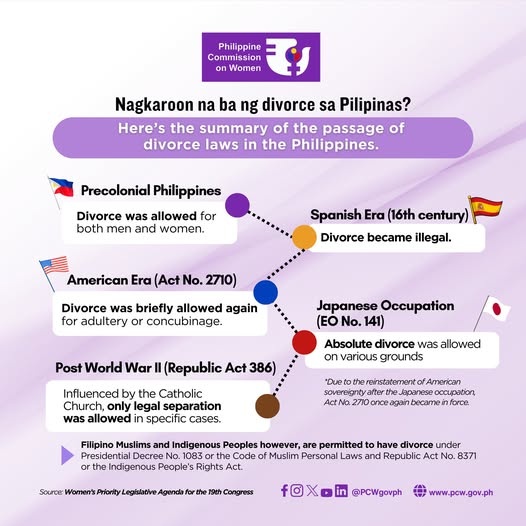
Divorce has not always been prohibited in the Philippines. During the Spanish colonial period, which lasted until the late nineteenth century, Spanish authorities imposed Catholic legal traditions. These laws allowed only “relative divorce,” or legal separation, in cases such as adultery or when one spouse entered a religious order. However, the law emphasized the permanence of marriage, declaring that “so great is the tie and force of marriage, that when legally contracted, it cannot be dissolved even if one of the parties should turn heretic, or Jew, or Moor, or even commit adultery.” [Source: Ana P. Santos, The Atlantic, June 25, 2015]
After Spanish rule ended, divorce policies changed depending on the colonial power in control. When the United States took possession of the Philippines in 1898 following the Spanish-American War, it permitted divorce but only on limited grounds, specifically adultery or concubinage. During World War II, the Japanese occupation government introduced more liberal divorce laws. After the war and the restoration of Philippine governance, however, divorce was again prohibited—except for the Muslim minority—under the Philippine Civil Code of 1949.
Modern legal alternatives to divorce, such as annulment and legal separation, remain limited and often difficult to obtain. Statistics from the Philippines’ Office of the Solicitor General (OSG) indicate that more than 10,000 petitions to end marriages were filed in 2013 in the Philippines when the population was about 100 million people. Women filed slightly more than half of these petitions.
According to OSG data from a sample of cases between 2010 and 2011, about 6 percent of petitions were dismissed or denied. However, these figures do not reflect the lengthy and costly nature of such proceedings. Cases can take years to resolve, and court fees—often around $400 just to file paperwork—can exceed the average monthly wage of Filipino workers, which a 2012 International Labour Organization study estimated at less than $300.
Annulment in the Philippines
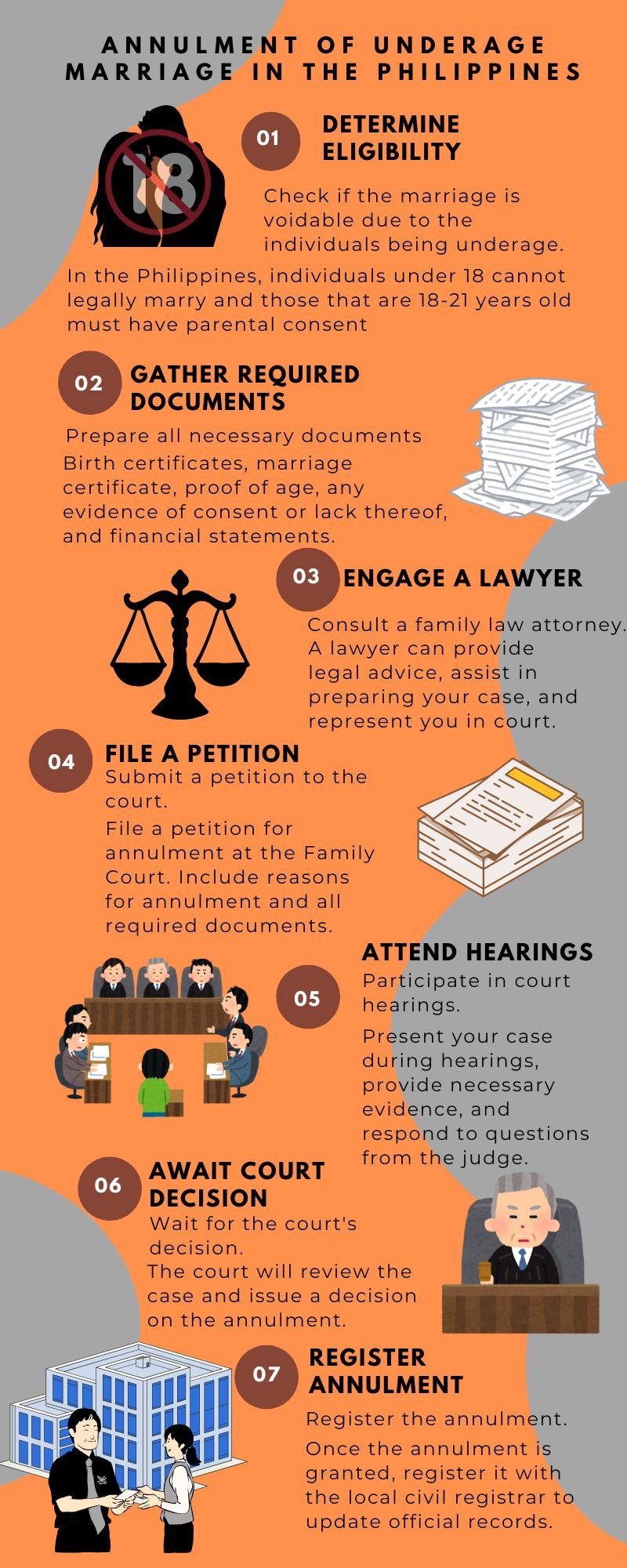
Currently, The only way to terminate a marriage in the Philippines is to nullify it through an annulment—legally declaring that the marriage never existed or was invalid from the beginning. According to the BBC: Annulments requires a civil case in which spouses have to undergo mental health tests and testify in court, all in a bid to have a judge declare a marriage invalid. Such cases can last up to ten years and are generally expensive. [Source: BBC, March 19, 2018]
The Catholic Church does not permit divorce. For many Filipinos, annulment was once considered socially uncomfortable or undesirable. Over time, however, civil processes such as legal separation, divorce for Muslims, and annulment have become somewhat more socially acceptable among both Christian and Muslim Filipinos. In cases of civil separation, the former husband is generally expected to support the children and provide some financial assistance for the former wife and household maintenance. [Source:Jose Florante J. Leyson, M.D., Encyclopedia of Sexuality |~| ]
The grounds for nullity in the Philippines include: 1) marriage to a minor (below 18, even with parental consent); 2) lack of authority of the person who solemnized the marriage; 3) absence of a valid marriage license; 4) a bigamous or polygamous marriage; 5) mistaken identity of one of the spouses; 6) an incestuous marriage; and 7) psychological incapacity. According to one legal authority, psychological incapacity “contemplates a genuine incapacity or inability to recognize and assume basic marital obligations, not merely refusal, neglect, or ill will on the part of the errant spouse.” [Source: Ridel Rodis, Philippine Daily Inquirer, July 2009.]
Under earlier provisions of the law, Filipinos could obtain an annulment only for conditions that already existed at the time of the marriage. This changed in 1988, when courts began allowing petitions for nullity based on conditions that became evident after the marriage. These could include cases where one spouse displayed a conflicting personality, emotional immaturity, irresponsibility, or engaged in behaviors such as physical abuse, habitual alcoholism, sexual infidelity or perversion, abandonment, and even habitual lying.
In many other countries, including the United States, such behaviors are typically grounds for divorce rather than annulment. However, because divorce has long been unavailable in most of the Philippines, the concept of psychological incapacity became an important legal avenue for dissolving marriages. By 2009, the interpretation of “psychological incapacity” had broadened further. Courts sometimes applied it even in cases where a spouse living outside the Philippines could not be served legal papers, making annulment possible in situations where a standard legal process would otherwise be difficult to carry out.
Separation and Remarriage in the Philippines
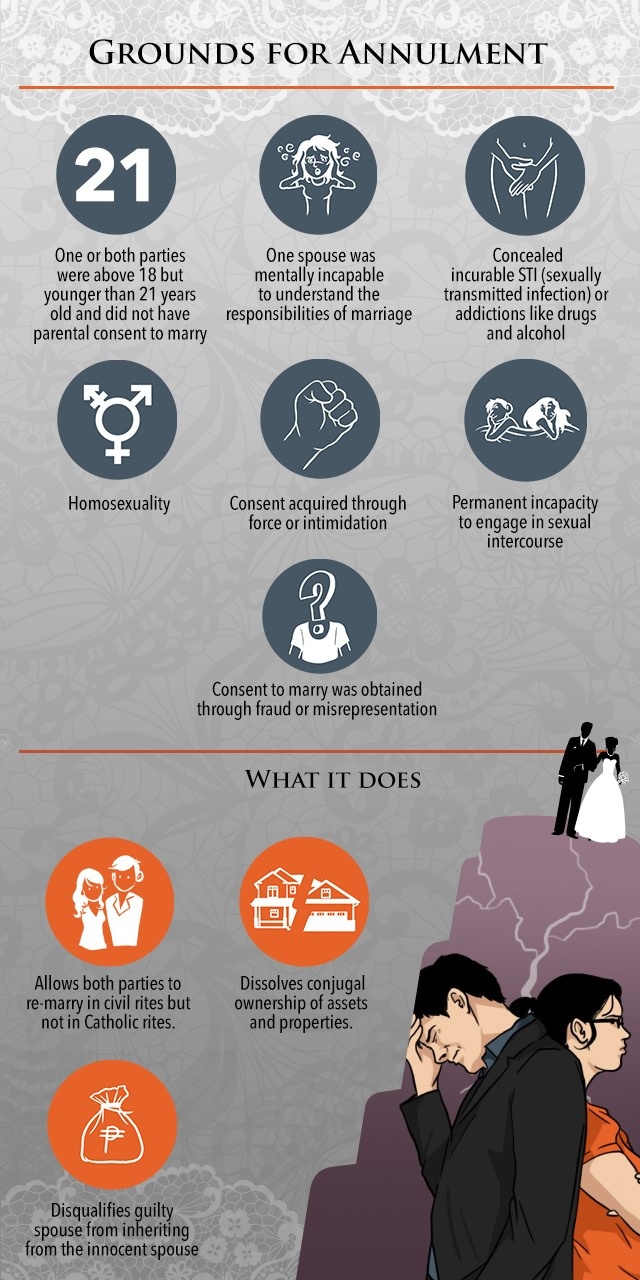
Consensual separations are an alternative to annulment. Legal separation allows couples to separate their possessions and live apart, but does not legally end a marital union and thus does not permit remarriage. Such separations are often viewed as more acceptable than formal legal actions. In recent decades, many couples have sought to have their marriages declared null and void under the Philippine Family Code (Executive Order 209, Article 36). This law recognizes “psychological incapacity” as grounds for civil annulment, meaning that one spouse is considered unable to fulfill basic marital responsibilities. The concept reflects a standard introduced in Catholic Church annulment practices after the reforms of the Second Vatican Council, when annulments became more common. A civil annulment dissolves the marriage and allows both individuals to remarry legally. As annulments increased in the 1990s, Senator A. D. (Nikki) Coseteng proposed legislation emphasizing marriage as an inviolable social institution and the foundation of the family. [Source:Jose Florante J. Leyson, M.D., Encyclopedia of Sexuality |~| ]
You can get child support in the Philippines if you are legally separated or living apart. Under the Family Code, both parents are legally obligated to support their children (food, shelter, education, medical needs) regardless of their marital status or separation. But many women who are physically but not legally separated can’t afford the considerable legal costs of separation proceedings and have a hard time claiming child support.
Reliable statistics on remarriage remain limited, but both rural and urban areas have seen a rise in cohabitation. This trend is often linked to Western cultural influences as well as economic pressures. In major cities, younger and more financially independent women may have greater opportunities to remarry, although Catholic priests generally will not officiate at a second marriage unless the Church itself has granted an annulment of the previous union.
Despite gradual changes in attitudes toward separation and annulment, the overall rate of marital dissolution in the Philippines has remained relatively low compared with many industrialized countries. This is largely due to the continuing influence of the Catholic Church, strong parental values, and the importance of extended family networks. Families provide emotional, social, and financial support, and they often play an important role in many aspects of life, including employment opportunities. Because of these factors, legal separation or annulment is still frequently viewed as a personal failure or a social irregularity, and the end of a marriage is often seen not as a symbol of independence but as the beginning of a new and sometimes difficult phase of life.
Women Who Filed for Annulments in the Philippines
Ana P. Santos wrote: Filipino TV host Amy Perez is familiar with the difficulties these rules pose. Perez married a rock musician in 1995, and the couple had a son two years later. But within a year of his birth, Perez’s husband had left her with their baby and gone to live abroad. Perez filed for an annulment in 2000, and was denied. She appealed and lost. In 2006, the Philippine Supreme Court declined to hear her case, declaring: We find [the husband’s] alleged mixed personality disorder, the ‘leaving-the-house’ attitude whenever they quarreled, the violent tendencies during epileptic attacks, the sexual infidelity, the abandonment and lack of support, and his preference to spend more time with his band mates than his family, are not rooted on some debilitating psychological condition but a mere refusal or unwillingness to assume the essential obligations of marriage. The system is so unfair, especially to women like me in a situation of abandonment. Why do they have to make it so hard?” asked Perez, whose marriage didn’t formally end until a decade after her husband left her. She declined to give details about how she finally obtained the annulment. Last year, she married her longtime boyfriend, with whom she has two children. [Source: Ana P. Santos, The Atlantic, June 25, 2015]
This kind of hassle can be avoided for the right price, however. Michelle, a former classmate of mine who asked that I not use her full name, claims to have paid her lawyer $10,000 for an all-inclusive annulment package that covered a psychiatric evaluation, all the related paperwork and fees, and a guarantee of a favorable decision from the judge, an old law-school buddy of the lawyer’s...You get what you pay for. Michelle got her annulment in six months. I waited four years. Michelle only had to appear in court once. I spent years using up vacation days for intermittent court appearances. Michelle took the stand to answer only one question: her name.
Annulments have become a lucrative sideline for judges whose courtrooms have earned the reputation of being annulment mills that manufacture the decisions in bulk, changing only the names of the petitioners to cope with the demand. "Corruption is widespread in the annulment courts,” said Noel Segovia, senior prosecutor of the Office of the Solicitor General. “It is like a cancer.” Even without bribes, legal fees associated with annulment come out to about $5,000. Add on the grease money, experts say, and the totals can shoot up to $10,000, far out of reach for the average Filipino who earns about $300 a month. [Source: Ana Santos, Los Angeles Times, August 23, 2016]
Annulment Process for a Filipino Woman
Ana P. Santos wrote in The Atlantic: The call came in the middle of a workday. My lawyer’s name flashed on the caller-ID screen, and there was no small talk when I picked up. I have the court decision,” she said. She was literally holding my future in her hands, in the form of an annulment decision we had sought for four years. After opening the envelope, she rambled a bit, skimming the contents out loud to fill the dead air. Then she paused. Petition approved. Congratulations!” she said. “You are now a free woman!” [Source: Ana P. Santos, The Atlantic, June 25, 2015]
I had finally gotten out of my long-dead marriage in the devoutly Catholic Philippines, the only country in the world (other than Vatican City) where divorce is not legal. Two people can voluntarily choose to love, honor, and remain faithful to each other, but in the Philippines it is pretty much only through death, or the torturously long process of annulment, that they can part.
I had walked out on my marriage five years earlier and had barely spoken with my daughter’s father for just as long, but on paper he was still my husband. I was a single woman, but I was not free. My name was only half mine—all my identification papers remained in my married name. Any major purchase I made would be considered conjugal property. If I got into a new relationship, I risked being charged with adultery and jailed. I was 28 when I left my husband, 29 when I finally decided—against my family’s wishes and without their support—to file for annulment. I was 33 when I received the court decision. And on the phone that day, I felt like the oldest 33-year-old in the world.
As a 28-year-old middle manager, I couldn’t afford” the $10,000 easy annulment plan described above. “It took me a year before I found a lawyer I could afford; my cousin eventually negotiated a fee of $2,000 with a former law-school classmate. I paid this lawyer in installments as my case dragged on. Like Perez, I filed for annulment claiming my spouse was psychologically incapacitated. My lawyer suggested I try to have both of us declared psychologically incapacitated to double the chances of success, but I refused. I was afraid such a designation would damage my chances of getting a job or custody of my daughter. Don’t worry. It’s just a term to justify your petition,” my lawyer assured me, echoing the two other lawyers I had consulted before her. (I wanted a second opinion.) They all gave me some variation on: “It’s just the Philippine version of ‘irreconcilable differences.’”
But making such a claim is not an innocuous formality. Trying to show psychological incapacity is an adversarial process in civil court, aimed at proving beyond a reasonable doubt that one spouse was exhibiting behavior indicating an inability to take on the responsibilities of marriage. It means stating in public court all the reasons—both trivial and consequential—why you cannot stay married to your spouse. It involves psychological tests and, in some cases, witnesses. It’s a game of mud-slinging and one-upmanship that makes breaking up that much harder and uglier. It encourages a petitioner to exaggerate problems—to declare a once-loved partner an alcoholic as opposed to someone who occasionally came home drunk, or a chronic womanizer as opposed to someone who once had an affair.
I withstood a barrage of inquiries from a judge. It was a harrowing experience, forcing me to dredge up years of bad, buried memories. The judge probed for details about the fights I’d had with my husband. He accused me of not trying hard enough to keep the peace in our relationship. When I brought up the allegations in my petition—regarding the abuse and infidelity I’d had to endure—he asked me if I thought that was enough to end a marriage. (My then-husband didn’t show up to any of the court proceedings, which is a way of opposing the annulment petition.) I was too proud to beg the judge to stop his line of questioning, too angry to stay quiet. I was ultimately taken off the stand because I was crying uncontrollably. I felt like I was on trial, as if I were a criminal.
How to Split When Divorce Is Not an Option
With divorce, Kate McGeown of the BBC wrote: “as in many aspects of life” in the Philippines “people have found ways to get around the rules. The main way, if you have got the money to do it, is to get your marriage annulled. It is as if someone waves a magic wand, and both the wedding and the unhappy-ever-after simply never happened. All you need is a psychiatrist to say that there is something wrong with either you or your partner, leaving you unable to fulfil the essential obligations of marriage. Exactly what those obligations are remains somewhat vague - a loophole that has not gone unnoticed by warring couples and their lawyers. [Source: Kate McGeown, BBC, June 11, 2011 */]
“Joey's story is typical. He works in PR in Manila's business district, and is bright, articulate and confident. Yet in order for his first marriage to be annulled, he had to declare that he was psychologically incapacitated. Now I am no expert, but Joey does not look psychologically incapacitated to me. He has a broad smile and a ready wit - and he even manages to find our meeting place despite my appalling directions. But a psychiatrist said he was psychologically incapacitated, and a judge agreed. Six months later, and more than $1,000 (£600) poorer, Joey was free to marry again. It is a legal fudge that seems to work quite well. Many celebrities have gone down the same route, sometimes more than once, but success is not guaranteed. I have heard of cases mired in the courts for years, others which have cost $5,000 (£3,000) or even more, and some which have been refused outright. */
“And it is hardly an option available to everyone. This is a country where a third of the population live on less than a dollar a day. An annulment is simply too expensive for the vast majority of people. The result is a two-tier system, where rich people can marry again and poor people cannot. I have visited many of Manila's slums in the course of my job. Almost everyone is Catholic, and almost everyone attends Sunday worship - large families filing out of the rabbit warren of precarious structures they call home and piling into the churches. But, even here, it is not hard to find people who have circumvented the church's rules. Many of those whose marriages have fallen apart simply move on to live with someone else. */
So why does the government not just accept that some marriages fail, like they do everywhere else - and that divorce is sometimes the only option? Because that would be to ignore the strong feelings people have toward their faith. The majority of people here are not just lip-service Catholics, but fasting, praying, regular-attending members of the church. And when the bishops say that divorce is anti-Filipino, and to legalise it would be to cheapen the institution of marriage, people take that message seriously. What really surprises me is that out of all the people I've spoken to who are separated, or have had their marriages annulled, few say the Philippines is ready for a divorce law. Annulment should be accessible to everyone, they say - laws should be passed to make it quicker and simpler, broadening the criteria for when it can be granted, and dispensing with the need for a psychiatrist. So, basically, divorce by another name - a uniquely Philippine solution. */
Staying Married in the Philippines Even After Being Threatened with a Knife
One Filipino woman wrote in the Huffington Post, “My friend Anna was seven years old when her father entered their room with a knife and threatened to stab her mother. That night, Anna and her mother ran away from their home, leaving Anna’s father and her siblings behind. Eleven years later, Anna still remembers that night extremely clearly. Anna says her mother had to run away to escape from her father since their marriage could not be dissolved legally. [Source: Huffington Post, October 24, 2013 +/+]
“In Anna’s mother’s case, the beatings started when she discovered that her husband had a mistress, a woman he had met at a beer house. Anna’s mother confronted him, and he responded by regularly punching, kicking, and throwing hot coffee at her. He would go home drunk and beat her. Anna’s mother’s case is not an isolated one. The Philippines’s National Statistics Office (NSO), through the 2008 National Demographic and Health Survey (NDHS), found that one in seven married women experienced physical violence from their husbands. They also experienced other forms of abuse including sexual, emotional, and economic violence. +/+
“Anna’s mother, like many other Filipino women, will not file for legal separation or an annulment because it’s a long, time-consuming, and expensive process. She says she might as well spend the money on food. For Anna, the separation of her parents brought distress and confusion to her life as a child. Her siblings didn’t take the separation easily either. They rebelled against their parents and did not finish their studies.” When asked about her feelings on divorce, Anna remains indifferent. “For me, marriage doesn’t really matter, and neither does divorce,” she says.+/+
Efforts to Change the Divorce Laws in the Philippines
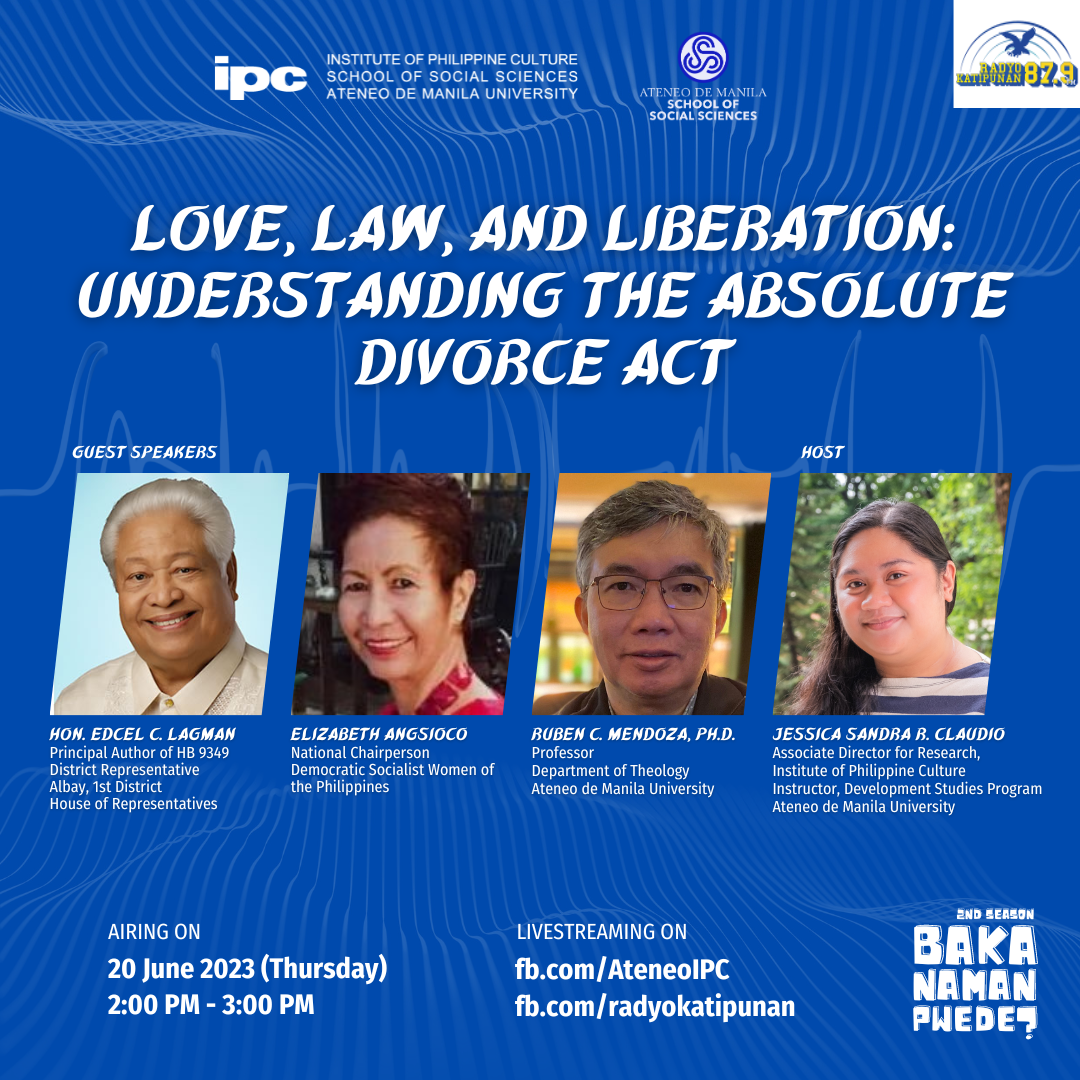
The Absolute Divorce Bill, often linked to House Bill 7303 in earlier Congresses and later House Bill 9349 was approved by the Philippine House of Representatives on its third and final reading in May 2024. As of early 2025, however, the proposed law remains pending in the Senate and faces uncertainty due to political opposition and the limited legislative calendar ahead of national elections. In May 2024, the House passed the proposed Absolute Divorce Act, which would allow married couples to legally dissolve their marriages under specific circumstances. The bill outlines grounds such as domestic abuse, infidelity, abandonment, and irreconcilable differences. Supporters argue that the measure would provide a humane and practical solution for couples trapped in irreparably broken marriages.
After its approval in the House, the bill was transmitted to the Senate, where it has yet to be passed. Some senators have expressed reservations about creating a full divorce law and have instead suggested expanding existing legal remedies such as annulment or legal separation. The May 2025 midterm elections were expected to affect the bill’s prospects. If the Senate does not approve the measure before the current Congress ends, the entire legislative process will have to begin again in the next Congress.
Representative Luzviminda Ilagan, who represents the women’s organization Gabriela in Congress, argues that widespread domestic violence is a compelling reason to legalize divorce in the Philippines. She says, “Divorce, when introduced into our laws, will provide an alternative for couples in irreparable marriages.” Ilagan also stresses that “the extent of domestic violence and abuse in the Philippines is one of the main reasons in pushing for divorce,” and believes the law would empower women and address their vulnerability to abuse. [Source: Huffington Post, October 24, 2013]
Ilagan counters that divorce would not undermine families but would address the reality of abusive and irreparable marriages. She says, “It will not weaken marriages and families in the Philippines… We cannot deny the existence of abusive and irreparable marriages,” adding that couples already separate even without a divorce law. She also argues that current legal options are inadequate. According to Ilagan, “These options have their respective limitations and loopholes,” noting that legal separation does not allow remarriage and annulment treats the marriage as if it never existed. By contrast, a divorce law could clarify issues such as conjugal property, children’s legitimacy, and child support after a marriage ends.
Opposition comes from James Imbong, legal counsel for the Catholic Bishops’ Conference of the Philippines. He argues that divorce would be unconstitutional, citing 1987 Constitution of the Philippines, which states: “Marriage, as an inviolable social institution, is the foundation of the family and shall be protected by the State.” Imbong interprets this to mean the state must prevent anything from destroying marriage. Imbong maintains that divorce could harm children by separating them from parental guidance, arguing that children require adults to help shape them into responsible citizens. Ilagan responds that the proposed divorce law would include provisions to protect children and ensure financial support after a marriage is dissolved.
Image Sources: Wikimedia Commons
Text Sources: “Encyclopedia of World Cultures Volume 5: East/Southeast Asia:” edited by Paul Hockings, 1993; “Culture Shock!: Philippines” by Alfredo Roces and Grace Roces, Marshall Cavendish International, 2010; National Geographic, Live Science, Philippines Department of Tourism, New York Times, Washington Post, Los Angeles Times, Smithsonian magazine, Encyclopedia.com, Library of Congress, The Conversation, The New Yorker, Time, BBC, CNN, Reuters, Associated Press, AFP, Lonely Planet Guides, Google AI, Wikipedia, The Guardian and various websites, books and other publications.
Last updated March 2026