
FILIPINO CHINESE WEDDINGS

The Chinese, like the Filipinos, have unique wedding traditions, ceremonies, and even superstitions. Because China is a large country, each clan has its own special tradition and customs. Their traditions mixed with the Filipinos, made Filipino-Chinese weddings even more colorful. Here is a guide on the basic wedding rituals of the Filipino-Chinese. [Source: Jonathan Dionisio, July 13, 2009 /*/]
The elements of ancestor worship and elder reverence, the lookout for omens, the use of professional matchmakers, the ornate gift-giving rituals and patrilineal kinship are similarly present in both traditional Chinese weddings and Chinese marriages in Philippine soil, along with the primary objectives of enhancing families and perpetuation of lineage. The element of time likewise plays a major part in Chinese weddings. Compatibility between bride and groom, for one, is more often than not determined by their respective star signs and horoscopes, which are in turn determined by the date and time of their births. The time of the ceremony is carefully picked, again for purposes of adherence to what their horoscopes dictate. [Source: kasal.com ^]
Unlike their western counterparts, Chinese weddings make extensive use of the color red, for it is believed that the color symbolizes joy and luck. On the other hand, the practice of showering the newlyweds with rice is remarkably present in both cultures. In a marriage, the dragon symbolizes the male role while the phoenix symbolizes the female role. Dragon and Phoenix designs symbolize male and female harmony and a balanced relationship. The motif is rooted in mythology where the dragon symbolizes the Emperor and at his side stands the magically powerful phoenix with her life-giving song. ^
Chinese elders usually play a major role in the Chinese wedding. This role traditionally starts even before the child to be wed is born, when parents arrange for the weddings of their children. Sometimes, couples seek the help of a professional matchmaker, usually an elderly local woman of reputable character. Children, for their part, customarily follow their parents, as dictated by the analects of Confucius. ^
For the Chinese, the preferred partner is also Chinese. Chinese parents usually dislike Filipinos for in-laws. This prejudice against Filipinos mainly stems from their values which are different from those of Filipinos. Thus, inter-racial marriages are rare. In a culture where ancestral worship is practiced, it comes as no surprise that weddings are held in front of the family altar. The local Chinoy version varies little, as ceremonies are usually held before ancestral shrines in clan halls. ^
Once the future bride has accepted the marriage proposal of the future groom, the couple consults a Feng Shui expert to assist them in choosing the date of their Kiu Tsin or Kiu Hun or pamamanhikan (asking of hand in marriage), Ting Hun or engagement, and Kan Chiu or wedding ceremony. The Feng Shui expert determines the most auspicious date and time for these three important occasions based on the Chinese Zodiac sign of the marrying couple, their parents, and grandparents. [Source: Jonathan Dionisio, July 13, 2009 /*/]
RELATED ARTICLES:
WEDDINGS IN THE PHILIPPINES factsanddetails.com
WEDDING CEREMONY IN THE PHILIPPINES factsanddetails.com
FILIPINO WEDDING DAY FESTIVITIES: RECEPTION, PARTIES, ENTERTAINMENT factsanddetails.com
WEDDING CUSTOMS OF DIFFERENT ETHNIC GROUPS AND REGIONS IN THE PHILIPPINES factsanddetails.com
MARRIAGE IN THE PHILIPPINES factsanddetails.com
COURTSHIP, DATING AND LOVE IN THE PHILIPPINES factsanddetails.com
DIVORCE IN THE PHILIPPINES: BAN, LAWS, ANNULMENTS, IMPACTS factsanddetails.com
CATHOLIC MARRIAGE, WEDDINGS, DIVORCE AND ANNULMENT europe.factsanddetails.com
Marriage Compatibility According to the Chinese Zodiac
The Chinese zodiac sign is based on a 12-year cycle, each year represented by an animal, associated with a specific type of personality. As such, those born under a certain Chinese zodiac also bear the same characteristics of their sign. As ritual to ensuring marital bliss, soon-to-wed Filipino-Chinese, or simply Tsinoys, as well as other Filipino couples, consult their Chinese zodiac sign to see if they are compatible with their soon-to-be partner for life. [Source: Jonathan Dionisio, July 13, 2009 /*/]
It is easier to identify incompatible signs of the Chinese zodiac. The main reason why certain zodiac signs are incompatible with one another is because of the clash of their personalities. For example those born under the year of the Dragon (1964, 1976, 1988) are said to have “quick, sometimes vengeful tempers”. They are also known to be aggressive and dominant. With this, they become incompatible with people born in the Year of the Dog (1958, 1970, 1982) since they have “a sharp tongue and a tendency to be a faultfinder”. /*/
Here is the complete list of incompatible signs: 1) Rat (1960, 1972, 1984, 1996) and Horse (1954, 1966, 1978, 1990); 2) Ox (961, 1973, 1985, 1997) and Sheep (1955, 1967, 1979, 1991); 3) Tiger (1962, 1974, 1986, 1998) and Monkey (1956, 1968, 1980, 1992); 4) Rabbit (1963, 1975, 1987, 1999) and Rooster (1957, 1969, 1981, 1993); 5) Dragon (1952, 1964, 1976, 1988, 2000) and Dog (958, 1970, 1982, 1994); 6) Snake (1965, 1977, 1989, 2001) and 7) Pig (1959, 1971, 1983, 1995). /*/
On the other end, there are Chinese zodiac signs that are perfect for each other. They complement the personal traits of their partner’s signs. To establish compatibility, astrologers have grouped each of the twelve signs into four trines. By definition, a trine is a Ptolemaic aspect with an angle of 120̊ (1/3 of the 360̊ ecliptic), represented by the triangle. The trine indicates harmony, and ease of expression, with the two elements reinforcing each other. In Chinese astrology, each trine is evenly spaced at four years apart. People born under similar trines are said to have the same traits, mindset, and personality. This makes the couple with the same group of trine very compatible. /*/
1) First Trine: Rat, Dragon, and Monkey: These three signs are said to be the most powerful signs in the Chinese zodiac. People born under these signs are said to be capable of great good or great evil. When it comes to relationships, they are highly intelligent, charming, yet authoritative. Their relationships are usually intense and would like it to remain that way. 2) Second Trine: Ox, Snake, and Rooster: Members of the second trine are known to conquer life through endurance, application, and slow accumulation of energy. They are meticulous planners, and are very good at it. Also, they are loyal, philosophical, patient, good-hearted, and has high moral values. /*/
3) Third Trine: Tiger, Horse, and Dog: People born in the year of the Tiger, Horse, and Dog can simply be described as the 'true romantics'. They set relationships and personal contacts as their highest priorities. The third trine signs are also productive, engaging, independent, and loyal. They have the tendency be very protective. The three signs do not enjoy being told what to do, but will listen when comes from a person they love or trust whole-heartedly. 4) Fourth Trine: Rabbit, Sheep and Pig: The last trine is a seeker of beauty in life. They are capable of great sacrifices for the sake of their loved one. These three signs are compassionate, caring, sensible, emphatic, prudent, and are very affectionate. Off all the four, members of the fourth trine possess a calmer nature than the rest of the zodiacs. Incidentally, they are fine artists in their lovemaking. /*/
For couples who are neither in the compatible or incompatible group (example, Tiger and Rabbit), the degree of their compatibility may vary. This depends upon their personalities and the nature of their relationship. Whether compatible or not, the married life of a couple depends on themselves. Their love, respect, and understanding for each other should serve as the foundation of their relationship. Their ideals and characteristics may cause conflict at times, but surely, by the end of the day, their love for one another should transcend their differences. Best wishes! /*/
Ting Hun: Formal Chinese Filipino Engagement Ceremony
On the day of the Formal Engagement Ceremony, called Ting Hun, no formal invitations will be printed or distributed for this occasion. However, the groom parents shall have it announced in a local Chinese newspaper ad on the day itself. During the Ting Hun, the groom’s engagement party arrives at the ceremonial place an hour before the said time and the bride serves tea to the groom's family in order of seniority. The bride is escorted by a female relative, chosen for her good qualities and standing. She should be a married woman with children and has a birth sign that is compatible with the bride. [Source: Jonathan Dionisio, July 13, 2009 /*/]
The ceremony begins with the bride’s parents welcoming and receiving the groom’s party. First, the groom enters with the box of corsage in his hand. He is followed by his relatives who will enter the ceremony venue in two’s, with each pair carrying a Sin Na. They are followed by the parents of the groom, and last, the other representatives of the family carrying the other gifts. As the gifts are being carried into the ceremonial room, the elder representatives of the groom fix the ceremonial table, cover it with the red bridal satin cloth and place the gifts on top. After the groom's family has entered, their chosen representatives are asked to proceed to their ceremonial seats together with the bride's chosen representatives. The representatives of the groom's family fixes the ceremonial table. /*/
The bride enters the ceremonial room walking backward. This is to avoid negative energy and to avoid her from seeing the groom. The bride is turned three times clockwise by her escort. After which, he allowed to look at the groom. Welcome drink such as red or orange juice, which denotes good luck and happiness, is served as soon as the bride is seated. The bride's female family member serves the drink to both entourages, from eldest to youngest, before it is served to the marrying couple. Once the marrying couple is served, the families can now proceed to exchanging of gifts or Gift-Giving Ceremony. /*/
After the exchange of gifts, the Wedding Tea Ceremony comes next. For Chinese, tea plays a significant part on both engagement and wedding as tea symbolizes respect. During the tea ceremony, the bride serves the tea to the groom's family in order of seniority. She is followed by the groom who, in turn, serves the bride's family in the same order. Through this ceremony, the bride is formally introduced to the family of the groom. /*/
Once all the guests have been served with tea, formal pictorial follows. It may be followed in this sequence:; 1) Newly engaged couple; 2) Couple with bride's parents; 3) Couple with bride's immediate family; 4) Couple with both parents; 5) Couple with groom's parents; 6) Couple with groom's immediate family; 7) Couple with groom's engagement party; 8) Couple with bride's engagement party; 9) Couple with bride's relative; 10) Couple with bride's friends. Just before the wedding reception the newlyweds are served with misua (thin noodles made from wheat flour, originating in Fujian), a symbol of long lasting relationship. /*/
The family members of the bride prepare the dining table where the engagement party will take sweet tea soup and misua, a symbol of long lasting relationship. The bride's mother invites the engagement party for sweet tea soup and misua eating as part of the ceremony. Each guest at the table is served with a bowl of sweet tea soup, containing two pieces of eggs, two pieces of red dates and two pieces of sliced condoles. The sweet taste of the tea soup is a wish for sweet relations among the bride and her new family. One doesn’t need to finish two eggs. If unable to finish, he/she may cut the remaining egg in half. However, should anyone choose not to eat them, he/she may opt to leave them in pair. Pair signifies a couple's togetherness. /*/
After the sweet tea soup, bowls of misua are served. The same procedure in serving is followed, with the elders served first and the marrying couple served last. After the misua is eaten, the Ang Paos are returned to the groom, who in turn, returns the money to his parents. The bride's female family members distribute flowers to the single ladies while other female members prepare goodie bags for giveaway. /*/
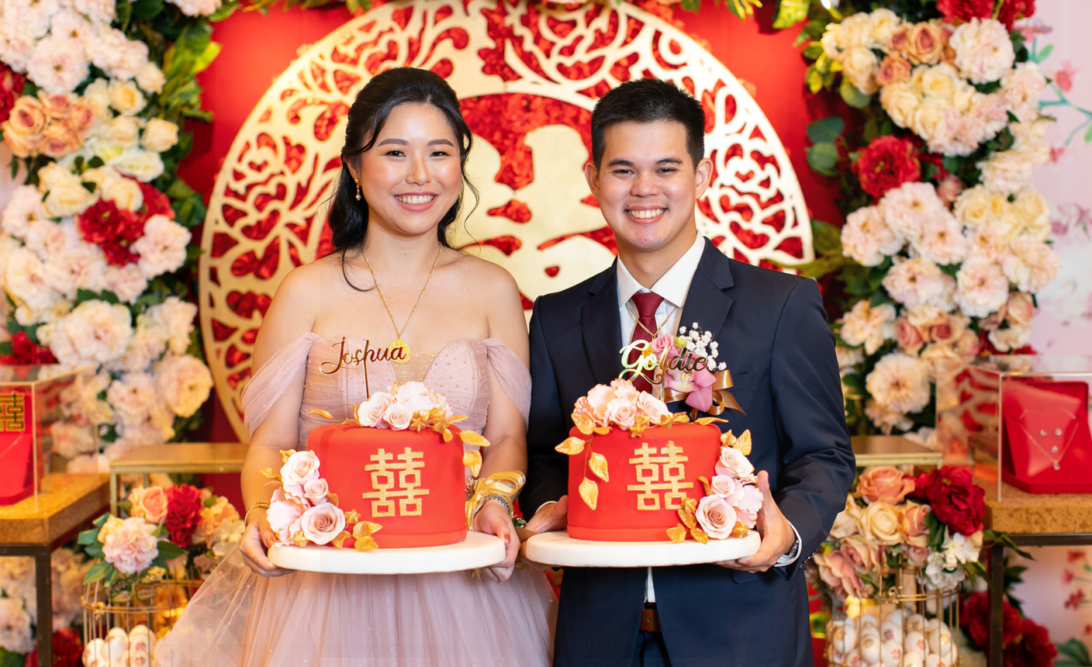
The groom places back the cakes displayed earlier at the table in their respective boxes. He carries the cake with bride's name, while the cake bearing his name is carried by one of his representative. Riding a car, they will drive around the block of the ceremonial venue twice. Driving around is like forming a circle, a shape which signifies unending union or lasting relationship of the couple. The groom comes back carrying the cake with his name and leaves the other cake in his car. The numbers of Sin Na's content and other goodies is divided into half and are returned to the groom's family before or after the reception. After this ceremony, the bride and groom, together with their family and those who were not allowed to witness the ceremony, eat at the prepared reception. /*/
Chinese Filipino Pamamanhikan (Kiu Hun, Kiu Tsin)
The future groom and his family visit the future bride and her parents to formally ask for her hand in marriage. The groom’s family brings basket of fruits and sweets to the bride’s family. These gifts represent fertility and prosperity in Chinese culture. During this time, both families discuss about the wedding date, wedding preparation, and other details. Once the dates have been identified, both families prepare their traditional gifts for each other. [Source: Jonathan Dionisio, July 13, 2009 /*/]
The female's family picks an auspicious date from the suggested dates of the male's family. Auspicious days are subject to interpretation by fortunetellers that perform the analysis based on one's birth date (day and hour) after consultation with the Chinese almanac. The 15 day period from the middle to the end of the seventh lunar month is considered inauspicious because that is time of the Hungry Ghost Festival when the gates of Hell are opened and the lost spirits are allowed to wonder the earth. Usually the whole seventh lunar month is considered inauspicious. The 15 day period from the middle to the end of the seventh lunar month is considered inauspicious because that is time of the Hungry Ghost Festival when the gates of Hell are opened and the lost spirits are allowed to wonder the earth. The male's family will present the betrothal gifts which includes tea, dragon and phoenix bridal cakes, wine, pairs of male and female poultry, sweetmeats and sugar. In extremely rich families, they even send out jewelry. Tea is a primary part of these gifts. [Source: Karen Grace Pascual, Tsinoy.com \=]
Below are the gifts the groom and his family have to prepare, with Sang Hee sticker on top: A) Jewelry; Wedding rings; Lady’s watch; Lady’s necklace with medallion pendant; A pair of Chinese bangles with red thread; Sets of jewelries placed in a red box; B) Ang Paos: 2 pairs of Ang Paos, one pair of small amount and one pair of big amount; C) Fabric (Quantity of clothes/fabric should be in even numbers); D) Flowers: One box of corsage; One box of boutonnière; Six (6) or eight (8) varieties of flowers (all colors are allowed except white); E) Fruits: Boxes of fruits (in even numbers); 4 pieces of Pomelo; F) Canned Goods: Canned porklegs (in even numbers); Canned fruit cocktails (in even numbers); G) Chinese Hopia: Each set has four (4) kinds of Chinese delicacies) (minimum of 12 sets); H) Candies and cookies (preferably chocolate coins); I) Chinese misua (placed in red boxes); J) Gifts: for the bride’s parents and senior members of the family (usually a suit/barong fabric for men and lace fabric for women) and Sin Na (a 4-layered basket made out of bamboo). /*/
After preparing the gifts, the participants of the formal engagement party are chosen based on the compatibility of their Chinese zodiac signs to the marrying couple and both parents. This is to avoid the presence of bad luck or negative energy during the ceremony. Family members and guests who are incompatible are not allowed to witness the ceremony but they are welcome to join the reception. Engaged couples and pregnant women are not allowed as well because the Chinese believe that they may pull out the luck intended for the marrying couple. In Chinese weddings, pomelos are given because of the Chinese Proverb, "Yiu Lai, Yiu Khi", which means smooth relationship). /*/
Pre-Wedding Filipino Chinese Traditions
Giving out invitations is a must for every wedding. But the Chinese really does it with style. They send out Double Happiness cakes to the close friends and relatives to announce their wedding. Along with these cakes comes an invitation printed on red paper. Those who received it must give them a congratulatory gift on the wedding day. Another pre-wedding ritual is installing the bridal bed probably for the couples first tonight together. A respected relative considered a good luck man or good luck woman, one man or women with many children and living mates will install the bed. Installing the bed means moving the bed slightly or putting the bed cover and the pillows. Once the bed is installed, children (as many as you want) are asked to play on the bed. Later on they will scatter red dates, pomegranates and other fruits. The female has to bathe in water infused with pomelo skin or peelings or leaves, to clense her of the bad things. [Source: Karen Grace Pascual, Tsinoy.com \=]
After the Ting Hun, the couple arranges a visit to chosen individuals to formally ask them to serve as principal sponsors. The couple brings a basket of goods containing canned pork leg, misua, canned fruit cocktail and sweets during their visit. Once the prospect sponsors agree, the couple visits again to bring fabric for his or her attire for the wedding. Other couples may only pay one visit to their future sponsor who is really close to them. They bring along the fabric together with the basket of goods on the day of their visit. [Source: Jonathan Dionisio, July 13, 2009 /*/]
Both bride and groom have their own pre-wedding preparations. For the groom, he delivers the bridal gown and other accessories at the bride’s house. He gives this to the sister or mother of the bride. This is because the Chinese, like Filipinos, believe that the couple must not see each other before the wedding day. The marrying couple must consult their parents regarding the sequence of ceremony. Sometimes Chinese beliefs differ between families and not talking about it beforehand may cause conflict along the way. For example, others would have the pinning of the corsage at the start of the ceremony while others would have it at the end. /*/
The groom is in charge of installing the matrimonial bed at the couple’s new room. This is a new bed complete with cases, comforters, pillows, and sheets sprinkled with red dates, oranges, lotus seeds, peanuts, pomegranates and other fruits. The installation date is chosen by a Feng Shui expert. Once the bed has been installed, a baby boy born under the Year of the Dragon is made to roll around and sleep on the bed to ensure the couple’s future in bearing a son. Some families require the groom to sleep on the bed as well. For other Tsinoys, a respected relative considered as a ‘good luck man’ or ‘good luck woman’, a man or woman with many children and living mates, will install the bed. They are the ones asked to play on the bed to pass their good luck and fertility to the soon-to-wed couple. /*/
For the bride, she prepares her personal belongings, called Ke Tseng to be brought to her new home. These are neatly wrapped and are all labeled with Sang Hee. The bride's dowry is mainly interior ornaments or daily necessities. Wealthy parents have the options of giving complete home appliances, car, and real estate property. Ke Tseng items include: 1) A pair of red lantern; 2) A mirror covered in red cloth to dispel bad energy; 23 A pair of floral arrangement in a vase; 4) A pair of Mini Sin Na filled with sweet and Chinese herbs; 5) Small urinal/toilet kettle; 6) New sets of clothing; 7) New sets of jewelry; 8) New sets of suit case; and 9) a baby bath tub with toiletries. These items are then brought to the new house on a given date and time by the Feng Shui expert. The bride’s siblings bring all the items to the new house. Once everything has been brought to the new house, the family of the bride is served with misua, hard boiled egg and drinks. They will also receive Ang Paos as a token of gratitude. /*/
Filipino Chinese Wedding Day
On her wedding day the bride has to bath in water infused with pomelo skin or peelings or leaves, to cleanse her of the bad things. Then a good luck woman comes to help dress up the bride's hair. This woman should speak auspicious words while tying up the bride’s hair in a bun, the style of married woman. The bride’s face is covered with either a red silk veil or a 'curtain' of tassels or beads that hang from the bridal Phoenix crown. For the groom a capping ritual is done. The groom kneels at the family altar while his father places a cap decorated with cypress leaves on his head. They then set up the bridal sedan chair to pick up the bride along with the relatives and friends. [Source: Karen Grace Pascual, Tsinoy.com \=]
In some cases, the groom has dinner with the bride's family, and receives a pair of chopsticks and two wine goblets wrapped in red paper, symbolic of his receiving the joy of the family in the person of their daughter. In some regions, the groom is offered sweet longan tea, two hard-boiled eggs in syrup and transparent noodles. Another variation is for the groom to partake in a soup with a soft-boiled egg, the yolk of which is broken to symbolize the breaking the bride's ties with her family.\=\
The festive procession of picking up the bride includes firecrackers and loud gongs. The groom leads the procession accompanied by a child as an omen of his future sons, and attendants with lanterns and banners, musicians, and a 'dancing' lion or unicorn follows the bridal sedan chair. The 'good luck woman' carries the bride on her back to the sedan chair. Another attendant sometimes shields the bride with a parasol while a third tosses rice at the sedan chair. It is written that the bride cannot touch the bare earth. Great care is taken to ensure that no inauspicious influence affects the marriage. The female attendants are chosen with particular care so that the horoscope animals of their birth years are compatible with that of the bridegroom. The sedan chair is heavily curtained so that the bride may avoid seeing unlucky things. \=\
The wedding ceremony depends on the religion of the couple. Based on study, most Tsinoys are Catholics, thus following the Catholic wedding ceremony. Some practice their traditional Chinese religion, such as Mahayana Buddhism and Taoism, side by side with Catholicism or other religions. Typically the wedding ceremony only takes a few minutes. In a traditional Chinese style wedding the bride and the groom go to the family altar and pay homage to the Heaven and Earth, the family ancestors and then to their parents. The groom's parents are offered tea with two lotus seeds or dates in the cup. After they bow, the ceremony is over. In some other rituals, the couple drinks wine from the same goblet, eat sugar molded in the form of a rooster, and partake in a the wedding dinner together. \=\ /*/
Chinese Filipino Wedding Day Traditions
On the day of the wedding, more traditions are followed. For the wedding itself, formal invitations are printed and distributed to relatives and friends. The groom’s parents will again announce the wedding in a local Chinese newspaper. [Source: Jonathan Dionisio, July 13, 2009 /*/]
During the preparation of the bride, she wears a red robe with a dragon emblem while having her hair and make up done. After changing into her bridal outfit, her father is tasked to comb her hair 2 to 4 strokes downward to remove bad luck. A pair of Sang Hee coin is sewn in her entire outfit: bridal gown, long veil, stockings and shoes. Same thing goes with her future mother in law's stockings and shoes that were given by the bride. /*/
When the bride is prepared to leave for the church, she throws a fan bearing Sang Hee sign to family member sending her off. The bride's mother would pick it up and keep it. This gesture shows that her leaving will not take away all the good fortune from her. The door game originated from ancient times and shows that the bride's family and friends do not want to marry her away. /*/
Another tea ceremony takes place after the wedding ceremony and before they head to the reception. This is held in their new home or a small room at the reception venue. It is done by the newlywed couple and the groom's family. The bride serves tea to the groom's family in order of seniority which is similar to their engagement. After the drinking of tea, she receives a gift or Ang Pao from each member of the groom’s family. Gifts are usually in form of red envelopes or Ang Pao and contain money or jewelry. Some relatives prefer that the bride uses the jewelry immediately. After which, the bride gives her gift to the elders of the family. Misua is served to the couple after. family. In Chinese weddings, white-colored items are never given as gifts because the Chinese associate the color white as a sign of mourning. /*/
The ritual of gift-giving is a bit more complicated in Chinese marriages. Betrothal gifts from the groom may include money, tea, Dragon and Phoenix cakes, poultry, sugar, wine, tobacco andand other items. These gifts are countered with gifts of food and clothing. The Chinoy version goes as far as the offering of furniture and appliances to the groom, as though to say that the bride's family isn't marrying their daughter because it is unable to provide for her. [Source: kasal.com ^]
Filipino Chinese Wedding Banquet
The wedding reception is usually in the form of a Chinese banquet. The Chinese wedding banquet usually consists of fish, roast suckling pig, pigeon, chicken cooked in red oil, lobster and desert bun with lotus seeds stuffed inside. Each dish represents a significant wish for the young couple. The fish sounds like 'yu' which means abundance. The roast suckling pig symbolizes bride's purity. Pigeon implies peaceful future while the chicken which also means 'phoenix' cooked in red oil symbolizes a wish for a good life. The lobster is literally called 'dragon shrimp ' in Chinese. The lobster and chicken is a yin yang and represents a balance that must be met like the marriage of man and woman. [Source: Karen Grace Pascual, Tsinoy.com \=]
Getting married was never easy in every culture. All preparations and cooperation from both sides are needed. There is chaos, miscommunication, panic, almost everything can happen between the preparations and the wedding day itself. But amidst of this all, a wedding, whether Chinese or Filipino, American or African, is a symbol of unity and harmony that man and a woman is bound to. It is, as cliché as it may sound, a celebration of love that will last forever. \=\
Common must-have food for Chinese wedding banquet consists of fish, roast suckling pig, pigeon, chicken cooked in red oil, lobster and desert bun with lotus seeds stuffed inside. Each of these dishes represents a significant wish for the young couple. But nowadays, Tsinoys are more open to serving other cuisines. During the reception, members of the entourage are given Ang Paos by the groom’s family. At times, the bride’s family gives Ang Paos to the entourage members as well. /*/
Chinese Filipino Post Wedding Rituals
After the wedding reception, the couple proceeds to their new home and removes the red satin cloth covering the mirror. Then, two single brothers or male relatives of the bride gives the couple Wa Hue set. This is a bouquet of flowers with umbrella and sewing kit. The bride receives the gifts and gives Ang Pao in return. [Source: Jonathan Dionisio, July 13, 2009 /*/]
Three days after the wedding, the couple visits the house of the bride’s parents. The day of the wedding is counted as day one, so if the wedding falls on a Sunday, Tuesday will be the third day. The couple will have lunch with the bride’s parents. After the meal, the couple is sent home with a pair of sugar cane branch or a bottle of sugar cane juice and a live rooster and hen placed in a cage. The sugar cane represents sweet and harmonious life. /*/
Once the couple gets back home from their visit, they proceed to their bedroom and release the chickens. It is believed that if the rooster comes out first, the first born will be a boy; if it is the hen, then their first born will be a girl. /*/
Image Sources: Wikimedia Commons
Text Sources: “Encyclopedia of World Cultures Volume 5: East/Southeast Asia:” edited by Paul Hockings, 1993; “Culture Shock!: Philippines” by Alfredo Roces and Grace Roces, Marshall Cavendish International, 2010; National Geographic, Live Science, Philippines Department of Tourism, New York Times, Washington Post, Los Angeles Times, Smithsonian magazine, Encyclopedia.com, Library of Congress, The Conversation, The New Yorker, Time, BBC, CNN, Reuters, Associated Press, AFP, Lonely Planet Guides, Google AI, Wikipedia, The Guardian and various websites, books and other publications.
Last updated March 2026