
WEDDING CEREMONY IN THE PHILIPPINES
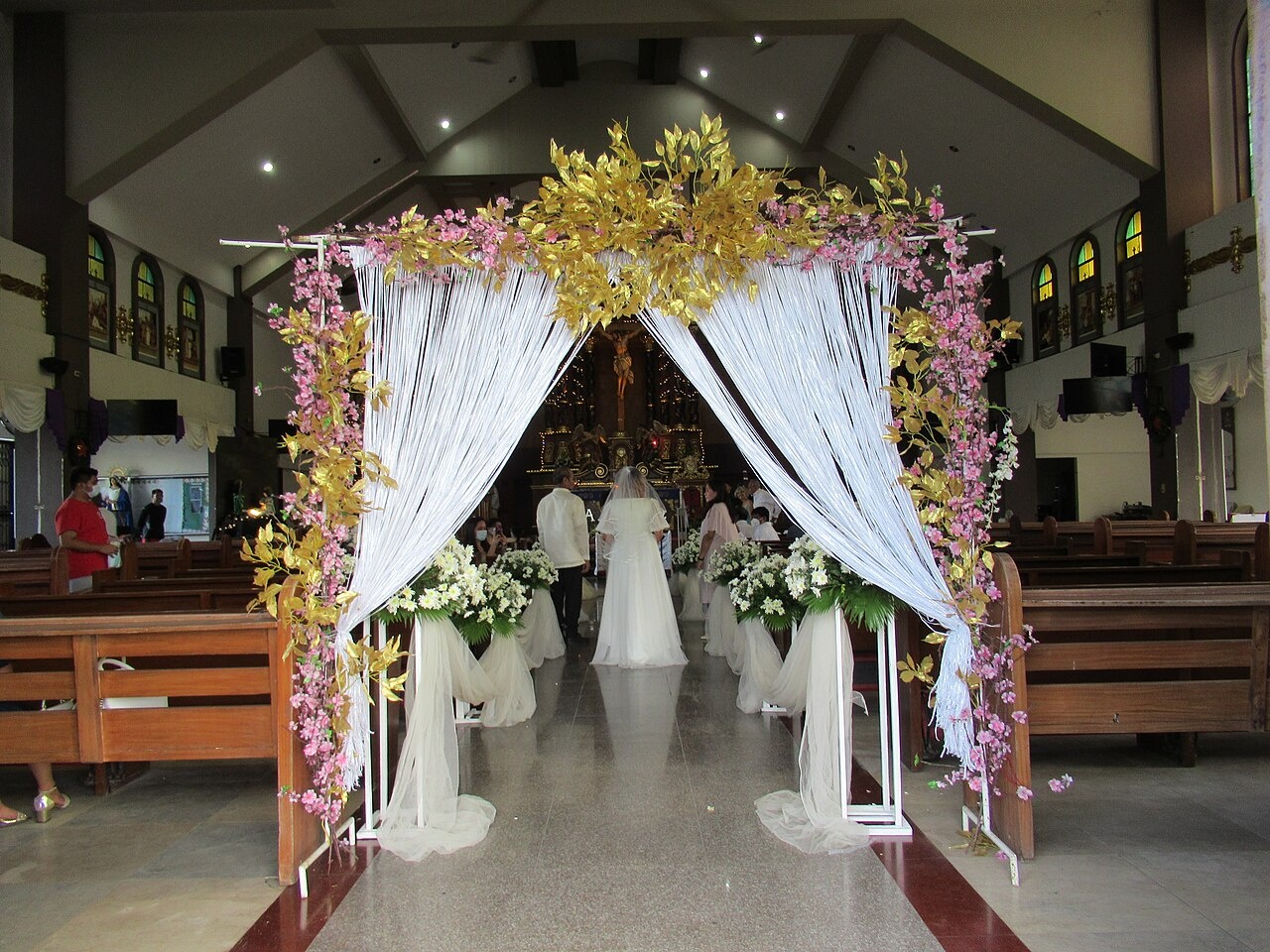
Wedding rites are usually church ceremonies. Elaborate weddings can involve multiple sponsors as well as an entourage of flower girls, a ring bearer, bridesmaids, a maid of honor, candle sponsors, cord sponsors, and veil sponsors, in addition to the main godparent sponsors. By Philippine standards, weddings move fairly quickly, and only the bride is allowed leeway for tardiness. (She must not seem too eager by arriving too early.) Only a very important sponsor can arrive later than the bride. Unlike invitations to a feast, where people do not like to appear too eager to eat and so come late on purpose, there is no shame in being early to a wedding. [Source: “Culture Shock!: Philippines” by Alfredo Roces and Grace Roces, Marshall Cavendish International, 2010]
In pre-colonial days, a wedding ceremony lasted three days. On the first day, the bride and groom were brought to the house of a priest or babaylan, who joined their hands over a plate of raw rice and blessed the couple. On the third day, the priest pricked the chests of both bride and groom and drew a little blood. Joining their hands, they declared their love for each other three times. The priest then fed them cooked rice from the same plate and gave them a drink of some of their blood mixed with water. Binding their hands and necks with a cord, he declared them married. The majority of Filipino weddings are now Catholic weddings, but some native traditions remain. [Source: Shu Shu Costa, weddingsatwork.com]
Most have special “sponsors” who act as witnesses to the marriage. The principal sponsors could be godparents, counselors, a favorite uncle and aunt, even a parent. Secondary sponsors handle special parts of the ceremony, such as the candle, cord and veil ceremonies. Candle sponsors light two candles, which the bride and groom use to light a single candle to symbolize the joining of the two families and to invoke the light of Christ in their married life. Veil sponsors place a white veil over the bride’s head and the groom’s shoulders, a symbol of two people clothed as one. Cord sponsors drape the yugal (a decorative silk cord) in a figure-eight shape–to symbolize everlasting fidelity–over the shoulders of the bride and groom. The groom gives the bride 13 coins or arrhae, blessed by the priest, as a sign of his dedication to his wife’s well-being and the welfare of their future children. [Ibid]
RELATED ARTICLES:
WEDDINGS IN THE PHILIPPINES factsanddetails.com
FILIPINO WEDDING DAY FESTIVITIES: RECEPTION, PARTIES, ENTERTAINMENT factsanddetails.com
WEDDING CUSTOMS OF DIFFERENT ETHNIC GROUPS AND REGIONS IN THE PHILIPPINES factsanddetails.com
FILIPINO CHINESE WEDDINGS factsanddetails.com
MARRIAGE IN THE PHILIPPINES factsanddetails.com
COURTSHIP, DATING AND LOVE IN THE PHILIPPINES factsanddetails.com
DIVORCE IN THE PHILIPPINES: BAN, LAWS, ANNULMENTS, IMPACTS factsanddetails.com
CATHOLIC MARRIAGE, WEDDINGS, DIVORCE AND ANNULMENT europe.factsanddetails.com
Duties of Main Participants in a Filipino Church Wedding

Groomsman: A member of your barkada is taking the plunge, the rest of you are his groomsmen. Consider this one an honor, and with this honor comes great responsibility. 1) Before the Wedding: A) Help the best man plan the bachelor party, the last night your bud parties with you as a single man. Just make sure the wedding will still push through after this party. B) Attend pre-wedding parties like the despedida de soltera and rehearsal dinner. C) Gather the rest of your barkada and think up a perfect gift for the groom. 2) On the Wedding Day: A) Help usher guests to their seats. B) Assist the best man in his duties. 3) At the Reception: A) Assist in welcoming and ushering in guests. B) Participate in the garter throw. C) Dance with the bridesmaids or other female guests. (asking them to dance could be your hardest task so far.) [Source: kasal.com ^]
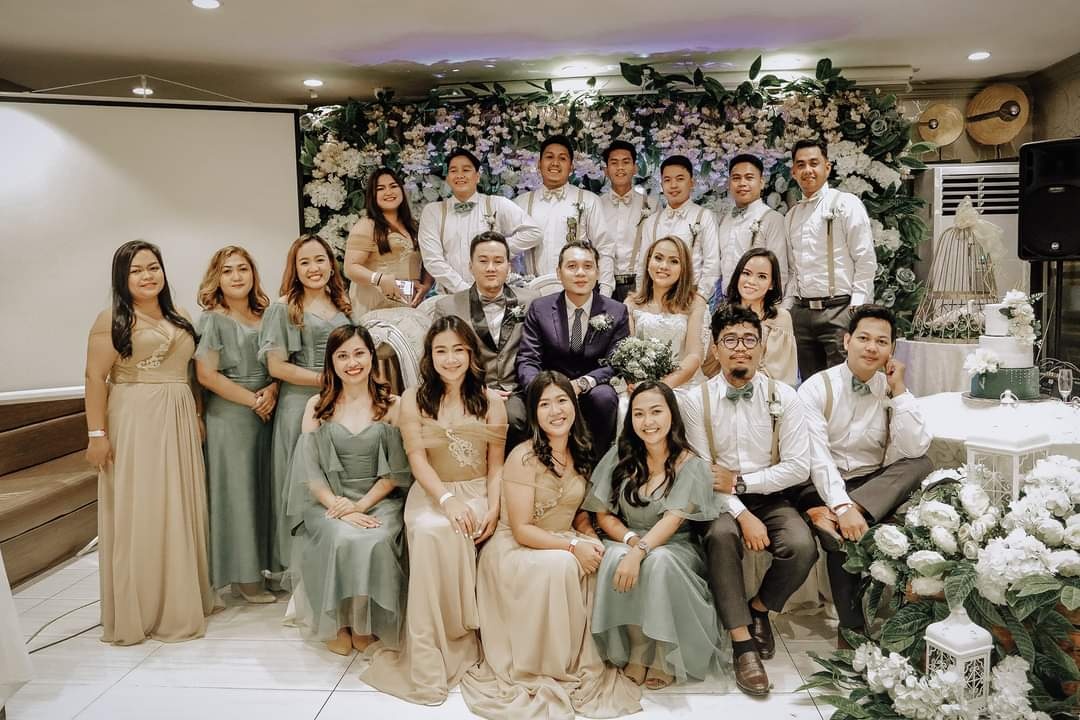
Bridesmaid: Being a bridesmaid means more than wearing a silky gown and having flowers on your hair. Bridesmaids are chosen for being the closest and most trustworthy female relatives and girlfriends of the bride. They support the maid of honor and help with the numerous pre-wedding tasks. On the wedding day, they likewise double as usherettes. To be a good bridesmaid: 1) Before the Wedding: A) Offer your help. It would be nicer if you are specific when you volunteer rather than asking, "What can I do?" B) Help organize the bridal shower or bachelorette party. C) Attend the dress rehearsal (if any). D) Help maintain lists such as the gift registry and the RSVP. 2) On the Wedding Day: A) Assist the maid or matron of honor in her duties. B) Help usher guests and guide them to their assigned seats (if there is such an arrangement). C) Make sure wedding accessories such as the veil, pillows, flowers are in order. 3) At the Reception: A) Assist in welcoming and ushering in guests. B) Go around and invite the guests sign the signature frame or the guest book. C) When it’s time for the bouquet toss, please get out there and at least try to catch the bouquet. Do not let the bride throw the bouquet over and over again. D) Distribute the give-aways. ^
Best Man: 1) Before the Wedding: A) Provide moral support to the groom. B) Accompany the groom in picking out his barong or tuxedo. C) Organize the bachelor’s party. D) Emcee the rehearsal dinner or party, if any. E) Lead the groomsmen. 2) On the Wedding Day: A) Accompany the groom to breakfast or lunch. Make sure he eats something (grooms may faint at the ceremony, too!). B) Help in ushering in the guests. C) Accompany the groom to the church. D) Keep track of the wedding rings. E) Bring a pen and an extra handkerchief. F) Escort the maid of honor down the aisle (your easiest duty so far!). G) Assist in the signing of the marriage contract. 3) At the Reception: A) Help welcome and assist the guests to their seats. B) Toast the newlyweds. Two words for the speech: short and sweet. C) Help the groom pack his things for the honeymoon. D) If you’re sober enough, you could drive the newlyweds to the airport. ^
Maid of Honor: The maid or matron of honor (if married) serves as the bride's right-hand (wo)man, her adviser, helper, even slave, if you must. Here are some of the maid of honor's duties: 1) Before the wedding: A) Be the leader of the female entourage members — the bridesmaids and flower girls. B) Help the bride in drafting the guest list and addressing the invitations. C) Accompany the bride in sourcing out the wedding suppliers. D) Inform the guests where the couple has set up their bridal registry. E) Host or organize the bridal shower. F) Help organize the rehearsal dinner or despedida de soltera. Make sure that the entourage members are in full attendance. 2) During the wedding day: A) Make sure that the bridesmaids and flower girls are properly made up and have their bouquets. B) Assist the bride as she prepares in her room. C) Make sure that no wedding accessories are left behind before leaving the house or hotel. D) Fix the bride’s veil, gown, bouquet and train before and during the ceremony. E) Carry the bride’s purse, if any. F) Assist in the signing of the marriage contract. 3) At the reception: A) Help welcome and assist the guests to their seats. B) Collect any gift envelopes. C) Make sure the bride eats something at the reception. D) Make a speech honoring the couple. (optional) E) Help the bride change for the honeymoon and pack her bag. F) All throughout the preparations, always be the shoulder to cry on, to present a patient ear and assure the bride with warm hugs and soothing words. ^
Candles, Coins, Veil and Cord in the Wedding Ceremony

Sequence of symbols in the Wedding Ceremony: 1) Lighting of the candles usually takes place before the readings. The candles may also be lit at the beginning of the ceremony. 2) The sharing/exchange of the Wedding Coins takes place immediately after the exchange of rings. The Wedding Coins are blessed, and then the celebrant gives it to the couple to share or pass from one to the other. 3) The Couple's Veil is placed over the shoulders of the couple as they kneel side-by-side. This is usually done immediately after the exchange of arrhae and before.
4) The placing of the Cord follows after the veil is in place. the bride and groom want to be part of the Offertory, either as gift bearers or as those receiving the gifts from the bearers and handing them to the celebrant, then the veil and cord are placed after that. Once the veil and cord are in place, they are to remain kneeling until after Communion. IF the bride and groom would like to participate in the Sign of Peace the veil and cord can be removed after the nuptial blessing.
Originally, there was an understanding of husband as "bread winner" and wife as "home maker" so the coins were given and received not in a spirit of reciprocity but in a give/take relationship. Nowadays the coins are a reminder of good stewardship for all couples; that they will mutually support each other, their children and the world around them.
In order for the congregation to understand the meaning of the actions and the various symbols: a. the celebrant may preface the action before calling on the secondary sponsors. b. have another person read a commentary explaining the actions c. the couple may print a short explanation in their program. [Source: mybarong2.com]
Rose Ceremonies at a Filipino Wedding
Though more prevalent in Western weddings, some Filipino couples incorporate rose ceremonies into their wedding as an added special touch. In the past, and even now, the rose has always been considered a symbol of love. A single rose always meant only one thing - it meant "I love you." The rose ceremonies could take place after couple has been pronounced as husband and wife. For the first rose ceremony, the bride and groom offers each other a single, preferably, red rosebud. This symbolizes the giving and receiving of their love for each other throughout their entire married life. The second rose ceremony has the bride and groom offering roses to their mothers. The roses serve as tokens of gratitude for their mothers' unfailing and unconditional love. [Source: kasal.com ^]
For the rose ceremony, the following script could be recited by your priest: "Your gift to each other for your wedding today has been your wedding rings - which shall always be an outward demonstration of your vows of love and respect; and a public showing of your commitment to each other. You now have what remains the most honorable title which may exist between a man and a woman - the title of "husband" and "wife." For your first gift as husband and wife, that gift will be a single rose. In the past, the rose was considered a symbol of love and a single rose always meant only one thing - it meant the words "I love you." So it is appropriate that for your first gift - as husband and wife - that gift would be a single rose. ^
“Please exchange your first gift as husband and wife. In some ways it seems like you have not done anything at all. Just a moment ago you were holding one small rose - and now you are holding one small rose. In some ways, a marriage ceremony is like this. In some ways, tomorrow is going to seem no different than yesterday. But in fact today, just now, you both have given and received one of the most valuable and precious gifts of life - one I hope you always remember - the gift of true and abiding love within the devotion of marriage. ^
“ Bride and Groom, I would ask that where ever you make your home in the future - whether it be a large and elegant home - or a small and graceful one - that you both pick one very special location for roses; so that on each anniversary of this truly wonderful occasion you both may take a rose to that spot both as a recommitment to your marriage - and a recommitment that THIS will be a marriage based upon love. ^
“In every marriage there are times where it is difficult to find the right words. It is easiest to hurt who we most love. It is easiest to be most hurt by who we most love. It might be difficult some time to words to say "I am sorry" or "I forgive you"; "I need you" or "I am hurting". If this should happen, if you simply can not find these words, leave a rose at that spot which both of you have selected - for that rose than says what matters most of all and should overpower all other things and all other words. Bride and Groom, if there is anything you remember of this marriage ceremony, it is that it was love that brought you here today, it is only love which can make it a glorious union, and it is by love which your marriage shall endure." ^
Papal Blessing, Honoring the Virgin Mary, and Who Can Preside Over a Wedding
Nowadays, many brides practice another special and touching spiritual ceremony in their weddings, which is honoring the Blessed Virgin Mary. There are three ways to honor the Blessed Mother who was once a bride herself. One is by incorporating the piece, Ave Maria, in the ceremony rites. Another is by reciting the prayers for the Virgin Mary such as the Hail Holy Queen. Kindly consult with your officiating priest where you could have this in the ceremony. Lastly, most brides offer a bouquet of flowers, sometimes her bridal bouquet or a part of it, at the statue of the Virgin Mary. This is done before she and her husband leaves the altar. [Source: kasal.com ^]
Did you know that you could ask for the Pope's blessing for your wedding? If you are both Catholic and are getting married in a Catholic church, you are eligible to receive the papal blessing or Benediction Papalis. Though it may take some time and is not for free (the fee goes to charity), the papal blessing provides a wonderful and spiritual touch for your marriage. It comes from the Vatican and is a piece of parchment paper hand-painted with calligraphy, flowers, and different sketches of the Vatican. It also has the reigning Pope's photograph, official raised seal, signature and the blessing. To get one, those who have received the papal blessing say you may write to the Vatican and enclose your wedding invitation. You may also ask for help from your parish priest or Diocese office. ^
Muslim marriages are conducted by a judge or an imam (a religious cleric), Christian marriages by a priest or pastor. Civil marriages are recognized and accepted in both the Christian and Muslim communities when conducted by judges and commercial chiefs, such as pilots and ship captains. The 1987 Family Code of the Philippines' Chapter 1, Article 7 recognizes the authority of the following to solemnize marriages: 2) Any incumbent member of the judiciary is authorized to solemnize marriages within his court's jurisdiction (i.e. a Supreme Court justice could solemnize marriages anywhere in the Philippines while a Municipal Trial Court judge of Dagupan Cit y cannot solemnize a marriage in Quezon City); 3) Any priest, rabbi, imam, or minister of any church or religious sect duly authorized by his church or religious sect. He should be registered with the civil registrar general and act within the limits of the written authority granted him by his church or religious sect. Likewise, at least one of the contracting parties should belong to the solemnizing officer's church or religious sect;
4) Any ship captain or airplane chief only in the case of marriages in articulo mortis between passengers or crew members, not only while the ship is at sea or the plane is in flight, but also during stopovers at ports of call; 5) Any military commander of a unit to which a chaplain is assigned. The commander could solemnize marriages in the absence of the chaplain or during military operation. Likewise, in the case of marriages in articulo mortis between persons within the zone of military operation, whether members of the armed forces or civilians; 5) Any consul-general, consul or vice-consul in the case of marriages between Filipino citizens abroad. The issuance of the marriage license and the duties of the local civil registrar and of the solemnizing officer with regard to the celebration of marriage shall be performed by the said consular official.
Filipino Wedding Sponsors
A typical Filipino wedding features a long lineup of ninongs and ninangs, or godparents. Their names appear in the invitation under the heading "principal sponsors." Ninongs and ninangs are senior men and women, preferably married, who are family members or close friends of the couple's parents. They are expected to serve as the couple's second parents or counselors, especially when the newlyweds' parents are no longer around to guide them. During Mass, the sponsors stand at the altar while the married couple kneels. At the end of the ceremony, they sign the wedding documents as witnesses. [Source:kasal.com ^]
Principal Sponsors (Ninang and Ninong) are women and men whom the bride and groom respect & admire. They are, as in the early days of the Church, sponsors of the couple attesting to their readiness for marriage and freedom to marry. These are often aunts and uncles or close friends of the family. In the Philippines, they are the official witnesses of the state and they sign the marriage license. Worldwide, their participation is symbolic of the wisdom & support they shall offer the new couple. The number of sponsors can vary from a single couple to many couples. The Principal sponsors are part of the bridal procession. At the nuptial blessing, they may also be invited to come up with the celebrant and to extend their right hands to join in the prayer of blessing. In doing so, they are fulfilling their roles as sponsors. [Source: mybarong2.com]
Secondary Sponsors are women and men whom the couple chooses to involve in their ceremony because of their affinity or friendship with them. They are typically relatives or close friends. There are four sets of Secondary Sponsors: 1) The Coin Sponsors - those who will present the Unity Coins. Often, they will also provide the Unity Coins. Alternately, the coins may be brought to the altar by a coin bearer who is a child (relative or friend). 2) The Veil Sponsors - those who will place a white veil over the shoulders of the couple. 3) The Cord Sponsors - those who will place a knotted cord over the heads of the couple, to lay on their shoulders. 4) The Candle Sponsors - those who will light the candles on the altar. Some couples choose to have their mothers or fathers light the candles in this ritual.
According to the Bride's Maids and Co.'s Veil, in the Philippines, the social status of the wedding is dictated by its line-up of principal sponsors. Hence, it is not surprising that prominent personalities are often asked to be a ninong or ninang. Neri adds that it is rare for a Filipino to refuse to be a godparent not only because of the honor that goes with it but because it is considered unlucky to do so. The law requires at least two wedding sponsors or witnesses. Veil suggests two to four pairs of principal sponsors for small weddings while larger weddings can do with a maximum of six to eight pairs. After a couple has finalized the line-up, they are advised to personally invite their soon-to-be godparents, a phone call or letter just won't do. Principal sponsors are also expected to grace the despedida de soltera. ^
Filipino Wedding Ceremony Places and Procession
Facing the altar, the bride stays at the left side of the church while the groom is on the right. This comes from a belief that in the olden times, the bride has to stay at the groom's left side to enable him to draw his sword on his right side and thwart jealous suitors trying to steal his beloved. The female entourage members are seated behind the bride or in the left side of the church as the male entourage members stay at the right side. The bride's family and friends ideally are seated at the left side of the church with the groom's kin on the right side. [Source:kasal.com ^]
Processional: In the Philippines, the entourage traditionally enter in this order: 1) Best Man; 2) Groom with his parents; 3) Principal Sponsors; 4) Secondary Sponsors; 5) Ring Bearer; 6) Coin Bearer; 7) Bible Bearer; 8) Flower Girls; 9) Bridesmaids and Groomsmen; 10 ) Maid/Matron of Honor; 11) Bride with her parents (The bride stays at the left of her father.) This order could vary, the groom and his parents may not march and wait instead at the altar. Nowadays, the parents of the bride wait for her halfway down the aisle as she makes her solo entrance up to the center and then they march altogether. ^
Recessional: After the ceremony, the procession is reversed: 1) Bride and groom (The bride is at the groom's right side.); 2) Flower girls, ring bearer, coin bearer and bible bearer (optional); 3) Maid/Matron of Honor and Best Man; 4) Bridesmaids and groomsmen.^
Blessing of the Wedding Coins
As the couple exchange the coins: One says: “(name of spouse), take these coins as a pledge of our commitment to share God's gifts.” The other says: “(name of spouse), I accept and treasure your gift. Let us together always share God's blessings. (name of Coin Bearer) will present the pillow with the coins. [Source: mybarong2.com ^^]
A celebrant says: “Lord, bless these coins. Grant (names of couple) not only material possessions, but abundant spiritual strength, which these coins symbolize, so that they use them to bless others and to attain eternal life. Hold the coins in your hands as a sign that your blessings will no longer be held separately, but together. And may you always show that whatever gift you may have in this life is not ultimately yours but the Lords.” ^^
One of the couple lets the coins fall into the hands of the other: One says: “ (name of spouse), accept these coins as a pledge of my total dedication and constant concern for your welfare. In the name of the Father, and of the Son and of the Holy Spirit.” ^^
An alternative is for someone to say: “(name of Coin Bearer) will present the pillow with the coins. A celebrant says: “May God bless these coins / arras as a sign of mutual support and responsibility.” One of the couple says: “I give you these coins as a pledge of my dedication to you, the care of our home, and the welfare of our children.” The other says: “I accept them and in the same way pledge my dedication to you, the care of our home, and the welfare of our children.” ^^
Wedding Ceremony Prayers for Couple's Veil and Cord
Prayer for Couple's Veil & Cord No. 1: A reader or celebrant reads as Veil Sponsors place veil over couple's shoulders: “(couple's names), at Baptism you were clothed with the white garments symbolizing the new life of purity and joy in the Lord, to which the Risen Christ has called you. We clothe you again with this precocious garment as you enter into the new phase of your life with God. Wear it unstained and let the joy of the spirit shine forth to you and your children whom the Lord's loving design will bring into your life. [Source: mybarong2.com ^^]
A reader or celebrant reads as Cord Sponsors place cord over couple's shoulders: “This cord symbolizes the love of God which brings your hearts and souls together. May your love grow stronger and bind you closer together through years, from here to eternity. We ask this from the Father, through Christ our Lord.” ALL: “Amen.” ^^
Prayer for Couple's Veil & Cord No. 2: A reader or celebrant reads as Veil Sponsors place veil over couple's shoulders: :Let this veil be a symbol of the faithful love you have for each other.” A reader or celebrant reads as Cord Sponsors place cord over couple's shoulders: “May this cord remind you to face your life together courageously and to be mutual in support of each other in carrying out your duties and responsibilities as a couple.” ALL: “Amen.” ^^
Prayer for Couple's Veil & Cord No. 3: A reader, celebrant reads as Veil Sponsors place veil over couple's shoulders: “The Veil covers this couple today reminding them and us that Christ covers us in his love. Their new home will be a place where God dwells because this couple chooses to be under the mantel of his love.” A reader or celebrant reads as Cord Sponsors place cord over couple's shoulders: “The Cord, looped and crossed in the middle is wrapped around the bride and groom to symbolize the Blessed Trinity; The Father, the Son and the Holy Spirit, who are one and the same. The cord symbolizes this same union and the infinite nature of marriage.” ALL: “Amen.” ^^
Prayer for Couple's Veil & Cord No. 4: The reader or celebrant reads as Veil Sponsors place veil over couple's shoulders: “Lord, with this veil, which represents this couple's union and mutual surrender to each other, may you always protect (names of couple) from any harm and strengthen them to provide continuous moral and spiritual support to each other and their children. May they remain loyal helpmates to each other as they carry life’s burden with joy.” The reader or celebrant reads as Cord Sponsors place cord over couple's shoulders): “Lord, with this cord, may the bond of love and friendship uniting (names of couple) grow stronger over the years. May they remain united to you all their lives knowing, loving and serving in each other and the community.” ALL: “Amen.” ^^
Prayer for Couple's Veil & Cord No. 5: The reader or celebrant reads as Veil Sponsors place veil over couple's shoulders): “(names of couple), (names of Veil Sponsors) will now place a veil over you. Let this be a symbol of the faithful love you have for each other. Through the passing of the years, let the veil remind you that you belong to each other and to no one else, and that the love you have for each other becomes more beautiful in self-surrender that is total and pure.” The reader or celebrant reads as Cord Sponsors place cord over couple's shoulders): “(names of couple), (names of Veil Sponsors) will lay the cord on you to remind you of your responsibility to hold each other with the tenderness that Christ has for His Church. Keep the bond of your love steadfast so that you can support one another throughout your lives.” ^^
Wedding Ceremony Prayers for Candles
Prayer for candle lighting No. 1: “(couple's names), will now light center Unity Candle. You will take the flame from the candles which your (names of candle lighters) have lighted. You will see that this center candle is larger than the other two because it is the new family that has been formed today as you repeated your vows and will be a blending of all the love, traditions and experiences you have both shared with your individual families. It is also larger because the middle candle represents Christ, who has brought you both together for this moment and to remind you that He is with you always as a partner in your marriage, to guard and to guide you in all that you do. [Source: mybarong2.com ^^]
Prayer for candle lighting No. 2: A reader or celebrant reads: “The ceremonies (refers to candle, coins, veil & cord) you are about to witness are uniquely and traditionally a part of the Filipino wedding.” Candle lighters come forward to light the candles. A reader or celebrant continues: “(couple's names), (names of candle lighters) now light the candles for you. The candles represent the light from God that you will need to guide you throughout the rest of your married life. The candles also express the silent promise that the couple will continue to be light and warmth to each other for life.” ^^
The couple comes forward to light the center Unity Candle. A reader or celebrant continues: “Take the flame from the candles which your mothers have lit. This center candle is a sign that a new family has been formed today blending all the love, traditions and experiences you have both shared with your individual families. It also represents Christ, who has brought you both together for this moment and to remind you that He is with you always as a partner in your marriage, to guard and guide you in all that you do.” ^^
Prayer for candle lighting No. 3: “A reader or celebrant reads reads as the candle lighters light the candles: “(couple's names), (names of candle lighters) now light the candles that represent the light from God.” A reader or celebrant continues as the couple lights the center candle: As you light the Christ candle let it remind you that Christ is with you always as a partner in your marriage, to guard and guide you in all that you do.” ^^
Prayer for candle lighting No. 4: A reader or celebrant reads: “Today, as candles are lit at the altar, remember the light of Christ that burns in all Christian hearts and our responsibility to share that light with the world, especially in this celebration of Eucharist. ^^
Prayer for candle lighting No. 5: The reader or celebrant reads as the candle lighters light the candles): “Today, as candles are lit at the altar, remember the light of Christ that burns in all Christian hearts and our responsibility to share that light with the world, especially in this celebration of Eucharist.” The reader or celebrant continues to read as couple lights the unity candle): “Take the flame from the candles which your mothers have lit. This center candle is a sign that a new family has been formed today blending all the love, traditions and experiences you have both shared with your individual families. It also represents Christ, who has brought you both together for this moment and to remind you that He is with you always as a partner in your marriage, to guard and guide you in all that you do.” ^^
Image Sources: Wikimedia Commons
Text Sources: “Encyclopedia of World Cultures Volume 5: East/Southeast Asia:” edited by Paul Hockings, 1993; “Culture Shock!: Philippines” by Alfredo Roces and Grace Roces, Marshall Cavendish International, 2010; National Geographic, Live Science, Philippines Department of Tourism, New York Times, Washington Post, Los Angeles Times, Smithsonian magazine, Encyclopedia.com, Library of Congress, The Conversation, The New Yorker, Time, BBC, CNN, Reuters, Associated Press, AFP, Lonely Planet Guides, Google AI, Wikipedia, The Guardian and various websites, books and other publications.
Last updated March 2026