
COURTSHIP IN THE PHILIPPINES
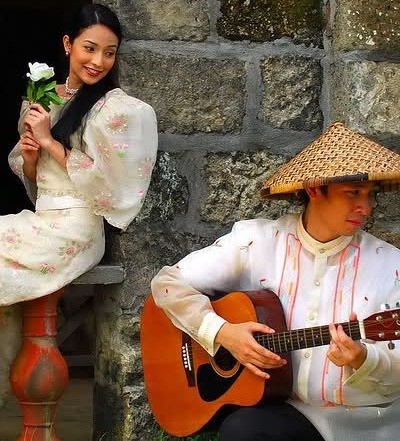
In Philippine culture, courtship is far more subdued and indirect unlike in some Western societies. A man who is interested in courting a woman has to be discreet and friendly at first, in order not to be seen as too presko or mayabang (aggressive or too presumptuous). Friendly dates are often the starting point, often with a group of other friends. Later, couples may go out on their own, but this is still to be done discreetly. If the couple has decided to come out in the open about their romance, they will tell their family and friends as well.[Source: Center for Southeast Asian Studies Northern Illinois University, seasite.niu.edu]
In the Philippines, if a man wants to be taken seriously by a woman, he has to visit the latter's family and introduce himself formally to the parents of the girl. It is rather inappropriate to court a woman and formalize the relationship without informing the parents of the girl. It is always expected that the guy must show his face to the girl's family. And if a guy wants to be acceptable to the girl's family, he has to give pasalubong (gifts) every time he drops by her family's house. It is said that in the Philippines, courting a Filipina means courting her family as well.
A common element of courtship is bola, a form of exaggerated flattery or sweet talk. Men may use romantic lines and compliments to impress women, sometimes repeating the same phrases with different people. When such flattery succeeds, it may become a point of playful boasting among friends. However, overuse of bola can make it harder for women to know when compliments are sincere.
In contemporary Filipino society, dating has become more direct and influenced by modern communication and changing gender norms. While playful teasing and romantic gestures remain part of courtship, many young people now place greater emphasis on honesty, mutual respect, and clear communication when forming relationships. [Source: “Culture Shock!: Philippines” by Alfredo Roces and Grace Roces, Marshall Cavendish International, 2010]
RELATED ARTICLES:
MARRIAGE IN THE PHILIPPINES factsanddetails.com
SEX IN THE PHILIPPINES: HISTORY, INFLUENCES, STORIES factsanddetails.com
BIRTH CONTROL IN THE PHILIPPINES: CONTRACEPTIVES, CATHOLICS, REPRODUCTIVE HEALTH LAW factsanddetails.com
SEXUAL PRACTICES IN THE PHILIPPINES: AFFAIRS, ADOLESCENCE, ORAL SEX factsanddetails.com
SEX EDUCATION, PORNOGRAPHY, COUNSELING AND SEX RESEARCH IN THE PHILIPPINES factsanddetails.com
DIVORCE IN THE PHILIPPINES: BAN, LAWS, ANNULMENTS, IMPACTS factsanddetails.com
CATHOLIC MARRIAGE, WEDDINGS, DIVORCE AND ANNULMENT europe.factsanddetails.com
WEDDINGS IN THE PHILIPPINES factsanddetails.com
WEDDING CEREMONY IN THE PHILIPPINES factsanddetails.com
FILIPINO WEDDING DAY FESTIVITIES: RECEPTION, PARTIES, ENTERTAINMENT factsanddetails.com
WEDDING CUSTOMS OF DIFFERENT ETHNIC GROUPS AND REGIONS IN THE PHILIPPINES factsanddetails.com
FILIPINO CHINESE WEDDINGS factsanddetails.com
Expectations in Filipino Courtship
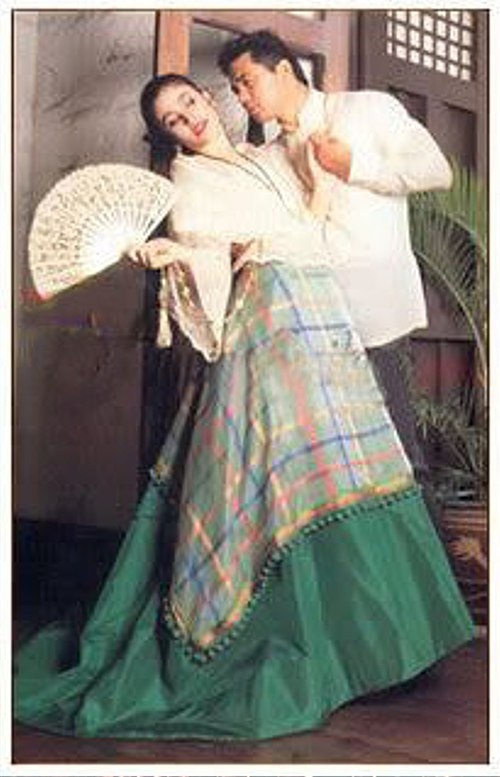
In traditional Filipino courtship, young men often make strong efforts to win a woman’s attention and affection. They may send flowers, give gifts, and call frequently to show their interest and devotion. A woman typically does not accept the first invitation from a new suitor, and initial refusals are often interpreted as part of a social expectation that she should appear reserved or “hard to get.” Because of this custom, a man may ask several times before receiving a positive response. While this persistence is sometimes seen as a sign of sincerity, it can also make it difficult to distinguish between polite hesitation and a genuine rejection. As a result, some men continue courting even when their interest is not reciprocated. [Source: “Culture Shock!: Philippines” by Alfredo Roces and Grace Roces, Marshall Cavendish International, 2010]
In courting a Filipina, the metaphor often used is that of playing baseball. The man is said to reach 'first base' if the girl accepts his proposal to go out on a date for the first time. Thereafter, going out on several dates is like reaching the second and third bases. A 'home-run' is one where the girl formally accepts the man's love, and they become magkasintahan (from sinta, love), a term for boyfriend-girlfriend.
Filipino women are expected to be pakipot (playing hard to get) because it is seen as an appropriate behavior in a courtship dance. By being pakipot, the girl tells the man that he has to work hard to win her love. It is also one way by which the Filipina will be able to measure the sincerity of her admirer. Some courtships could last years before the woman accepts the man's love.
A traditional dalagang Pilipina (Filipinpa maiden) is someone who is mahinhin (modest, shy, with good upbringing, well-mannered) and does not show her admirer that she is also in love with him immediately. She is also not supposed to go out on a date with several men. The opposite of mahinhin is malandi (flirt), which is taboo in Filipino culture as far as courtship is concerned.
Traditional Dating and Courting the Philippines
Courtship remains an important Filipino tradition shaped by religious beliefs, social norms, and family values. Several commonly accepted rules guide the process. First, a woman is generally expected to accept the first invitation for a date. Second, on the first outing she is usually accompanied by an escort—often a friend or relative—although women aged twenty-eight or older may go without one. Third, modest public displays of affection, such as kissing or holding hands, are considered acceptable. Fourth, a woman is expected to be discreet about her feelings after the first date, while the man traditionally pays for all expenses. Finally, if the relationship leads to marriage, it is understood that one is marrying not only the partner but also becoming part of the partner’s extended family. Many young Filipinos believe that love, physical attraction, shared religious beliefs, and trust are essential for a stable relationship. [Source: Jose Florante J. Leyson, M.D., Encyclopedia of Sexuality 2001]
When Filipinos are in their teens, groups of males and females go out together in a kind of group dating. In the cities one-on-one dating and dancing are common. In rural areas, young men have traditionally serenaded women under their bedroom window. Filipinos are born matchmakers. They like to match up their friends and relatives. Blind dates are common. Girls often have to permission from their parents and guys are sometimes subjected to mild interrogation by parents.
In the old days in rural areas of the Philippines, Filipino men would make harana (serenade) the women at night and sing songs of love and affection. This is basically a Spanish influence. The man is usually accompanied by his close friends who provide moral support for the guy, apart from singing with him. [Source: Center for Southeast Asian Studies Northern Illinois University, seasite.niu.edu]
On rural traditions Salmagundi wrote in stuartxchange.com: The "lupakan" was the afternoon gathering of the rural youth, the men pounding on unripe bananas fed onto the "lusong" by the young village lasses, the air palpable with raging hormones, the young men oozing with testosterone, the young women flushed with flirting. In the evenings, there was once the "harana," when a suitor, spurred by love and a supporting cast of a friend or two, guitar in tote, will venture to the young woman's house, serenading her with love songs. During the days, the young man labors for good impressions, courts the good graces of the girl's parents, dropping by to offer a hand with the daily chores–chopping wood, fetching water from the river, helping with the tilling of the land. And believe it or not, love letters were exchanged. . . by mail. These rituals of courtship are fast fading into oblivion, persisting in a few and scattered rural communities. [Source: Salmagundi, stuartxchange.com /]
What has replaced the romance of rural courtship is. . . texting. Yes, texting. . . in its abbreviated and abridged messaging. Often it starts as an anonymous faceless text introduction that leads to a flurry of text-exchanges. The texting could go on for a month or two before an actual meeting occurs. Then if sparks fly. . . courtship continues on the cheap, with unlimited texting that leads to: i luv u. . . i luv u2. . . mis u. . . mis u2. . and eventually, texted marriage proposals. /
Tuksuhan Lang
According to an article on the website for the Center for Southeast Asian Studies Northern Illinois University: The traditional dalagang Pilipina (Filipina maiden) is shy and secretive about her real feelings for a suitor and denies it even though she is really in love with the man. Tuksuhan lang (just teasing) is the usual term associated with pairing off potential couples in Filipino culture. This is common among teenagers and young adults. It is a way of matching people who may have mutual admiration or affection for each other. It may end up in a romance or avoidance of each other if the situation becomes embarrassing for both individuals. [Source: Center for Southeast Asian Studies Northern Illinois University, seasite.niu.edu]
Tuksuhan (teasing — and a girl's reaction to it) is a means for 'feeling out' a woman's attitude about an admirer or suitor. If the denial is vehement and the girl starts avoiding the boy, then he gets the message that his desire to pursue her is hopeless. The advantage of this is that he does not get embarrassed because he has not started courting the girl in earnest. As in most Asian cultures, Filipinos avoid losing face. Basted (from English busted) is the Tagalog slang for someone who fails to reach 'first base' in courting a girl because she does not have any feelings for him to begin with. However, if the girl 'encourages' her suitor (either by being nice to him or not getting angry with the 'teasers'), then the man can court in earnest and the tuksuhan eventually ends. The courtship then has entered a 'serious' stage, and the romance begins.
A man who is unable to express his affection to a woman (who may have the same feelings for him) is called a torpe (stupid), dungo (extremely shy), or simply duwag (coward). To call a man torpe means he does not know how to court a girl, is playing innocent, or does not know she also has an affection for him. If a man is torpe, he needs a tulay (bridge) — anyone who is a mutual friend of him and the girl he loves — who then conveys to the girl his affection for her. It is also a way of 'testing the waters' so to speak. If the boy realizes that the girl does not have feelings for him, he will then not push through with the courtship, thus saving face. Some guys are afraid of their love being turned down by the girl. In Tagalog, a guy whose love has been turned down by the girl is called sawi (romantically sad), basted (busted), or simply labless (loveless).
Panliligaw or ligawan are the Tagalog terms for courtship, which in some parts of the Tagalog-speaking regions is synonymous with pandidiga or digahan (from Spanish diga, 'to say, express'). Manliligaw is the one who courts a girl; nililigawan is the one who is being courted.
Courtship Customs of Different Philippines Ethnic Groups
Palawanon courtship is peculiar in a sense that it departs from the tradition of majority ethnic groups wherein most important consideration is for the prospective bridegroom to have ample means. It would seem that, among Palawanons the most important qualification is for the parents to be adept in the art of answering riddles. Pasabuli is how this stage of Palawanon courtship is termed. Riddles are propounded by the prospective bride's parents. It devolves upon the prospective bridegroom's parents to solve and answer them. Only when the prospective bridegroom's parents can satisfactorily answer them does the courtship transfer to the Pabalic, or session for the bargaining of the onsod (or dowry). [Source: kasal.com ^]
One of the things that imbue Pangasinense courtship and marriage practices a class unto itself is an object locally known as taga-amo. In the Pangasinense vernacular, it means "potion or drink." In other words, Taga-amo courtship should be taken to mean "courtship by means of love charm." But it is not only a drink. It could also be oil immersed in herbs with known aphrodisiac properties. When the taga-amo is drank or when the oil is rubbed on a woman's skin, it makes her a slave in love, if not actually so, even if she hates a man at first. ^
In Samar, otherwise known as "the land of the fierce Waray-warays," customs continue to cling on like vines to age-old beliefs with stubborn tenacity. They refuse to die. Nowhere is this more evident than in their courtship and marriage practices. Semi-primitive customs are still fashionable there. Modernism seems unable to contain them. Courtship may take the form of Pakighiruhimangraw, or teasing or flirting. Pakipagharampang is the broaching of a marriage proposal; this is their version of the Pamanhikan of the Tagalogs or the Tampa of the Ilocanos. Which means that a Parayakan, or an emissary is sent to propose a wedding match. ^
Among other things, the Parayakan must be endowed with the following qualities: a sweet smile, charismatic voice, glib tongue, ready wit, charming disposition, winsome ways and suave personality. He must also be versed in the art of winning love. Being good at Siday, or poetry, will come in handy, as some of the exchanges are poetical in nature. A successful performance in the Pakipagharampang results in the next stage of courtship which is the Pamalaye, whose sole agenda is the bargaining of the Bugay, or dowry. This session is attended by elders, some of them relatives, others not. Feasting and drinking occasions it. The fact that the presence of the prospective bridegroom and his father is here to be noted somehow formalizes and makes official whatever has been taken up in the Pakipagharampang. Tinuha, or "marriage without benefit of courtship" is the name of this marriage. It is arranged solely by the parents of the bride and the bridegroom among themselves for and in behalf of their respective children. The option of dowry is, however, retained. This is something that's never dispensed with, ever. ^
Liberal, Reckless and Vengeful Courtship
Mahal-Allay or Liberal Courtship: Beauty seems to have very little premium, if at all, in the Apayao customs and traditions with respect to courtship and marriage. Considerations of beauty are not what propels Apayao swains toward the choice of a mate for all seasons, but rather a woman's capacity to work. Her physical constitution is more important. It is one instance where the amazon-like womenhood have a decided edge over the fragile ones in the feminine struggle toward the affection of a man, something which can be classified as a reverse trend. Such seems to be the sad lot of the Apayao women-to work in the kaingins. And when a man happens to own a vast kaingin-by their standards, anyway—he is constrained to indulge in polygamy just so he can obtain additional help to till his land. Polygamy is duly sanctioned by their traditions. But even as this is so, it is, however, rarely availed of—unlike their Muslim counterparts. Indeed, an Apayao swain exercises polygamy not only to satisfy his carnal mischief, but to acquire additional help. [Source: kasal.com ^]
Maratabat or Vengeful Courtship: A distinct character of the Maranao(w) courtship is the so-called maratabat, or vengeful courtship. It is a kind of courtship pursued out of spite. Its avowed purpose is not love, as should be the case, but to get even, to uphold personal honor which is often equated with family honor. It usually arises out of a girl having offended an immediate kin of a man. Thus, it can be seen that the offense committed is not always upon the person of the party seeking to avenge an insult perpetrated but on another as well who is a close kin. ^
Magpasumbaih or Reckless Courtship: Magpasumbaih (also sarahakan tupul, this according to another observer of the Tausog custom with respect to the same, Amadeo S. Timbol) seems to be a reckless form of Tausog courtship. In this, the love-smitten fellow tries to forego the usual tradition of courtship by going directly to the heartthrob's father, bringing with him a barong or kali (a kind of Tausog bladed weapon) and thereby present it to the latter accompanied by the following admonition: "Sire, I am in love with your daughter, a love that transcends everything in this life. Permit me to ask for her hands in marriage. But should you refuse the offer, life would be meaningless for me. Death would be sweet. You may smite me down with this barong if you so desire." It would be nice if the prospective father-in-law is in an amiable frame of mind when this transgression occurs. But if is not, it is utterly dangerous, as he really might cut the swain down. ^
Dating in the Philippines
In traditional Filipino dating culture, the man is generally expected to pay for the outing, even if the woman initiated the invitation. When dating takes place in groups, the men usually divide the bill among themselves. This custom reflects older social expectations about male responsibility in courtship. [Source: “Culture Shock!: Philippines” by Alfredo Roces and Grace Roces, Marshall Cavendish International, 2010]
Many parents, particularly in the past, set curfews for their daughters. Because of this, it is considered polite for a young man to ask whether his date has a curfew and to make sure she returns home on time. Parents often expect to know details about their daughter’s plans before granting permission for her to go out.
Girls traditionally needed to ask their parents’ permission before accepting a date and might be questioned closely about the outing. Parents often wanted to know where their daughter would be going, who would accompany her, and what time she would return. If the suitor was new, parents might also ask about his family background, occupation, education, and age before approving the date. Today, however, young people generally enjoy greater independence, and parental supervision is less strict. Women are also more likely to initiate dates themselves.
Dates are often arranged through friends or relatives, as matchmaking remains a common social activity. Filipinos frequently introduce acquaintances to one another in the hope of forming romantic connections. Blind dates are therefore fairly common, and a mutual friend may help arrange a meeting if someone is interested in getting to know a particular person.
Dating Filipino Girls
Winston posted in his blog happierabroad.com: The Philippines “is a dating paradise for men, especially foreign men. It is easy to get dates or sex anytime you want. No deprivation in this area for men. With most local guys being poor and a large percentage of them being gay or transsexuals, the supply of dateable men is very low. Hence there are always single girls who are looking everywhere you go, a huge surplus of them, never a shortage. 2) Girls are tender, affectionate and treat their boyfriend or suitor very well. They are always there for you and make time for you. They are not hung up on looks. 3) Girls like to flirt and enjoy flattery and compliments. They do not consider a guy who is attracted to them or asks them out to be a creep who ought to leave them alone. There is no such attitude at all. Flirting and signifying interest is not vilified, but seen as natural and adorable. Girls love attention and flattery too, even if they are shy. [Source:Winston, happierabroad.com, December 22, 2011]
4) Females are not prudish or uptight when it comes to touching or physical affection, but are quite receptive and into it themselves. They are not puritanical like their British, American and Oriental counterparts. When they make love, they are tender and soothe you in a way white women can't. 5) There are a variety of girls to choose from in terms of ethnic mixes, ranging from light skinned Chinese types to darker Malay types to Spanish looking white types. 6) Go go bars and videoke bars are cheap to get a girl from to take home. You don't have to sleep alone if you don't want to (unlike some countries where you are forced to sleep alone every night without choice).
“Most girls that date foreigners usually come from poor families who will expect you to support them or give her an allowance that she can use to support them. In other words, they will attempt to leech off you shamelessly. If you are frugal and prefer to save rather than to spend, your will will be constantly in conflict with their will. If you are a foreigner, there will be a double standard against you in that locals are allowed to be stingy toward you, giving you nothing for free and counting every peso. However, you are expected to be a super generous Santa who is happy to give away things for free, and you are supposed to be willing to spend away from your "bottomless pockets" without complaining. In fact, although they may call a foreigner "kuripot" (cheapskate in Tagalog) if he is frugal or tries to save money, it is very odd and out of place for a foreigner to call a Filipino a "kuripot" because Filipinos are expects to be stingy, but foreigners aren't.
Gmmurgirl.hubpages.com reported: “Men from the Philippines are often referred to as 'Pinoy' men or 'Filipino' men. Indeed, Filipino guys are a class of their own. A number of foreign women might find dating them an experience worth trying. Filipino men are often seen as thoughtful, sensitive, romantic and sweet, thought this may not be true for all. Some guys can discriminating and choosy. Any woman foreign or otherwise, confident of herself will not have difficulty getting a Filipino date. Learn about the what makes Filipino guys unique. So here is a lowdown, in case you manage to snag a Filipino date. [Source: gmmurgirl.hubpages.com ]
“If you are a foreign woman looking for a Filipino man to go out with, it helps to know that the local dating scene in the Philippines is very dynamic and colorful. With the proliferation of social networks and mobile phones, opportunities to meet singles and dating sites abound! If you are lucky, speed dating events are organized by a few groups. Moreover, knowing friends will double your chances of meeting eligible male Filipinos. They will be more than willing to play cupid and set you up on a blind date. Hence, a foreign woman trying to look for her Filipino dream date will not run out of options.
“On the other hand, if you are in the capital city on a business trip and hardly know any local friends, do not fret. There are many bars in the city specifically in the business districts area of Makati, Ortigas, and even the Global City with great places to meet new people. Most Filipino men will be friendly enough to strike a conversation with a lone foreigner woman. Nevertheless, do not immediately trust anyone who is too friendly for comfort.
“Dating and finding a Filipino date can be easy for a foreign woman. It has its own advantages and disadvantages. Despite background differences, an interracial relationship can prosper, since many Filipino guys are open to the idea of dating women from a different race or culture. Just make sure you know how to deal with him.
Dating Filipino Men
Gmmurgirl.hubpages.com reported: “Men from the Philippines are often referred to as 'Pinoy' men or 'Filipino' men. Indeed, Filipino guys are a class of their own. A number of foreign women might find dating them an experience worth trying. Filipino men are often seen as thoughtful, sensitive, romantic and sweet, thought this may not be true for all. Some guys can discriminating and choosy. Any woman foreign or otherwise, confident of herself will not have difficulty getting a Filipino date. Learn about the what makes Filipino guys unique. So here is a lowdown, in case you manage to snag a Filipino date. [Source: gmmurgirl.hubpages.com ]
“If you are a foreign woman looking for a Filipino man to go out with, it helps to know that the local dating scene in the Philippines is very dynamic and colorful. With the proliferation of social networks and mobile phones, opportunities to meet singles and dating sites abound! If you are lucky, speed dating events are organized by a few groups. Moreover, knowing friends will double your chances of meeting eligible male Filipinos. They will be more than willing to play cupid and set you up on a blind date. Hence, a foreign woman trying to look for her Filipino dream date will not run out of options.
“On the other hand, if you are in the capital city on a business trip and hardly know any local friends, do not fret. There are many bars in the city specifically in the business districts area of Makati, Ortigas, and even the Global City with great places to meet new people. Most Filipino men will be friendly enough to strike a conversation with a lone foreigner woman. Nevertheless, do not immediately trust anyone who is too friendly for comfort.
“Dating and finding a Filipino date can be easy for a foreign woman. It has its own advantages and disadvantages. Despite background differences, an interracial relationship can prosper, since many Filipino guys are open to the idea of dating women from a different race or culture. Just make sure you know how to deal with him.
Male Filipino Date Types
On types of Filipino guts, Gmmurgirl.hubpages.com reported: 1) The Romantic: The romantic types may come few and far in between, but this breed of Filipino men still exists. He is the kind of guy who remembers the special days in your life, wont to bringing gifts, and treats you like a princess. Expect Mr. Romantic to be there for you at all times. He can be cheesy, mushy at times, but that's just him showing his true romantic side. Simply enjoy and return the courtesy. However, if you are not bent on getting serious with him, try not to lead him on nor keep him dangling. Make it clear to him that you are not yet bent on settling down either. Otherwise, you might be proposed at even before you even celebrated your first anniversary. [Source: gmmurgirl.hubpages.com ]
2) The Cool Hunk: He is often attractive, savvy and slick with the girls. You better be careful and not easily fall for his charms. He often brags (or not) about his chick-magnetic personality. Women are drawn to him naturally. He generally loves to take care of himself by going to the gym, loves hip clothes, and often becomes the life of the part. He is aware of his effect on women. If you are not ready to break your heart or wants a real keeper, better touch him with a ten-foot pool. He can be fun to be with but a long term relationship is simply not what he's looking for right now. If you want great eye-candy, then having him as a date would do good, but that's it. You better proceed with caution.
3) The Geeky: He may not look like the over-hyped geek in those reality shows but yes, they exist and can be 'geekily' hot even. Intelligent-looking guys have their special allure that draws certain women. He can be cute and geeky at the same time. He can be serious and might seem to be more interested in his studies or career but scratch beneath the surface and you might find a real gem. This kind of guy loves knowledge and you better be up to the challenge. He might look boring at times but definitely he wants someone who can be up her toes. He also loves setting high goals for himself be it in school or in his career. He can be intensely tied up with work or pursuing his masters or doctoral degree. A geek can be quite a handful if you are looking for engaging company as they may never run out of conversation topics. Since they crank their brains on a 24/7 basis, you might as well be on your toes and make sure that you have enough in between the ears to at least match his intellect. Finally, Mr. Geek can be quite choosy in their women.
4) The Master Chicker: He is the modern Casanova and he would often like to maintain this image for a long time. He simply loves women and monogamy is not in his vocabulary. Most of them can't stand being in a serious relationship. Love for him is like a game of hunting and chasing. This may go on even into his middle age. Don't get too close, lest you risk losing your mind and heart.
5) The Mama's Boy: Mama's boys are everywhere and there are good and bad sides of this types. They would rather follow what mom says and this can include who to date and when. You need not worry much if you're not bent on marrying him. There is nothing wrong if he simply adores his mother but it's a total different story if he makes her dictate everything in his life when he is already a full-grown adult. 6) Mr. Dependent: Yes, since the Filipino culture allows it, there are many Filipino guys still living with their parents. This may come as a shock for those in the west, but that's how it goes in the Philippines. Extended families are common and a guy may still be with his folks until he is ready to move out. In fact, many still live with their parents until well into their 30's or until they marry. This doesn't mean that the guy that you are dating is still a baby.
Language and Love in the Philippines
A study of women in Europe, Japan and the Philippines asked them to fill out forms that measured heir experiences of passionate love. All three said they felt love with the same level of intensity.
Edilberto Alegre wrote in his From Pinoy na Pinoy column in Businessworld: "Mahal kita, mahal kita, hindi ito bola." The phrase is the first verse line of a song which was written by a teenager, so said a DJ of the time, in the early 1970s. That's some three decades ago. And yet we still hear it played on the radio, especially around this time of the year. The line literally means "I love you, I love you, I am not joking." Bola means ball, as in basketball. To "make bola," a patent and peculiar English Tagalog statement, derives from Tagalog: e.g. Binobola mo lang ako, which implies saying untruths but in such a charming manner that what the speaker says appear to be true. It's related to "binibilog ang ulo," literally making a head round — bola (ball) and bilog (circle) have the same shape round. It remotely recalls "drawing circles" around someone. [Source: Edilberto Alegre, From Pinoy na Pinoy column, Businessworld February 14, 2002, Center for Southeast Asian Studies Northern Illinois University, seasite.niu.edu ]
“To make the title of this section sound closer to English, then: "Seriously, I love you." That deflates the statement though, since the translation is bereft of all that affection in a Pinoy's wooing of a woman. Affection and the lightness of language — for she, if Pinoy, too, knows he can just be saying it but not truly meaning it, so he enjoins her at the end of the line plaintively: do believe me, hindi ito bola, seriously, peks man, cross my heart and hope to die.
“Deep down the Pinoy knows words are just that — words. Sounds articulated by the vocal cords. Nice to say, good to hear. They need not always carry the weight of truth. And we're adept at manipulating them. It's a cultural attitude to language. We're not supposed to believe everything we hear. Verbal meaning is kahulugan. The root word is hulog which means "fall" (nahulog sa hagdan — (s)he fell down the stairs) primarily and "partial" (hulugan — installment) secondarily. So there are always implications and nuances and the truth is more in them than in the words themselves. So, the bearer must be assured by the speaker — Hindi ito bola.
“Love in the oral level is a game. There is the pursuer and the pursued. And there are the arrows of words to slay the wooed into belief. Even in the written certainly, the attitude to language is the same. No wonder then that the perennial best-seller continues to be a thin book of samples of loveletters. In Tagalog, that is. Where is the truth of the loving, then? In the acts of loving, in the action of love — especially those which are not meretricious; those which do not advertise the feeling of love and loving behind the act and actions. Wala sa salita; nasa gawa. Not in the words but in the actions.
“What does our language tell us about love? There's a range starting with wooing, suyuan, an old fine Tagalog word that indicates a man's declaration of his love by overt action, verbal or otherwise. Usually it's non-verbal — singing, glancing or stealing glances, services — and indirect. Ligaw, a more modern term, has directness. Ibig connotes desire, wanting, even an impulse to possess the other. Its highest statement, though, is love of country — pag-ibig sa tinubuang lupa which carries a hint of self-immolation. Mahal implies valuation, therefore, the other is prized, valued highly. It's root meaning has to do with the monetary cost of goods as in Mahal ang mga bilihin ngayon (Goods are costly now).
“While manuyo (from suyo) and manligaw are active, they are traditionally a man's action toward a woman. A one-sided wooing, a pursuit of the woman's heart. Ibig and mahal are feelings. They express the content of the heart that pursues. The words are focused on what the wooer feels for the wooed. There are three words which have become poetic because, I think, they are old expressions. Irog is fondness or affection for another. When there's a hint of yearning it becomes giliw. When there is reciprocity it becomes sinta. And thus sweethearts or lovers or magkasintahan. And when one introduces the other the term of reference is kasintahan. If it's friendship it's ka-ibig-an; a friendship which has a latent possibility for desire. Kasintahan is closer to affection.
“Purely physical desire is of another category altogether: pagnanais. The root word nais implies focused desire; focused on an object or objection, that is. While that which is desirable is kanais-nais, its opposite, di-kanais-nais, is not only not nice but unpleasant. In contrast to pagnanais the words which refer to love or loving (suyo, ligaw, ibig, mahal, irog, giliw, sinta) contain a lightness — fondness, affection, yearning. There's no obsessiveness, no imprisoning. There's the lightness of flowing air, the grace of morning's tropical sunlight.
“No possessiveness. Perhaps this has to do with man's regard for woman, for it is the man who woos. More probably though, it has to do with the completion of the self with, in, and through one other person (the kita relationship in Tagalog) as only one aspect of the I — personhood: there's also ako (just the self and no other), tayo (relationship with two or more persons, including the person directly addressed) and kami (also with two or more persons, but excluding the person directly addressed). The completion of the self in kita cannot possibly deny tayo and kami. While one desires, one wants, too, to yield. There can be and there is passion, physical, but it dissolves in tenderness, in affection, in fondness. Softness wins out in Pinoy loving: it's only in yielding the self that one becomes complete.
Filipino Love Stories
Edilberto Alegre wrote in his From Pinoy na Pinoy column in Businessworld: "How does one show na hindi ito bola? There is a cultural context to it, of course. As red roses in the west. There's the gift giving, too. But traditionally it's pasalubong — bringing someone a gift since (s)he was not there when the giver was. A gift to show that one remembered. Valentine's Day is a foreign idea which has not yet seeped into our traditional cultures. [Source: Edilberto Alegre, From Pinoy na Pinoy column, Businessworld February 14, 2002, Center for Southeast Asian Studies Northern Illinois University, seasite.niu.edu ]
“But let me dwell on it a bit. Red is the emblem of the heart (so very bloody, though!), as roses should be red if one wishes to get across love as the message of the giving. This one day even old people won't feel corny wearing red shirts or red skirt. I know, in fact, a few who have Valentine's Day attire which they take out only once a year. In the 1970s there was this red-and-white taxi named Alfredo's. On that one day, riders who wore red or red-and-white were entitled to a 50 percent discount. See, how far we can go! Luneta (national park) in those times bloomed in red. That one crazy day!
“They are not that crazy in Japan. Primarily it's because the culture which Valentine's Day still tries to penetrate does not possess the articulate meretriciousness of ours. Theirs is an oppressed society — oppressed by feudalism which continues to fuel it. Their extreme behavior on this day consists of a mild reversal of roles, namely, the girls can gift the boys with chocolates to express their feelings. And that's confined to the young. Just the young.
“Let me contrast that with a story here in Tacloban, Leyte (Eastern Visayas). A couple who had been married for almost three decades had seven children between them. On Valentine's Day morning, the husband forgot to greet his wife. She let it pass. In the evening he came home a bit tipsy. He had forgotten completely that it was Valentine's Day. When he was changing his clothes she threw her slippers at him. Love and loving we expect even after decades of togetherness.
Hundreds of ‘Good-Looking’ People Rescued from Love Scam Centre
In March 2024, hundreds of people were rescued from a large scam compound 100 kilometers (60 miles) north of Manila after being lured there with promises of well-paid jobs, only to have their passports confiscated and be forced into online fraud. The operation, disguised as an online gaming company, primarily ran “love scams,” where victims were manipulated through fake romantic relationships and persuaded to invest in fraudulent schemes, including cryptocurrencies. Recruiters specifically targeted “good-looking men and women” to make the scams more alluring. [Source: Sarah Newey, The Telegraph, March 15, 2024]
The Telegraph reported: Authorities said that romance scams — also known as “pig butchering” operations, a reference to the farming practice of fattening pigs before slaughter — were a key element of the operation, which was masquerading as an online gaming company. Those trapped in the centre were forced to send “sweet nothings” to their victims, peppering them with questions about their day and what they were eating, according to Winston Casio, spokesman for the presidential commission against organised crime. He added that those running the centre had purposefully trapped “good-looking men and women to lure [victims]”. They were forced to send photos online, to cultivate a strong relationship before persuading victims to invest in fake schemes, cryptocurrencies or businesses.
The compound was discovered after a trafficked Vietnamese man escaped and alerted authorities, showing signs of abuse. During the raid, police rescued over 800 individuals of various nationalities — including 432 Chinese nationals, 371 Filipinos, and people from as far away as Rwanda — and arrested several suspects for human trafficking and illegal detention. Victims reported being beaten, deprived of sleep, or confined if they failed to meet scamming quotas.
Image Sources: Wikimedia Commons
Text Sources: “Encyclopedia of World Cultures Volume 5: East/Southeast Asia:” edited by Paul Hockings, 1993; “Culture Shock!: Philippines” by Alfredo Roces and Grace Roces, Marshall Cavendish International, 2010; National Geographic, Live Science, Philippines Department of Tourism, New York Times, Washington Post, Los Angeles Times, Smithsonian magazine, Encyclopedia.com, Library of Congress, The Conversation, The New Yorker, Time, BBC, CNN, Reuters, Associated Press, AFP, Lonely Planet Guides, Google AI, Wikipedia, The Guardian and various websites, books and other publications.
Last updated March 2026